


Genesis 8:3
- וַיָּשֻׁבוּvai·ya·Shu·vuand they turned backH7725Conj-w ¦ V-Qal-ConsecImperf-3mpVerb Qal Consecutive Imperfect 3rd Plural Masculineוַandיָּשֻׁבוּthey turned back
- הַמַּיִםha·Ma·yimthe watersH4325Art ¦ N-mpNoun Plural Masculine Absoluteהַtheמַּיִםwaters
- מֵעַלme·'Alfrom onH5921Prep-m ¦ PrepPrepositionמֵfromעַלon
- הָאָרֶץha·'A·retzthe earthH776Art ¦ N-fsNoun Singular Feminine Absoluteהָtheאָרֶץearth
- הָלוֹךְha·LokhgoingH1980V-Qal-InfAbsVerb Qal Infinitive Absolute
- וָשׁוֹבva·Shovand turning backH7725Conj-w ¦ V-Qal-InfAbsVerb Qal Infinitive Absoluteוָandשׁוֹבturning back
- וַיַּחְסְרוּvai·yach·se·Ruand they decreasedH2637Conj-w ¦ V-Qal-ConsecImperf-3mpVerb Qal Consecutive Imperfect 3rd Plural Masculineוַandיַּחְסְרוּthey decreased
- הַמַּיִםha·Ma·yimthe watersH4325Art ¦ N-mpNoun Plural Masculine Absoluteהַtheמַּיִםwaters
- מִקְצֵהmik·Tzehfrom [the] end ofH7097Prep-m ¦ N-mscNoun Singular Masculine Constructמִfromקְצֵה[the] end of
- חֲמִשִּׁיםcha·mi·ShimfiftyH2572Adj-mpAdjective Numerical Plural Masculine Absolute
- וּמְאַתu·me·'Atand one hundredH3967Conj-w ¦ Adj-fscAdjective Numerical Singular Feminine Constructוּandמְאַתone hundred
- יוֹםYomday[s]H3117N-msNoun Singular Masculine Absolute
English is a literal word-by-word gloss of the Hebrew, not the KJV's wording. Why?
This is the original text the KJV's translators worked from — each Hebrew word with its own literal English meaning in this verse, prepared by scholars at Tyndale House, Cambridge. The KJV translates whole sentences, not word by word, so its wording differs: one Hebrew word can become several English words, and the KJV may choose “the LORD” where the gloss reads “Yahweh”. Both are faithful — they answer different questions. For the KJV's own rendering, switch to the KJV text.
Details
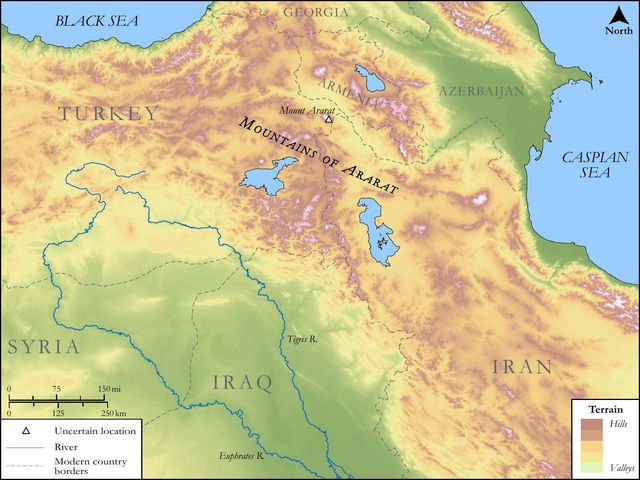
See on the biblical-era map


Study this verse
Public-domain commentary
Matthew Henry
From his Commentary on the Whole Bible. Henry comments on passages, not single verses — this entry covers Genesis 8:1–3. His four-level outline is real structure in the source text, so it is rendered as structure.
Here is, I. An act of God's grace: God remembered Noah and every living thing. This is an expression after the manner of men; for not any of his creatures (Luk 12:6), much less any of his people, are forgotten of God, Isa 49:15, Isa 49:16. but, 1. The whole race of mankind, except Noah and his family, was now extinguished, and driven into the land of forgetfulness, to be remembered no more; so that God's remembering Noah was the return of his mercy to mankind, of whom he would not make a full end. It is a strange expression, Eze 5:13, When I have accomplished my fury in them, I will be comforted. The demands of divine justice had been answered by the ruin of those sinners; he had eased him of his adversaries (Isa 1:24), and now his spirit was quieted (Zac 6:8), and he remembered Noah and every living thing. he remembered mercy in wrath (Hab 3:2), remembered the days of old (Isa 63:11), remembered the holy seed, and then remembered Noah. 2. Noah himself, though one that had found grace in the eyes of the Lord, yet seemed to be forgotten in the ark, and perhaps began to think himself so; for we do not find that God had told him how long he should be confined and when he should be released. Very good men have sometimes been ready to conclude themselves forgotten of God, especially when their afflictions have been unusually grievous and long. Perhaps Noah, though a great believer, yet when he found the flood continuing so long after it might reasonably be presumed to have done its work, was tempted to fear lest he that shut him in would keep him in, and began to expostulate. How long wilt thou forget me? But at length God returned in mercy to him, and this is expressed by remembering him. Note, Those that remember God shall certainly be remembered by him, how desolate and disconsolate soever their condition may be. He will appoint them a set time and remember them, Job 14:13. 3. With Noah, God remembered every living thing; for, though his delight is especially in the sons of men, yet he rejoices in all his works, and hates nothing that he has made. He takes special care, not only of his people's persons, but of their possessions - of them and all that belongs to them. He considered the cattle of Nineveh, Jon 4:11.
II.An act of God's power over wind and water, both of which are at his beck, though neither of them is under man's control. Observe,
1.He commanded the wind, and said to that, Go, and it went, in order to the carrying off of the flood: God made a wind to pass over the earth. See here,
(1.)What was God's remembrance of Noah: it was his relieving him. Note, Those whom God remembers he remembers effectually, for good; he remembers us to save us, that we may remember him to serve him.
(2.)What a sovereign dominion God has over the winds. He has them in his fist (Pro 30:4) and brings them out of his treasuries, Psa 135:7. He sends them when, and whither, and for what purposes, he pleases. Even stormy winds fulfil his word, Psa 148:8. It should seem, while the waters increased, there was no wind; for that would have added to the toss of the ark; but now God sent a wind, when it would not be so troublesome. Probably, it was a north wind, for that drives away rain. However, it was a drying wind, such a wind as God sent to divide the Red Sea before Israel, Exo 14:21.
2.He remanded the waters, and said to them, Come, and they came.
(1.)He took away the cause. He sealed up the springs of those waters, the fountains of the great deep, and the windows of heaven. Note,
[1.]As God has a key to open, so he has a key to shut up again, and to stay the progress of judgments by stopping the causes of them: and the same hand that brings the desolation must bring the deliverance; to that hand therefore our eye must ever be. He that wounds is alone able to heal. See Job 12:14, Job 12:15.
[2.]When afflictions have done the work for which they are sent, whether killing work or curing work, they shall be removed. God's word shall not return void, Isa 55:10, Isa 55:11.
(2.)Then the effect ceased; not all at once, but by degrees: The waters abated (Gen 8:1), returned from off the earth continually, Heb. they were going and returning (v. 3), which denotes a gradual departure. The heat of the sun exhaled much, and perhaps the subterraneous caverns soaked in more. Note, As the earth was not drowned in a day, so it was not dried in a day. In the creation, it was but one day's work to clear the earth from the waters that covered it, and to make it dry land; nay, it was but half a day's work, Gen 1:9, Gen 1:10. But, the work of creation being finished, this work of providence was effected by the concurring influence of second causes, yet thus enforced by the almighty power of God. God usually works deliverance for his people gradually, that the day of small things may not be despised, nor the day of great things despaired of, Zac 4:10. See Pro 4:18.
Historical interpretation
Historical reception
3 surviving comments on this verse. Each one is dated, so this reads as a timeline rather than a list.
Select a marker to jump to its quote. Markers stagger vertically where authors wrote within a few decades of each other.
The springs of the abyss and the floodgates of heaven were open forty days and forty nights and “the ark was afloat for one hundred fifty days.” But after one hundred fifty days the waters began to subside and the ark came to rest on Mt. Qardu. In the tenth month the tops of the mountains were seen. In the six hundred and first year, in the first month, the first day of the month, the waters were dried from off the earth. In the second month, that is, Iyor, “on the twenty-seventh day of the month, the earth was dry.” Therefore Noah and those with him had been in the ark three hundred sixty-five days, for from the seventeenth of the second month, that is, Iyor, until the twenty-seventh of the same month the following year, according to the lunar reckoning, there were three hundred sixty-five days. Notice then that even the generation of the house of Noah employed this reckoning of three hundred sixty-five days in a year. Why then should you say that it was the Chaldeans and Egyptians who invented and developed it?
And the Lord brought a spirit upon the earth, and the water ceased (Genesis VIII, 1). I do not think this is said in such a way that we should understand the spirit as the name for wind. For the wind could not have dried up the flood. Otherwise, since the sea is stirred up daily by winds, it would certainly be emptied. For how could the sea, which had spread out over the whole earth in the flood, not be emptied by the force of the winds, if it had receded even to the pillars of Hercules, as they say, and the Great Sea was boiling up against the roofs of high mountains? Therefore, it is not doubtful that by the power of the invisible divine spirit, that flood was repressed, not by a gust of wind, but by celestial operation.
See how God did everything out of his esteem for the human being. As in the case of the destruction of human beings in the flood he destroyed also along with them the whole range of brute beasts, so in this case too, when he intends to show his characteristic love for the good man out of his regard for him, he extends his goodness to the animal kingdom as well, the wild beasts, the birds and the reptiles. “God was mindful of Noah,” the text says, “and of all the wild beasts, all the cattle and all the reptiles that were with him in the ark. God sent a wind upon the earth, and the water subsided.” Being mindful of Noah, the text says, and of those with him in the ark, he directed the flood of water to halt so that little by little he might show his characteristic love and now give the good man a breath of fresh air, free him from the turmoil of his thoughts and restore him to a state of tranquility by granting him the enjoyment of daylight and a breath of fresh air. “God sent a wind upon the earth, and the water subsided. The torrents of the depths and the sluice gates of heaven were shut off.”
Continue studying Genesis 8:3 across the web’s major study libraries — every link below opens this exact verse, chapter, or book on the destination site.
Read & Compare
 BibleGatewayThis verse in more than 200 translations and 70 languages.
 Bible.comThe YouVersion reader — hundreds of translations, reading plans, and highlights.
 ESV.orgCrossway's official English Standard Version reader.
 NET BibleThe NET translation with 60,000+ translators' notes on every rendering decision.
 STEP BibleTyndale House's free study tool — original text, vocabulary, and scholarly resources.
 BibliaLogos Bible Software's free web reader.
 USCCBThe New American Bible (Revised Edition) with the U.S. bishops' study notes.
Commentaries
 BibleHub CommentariesDozens of classic commentaries on this verse, gathered on one page.
 StudyLightMore than 100 commentary sets — the largest collection on the web.
 BibleRefPlain-English commentary on what this verse means, verse by verse.
 Enduring WordDavid Guzik's free commentary on this chapter, widely used by Bible teachers.
 Bible Study ToolsVerse commentary alongside Greek and Hebrew study aids.
Original Language & Research
- BibleHub InterlinearThe verse word by word — original language, transliteration, and English.
- BibleHub LexiconEvery word's original-language definition and Strong's entry.
 Blue Letter BibleDeep-study tools — Strong's numbers, concordance, and word studies.
 SefariaThe Hebrew text with Rashi and centuries of Jewish commentary.
Sermons, Hymns & Audio


TrulyRandomVerse is not affiliated with these sites and doesn’t control their content. They’re linked because they’re genuinely useful.
Summary
Genesis 8:3 marks a pivotal moment in the biblical Flood narrative, signaling the definitive commencement of the waters' recession "continually" after the initial 150 days of their prevailing. This verse highlights God's active and methodical reversal of the deluge, transitioning from judgment towards restoration and offering the first tangible sign of hope and deliverance for Noah, his family, and all life preserved within the ark, thereby indicating the earth's gradual recovery.
Context
ShowHideLiterary Context
Genesis 8:3 is strategically placed within the larger Flood narrative, immediately following the peak of the deluge described in Genesis 7:17-24. After 150 days of the waters prevailing over the earth, covering even the highest mountains and destroying all life outside the ark, Genesis 8:1 introduces God's active intervention: "But God remembered Noah and all the wild animals and all the livestock that were with him in the ark, and he sent a wind over the earth, and the waters receded." Verse 3 then elaborates on the precise timing and persistent nature of this abatement, detailing the mechanism and duration of the waters' withdrawal, setting the stage for the ark's eventual landing and the re-emergence of dry land.
Historical & Cultural Context
The Flood narrative, while unique in its scope and divine purpose, resonates with ancient Near Eastern flood myths (e.g., the Epic of Gilgamesh, Atrahasis). However, the biblical account distinguishes itself by emphasizing God's moral judgment against human wickedness (Genesis 6:5-7) and His covenantal faithfulness to Noah. The mention of specific timeframes (150 days) reflects a cultural understanding of time and chronology, grounding the extraordinary event in a structured, observable progression. The process of water receding would have been a familiar natural phenomenon, but its scale here underscores the miraculous nature of God's intervention, contrasting with the destructive power of the initial deluge.
Key Themes
ShowHideThis verse contributes significantly to several overarching themes in Genesis and the broader biblical narrative. It underscores Divine Sovereignty and Control over creation, demonstrating that God, who initiated the judgment, also orchestrates its precise reversal. It highlights the theme of Judgment and Restoration, marking the transition from a period of divine wrath to the beginning of a new creation. Furthermore, it subtly introduces the theme of Hope and Deliverance, as the receding waters are the first tangible sign of salvation for Noah and his family, foreshadowing God's ongoing work of salvation throughout history, culminating in the ultimate deliverance found in Christ Jesus. The gradual nature of the recession also speaks to God's Patience and Methodical Work, a theme echoed in His dealings with humanity throughout the Old and New Testaments.
Exposition and Analysis
ShowHideGenesis 8:3 precisely details the turning point in the global deluge: "And the waters returned from off the earth continually: and after the end of the hundred and fifty days the waters were abated." This verse marks the shift from the flood's destructive power to its gradual retreat, orchestrated by divine will.
Key Word Analysis
ShowHideThis term (H4325) refers to the vast expanse of water that covered the earth during the Flood. In this context, it signifies the overwhelming force of divine judgment that is now being actively withdrawn, demonstrating God's complete control over the elements He used for judgment.
The verb (H7725) indicates a turning back or withdrawing. Here, it specifically denotes the recession of the floodwaters. Its use emphasizes a deliberate reversal of the previous state, highlighting God's active intervention in causing the waters to recede from the earth.
This word (H1980), often translated as "going" or "walking," is part of the Hebrew idiom haloch vashov ("going and returning" or "continually returning"). It describes a persistent, ongoing, and gradual process. It emphasizes that the recession was not instantaneous but a steady, methodical withdrawal, underscoring the immense volume of water and the deliberate nature of God's restorative work.
This verb (H2637) means "to lack," "to fail," or "to lessen." In this context, it signifies that the immense volume of floodwaters was actively diminishing in quantity and intensity. Coupled with "continually," châçêr paints a vivid picture of a consistent, divinely orchestrated reduction of the waters, meticulously paving the way for the emergence of dry land and the re-establishment of life.
Verse Breakdown
ShowHide"And the waters returned from off the earth continually"
This clause describes the active process of the floodwaters receding. The phrase "returned from off the earth" signifies a reversal of their previous dominion, while "continually" (Hebrew haloch vashov) emphasizes the steady, persistent, and gradual nature of this withdrawal. It highlights God's methodical work in reversing the deluge, not through an instant miracle, but through a sustained process.
"and after the end of the hundred and fifty days"
This temporal marker is crucial for understanding the chronology of the Flood. It specifies that the recession began after the initial 150 days during which the waters had prevailed at their maximum height, covering the earth (Genesis 7:24). This marks the precise turning point from the destructive phase of the Flood to its restorative phase.
"the waters were abated"
This final clause confirms the outcome of the continuous returning: the waters were lessened, diminished, and decreased. The term "abated" signifies a reduction in both volume and power, indicating that the earth was gradually becoming habitable again. This marks the definitive start of the earth's recovery and the first tangible sign of deliverance for Noah and all life within the ark.
Literary Devices
ShowHideGenesis 8:3 employs several literary devices to convey its profound message. The Chronological Marker "after the end of the hundred and fifty days" precisely situates this event within the larger narrative, emphasizing the duration of the flood's peak and the divine timing of its reversal. The Repetition inherent in the Hebrew idiom haloch vashov, translated as "continually" or "going and returning," creates a sense of persistent, gradual action, underscoring the methodical nature of God's work. This Emphasis on a slow, steady recession contrasts with the sudden, overwhelming onset of the flood, highlighting God's patience and thoroughness in restoration. Furthermore, the receding waters serve as powerful Symbolism, representing the conclusion of divine judgment and the dawning of a new era of hope and renewal, paving the way for the covenant God will establish with Noah.
Theological and Thematic Connections
ShowHideGenesis 8:3 profoundly illustrates God's absolute sovereignty over creation and His meticulous control over both judgment and restoration. Just as He initiated the flood as an act of righteous judgment against human wickedness, He orchestrates its precise and methodical withdrawal, demonstrating His power to reverse even the most catastrophic events. This transition from prevailing waters to their abatement signifies the conclusion of divine wrath and the dawning of a new era, offering the first tangible sign of hope and deliverance for Noah and his family. It underscores God's faithfulness to His promise to remember Noah (Genesis 8:1), showcasing His patient and deliberate work in bringing about salvation and renewal, even when circumstances seem unending. This verse thus serves as a powerful testament to God's providence, His commitment to His chosen ones, and His ultimate plan for a new creation.
Reflection and Application
ShowHideGenesis 8:3 offers profound lessons for believers today, reminding us that even the most overwhelming trials have a divinely appointed end. Just as the floodwaters receded after a long period, so too do many of life's difficulties eventually diminish under God's sovereign hand. This verse encourages us to cultivate unwavering trust in God's faithfulness, knowing that He is actively working behind the scenes, even when circumstances seem unending. It calls us to embrace patience, understanding that God's deliverance may not be immediate but is always certain and perfectly orchestrated according to His divine timing. Furthermore, we are taught to recognize and appreciate gradual progress, discerning the incremental signs of God's restorative work in our lives and in the world, even when a full solution isn't yet visible. This patient process of abatement points to the larger biblical narrative of God's patient work culminating in the new heaven and new earth, where all things are made new.
Questions for Reflection
ShowHideFAQ
ShowHideWhat is the significance of the "hundred and fifty days" mentioned here?
ShowHideThe "hundred and fifty days" refers to the initial period during which the floodwaters prevailed upon the earth, reaching their maximum height and covering all the high mountains (Genesis 7:24). Genesis 8:3 marks the conclusion of this prevailing period and the beginning of the waters' recession, signifying a crucial turning point from the flood's peak to its gradual abatement. It highlights the precise chronology of God's judgment and subsequent restoration.
Does "continually" suggest a slow process, and what does that teach us about God?
ShowHideYes, "continually" (Hebrew: haloch vashov, "going and returning") strongly suggests a steady, ongoing, and gradual process rather than an instantaneous event. This teaches us about God's methodical and deliberate nature. While He is capable of instant miracles, He often works through sustained, incremental processes, demonstrating His patience, persistence, and the thoroughness of His restorative work. It reminds us that significant change and healing often unfold over time, aligning with His perfect timing and comprehensive plan.
Christ-Centered Fulfillment
ShowHideGenesis 8:3, marking the end of the flood's judgment and the beginning of new life, powerfully prefigures the redemptive work of Jesus Christ. Just as the receding waters signified the cessation of divine wrath and the promise of a new creation for Noah, so too does Christ's death on the cross and His glorious resurrection mark the definitive end of God's judgment upon sin for all who believe. He is the ultimate "ark" of salvation, through whom believers are delivered from the deluge of sin and death, being "baptized into Christ Jesus" and sharing in His death and resurrection (Romans 6:3-4). His finished work initiates a new creation, where the "old has passed away; behold, the new has come" (2 Corinthians 5:17). Through Christ, God's restorative work is fully realized, not merely abating a flood, but ushering in an eternal kingdom of righteousness and life, where He promises to "wipe away every tear from their eyes, and death shall be no more" (Revelation 21:4).