


Genesis 8:5
- וְהַמַּיִםve·ha·Ma·yimand the watersH4325Conj-w ¦ Art ¦ N-mpNoun Plural Masculine Absoluteוְandהַtheמַּיִםwaters
- הָיוּha·Yuthey wereH1961V-Qal-Perf-3cpVerb Qal Perfect 3rd Plural common gender
- הָלוֹךְha·LokhgoingH1980V-Qal-InfAbsVerb Qal Infinitive Absolute
- וְחָסוֹרve·cha·Sorand decreasingH2637Conj-w ¦ V-Qal-InfAbsVerb Qal Infinitive Absoluteוְandחָסוֹרdecreasing
- עַד'aduntilH5704PrepPreposition
- הַחֹדֶשׁha·Cho·deshthe monthH2320Art ¦ N-msNoun Singular Masculine Absoluteהַtheחֹדֶשׁmonth
- הָעֲשִׂירִיha·'a·si·Ri<the> tenthH6224Art ¦ Adj-msAdjective Numerical Position Singular Masculine Absoluteהָ<the>עֲשִׂירִיtenth
- בָּעֲשִׂירִיba·'a·si·Riin the tenth [month]H6224Prep-b ¦ Adj-msAdjective Numerical Position Singular Masculine Absoluteבָּin theעֲשִׂירִיtenth [month]
- בְּאֶחָדbe·'e·Chadon [day] oneH259Prep-b ¦ Adj-fsAdjective Numerical Singular Feminine Absoluteבְּonאֶחָד[day] one
- לַחֹדֶשׁla·Cho·deshof the monthH2320Prep-l ¦ N-msNoun Singular Masculine Absoluteלַof theחֹדֶשׁmonth
- נִרְאוּnir·'Uthey were seenH7200V-Niphal-Perf-3cpVerb Niphal Perfect 3rd Plural common gender
- רָאשֵׁיra·Shei[the] tops ofH7218N-mpcNoun Plural Masculine Construct
- הֶהָרִיםHe·ha·Rimthe mountainsH2022Art ¦ N-mpNoun Plural Masculine Absoluteהֶtheהָרִיםmountains
English is a literal word-by-word gloss of the Hebrew, not the KJV's wording. Why?
This is the original text the KJV's translators worked from — each Hebrew word with its own literal English meaning in this verse, prepared by scholars at Tyndale House, Cambridge. The KJV translates whole sentences, not word by word, so its wording differs: one Hebrew word can become several English words, and the KJV may choose “the LORD” where the gloss reads “Yahweh”. Both are faithful — they answer different questions. For the KJV's own rendering, switch to the KJV text.
Details
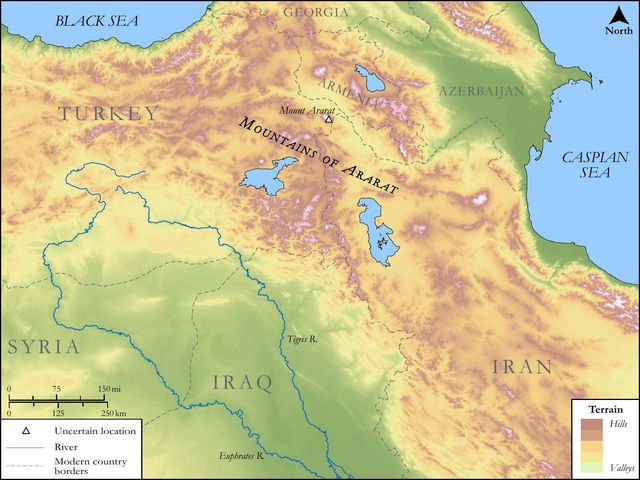
See on the biblical-era map


Study this verse
Public-domain commentary
Matthew Henry
From his Commentary on the Whole Bible. Henry comments on passages, not single verses — this entry covers Genesis 8:4–5.
Here we have the effects and evidences of the ebbing of the waters. 1. The ark rested. This was some satisfaction to Noah, to feel the house he was in upon firm ground, and no longer movable. It rested upon a mountain, whither it was directed, not by Noah's prudence (he did not steer it), but by the wise and gracious providence of God, that it might rest the sooner. Note, God has times and places of rest for his people after their tossings; and many a time he provides for their seasonable and comfortable settlement without their own contrivance and quite beyond their own foresight. The ark of the church, though sometimes tossed with tempests, and not comforted (Isa 54:11), yet has its rests, Act 9:31. 2. The tops of the mountains were seen, like little islands, appearing above the water. We must suppose that they were seen by Noah and his sons; for there were none besides to see them. It is probable that they had looked through the window of the ark every day, like the longing mariners, after a tedious voyage, to see if they could discover land, or as the prophet's servant (Kg1 18:43, Kg1 18:44), and at length they spy ground, and enter the day of the discovery in their journal. They felt ground above forty days before they saw it, according to Dr. Lightfoot's computation, whence he infers that, if the waters decreased proportionably, the ark drew eleven cubits in water.
Historical interpretation
Four Centuries of Reception
3 surviving comments on this verse. Each one is dated, so this reads as a timeline rather than a list.
Select a marker to jump to its quote. Markers stagger vertically where authors wrote within a few decades of each other.
The springs of the abyss and the floodgates of heaven were open forty days and forty nights and “the ark was afloat for one hundred fifty days.” But after one hundred fifty days the waters began to subside and the ark came to rest on Mt. Qardu. In the tenth month the tops of the mountains were seen. In the six hundred and first year, in the first month, the first day of the month, the waters were dried from off the earth. In the second month, that is, Iyor, “on the twenty-seventh day of the month, the earth was dry.” Therefore Noah and those with him had been in the ark three hundred sixty-five days, for from the seventeenth of the second month, that is, Iyor, until the twenty-seventh of the same month the following year, according to the lunar reckoning, there were three hundred sixty-five days. Notice then that even the generation of the house of Noah employed this reckoning of three hundred sixty-five days in a year. Why then should you say that it was the Chaldeans and Egyptians who invented and developed it?
For on the first day of the tenth month, the mountain peaks appeared. The first day of the tenth month can be understood as the beginning of that eternal life, in which the saints, even while placed in this life, taste and see that the Lord is good. On this day, the mountain peaks appear because the more perfectly this is held in their pure hearts, the more clearly the empty heights of the world, which are inflated in vain, become apparent.
But the waters went back and decreased until the tenth month. The time of the tenth month can signify that period during which the saints enter the joys of eternal light with the Lord. For He also in the Gospel by the name of the denarius, which was to be given to the laborers of the vineyard, intimates the perception of the same heavenly kingdom. For a denarius contains ten obols. So the waters go back, which had flooded the ark, and decrease until the tenth month, because the washing of baptism, where it has fulfilled its office in each of the faithful, ceases. For no one, if he has sinned, can be cleansed anew by the same font of sacred baptism; but it sends those already once washed and sanctified to the hope of heavenly life, when they come and appear before the face of God.
Continue studying Genesis 8:5 across the web’s major study libraries — every link below opens this exact verse, chapter, or book on the destination site.
Read & Compare
 BibleGatewayThis verse in more than 200 translations and 70 languages.
 Bible.comThe YouVersion reader — hundreds of translations, reading plans, and highlights.
 ESV.orgCrossway's official English Standard Version reader.
 NET BibleThe NET translation with 60,000+ translators' notes on every rendering decision.
 STEP BibleTyndale House's free study tool — original text, vocabulary, and scholarly resources.
 BibliaLogos Bible Software's free web reader.
 USCCBThe New American Bible (Revised Edition) with the U.S. bishops' study notes.
Commentaries
 BibleHub CommentariesDozens of classic commentaries on this verse, gathered on one page.
 StudyLightMore than 100 commentary sets — the largest collection on the web.
 BibleRefPlain-English commentary on what this verse means, verse by verse.
 Enduring WordDavid Guzik's free commentary on this chapter, widely used by Bible teachers.
 Bible Study ToolsVerse commentary alongside Greek and Hebrew study aids.
Original Language & Research
- BibleHub InterlinearThe verse word by word — original language, transliteration, and English.
- BibleHub LexiconEvery word's original-language definition and Strong's entry.
 Blue Letter BibleDeep-study tools — Strong's numbers, concordance, and word studies.
 SefariaThe Hebrew text with Rashi and centuries of Jewish commentary.
Sermons, Hymns & Audio


TrulyRandomVerse is not affiliated with these sites and doesn’t control their content. They’re linked because they’re genuinely useful.
Summary
Genesis 8:5 marks a crucial turning point in the biblical Flood narrative, detailing the methodical and continuous recession of the global waters until the tenth month, when the peaks of the mountains finally became visible. This verse signifies the first tangible evidence of the earth's recovery and God's precise orchestration of restoration after the comprehensive judgment, offering a profound beacon of hope and a promise of new beginnings for Noah and all life preserved within the Ark.
Context
ShowHideLiterary Context
Genesis 8:5 follows a sequence of events that describe the Flood's progression and eventual abatement. After the initial 40 days of rain (Genesis 7:12) and 150 days during which the waters prevailed over the earth, covering even the highest mountains (Genesis 7:19-20), the narrative shifts. Genesis 8:1-3 recounts God's remembrance of Noah, His sending a wind to dry the earth, and the beginning of the waters' decrease. The Ark's resting on the mountains of Ararat in the seventh month (Genesis 8:4) precedes the verse in question, setting the stage for the gradual revelation of dry land. Genesis 8:5 thus serves as the next chronological marker, emphasizing the ongoing process of desiccation and the first visual confirmation of the earth's re-emergence, leading to Noah's subsequent actions of sending out birds to test the conditions (Genesis 8:6-12).
Historical & Cultural Context
The ancient Near East, where the book of Genesis originated, was intimately familiar with the power and unpredictability of water, particularly through river floods (e.g., the Tigris and Euphrates). However, a global deluge of the scale described in Genesis would have been an unimaginable catastrophe, fundamentally altering the landscape and human existence. The meticulous chronological details provided in the Flood narrative, including the specific months and days for various events, reflect an ancient interest in precise record-keeping and a theological emphasis on divine timing. The mention of "mountains" as the first visible landforms would have resonated with cultures that often viewed mountains as sacred places, points of connection between heaven and earth, and symbols of stability and permanence, even in the face of cataclysm. The long period of waiting in the Ark also underscores the immense patience required in a world without modern means of communication or immediate information, relying solely on observation and divine providence.
Key Themes
ShowHideGenesis 8:5 contributes significantly to several overarching themes within the Flood narrative and the broader book of Genesis. Foremost is the theme of Divine Sovereignty and Control, demonstrating God's absolute dominion over creation, not only in judgment but also in restoration. The precise timing and methodical nature of the waters' recession underscore His meticulous plan, contrasting with the chaos of the deluge. Another key theme is God's Faithfulness and Remembrance, particularly His "remembering" Noah (Genesis 8:1). The visible signs of receding waters are a direct manifestation of this divine commitment to preserve and restore. The verse also highlights Patience and Hope Amidst Adversity, as Noah and his family endured a prolonged period of confinement and uncertainty, waiting for a tangible sign of new beginnings. Finally, it reinforces the theme of Judgment and Renewal, illustrating that divine judgment, though severe, is always followed by God's redemptive work, leading to a new creation and the establishment of new covenants, as seen later in Genesis 9.
Exposition and Analysis
ShowHideKey Word Analysis
ShowHideThis primitive root signifies "to lack," "to fail," "to want," or "to lessen." In the context of Genesis 8:5, its use describes the continuous abatement of the waters, emphasizing a steady, ongoing diminution rather than a sudden or abrupt drop. This conveys a sense of methodical, gradual reduction, highlighting the immense volume of water that had covered the earth and the comprehensive nature of its recession.
Akin to the root meaning "to walk," this word conveys the idea of an ongoing, progressive movement. When paired with "decreased," it intensifies the sense of a steady, persistent process. It suggests that the waters were not just decreasing, but "walking away" or "going along" in their recession, indicating a sustained and uninterrupted process of drying the earth over an extended period.
A shortened form of a word meaning "a mountain or range of hills," this term refers to the elevated landmasses that were the last to be covered and the first to reappear. Mountains, in biblical thought, often symbolize stability, permanence, and elevation. Their re-emergence signifies the return of a stable, habitable earth, providing the first concrete visual evidence of the Flood's end and the possibility of new life.
Verse Breakdown
ShowHide"And the waters decreased continually until the tenth month:"
This clause establishes the ongoing nature of the Flood's recession. The term "decreased continually" (Hebrew: châçêr hâlak) implies a steady, persistent, and methodical process, not a sudden draining. This highlights the immense scale of the global deluge and the gradual, divinely orchestrated reversal of the catastrophe. The specification "until the tenth month" provides a chronological marker, indicating a significant period of time had passed since the Ark rested and the waters began to recede, underscoring the patience required of Noah and those with him.
"in the tenth [month], on the first [day] of the month,"
This precise temporal detail underscores the meticulous chronology of the Flood narrative. The "first day of the month" often carries symbolic weight in biblical contexts, frequently marking a new beginning or a significant turning point (e.g., the start of a festival or a new phase). Here, it denotes the exact moment when the next crucial stage of the earth's recovery became evident, emphasizing God's precise timing and the unfolding of His plan with deliberate accuracy.
"were the tops of the mountains seen."
This is the climactic observation of the verse. After months of being surrounded by an endless expanse of water, the sight of the "tops of the mountains" would have been an incredibly profound and hopeful moment for Noah and his family. It provided the first tangible, visual evidence of dry land, signaling the imminent end of their confinement and the beginning of a new era. The mountains, representing stability and high ground, were the first to re-emerge, offering a clear sign of God's faithfulness and the promise of a habitable world once more.
Literary Devices
ShowHideGenesis 8:5 employs several significant literary devices. Chronological Precision is evident in the specific mention of "the tenth month, on the first day of the month," which lends an air of historical accuracy and emphasizes the meticulous nature of God's unfolding plan. This precision contrasts with the immense, chaotic scale of the Flood, highlighting divine order. Synecdoche is used when "the tops of the mountains" are seen, as the part (the tops) stands for the whole (the mountains themselves, and by extension, the emerging landmass). This focuses the reader's attention on the initial, most prominent signs of recovery. The verse also utilizes Foreshadowing, as the appearance of dry land anticipates Noah's eventual disembarkation and the establishment of God's covenant with humanity, signaling a new beginning. Furthermore, the phrase "decreased continually" employs Verbal Repetition (implied by the continuous aspect of hâlak with châçêr) to emphasize the persistent, gradual nature of the recession, underscoring God's patient and methodical work of restoration.
Theological and Thematic Connections
ShowHideGenesis 8:5 is a powerful testament to God's unwavering sovereignty and His meticulous care for creation, even in the aftermath of severe judgment. The continuous, methodical recession of the waters, culminating in the precise timing of the mountains' appearance, demonstrates that God remains actively in control, orchestrating every detail of the earth's restoration. This gradual process teaches humanity about divine patience and the importance of waiting on God's perfect timing for renewal and new beginnings. The emergence of the mountain tops serves as a tangible sign of hope, a visual promise that God's faithfulness endures, even through the most profound trials, leading to a new era of life and covenant.
Reflection and Application
ShowHideGenesis 8:5 offers profound lessons in patience, perseverance, and unwavering trust in God's sovereign timing. Just as Noah and his family endured a prolonged period of waiting, confined within the Ark, for visible signs of the waters receding, believers today often face seasons of uncertainty, tribulation, or delayed answers to prayer where God's plan seems to unfold slowly. The appearance of "the tops of the mountains" serves as a powerful reminder that even after periods of immense difficulty, God faithfully brings about new beginnings and reveals tangible signs of hope. This encourages us to cultivate a spirit of patient endurance, knowing that God is actively at work, even when His progress appears imperceptible or His timing seems protracted. We are called to trust that He is orchestrating events for our good and His glory, and that He will reveal His purpose and bring about restoration in His perfect time, just as He did for Noah, ushering in a new era of life and promise.
Questions for Reflection
ShowHideFAQ
ShowHideWhy did the waters recede "continually" rather than all at once?
ShowHideThe phrase "decreased continually" (Hebrew: châçêr hâlak) emphasizes a gradual, ongoing process, not an instantaneous event. This highlights the immense scale of the Flood and the volume of water involved, demonstrating God's methodical and patient work in reversing the judgment. It also underscores the need for Noah's continued patience and trust in God's precise timing for the earth's restoration, much like how God often works progressively in our lives, bringing about change and growth over time rather than in a single moment (Philippians 1:6).
What is the significance of the "tenth month, on the first day of the month" for the mountains to be seen?
ShowHideThis precise dating, following the 150 days of prevailing waters and the Ark's resting in the seventh month (Genesis 8:4), marks a significant chronological milestone in the Flood narrative. It indicates a clear turning point and the beginning of the final phase of the drying process. The "first day of the month" often symbolizes a new beginning or a fresh start in biblical chronology, underscoring the advent of a new era for humanity and creation. This meticulous timing reflects God's sovereign control and His deliberate orchestration of every detail of His plan.
Why are the "tops of the mountains" specifically mentioned as being seen?
ShowHideThe visibility of mountain tops was the first concrete, tangible evidence of dry land after months of being surrounded by water. Mountains represent stability, elevation, and often, a point of connection with the divine. Their emergence signified the beginning of the earth's re-emergence from the deluge. For Noah, it was a profound visual confirmation of hope, indicating that the judgment was subsiding and the possibility of disembarkation and a new life was drawing near. It was the initial, most prominent sign that God's promise of preservation was being fulfilled, much like a visible sign in the wilderness guiding His people (Exodus 13:21).
Christ-Centered Fulfillment
ShowHideGenesis 8:5, with its depiction of the waters receding and new land emerging after divine judgment, powerfully foreshadows the ultimate new creation and new beginning found in Jesus Christ. Just as the Ark brought Noah and his family through the judgment of the Flood to a restored earth, Christ's death and resurrection bring believers through the judgment of sin to a new life and a new creation (2 Corinthians 5:17). The visible mountain tops, signaling hope and a new dwelling place, point to Christ as the very foundation of God's renewed covenant and the promise of a new heavens and new earth, where righteousness dwells eternally (2 Peter 3:13). He is the true Ark, providing salvation from the deluge of sin and leading humanity not merely to a physically restored earth, but to a final, perfect restoration and an eternal dwelling place with God, fulfilling the deepest longings for a new world that dawned for Noah and his descendants (Revelation 21:1-4).