


Isaiah 66:10
- שִׂמְחוּsim·ChurejoiceH8055V-Qal-Imp-2mpVerb Qal Imperative 2nd Plural Masculine
- אֶת'etwithH854PrepPreposition
- יְרוּשָׁלִַםye·ru·sha·LimJerusalemH3389N-properNoun Proper Location
- וְגִילוּve·Gi·luand be gladH1523Conj-w ¦ V-Qal-Imp-2mpVerb Qal Imperative 2nd Plural Masculineוְandגִילוּbe glad
- בָהּvahin itPrep-b ¦ 3fsSuffix Personal 3rd Singular Feminineבָinהּit
- כָּלkolO allH3605N-mscNoun Singular Masculine Construct
- אֹהֲבֶיהָ'o·ha·Vei·ha[those who] love itH157V-Qal-Prtcpl-mp ¦ 3fsVerb Qal Participle Plural Masculine Constructאֹהֲבֶי[those who] loveהָit
- שִׂישׂוּSi·suexultH7797V-Qal-Imp-2mpVerb Qal Imperative 2nd Plural Masculine
- אִתָּהּ'i·Tahwith itH854Prep ¦ 3fsPrepositionאִתָּwithהּit
- מָשׂוֹשׂma·SosexultationH4885N-msNoun Singular Masculine Absolute
- כָּלkolO allH3605N-mscNoun Singular Masculine Construct
- הַמִּתְאַבְּלִיםha·mit·'a·be·Limthose [who] mournH56Art ¦ V-Hithpael-Prtcpl-mpVerb Hithpael Participle Plural Masculine Absoluteהַthoseמִּתְאַבְּלִים[who] mourn
- עָלֶיהָ'a·Lei·haon itH5921Prep ¦ 3fsPrepositionעָלֶיonהָit
English is a literal word-by-word gloss of the Hebrew, not the KJV's wording. Why?
This is the original text the KJV's translators worked from — each Hebrew word with its own literal English meaning in this verse, prepared by scholars at Tyndale House, Cambridge. The KJV translates whole sentences, not word by word, so its wording differs: one Hebrew word can become several English words, and the KJV may choose “the LORD” where the gloss reads “Yahweh”. Both are faithful — they answer different questions. For the KJV's own rendering, switch to the KJV text.
Details
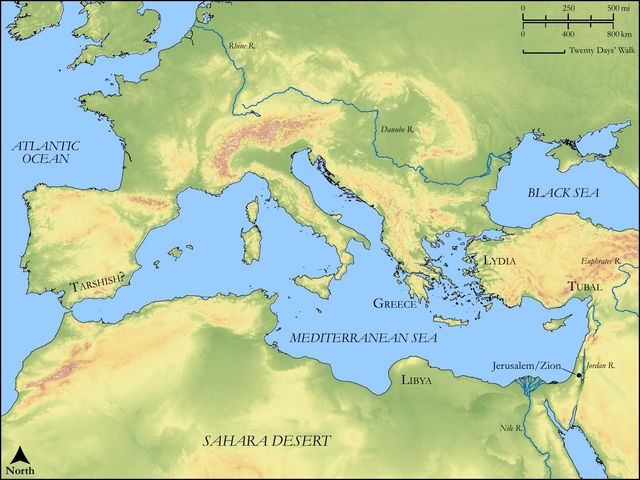
See on the biblical-era map
Study this verse
Public-domain commentary
Matthew Henry
From his Commentary on the Whole Bible. Henry comments on passages, not single verses — this entry covers Isaiah 66:5–14. His three-level outline is real structure in the source text, so it is rendered as structure.
The prophet, having denounced God's judgments against a hypocritical nation, that made a jest of God's word and would not answer him when he called to them, here turns his speech to those that trembled at his word, to comfort and encourage them; they shall not be involved in the judgments that are coming upon their unbelieving nation. Ministers must distinguish thus, that, when they speak terror to the wicked, they may not make the hearts of the righteous sad. Bone Christiane, hoc nihil ad te - Good Christian, this is nothing to thee. The prophet, having assured those that tremble at God's word of a gracious look from him (Isa 66:2), here brings them a gracious message from him. The word of God has comforts in store for those that by true humiliation for sin are prepared to receive them. There were those (Isa 66:4) who, when God spoke, would not hear; but, if some will not, others sill. If the heart tremble at the word, the ear will be open to it. Now what is here said to them?
I.Let them know that God will plead their just but injured cause against their persecutors (Isa 66:5):
Your brethren that hated you said, Let the Lord be glorified. But he shall appear to your joy. This perhaps might have reference to the case of some of the Jews at their return out of captivity; but nothing like it appears in the history, and therefore it is rather to be referred to the first preachers and professors of the gospel among the Jews, to whose case it is very applicable. Observe,
1.How the faithful servants of God were persecuted: Their brethren hated them. The apostles were Jews by birth, and yet even in the cities of the Gentiles the Jews they met with there were their most bitter and implacable enemies and stirred up the Gentiles against them. The spouse complains (Sol 1:6) that her mother's children were angry with her. Pilate upbraided our Lord Jesus with this, Thy own nation have delivered thee unto me, Joh 18:35. Their brethren, who should have loved them and encouraged them for their work's sake hated them, and cast them out of their synagogues, excommunicated them as if they had been the greatest blemishes, when they were really the greatest blessings, of their church and nation. This was a fruit of the old enmity in the seed of the serpent against the seed of the woman. Those that hated Christ hated his disciples, because they supported his kingdom and interest (Joh 15:18), and they cast them out for his name's sake, because they were called by his name, and called upon his name, and laid out themselves to advance his name. Note, It is no new thing for church censures to be misapplied, and for her artillery, which was intended for her defence, to be turned against her best friends, by the treachery of her governors. And those that did this said, Let the Lord be glorified; they pretended conscience and a zeal for the honour of God and the church in it, and did it with all the formalities of devotion. Our Saviour explains this, and seems to have reference to it, Joh 16:2. They shall put you out of their synagogues, and whosoever kills you will think that he does God service. In nomine Domini incipit omne malum - In the name of the Lord commences evil of every kind. Or we may understand it as spoken in defiance of God: "You say God will be glorified in your deliverance; let him be glorified then; let him make speed and hasten his work (Isa 5:19); let him deliver him, seeing he delighted in him." Some take it to be the language of the profane Jews in captivity, bantering their brethren that hoped for deliverance, and ridiculing the expectations they often comforted themselves with, that God would shortly be glorified in it. They thus did what they could to shame the counsel of the poor, Psa 14:6.
2.How they were encouraged under these persecutions: "Let your faith and patience hold out yet a little while; your enemies hate you and oppress you, your brethren hate you and cast you out, but your Father in heaven loves you, and will appear for you when no one else will or dare. His providence shall order things so as shall be for comfort to you; he shall appear for your joy and for the confusion of those that abuse you and trample on you; they shall be ashamed of their enmity to you." This was fulfilled when, upon the signals given of Jerusalem's approaching ruin, the Jews' hearts failed them for fear; but the disciples of Christ, whom they had hated and persecuted, lifted up their heads with joy, knowing that their redemption drew nigh, Luk 21:26, Luk 21:28. Though God seem to hide himself, he will in due time show himself.
II.Let them know that God's appearances for them will be such as will make a great noise in the world (Isa 66:6):
There shall be a voice of noise from the city, from the temple. Some make it the joyful and triumphant voice of the church's friends, others the frightful lamenting voice of her enemies, surprised in the city, and fleeing in vain to the temple for shelter. These voices do but echo to the voice of the Lord, who is now rendering a recompence to his enemies; and those that will not hear him speaking this terror shall hear them returning the alarms of it in doleful shrieks. We may well think what a confused noise there was in the city and temple when Jerusalem, after a long siege, was at last taken by the Romans. Some think this prophecy was fulfilled in the prodigies that went before that destruction of Jerusalem, related by Josephus in his History of the Wars of the Jews (4.388 and 6.311), that the temple-doors flew open suddenly of their own accord, and the priests heard a noise of motion or shifting in the most holy place, and presently a voice, saying, Let us depart hence. And, some time after, one Jesus Bar-Annas went up and down the city, at the feast of tabernacles, continually crying, A voice from the east, a voice from the west, a voice from the four winds, a voice against Jerusalem and the temple, a voice against all this people.
III.Let them know that God will set up a church for himself in the world, which shall be abundantly replenished in a little time (Isa 66:7):
Before she travailed she brought forth. This is to be applied in the type to the deliverance of the Jews out of their captivity in Babylon, which was brought about very easily and silently, without any pain or struggle, such as was when they were brought out of Egypt; that was done by might and power (Deu 4:34), but this by the Spirit of the Lord of hosts, Zac 4:6. The man-child of the deliverance is rejoiced in, and yet the mother was never in labour for it; before her pain came she was delivered. This is altogether surprising, uncommon, and without precedent, unless in the story which the Egyptian midwives told of the Hebrew women (Exo 1:19), that they were lively and were delivered ere the midwives came in unto them. But shall the earth be made to bring forth her fruits in one day? No, it is the work of some weeks in the spring to renew the face of the earth and cover it with its products. Some read this to the same purport with the next clause, Shall a land be brought forth in one day, or shall a nation be born at once? Is it to be imagined that a woman at one birth should bring children sufficient to people a country and that they should in an instant grow up to maturity? No; something like this was done in the creation; but God has since rested from all such works, and leaves second causes to produce their effects gradually. Nihil facit per saltum - He does nothing abruptly. Yet, in this case, as soon as Zion travailed she brought forth. Cyrus's proclamation was no sooner issued out than the captives were formed into a body and were ready to make the best of their way to their own land. And the reason is given (Isa 66:9), because it is the Lord's doing; he undertakes it whose work is perfect. If he bring to the birth in preparing his people for deliverance, he will cause to bring forth in the accomplishment of the deliverance. When every thing is ripe and ready for their release, and the number of their months is accomplished, so that the children are brought to the birth, shall not I then give strength to bring forth, but leave mother and babe to perish together in the most miserable case? How will this agree with the divine pity? Shall I begin a work and not go through with it? How will that agree with the divine power and perfection? Am I he that causes to bring forth (so the following clause may be read) and shall I restrain her? Does God cause mankind, and all the species of living creatures, to propagate, and replenish the earth, and will he restrain Zion? Will he not make her fruitful in a blessed offspring to replenish the church? Or, Am I he that begat, and should I restrain from bringing forth? Did God beget the deliverance in his purpose and promise, and will he not bring it forth in the accomplishment and performance of it? But this was a figure of the setting up of the Christian church in the world, and the replenishing of that family with children which was to be named from Jesus Christ. When the Spirit was poured out, and the gospel went forth from Zion, multitudes were converted in a little time and with little pains compared with the vast product. The apostles, even before they travailed, brought forth, and the children born to Christ were so numerous, and so suddenly and easily produced, that they were rather like the dew from the morning's womb than like the son from the mother's womb, Psa 110:3. The success of the gospel was astonishing; that light, like the morning, strangely diffused itself till it took hold even of the ends of the earth. Cities and nations were born at once to Christ. The same day that the Spirit was poured out there were 3000 souls added to the church. And, when this glorious work was once begun, it was carried on wonderfully, beyond what could be imagined, so mightily grew the word of God and prevailed. He that brought to the birth in conviction of sin caused to bring forth in a thorough conversion to God.
IV.Let them know that their present sorrows shall shortly be turned into abundant joys, Isa 66:10, Isa 66:11. Observe,
1.How the church's friends are described; they are such as love her, and mourn with her and for her. Note, All that love God love Jerusalem; they love the church of God, and lay its interest very near their heart. They admire the beauty of the church, take pleasure in communion with it, and heartily espouse its cause. And those that have a sincere affection for the church have a cordial sympathy with her in all the cares and sorrows of her militant state. They mourn for her; all her grievances are their griefs; if Jerusalem be in distress, their harps are hung on the willow-trees.
2.How they are encouraged: Rejoice with her, and again and again I say, Rejoice. This intimates that Jerusalem shall have cause to rejoice; the days of her mourning shall be at an end, and she shall be comforted according to the time that she has been afflicted. It is the will of God that all her friends should join with her in her joys, for they shall share with her in those blessings that will be the matter of her joy. If we suffer with Christ and sorrow with his church, we shall reign with him and rejoice with her. We are here called, (1.) To bear our part in the church's praises: "Come, rejoice with her, rejoice for joy with her, rejoice greatly, rejoice and know why you rejoice, rejoice on the days appointed for public thanksgiving. You that mourned for her in her sorrows cannot but from the same principle rejoice with her in her joys." (2.) To take our part in the church's comforts. We must suck and be satisfied with the breasts of her consolation. The word of God, the covenant of grace (especially the promises of that covenant), the ordinances of God, and all the opportunities of attending on him and conversing with him, are the breasts, which the church calls and counts the breasts of her consolations, where her comforts are laid up, and whence by faith and prayer they are drawn. With her therefore we must suck from these breasts, by an application of the promises of God to ourselves and a diligent attendance on his ordinances; and with the consolations which are drawn hence we must be satisfied, and not be dissatisfied though we have ever so little of earthly comforts. It is the glory of the church that she has the Lord for her God, that to her pertain the adoption and the service of God; and with the abundance of this glory we must be delighted. We must take more pleasure in our relation to God and communion with him than in all the delights of the sons and daughters of men. Whatever is the glory of the church must be our glory and joy, particularly her purity, unity, and increase.
V.Let them know that he who gives them this call to rejoice will give them cause to do so and hearts to do so, Isa 66:12-14.
1.He will give them cause to do so. For,
(1.)They shall enjoy a long uninterrupted course of prosperity: I will extend, or am extending, peace to her (that is, all good to her) like a river that runs in a constant stream, still increasing till it be swallowed up in the ocean. The gospel brings with it, wherever it is received in its power, such peace as this, which shall go on like a river, supplying souls with all good and making them fruitful, as a river does the lands it passes through, such a river of peace as the springs of the world's comforts cannot send forth and the dams of the world's troubles cannot stop nor drive back nor its sand rack up, such a river of peace as will carry us to the ocean of boundless and endless bliss.
(2.)There shall be large and advantageous additions made to them: The glory of the Gentiles shall come to them like a flowing stream. Gentiles converts shall come pouring into the church, and swell the river of her peace and prosperity; for they shall bring their glory with them; their wealth and honour, their power and interest, shall all be devoted to the service of God and employed for the good of the church: "Then shall you suck from the breasts of her consolations. When you see such crowding for a share in those comforts you shall be the more solicitous and the more vigorous to secure your share, not for fear of having the less for others coming in to partake of Christ" (there is no danger of that; he has enough for all and enough for each), "but their zeal shall provoke you to a holy jealousy." It is well when it does so, Rom 11:14; Co2 9:2.
(3.)God shall be glorified in all, and that ought to be more the matter of our joy than any thing else (Isa 66:14): The hand of the Lord shall be known towards his servants, the protecting supporting hand of his almighty power, the supplying enriching hand of his inexhaustible goodness; the benefit which his servants have by both these shall be known to his glory as well as theirs. And, to make this the more illustrious, he will at the same time make known his indignation towards his enemies. God's mercy and justice shall both be manifested and for ever magnified
2.God will not only give them cause to rejoice, but will speak comfort to them, will speak it to their hearts; and it is he only that can do that, and make it fasten there. See what he will do for the comfort of all the sons of Zion.
(1.)Their country shall be their tender nurse: You shall be carried on her sides, under her arms, as little children are, and shall be dangled upon her knees, as darlings are, especially when they are weary and out of humour, and must be got to sleep. Those that are joined to the church must be treated thus affectionately. The great Shepherd gathers the lambs in his arms and carries them in his bosom, and so must the under-shepherds, that they may not be discouraged. Proselytes should be favourites.
(2.)God will himself be their powerful comforter: As one whom his mother comforts, when he is sick or sore, or upon any account in sorrow, so will I comfort you; not only with the rational arguments which a prudent father uses, but with the tender affections and compassions of a loving mother, that bemoans her afflicted child when it has fallen and hurt itself, that she may quiet it and make it easy, or endeavours to pacify it after she has chidden it and fallen out with it (Jer 31:20): Since I spoke against him, my bowels are troubled for him; he is a dear son, he is a pleasant child. Thus the mother comforts. Thus you shall be comforted in Jerusalem, in the favours bestowed on the church, which you shall partake of, and in the thanksgivings offered by the church, which you shall concur with.
(3.)They shall feel the blessed effects of this comfort in their own souls (Isa 66:13): When you see this, what a happy state the church is restored to, not only your tongues and your countenances, but your hearts shall rejoice. This was fulfilled in the wonderful satisfaction which Christ's disciples had in the success of their ministry. Christ, with an eye to that, tells them (Joh 16:22), Your heart shall rejoice and your joy no man taketh from you. Then your bones, that were dried and withered (the marrow of them quite exhausted), shall recover a youthful strength and vigour and shall flourish like a herb. Divine comforts reach the inward man; they are marrow and moistening to the bones, Pro 3:8. The bones are the strength of the body; those shall be made to flourish with these comforts. The joy of the Lord will be your strength, Neh 8:10.
Historical interpretation
Historical reception
3 surviving comments on this verse. Each one is dated, so this reads as a timeline rather than a list.
Select a marker to jump to its quote. Markers stagger vertically where authors wrote within a few decades of each other.
(Verse 10.) Rejoice with Jerusalem, and be glad for her, all you who love her. Delight in her with joy, all you who mourn over her, so that you may nurse and be satisfied from her comforting breast, and drink deeply and enjoy the abundance of her glory. LXX: Rejoice, O Jerusalem, and gather together all you who love her. Delight in her with joy, all you who mourn over her, so that you may nurse and be filled from her comforting breast, and after you have nursed, be delighted by the entrance of her glory. The apostles are commanded, and the apostolic men, who love both Jerusalems, and the one that has fallen they mourn and lament, and the one that will rise again they eagerly await with all desire, so that they may rejoice with her and in her, the one that is built with living stones, which roll upon the earth, and in the likeness of the wheels of the Cherubim, they follow the preceding spirit: not in those who have been dissolved into eternal ashes. About which the Lord spoke: Amen, amen I say to you, not one stone will remain upon another, until all these things are accomplished (Matthew 24:2). Rejoice, He says, with joy, all you who mourn for her. As we have taught about Peter and Paul, the apostles, and all who were awaiting the redemption of Israel, in order to suckle and be filled with the breasts of her consolation. For it could not be that she who gave birth to a male and was a mother, lacked an abundance of milk for the raising of her people and infants, who were born together, so that she would offer them two breasts, not at all like before in Egypt, broken and lying down, but whole and standing in virgin beauty, of the old and new Instrument, to offer rational milk. About whom the bridegroom speaks to her: Your breasts are better than wine (Song of Solomon 1:1). These were the ones about whom it was specifically said: Blessed are those who mourn, for they will be comforted (Matthew 5:5). And it should be noted that those who are little children are in need of milk for consolation, and they are still in a mortal place. But those who have progressed from the milk of consolation to solid food will have abundant delights of truth and knowledge of all glory, which is called Ziz in Hebrew. For this reason, where in our and the Greek codices it is read μόνιος ἄγριος, that is, singular wild, in Hebrew it is written Ziz Sadai, which Aquila translated as παντόδαπον χώρας, that is, various kinds of regions, to signify that Israel was devastated not only by the Romans, but by all nations. However, the glorious entrance of the Church is to be understood, about which the apostle John writes: 'And the twelve gates were twelve pearls, and the streets of the city were pure gold, as transparent glass' (Rev. 21:21). These pearls are forbidden by the Lord to be thrown before swine (Matt. 7), which the good merchant, when he found them in the Prophets and the Apostles, goes to one most precious pearl, not rejecting the others, but seeking through them something more precious (Matt. 13).
Those who write of the nature of animals say that all wild creatures, beasts of burden, and sheep and birds have an innate affection for their offspring and young but that the greatest love is found among eagles, who build their nests in very high and inaccessible locations so that no serpent can harm their chicks. Also to be found among newly hatched eagles is the aetiten stone, which overcomes all poisons. If this is true, then the eagle’s affection is rightly compared with that of God for his creatures, who protects his children by taking every precaution to shatter the adversary’s plots on the name of the stone that is placed in Zion’s foundation, lest the dragon and ancient serpent, the devil and Satan, seize his newborns. And this Jerusalem, a mother by whom sons are consoled and caressed on her knees, is she of whom the apostle wrote: “But the Jerusalem above, who is the mother of us all, is free.”
This struggle is the correction of noble good deeds in them. For their sweat is profitable, and they have youth-like endurance in order to gain not an earthly possession but rather so that they become filled with graces from God and are satisfied in every desire. To these he makes this promise, “Like infants at the breast you will be filled by the breasts of consolation.” Since Isaiah has previously compared the figure of a woman with the new Zion, he remains in this way of speaking and compares this comfort with that of the breasts and milk of the Holy Spirit. For in the Song of Songs it says, “Your breasts are better than wine.” … And Scripture calls Christ “glory,” for the psalmist says about him, “to prepare glory in our land.” This entrance is the mystery of the economy in the flesh. Being God by nature, he became man through his incarnation and in such manner came into the world. Those feed on the precise message of faith concerning him, and they learn in what way the glory, that is, Christ came into the world. And directly connected to this, the divine prophet speaks of his clear appearance in the flesh, taking on Christ’s voice as he says, “I will descend on them as a river of peace, and as a spring I will wash over the glory of the nations.”
Continue studying Isaiah 66:10 across the web’s major study libraries — every link below opens this exact verse, chapter, or book on the destination site.
Read & Compare
 BibleGatewayThis verse in more than 200 translations and 70 languages.
 Bible.comThe YouVersion reader — hundreds of translations, reading plans, and highlights.
 ESV.orgCrossway's official English Standard Version reader.
 NET BibleThe NET translation with 60,000+ translators' notes on every rendering decision.
 STEP BibleTyndale House's free study tool — original text, vocabulary, and scholarly resources.
 BibliaLogos Bible Software's free web reader.
 USCCBThe New American Bible (Revised Edition) with the U.S. bishops' study notes.
Commentaries
 BibleHub CommentariesDozens of classic commentaries on this verse, gathered on one page.
 StudyLightMore than 100 commentary sets — the largest collection on the web.
 BibleRefPlain-English commentary on what this verse means, verse by verse.
 Enduring WordDavid Guzik's free commentary on this chapter, widely used by Bible teachers.
 Bible Study ToolsVerse commentary alongside Greek and Hebrew study aids.
Original Language & Research
- BibleHub InterlinearThe verse word by word — original language, transliteration, and English.
- BibleHub LexiconEvery word's original-language definition and Strong's entry.
 Blue Letter BibleDeep-study tools — Strong's numbers, concordance, and word studies.
 SefariaThe Hebrew text with Rashi and centuries of Jewish commentary.
Sermons, Hymns & Audio


TrulyRandomVerse is not affiliated with these sites and doesn’t control their content. They’re linked because they’re genuinely useful.
Summary
Isaiah 66:10 is a vibrant prophetic summons, calling all who love and have mourned for Jerusalem to participate in an exuberant, divinely orchestrated celebration of her future glory and profound comfort. It heralds a dramatic reversal of fortunes, where deep sorrow and lamentation give way to overflowing joy, serving as a powerful testament to God's unwavering faithfulness and comprehensive restoration plan for His people and His city.
Context
ShowHideLiterary Context
This verse stands as a climactic declaration within the final chapter of Isaiah, which serves as a grand conclusion to the prophet's expansive vision of judgment, redemption, and a new creation. Following profound descriptions of God's universal judgment upon the wicked and His glorious plans for His faithful remnant, Isaiah 66:10 is embedded within a powerful depiction of God's intimate dwelling with His people in a renewed cosmos. The preceding verses in Isaiah 66 describe the miraculous and swift birth of a nation (vv. 7-9), a sudden and joyous expansion of God's family, and the Lord's coming in fire to execute judgment (v. 15). This call to rejoice is not a mere suggestion but the Spirit-wrought, inevitable response to God's decisive and transformative intervention, which brings comfort and renewal on an unprecedented scale. It is the joyous crescendo to a symphony of divine promise.
Historical & Cultural Context
The prophetic book of Isaiah addresses audiences across significant historical periods, encompassing both pre-exilic warnings and post-exilic promises. For those living through or returning from the Babylonian exile, Jerusalem was a deeply evocative symbol—a poignant reminder of past glory, present ruin, and future hope. To "mourn for Jerusalem" was a deeply ingrained, communal expression of grief over its destruction, the desecration of the Temple, and the scattering of God's people, a sentiment vividly captured in Lamentations 1:4. The divine imperative to "rejoice" in this context was a radical counter-cultural call, speaking to a profound longing for restoration that transcended mere political or physical rebuilding, aiming for a spiritual and theological renewal. Jerusalem, as God's chosen city and the symbolic nexus of His presence, represented the very destiny of God's people, and the cultural expectation was that God would ultimately vindicate His name and His people by restoring Zion to its rightful place of glory and peace.
Key Themes
ShowHideIsaiah 66:10 encapsulates several profound theological and narrative themes woven throughout the book of Isaiah. Firstly, Divine Restoration and Comfort is paramount; it underscores God's unwavering commitment to restore Jerusalem to a state of unparalleled glory and to provide immense, comprehensive comfort to those who have grieved over its desolation or the suffering of its inhabitants. Secondly, Solidarity with God's People is powerfully emphasized, as the universal call for "all ye that love her" and "all ye that mourn for her" to rejoice signifies a deep spiritual connection and empathetic participation with God's chosen city and, by extension, His people. It is a collective rejoicing over God's faithfulness, echoing the ancient wisdom that those who love Zion will prosper, as articulated in Psalm 122:6. Thirdly, the Transformation of Sorrow into Joy is a central motif, highlighting a complete and dramatic reversal of fortune. Those who experienced profound sorrow and lamentation over Jerusalem's plight are promised an overwhelming experience of joy, a truth that resonates deeply with the assurance that "weeping may endure for a night, but joy comes in the morning" (Psalm 30:5). Finally, this prophecy carries a strong Eschatological Hope, pointing beyond any immediate historical fulfillment to the ultimate, spiritual Jerusalem—the New Jerusalem—where God's presence will be fully realized, and all tears will be eternally wiped away (Revelation 21:4).
Exposition and Analysis
ShowHideKey Word Analysis
ShowHideThis primitive root (H8055) primarily means "to brighten up," and figuratively, "to be (causatively, make) blithe or gleesome." It conveys a sense of inner cheerfulness that often expresses itself outwardly through actions or demeanor. The imperative "rejoice" here is a divine command for a deep, heartfelt, and active expression of joy, reflecting a profound and divinely initiated shift from a state of sorrow to one of exuberant gladness.
This dual noun (H3389), likely meaning "founded peaceful," refers to the capital city of Palestine. In this profound prophetic context, Jerusalem transcends its geographical reality; it functions as a metonym for God's covenant people, His chosen dwelling place, and the symbolic center of His unfolding redemptive plan for humanity. The call to rejoice with Jerusalem emphasizes a communal and empathetic participation in its destiny, signifying that the joy is shared with the very essence of God's presence among His people.
A primitive root (H56) meaning "to bewail" or "lament." This word describes a deep, often public, and communal expression of grief, typically associated with death, destruction, or profound loss. Its inclusion in this verse highlights the dramatic and divinely orchestrated contrast between the past state of profound sorrow and the promised future of overwhelming, transformative joy, underscoring the magnificent scale and redemptive power of God's work.
Verse Breakdown
ShowHide"Rejoice ye with Jerusalem, and be glad with her"
This opening imperative is a direct, urgent, and universal call to a corporate act of profound joy. The pairing of two distinct verbs for "rejoice" (from sâmach and gîyl, the latter implying spinning round in violent emotion) emphasizes the intensity, exuberance, and uncontainable nature of the commanded emotion. The crucial preposition "with" signifies a shared, empathetic experience, indicating that the joy is not merely about Jerusalem's restoration, but in solidarity with her, as if the city itself is experiencing a profound, personal moment of celebration and triumph.
"all ye that love her"
This phrase identifies the first, and perhaps most obvious, group summoned to participate in this great rejoicing. "Those who love her" are the faithful, the loyal, those who have remained devoted to God's city and, by extension, to God Himself, even through periods of desolation, hardship, and spiritual decline. Their steadfast love and allegiance are now vindicated and richly rewarded with the opportunity to share intimately in Jerusalem's glorious triumph and renewed prosperity.
"rejoice for joy with her"
This repetition of the command to rejoice, reinforced by the abstract noun "joy" (mâsôws), serves to intensely amplify the call to exultation. The phrase "rejoice for joy" (literally "rejoice with rejoicing") is a powerful Hebrew idiom signifying extreme, overflowing, and unbridled gladness. It underscores that the joy being commanded is not superficial or fleeting, but deep, abundant, and utterly overwhelming, a direct and inevitable consequence of Jerusalem's divinely restored and exalted state.
"all ye that mourn for her"
This second group highlights the most dramatic and redemptive aspect of the prophecy: a complete transformation. These are the ones who have experienced profound grief, lamentation, and sorrow over Jerusalem's past suffering, destruction, or spiritual decline. The explicit call for them to now rejoice signifies a divine reversal of monumental proportions: their deep sorrow is not merely alleviated but fundamentally transformed into its polar opposite, an overwhelming joy. This transformation stands as a powerful testament to God's sovereign power to bring comfort, healing, and new life out of the deepest desolation.
Literary Devices
ShowHideIsaiah 66:10 is rich with rhetorical and literary artistry that amplifies its prophetic message. The pervasive use of the Imperative Mood in verbs like "Rejoice" and "be glad" conveys a sense of divine command, urgency, and authority, signaling that this is not an optional emotion but a mandated response to God's work. Repetition is a prominent feature, with the verb "rejoice" appearing three times and the phrase "with her" also recurring three times. This iterative structure creates a powerful rhetorical emphasis, underscoring both the intensity of the commanded joy and the communal, empathetic nature of the celebration. The city of Jerusalem is imbued with human qualities, making the call to "rejoice with her" a clear instance of Personification, inviting a deeply personal and empathetic participation in her experience of restoration. Furthermore, the verse employs stark Contrast between the past state of "mourning for her" and the future command to "rejoice for joy with her." This juxtaposition dramatically highlights the transformative nature of God's redemptive work, amplifying the magnitude of the divine comfort and restoration being proclaimed.
Theological and Thematic Connections
ShowHideThis verse powerfully articulates the communal and corporate nature of God's redemptive plan and the profound, overflowing joy that accompanies its fulfillment. It underscores God's unwavering faithfulness to His covenant promises, demonstrating His steadfast commitment to restore His people and His dwelling place, Jerusalem, to a state of glorious prosperity, peace, and divine favor. The call to rejoice, particularly for those who have experienced deep mourning, reveals a core theological truth about God's character and ultimate purpose: His design is to transform sorrow into joy, lament into praise, and desolation into flourishing life. This is not merely an emotional shift but a divinely orchestrated, comprehensive reversal of circumstances, signifying the triumph of God's grace over human suffering and the ultimate vindication of His justice, love, and sovereign power. It profoundly invites believers to participate empathetically in God's ongoing work of restoration, recognizing that the destiny of God's people is intricately intertwined with His glory.
Reflection and Application
ShowHideIsaiah 66:10 offers profound encouragement and a vital call to perspective for believers today. It powerfully reminds us that our faith is not a solitary journey but is deeply communal, inviting us to share empathetically in the joys and sorrows of God's people globally, and to anticipate with eager hope the full realization of God's kingdom. Even in times of present difficulty, personal suffering, or global brokenness, this verse anchors our hope in God's unwavering faithfulness to His promises of restoration and comfort. It challenges us to cultivate a heart that truly mourns with those who mourn and rejoices with those who rejoice, fostering a deep and active empathy rooted in our shared identity as God's redeemed people. Ultimately, it invites us to live with a vibrant eschatological hope, anticipating the glorious day when all sorrow will cease, and God's perfect reign will bring everlasting joy and peace to His people in the new heavens and new earth. This prophetic vision encourages us to look beyond immediate circumstances to God's ultimate victory, allowing that future certainty to infuse our present with resilient joy, unwavering perseverance, and active participation in His redemptive work.
Questions for Reflection
ShowHideFAQ
ShowHideWhy is Jerusalem so central to this prophecy?
ShowHideJerusalem is central because it is not merely a geographical city but a profound and multifaceted symbol in biblical prophecy. It represents God's chosen dwelling place, the historical center of His covenant with Israel, and the focal point of His redemptive plan for the world. In Isaiah, Jerusalem embodies God's people, their spiritual condition, their historical suffering, and their ultimate destiny. The mourning for Jerusalem reflects the historical suffering and desolation experienced by God's people, particularly during the Babylonian exile, as vividly described in Lamentations 1. The call to rejoice with Jerusalem signifies God's faithfulness to restore His people, to establish His presence fully and permanently, and to bring about an era of unparalleled peace and joy. Ultimately, this prophetic vision points beyond the literal city to the spiritual New Jerusalem, where God will dwell with humanity forever (Revelation 21:3) and all promises of peace and joy find their eternal realization.
How does this verse relate to the concept of Christian joy?
ShowHideThis verse is deeply relevant to the concept of Christian joy, which is not merely a fleeting emotion but a profound, enduring fruit of the Spirit (Galatians 5:22). The joy commanded here is rooted in God's unwavering faithfulness and His ultimate triumph over sorrow, suffering, and desolation. For Christians, this joy is found preeminently in the finished work of Christ, His victorious resurrection, and the certain promise of His glorious return. It is a joy that can exist even amidst present suffering and trials, because it is grounded in the unshakeable certainty of God's redemptive plan and the hope of eternal life in His presence. Just as those who mourned for Jerusalem were called to rejoice in God's restoration, Christians are called to find deep, abiding joy in God's sovereign control and His promise to wipe away every tear (Revelation 21:4), transforming present sorrow into future glory and eternal rejoicing.
Christ-Centered Fulfillment
ShowHideIsaiah 66:10 finds its ultimate and most profound fulfillment in the person and work of Jesus Christ. While the immediate prophetic context speaks to the restoration of literal Jerusalem, the New Testament reveals that the true Jerusalem is ultimately spiritual—the community of God's redeemed people, the Church, with Christ as its glorious head. Jesus is the very embodiment of God's presence among humanity (Emmanuel, Matthew 1:23), and through His atoning work on the cross and His resurrection, He brings about the new creation that Isaiah so powerfully foretold (2 Corinthians 5:17). Those who "mourned for Jerusalem" in the Old Testament foreshadow those who grieve over sin, brokenness, and the fallen state of the world. Christ, through His suffering and resurrection, transforms this mourning into eternal and unassailable joy (John 16:20). He is the ultimate source of comfort, the one who truly wipes away every tear from the eyes of His people (Revelation 7:17). Therefore, the call to "rejoice with Jerusalem" is now a jubilant call for all believers to rejoice in the New Jerusalem, the glorious bride of Christ (Revelation 21:9-10), knowing that in Him, God's dwelling is truly with humanity, and all the ancient promises of peace, comfort, and abundant, overflowing joy are eternally secured and realized.