


Romans 7:4
- ὭστεHōsteLikewiseG5620CONJConjunction
- ἀδελφοίadelphoibrothersG80N-VPMNoun Vocative Plural Masculine
- μουmouof mineG3165P-1GSPersonal pronoun Genitive 1st Singular
- καὶkaialsoG2532CONJConjunction
- ὑμεῖςhumeisyou yourselvesG4771P-2NPPersonal pronoun Nominative 2nd Plural
- ἐθανατώθητεethanatōthētewere put to deathG2289V-API-2PVerb Aorist Passive Indicative 2nd Plural
- τῷtōto theG3588T-DSMDefinite article Dative Singular Masculine
- νόμῳnomōlawG3551N-DSMNoun Dative Singular Masculine
- διὰdiathroughG1223PREPPreposition
- τοῦtoutheG3588T-GSNDefinite article Genitive Singular Neuter
- σώματοςsōmatosbodyG4983N-GSNNoun Genitive Singular Neuter
- τοῦtou<the>G3588T-GSMDefinite article Genitive Singular Masculine
- ΧριστοῦChristouof ChristG5547N-GSM-TNoun Genitive Singular Masculine Title
- εἰςeisforG1519PREPPreposition
- τὸto<the>G3588T-ASNDefinite article Accusative Singular Neuter
- γενέσθαιgenesthaito belongG1096V-2ADNVerb 2nd Aorist Middle Deponent Infinitive
- ὑμᾶςhumasyouG4771P-2APPersonal pronoun Accusative 2nd Plural
- ἑτέρῳheterōto anotherG2087A-DSMAdjective Dative Singular Masculine
- τῷtōto the [One]G3588T-DSMDefinite article Dative Singular Masculine
- ἐκekout fromG1537PREPPreposition
- νεκρῶνnekrōn[the] deadG3498A-GPMAdjective Genitive Plural Masculine
- ἐγερθέντιegerthentihaving been raisedG1453V-APP-DSMVerb Aorist Passive Participle Dative Singular Masculine
- ἵναinaso thatG2443CONJConjunction
- καρποφορήσωμενkarpophorēsōmenwe may bear fruitG2592V-AAS-1PVerb Aorist Active Subjunctive 1st Plural
- τῷtō<the>G3588T-DSMDefinite article Dative Singular Masculine
- θεῷtheōto GodG2316N-DSM-TNoun Dative Singular Masculine Title
English is a literal word-by-word gloss of the Greek, not the KJV's wording. Why?
This is the original text the KJV's translators worked from — each Greek word with its own literal English meaning in this verse, prepared by scholars at Tyndale House, Cambridge. The KJV translates whole sentences, not word by word, so its wording differs: one Greek word can become several English words, and the KJV may choose “charity” where the gloss reads “love”. Both are faithful — they answer different questions. For the KJV's own rendering, switch to the KJV text.
Details
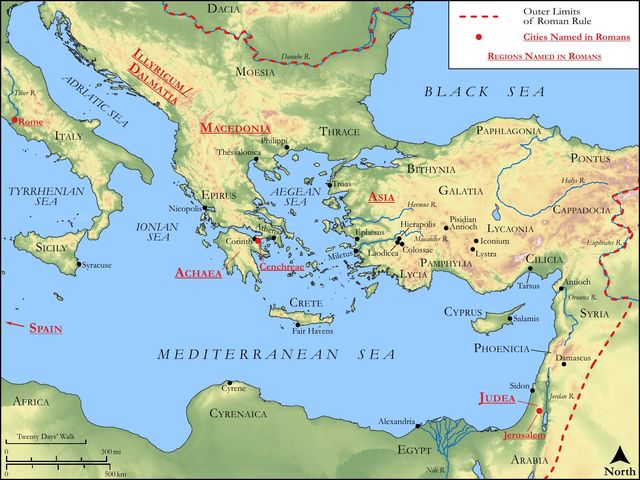
See on the biblical-era map

Study this verse
Public-domain commentary
Matthew Henry
From his Commentary on the Whole Bible. Henry comments on passages, not single verses — this entry covers Romans 7:1–6. His three-level outline is real structure in the source text, so it is rendered as structure.
Among other arguments used in the foregoing chapter to persuade us against sin, and to holiness, this was one (Rom 7:14), that we are not under the law; and this argument is here further insisted upon and explained (Rom 7:6): We are delivered from the law. What is meant by this? And how is it an argument why sin should not reign over us, and why we should walk in newness of life? 1. We are delivered from the power of the law which curses and condemns us for the sin committed by us. The sentence of the law against us is vacated and reversed, by the death of Christ, to all true believers. The law saith, The soul that sins shall die; but we are delivered from the law. The Lord has taken away thy sin, thou shalt not die. We are redeemed from the curse of the law, Gal 3:13. 2. We are delivered from that power of the law which irritates and provokes the sin that dwelleth in us. This the apostle seems especially to refer to (Rom 7:5): The motions of sins which were by the law. The law, by commanding, forbidding, threatening, corrupt and fallen man, but offering no grace to cure and strengthen, did but stir up the corruption, and, like the sun shining upon a dunghill, excite and draw up the filthy steams. We being lamed by the fall, the law comes and directs us, but provides nothing to heal and help our lameness, and so makes us halt and stumble the more. Understand this of the law not as a rule, but as a covenant of works. Now each of these is an argument why we should be holy; for here is encouragement to endeavours, though in many things we come short. We are under grace, which promises strength to do what it commands, and pardon upon repentance when we do amiss. This is the scope of these verses in general, that, in point of profession and privilege, we are under a covenant of grace, and not under a covenant of works - under the gospel of Christ, and not under the law of Moses. The difference between a law-state and a gospel-state he had before illustrated by the similitude of rising to a new life, and serving a new master; now here he speaks of is under the similitude of being married to a new husband.
I.Our first marriage was to the law, which, according to the law of marriage, was to continue only during the life of the law.
The law of marriage is binding till the death of one of the parties, no matter which, and no longer. The death of either discharges both. For this he appeals to themselves, as persons knowing the law (Rom 7:1): I speak to those that know the law. It is a great advantage to discourse with those that have knowledge, for such can more readily understand and apprehend a truth. Many of the Christians at Rome were such as had been Jews, and so were well acquainted with the law. One has some hold of knowing people. The law hath power over a man as long as he liveth; in particular, the law of marriage hath power; or, in general, every law is so limited - the laws of nations, of relations, of families, etc.
1.The obligation of laws extends no further; by death the servant who, while he lived, was under the yoke, is freed from his master, Job 3:19.
2.The condemnation of laws extends no further; death is the finishing of the law. Actio moritur cum person - The action expires with the person. The severest laws could but kill the body, and after that there is no more that they can do. Thus while we were alive to the law we were under the power of it - while we were in our Old Testament state, before the gospel came into the world, and before it came with power into our hearts. Such is the law of marriage (Rom 7:2), the woman is bound to her husband during life, so bound to him that she cannot marry another; if she do, she shall be reckoned an adulteress, Rom 7:3. It will make her an adulteress, not only to be defiled by, but to be married to, another man; for that is so much the worse, upon this account, that it abuses an ordinance of God, by making it to patronise the uncleanness. Thus were we married to the law (Rom 7:5): When we were in the flesh, that is, in a carnal state, under the reigning power of sin and corruption - in the flesh as in our element - then the motions of sins which were by the law did work in our members, we were carried down the stream of sin, and the law was but as an imperfect dam, which made the stream to swell the higher, and rage the more. Our desire was towards sin, as that of the wife towards her husband, and sin ruled over us. We embraced it, loved it, devoted all to it, conversed daily with it, made it our care to please it. We were under a law of sin and death, as the wife under the law of marriage; and the product of this marriage was fruit brought forth unto death, that is, actual transgressions were produced by the original corruption, such as deserve death. Lust, having conceived by the law (which is the strength of sin, Co1 15:56), bringeth forth sin, and sin, when it is finished, bringeth forth death, Jam 1:15. This is the posterity that springs from this marriage to sin and the law. This comes of the motions of sin working in our members. And this continues during life, while the law is alive to us, and we are alive to the law.
II.Our second marriage is to Christ: and how comes this about? Why,
1.We are freed, by death, from our obligation to the law as a covenant, as the wife is from her obligation to her husband, Rom 7:3. This resemblance is not very close, nor needed it to be. You are become dead to the law, Rom 7:4. He does not say, "The law is dead" (some think because he would avoid giving offence to those who were yet zealous for the law), but, which comes all to one, You are dead to the law. As the crucifying of the world to us, and of us to the world, amounts to one and the same thing, so doth the law dying, and our dying to it. We are delivered from the law (Rom 7:6), katērgēthēmen - we are nulled as to the law; our obligation to it as a husband is cassated and made void. And then he speaks of the law being dead as far as it was a law of bondage to us: That being dead wherein we were held; not the law itself, but its obligation to punishment and its provocation to sin. It is dead, it has lost its power; and this (Rom 7:4) by the body of Christ, that is, by the sufferings of Christ in his body, by his crucified body, which abrogated the law, answered the demands of it, made satisfaction for our violation of it, purchased for us a covenant of grace, in which righteousness and strength are laid up for us, such as were not, nor could be, by the law. We are dead to the law by our union with the mystical body of Christ. By being incorporated into Christ in our baptism professedly, in our believing powerfully and effectually, we are dead to the law, have no more to do with it than the dead servant, that is free from his master, hath to do with his master's yoke.
2.We are married to Christ. The day of our believing is the day of our espousals to the Lord Jesus. We enter upon a life of dependence on him and duty to him: Married to another, even to him who is raised from the dead, a periphrasis of Christ and very pertinent here; for as our dying to sin and the law is in conformity to the death of Christ, and the crucifying of his body, so our devotedness to Christ in newness of life is in conformity to the resurrection of Christ. We are married to the raised exalted Jesus, a very honourable marriage. Compare Co2 11:2; Eph 5:29. Now we are thus married to Christ,
(1.)That we should bring forth fruit unto God, Rom 7:4. One end of marriage is fruitfulness: God instituted the ordinance that he might seek a godly seed, Mal 2:15. The wife is compared to the fruitful vine, and children are called the fruit of the womb. Now the great end of our marriage to Christ is our fruitfulness in love, and grace, and every good work. This is fruit unto God, pleasing to God, according to his will, aiming at his glory. As our old marriage to sin produced fruit unto death, so our second marriage to Christ produces fruit unto God, fruits of righteousness. Good works are the children of the new nature, the products of our union with Christ, as the fruitfulness of the vine is the product of its union with the root. Whatever our professions and pretensions may be, there is no fruit brought forth to God till we are married to Christ; it is in Christ Jesus that we are created unto good works, Eph 2:10. The only fruit which turns to a good account is that which is brought forth in Christ. This distinguishes the good works of believers from the good works of hypocrites and self-justifiers that they are brought forth in marriage, done in union with Christ, in the name of the Lord Jesus, Col 3:17. This is, without controversy, one of the great mysteries of godliness.
(2.)That we should serve in newness of spirit, and not in the oldness of the letter, Rom 7:6. Being married to a new husband, we must change our way. Still we must serve, but it is a service that is perfect freedom, whereas the service of sin was a perfect drudgery: we must now serve in newness of spirit, by new spiritual rules, from new spiritual principles, in spirit and in truth, Joh 4:24. There must be a renovation of our spirits wrought by the spirit of God, and in that we must serve. Not in the oldness of the letter; that is, we must not rest in mere external services, as the carnal Jews did, who gloried in their adherence to the letter of the law, and minded not the spiritual part of worship. The letter is said to kill with its bondage and terror, but we are delivered from that yoke that we may serve God without fear, in holiness and righteousness, Luk 1:74, Luk 1:75. We are under the dispensation of the Spirit, and therefore must be spiritual, and serve in the spirit. Compare with this Co2 3:3, Co2 3:6, etc. It becomes us to worship within the veil, and no longer in the outward court.
Historical interpretation
Two Centuries of Reception
9 surviving comments on this verse. Each one is dated, so this reads as a timeline rather than a list.
Select a marker to jump to its quote. Markers stagger vertically where authors wrote within a few decades of each other.
But "we are dead to the law by the body of Christ, that we should belong to another, to him who was raised from the dead" and was prophesied by the law: "that we might bear fruit unto God."
Whose grace, if not of that God from whom also came the law? Unless it be, forsooth, that the Creator intercalated His law for the mere purpose of producing some employment for the grace of a rival god, an enemy to Himself (I had almost said, a god unknown to Him), "that as sin had" in His own dispensation "reigned unto death, even so might grace reign through righteousness unto (eternal) life by Jesus Christ," His own antagonist! For this (I suppose it was, that) the law of the Creator had "concluded all under sin," and had brought in "all the world as guilty (before God)," and had "stopped every mouth," so that none could glory through it, in order that grace might be maintained to the glory of the Christ, not of the Creator, but of Marcion! I may here anticipate a remark about the substance of Christ, in the prospect of a question which will now turn up. For he says that "we are dead to the law." It may be contended that Christ's body is indeed a body, but not exactly flesh.
Now, whatever may be the substance, since he mentions "the body of Christ," whom he immediately after states to have been "raised from the dead," none other body can be understood than that of the flesh, in respect of which the law was called (the law) of death.
When we were in the flesh and living according to it, we were unable to serve the newness of the Spirit on account of those sins which the law itself, which was in our members, nourished in order that they might bear fruit to death.… But when Christ died for us and we died to sin along with him, we were set free by him from the law of sin in which we were held, and now we can serve the law of God in newness of Spirit and not in the dead form of the law.
Since the Savior allowed the devil to crucify his body knowing that this was for us and against him, Paul says that we have been saved by the body of Christ. For to die to the law is to live to God, since the law rules over sinners. Therefore the one whose sins are forgiven dies to the law; this is what it means to be set free from the law. We receive this blessing through the body of Christ, for by giving up his body the Savior conquered death and condemned sin. The devil sinned against him when it killed him even though he was innocent and entirely without sin. For when the devil claims a man for himself because of sin, he is found to be guilty of the thing he accuses him of. Thus it happens that all who believe in Christ are delivered from the law, because sin has been condemned. For sin, which is of the devil, has been conquered by the body of Christ. Now he has no authority over those who belong to Christ, by whom he has been conquered. For because Christ was sinless yet was killed as if he were guilty, he conquered sin by sin—that is to say, he defeated the devil by his own sin. And what he allowed to get into the devil he condemned, thereby destroying the penalty which had been decreed because of the sin of Adam. When he rose again from the dead an image of new life was stamped upon those who believe in him, so that they cannot be bound by the second death. For this reason we have died to the law by the body of Christ. Thus whoever has not died to the law is still guilty, and whoever is guilty cannot escape the second death.… Whoever perseveres in the grace of Christ belongs to God and is worthy of the promised resurrection.
Now it is not on this only he grounds his exhortation, but also on the superiority of this second husband. And so he proceeds: "that ye should be married to another, even to Him Who is raised from the dead." Then to prevent their saying, If we do not choose to live with another husband, what then? For the Law does not indeed make an adulteress of the widow who lives in a second marriage, but for all that it does not force her to live in it. Now that they may not say this, he shows that from benefits already conferred, it is binding on us to choose it: and this he lays down more clearly in other passages, where he says, "Ye are not your own;" and, "Ye are bought with a price;" and, "Be not ye the servants of men"; and again, "One died for all, that they which live should not henceforth live unto themselves, but unto Him which died for them." This is then what he here alludes to in the words, "By the Body." And next he exhorts to better hopes, saying, "That we should bring forth fruit unto God." For then, he means, ye brought forth fruit unto death, but now unto God.
Paul was reluctant to tell the Jews that the law was dead, but what he dared not say out loud he leaves to be understood.… A man bears fruit for God when his works of righteousness like fruit break out in blossom, then grow into fruit, and finally become fully ripe, for no fruit is forever in blossom.
The phrase “in order that we” should be read as: “and so we shall”.… For Paul wants to say that once we have been established in this life we shall bear the fruits of righteousness for God, since we have been changed from our behavior under the law.It is most remarkable that Paul says that we have died not through baptism but through the body of Christ. For Adam was the beginning of this life, and Christ is the beginning of the life to come. So, just as in this life we have everything in common with Adam, so also in the next life we shall have everything in common with Christ, beginning with his resurrection. We are said to be a part of the Lord’s body because we share this with him. So just as we have been metaphorically born again by baptism, Paul says that we have become a part of Christ’s body by sharing in the resurrection which is typified by baptism.
In order not to offend the Jews or to give those heretics who reject the Old Testament any encouragement, Paul did not say that the law had come to an end but rather that we have died to the law by the saving grace of baptism.
Continue studying Romans 7:4 across the web’s major study libraries — every link below opens this exact verse, chapter, or book on the destination site.
Read & Compare
 BibleGatewayThis verse in more than 200 translations and 70 languages.
 Bible.comThe YouVersion reader — hundreds of translations, reading plans, and highlights.
 ESV.orgCrossway's official English Standard Version reader.
 NET BibleThe NET translation with 60,000+ translators' notes on every rendering decision.
 STEP BibleTyndale House's free study tool — original text, vocabulary, and scholarly resources.
 BibliaLogos Bible Software's free web reader.
 USCCBThe New American Bible (Revised Edition) with the U.S. bishops' study notes.
Commentaries
 BibleHub CommentariesDozens of classic commentaries on this verse, gathered on one page.
 StudyLightMore than 100 commentary sets — the largest collection on the web.
 BibleRefPlain-English commentary on what this verse means, verse by verse.
 Enduring WordDavid Guzik's free commentary on this chapter, widely used by Bible teachers.
 Bible Study ToolsVerse commentary alongside Greek and Hebrew study aids.
Original Language & Research
- BibleHub InterlinearThe verse word by word — original language, transliteration, and English.
- BibleHub LexiconEvery word's original-language definition and Strong's entry.
 Blue Letter BibleDeep-study tools — Strong's numbers, concordance, and word studies.
 CNTR CollationThe earliest Greek manuscripts of this verse, collated letter by letter.
Sermons, Hymns & Audio


TrulyRandomVerse is not affiliated with these sites and doesn’t control their content. They’re linked because they’re genuinely useful.
Summary
Romans 7:4 reveals the profound theological truth that believers, through their spiritual identification with Christ's death on the cross, have been irrevocably freed from the Law's dominion. This liberation is not an end in itself but serves a divine purpose: to enable a new, life-giving union with the resurrected Christ, a spiritual marriage intended to produce genuine, God-honoring fruit that reflects His character and glory.
Context
ShowHideLiterary Context
Romans 7:4 serves as the climactic conclusion to Paul's intricate marriage analogy, which begins in Romans 7:1. In the preceding verses (Romans 7:1-3), Paul uses the example of a woman bound to her husband by law until his death, after which she is free to marry another. He applies this legal principle to the believer's relationship with the Mosaic Law, establishing that just as death dissolves a legal bond, so too has the believer "died" to the Law's power. This passage immediately follows the robust discussion in Romans 6, where Paul asserts that believers are "dead to sin" and "alive to God in Christ Jesus" (Romans 6:11). Romans 7:4 thus bridges the themes of freedom from sin's dominion and freedom from the Law's condemnation, grounding both in Christ's death and resurrection.
Historical & Cultural Context
Paul's audience in Rome, comprising both Jewish and Gentile believers, would have been familiar with the concept of marriage as a legally binding covenant. For Jewish believers, the Mosaic Law was central to their identity and relationship with God, and the idea of being "dead to the law" would have been revolutionary, even scandalous, without proper explanation. Paul is addressing a common misunderstanding that freedom from the Law meant license to sin, or that the Law itself was inherently evil. He clarifies that the Law is holy and good (Romans 7:12), but it cannot justify or impart life. The cultural understanding of legal contracts and the sanctity of marriage provides a relatable framework for Paul to explain the profound shift in covenantal relationship brought about by Christ.
Key Themes
ShowHideThis verse powerfully articulates several foundational themes within Romans and Pauline theology. It highlights the Supremacy of Christ's Work, emphasizing that our liberation from the Law's condemning power is solely "by the body of Christ," referring to His atoning death. It underscores the New Covenant Reality, where believers are no longer under the old covenant of Law but are now "married to another," signifying a new, intimate, and life-giving union with the resurrected Christ. This union is the wellspring of Spiritual Transformation and Fruitfulness, as the ultimate purpose of this new relationship is "that we should bring forth fruit unto God." This contrasts sharply with the "fruit unto death" that the Law, through sin, produced (Romans 7:5). The theme of Justification by Faith is implicitly reinforced, as freedom from the Law's demands points away from human effort and towards God's grace in Christ.
Exposition and Analysis
ShowHideKey Word Analysis
ShowHideMeaning "to kill" (literally or figuratively); "to become dead, (cause to be) put to death, kill, mortify." In this context, it signifies a decisive, spiritual severance or rendering inoperative. Believers are not merely "released" from the Law, but have undergone a death to its dominion, a radical break from its power to condemn or define their standing before God. This death is not the annihilation of the Law itself, but the believer's cessation of being under its authority as a means of righteousness.
Meaning "to cause to be," "to become," or "come into being." Here, it is specifically translated "to be married." This word emphasizes a new state of being, a profound and active transition into a new covenantal relationship. It's not a passive state but an active becoming, signifying the initiation of a deep, intimate, and legally recognized union between the believer and Christ.
Meaning "to be fertile" (literally or figuratively); "to be (bear, bring forth) fruit(-ful)." This term highlights the natural and expected outcome of the new union with Christ. Just as a marriage is intended to be fruitful, so too is the believer's union with Christ meant to produce spiritual "fruit" – a life characterized by righteousness, good works, and the character of God, which ultimately brings glory to Him. It implies productivity and spiritual vitality.
Verse Breakdown
ShowHide"Wherefore, my brethren, ye also are become dead to the law by the body of Christ;"
Paul addresses his audience as "brethren," emphasizing their shared spiritual family. The phrase "ye also are become dead to the law" asserts a completed action: believers have undergone a decisive break from the Law's authority as a means of salvation or condemnation. This "death" is explicitly achieved "by the body of Christ," referring to Christ's physical death on the cross. His crucifixion is the means by which believers are spiritually identified with Him in death, thereby fulfilling the Law's demands and releasing them from its binding power.
"that ye should be married to another, [even] to him who is raised from the dead,"
The purpose (indicated by "that") of this death to the Law is not merely freedom, but a new, positive relationship. The analogy shifts to a spiritual "marriage" to "another," specifically identified as "him who is raised from the dead." This highlights the essential role of Christ's resurrection. It is not to a dead Christ that believers are united, but to the living, resurrected Lord, signifying a union that is life-giving, dynamic, and eternal, forming a new covenantal bond.
"that we should bring forth fruit unto God."
This final clause states the ultimate teleological purpose of the entire process: the production of spiritual fruit. The union with the resurrected Christ is not an end in itself, but a means to a transformed life that yields "fruit unto God." This fruit is not merely human effort or moralism, but the natural outflow of the Holy Spirit's work within those united to Christ, reflecting God's character and purposes, and ultimately bringing Him glory.
Literary Devices
ShowHidePaul masterfully employs Analogy throughout Romans 7:1-4, specifically the Marriage Analogy, to explain a complex theological truth in a relatable way. The legal dissolution of a marriage through death provides a clear parallel for the believer's release from the Law's dominion. The Personification of the Law as a "husband" underscores its former binding authority over individuals. Furthermore, the concept of "death to the law" and "married to another" involves Metaphor, where spiritual realities are described using terms from physical life and relationships. The phrase "bring forth fruit unto God" is also a Metaphor for spiritual productivity and righteous living, drawing on the natural imagery of a fruitful vine or tree. These devices work together to illuminate the radical shift from legal bondage to a vibrant, life-producing union with Christ.
Theological and Thematic Connections
ShowHideRomans 7:4 is a pivotal verse, articulating the believer's new covenant reality and the profound implications of union with Christ. It clarifies that the Law, while holy and good, was never intended to justify or sanctify; rather, it exposed sin and condemned. Through Christ's death, believers are liberated from this condemnation and the Law's power as a master, enabling them to enter into an intimate, life-giving relationship with the resurrected Christ. This union is the source of true righteousness and spiritual fruit, shifting the basis of relationship with God from legal performance to gracious union, thus fulfilling God's redemptive purpose.
Reflection and Application
ShowHideRomans 7:4 offers immense comfort and profound clarity for every believer. It assures us that our salvation, righteousness, and acceptance before God do not depend on our imperfect efforts to keep the Law, but entirely on our unbreakable union with the resurrected Christ. This truth liberates us from the heavy burden of legalism, self-condemnation, and the endless striving for acceptance through works. Instead, it invites us into a relationship of grace, where our motivation for living righteously springs not from fear of punishment, but from love for our new "Husband," Jesus Christ, and the indwelling power of His Spirit. Our identity is no longer defined by our adherence to rules or our past failures, but by our profound and eternal union with the One who died for us and rose again, empowering us to live a life that naturally produces fruit for God's glory.
Questions for Reflection
ShowHideFAQ
ShowHideWhat does it mean to be "dead to the law"?
ShowHideTo be "dead to the law" means that believers are no longer under the Law's authority as a system for justification, condemnation, or as the primary means by which they relate to God. It does not mean the Law is abolished or evil, but that its power to condemn and its role as a covenantal bond for believers has been rendered inoperative through Christ's death. Just as death dissolves a marriage bond, Christ's death on the cross spiritually "killed" the believer's former relationship with the Law, freeing them from its demands and penalties. This concept is further elaborated in Galatians 2:19.
How does being "married to another" relate to Christian living?
ShowHideBeing "married to another, even to him who is raised from the dead" signifies a new, intimate, and covenantal union between the believer and the resurrected Christ. This spiritual marriage is the foundation of Christian living. It implies shared identity, resources, and purpose. Just as a physical marriage aims for fruitfulness, this spiritual union is intended to produce "fruit unto God" – a life characterized by righteousness, love, joy, peace, and other attributes of the Holy Spirit (Galatians 5:22-23). This fruit is not produced by human effort to keep rules, but by the indwelling Spirit working through the believer's intimate connection with Christ, as highlighted in John 15:4-5.
Christ-Centered Fulfillment
ShowHideRomans 7:4 finds its ultimate Christ-centered fulfillment in the person and work of Jesus, who is the embodiment of the new covenant and the very means by which believers are freed from the old. His "body of Christ" refers directly to His sacrificial death on the cross, which served as the decisive act that "killed" the believer's old relationship with the Law, fulfilling its righteous demands and breaking its condemning power (Colossians 2:14). Furthermore, the verse points to Christ's glorious resurrection ("him who is raised from the dead") as the basis for the believer's new, life-giving union. It is through His resurrection that He becomes the living "Husband" to whom His church, the bride, is united (Ephesians 5:25-27). This spiritual marriage is the very purpose of His redemptive work, enabling believers to bear "fruit unto God" – a life transformed by the Spirit, reflecting the character of Christ Himself, and ultimately bringing glory to the Father (John 15:8). Thus, Christ is not only the agent of our liberation but also the object of our new covenantal union and the source of all spiritual fruitfulness.