


1 Corinthians 10:27
Bible text: King James Version (1769 Blayney text) · Public domain
Bible text: King James Version with Strong's numbers · Public domain
Bible text: Berean Standard Bible · Public domain
Bible text: American Standard Version (1901) · Public domain
Bible text: World English Bible, Messianic edition · Public domain
Bible text: Geneva Bible (1599) · Public domain
Bible text: Young's Literal Translation · Public domain
- ΕἴEiIfG1487CONDConjunction
- δέdenowG1161CONJConjunction
- τιςtisanyoneG5100X-NSMIndefinite pronoun Nominative Singular Masculine
- καλεῖkaleiinvitesG2564V-PAI-3SVerb Present Active Indicative 3rd Singular
- ὑμᾶςhumasyouG4771P-2APPersonal pronoun Accusative 2nd Plural
- τῶνtōnof theG3588T-GPMDefinite article Genitive Plural Masculine
- ἀπίστωνapistōnunbelievingG571A-GPMAdjective Genitive Plural Masculine
- καὶkaiandG2532CONJConjunction
- θέλετεtheleteyou wishG2309V-PAI-2PVerb Present Active Indicative 2nd Plural
- πορεύεσθαιporeuesthaito goG4198V-PNNVerb Present Middle Or Passive Deponent Infinitive
- πᾶνpaneverythingG3956A-ASNAdjective Accusative Singular Neuter
- τὸtowhichG3588T-ASNDefinite article Accusative Singular Neuter
- παρατιθέμενονparatithemenonis being set beforeG3908V-PPP-ASNVerb Present Passive Participle Accusative Singular Neuter
- ὑμῖνhuminyouG4771P-2DPPersonal pronoun Dative 2nd Plural
- ἐσθίετεesthietedo eatG2068V-PAM-2PVerb Present Active Imperative 2nd Plural
- μηδὲνmēdennothingG3367A-ASN-NAdjective Accusative Singular Neuter Negative
- ἀνακρίνοντεςanakrinontesinquiringG350V-PAP-NPMVerb Present Active Participle Nominative Plural Masculine
- διὰdiaon account ofG1223PREPPreposition
- τὴνtēn<the>G3588T-ASFDefinite article Accusative Singular Feminine
- συνείδησιν·suneidēsinconscienceG4893N-ASFNoun Accusative Singular Feminine
English is a literal word-by-word gloss of the Greek, not the KJV's wording. Why?
This is the original text the KJV's translators worked from — each Greek word with its own literal English meaning in this verse, prepared by scholars at Tyndale House, Cambridge. The KJV translates whole sentences, not word by word, so its wording differs: one Greek word can become several English words, and the KJV may choose “charity” where the gloss reads “love”. Both are faithful — they answer different questions. For the KJV's own rendering, switch to the KJV text.
Details
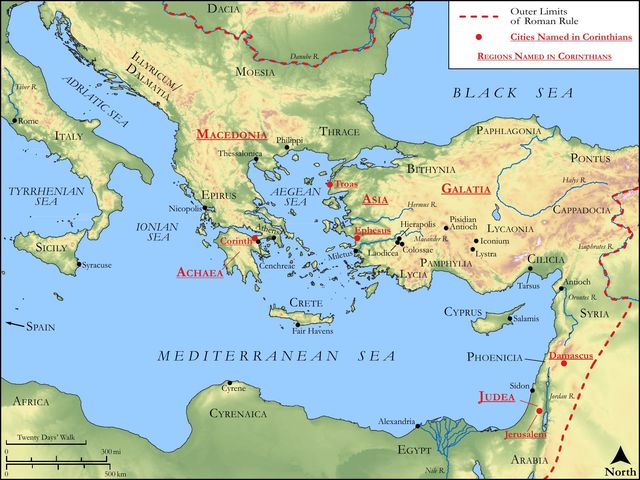
See on the biblical-era maps

Study this verse
Public-domain commentary
Matthew Henry
From his Commentary on the Whole Bible. Henry comments on passages, not single verses — this entry covers 1 Corinthians 10:23–33.
In this passage the apostle shows in what instances, notwithstanding, Christians might lawfully eat what had been sacrificed to idols. They must not eat it out of religious respect to the idol, nor go into his temple, and hold a feast there, upon what they knew was an idol-sacrifice; nor perhaps out of the temple, if they knew it was a feast held upon a sacrifice, but there were cases wherein they might without sin eat what had been offered. Some such the apostle here enumerates. - But,
I.He gives a caution against abusing our liberty in lawful things.
That may be lawful which is not expedient, which will not edify. A Christian must not barely consider what is lawful, but what is expedient, and for the use of edification. A private Christian should do so even in his private conduct. He must not seek his own only, but his neighbour's wealth. He must be concerned not to hurt his neighbour, nay, he must be concerned to promote his welfare; and must consider how to act so that he may help others, and not hinder them in their holiness, comfort, or salvation. Those who allow themselves in every thing not plainly sinful in itself will often run into what is evil by accident, and do much mischief to others. Every thing lawful in itself to be done is not therefore lawfully done. Circumstances may make that a sin which in itself is none. These must be weighed, and the expediency of an action, and its tendency to edification, must be considered before it be done. Note, The welfare of others, as well as our own convenience, must be consulted in many things we do, if we would do them well.
II.He tells them that what was sold in the shambles they might eat without asking questions.
The priest's share of heathen sacrifices was thus frequently offered for sale, after it had been offered in the temple. Now the apostle tells them they need not be so scrupulous as to ask the butcher in the market whether the meat he sold had been offered to an idol? It was there sold as common food, and as such might be bought and used; for the earth is the Lord's, and the fulness thereof (Co1 10:26), and the fruit and products of the earth were designed by him, the great proprietor, for the use and subsistence of mankind, and more especially of his own children and servants. Every creature of God is good, and nothing to be refused, if it be received with thanksgiving; for it is sanctified by the word of God and prayer, Ti1 4:4, Ti1 4:5. To the pure all things are pure, Tit 1:15. Note, Though it is sinful to use any food in an idolatrous manner, it is no sin, after such abuse, to apply it, in a holy manner, to its common use.
III.He adds that if they were invited by any heathen acquaintances to a feast, they might go, and eat what was set before them, without asking questions (Co1 10:27), nay, though they knew things sacrificed to idols were served up at such entertainments, as well as sold in the shambles. Note, The apostle does not prohibit their going to a feast upon the invitation of those that believed not. There is a civility owing even to infidels and heathens. Christianity does by no means bind us up from the common offices of humanity, nor allow us an uncourteous behaviour to any of our own kind, however they may differ from us in religious sentiments or practices. And when Christians were invited to feast with infidels they were not to ask needless questions about the food set before them, but eat without scruple. Needless enquiries might perplex their minds and consciences, for which reason they were to be avoided. Any thing fit to be eaten, that was set before them at a common entertainment, they might lawfully eat. And why then should they scrupulously enquire whether what was set before them had been sacrificed? It is to be understood of civil feasting, not religious; for the latter among the heathens was feasting upon their sacrifices, which he had condemned before as a participation in their idolatrous worship. At a common feast they might expect common food; and they needed not to move scruples in their own minds whether what was set before them was otherwise or no. Note, Though Christians should be very careful to know and understand their duty, yet they should not, by needless enquiries, perplex themselves.
IV.Yet, even at such an entertainment, he adds, if any should say it was a thing that had been offered to idols, they should refrain:
Eat not, for his sake that showed it, and for conscience' sake. Whether it were the master of the feast or any of the guests, whether it were spoken in the hearing of all or whispered in the ear, they should refrain for his sake who suggested this to them, whether he were an infidel or an infirm Christian; and for conscience' sake, out of regard to conscience, that they might show a regard to it in themselves, and keep up a regard to it in others. This he backs with the same reason as the former: For the earth is the Lord's. There is food enough provided by our common Lord, of which we maya eat without scruple. The same doctrine may be variously improved, as here: "The earth is the Lord's, therefore you may eat any thing without scruple that is set before you as common food; and yet, because the earth is the Lord's, eat nothing that will give offence, lay a stumbling-block before others, and encourage some in idolatry, or tempt others to eat when they are not clear in their own mind that it is lawful, and so sin, and wound their own consciences." Note, Christians should be very cautious of doing what may thus prejudice the consciences of others, and weaken their authority with them, which is by all means to be kept up.
V.He urges them to refrain where they will give offence, while yet he allows it lawful to eat what was et before them as common food, though it had been offered in sacrifice. "Another man's conscience is no measure to our conduct. What he thinks unlawful is not thereby made unlawful to me, but may be a matter of liberty still; and as long as I own God as a giver of my food, and render him thanks for it, it is very unjust to reproach me for using it." This must be understood abstracted from the scandal given by eating in the circumstance mentioned. Though some understand it to mean, "Why should I, by using the liberty I have, give occasion to those who are scandalized to speak evil of me?" According to that advice of the apostle (Rom 14:16), Let not your good be evil spoken of. Note, Christians should take care not to use their liberty to the hurt of others, nor their own reproach.
VI.The apostle takes occasion from this discourse to lay down a rule for Christians' conduct, and apply it to this particular case (Co1 10:31, Co1 10:32), namely, that in eating and drinking, and in all we do, we should aim at the glory of God, at pleasing and honouring him. This is the fundamental principle of practical godliness. The great end of all practical religion must direct us where particular and express rules are wanting. Nothing must be done against the glory of God, and the good of our neighbours, connected with it. Nay, the tendency of our behaviour to the common good, and the credit of our holy religion, should give direction to it. And therefore nothing should be done by us to offend any, whether Jew, or Gentile, or the church, Co1 10:32. The Jews should not be unnecessarily grieved nor prejudiced, who have such an abhorrence of idols that they reckon every thing offered to them thereby defiled, and that it will pollute and render culpable all who partake of it; nor should heathens be countenanced in their idolatry by any behaviour of ours, which they may construe as homage or honour done to their idols; nor young converts from Gentilism take any encouragement from our conduct to retain any veneration for the heathen gods and worship, which they have renounced: nor should we do any thing that may be a means to pervert any members of the church from their Christian profession or practice. Our own humour and appetite must not determine our practice, but the honour of God and the good and edification of the church. We should not so much consult our own pleasure and interest as the advancement of the kingdom of God among men. Note, A Christian should be a man devoted to God, and of a public spirit.
VII.He presses all upon them by his own example:
Even as I please all men (or study to do it) in all things (that I lawfully can), not seeking my own profit, but that of many, that they may be saved, Co1 10:33. Note, A preacher may press his advice home with boldness and authority when he can enforce it with his own example. He is most likely to promote a public spirit in others who can give evidence of it in himself. And it is highly commendable in a minister to neglect his own advantage that he may promote the salvation of his hearers. This shows that he has a spirit suitable to his function. It is a station for public usefulness, and can never be faithfully discharged by a man of a narrow spirit and selfish principles.
Historical interpretation
Two Centuries of Reception
2 surviving comments on this verse. Each one is dated, so this reads as a timeline rather than a list.
Select a marker to jump to its quote. Markers stagger vertically where authors wrote within a few decades of each other.
"And if one of the unbelievers call us to a feast, and we determine to go" (for it is a good thing not to mix with the dissolute), the apostle bids us "eat what is set before us, asking no questions for conscience sake."
"If one of them that believe not biddeth you," saith he, "to a feast, and you are disposed to go; whatsoever is set before you, eat, asking no question for conscience sake."
See again his moderation. For he did not command and make a law that they should withdraw themselves, yet neither did he forbid it. And again, should they depart, he frees them from all suspicion. Now what may be the account of this? That so great curiousness might not seem to arise from any fear and cowardice. For he who makes scrupulous enquiry doth so as being in dread: but he who, on hearing the fact, abstains, abstains as out of contempt and hatred and aversion. Wherefore Paul, purposing to establish both points, saith, "Whatsoever is set before you, eat."
Continue studying 1 Corinthians 10:27 across the web’s major study libraries — every link below opens this exact verse, chapter, or book on the destination site.
Read & Compare
 BibleGatewayThis verse in more than 200 translations and 70 languages.
 Bible.comThe YouVersion reader — hundreds of translations, reading plans, and highlights.
 ESV.orgCrossway's official English Standard Version reader.
 NET BibleThe NET translation with 60,000+ translators' notes on every rendering decision.
 STEP BibleTyndale House's free study tool — original text, vocabulary, and scholarly resources.
 BibliaLogos Bible Software's free web reader.
 USCCBThe New American Bible (Revised Edition) with the U.S. bishops' study notes.
Commentaries
 BibleHub CommentariesDozens of classic commentaries on this verse, gathered on one page.
 StudyLightMore than 100 commentary sets — the largest collection on the web.
 BibleRefPlain-English commentary on what this verse means, verse by verse.
 Enduring WordDavid Guzik's free commentary on this chapter, widely used by Bible teachers.
 Bible Study ToolsVerse commentary alongside Greek and Hebrew study aids.
Original Language & Research
- BibleHub InterlinearThe verse word by word — original language, transliteration, and English.
- BibleHub LexiconEvery word's original-language definition and Strong's entry.
 Blue Letter BibleDeep-study tools — Strong's numbers, concordance, and word studies.
 CNTR CollationThe earliest Greek manuscripts of this verse, collated letter by letter.
Sermons, Hymns & Audio


TrulyRandomVerse is not affiliated with these sites and doesn’t control their content. They’re linked because they’re genuinely useful.
Summary
First Corinthians 10:27 offers practical guidance for believers navigating social interactions with unbelievers, specifically concerning meals where food might have been offered to idols. Paul instructs that if invited to a feast by a non-believer and one chooses to attend, they should freely eat whatever is served without inquiring about its origin, provided their own conscience is not troubled. This directive underscores the principles of Christian liberty, the importance of maintaining a clear conscience, and the strategic value of open fellowship for the sake of the Gospel, all while avoiding unnecessary legalism or scrupulosity.
Context
ShowHideLiterary Context
This verse is deeply embedded within Paul's extensive discourse on Christian liberty and responsibility regarding food sacrificed to idols, spanning 1 Corinthians 8-10. Prior to this, Paul established that idols are nothing (1 Corinthians 8:4), granting believers freedom to eat such meat if their conscience allowed. However, he immediately qualified this liberty with the paramount principle of love, warning against causing a "weaker brother" to stumble (1 Corinthians 8:9-13). Chapter 1 Corinthians 9 then illustrates Paul's own willingness to forgo rights for the sake of the Gospel. Chapter 1 Corinthians 10 further warns against idolatry by drawing lessons from Israel's history, before returning to the practical application of liberty. Verse 1 Corinthians 10:23 reiterates the "all things are lawful" principle, but adds "not all things are profitable" and "not all things edify." Thus, 1 Corinthians 10:27 provides a specific scenario and instruction within this broader framework, focusing on private social engagements with unbelievers, distinct from public market purchases or temple feasts.
Historical & Cultural Context
In first-century Greco-Roman society, meat consumption was often intertwined with pagan religious practices. Animals were frequently sacrificed in pagan temples, with portions then sold in public markets (the macellum) or served at private and public feasts. For a Christian, eating such meat could be problematic, not because the idol itself had power, but due to the potential for complicity in idolatry, or, more commonly, causing a fellow believer with a sensitive conscience to stumble. Social invitations were crucial for maintaining relationships and conducting business. Christians in Corinth, a bustling port city with diverse religious practices, would frequently encounter situations where they were invited to meals by pagan neighbors, friends, or business associates. Paul's instruction here addresses the specific etiquette for these private, non-sacrificial meals, distinguishing them from direct participation in idolatrous rituals or situations where a "weaker" Christian might be present and observe their actions. The cultural expectation was to accept hospitality, and refusing food or asking intrusive questions could be seen as deeply offensive.
Key Themes
ShowHideThis verse contributes significantly to several overarching themes in Paul's letter. First, it powerfully illustrates Christian Liberty and its Limits. Believers are free from the law concerning food, as "food does not commend us to God" (1 Corinthians 8:8). This liberty, however, is not absolute but is always to be exercised within the bounds of love and for the glory of God (1 Corinthians 10:31). Second, the passage emphasizes the role of Conscience. Paul distinguishes between one's own conscience and that of others. Here, the focus is on the believer's personal conviction: if one's own conscience is clear, there is no need to create a problem where none exists. This avoids Scrupulosity – an excessive preoccupation with minor sins or religious duties – and encourages a robust faith that trusts God's provision. Finally, the instruction to accept invitations and eat without fuss highlights the theme of Witness and Fellowship. By participating in normal social life, Christians maintain open doors for evangelism and demonstrate the practical, non-legalistic nature of their faith, embodying Paul's strategy of becoming "all things to all people" to save some (1 Corinthians 9:22).
Exposition and Analysis
ShowHideKey Word Analysis
ShowHideMeaning "to call (properly, aloud, but used in a variety of applications, directly or otherwise):--bid, call (forth), (whose, whose sur-)name (was (called))." In this context, it signifies an invitation, specifically to a feast or meal. The act of "bidding" implies a social overture, an opening for fellowship and interaction, which Paul encourages believers to accept if they are "disposed to go."
This phrase combines G3367 ("not even one") and G350 ("to scrutinize, i.e. (by implication) investigate, interrogate, determine"). The instruction is to refrain from any inquiry or investigation into the origin or history of the food. This is not about willful ignorance but about avoiding the creation of unnecessary moral dilemmas or legalistic burdens for oneself. It implies a trust that God has sanctified all food for consumption when received with thanksgiving (1 Timothy 4:4-5).
Meaning "co-perception, i.e. moral consciousness:--conscience." This refers to the inner moral faculty that judges one's actions and thoughts. Paul's directive, "for conscience sake," specifically refers to the believer's own conscience. If a believer has no internal conviction that eating the food is wrong, then they should not invent one by asking questions that could lead to doubt or self-condemnation. This is distinct from the "weak" conscience of another believer, which is addressed in the following verse (1 Corinthians 10:28).
Verse Breakdown
ShowHide"If any of them that believe not bid you [to a feast], and ye be disposed to go;"
This clause sets the specific scenario: a Christian receives an invitation from a non-believer to a meal. The phrase "disposed to go" (from the Greek thélō and poreúomai) implies a willing choice, not a compulsion. Paul acknowledges that believers have the freedom to accept such invitations, recognizing the value of maintaining social connections with those outside the faith. This willingness to engage is foundational to gospel witness.
"whatsoever is set before you, eat, "
This is a direct, practical command. Once the invitation is accepted and one is seated at the table, the instruction is to consume the food presented. The word "whatsoever" (from the Greek pâs) emphasizes the breadth of this permission – no food is inherently defiling. This reinforces the New Testament understanding that ritual food laws are fulfilled in Christ and that "nothing is unclean in itself" (Romans 14:14).
"asking no question for conscience sake."
This final phrase provides the crucial rationale. The believer is not to inquire about the food's origin (e.g., "Was this meat offered to an idol?"). Such questioning is forbidden specifically "for conscience sake," meaning for the sake of one's own moral consciousness. If the believer's conscience is not troubled by the food as presented, then raising questions would only serve to create an unnecessary scruple, potentially leading to self-condemnation or an ungracious refusal of hospitality. It promotes a confident, unburdened exercise of Christian liberty in private settings.
Literary Devices
ShowHidePaul employs several literary devices in 1 Corinthians 10:27 to convey his practical instruction. The verse functions as a Conditional Clause, setting up a specific "if...then" scenario: "If any of them that believe not bid you... and ye be disposed to go; whatsoever is set before you, eat..." This structure provides clear, actionable guidance based on a specific set of circumstances. Furthermore, the instruction "eat, asking no question for conscience sake" is a form of Apophatic Instruction, where Paul defines what not to do (ask questions) to achieve a desired outcome (a clear conscience and unhindered fellowship). This highlights the importance of avoiding unnecessary legalistic burdens. There is also an Implied Analogy at play, contrasting the believer's inner freedom with potential external pressures or self-imposed anxieties. The verse also demonstrates Pragmatic Instruction, offering concrete, real-world advice for navigating complex social situations, characteristic of Paul's pastoral counsel throughout his epistles.
Theological and Thematic Connections
ShowHide1 Corinthians 10:27 profoundly connects to the broader theological understanding of Christian liberty, the nature of conscience, and the imperative of Christian witness. The core theological principle is that in Christ, believers are freed from external ritualistic regulations concerning food, as God has sanctified all food for consumption with thanksgiving. This liberty, however, is not an end in itself but is to be exercised responsibly, guided by love for God and neighbor. The verse emphasizes the believer's personal conscience as the internal arbiter of moral permissibility in morally neutral matters, urging against self-imposed legalism or the creation of artificial stumbling blocks. It implicitly affirms the goodness of creation and God's sovereignty over all things, even food that may have been associated with pagan practices, so long as one's heart remains devoted to Christ. This freedom also serves the greater mission of the church, enabling believers to engage with unbelievers in normal social settings, thereby creating opportunities for gospel proclamation and demonstrating the attractiveness of a faith that is both principled and gracious.
Reflection and Application
ShowHideFirst Corinthians 10:27 offers timeless wisdom for navigating the complexities of Christian life in a pluralistic world. It calls believers to embrace a robust and confident faith that understands the freedom granted in Christ, rather than being shackled by unnecessary anxieties or legalistic interpretations of external practices. When invited into social spaces by those who do not share our faith, this verse encourages us to be gracious guests, accepting hospitality without suspicion or creating awkward situations through intrusive questioning. This approach not only demonstrates respect for our hosts but also showcases the liberating nature of the Gospel, allowing for genuine connection and potential opportunities for witness. It challenges us to discern when an issue is truly a matter of sin versus a matter of personal preference or cultural norm. Ultimately, our actions should be driven by love, a clear conscience before God, and the overarching desire to glorify Him in all things, fostering relationships that might lead others to Christ rather than erecting barriers.
Questions for Reflection
ShowHideFAQ
ShowHideDoes "asking no question for conscience sake" mean I should never consider the ethical implications of what I eat?
ShowHideNo, this verse does not advocate for willful ignorance regarding the ethical implications of food sourcing (e.g., fair trade, animal welfare, environmental impact). Paul's instruction in 1 Corinthians 10:27 is specifically about food that might have been offered to idols in a pagan context, and the concern is about one's own conscience being troubled by such a past association. He is addressing the problem of scrupulosity regarding ritual purity, not broader ethical consumption. The context is a private meal with an unbeliever where the origin of the food is not explicitly stated to be problematic. If a believer has a personal conviction about certain ethical issues related to food, or if they are in a situation where their actions might cause a "weaker brother" to stumble (1 Corinthians 10:28), then different principles apply. The overarching principle is to "do all to the glory of God" (1 Corinthians 10:31), which certainly includes ethical considerations when they are genuinely relevant to honoring God and loving neighbor.
Christ-Centered Fulfillment
ShowHideFirst Corinthians 10:27, while offering practical guidance on social etiquette, finds its ultimate fulfillment in the person and work of Jesus Christ. Christ himself is the embodiment of perfect liberty and perfect love, setting the standard for how believers are to live in the world. He taught that "not what goes into the mouth defiles a person, but what comes out of the mouth; this defiles a person" (Matthew 15:11). By His life, death, and resurrection, Christ abolished the ceremonial laws that once distinguished clean from unclean, declaring all foods clean (Mark 7:19). This verse, therefore, reflects the freedom from legalistic burdens that Christ secured for His followers, allowing them to participate in the common life of humanity without fear or ritualistic anxiety. Moreover, Christ's mission was characterized by His willingness to "eat with tax collectors and sinners" (Matthew 9:11), demonstrating an universal reach and a desire to engage with those outside the religious establishment. Just as Jesus entered into the world of sinners to bring salvation, so believers are called to engage with unbelievers, not isolating themselves, but seeking opportunities for fellowship and witness. The principle of considering one's own conscience and avoiding unnecessary scruples allows believers to live out this Christ-like posture of gracious engagement, reflecting the liberating truth of the Gospel to a watching world, all for the glory of the One who freed us from all bondage (Galatians 5:1).