


Romans 2:19
Bible text: King James Version (1769 Blayney text) · Public domain
Bible text: Berean Standard Bible · Public domain
Bible text: American Standard Version (1901) · Public domain
Bible text: World English Bible, Messianic edition · Public domain
Bible text: Geneva Bible (1599) · Public domain
Bible text: Young's Literal Translation · Public domain
- πέποιθάςpepoithasyou are confidentG3982V-2RAI-2SVerb 2nd Perfect Active Indicative 2nd Singular
- τεtethen [that]G5037CONJConjunction
- σεαυτὸνseautonyou yourselfG4771F-2ASMReflexive pronoun Accusative 2nd Singular Masculine
- ὁδηγὸνhodēgona guideG3595N-ASMNoun Accusative Singular Masculine
- εἶναιeinaibeingG1511V-PANVerb Present Active Infinitive
- τυφλῶνtuphlōnof [the] blindG5185A-GPMAdjective Genitive Plural Masculine
- φῶςphōsa lightG5457N-ASNNoun Accusative Singular Neuter
- τῶνtōnto thoseG3588T-GPMDefinite article Genitive Plural Masculine
- ἐνeninG1722PREPPreposition
- σκότειskoteidarknessG4655N-DSNNoun Dative Singular Neuter
English is a literal word-by-word gloss of the Greek, not the KJV's wording. Why?
This is the original text the KJV's translators worked from — each Greek word with its own literal English meaning in this verse, prepared by scholars at Tyndale House, Cambridge. The KJV translates whole sentences, not word by word, so its wording differs: one Greek word can become several English words, and the KJV may choose “charity” where the gloss reads “love”. Both are faithful — they answer different questions. For the KJV's own rendering, switch to the KJV text.
Details
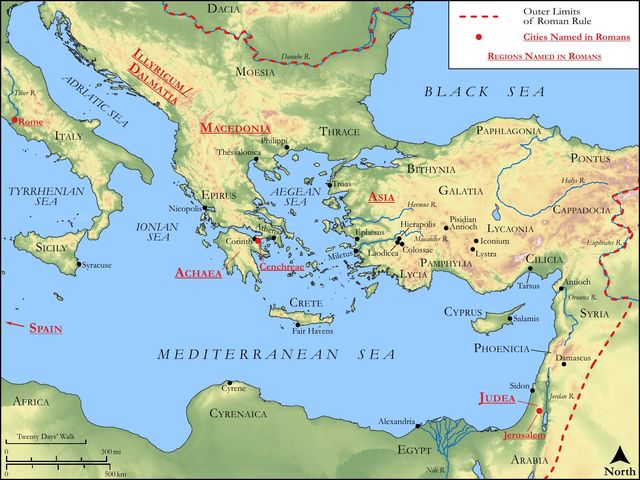
See on the biblical-era maps

Study this verse
Public-domain commentary
Matthew Henry
From his Commentary on the Whole Bible. Henry comments on passages, not single verses — this entry covers Romans 2:17–29. His three-level outline is real structure in the source text, so it is rendered as structure.
In the latter part of the chapter the apostle directs his discourse more closely to the Jews, and shows what sins they were guilty of, notwithstanding their profession and vain pretensions. He had said (Rom 2:13) that not the hearers but the doers of the law are justified; and he here applies that great truth to the Jews. Observe,
I.He allows their profession (Rom 2:17-20) and specifies their particular pretensions and privileges in which they prided themselves, that they might see he did not condemn them out of ignorance of what they had to say for themselves; no, he knew the best of their cause.
1.They were a peculiar people, separated and distinguished from all others by their having the written law and the special presence of God among them.
(1.)Thou art called a Jew; not so much in parentage as profession. It was a very honourable title. Salvation was of the Jews; and this they were very proud of, to be a people by themselves; and yet many that were so called were the vilest of men. It is no new thing for the worst practices to be shrouded under the best names, for many of the synagogue of Satan to say they are Jews (Rev 2:9), for a generation of vipers to boast they have Abraham to their father, Mat 3:7-9.
(2.)And restest in the law; that is, they took a pride in this, that they had the law among them, had it in their books, read it in their synagogues. They were mightily puffed up with this privilege, and thought this enough to bring them to heaven, though they did not live, up to the law. To rest in the law, with a rest of complacency and acquiescence, is good; but to rest in it with a rest of pride, and slothfulness, and carnal security, is the ruin of souls. The temple of the Lord, Jer 7:4. Bethel their confidence, Jer 48:13. Haughty because of the holy mountain, Zep 3:11. It is a dangerous thing to rest in external privileges, and not to improve them.
(3.)And makest thy boast of God. See how the best things may be perverted and abused. A believing, humble, thankful glorying in God, is the root and summary of all religion, Psa 34:2; Isa 45:15; Co1 1:31. But a proud vainglorious boasting in God, and in the outward profession of his name, is the root and summary of all hypocrisy. Spiritual pride is of all kinds of pride the most dangerous.
2.They were a knowing to people (Rom 2:18): and knowest his will, thelēma - the will. God's will is the will, the sovereign, absolute, irresistible will. The world will then, and not till then, be set to rights, when God's will is the only will, and all other wills are melted into it. They did not only know the truth of God, but the will of God, that which he would have them to do. It is possible for a hypocrite to have a great deal of knowledge in the will of God. - And approvest the things that are more excellent - dokimazeis ta diapheronta. Paul prays for it for his friends as a very great attainment, Phi 1:10. Eis to dokemazein humas ta diapheronta. Understand it,
(1.)Of a good apprehension in the things of God, reading it thus, Thou discernest things that differ, knowest how to distinguish between good and evil, to separate between the precious and the vile (Jer 15:19), to make a difference between the unclean and the clean, Lev 11:47. Good and bad lie sometimes so near together that it is not easy to distinguish them; but the Jews, having the touchstone of the law ready at hand, were, or at least thought they were, able to distinguish, to cleave the hair in doubtful cases. A man may be a good casuist and yet a bad Christian - accurate in the notion, but loose and careless in the application. Or, we may, with De Dieu, understand controversies by the ta diapheronta. A man may be well skilled in the controversies of religion, and yet a stranger to the power of godliness.
(2.)Of a warm affection to the things of God, as we read it, Approvest the things that are excellent. There are excellences in religion which a hypocrite may approve of: there may be a consent of the practical judgment to the law, that it is good, and yet that consent overpowerd by the lusts of the flesh, and of the mind: -
- Video meliora proboque
Deteriora sequor.
I see the better, but pursue the worse.
and it is common for sinners to make that approbation an excuse which is really a very great aggravation of a sinful course. They got this acquaintance with, and affection to, that which is good, but being instructed out of the law, katēchoumenos - being catechised. The word signifies an early instruction in childhood. It is a great privilege and advantage to be well catechised betimes. It was the custom of the Jews to take a great deal of pains in teaching their children when they were young, and all their lessons were out of the law; it were well if Christians were but as industrious to teach their children out of the gospel. Now this is called (Rom 2:20), The form of knowledge, and of the truth in the law, that is, the show and appearance of it. Those whose knowledge rests in an empty notion, and does not make an impression on their hearts, have only the form of it, like a picture well drawn and in good colours, but which wants life. A form of knowledge produces but a form of godliness, Ti2 3:5. A form of knowledge may deceive men, but cannot impose upon the piercing eye of the heart-searching God. A form may be the vehicle of the power; but he that takes up with that only is like sounding brass and a tinkling cymbal.
3.They were a teaching people, or at least thought themselves so (Rom 2:19, Rom 2:20): And art confident that thou thyself art a guide of the blind. Apply it,
(1.)To the Jews in general. They thought themselves guides to the poor blind Gentiles that sat in darkness, were very proud of this, that whoever would have the knowledge of God must be beholden to them for it. All other nations must come to school to them, to learn what is good, and what the Lord requires; for they had the lively oracles.
(2.)To their rabbis, and doctors, and leading men among them, who were especially those that judged others, Rom 2:1. These prided themselves much in the possession they had got of Moses's chair, and the deference which the vulgar paid to their dictates; and the apostle expresses this in several terms, a guide of the blind, a light of those who are in darkness, an instructor of the foolish, a teacher of babes, the better to set forth their proud conceit of themselves, and contempt of others. This was a string they loved to be harping upon, heaping up titles of honour upon themselves. The best work, when it is prided in, is unacceptable to God. It is good to instruct the foolish, and to teach the babes: but considering our own ignorance, and folly, and inability to make these teachings successful without God, there is nothing in it to be proud of.
II.He aggravates their provocations (Rom 2:21-24) from two things: -
1.That they sinned against their knowledge and profession, did that themselves which they taught others to avoid: Thou that teachest another, teachest thou not thyself? Teaching is a piece of that charity which begins at home, though it must not end there. It was the hypocrisy of the Pharisees that they did not do as they taught (Mat 23:3), but pulled down with their lives what they built up with their preaching; for who will believe those who do not believe themselves? Examples will govern more than rules. The greatest obstructors of the success of the word are those whose bad lives contradict their good doctrine, who in the pulpit preach so well that it is a pity they should ever come out, and out of the pulpit live so ill that it is a pity they should ever come in. He specifies three particular sins that abound among the Jews: - (1.) Stealing. This is charged upon some that declared God's statutes (Psa 50:16, Psa 50:18), When thou sawest a thief, then thou consentedst with him. The Pharisees are charged with devouring widows' houses (Mat 23:14), and that is the worst of robberies. (2.) Adultery, Rom 2:22. This is likewise charged upon that sinner (Psa 50:18), Thou hast been partaker with adulterers. Many of the Jewish rabbin are said to have been notorious for this sin. (3.) Sacrilege - robbing in holy things, which were then by special laws dedicated and devoted to God; and this is charged upon those that professed to abhor idols. So the Jews did remarkably, after their captivity in Babylon; that furnace separated them for ever from the dross of their idolatry, but they dealt very treacherously in the worship of God. It was in the latter days of the Old Testament church that they were charged with robbing God in tithes and offerings (Mal 3:8, Mal 3:9), converting that to their own use, and to the service of their lusts, which was, in a special manner, set apart for God. And this is almost equivalent to idolatry, though this sacrilege was cloaked with the abhorrence of idols. Those will be severely reckoned with another day who, while they condemn sin in others, do the same, or as bad, or worse, themselves.
2.That they dishonoured God by their sin, Rom 2:23, Rom 2:24. While God and his law were an honour to them, which they boasted of and prided themselves in, they were a dishonour to God and his law, by giving occasion to those that were without to reflect upon their religion, as if that did countenance and allow of such things, which, as it is their sin who draw such inferences (for the faults of professors are not to be laid upon professions), so it is their sin who give occasion for those inferences, and will greatly aggravate their miscarriages. This was the condemnation in David's case, that he had given great occasion to the enemies of the Lord to blaspheme, Sa2 12:14. And the apostle here refers to the same charge against their forefathers: As it is written, Rom 2:24. He does not mention the place, because he wrote this to those that were instructed in the law (in labouring to convince, it is some advantage to deal with those that have knowledge and are acquainted with the scripture), but he seems to point at Isa 52:5; Eze 36:22, Eze 36:23; and Sa2 12:14. It is a lamentation that those who were made to be to God for a name and for a praise should be to him a shame and dishonour. The great evil of the sins of professors is the dishonour done to God and religion by their profession. "Blasphemed through you; that is, you give the occasion for it, it is through your folly and carelessness. The reproaches you bring upon yourselves reflect upon your God, and religion is wounded through your sides." A good caution to professors to walk circumspectly. See Ti1 6:1.
III.He asserts the utter insufficiency of their profession to clear them from the guilt of these provocations (Rom 2:25-29):
Circumcision verily profiteth, if thou keep the law; that is, obedient Jews shall not lose the reward of their obedience, but will gain this by their being Jews, that they have a clearer rule of obedience than the Gentiles have. God did not give the law nor appoint circumcision in vain. This must be referred to the state of the Jews before the ceremonial polity was abolished, otherwise circumcision to one that professed faith in Christ was forbidden, Gal 5:1. But he is here speaking to the Jews, whose Judaism would benefit them, if they would but live up to the rules and laws of it; but if not "thy circumcision is made uncircumcision; that is, thy profession will do thee no good; thou wilt be no more justified than the uncircumcised Gentiles, but more condemned for sinning against greater light." The uncircumcised are in scripture branded as unclean (Isa 52:1), as out of the covenant, (Eph 2:11, Eph 2:12) and wicked Jews will be dealt with as such. See Jer 9:25, Jer 9:26. Further to illustrate this,
1.He shows that the uncircumcised Gentiles, if they live up to the light they have, stand upon the same level with the Jews; if they keep the righteousness of the law (Rom 2:26), fulfil the law (Rom 2:27); that is, by submitting sincerely to the conduct of natural light, perform the matter of the law. Some understand it as putting the case of a perfect obedience to the law: "If the Gentiles could perfectly keep the law, they would be justified by it as well as the Jews." But it seems rather to be meant of such an obedience as some of the Gentiles did attain to. The case of Cornelius will clear it. Though he was a Gentile, and uncircumcised, yet, being a devout man, and one that feared God with all his house (Act 10:2), he was accepted, Rom 2:4. Doubtless, there were many such instances: and they were the uncircumcision, that kept the righteousness of the law; and of such he says,
(1.)That they were accepted with God, as if they had been circumcised. Their uncircumcision was counted for circumcision. Circumcision was indeed to the Jews a commanded duty, but it was not to all the world a necessary condition of justification and salvation.
(2.)That their obedience was a great aggravation of the disobedience of the Jews, who had the letter of the law, Rom 2:27. Judge thee, that is, help to add to thy condemnation, who by the letter and circumcision dost transgress. Observe, To carnal professors the law is but the letter; they read it as a bare writing, but are not ruled by it as a law. They did transgress, not only notwithstanding the letter and circumcision, but by it, that is, they thereby hardened themselves in sin. External privileges, if they do not do us good, do us hurt. The obedience of those that enjoy less means, and make a less profession, will help to condemn those that enjoy greater means, and make a greater profession, but do not live up to it.
2.He describes the true circumcision, Rom 2:28, Rom 2:29.
(1.)It is not that which is outward in the flesh and in the letter. This is not to drive us off from the observance of external institutions (they are good in their place), but from trusting to them and resting in them as sufficient to bring us to heaven, taking up with a name to live, without being alive indeed. He is not a Jew, that is, shall not be accepted of God as the seed of believing Abraham, nor owned as having answered the intention of the law. To be Abraham's children is to do the works of Abraham, Joh 8:39, Joh 8:40.
(2.)It is that which is inward, of the heart, and in the spirit. It is the heart that God looks at, the circumcising of the heart that renders us acceptable to him. See Deu 30:6. This is the circumcision that is not made with hands, Col 2:11, Col 2:12. Casting away the body of sin. So it is in the spirit, in our spirit as the subject, and wrought by God's Spirit as the author of it.
(3.)The praise thereof, though it be not of men, who judge according to outward appearance, yet it is of God, that is, God himself will own and accept and crown this sincerity; for he seeth not as man seeth. Fair pretences and a plausible profession may deceive men: but God cannot be so deceived; he sees through shows to realities. This is alike true of Christianity. He is not a Christian that is one outwardly, nor is that baptism which is outward in the flesh; but he is a Christian that is one inwardly, and baptism is that of the heart, in the spirit, and not in the letter, whose praise is not of men but of God.
Historical interpretation
Historical reception
2 surviving comments on this verse. Each one is dated, so this reads as a timeline rather than a list.
Select a marker to jump to its quote. Markers stagger vertically where authors wrote within a few decades of each other.
"And art confident that thou thyself." Here again he does not say that thou art "a guide of the blind," but "thou art confident," so thou boastest, he says. So great was the unreasonableness of the Jews. Wherefore he also repeats nearly the very words, which they used in their boastings. See for instance what they say in the Gospels. "Thou wast altogether born in sin, and dost thou teach us?" (John ix. 34.) And all men they utterly looked down upon, to convince them of which, Paul keeps extolling them and lowering the others, that so he may get more hold on them, and make his accusation the weightier. Wherefore he goes on adding the like things, and making more of them by different ways of relating them. For "Thou art confident," he saith, "that thou thyself art a leader of the blind, An instructor of the foolish, a teacher of babes, which hast the form of knowledge and truth, which is in the Law." Here again he says not, in the conscience and in actions and in well-doings, but "in the Law;" and after saying so, he does here also what he did with regard to the Gentiles. For as there he says, "for wherein thou judgest another, thou condemnest thyself," so saith he here also.
The blind are those who have been deprived of the light of knowledge.
Continue studying Romans 2:19 across the web’s major study libraries — every link below opens this exact verse, chapter, or book on the destination site.
Read & Compare
 BibleGatewayThis verse in more than 200 translations and 70 languages.
 Bible.comThe YouVersion reader — hundreds of translations, reading plans, and highlights.
 ESV.orgCrossway's official English Standard Version reader.
 NET BibleThe NET translation with 60,000+ translators' notes on every rendering decision.
 STEP BibleTyndale House's free study tool — original text, vocabulary, and scholarly resources.
 BibliaLogos Bible Software's free web reader.
 USCCBThe New American Bible (Revised Edition) with the U.S. bishops' study notes.
Commentaries
 BibleHub CommentariesDozens of classic commentaries on this verse, gathered on one page.
 StudyLightMore than 100 commentary sets — the largest collection on the web.
 BibleRefPlain-English commentary on what this verse means, verse by verse.
 Enduring WordDavid Guzik's free commentary on this chapter, widely used by Bible teachers.
 Bible Study ToolsVerse commentary alongside Greek and Hebrew study aids.
Original Language & Research
- BibleHub InterlinearThe verse word by word — original language, transliteration, and English.
- BibleHub LexiconEvery word's original-language definition and Strong's entry.
 Blue Letter BibleDeep-study tools — Strong's numbers, concordance, and word studies.
 CNTR CollationThe earliest Greek manuscripts of this verse, collated letter by letter.
Sermons, Hymns & Audio


TrulyRandomVerse is not affiliated with these sites and doesn’t control their content. They’re linked because they’re genuinely useful.
Summary
Romans 2:19 is a pivotal verse in Paul's argument, exposing the self-assured confidence of those (primarily Jewish people) who possessed God's Law, believing themselves uniquely qualified as spiritual guides and illuminators for those without divine revelation. Paul highlights their perception of their elevated status and responsibility, setting the stage for his subsequent critique of their hypocrisy and the universal need for God's righteousness, which transcends mere knowledge of the Law.
Context
ShowHideLiterary Context
This verse is deeply embedded within Paul's broader theological argument in Romans 1-3, where he systematically demonstrates the universal sinfulness of humanity—both Gentiles (who suppress the truth of God revealed in creation, as discussed in Romans 1:18-32) and Jews. In Romans 2, Paul turns his attention to those who judge others, particularly those who boast in the Law but fail to live by it. Verses Romans 2:17-18 establish the Jewish person's reliance on the Law and their pride in their relationship with God. Verse 19 continues this thought, detailing the specific roles—"guide of the blind" and "light of them which are in darkness"—that they confidently ascribed to themselves, implicitly by virtue of possessing the Torah. This sets up the dramatic reveal in Romans 2:21-24, where Paul exposes the stark contradiction between their claims and their conduct.
Historical & Cultural Context
In the first century, Jewish identity was profoundly shaped by the possession of the Torah, which was understood as God's unique revelation to Israel. This gave rise to a strong sense of spiritual superiority over Gentiles, who were considered "without the Law" and therefore "blind" or "in darkness." Synagogues served as centers of instruction, and rabbis and teachers (scribes, Pharisees) were indeed seen as guides and lights, interpreting and applying the Law. This verse reflects the prevailing self-perception within segments of the Jewish community, where the mere possession of the Law, and the perceived ability to teach it, was a source of immense pride and confidence. It highlights the cultural reality of a distinct religious group who believed they held the exclusive key to divine truth, and thus, a responsibility to enlighten the world.
Key Themes
ShowHideRomans 2:19 contributes to several overarching themes in Paul's letter. It underscores the theme of spiritual confidence or arrogance, where one's status or knowledge of the Law becomes a basis for self-righteousness rather than humble obedience. It also touches upon the responsibility of knowledge, implying that possessing divine truth carries a weighty obligation to live consistently with it and genuinely share it. The descriptions of "the blind" and "them which are in darkness" highlight the perceived spiritual state of others (Gentiles) and the presumed necessity of Jewish guidance. Most significantly, this verse serves as a crucial setup for the theme of hypocrisy, which Paul explicitly addresses in the subsequent verses. The claims made in Romans 2:19-20 are starkly contrasted with the failures detailed in Romans 2:21-24, revealing that mere intellectual assent to or possession of the Law is insufficient for true righteousness before God. This ultimately leads to Paul's broader argument that true circumcision is of the heart, not merely external, as articulated in Romans 2:28-29.
Exposition and Analysis
ShowHideKey Word Analysis
ShowHideFrom the verb meaning "to convince," "to persuade," or "to trust." Here, in the passive or reflexive sense, it conveys "to assent (to evidence or authority)," or "to rely (by inward certainty)." This indicates a strong, internal conviction or assurance regarding their own capabilities and status. It's not merely an external claim but a deep-seated belief in their own spiritual competence and authority.
Derived from "way" (hodos) and "to lead" (hēgeomai), this noun literally means "a conductor" or "one who leads the way." Figuratively, it denotes a "teacher" or "leader." This word emphasizes the active role they believed they played in directing others, implying a position of authority and instruction in spiritual matters.
This term signifies "luminousness" in its broadest application—natural or artificial, abstract or concrete, literal or figurative. In biblical contexts, "light" often represents divine truth, knowledge, understanding, and salvation, contrasting sharply with spiritual "darkness" (ignorance, sin, separation from God). To claim to be a "light" implies being a source or embodiment of divine revelation and enlightenment for others.
Verse Breakdown
ShowHide"And art confident that thou thyself art"
This opening phrase establishes the internal conviction and self-perception of the individual being addressed. The "thou thyself" (G4572, seautoû) emphasizes the personal, almost boastful, nature of this confidence. It highlights a self-assessment of their spiritual standing and role, rather than a divinely appointed or externally validated one.
"a guide of the blind"
This clause describes the first of two roles the individual confidently assumes. "The blind" (G5185, typhlós) refers to those who are spiritually ignorant or unable to discern divine truth, lacking the revelation of God's Law. The self-proclaimed "guide" (G3595, hodēgós) believes they possess the necessary knowledge and insight to lead such individuals out of their spiritual darkness.
"a light of them which are in darkness"
This second clause reiterates and amplifies the previous one, using a powerful metaphor. "Darkness" (G4655, skótos) represents spiritual obscurity, sin, and separation from God's truth. The "light" (G5457, phōs) claims to illuminate this darkness, bringing understanding and revelation. Together, these two phrases paint a picture of someone who sees themselves as indispensable for the spiritual welfare of others, possessing a unique and superior access to divine truth.
Literary Devices
ShowHidePaul employs several literary devices in Romans 2:19. The most prominent is Metaphor, as seen in "guide of the blind" and "light of them which are in darkness." These vivid images are not literal but represent spiritual states and roles. "Blindness" and "darkness" are metaphors for spiritual ignorance, sin, and lack of divine revelation, while "guide" and "light" metaphorically describe the self-perceived role of the Law-keeper as a source of truth and direction. There is also an implied Irony that permeates this passage, which becomes fully evident in the subsequent verses (Romans 2:21-24). The irony lies in the stark contrast between the lofty claims of being a guide and light, and the actual behavior of those making such claims, which often contradicted the very Law they professed to teach. This sets up a profound Juxtaposition between self-perception and reality, highlighting the hypocrisy that Paul is intent on exposing.
Theological and Thematic Connections
ShowHideRomans 2:19 serves as a powerful theological statement about the dangers of spiritual pride and the inadequacy of mere intellectual knowledge or religious status. It challenges the notion that possessing divine revelation automatically confers righteousness or the right to judge others. Theologically, Paul is dismantling the idea of an ethnic or religious privilege that exempts one from God's impartial judgment. The confidence described is rooted in human achievement (knowing the Law) rather than divine grace or genuine transformation. This verse underscores that true spiritual guidance and illumination come not from external adherence or self-proclaimed authority, but from an internal, living relationship with God that manifests in righteous conduct. It sets the stage for Paul's argument that all humanity, regardless of their religious background, stands equally in need of God's saving grace through faith, rather than relying on their own perceived ability to guide or enlighten.
Reflection and Application
ShowHideRomans 2:19 offers a timeless mirror for self-examination, challenging us to scrutinize the foundations of our spiritual confidence. It warns against the subtle, yet pervasive, temptation to rely on our knowledge of scripture, theological understanding, or religious affiliation as a source of superiority or justification. Are we, like those Paul addresses, quick to identify the "blindness" or "darkness" in others, while overlooking our own inconsistencies and failures to live out the truth we claim to possess? This verse calls us to humility, reminding us that true spiritual authority and effectiveness stem not from what we know, but from how authentically we live and how genuinely we point others to the ultimate source of light. Our confidence should never be in our own ability to guide or enlighten, but solely in God's grace and transforming power. It compels us to ask if our lives genuinely reflect the light we profess to carry, or if we are merely "blind guides" leading others, and ourselves, astray by our hypocrisy.
Questions for Reflection
ShowHideFAQ
ShowHideWho is Paul primarily addressing in Romans 2:19, and does it apply to Christians today?
ShowHideWhile Paul's immediate audience in Romans 2 is primarily the Jewish people who boasted in their possession of the Law, the principles articulated are universal. Paul is critiquing a mindset where religious privilege or knowledge leads to self-righteousness and hypocrisy. Therefore, the warning in Romans 2:19 applies equally to Christians today who might rely on their theological understanding, church affiliation, or moral uprightness as a basis for judging others or for their own salvation, rather than on the grace of God through faith in Christ. It serves as a perennial caution against spiritual pride in any form.
What does it mean to be "a guide of the blind" and "a light of them which are in darkness" in a spiritual sense?
ShowHideIn a spiritual sense, "the blind" and "them which are in darkness" refer to individuals who lack spiritual understanding, are ignorant of God's truth, or are enslaved by sin. This state is often contrasted with the light of divine revelation (the Law in the Old Testament, and ultimately Christ in the New Testament). To be "a guide of the blind" or "a light of them which are in darkness" implies possessing divine truth and the ability to interpret and teach it, thereby leading others out of spiritual ignorance and into the light of God's knowledge and righteousness. It signifies a role of spiritual leadership, instruction, and moral example.
Christ-Centered Fulfillment
ShowHideRomans 2:19, while exposing the flawed self-confidence of those who relied on the Law, ultimately points to the profound necessity of Christ. The "guide" and "light" that humanity truly needs is not found in human knowledge or religious status, but in Jesus Christ Himself. He is the true light of the world, who illuminates every person and exposes the darkness of sin and spiritual ignorance. Unlike the "blind guides" condemned by Jesus in Matthew 23:24, Christ perfectly embodies the truth He proclaims, living a life of perfect obedience and offering Himself as the ultimate sacrifice. He is the Way, the Truth, and the Life, the only true guide who can lead humanity out of the darkness of sin and into the light of God's presence. Through His death and resurrection, He provides the righteousness that the Law could only expose the lack of, fulfilling the Law's demands and offering a new covenant where God's Spirit writes His laws on our hearts, enabling us to truly be lights in the world, not by our own boastful confidence, but by reflecting His glory (Matthew 5:14-16).