


Jeremiah 9:26
Bible text: King James Version (1769 Blayney text) · Public domain
Bible text: King James Version with Strong's numbers · Public domain
Bible text: Berean Standard Bible · Public domain
Bible text: American Standard Version (1901) · Public domain
Bible text: World English Bible, Messianic edition · Public domain
Bible text: Geneva Bible (1599) · Public domain
Bible text: Young's Literal Translation · Public domain
- עַל'alonH5921PrepPreposition
- מִצְרַיִםmitz·Ra·yimEgyptH4714N-properNoun Proper Location
- וְעַלve·'aland onH5921Conj-w ¦ PrepPrepositionוְandעַלon
- יְהוּדָהye·hu·DahJudahH3063N-properNoun Proper Location
- וְעַלve·'aland onH5921Conj-w ¦ PrepPrepositionוְandעַלon
- אֱדוֹם'e·DomEdomH123N-proper-mNoun Proper Masculine
- וְעַלve·'aland onH5921Conj-w ¦ PrepPrepositionוְandעַלon
- בְּנֵיbe·Nei[the] people ofH1121N-mpcNoun Plural Masculine Construct
- עַמּוֹן'a·mOnAmmonH5983N-proper-mNoun Proper Masculine
- וְעַלve·'aland onH5921Conj-w ¦ PrepPrepositionוְandעַלon
- מוֹאָבmo·'AvMoabH4124N-properNoun Proper Location
- וְעַלve·'Aland onH5921Conj-w ¦ PrepPrepositionוְandעַלon
- כָּלkolallH3605N-mscNoun Singular Masculine Construct
- קְצוּצֵיke·tzu·Tzei[those who] are cut off ofH7112V-Qal-PassPrtcpl-mpVerb Qal Participle Passive Plural Masculine Construct
- פֵאָהfe·'Ah[the] cornerH6285N-fsNoun Singular Feminine Absolute
- הַיֹּשְׁבִיםhai·yo·she·Vimwho dwellH3427Art ¦ V-Qal-Prtcpl-mpVerb Qal Participle Plural Masculine Absoluteהַwhoיֹּשְׁבִיםdwell
- בַּמִּדְבָּרba·mid·Barin the wildernessH4057Prep-b ¦ N-msNoun Singular Masculine Absoluteבַּin theמִּדְבָּרwilderness
- כִּיkiforH3588PrtParticle Conditional
- כָלkholallH3605N-mscNoun Singular Masculine Construct
- הַגּוֹיִםha·go·Yimthe nationsH1471Art ¦ N-mpNoun Plural Masculine Absoluteהַtheגּוֹיִםnations
- עֲרֵלִים'a·re·Lim[are] uncircumcisedH6189Adj-mpAdjective Plural Masculine Absolute
- וְכָלve·kholand allH3605Conj-w ¦ N-mscNoun Singular Masculine Constructוְandכָלall
- בֵּיתbeit[the] house ofH1004N-mscNoun Singular Masculine Construct
- יִשְׂרָאֵלYis·ra·'ElIsraelH3478N-properNoun Proper Location
- עַרְלֵי'ar·lei[are] uncircumcised ofH6189Adj-mpcAdjective Plural Masculine Construct
- לֵבLevheartH3820N-msNoun Singular Masculine Absolute
English is a literal word-by-word gloss of the Hebrew, not the KJV's wording. Why?
This is the original text the KJV's translators worked from — each Hebrew word with its own literal English meaning in this verse, prepared by scholars at Tyndale House, Cambridge. The KJV translates whole sentences, not word by word, so its wording differs: one Hebrew word can become several English words, and the KJV may choose “the LORD” where the gloss reads “Yahweh”. Both are faithful — they answer different questions. For the KJV's own rendering, switch to the KJV text.
Details
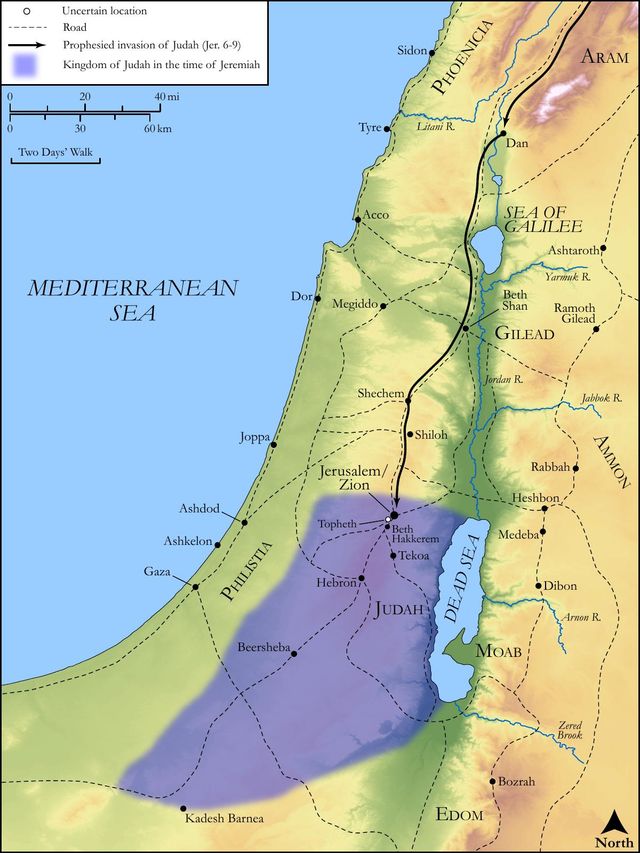
See on the biblical-era map
Study this verse
Public-domain commentary
Matthew Henry
From his Commentary on the Whole Bible. Henry comments on passages, not single verses — this entry covers Jeremiah 9:23–26. His three-level outline is real structure in the source text, so it is rendered as structure.
The prophet had been endeavouring to possess this people with a holy fear of God and his judgments, to convince them both of sin and wrath; but still they had recourse to some sorry subterfuge or other, under which to shelter themselves from the conviction and with which to excuse themselves in the obstinacy and carelessness. He therefore sets himself here to drive them from these refuges of lies and to show them the insufficiency of them.
I.When they were told how inevitable the judgment would be they pleaded the defence of their politics and powers, which, with the help of their wealth and treasure, they thought made their city impregnable. In answer to this he shows them the folly of trusting to and boasting of all these stays, while they have not a God in covenant to stay themselves upon, Jer 9:23, Jer 9:24. Here he shows,
1.What we may not depend upon in a day of distress: Let not the wise man glory in his wisdom, as if with the help of that he could outwit or countermine the enemy, or in the greatest extremity find out some evasion or other; for a man's wisdom may fail him when he needs it most, and he may fail him when he needs it most, and he may be taken in his own craftiness. Ahithophel was befooled, and counsellors are often led away spoiled. But, if a man's policies fail him, yet surely he may gain his point by might and dint of courage. No: Let not the strong man glory in his strength, for the battle is not always to the strong. David the stripling proves too hard for Goliath the giant. All human force is nothing without God, worse than nothing against him. But may not the rich man's wealth be his strong city? (money answers all things) No: Let not the rich man glory in his riches, for they may prove so far from sheltering him that they may expose him and make him the fairer mark. Let not the people boast of the wise men, and mighty men, and rich men that they have among them, as if they could make their part good against the Chaldeans because they have wise men to advise concerning the war, mighty men to fight their battles, and rich men to bear the charges of the war. Let not particular persons think to escape the common calamity by their wisdom, might, or money; for all these will prove but vain things for safety.
2.He shows what we may depend upon in a day of distress.
(1.)Our only comfort in trouble will be that we have done our duty. Those that refused to know God (Jer 9:6) will boast in vain of their wisdom and wealth; but those that know God, intelligently, that understand aright that he is the Lord, that have not only right apprehensions concerning his nature, and attributes, and relations to man, but receive and retain the impressions of them, may glory in this it will be their rejoicing in the day of evil.
(2.)Our only confidence in trouble will be that, having through grace in some measure done our duty, we shall find God a God all-sufficient to us. We may glory in this, that, wherever we are, we have an acquaintance with an interest in a God that exercises lovingkindness, and judgment, and righteousness in the earth, that is not only just to all his creatures and will do no wrong to any of them, but kind to all his children and will protect them and provide for them. For in these things I delight. God delights to show kindness and to execute judgment himself, and is pleased with those who herein are followers of him as dear children. Those that have such knowledge of the glory of God as to be changed into the same image, and to partake of his holiness, find it to be their perfection and glory; and the God they thus faithfully conform to they may cheerfully confide in, in their greatest straits. But the prophet intimates that the generality of this people took no care about this. Their wisdom, and might, and riches, were their joy and hope, which would end in grief and despair. But those few among them that had the knowledge of God might please themselves with it, and boast themselves of it; it would stand them in better stead than thousands of gold and silver.
II.When they were told how provoking their sins were to God they vainly pleaded the covenant of their circumcision.
They were undoubtedly the people of God; as they had the temple of the Lord in their city, so they had the mark of his children in their flesh. "It is true that Chaldean army has laid such and such nations waste, because they were uncircumcised, and therefore not under the protection of the divine providence, as we are." To this the prophet answers, That the days of visitation were now at hand, in which God would punish all wicked people, without making any distinction between the circumcised and uncircumcised, Jer 9:25, Jer 9:26. They had by sin profaned the crown of their peculiarity, and lived in common with the uncircumcised nations, and so had forfeited the benefit of that peculiarity and must expect to fare never the better for it. God will punish the circumcised with the uncircumcised. As the ignorance of the uncircumcised shall not excuse their wickedness, so neither shall the privileges of the circumcised excuse theirs, but they shall be punished together. Note, The Judge of all the earth is impartial, and none shall fare the better at his bar for any external advantages, but he will render to every man, circumcised or uncircumcised, according to his works. The condemnation of impenitent sinners that are baptized will be as sure as, nay, and more severe than, that of impenitent sinners that are unbaptized. It would affect one to find here Judah industriously put between Egypt and Edom, as standing upon a level with them and under the same doom, Jer 9:26. These nations were forbidden a share in the Jews' privileges (Deu 23:3); but the Jews are here told that they shall share in their punishments. Those in the utmost corners, that dwell in the wilderness, are supposed to be the Kedarenes and those of the kingdoms of Hazor, as appears by comparing Jer 49:28-32. Some think they are so called because they dwelt as it were in a corner of the world, others because they had the hair of their head polled into corners. However that was, they were of those nations that were uncircumcised in flesh, and the Jews are ranked with them and are as near to ruin for their sins as they; for all the house of Israel are uncircumcised in the heart: they have the sign, but not the thing signified, Jer 4:4. They are heathens in their hearts, strangers to God, and enemies in their minds by wicked works. Their hearts are disposed to idols, as the hearts of the uncircumcised Gentiles are. Note, The seals of the covenant, though they dignify us, and lay us under obligations, will not save us, unless the temper of our minds and the tenour of our lives agree with the covenant. That only is circumcision, and that baptism, which is of the heart, Rom 2:28, Rom 2:29.
Historical interpretation
Two Centuries of Reception
3 surviving comments on this verse. Each one is dated, so this reads as a timeline rather than a list.
Select a marker to jump to its quote. Markers stagger vertically where authors wrote within a few decades of each other.
The novelty of the expression may perhaps deter not only the Jews but even some of our brothers. For Paul, who introduces "circumcision of the heart," seems to assume things that are impossible. For how shall it be possible that a member be circumcised that, covered by the internal viscera, lies hidden even from the view of people? Let us return, therefore, to the words of the prophets that, with the aid of your prayers, these matters about which we are inquiring might become clear. Ezekiel the prophet says, "No stranger uncircumcised in heart and uncircumcised in flesh shall enter my sanctuary." Likewise elsewhere no less the prophet, reproaching, says, "All strangers are uncircumcised in the flesh, but the sons of Israel are uncircumcised in the heart." It is pointed out, therefore, that unless one has been circumcised in the heart and the flesh, "he shall not enter the sanctuary" of God.
(Vers. 25, 26.) Behold, the days are coming, says the Lord, when I will visit everyone who is circumcised and has the foreskin, including Egypt, Judah, Edom, the Ammonites, the Moabites, and all those who have shaved their heads and live in the desert, for all the nations are uncircumcised. But the house of Israel is uncircumcised in heart. Many of the nations, especially those bordering Judea and Palestine, still practice circumcision to this day, particularly the Egyptians, Edomites, Ammonites, Moabites, and all the region of the Saracens who dwell in the wilderness and are said to have shaved heads and live in the desert. Therefore, Judah, who is mixed with the aforementioned Gentiles, should not boast, because he does not have foreskin, but is circumcised according to God's law. For there are others who do these things and do not keep the commandments of the law, and they are ignorant of the God of Israel. Circumcision does not profit, which is given as a sign, unless the commandments of the Lord are fulfilled; just as the hair, which signifies a nation, does not provide strength of body and the might of warriors. And what follows: All nations have foreskin, but all the house of Israel is uncircumcised in heart. This has the meaning that, except for the Egyptians, Edomites, Ammonites, and Moabites, and the Ishmaelites who dwell in the wilderness, most of whom are circumcised, all other nations throughout the world are uncircumcised in flesh; but the whole house of Israel is uncircumcised in heart, not in flesh; and this uncircumcision leads to death. For that is the flesh, this is the spirit.
The ancient Scriptures therefore teach the benefit of spiritual circumcision and that bodily circumcision makes no difference. For it is not the Gentiles who are accused of being uncircumcised but the Jews, who were physically circumcised but whose heart was uncircumcised.
Continue studying Jeremiah 9:26 across the web’s major study libraries — every link below opens this exact verse, chapter, or book on the destination site.
Read & Compare
 BibleGatewayThis verse in more than 200 translations and 70 languages.
 Bible.comThe YouVersion reader — hundreds of translations, reading plans, and highlights.
 ESV.orgCrossway's official English Standard Version reader.
 NET BibleThe NET translation with 60,000+ translators' notes on every rendering decision.
 STEP BibleTyndale House's free study tool — original text, vocabulary, and scholarly resources.
 BibliaLogos Bible Software's free web reader.
 USCCBThe New American Bible (Revised Edition) with the U.S. bishops' study notes.
Commentaries
 BibleHub CommentariesDozens of classic commentaries on this verse, gathered on one page.
 StudyLightMore than 100 commentary sets — the largest collection on the web.
 BibleRefPlain-English commentary on what this verse means, verse by verse.
 Enduring WordDavid Guzik's free commentary on this chapter, widely used by Bible teachers.
 Bible Study ToolsVerse commentary alongside Greek and Hebrew study aids.
Original Language & Research
- BibleHub InterlinearThe verse word by word — original language, transliteration, and English.
- BibleHub LexiconEvery word's original-language definition and Strong's entry.
 Blue Letter BibleDeep-study tools — Strong's numbers, concordance, and word studies.
 SefariaThe Hebrew text with Rashi and centuries of Jewish commentary.
Sermons, Hymns & Audio


TrulyRandomVerse is not affiliated with these sites and doesn’t control their content. They’re linked because they’re genuinely useful.
Summary
Jeremiah 9:26 delivers a profound and unsettling prophetic declaration of impending divine judgment, encompassing not only physically uncircumcised foreign nations but, most critically, the nation of Judah. The verse underscores a foundational theological truth: God's ultimate criterion for judgment is not outward ritual or ethnic identity, but the inward spiritual condition of the heart. While surrounding peoples are condemned for their lack of covenant sign, Israel faces an even more severe indictment for their spiritual uncircumcision, signifying a hardened, rebellious heart unresponsive to God's covenant demands and ultimately rendering their external observances meaningless.
Context
ShowHideLiterary Context
Jeremiah 9:26 serves as the climactic conclusion to a significant theological section (verses 23-26) that contrasts true glory with false glory. Verses 23-24 famously declare that wisdom, might, and riches are not grounds for boasting, but rather a profound knowledge and understanding of the Lord, who exercises steadfast love, justice, and righteousness on earth. This sets a crucial ethical and theological framework for the subsequent judgment, implying that those who boast in external markers, worldly achievements, or even superficial religious identity, rather than in a true, intimate relationship with God, will face severe consequences. The preceding verse, Jeremiah 9:25, introduces the paradoxical theme of God's impending visitation upon those "circumcised in their uncircumcision," a phrase hinting at the superficiality and spiritual emptiness of their covenant sign. Thus, verse 26 functions as the definitive explanation, revealing that Israel's outward sign of covenant did not guarantee inward faithfulness, tragically placing them on par with, or even below, the pagan nations in God's discerning sight due to their profound spiritual rebellion.
Historical & Cultural Context
The prophet Jeremiah ministered during the tumultuous late 7th and early 6th centuries BCE, a period marked by the decline of Assyrian power, the rise of Babylon, and the spiritual decay of the Kingdom of Judah, ultimately culminating in the Babylonian exile. Circumcision was the foundational sign of the Abrahamic covenant, established in Genesis 17:9-14, distinguishing Israel as God's chosen people and symbolizing their unique relationship with Him. While some surrounding nations, like the Egyptians, practiced forms of circumcision, it did not carry the same theological weight or covenantal significance as it did for Israel. For Judah, it was a unique marker of their identity and their participation in God's covenant promises. However, by Jeremiah's time, this physical sign had tragically become a source of false security and spiritual complacency. The people erroneously believed their status as God's chosen, marked by circumcision and possessing the Temple, would automatically shield them from divine judgment—a dangerous delusion Jeremiah vehemently challenged throughout his prophetic ministry, most notably in his powerful Temple Sermon in Jeremiah 7.
Key Themes
ShowHideThe central theme in Jeremiah 9 and particularly in verse 26 is the stark distinction between outward religious practice and inward spiritual reality. God's judgment is not based solely on external rituals or ethnic identity, but on the true condition of the heart. The verse highlights universal accountability, demonstrating God's sovereignty and coming judgment over all peoples, regardless of their cultural or religious practices. By listing various nations alongside Judah, it underscores that all are held accountable for their spiritual state before the righteous God. Furthermore, it exposes the profound hypocrisy and false security prevalent in Judah. Despite their physical circumcision and esteemed status as God's covenant people, their hearts were hardened and unresponsive to God's commands, making them spiritually akin to the uncircumcised nations they often disdained. This crucial concept of "circumcision of the heart" was not new, having been commanded and anticipated in the Pentateuch (e.g., Deuteronomy 10:16 and Deuteronomy 30:6).
Exposition and Analysis
ShowHideKey Word Analysis
ShowHideThis term, derived from a root meaning "exposed" or "projecting loose," technically refers to the state of having the prepuce uncurtailed. However, in Jeremiah 9:26, its application to the "heart" is profoundly metaphorical. When applied in this spiritual sense, it signifies a condition of being closed off, unresponsive, dull, and rebellious to God's voice and will. It implies an inability or unwillingness to receive divine instruction or to enter into a true, intimate, and yielding relationship with the Lord. It describes a state of spiritual insensitivity, akin to a barrier that prevents full access or reception of divine truth and grace.
This word is used very widely in Hebrew thought, extending far beyond merely the seat of emotions. It encompasses the entire inner person—feelings, will, intellect, and the very core of one's being. It is the center of thought, decision-making, moral character, and spiritual vitality. To be "uncircumcised in the heart" means that the deepest essence of Israel's being—their will, understanding, affections, and moral compass—was unyielded, hardened, and resistant to God, rendering their outward religious observances a hollow shell. It speaks to a fundamental spiritual defect at the very core of their existence.
Verse Breakdown
ShowHide"Egypt, and Judah, and Edom, and the children of Ammon, and Moab, and all [that are] in the utmost corners, that dwell in the wilderness:"
This initial clause presents a comprehensive and deliberately shocking list of nations and peoples facing God's impending judgment. It includes Egypt (H4714 Mitsrayim), a powerful ancient empire with a long history of interaction with Israel; Edom (H123 ʼĔdôm), Ammon (H5983 ʻAmmôwn), and Moab (H4124 Môwʼâb), traditional enemies and distant relatives of Israel. The phrase "all [that are] in the utmost corners (H7112 qâtsats, H6285 pêʼâh), that dwell (H3427 yâshab) in the wilderness (H4057 midbâr)" likely refers to nomadic or semi-nomadic tribes on the fringes of settled lands, possibly those with distinctive haircuts or customs associated with their nomadic lifestyle. The inclusion of Judah (H3063 Yᵉhûwdâh), God's covenant people, within this list of pagan nations is profoundly shocking and intentional, setting the stage for the crucial distinction and indictment that follows.
"for all [these] nations [are] uncircumcised,"
This sub-clause explains the basis of judgment for the listed foreign nations: their physical uncircumcision (H6189 ʻârêl). For Israel, this was the definitive mark of their Gentile status, signifying their lack of covenant relationship with the true God. While some of these nations might have practiced forms of circumcision for cultural or hygienic reasons, the prophetic declaration here emphasizes their spiritual distinction from Israel's unique covenant identity and their consequent accountability before God.
"and all the house of Israel [are] uncircumcised in the heart."
This is the climactic and most damning indictment of the verse. Despite their physical circumcision, "all the house (H1004 bayith) of Israel (H3478 Yisrâʼêl)" (representing the entire nation, particularly Judah at this time) is declared "uncircumcised (H6189 ʻârêl) in the heart (H3820 lêb)." This powerful metaphor signifies that their inner being—their will, affections, intellect, and moral core—was hardened, rebellious, and closed off to God's commands and covenant truth. Their outward religious practice was a hollow shell, lacking genuine inward devotion and obedience, rendering them spiritually indistinguishable from, or even worse than, the physically uncircumcised nations, as their rebellion was against a covenant they had explicitly entered.
Literary Devices
ShowHideJeremiah 9:26 masterfully employs several literary devices to convey its powerful and convicting message. Juxtaposition is central to the verse's impact, as it explicitly places Judah, God's chosen covenant people, alongside pagan nations like Egypt, Edom, Ammon, and Moab. This shocking alignment highlights the severity of Judah's spiritual condition, implying that their covenant status offered no protection from judgment when their hearts were rebellious. The most prominent device is Metaphor, specifically the phrase "uncircumcised in the heart." This vivid image transforms a physical ritual (circumcision) into a profound spiritual reality, signifying a heart that is unresponsive, hardened, obstinate, and unwilling to submit to God's will. It's a powerful way to communicate spiritual insensitivity and deep-seated rebellion. Additionally, the comprehensive listing of nations, including those "in the utmost corners," can be seen as a form of Merism, where listing various parts implies the totality or universality of all peoples, underscoring the universal scope of God's judgment and the principle that all humanity is accountable to Him.
Theological and Thematic Connections
ShowHideJeremiah 9:26 is a pivotal verse that profoundly redefines the nature of true covenant relationship, moving beyond mere external markers to emphasize the indispensable role of inward spiritual reality. It teaches that God's covenant demands a transformed heart, not just a circumcised body or adherence to outward rituals. This prophetic insight challenges any notion of automatic salvation or divine favor based solely on lineage or ritual, asserting that a hardened heart renders even the most sacred outward signs meaningless in God's eyes. The verse thus serves as a foundational text for understanding the New Covenant emphasis on internal transformation and genuine spiritual devotion over mere external conformity.
Reflection and Application
ShowHideJeremiah 9:26 serves as a timeless and piercing mirror for self-examination, urging us to look beyond outward religious practices and assess the true condition of our hearts. In an age where religious affiliation, participation in rituals, or even adherence to theological doctrines can often be mistaken for genuine faith, this verse powerfully reminds us that God prioritizes inner devotion, humility, and obedience. It challenges us to ask if our faith is merely a cultural inheritance, a set of external observances, or a superficial intellectual assent, or if our hearts are truly softened, yielded, and responsive to the Holy Spirit. Spiritual complacency, a reliance on past blessings, or a superficial understanding of grace can tragically lead to a hardened heart that is "uncircumcised" in its core, rendering our outward expressions of faith hollow and ineffective. True spiritual vitality and genuine relationship with God come from an ongoing, intimate walk with Him that transforms us from the inside out, making our hearts receptive to His Word, His will, and His loving correction.
Questions for Reflection
ShowHideFAQ
ShowHideWhat does "uncircumcised in the heart" mean, and why is it so significant?
ShowHide"Uncircumcised in the heart" is a powerful and profound metaphor signifying a spiritual condition where the inner person—the will, mind, affections, and moral core—is hardened, rebellious, and unresponsive to God's commands and truth. It means that despite outward religious practices or ethnic identity (like physical circumcision for Israel), the core of one's being is closed off to God's influence and unwilling to obey Him. This concept is immensely significant because it shifts the focus from external ritual to internal spiritual reality, revealing that God values genuine, heartfelt devotion and obedience above all else. For ancient Israel, it meant their covenant sign was meaningless without a corresponding inward transformation, leading to their judgment alongside pagan nations. This crucial idea is echoed and expanded upon in the New Testament, for instance, in Romans 2:29, where Paul states that "circumcision is that of the heart, in the Spirit, and not in the letter."
Christ-Centered Fulfillment
ShowHideJeremiah's indictment of Israel's "uncircumcised heart" finds its ultimate fulfillment and resolution in the New Covenant established through Jesus Christ. The Old Covenant, with its emphasis on external law and ritual, could only expose the heart's rebellion and inability to perfectly obey; it could not inherently transform it. The glorious promise of a new heart, prophesied not only by Jeremiah (Jeremiah 31:31-34) but also by Ezekiel (Ezekiel 36:26-27), is fully realized in Christ. Through His atoning sacrifice on the cross and His resurrection, Jesus provides the means for true spiritual circumcision—a cutting away of the sinful nature, not by human hands or ritual, but by the transformative work of the Holy Spirit. As Colossians 2:11 profoundly explains, believers "were also circumcised with a circumcision made without hands, by the removal of the body of the flesh by the circumcision of Christ." This spiritual transformation, empowered by the indwelling Spirit, enables believers to obey God from a softened, responsive, and truly devoted heart, fulfilling the very desire God expressed through Jeremiah. Thus, Christ is not only the Lamb of God who takes away the sin of the world (John 1:29), but also the one who circumcises the heart, making it soft, receptive, and truly devoted to God, a reality beautifully articulated in Romans 2:29 and central to the New Covenant experience.