


Isaiah 19:24
Bible text: King James Version (1769 Blayney text) · Public domain
Bible text: Berean Standard Bible · Public domain
Bible text: American Standard Version (1901) · Public domain
Bible text: World English Bible, Messianic edition · Public domain
Bible text: Geneva Bible (1599) · Public domain
Bible text: Young's Literal Translation · Public domain
- בַּיּוֹםbai·Yomin the dayH3117Prep-b ¦ N-msNoun Singular Masculine Absoluteבַּin theיּוֹםday
- הַהוּאha·Hu'<the> thatH1931Art ¦ Pro-3msPronoun Personal 3rd Singular Masculineהַ<the>הוּאthat
- יִהְיֶהyih·Yehit will beH1961V-Qal-Imperf-3msVerb Qal Imperfect 3rd Singular Masculine
- יִשְׂרָאֵלYis·ra·'ElIsraelH3478N-properNoun Proper Location
- שְׁלִישִׁיָּהshe·Li·shi·Yaha thirdH7992Adj-fsAdjective Numerical Position Singular Feminine Absolute
- לְמִצְרַיִםle·mitz·Ra·yimto EgyptH4714Prep-l ¦ N-properNoun Proper LocationלְtoמִצְרַיִםEgypt
- וּלְאַשּׁוּרu·le·'a·Shurand to AssyriaH804Conj-w ¦ Prep-l ¦ N-properNoun Proper LocationוּandלְtoאַשּׁוּרAssyria
- בְּרָכָהbe·ra·Khaha blessingH1293N-fsNoun Singular Feminine Absolute
- בְּקֶרֶבbe·Ke·revin [the] midst ofH7130Prep-b ¦ N-mscNoun Singular Masculine Constructבְּinקֶרֶב[the] midst of
- הָאָרֶץha·'A·retzthe earthH776Art ¦ N-fsNoun Singular Feminine Absoluteהָtheאָרֶץearth
English is a literal word-by-word gloss of the Hebrew, not the KJV's wording. Why?
This is the original text the KJV's translators worked from — each Hebrew word with its own literal English meaning in this verse, prepared by scholars at Tyndale House, Cambridge. The KJV translates whole sentences, not word by word, so its wording differs: one Hebrew word can become several English words, and the KJV may choose “the LORD” where the gloss reads “Yahweh”. Both are faithful — they answer different questions. For the KJV's own rendering, switch to the KJV text.
Details
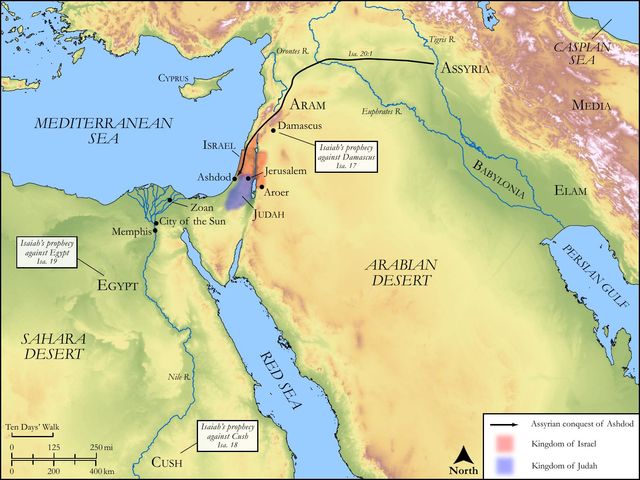
See on the biblical-era map
Study this verse
Public-domain commentary
Matthew Henry
From his Commentary on the Whole Bible. Henry comments on passages, not single verses — this entry covers Isaiah 19:18–25. His four-level outline is real structure in the source text, so it is rendered as structure.
Out of the thick and threatening clouds of the foregoing prophecy the sun of comfort here breaks forth, and it is the sun of righteousness. Still God has mercy in store for Egypt, and he will show it, not so much by reviving their trade and replenishing their river again as by bringing the true religion among them, calling them to, and accepting them in, the worship of the one only living and true God; and these blessings of grace were much more valuable than all the blessings of nature wherewith Egypt was enriched. We know not of any event in which this prophecy can be thought to have its full accomplishment short of the conversion of Egypt to the faith of Christ, by the preaching (as is supposed) of Mark the Evangelist, and the founding of many Christian churches there, which flourished for many ages. Many prophecies of this book point to the days of the Messiah; and why not this? It is no unusual thing to speak of gospel graces and ordinances in the language of the Old Testament institutions. And, in these prophecies, those words, in that day, perhaps have not always a reference to what goes immediately before, but have a peculiar significancy pointing at that day which had been so long fixed, and so often spoken of, when the day-spring from on high should visit this dark world. Yet it is not improbable (which some conjecture) that this prophecy was in part fulfilled when those Jews who fled from their own country to take shelter in Egypt, when Sennacherib invaded their land, brought their religion along with them, and, being awakened to great seriousness by the troubles they were in, made an open and zealous profession of it there, and were instrumental to bring many of the Egyptians to embrace it, which was an earnest and specimen of the more plentiful harvest of souls that should be gathered in to God by the preaching of the gospel of Christ. Josephus indeed tells us that Onias the son of Onias the high priest, living an outlaw at Alexandria in Egypt, obtained leave of Ptolemy Philometer, then king, and Cleopatra his queen, to build a temple to the God of Israel, like that at Jerusalem, at Bubastis in Egypt, and pretended a warrant for doing it from this prophecy in Isaiah, that there shall be an altar to the Lord in the land of Egypt; and the service of God, Josephus affirms, continued in it about 333 years, when it was shut up by Paulinus soon after the destruction of Jerusalem by the Romans; see Antiq. 13.62-79, and Jewish War 7.426-436. But that temple was all along looked upon by the pious Jews as so great an irregularity, and an affront to the temple at Jerusalem, that we cannot suppose this prophecy to be fulfilled in it.
Observe how the conversion of Egypt is here described.
I.They shall speak the language of Canaan, the holy language, the scripture-language; they shall not only understand it, but use it (Isa 19:18); they shall introduce that language among them, and converse freely with the people of God, and not, as they used to do, by an interpreter, Gen 42:23. Note, Converting grace, by changing the heart, changes the language; for out of the abundance of the heart the mouth speaks. Five cities in Egypt shall speak this language; so many Jews shall come to reside in Egypt, and they shall so multiply there, that they shall soon replenish five cities, one of which shall be the city of Heres, or of the sun, Heliopolis, where the sun was worshipped, the most infamous of all the cities of Egypt for idolatry; even there shall be a wonderful reformation, they shall speak the language of Canaan. Or it may be taken thus, as we render it - That for every five cities that shall embrace religion there shall be one (a sixth part of the cities of Egypt) that shall reject it, and that shall be called a city of destruction, because it refuses the methods of salvation.
II.They shall swear to the Lord of hosts, not only swear by him, giving him the honour of appealing to him, as all nations did to the gods they worshipped; but they shall by a solemn oath and vow devote themselves to his honour and bind themselves to his service. They shall swear to cleave to him with purpose of heart, and shall worship him, not occasionally, but constantly. They shall swear allegiance to him as their King, to Christ, to whom all judgment is committed.
III.They shall set up the public worship of God in their land (Isa 19:19):
There shall be an altar to the Lord in the midst of the land of Egypt, an altar on which they shall do sacrifice and oblation (Isa 19:21); therefore it must be understood spiritually. Christ, the great altar, who sanctifies every gift, shall be owned there, and the gospel sacrifices of prayer and praise shall be offered up; for by the law of Moses there was to be no altar for sacrifice but that at Jerusalem. In Christ Jesus all distinction of nations is taken away; and a spiritual altar, a gospel church, in the midst of the land of Egypt, is as acceptable to God as one in the midst of the land of Israel; and spiritual sacrifices of faith and love, and a contrite heart, please the Lord better than an ox or bullock.
IV.There shall be a face of religion upon the nation, and an open profession made of it, discernible to all who come among them.
Not only in the heart of the country, but even in the borders of it, there shall be a pillar, or pillars, inscribed, To Jehovah, to his honour, as before there had been such pillars set up in honour of false gods. As soon as a stranger entered upon the borders of Egypt he might perceive what God they worshipped. Those that serve God must not be ashamed to own him, but be forward to do any thing that may be for a sign and for a witness to the Lord of hosts. Even in the land of Egypt he had some faithful worshippers, who boasted of their relation to him and made his name their strong tower, or bulwark, on their borders, with which their coasts were fortified against all assailants.
V.Being in distress, they shall seek to God, and he shall be found of them; and this shall be a sign and a witness for the Lord of hosts that he is a God hearing prayer to all flesh that come to him, Isa 19:20. See Psa 65:2. When they cry to God by reason of their oppressors, the cruel lords that shall rule over them (Isa 19:4) he shall be entreated of them (Isa 19:22); whereas he had told his people Israel, who had made it their own choice to have such a king, that they should cry to him by reason of their king, and he would not hear them, Sa1 8:18.
VI.They shall have an interest in the great Redeemer.
When they were under the oppression of cruel lords perhaps God sometimes raised them up mighty deliverers, as he did for Israel in the days of the judges; and by them, though he had smitten the land, he healed it again; and, upon their return to God in a way of duty, he returned to them in a way of mercy, and repaired the breaches of their tottering state. For repenting Egyptians shall find the same favour with God that repenting Ninevites did. But all these deliverances wrought for them, as those for Israel, were but figures of gospel salvation. Doubtless Jesus Christ is the Saviour and the great one here spoken of, whom God will send the glad tidings of to the Egyptians, and by whom he will deliver them out of the hands of their enemies, that they may serve him without fear, Luk 1:74, Luk 1:75. Jesus Christ delivered the Gentile nations from the service of dumb idols, and did himself both purchase and preach liberty to the captives.
VII.The knowledge of God shall prevail among them, Isa 19:21.
1.They shall have the means of knowledge. For many ages in Judah only was God known, for there only were the lively oracles found; but now the Lord, and his name and will, shall be known to Egypt. Perhaps this may in part refer to the translation of the Old Testament out of Hebrew into Greek by the Septuagint, which was done at Alexandria in Egypt, by the command of Ptolemy king of Egypt; and it was the first time that the scriptures were translated into any other language. By the help of this (the Grecian monarchy having introduced their language into that country) the Lord was known to Egypt, and a happy omen and means it was of his being further known.
2.They shall have grace to improve those means. It is promised not only that the Lord shall be known to Egypt, but that the Egyptians shall know the Lord; they shall receive and entertain the light granted to them, and shall submit themselves to the power of it. The Lord is known to our nation, and yet I fear there are many of our nation that do not know the Lord. But the promise of the new covenant is that all shall know the Lord, from the least even to the greatest, which promise is sure to all the seed. The effect of this knowledge of God is that they shall vow a vow to the Lord and perform it. For those do not know God aright who either are not willing to come under binding obligations to the Lord or do not make good those obligations.
VIII.They shall come into the communion of saints.
Being joined to the Lord, they shall be added to the church, and be incorporated with all the saints.
1.All enmities shall be slain. Mortal feuds there had been between Egypt and Assyria; they often made war upon one another; but now there shall be a highway between Egypt and Assyria (Isa 19:23), a happy correspondence settled between he two nations; they shall trade with one another, and every thing that passes between them shall be friendly. The Egyptians shall serve (shall worship the true God) with the Assyrians; and therefore the Assyrians shall come into Egypt and the Egyptians into Assyria. Note, It becomes those who have communion with the same God, through the same Mediator, to keep up an amicable correspondence with one another. The consideration of our meeting at the same throne of grace, and our serving with each other in the same business of religion, should put an end to all heats and animosities, and knit our hearts to each other in holy love.
2.The Gentile nations shall not only unite with each other in the gospel fold under Christ the great shepherd, but they shall all be united with the Jews. When Egypt and Assyria become partners in serving God Israel shall make a third with them (Isa 19:24); they shall become a three-fold cord, not easily broken. The ceremonial law, which had long been the partition-wall between Jews and Gentiles, shall be taken down, and then they shall become one sheep-fold under one shepherd. Thus united, they shall be a blessing in the midst of the land, whom the Lord of hosts shall bless, Isa 19:24, Isa 19:25.
(1.)Israel shall be a blessing to them all, because of them, as concerning the flesh, Christ came, and they were the natural branches of the good olive, to whom did originally pertain its root and fatness, and the Gentiles were but grafted in among them, Rom 11:17. Israel lay between Egypt and Assyria, and was a blessing to them both by bringing them to meet in that word of the Lord which went forth from Jerusalem, and that church which was first set up in the land of Israel. Qui conveniunt in aliquo tertio inter se conveniunt - Those who meet in a third meet in each other. Israel is that third in whom Egypt and Assyria agree, and is therefore a blessing; for those are real and great blessings to their generation who are instrumental to unite those that have been at variance.
(2.)They shall all be a blessing to the world: so the Christian church is, made up of Jews and Gentiles; it is the beauty, riches, and support of the world.
(3.)They shall all be blessed of the Lord.
[1.]They shall all be owned by him as his. Though Egypt was formerly a house of bondage to the people of God, and Assyria an unjust invader of them, all this shall now be forgiven and forgotten, and they shall be as welcome to God as Israel. They are all alike his people whom he takes under his protection. They are formed by him, for they are the work of his hands; not only as a people, but as his people. They are formed for him; for they are his inheritance, precious in his eyes, and dear to him, and from whom he has his rent of honour out of this lower world.
[2.]They shall be owned together by him as jointly his, his in concert; they shall all share in one and the same blessing. Note, Those that are united in the love and blessing of God ought, for that reason, to be united to each other in charity.
Historical interpretation
Historical reception
1 surviving comment on this verse from the historical church.
(Verse 24, 25.) On that day, Israel will be a third, along with Egypt and Assyria, a blessing in the midst of the earth. The Lord Almighty will bless them, saying, 'Blessed be Egypt my people, Assyria my handiwork, and Israel my inheritance.' In no way will Israel be a mediator between Egypt and Assyria, now that Antiochus and Demetrius are drawing the kingdom to themselves, now that the Ptolemies are claiming its possession for themselves. But even under Roman rule, and therefore under the rule of Christ, it will be of the same condition as Egypt and Assyria, and it will be blessed in all the earth. Because the law will go forth from Zion, and the word of the Lord from Jerusalem. Then it will be said by the Lord: Blessed is my people of Egypt: when by no means Moses, but Christ the Lord leading the way, the countless thousands of men have filled the wilderness, and with Pharaoh submerged, they have said in the desert: Let us sing to the Lord, for He has been gloriously magnified: He has cast horse and rider into the sea (Exodus 15:1). Then the work of the Lord will also reign in Assyria; for these are the largest nations of monks, Egypt and Mesopotamia, and they contend with each other in equal piety. But the inheritance of Christ is the Israel, that is, the places of his birth, and the cross, and the resurrection, and his ascension, to which people from all over the world gather.
Continue studying Isaiah 19:24 across the web’s major study libraries — every link below opens this exact verse, chapter, or book on the destination site.
Read & Compare
 BibleGatewayThis verse in more than 200 translations and 70 languages.
 Bible.comThe YouVersion reader — hundreds of translations, reading plans, and highlights.
 ESV.orgCrossway's official English Standard Version reader.
 NET BibleThe NET translation with 60,000+ translators' notes on every rendering decision.
 STEP BibleTyndale House's free study tool — original text, vocabulary, and scholarly resources.
 BibliaLogos Bible Software's free web reader.
 USCCBThe New American Bible (Revised Edition) with the U.S. bishops' study notes.
Commentaries
 BibleHub CommentariesDozens of classic commentaries on this verse, gathered on one page.
 StudyLightMore than 100 commentary sets — the largest collection on the web.
 BibleRefPlain-English commentary on what this verse means, verse by verse.
 Enduring WordDavid Guzik's free commentary on this chapter, widely used by Bible teachers.
 Bible Study ToolsVerse commentary alongside Greek and Hebrew study aids.
Original Language & Research
- BibleHub InterlinearThe verse word by word — original language, transliteration, and English.
- BibleHub LexiconEvery word's original-language definition and Strong's entry.
 Blue Letter BibleDeep-study tools — Strong's numbers, concordance, and word studies.
 SefariaThe Hebrew text with Rashi and centuries of Jewish commentary.
Sermons, Hymns & Audio


TrulyRandomVerse is not affiliated with these sites and doesn’t control their content. They’re linked because they’re genuinely useful.
Summary
Isaiah 19:24 presents a radical prophetic vision of a future era where Israel, Egypt, and Assyria—nations historically marked by animosity and conflict—will stand together as a unified entity, serving as a profound blessing "in the midst of the land." This verse culminates a surprising shift in Isaiah's oracle concerning Egypt, moving from pronouncements of judgment to a breathtaking depiction of divine reconciliation and universal worship, underscoring God's sovereign plan to redeem and unite all peoples under His benevolent rule.
Context
ShowHideLiterary Context
Isaiah 19 primarily functions as an oracle against Egypt, detailing its impending judgment, internal strife, and eventual subjugation. The chapter begins with vivid descriptions of Egypt's idols trembling and its wisdom failing, as seen in Isaiah 19:1, leading to economic collapse and social disorder. However, a remarkable turning point occurs from verse 16 onward, where the tone shifts from condemnation to a vision of future restoration and conversion. Verses 23-25 describe a highway between Egypt and Assyria, symbolizing peace and unimpeded movement, and explicitly state that these former adversaries will worship the Lord alongside Israel. Isaiah 19:24 specifically positions Israel as the "third" in this alliance, not as a superior power, but as a central conduit of blessing, thereby fulfilling God's ancient covenantal promises on a global scale.
Historical & Cultural Context
At the time of Isaiah's prophecy (8th century BCE), Egypt and Assyria represented the dominant superpowers of the ancient Near East, frequently vying for control over the Levant, including Judah. Both nations had histories of oppressing Israel, with Egypt holding them in slavery for centuries and Assyria being the instrument of God's judgment against the Northern Kingdom of Israel (722 BCE) and a constant threat to Judah. The idea of these formidable, often hostile, empires joining Israel in worship of Yahweh was utterly counter-cultural and politically improbable. This prophecy transcends the immediate geopolitical realities, pointing to a divine intervention that would fundamentally reorder international relations and spiritual allegiances, transforming a landscape of conflict into one of shared devotion, a vision of peace that echoes the ultimate peace found in God's kingdom.
Key Themes
ShowHideThis verse powerfully encapsulates several profound theological themes. Foremost is Divine Reconciliation, demonstrating God's ultimate intention to break down barriers of national enmity and unite diverse peoples in worship. The inclusion of Egypt and Assyria, quintessential enemies, highlights the boundless scope of God's redemptive plan, foreshadowing a time when all nations will stream to the Lord's mountain, as prophesied in Isaiah 2:2. Secondly, it emphasizes Israel's Role as a Universal Blessing. Echoing the Abrahamic covenant where all families of the earth would be blessed through Abraham's descendants, as recorded in Genesis 12:3, Israel is here depicted as an active participant in extending God's favor to the nations, not through political dominance but through spiritual influence. Finally, the phrase "In that day" points to Eschatological Hope, signaling a future, often messianic, era when God's ultimate purposes for humanity and creation will be realized, characterized by global peace and universal acknowledgment of the one true God, much like the vision of a new heaven and new earth where righteousness dwells found in 2 Peter 3:13.
Exposition and Analysis
ShowHideKey Word Analysis
ShowHideThis term signifies "benediction" or "prosperity." In this context, Israel is not merely the recipient of blessing but becomes the active agent or conduit of blessing for others. It implies a divine favor that radiates outward, bringing spiritual and perhaps even material prosperity to Egypt and Assyria, transforming their relationship from one of conflict to one of mutual benefit and shared spiritual abundance.
This phrase functions as a technical prophetic idiom, referring to a specific, decisive period in God's redemptive history. It can denote a time of judgment or, as here, a time of salvation and radical transformation. It points to a future, divinely appointed era when God's ultimate will is enacted, transcending immediate historical circumstances and signaling an eschatological fulfillment of His purposes for all nations.
This word properly refers to "the nearest part," "the center," or "inward." It implies a position of centrality, intimacy, and vital importance. Israel's placement "in the midst of the land" suggests its pivotal and indispensable role in this future global reconciliation and blessing, serving as the spiritual heart from which God's favor radiates to the surrounding nations.
Verse Breakdown
ShowHide"In that day shall Israel be the third with Egypt and with Assyria"
This clause sets the temporal context ("In that day") and introduces an unprecedented alliance. "The third" (H7992, shᵉlîyshîy) implies a co-equal standing, not a subordinate one. Israel, historically caught between these two superpowers, is now envisioned as an integral, respected partner in a tripartite union, signifying a radical reversal of historical power dynamics and deep-seated animosities. This implies a new order established by God, where former adversaries are brought into harmonious relationship.
"even a blessing in the midst of the land"
This phrase defines Israel's unique and active role within this alliance. Israel is not merely present but actively functions as "a blessing" (H1293, Bᵉrâkâh'). The phrase "in the midst of the land" (H7130, qereb' and H776, ʼerets') emphasizes Israel's central, pivotal position, suggesting that its presence and spiritual vitality will be the wellspring from which divine favor flows to the surrounding nations, transforming the entire region into a realm under God's benevolent influence.
Literary Devices
ShowHideIsaiah 19:24 employs several powerful literary devices to convey its transformative message. The most prominent is Prophecy, a direct divine utterance foretelling future events, here a radical reordering of geopolitical and spiritual realities. Symbolism is also crucial, as Egypt and Assyria, historical oppressors and powerful empires, symbolize the totality of the Gentile world or humanity's estranged nations. Their inclusion with Israel signifies God's universal redemptive scope, extending beyond a single nation. The phrase "the third" functions as a form of Numerical Parallelism or Triadic Structure, emphasizing the balance and equality within this new divine arrangement, where Israel is integrated rather than dominant or subjugated. Furthermore, the entire passage demonstrates Reversal, taking a situation of historical enmity and transforming it into one of profound peace and shared worship, highlighting God's power to transcend human limitations and animosities. This dramatic shift underscores the miraculous nature of God's ultimate plan for humanity.
Theological and Thematic Connections
ShowHideIsaiah 19:24 offers a profound theological statement about the breadth of God's redemptive plan, extending beyond the boundaries of Israel to encompass all nations. It challenges an exclusivist view of salvation, revealing God's ultimate desire for a reconciled humanity united in worship. This vision anticipates a future where national and ethnic divisions, often sources of conflict, are superseded by a shared allegiance to the Lord, demonstrating that God's kingdom is truly global in scope. It underscores the transformative power of God's grace, capable of turning bitter enemies into co-worshippers and instruments of blessing for one another. This prophecy serves as a powerful reminder that God's ultimate purpose is not merely to save individuals but to create a new humanity, reconciled to Him and to each other, reflecting the unity of the triune God.
Reflection and Application
ShowHideIsaiah 19:24 calls us to embrace a vision of God's kingdom that is far grander and more inclusive than our often-limited perspectives. It challenges us to look beyond present conflicts and historical grievances, recognizing God's power to bring about radical reconciliation among peoples. For believers today, this verse serves as a powerful impetus for prayer and action towards global peace and unity, reminding us that our mission extends to every nation, tribe, people, and language. It encourages us to actively participate in breaking down barriers—whether racial, ethnic, or social—within the church and in the wider world, embodying the reconciling love of Christ. Just as Israel is prophesied to be a blessing, we too are called to be agents of God's blessing, demonstrating His love and truth in a divided world, and living as a testament to the fact that His kingdom is a place where former enemies can become brothers and sisters in Christ, united by a common Savior and a shared purpose.
Questions for Reflection
ShowHideFAQ
ShowHideWhat does "the third" imply in this context?
ShowHideThe phrase "the third" (H7992, shᵉlîyshîy) signifies that Israel will be an integral and co-equal partner in this future alliance with Egypt and Assyria, not subordinate to them. It suggests a tripartite union where all three nations stand together in unity and shared devotion to the Lord, rather than a hierarchical arrangement. This is a radical departure from the historical reality where Israel was often subjugated or caught between these two superpowers. It speaks to a divine reordering where all are brought into a new, harmonious relationship under God's sovereignty, reflecting a profound shift from conflict to cooperative worship.
Why are Egypt and Assyria specifically mentioned, given their historical animosity towards Israel?
ShowHideEgypt (H4714, Mitsrayim) and Assyria (H804, ʼAshshûwr) were chosen precisely because they represented the dominant, often oppressive, world powers of Isaiah's time and were historical adversaries of Israel. By naming these two archetypal enemies, the prophecy powerfully symbolizes the universal scope of God's redemptive plan. It demonstrates that God's reconciliation extends even to the most unlikely and hostile nations, breaking down the deepest historical and ethnic barriers. Their inclusion signifies that no nation is beyond the reach of God's transforming grace and that His ultimate kingdom will encompass peoples from every corner of the earth, united in worship of the one true God.
Has this prophecy in Isaiah 19:24 been literally fulfilled, and if so, when?
ShowHideThe prophecy of Isaiah 19:24, particularly the specific tripartite alliance, has not seen a literal, political fulfillment in history where Israel, Egypt, and Assyria formed a unified, co-equal secular state serving Yahweh. Scholars generally interpret this prophecy as having an eschatological (future, ultimate) and spiritual fulfillment. While there have been periods of peace and interaction, the full vision of these nations being "a blessing in the midst of the land" and universally worshipping the Lord awaits a future culmination, likely in the Messianic age. Spiritually, it foreshadows the breaking down of barriers between Jews and Gentiles in the church, as seen in the New Testament, where believers from all nations are united in Christ, forming one body, as powerfully articulated in Ephesians 2:14.
Christ-Centered Fulfillment
ShowHideIsaiah 19:24, with its astonishing vision of reconciliation between historical enemies—Israel, Egypt, and Assyria—finds its ultimate and most profound fulfillment in the person and work of Jesus Christ. The "blessing in the midst of the land" is ultimately embodied in Christ, who is the source of all spiritual blessings, as affirmed in Ephesians 1:3. Through His atoning sacrifice on the cross, Jesus broke down the dividing wall of hostility that separated humanity, particularly between Jew and Gentile, as vividly described in Ephesians 2:14. He did not merely reconcile individuals to God, but also reconciled alienated groups to each other, creating "one new humanity" out of two, as detailed in Ephesians 2:15. The inclusion of Egypt and Assyria alongside Israel foreshadows the global, multi-ethnic composition of the church, where believers from every tribe, tongue, people, and nation are united in worship of the Lamb, a glorious vision presented in Revelation 5:9. Thus, the "day" envisioned by Isaiah is inaugurated in Christ's first advent and will be fully realized in His glorious return, when His kingdom of peace and righteousness will encompass all the earth, and He will indeed be the blessing "in the midst of the land" for all who believe, for Christ Himself is "Christ in you, the hope of glory" (Colossians 1:27).