


Isaiah 19:21
- וְנוֹדַעve·no·Da'and he will make himself knownH3045Conj-w ¦ V-Niphal-ConsecPerf-3msVerb Niphal Consecutive Perfect 3rd Singular Masculineוְandנוֹדַעhe will make himself known
- יְהוָהYah·wehYahwehH3068N-properNoun Proper Title
- לְמִצְרַיִםle·mitz·Ra·yimto EgyptH4714Prep-l ¦ N-properNoun Proper LocationלְtoמִצְרַיִםEgypt
- וְיָדְעוּve·ya·de·'Uand they will knowH3045Conj-w ¦ V-Qal-ConsecPerf-3cpVerb Qal Consecutive Perfect 3rd Plural common genderוְandיָדְעוּthey will know
- מִצְרַיִםmitz·Ra·yimEgyptH4714N-properNoun Proper Location
- אֶת'et<obj.>H853DirObjMParticle Object Indicator
- יְהוָהYah·wehYahwehH3068N-properNoun Proper Title
- בַּיּוֹםbai·Yomin the dayH3117Prep-b ¦ N-msNoun Singular Masculine Absoluteבַּin theיּוֹםday
- הַהוּאha·Hu'<the> thatH1931Art ¦ Pro-3msPronoun Personal 3rd Singular Masculineהַ<the>הוּאthat
- וְעָבְדוּve·'a·ve·Duand they will serveH5647Conj-w ¦ V-Qal-ConsecPerf-3cpVerb Qal Consecutive Perfect 3rd Plural common genderוְandעָבְדוּthey will serve
- זֶבַחZe·vachsacrificeH2077N-msNoun Singular Masculine Absolute
- וּמִנְחָהu·min·Chahand offeringH4503Conj-w ¦ N-fsNoun Singular Feminine Absoluteוּandמִנְחָהoffering
- וְנָדְרוּve·na·de·ruand they will vowH5087Conj-w ¦ V-Qal-ConsecPerf-3cpVerb Qal Consecutive Perfect 3rd Plural common genderוְandנָדְרוּthey will vow
- נֵדֶרNe·dera vowH5088N-msNoun Singular Masculine Absolute
- לַיהוָהla·Yah·wehto YahwehH3068Prep-l ¦ N-properNoun Proper TitleלַtoיהוָהYahweh
- וְשִׁלֵּמוּve·shi·Le·muand they will pay [it]H7999Conj-w ¦ V-Piel-ConsecPerf-3cpVerb Piel Consecutive Perfect 3rd Plural common genderוְandשִׁלֵּמוּthey will pay [it]
English is a literal word-by-word gloss of the Hebrew, not the KJV's wording. Why?
This is the original text the KJV's translators worked from — each Hebrew word with its own literal English meaning in this verse, prepared by scholars at Tyndale House, Cambridge. The KJV translates whole sentences, not word by word, so its wording differs: one Hebrew word can become several English words, and the KJV may choose “the LORD” where the gloss reads “Yahweh”. Both are faithful — they answer different questions. For the KJV's own rendering, switch to the KJV text.
Details
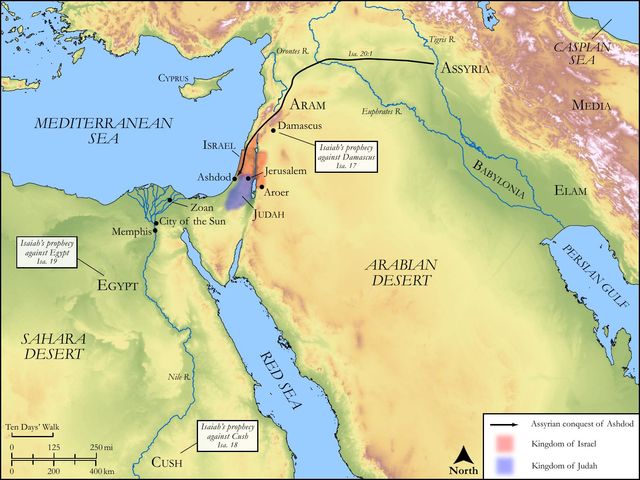
See on the biblical-era map
Study this verse
Public-domain commentary
Matthew Henry
From his Commentary on the Whole Bible. Henry comments on passages, not single verses — this entry covers Isaiah 19:18–25. His four-level outline is real structure in the source text, so it is rendered as structure.
Out of the thick and threatening clouds of the foregoing prophecy the sun of comfort here breaks forth, and it is the sun of righteousness. Still God has mercy in store for Egypt, and he will show it, not so much by reviving their trade and replenishing their river again as by bringing the true religion among them, calling them to, and accepting them in, the worship of the one only living and true God; and these blessings of grace were much more valuable than all the blessings of nature wherewith Egypt was enriched. We know not of any event in which this prophecy can be thought to have its full accomplishment short of the conversion of Egypt to the faith of Christ, by the preaching (as is supposed) of Mark the Evangelist, and the founding of many Christian churches there, which flourished for many ages. Many prophecies of this book point to the days of the Messiah; and why not this? It is no unusual thing to speak of gospel graces and ordinances in the language of the Old Testament institutions. And, in these prophecies, those words, in that day, perhaps have not always a reference to what goes immediately before, but have a peculiar significancy pointing at that day which had been so long fixed, and so often spoken of, when the day-spring from on high should visit this dark world. Yet it is not improbable (which some conjecture) that this prophecy was in part fulfilled when those Jews who fled from their own country to take shelter in Egypt, when Sennacherib invaded their land, brought their religion along with them, and, being awakened to great seriousness by the troubles they were in, made an open and zealous profession of it there, and were instrumental to bring many of the Egyptians to embrace it, which was an earnest and specimen of the more plentiful harvest of souls that should be gathered in to God by the preaching of the gospel of Christ. Josephus indeed tells us that Onias the son of Onias the high priest, living an outlaw at Alexandria in Egypt, obtained leave of Ptolemy Philometer, then king, and Cleopatra his queen, to build a temple to the God of Israel, like that at Jerusalem, at Bubastis in Egypt, and pretended a warrant for doing it from this prophecy in Isaiah, that there shall be an altar to the Lord in the land of Egypt; and the service of God, Josephus affirms, continued in it about 333 years, when it was shut up by Paulinus soon after the destruction of Jerusalem by the Romans; see Antiq. 13.62-79, and Jewish War 7.426-436. But that temple was all along looked upon by the pious Jews as so great an irregularity, and an affront to the temple at Jerusalem, that we cannot suppose this prophecy to be fulfilled in it.
Observe how the conversion of Egypt is here described.
I.They shall speak the language of Canaan, the holy language, the scripture-language; they shall not only understand it, but use it (Isa 19:18); they shall introduce that language among them, and converse freely with the people of God, and not, as they used to do, by an interpreter, Gen 42:23. Note, Converting grace, by changing the heart, changes the language; for out of the abundance of the heart the mouth speaks. Five cities in Egypt shall speak this language; so many Jews shall come to reside in Egypt, and they shall so multiply there, that they shall soon replenish five cities, one of which shall be the city of Heres, or of the sun, Heliopolis, where the sun was worshipped, the most infamous of all the cities of Egypt for idolatry; even there shall be a wonderful reformation, they shall speak the language of Canaan. Or it may be taken thus, as we render it - That for every five cities that shall embrace religion there shall be one (a sixth part of the cities of Egypt) that shall reject it, and that shall be called a city of destruction, because it refuses the methods of salvation.
II.They shall swear to the Lord of hosts, not only swear by him, giving him the honour of appealing to him, as all nations did to the gods they worshipped; but they shall by a solemn oath and vow devote themselves to his honour and bind themselves to his service. They shall swear to cleave to him with purpose of heart, and shall worship him, not occasionally, but constantly. They shall swear allegiance to him as their King, to Christ, to whom all judgment is committed.
III.They shall set up the public worship of God in their land (Isa 19:19):
There shall be an altar to the Lord in the midst of the land of Egypt, an altar on which they shall do sacrifice and oblation (Isa 19:21); therefore it must be understood spiritually. Christ, the great altar, who sanctifies every gift, shall be owned there, and the gospel sacrifices of prayer and praise shall be offered up; for by the law of Moses there was to be no altar for sacrifice but that at Jerusalem. In Christ Jesus all distinction of nations is taken away; and a spiritual altar, a gospel church, in the midst of the land of Egypt, is as acceptable to God as one in the midst of the land of Israel; and spiritual sacrifices of faith and love, and a contrite heart, please the Lord better than an ox or bullock.
IV.There shall be a face of religion upon the nation, and an open profession made of it, discernible to all who come among them.
Not only in the heart of the country, but even in the borders of it, there shall be a pillar, or pillars, inscribed, To Jehovah, to his honour, as before there had been such pillars set up in honour of false gods. As soon as a stranger entered upon the borders of Egypt he might perceive what God they worshipped. Those that serve God must not be ashamed to own him, but be forward to do any thing that may be for a sign and for a witness to the Lord of hosts. Even in the land of Egypt he had some faithful worshippers, who boasted of their relation to him and made his name their strong tower, or bulwark, on their borders, with which their coasts were fortified against all assailants.
V.Being in distress, they shall seek to God, and he shall be found of them; and this shall be a sign and a witness for the Lord of hosts that he is a God hearing prayer to all flesh that come to him, Isa 19:20. See Psa 65:2. When they cry to God by reason of their oppressors, the cruel lords that shall rule over them (Isa 19:4) he shall be entreated of them (Isa 19:22); whereas he had told his people Israel, who had made it their own choice to have such a king, that they should cry to him by reason of their king, and he would not hear them, Sa1 8:18.
VI.They shall have an interest in the great Redeemer.
When they were under the oppression of cruel lords perhaps God sometimes raised them up mighty deliverers, as he did for Israel in the days of the judges; and by them, though he had smitten the land, he healed it again; and, upon their return to God in a way of duty, he returned to them in a way of mercy, and repaired the breaches of their tottering state. For repenting Egyptians shall find the same favour with God that repenting Ninevites did. But all these deliverances wrought for them, as those for Israel, were but figures of gospel salvation. Doubtless Jesus Christ is the Saviour and the great one here spoken of, whom God will send the glad tidings of to the Egyptians, and by whom he will deliver them out of the hands of their enemies, that they may serve him without fear, Luk 1:74, Luk 1:75. Jesus Christ delivered the Gentile nations from the service of dumb idols, and did himself both purchase and preach liberty to the captives.
VII.The knowledge of God shall prevail among them, Isa 19:21.
1.They shall have the means of knowledge. For many ages in Judah only was God known, for there only were the lively oracles found; but now the Lord, and his name and will, shall be known to Egypt. Perhaps this may in part refer to the translation of the Old Testament out of Hebrew into Greek by the Septuagint, which was done at Alexandria in Egypt, by the command of Ptolemy king of Egypt; and it was the first time that the scriptures were translated into any other language. By the help of this (the Grecian monarchy having introduced their language into that country) the Lord was known to Egypt, and a happy omen and means it was of his being further known.
2.They shall have grace to improve those means. It is promised not only that the Lord shall be known to Egypt, but that the Egyptians shall know the Lord; they shall receive and entertain the light granted to them, and shall submit themselves to the power of it. The Lord is known to our nation, and yet I fear there are many of our nation that do not know the Lord. But the promise of the new covenant is that all shall know the Lord, from the least even to the greatest, which promise is sure to all the seed. The effect of this knowledge of God is that they shall vow a vow to the Lord and perform it. For those do not know God aright who either are not willing to come under binding obligations to the Lord or do not make good those obligations.
VIII.They shall come into the communion of saints.
Being joined to the Lord, they shall be added to the church, and be incorporated with all the saints.
1.All enmities shall be slain. Mortal feuds there had been between Egypt and Assyria; they often made war upon one another; but now there shall be a highway between Egypt and Assyria (Isa 19:23), a happy correspondence settled between he two nations; they shall trade with one another, and every thing that passes between them shall be friendly. The Egyptians shall serve (shall worship the true God) with the Assyrians; and therefore the Assyrians shall come into Egypt and the Egyptians into Assyria. Note, It becomes those who have communion with the same God, through the same Mediator, to keep up an amicable correspondence with one another. The consideration of our meeting at the same throne of grace, and our serving with each other in the same business of religion, should put an end to all heats and animosities, and knit our hearts to each other in holy love.
2.The Gentile nations shall not only unite with each other in the gospel fold under Christ the great shepherd, but they shall all be united with the Jews. When Egypt and Assyria become partners in serving God Israel shall make a third with them (Isa 19:24); they shall become a three-fold cord, not easily broken. The ceremonial law, which had long been the partition-wall between Jews and Gentiles, shall be taken down, and then they shall become one sheep-fold under one shepherd. Thus united, they shall be a blessing in the midst of the land, whom the Lord of hosts shall bless, Isa 19:24, Isa 19:25.
(1.)Israel shall be a blessing to them all, because of them, as concerning the flesh, Christ came, and they were the natural branches of the good olive, to whom did originally pertain its root and fatness, and the Gentiles were but grafted in among them, Rom 11:17. Israel lay between Egypt and Assyria, and was a blessing to them both by bringing them to meet in that word of the Lord which went forth from Jerusalem, and that church which was first set up in the land of Israel. Qui conveniunt in aliquo tertio inter se conveniunt - Those who meet in a third meet in each other. Israel is that third in whom Egypt and Assyria agree, and is therefore a blessing; for those are real and great blessings to their generation who are instrumental to unite those that have been at variance.
(2.)They shall all be a blessing to the world: so the Christian church is, made up of Jews and Gentiles; it is the beauty, riches, and support of the world.
(3.)They shall all be blessed of the Lord.
[1.]They shall all be owned by him as his. Though Egypt was formerly a house of bondage to the people of God, and Assyria an unjust invader of them, all this shall now be forgiven and forgotten, and they shall be as welcome to God as Israel. They are all alike his people whom he takes under his protection. They are formed by him, for they are the work of his hands; not only as a people, but as his people. They are formed for him; for they are his inheritance, precious in his eyes, and dear to him, and from whom he has his rent of honour out of this lower world.
[2.]They shall be owned together by him as jointly his, his in concert; they shall all share in one and the same blessing. Note, Those that are united in the love and blessing of God ought, for that reason, to be united to each other in charity.
Historical interpretation
Historical reception
2 surviving comments on this verse. Each one is dated, so this reads as a timeline rather than a list.
(Verse 19-21) On that day there will be an altar of the Lord in the midst of the land of Egypt, and a pillar near its boundary to the Lord. And it will be a sign and a witness to the Lord of hosts in the land of Egypt. For they will cry to the Lord because of the oppressor, and he will send them a Savior and a defender to deliver them, and the Lord will be known by Egypt. Accordingly, to what he said above: On that day there will be five cities in the land of Egypt speaking the language of Canaan and swearing by the Lord of hosts, now it is introduced: There will be an altar of the Lord in the midst of the land of Egypt, which Onias, according to Josephus (Antiquities of the Jews, Book 13, Chapter 6), mistakenly tried to fulfill. And the title of the Lord containing the passion, in which it is written in Hebrew letters, Greek, and Latin: Jesus of Nazareth, the king of the Jews (John 19), as a sign of the Cross, and as a testimony to all nations, which are now called Egypt. And when the persecution of those who trouble the name of Christians grows, then they will cry out in their hearts: Abba Father (Romans 8). And the Lord of hosts will send the Savior, that is, Jesus, and the Judge, or defender who will deliver them, so that they may know the Lord, and they themselves may be known by the Lord; and where sin abounded, grace may superabound (Romans 5). But the one altar of Egypt, that is, of this world, as we know, all altars that are raised against the Church altar are not of the Lord. Until the end of the vision of Egypt, in the book of Historical Explanation, because it was a clear prophecy, we said that all things are referred to Christ.
(Verses 19-21.) In that day there will be an altar to the Lord in the midst of the land of Egypt, and a pillar near its border to the Lord. And it will be for a sign and for a testimony to the Lord of hosts in the land of Egypt. For they will cry to the Lord because of the oppressor, and He will send them a Savior and a Champion who will deliver them. And the Lord will make Himself known to Egypt, and the Egyptians will know the Lord in that day. They will worship with sacrifices and offerings, and they will make vows to the Lord and fulfill them. From this place to the end of Egypt, both the Jews and we understand it as a vision or prophecy of Christ's coming; but they have different expectations for the future, while we consider it as already fulfilled. However, consider the day for the time being: although Josephus claims that these things happened during the time of Onias, who fled to Egypt and built a temple, an altar, and attempted to fulfill the prophecy of Christ in vain. But it is called one altar, just as there is one faith, one baptism, and one Church. And the title, next to its boundary, undoubtedly signifies the Gospel and the writings of the Apostles. For just as the land of Judea is understood above, according to the tropological understanding, as fearsome, or solemn, or the old Testament: so the title in the boundaries of Egypt is shown to be the history of the Gospels. Finally, it joins: And it shall be a sign and a testimony, namely of the Lord's passion. Then those who have believed, while the Egyptians are coming together against the Egyptians, and a man is fighting against his own brother, and city is fighting against city: when the time of persecution comes, they will implore the mercy of the Lord, and immediately the Savior will come, that is, Jesus, for this is what it means in our language. And the Lord will be known by the Egyptians, and they will recognize Him, whether the persecutors who have been overcome, or the believers who have been freed by His present help. And they shall worship him with sacrifices and gifts, and shall vow vows to the Lord and shall pay them. Let the Jews respond: It is prescribed by law that an altar should not be made except in the one place which the Lord God chooses, and only the sacrifices of the Levite priests should be offered. (Deut. XXVI). Behold, Isaiah clearly teaches that the Egyptians should recognize the Lord, and worship him, and offer sacrifices and gifts, and make vows and fulfill them. If the Egyptians have a priesthood, then the testimony of Paul is also fulfilled in them, which says: If the priesthood is transferred, it is necessary for there to be a transfer of the law. (Heb. VII, 12).
Continue studying Isaiah 19:21 across the web’s major study libraries — every link below opens this exact verse, chapter, or book on the destination site.
Read & Compare
 BibleGatewayThis verse in more than 200 translations and 70 languages.
 Bible.comThe YouVersion reader — hundreds of translations, reading plans, and highlights.
 ESV.orgCrossway's official English Standard Version reader.
 NET BibleThe NET translation with 60,000+ translators' notes on every rendering decision.
 STEP BibleTyndale House's free study tool — original text, vocabulary, and scholarly resources.
 BibliaLogos Bible Software's free web reader.
 USCCBThe New American Bible (Revised Edition) with the U.S. bishops' study notes.
Commentaries
 BibleHub CommentariesDozens of classic commentaries on this verse, gathered on one page.
 StudyLightMore than 100 commentary sets — the largest collection on the web.
 BibleRefPlain-English commentary on what this verse means, verse by verse.
 Enduring WordDavid Guzik's free commentary on this chapter, widely used by Bible teachers.
 Bible Study ToolsVerse commentary alongside Greek and Hebrew study aids.
Original Language & Research
- BibleHub InterlinearThe verse word by word — original language, transliteration, and English.
- BibleHub LexiconEvery word's original-language definition and Strong's entry.
 Blue Letter BibleDeep-study tools — Strong's numbers, concordance, and word studies.
 SefariaThe Hebrew text with Rashi and centuries of Jewish commentary.
Sermons, Hymns & Audio


TrulyRandomVerse is not affiliated with these sites and doesn’t control their content. They’re linked because they’re genuinely useful.
Summary
Isaiah 19:21 unveils a breathtaking prophetic vision of Egypt, a nation historically emblematic of idolatry and opposition to God's people, undergoing a profound spiritual metamorphosis. It foretells a future era when the Egyptians will not only come to intimately know the LORD but will also express their devotion through genuine sacrifices, oblations, and faithfully fulfilled vows, signaling a complete turning from their pagan heritage to devoted allegiance to the one true God.
Context
ShowHideLiterary Context
Isaiah 19 forms a significant "oracle concerning Egypt," situated within Isaiah's broader collection of prophecies against foreign nations (chapters 13-23). The chapter commences with stark pronouncements of divine judgment upon Egypt, depicting internal strife, economic collapse, and the drying up of the Nile, leading to national humiliation and distress (see Isaiah 19:1-15). However, this bleak forecast undergoes a dramatic shift in the latter half of the chapter (from Isaiah 19:16 onward), transitioning from judgment to a surprising promise of future conversion and blessing. Verse 21 stands as a pivotal statement within this hopeful turn, detailing the depth of Egypt's future spiritual awakening, which culminates in a remarkable vision where Egypt, alongside Assyria, will become a blessing to the earth alongside Israel, forming a highway of peace and worship (as prophesied in Isaiah 19:23-25).
Historical & Cultural Context
Ancient Egypt was a dominant world power, renowned for its deeply entrenched polytheistic religion, intricate pantheon of gods (such as Ra, Osiris, and Isis), and elaborate cultic practices. It represented a civilization profoundly steeped in idolatry, often serving as a biblical symbol of bondage and oppression for Israel, as vividly portrayed in the Exodus narrative. The Egyptians' spiritual practices were diametrically opposed to the monotheistic worship of Yahweh. Furthermore, Egypt frequently played a complex geopolitical role in the ancient Near East, sometimes as an unreliable ally, but often as a rival or oppressor to Israel. This historical backdrop makes the prophecy of their conversion to Yahweh worship particularly astonishing, highlighting the radical and expansive nature of God's redemptive plan to transform even His historical adversaries.
Key Themes
ShowHideThis verse powerfully contributes to several overarching themes found throughout the book of Isaiah and broader biblical prophecy. Firstly, it underscores Divine Revelation and Universal Knowledge of God, asserting that the LORD will make Himself known to a nation previously ignorant of Him, and they, in turn, will come to know Him experientially. This echoes the broader prophetic hope for a time when the earth will be full of the knowledge of the LORD as the waters cover the sea. Secondly, it highlights Authentic Worship and Radical Transformation. The mention of "sacrifice and oblation" and "vow a vow... and perform [it]" signifies a complete turning from pagan practices to the prescribed forms of worship given by God, demonstrating a profound internal and external shift in allegiance. This transformation points to God's sovereign power to change hearts and societies, even those deeply entrenched in idolatry. Lastly, it powerfully illustrates God's Redemptive Plan for All Nations, expanding the scope of His covenant promises beyond Israel to include Gentiles, even former enemies. This vision of Gentile inclusion prefigures the New Testament reality where God has shown no partiality and people from every tribe and language and people and nation will ultimately worship Him.
Exposition and Analysis
ShowHideKey Word Analysis
ShowHideThis word signifies more than mere intellectual acquaintance; it denotes a deep, experiential, and relational knowledge. When applied to God, it implies an intimate understanding, recognition, and acknowledgment of His character, power, and sovereignty, leading to a personal relationship. For the Egyptians to "know the LORD" means a profound, life-altering encounter and submission to His authority, moving from ignorance to intimate familiarity.
This term refers to a slaughter, specifically the flesh of an animal offered as a sacrifice. It represents a blood offering, typically a burnt offering or peace offering, central to Israelite worship. Its inclusion here indicates a complete adoption of Yahwistic cultic practices, signifying a decisive turning away from pagan rituals and an embrace of the true God's prescribed worship.
This word denotes a donation or a sacrificial offering, usually bloodless and voluntary, such as grain or meal offerings. Paired with "sacrifice," it completes the picture of comprehensive and genuine worship according to the Mosaic Law, emphasizing both atonement (through blood sacrifice) and devotion/thanksgiving (through grain offerings).
This root means "to be safe," "completed," or "to reciprocate." In the context of vows, it means to fulfill, make good on, or render what was promised. This highlights the sincerity and faithfulness of the Egyptians' future commitment; their vows to the LORD will not be empty words but will be genuinely carried out, demonstrating lasting devotion and integrity in their worship.
Verse Breakdown
ShowHide"And the LORD shall be known to Egypt"
This initial clause emphasizes God's sovereign initiative and active revelation. It is the LORD who, by His grace and power, breaks through centuries of idolatry and spiritual darkness to make His presence and identity evident to a nation that had not previously acknowledged Him. This implies a divine act of disclosure, not merely human discovery.
"and the Egyptians shall know the LORD in that day"
This is the reciprocal, active response to God's revelation. The Egyptians will not just be passively aware of God; they will actively, experientially, and relationally "know" Him, entering into a covenant relationship. The phrase "in that day" points to a specific, future eschatological time when this profound spiritual transformation will occur, marking a new era in their spiritual history and relationship with God.
"and shall do sacrifice and oblation;"
This clause details the practical and tangible manifestation of their newfound knowledge and relationship with the LORD. "Sacrifice" (zebach) and "oblation" (minchâh) refer to the prescribed forms of worship in the Mosaic Law. Their engagement in these acts signifies a complete abandonment of their former pagan religious practices and a full adoption of the worship of Yahweh, demonstrating genuine conversion and allegiance.
"yea, they shall vow a vow unto the LORD, and perform [it]."
This final clause underscores the depth of their commitment and sincerity. Vowing a vow implies a solemn promise or dedication to God, and the emphasis on "perform [it]" highlights the faithfulness and integrity of their devotion. It indicates that their worship will be characterized by obedience, commitment, and lasting faithfulness, not just fleeting emotion or superficial ritual.
Literary Devices
ShowHideIsaiah 19:21 employs several powerful literary devices that enhance its prophetic impact. Prophecy is the overarching device, presenting a future event with such certainty that it is spoken of as if already accomplished, lending divine authority and inevitability to God's word. The passage utilizes Parallelism in the phrases "the LORD shall be known to Egypt" and "the Egyptians shall know the LORD," creating a rhythmic emphasis on the mutual and reciprocal nature of this divine-human encounter and the profound transformation involved. There is also a strong element of Irony, as Egypt, a historical oppressor of Israel and a bastion of idolatry, is prophesied to become a devoted worshipper of Yahweh, subverting all human expectations and profoundly highlighting God's boundless grace and sovereign power to redeem even His former adversaries. Furthermore, the specific mention of "sacrifice and oblation" and "vow a vow, and perform it" serves as Symbolism, representing the concrete, tangible actions of true, committed worship, standing in stark contrast to their former idolatrous rituals and signifying a complete spiritual allegiance.
Theological and Thematic Connections
ShowHideThis verse stands as a powerful testament to God's universal sovereignty and His expansive redemptive plan, transcending national and ethnic boundaries. It reveals that God's desire for relationship and worship extends far beyond Israel, encompassing even nations historically hostile or deeply steeped in idolatry. The prophecy of Egypt's conversion underscores the radical transformative power of God's grace, demonstrating that no people group is beyond the reach of His saving knowledge. It foreshadows the New Covenant era where the distinction between Jew and Gentile in worship is dissolved, and all who believe are brought into God's family, participating in true worship that is not confined to a specific place or people but is offered in spirit and truth. This vision of universal worship points to the ultimate culmination of God's kingdom, where people from every nation will acknowledge and adore Him.
Reflection and Application
ShowHideIsaiah 19:21 offers profound encouragement and challenges for believers today. It powerfully reminds us that God's redemptive purposes are global, extending to every nation, tribe, and tongue. This should ignite within us a fervent hope for evangelism and missions, reinforcing the truth that no person or people group is beyond the transformative power of the Gospel, no matter how entrenched in sin or idolatry they may seem. Just as God purposed to reveal Himself to Egypt, He continues to work in the hearts of individuals and nations today, bringing light to the darkest corners of the world. Furthermore, the verse emphasizes that genuine knowledge of God leads to authentic, committed worship, characterized by active obedience and the fulfillment of our vows to Him. It calls us to examine the sincerity of our own devotion, ensuring that our faith is not merely intellectual assent but is expressed through tangible acts of worship, service, and faithfulness to the commitments we make to the LORD, reflecting a transformed heart and life that truly knows and honors Him.
Questions for Reflection
ShowHideFAQ
ShowHideDoes this prophecy mean that modern-day Egypt will literally convert to Christianity or Judaism?
ShowHideWhile some interpreters understand this prophecy in a literal sense, pointing to the historical growth of Christianity in Egypt (the Coptic Church) or a future mass conversion, many view it primarily through a theological lens. The prophecy signifies a profound spiritual transformation and alignment with the one true God, rather than a specific modern religious or political conversion. It speaks to the breaking down of spiritual strongholds and the inclusion of Gentiles in God's redemptive plan, ultimately fulfilled in the New Covenant through Christ. The emphasis is on a genuine turning to the LORD and authentic worship, which has spiritual implications that transcend mere national identity or a specific religious label in the modern sense. The "Egyptians" here represent those who were once alienated from God but are now brought into a saving relationship with Him, participating in true worship.
What is the significance of "sacrifice and oblation" in a post-Christ context, since animal sacrifices are no longer practiced?
ShowHideIn the Old Testament, "sacrifice and oblation" (Hebrew: zebach and minchâh) were the divinely prescribed forms of worship, symbolizing atonement, thanksgiving, and dedication to God. In the New Covenant, these literal practices are fulfilled and superseded by the once-for-all perfect sacrifice of Jesus Christ. Therefore, the prophecy's mention of these acts for Egypt should be understood symbolically. It represents a genuine turning to God and offering Him true spiritual worship, which includes lives of obedience, praise, thanksgiving, and service. As believers today, our "sacrifices" are spiritual: offering our bodies as living sacrifices, offering a sacrifice of praise, and giving generously. The essence is authentic devotion and commitment to the LORD, not the literal reintroduction of ancient rituals.
Christ-Centered Fulfillment
ShowHideIsaiah 19:21 finds its ultimate and most profound fulfillment in the person and redemptive work of Jesus Christ. The prophecy of Egypt knowing the LORD and offering true worship points directly to the New Covenant era inaugurated by Christ, where God's redemptive plan expands to embrace all nations. Jesus, the Lamb of God who takes away the sin of the world, offered the perfect, once-for-all sacrifice, rendering the Old Testament animal sacrifices obsolete. Through His atoning work on the cross, the way was opened for Gentiles, including those from lands historically opposed to God like Egypt, to be reconciled to God and brought into His family. The "knowing" of the LORD by the Egyptians is fulfilled in the saving knowledge of God through faith in Christ, as the Holy Spirit enables believers from every background to worship God in spirit and truth. The inclusion of Gentiles, once "strangers to the covenants of promise," into the commonwealth of Israel and the household of God (as powerfully described in Ephesians 2:11-22) is the grand fulfillment of this vision. Ultimately, Isaiah's prophecy anticipates the glorious reality seen in Revelation, where a multitude from every nation, tribe, people, and language stands before the throne, offering unified worship to God and the Lamb, demonstrating that Christ's kingdom truly knows no earthly boundaries.