


Jeremiah 9:25
- הִנֵּהhi·Nehhere!H2009PrtParticle Interjection
- יָמִיםya·MimdaysH3117N-mpNoun Plural Masculine Absolute
- בָּאִיםba·'Im[are] comingH935V-Qal-Prtcpl-mpVerb Qal Participle Plural Masculine Absolute
- נְאֻםne·'um[the] utterance ofH5002N-mscNoun Singular Masculine Construct
- יְהוָהYah·wehYahwehH3068N-properNoun Proper Title
- וּפָקַדְתִּיu·Fa·kad·Tiand I will visit [judgment]H6485Conj-w ¦ V-Qal-ConsecPerf-1csVerb Qal Consecutive Perfect 1st Singular common genderוּandפָקַדְתִּיI will visit [judgment]
- עַל'alonH5921PrepPreposition
- כָּלkoleveryH3605N-mscNoun Singular Masculine Construct
- מוּלmul[man] circumcisedH4135V-Qal-PassPrtcpl-msVerb Qal Participle Passive Singular Masculine Absolute
- בְּעָרְלָהbe·'a·re·Lahin a foreskinH6190Prep-b ¦ N-fsNoun Singular Feminine Absoluteבְּinעָרְלָהa foreskin
English is a literal word-by-word gloss of the Hebrew, not the KJV's wording. Why?
This is the original text the KJV's translators worked from — each Hebrew word with its own literal English meaning in this verse, prepared by scholars at Tyndale House, Cambridge. The KJV translates whole sentences, not word by word, so its wording differs: one Hebrew word can become several English words, and the KJV may choose “the LORD” where the gloss reads “Yahweh”. Both are faithful — they answer different questions. For the KJV's own rendering, switch to the KJV text.
Details
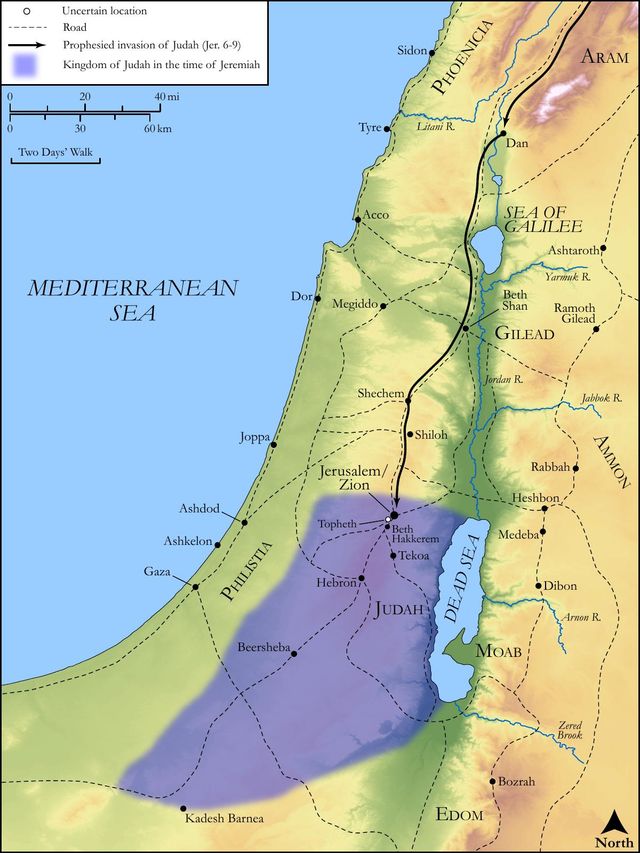
See on the biblical-era map
Study this verse
Public-domain commentary
Matthew Henry
From his Commentary on the Whole Bible. Henry comments on passages, not single verses — this entry covers Jeremiah 9:23–26. His three-level outline is real structure in the source text, so it is rendered as structure.
The prophet had been endeavouring to possess this people with a holy fear of God and his judgments, to convince them both of sin and wrath; but still they had recourse to some sorry subterfuge or other, under which to shelter themselves from the conviction and with which to excuse themselves in the obstinacy and carelessness. He therefore sets himself here to drive them from these refuges of lies and to show them the insufficiency of them.
I.When they were told how inevitable the judgment would be they pleaded the defence of their politics and powers, which, with the help of their wealth and treasure, they thought made their city impregnable. In answer to this he shows them the folly of trusting to and boasting of all these stays, while they have not a God in covenant to stay themselves upon, Jer 9:23, Jer 9:24. Here he shows,
1.What we may not depend upon in a day of distress: Let not the wise man glory in his wisdom, as if with the help of that he could outwit or countermine the enemy, or in the greatest extremity find out some evasion or other; for a man's wisdom may fail him when he needs it most, and he may fail him when he needs it most, and he may be taken in his own craftiness. Ahithophel was befooled, and counsellors are often led away spoiled. But, if a man's policies fail him, yet surely he may gain his point by might and dint of courage. No: Let not the strong man glory in his strength, for the battle is not always to the strong. David the stripling proves too hard for Goliath the giant. All human force is nothing without God, worse than nothing against him. But may not the rich man's wealth be his strong city? (money answers all things) No: Let not the rich man glory in his riches, for they may prove so far from sheltering him that they may expose him and make him the fairer mark. Let not the people boast of the wise men, and mighty men, and rich men that they have among them, as if they could make their part good against the Chaldeans because they have wise men to advise concerning the war, mighty men to fight their battles, and rich men to bear the charges of the war. Let not particular persons think to escape the common calamity by their wisdom, might, or money; for all these will prove but vain things for safety.
2.He shows what we may depend upon in a day of distress.
(1.)Our only comfort in trouble will be that we have done our duty. Those that refused to know God (Jer 9:6) will boast in vain of their wisdom and wealth; but those that know God, intelligently, that understand aright that he is the Lord, that have not only right apprehensions concerning his nature, and attributes, and relations to man, but receive and retain the impressions of them, may glory in this it will be their rejoicing in the day of evil.
(2.)Our only confidence in trouble will be that, having through grace in some measure done our duty, we shall find God a God all-sufficient to us. We may glory in this, that, wherever we are, we have an acquaintance with an interest in a God that exercises lovingkindness, and judgment, and righteousness in the earth, that is not only just to all his creatures and will do no wrong to any of them, but kind to all his children and will protect them and provide for them. For in these things I delight. God delights to show kindness and to execute judgment himself, and is pleased with those who herein are followers of him as dear children. Those that have such knowledge of the glory of God as to be changed into the same image, and to partake of his holiness, find it to be their perfection and glory; and the God they thus faithfully conform to they may cheerfully confide in, in their greatest straits. But the prophet intimates that the generality of this people took no care about this. Their wisdom, and might, and riches, were their joy and hope, which would end in grief and despair. But those few among them that had the knowledge of God might please themselves with it, and boast themselves of it; it would stand them in better stead than thousands of gold and silver.
II.When they were told how provoking their sins were to God they vainly pleaded the covenant of their circumcision.
They were undoubtedly the people of God; as they had the temple of the Lord in their city, so they had the mark of his children in their flesh. "It is true that Chaldean army has laid such and such nations waste, because they were uncircumcised, and therefore not under the protection of the divine providence, as we are." To this the prophet answers, That the days of visitation were now at hand, in which God would punish all wicked people, without making any distinction between the circumcised and uncircumcised, Jer 9:25, Jer 9:26. They had by sin profaned the crown of their peculiarity, and lived in common with the uncircumcised nations, and so had forfeited the benefit of that peculiarity and must expect to fare never the better for it. God will punish the circumcised with the uncircumcised. As the ignorance of the uncircumcised shall not excuse their wickedness, so neither shall the privileges of the circumcised excuse theirs, but they shall be punished together. Note, The Judge of all the earth is impartial, and none shall fare the better at his bar for any external advantages, but he will render to every man, circumcised or uncircumcised, according to his works. The condemnation of impenitent sinners that are baptized will be as sure as, nay, and more severe than, that of impenitent sinners that are unbaptized. It would affect one to find here Judah industriously put between Egypt and Edom, as standing upon a level with them and under the same doom, Jer 9:26. These nations were forbidden a share in the Jews' privileges (Deu 23:3); but the Jews are here told that they shall share in their punishments. Those in the utmost corners, that dwell in the wilderness, are supposed to be the Kedarenes and those of the kingdoms of Hazor, as appears by comparing Jer 49:28-32. Some think they are so called because they dwelt as it were in a corner of the world, others because they had the hair of their head polled into corners. However that was, they were of those nations that were uncircumcised in flesh, and the Jews are ranked with them and are as near to ruin for their sins as they; for all the house of Israel are uncircumcised in the heart: they have the sign, but not the thing signified, Jer 4:4. They are heathens in their hearts, strangers to God, and enemies in their minds by wicked works. Their hearts are disposed to idols, as the hearts of the uncircumcised Gentiles are. Note, The seals of the covenant, though they dignify us, and lay us under obligations, will not save us, unless the temper of our minds and the tenour of our lives agree with the covenant. That only is circumcision, and that baptism, which is of the heart, Rom 2:28, Rom 2:29.
Historical interpretation
Historical reception
2 surviving comments on this verse. Each one is dated, so this reads as a timeline rather than a list.
Select a marker to jump to its quote. Markers stagger vertically where authors wrote within a few decades of each other.
(Vers. 25, 26.) Behold, the days are coming, says the Lord, when I will visit everyone who is circumcised and has the foreskin, including Egypt, Judah, Edom, the Ammonites, the Moabites, and all those who have shaved their heads and live in the desert, for all the nations are uncircumcised. But the house of Israel is uncircumcised in heart. Many of the nations, especially those bordering Judea and Palestine, still practice circumcision to this day, particularly the Egyptians, Edomites, Ammonites, Moabites, and all the region of the Saracens who dwell in the wilderness and are said to have shaved heads and live in the desert. Therefore, Judah, who is mixed with the aforementioned Gentiles, should not boast, because he does not have foreskin, but is circumcised according to God's law. For there are others who do these things and do not keep the commandments of the law, and they are ignorant of the God of Israel. Circumcision does not profit, which is given as a sign, unless the commandments of the Lord are fulfilled; just as the hair, which signifies a nation, does not provide strength of body and the might of warriors. And what follows: All nations have foreskin, but all the house of Israel is uncircumcised in heart. This has the meaning that, except for the Egyptians, Edomites, Ammonites, and Moabites, and the Ishmaelites who dwell in the wilderness, most of whom are circumcised, all other nations throughout the world are uncircumcised in flesh; but the whole house of Israel is uncircumcised in heart, not in flesh; and this uncircumcision leads to death. For that is the flesh, this is the spirit.
The ancient Scriptures therefore teach the benefit of spiritual circumcision and that bodily circumcision makes no difference. For it is not the Gentiles who are accused of being uncircumcised but the Jews, who were physically circumcised but whose heart was uncircumcised.
Continue studying Jeremiah 9:25 across the web’s major study libraries — every link below opens this exact verse, chapter, or book on the destination site.
Read & Compare
 BibleGatewayThis verse in more than 200 translations and 70 languages.
 Bible.comThe YouVersion reader — hundreds of translations, reading plans, and highlights.
 ESV.orgCrossway's official English Standard Version reader.
 NET BibleThe NET translation with 60,000+ translators' notes on every rendering decision.
 STEP BibleTyndale House's free study tool — original text, vocabulary, and scholarly resources.
 BibliaLogos Bible Software's free web reader.
 USCCBThe New American Bible (Revised Edition) with the U.S. bishops' study notes.
Commentaries
 BibleHub CommentariesDozens of classic commentaries on this verse, gathered on one page.
 StudyLightMore than 100 commentary sets — the largest collection on the web.
 BibleRefPlain-English commentary on what this verse means, verse by verse.
 Enduring WordDavid Guzik's free commentary on this chapter, widely used by Bible teachers.
 Bible Study ToolsVerse commentary alongside Greek and Hebrew study aids.
Original Language & Research
- BibleHub InterlinearThe verse word by word — original language, transliteration, and English.
- BibleHub LexiconEvery word's original-language definition and Strong's entry.
 Blue Letter BibleDeep-study tools — Strong's numbers, concordance, and word studies.
 SefariaThe Hebrew text with Rashi and centuries of Jewish commentary.
Sermons, Hymns & Audio


TrulyRandomVerse is not affiliated with these sites and doesn’t control their content. They’re linked because they’re genuinely useful.
Summary
Jeremiah 9:25 presents a profound prophetic declaration from the LORD, announcing an imminent day of universal judgment that will transcend conventional distinctions of religious identity. This verse powerfully underscores God's righteous impartiality, revealing that His divine punishment will fall upon all who are inwardly corrupt and rebellious, regardless of their outward covenant signs or their lack thereof. It serves as a stark challenge to any false security derived from mere ritualistic adherence, asserting that true righteousness, or the profound absence of it, is the ultimate determinant of one's standing before a holy and just God.
Context
ShowHideLiterary Context
Jeremiah 9:25 is strategically placed within a larger prophetic indictment (chapters 7-10) where Jeremiah delivers a scathing critique against the people of Judah for their pervasive spiritual apostasy, rampant idolatry, and profound moral corruption. The preceding chapters, particularly the "Temple Sermon" in Jeremiah 7, dismantle the people's misplaced confidence in the physical Temple and their outward religious practices, exposing them as an empty façade. Jeremiah 9:1-6 laments the widespread deceit and unfaithfulness that has permeated Judahite society, even among those who claim to know the LORD. Verse 25 directly builds upon this critique, culminating in a declaration of judgment that will spare no one based on external markers of identity. The subsequent verse, Jeremiah 9:26, further clarifies the scope of this judgment, explicitly naming various "circumcised" nations (Egypt, Judah, Edom, Ammon, Moab) whose hearts are deemed "uncircumcised," thereby linking their fate to the truly uncircumcised nations and emphasizing the internal nature of true covenant faithfulness.
Historical & Cultural Context
Jeremiah prophesied during the tumultuous twilight of the Kingdom of Judah, spanning the late 7th to early 6th century BCE. This era was characterized by intense political instability, shifting regional alliances, and the ever-present, looming threat of the burgeoning Babylonian Empire. The practice of circumcision was the foundational and distinguishing sign of the Abrahamic covenant established in Genesis 17:9-14, setting Israel apart from the surrounding Gentile nations who were generally "uncircumcised." For the Israelites, this physical mark was meant to be a profound and perpetual symbol of their unique relationship with Yahweh and their identity as God's chosen people. However, by Jeremiah's time, this outward sign had tragically devolved into a source of false security, leading many to presume that their covenant status guaranteed immunity from divine judgment, despite their widespread idolatry, oppression, and profound moral decay. The prophet's message in Jeremiah 9:25 directly confronts this spiritual complacency, asserting with divine authority that God's judgment is not based on external ritual but on internal faithfulness and genuine obedience, a theme powerfully articulated centuries earlier in Deuteronomy 30:6.
Key Themes
ShowHideJeremiah 9:25 profoundly contributes to several critical themes prevalent throughout the book of Jeremiah and the broader prophetic literature. Firstly, it highlights God's Impartial Judgment, demonstrating unequivocally that divine justice is not swayed by ethnic identity, national origin, or religious ritual, but rather by the true condition of the human heart. This directly challenges the common Israelite presumption of automatic favor due to their covenant status. Secondly, the verse underscores the Inadequacy of Outward Ritual when it is disconnected from corresponding inward transformation. Circumcision, the very sign of the covenant, is rendered utterly meaningless if the heart remains rebellious, unrepentant, and "uncircumcised" in spirit. This theme is a consistent prophetic critique, emphasizing that God desires genuine obedience and true devotion over mere ceremonial observance, as famously declared in 1 Samuel 15:22. Thirdly, it speaks to the Universality of Sin and Judgment, implying that both covenant people and those outside the covenant are equally subject to God's righteous wrath if they persist in rebellion against Him. This foreshadows a broader biblical understanding of sin's pervasive reach and God's comprehensive judgment, a concept developed more fully in the New Testament, particularly in Romans 3:23.
Exposition and Analysis
ShowHideKey Word Analysis
ShowHideThis word carries a rich semantic range, meaning "to visit" with either friendly or, as in this context, hostile intent. It conveys the idea of a divine reckoning, a calling to account, or a judgment. It implies God's active intervention to oversee, muster, or charge, ultimately leading to consequences for actions. Here, it specifically denotes a divine visitation of punitive judgment, signifying that God will actively intervene to bring about a just consequence for widespread unfaithfulness.
This term refers to the act of cutting short, specifically the prepuce. It denotes the physical act of circumcision, which served as the indelible mark identifying male Israelites as participants in the Abrahamic covenant. In Jeremiah 9:25, it refers to those who bear this outward, physical sign, primarily the people of Israel, but also other nations that practiced a form of circumcision.
This term literally means "the prepuce" or "foreskin," and by extension, refers to those who are not circumcised, i.e., Gentiles. In this verse, it represents those outside the physical covenant sign of Israel. The deliberate juxtaposition with "circumcised" is crucial, as it highlights the unexpected and shocking universality of the impending judgment, demonstrating that external identity will not be a shield.
Verse Breakdown
ShowHide"Behold, the days come, saith the LORD,"
This opening phrase serves as a solemn and authoritative divine pronouncement, characteristic of prophetic oracles throughout the Old Testament. "Behold" (הִנֵּה, hinnēh) functions as an imperative, drawing immediate and urgent attention to a significant, impending event. "The days come" (יָמִים בָּאִים, yāmîm bāʾîm, from H3117 and H935) indicates a definite future time, a divinely appointed season of reckoning that is certain to arrive. The phrase "saith the LORD" (נְאֻם יְהוָה, nəʾum Yəhôvâh, from H5002 and H3068) emphatically authenticates the message as a direct revelation from Yahweh, the covenant God of Israel, lending it ultimate authority, certainty, and an inescapable quality.
"that I will punish all [them which are] circumcised with the uncircumcised;"
This is the core, startling declaration of the verse, revealing both the scope and the impartial nature of the impending judgment. The LORD declares His firm intention to "punish" (pâqad) – to visit with hostile, punitive intent – not merely the traditional enemies of Israel, but "all them which are circumcised with the uncircumcised." This shocking juxtaposition shatters any illusion of security based on outward religious identity. "The circumcised" refers primarily to Israel, God's covenant people, but also includes other nations who practiced circumcision (as clarified in Jeremiah 9:26). "The uncircumcised" refers to the Gentile nations. The critical phrase "with the uncircumcised" implies that the judgment will be indiscriminate, treating those who bore the covenant sign no differently from those who did not, if their hearts were equally rebellious and unfaithful. This powerfully emphasizes that God's judgment is fundamentally based on the internal spiritual condition and moral conduct, not merely on external ritual or ethnic affiliation.
Literary Devices
ShowHideJeremiah 9:25 is rich with powerful literary devices that amplify its prophetic impact. The most prominent is Divine Oracle, signaled by the authoritative and recurring prophetic formula "saith the LORD," which asserts the message's direct divine origin and incontestable truth. This lends immense weight, gravity, and certainty to the pronouncement. The verse also employs striking Juxtaposition by explicitly pairing "the circumcised" with "the uncircumcised." This unexpected and provocative pairing creates a profound sense of Irony, as it directly subverts the deeply ingrained Israelite assumption that their physical circumcision guaranteed them a privileged status or immunity from judgment compared to the Gentiles. The irony lies in the devastating truth that, in terms of spiritual rebellion and impending divine judgment, there will be no meaningful distinction between the two groups. Furthermore, the phrase "the days come" functions as potent Foreshadowing, pointing to a future, inevitable, and divinely appointed time of reckoning. The comprehensive nature of "all them which are circumcised with the uncircumcised" can also be understood as a form of Generalization or even Hyperbole, emphasizing the universal reach, absolute impartiality, and inescapable nature of God's impending judgment on all who are inwardly unrighteous.
Theological and Thematic Connections
ShowHideJeremiah 9:25 is a pivotal text for understanding God's righteous judgment and His unwavering demand for genuine heart transformation over mere outward ritual. It reveals that God's ultimate concern is not with external markers of identity, such as physical circumcision or religious affiliation, but with the internal disposition and moral condition of the heart. The verse powerfully challenges any notion of automatic salvation or exemption from divine judgment based solely on religious heritage or ceremonial observance. It asserts with divine authority that spiritual rebellion, unrighteousness, and idolatry will inevitably be met with divine punishment, regardless of whether one bears the sign of the covenant or not. This prophetic word sets the stage for a deeper, more profound theological understanding of true righteousness, which is rooted in inward devotion, sincere obedience, and a heart wholly surrendered to God, rather than superficial observance or inherited privilege.
Reflection and Application
ShowHideJeremiah 9:25 stands as an enduring and piercing challenge to all who might place their confidence in external religious practices, inherited affiliations, or outward displays of piety, rather than cultivating a genuine, heart-level relationship with God. For the Israelites of Jeremiah's day, physical circumcision, though a sacred sign of their covenant, tragically became a source of false security, masking deep-seated idolatry, pervasive injustice, and spiritual adultery. Similarly, in every age, adherence to rituals, church membership, theological orthodoxy, or even moral uprightness can subtly become a deceptive substitute for true repentance, living faith, and a life lived in humble, obedient surrender to God. This verse compels us to engage in a profound self-examination of our own hearts, prompting us to ask whether our faith is truly transformative, impacting our character, our ethics, our love for God, and our compassion for our neighbor, or if it remains merely a superficial veneer. The "days come" for all humanity, and God's impartial judgment will invariably penetrate beyond outward appearances to the very core of who we are, demanding an authentic response of heart and life.
Questions for Reflection
ShowHideFAQ
ShowHideWhat does "circumcised with the uncircumcised" mean in this context?
ShowHideThis phrase is a stark declaration highlighting God's impartial and universal judgment. "The circumcised" primarily refers to the Israelites, who bore the physical sign of the Abrahamic covenant, but also includes other nations like Egypt, Edom, Ammon, and Moab, who practiced circumcision (as clarified in Jeremiah 9:26). "The uncircumcised" refers to the Gentile nations who did not practice circumcision. The startling and revolutionary declaration is that God will punish both groups indiscriminately. This means that merely possessing the outward sign of the covenant (circumcision) will not exempt Israel from judgment if their hearts are unrighteous, rebellious, and idolatrous, just as the uncircumcised nations will face judgment for their sin. It profoundly underscores that God judges the heart, character, and actions, not simply external religious identity or ethnic origin.
Does this verse suggest that the Abrahamic covenant and its sign of circumcision were meaningless?
ShowHideNo, the verse does not suggest that the Abrahamic covenant or its sign of circumcision were meaningless in their original divine intent. Rather, it highlights that the abuse or misunderstanding of the covenant sign rendered it meaningless for those who relied on it as a magical charm, an automatic guarantee of impunity, or a substitute for genuine obedience while living in rebellion against God. The physical act of circumcision was always meant to symbolize an inward dedication, purity of heart, and separation unto God (as powerfully articulated in Deuteronomy 30:6). Jeremiah, like other prophets, emphasizes that God desires genuine obedience, heartfelt devotion, and a transformed inner life over mere ritualistic observance. The covenant was indeed meaningful and foundational, but its benefits were always contingent upon faithfulness and a corresponding inner reality, not just physical adherence. This prophetic critique paved the way for the New Testament understanding of true spiritual circumcision, which is a matter of the heart (e.g., Romans 2:28-29).
Christ-Centered Fulfillment
ShowHideJeremiah 9:25, with its powerful emphasis on the inadequacy of outward ritual and the profound necessity of a circumcised heart, finds its ultimate and glorious Christ-centered fulfillment in the New Covenant established through Jesus. The Old Testament sign of physical circumcision, though divinely ordained, always pointed forward to a deeper spiritual reality—a reality fully realized in the person and work of Christ. The Apostle Paul, in Romans 2:28-29, explicitly declares, "For no one is a Jew who is merely one outwardly, nor is circumcision merely outward and physical. But a Jew is one inwardly, and circumcision is a matter of the heart, by the Spirit, not by the letter." This spiritual circumcision, a profound cutting away of the sinful nature and a cleansing of the heart, is accomplished through faith in Jesus Christ, who Himself perfectly fulfilled the law and bore the righteous judgment for both the "circumcised" (Jews) and the "uncircumcised" (Gentiles) at the cross (as seen in Colossians 2:11-12). In Christ, the ancient dividing wall of hostility between Jew and Gentile is decisively broken down (a truth beautifully articulated in Ephesians 2:14), and a new humanity is created, united not by physical markers or ethnic lineage, but by saving faith in the Lamb of God, who takes away the sin of the world!. The impartial judgment prophesied in Jeremiah 9:25 now points to the ultimate judgment seat of Christ (2 Corinthians 5:10), where all will be judged not by their outward religious identity or heritage, but by their response to the gospel and the transformative work of the Holy Spirit in their hearts, made possible solely through Christ's atoning sacrifice and resurrection. Thus, the "days come" of universal judgment for sin, but also the "days come" of universal salvation and spiritual transformation for all who believe in the Lord Jesus Christ, the one who makes true circumcision of the heart a living reality.