


Romans 2:27
Bible text: King James Version (1769 Blayney text) · Public domain
Bible text: King James Version with Strong's numbers · Public domain
Bible text: Berean Standard Bible · Public domain
Bible text: American Standard Version (1901) · Public domain
Bible text: World English Bible, Messianic edition · Public domain
Bible text: Geneva Bible (1599) · Public domain
Bible text: Young's Literal Translation · Public domain
- καὶkaiAndG2532CONJConjunction
- κρινεῖkrineiwill judgeG2919V-FAI-3SVerb Future Active Indicative 3rd Singular
- ἡhētheG3588T-NSFDefinite article Nominative Singular Feminine
- ἐκekbyG1537PREPPreposition
- φύσεωςphuseōsnatureG5449N-GSFNoun Genitive Singular Feminine
- ἀκροβυστίαakrobustiauncircumcisionG203N-NSFNoun Nominative Singular Feminine
- τὸνtontheG3588T-ASMDefinite article Accusative Singular Masculine
- νόμονnomonlawG3551N-ASMNoun Accusative Singular Masculine
- τελοῦσαtelousafulfillingG5055V-PAP-NSFVerb Present Active Participle Nominative Singular Feminine
- σὲseyouG4771P-2ASPersonal pronoun Accusative 2nd Singular
- τὸνtonwhoG3588T-ASMDefinite article Accusative Singular Masculine
- διὰdiawithG1223PREPPreposition
- γράμματοςgrammatos[the] letterG1121N-GSNNoun Genitive Singular Neuter
- καὶkaiandG2532CONJConjunction
- περιτομῆςperitomēscircumcisionG4061N-GSFNoun Genitive Singular Feminine
- παραβάτηνparabatēn[are] a transgressorG3848N-ASMNoun Accusative Singular Masculine
- νόμουnomouof lawG3551N-GSMNoun Genitive Singular Masculine
English is a literal word-by-word gloss of the Greek, not the KJV's wording. Why?
This is the original text the KJV's translators worked from — each Greek word with its own literal English meaning in this verse, prepared by scholars at Tyndale House, Cambridge. The KJV translates whole sentences, not word by word, so its wording differs: one Greek word can become several English words, and the KJV may choose “charity” where the gloss reads “love”. Both are faithful — they answer different questions. For the KJV's own rendering, switch to the KJV text.
Details
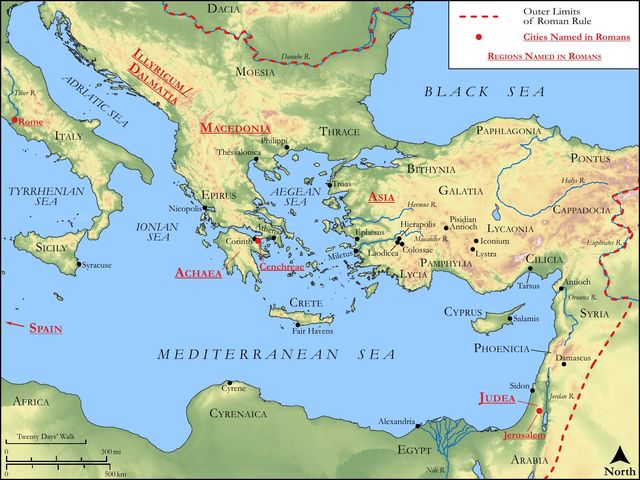
See on the biblical-era maps

Study this verse
Public-domain commentary
Matthew Henry
From his Commentary on the Whole Bible. Henry comments on passages, not single verses — this entry covers Romans 2:17–29. His three-level outline is real structure in the source text, so it is rendered as structure.
In the latter part of the chapter the apostle directs his discourse more closely to the Jews, and shows what sins they were guilty of, notwithstanding their profession and vain pretensions. He had said (Rom 2:13) that not the hearers but the doers of the law are justified; and he here applies that great truth to the Jews. Observe,
I.He allows their profession (Rom 2:17-20) and specifies their particular pretensions and privileges in which they prided themselves, that they might see he did not condemn them out of ignorance of what they had to say for themselves; no, he knew the best of their cause.
1.They were a peculiar people, separated and distinguished from all others by their having the written law and the special presence of God among them.
(1.)Thou art called a Jew; not so much in parentage as profession. It was a very honourable title. Salvation was of the Jews; and this they were very proud of, to be a people by themselves; and yet many that were so called were the vilest of men. It is no new thing for the worst practices to be shrouded under the best names, for many of the synagogue of Satan to say they are Jews (Rev 2:9), for a generation of vipers to boast they have Abraham to their father, Mat 3:7-9.
(2.)And restest in the law; that is, they took a pride in this, that they had the law among them, had it in their books, read it in their synagogues. They were mightily puffed up with this privilege, and thought this enough to bring them to heaven, though they did not live, up to the law. To rest in the law, with a rest of complacency and acquiescence, is good; but to rest in it with a rest of pride, and slothfulness, and carnal security, is the ruin of souls. The temple of the Lord, Jer 7:4. Bethel their confidence, Jer 48:13. Haughty because of the holy mountain, Zep 3:11. It is a dangerous thing to rest in external privileges, and not to improve them.
(3.)And makest thy boast of God. See how the best things may be perverted and abused. A believing, humble, thankful glorying in God, is the root and summary of all religion, Psa 34:2; Isa 45:15; Co1 1:31. But a proud vainglorious boasting in God, and in the outward profession of his name, is the root and summary of all hypocrisy. Spiritual pride is of all kinds of pride the most dangerous.
2.They were a knowing to people (Rom 2:18): and knowest his will, thelēma - the will. God's will is the will, the sovereign, absolute, irresistible will. The world will then, and not till then, be set to rights, when God's will is the only will, and all other wills are melted into it. They did not only know the truth of God, but the will of God, that which he would have them to do. It is possible for a hypocrite to have a great deal of knowledge in the will of God. - And approvest the things that are more excellent - dokimazeis ta diapheronta. Paul prays for it for his friends as a very great attainment, Phi 1:10. Eis to dokemazein humas ta diapheronta. Understand it,
(1.)Of a good apprehension in the things of God, reading it thus, Thou discernest things that differ, knowest how to distinguish between good and evil, to separate between the precious and the vile (Jer 15:19), to make a difference between the unclean and the clean, Lev 11:47. Good and bad lie sometimes so near together that it is not easy to distinguish them; but the Jews, having the touchstone of the law ready at hand, were, or at least thought they were, able to distinguish, to cleave the hair in doubtful cases. A man may be a good casuist and yet a bad Christian - accurate in the notion, but loose and careless in the application. Or, we may, with De Dieu, understand controversies by the ta diapheronta. A man may be well skilled in the controversies of religion, and yet a stranger to the power of godliness.
(2.)Of a warm affection to the things of God, as we read it, Approvest the things that are excellent. There are excellences in religion which a hypocrite may approve of: there may be a consent of the practical judgment to the law, that it is good, and yet that consent overpowerd by the lusts of the flesh, and of the mind: -
- Video meliora proboque
Deteriora sequor.
I see the better, but pursue the worse.
and it is common for sinners to make that approbation an excuse which is really a very great aggravation of a sinful course. They got this acquaintance with, and affection to, that which is good, but being instructed out of the law, katēchoumenos - being catechised. The word signifies an early instruction in childhood. It is a great privilege and advantage to be well catechised betimes. It was the custom of the Jews to take a great deal of pains in teaching their children when they were young, and all their lessons were out of the law; it were well if Christians were but as industrious to teach their children out of the gospel. Now this is called (Rom 2:20), The form of knowledge, and of the truth in the law, that is, the show and appearance of it. Those whose knowledge rests in an empty notion, and does not make an impression on their hearts, have only the form of it, like a picture well drawn and in good colours, but which wants life. A form of knowledge produces but a form of godliness, Ti2 3:5. A form of knowledge may deceive men, but cannot impose upon the piercing eye of the heart-searching God. A form may be the vehicle of the power; but he that takes up with that only is like sounding brass and a tinkling cymbal.
3.They were a teaching people, or at least thought themselves so (Rom 2:19, Rom 2:20): And art confident that thou thyself art a guide of the blind. Apply it,
(1.)To the Jews in general. They thought themselves guides to the poor blind Gentiles that sat in darkness, were very proud of this, that whoever would have the knowledge of God must be beholden to them for it. All other nations must come to school to them, to learn what is good, and what the Lord requires; for they had the lively oracles.
(2.)To their rabbis, and doctors, and leading men among them, who were especially those that judged others, Rom 2:1. These prided themselves much in the possession they had got of Moses's chair, and the deference which the vulgar paid to their dictates; and the apostle expresses this in several terms, a guide of the blind, a light of those who are in darkness, an instructor of the foolish, a teacher of babes, the better to set forth their proud conceit of themselves, and contempt of others. This was a string they loved to be harping upon, heaping up titles of honour upon themselves. The best work, when it is prided in, is unacceptable to God. It is good to instruct the foolish, and to teach the babes: but considering our own ignorance, and folly, and inability to make these teachings successful without God, there is nothing in it to be proud of.
II.He aggravates their provocations (Rom 2:21-24) from two things: -
1.That they sinned against their knowledge and profession, did that themselves which they taught others to avoid: Thou that teachest another, teachest thou not thyself? Teaching is a piece of that charity which begins at home, though it must not end there. It was the hypocrisy of the Pharisees that they did not do as they taught (Mat 23:3), but pulled down with their lives what they built up with their preaching; for who will believe those who do not believe themselves? Examples will govern more than rules. The greatest obstructors of the success of the word are those whose bad lives contradict their good doctrine, who in the pulpit preach so well that it is a pity they should ever come out, and out of the pulpit live so ill that it is a pity they should ever come in. He specifies three particular sins that abound among the Jews: - (1.) Stealing. This is charged upon some that declared God's statutes (Psa 50:16, Psa 50:18), When thou sawest a thief, then thou consentedst with him. The Pharisees are charged with devouring widows' houses (Mat 23:14), and that is the worst of robberies. (2.) Adultery, Rom 2:22. This is likewise charged upon that sinner (Psa 50:18), Thou hast been partaker with adulterers. Many of the Jewish rabbin are said to have been notorious for this sin. (3.) Sacrilege - robbing in holy things, which were then by special laws dedicated and devoted to God; and this is charged upon those that professed to abhor idols. So the Jews did remarkably, after their captivity in Babylon; that furnace separated them for ever from the dross of their idolatry, but they dealt very treacherously in the worship of God. It was in the latter days of the Old Testament church that they were charged with robbing God in tithes and offerings (Mal 3:8, Mal 3:9), converting that to their own use, and to the service of their lusts, which was, in a special manner, set apart for God. And this is almost equivalent to idolatry, though this sacrilege was cloaked with the abhorrence of idols. Those will be severely reckoned with another day who, while they condemn sin in others, do the same, or as bad, or worse, themselves.
2.That they dishonoured God by their sin, Rom 2:23, Rom 2:24. While God and his law were an honour to them, which they boasted of and prided themselves in, they were a dishonour to God and his law, by giving occasion to those that were without to reflect upon their religion, as if that did countenance and allow of such things, which, as it is their sin who draw such inferences (for the faults of professors are not to be laid upon professions), so it is their sin who give occasion for those inferences, and will greatly aggravate their miscarriages. This was the condemnation in David's case, that he had given great occasion to the enemies of the Lord to blaspheme, Sa2 12:14. And the apostle here refers to the same charge against their forefathers: As it is written, Rom 2:24. He does not mention the place, because he wrote this to those that were instructed in the law (in labouring to convince, it is some advantage to deal with those that have knowledge and are acquainted with the scripture), but he seems to point at Isa 52:5; Eze 36:22, Eze 36:23; and Sa2 12:14. It is a lamentation that those who were made to be to God for a name and for a praise should be to him a shame and dishonour. The great evil of the sins of professors is the dishonour done to God and religion by their profession. "Blasphemed through you; that is, you give the occasion for it, it is through your folly and carelessness. The reproaches you bring upon yourselves reflect upon your God, and religion is wounded through your sides." A good caution to professors to walk circumspectly. See Ti1 6:1.
III.He asserts the utter insufficiency of their profession to clear them from the guilt of these provocations (Rom 2:25-29):
Circumcision verily profiteth, if thou keep the law; that is, obedient Jews shall not lose the reward of their obedience, but will gain this by their being Jews, that they have a clearer rule of obedience than the Gentiles have. God did not give the law nor appoint circumcision in vain. This must be referred to the state of the Jews before the ceremonial polity was abolished, otherwise circumcision to one that professed faith in Christ was forbidden, Gal 5:1. But he is here speaking to the Jews, whose Judaism would benefit them, if they would but live up to the rules and laws of it; but if not "thy circumcision is made uncircumcision; that is, thy profession will do thee no good; thou wilt be no more justified than the uncircumcised Gentiles, but more condemned for sinning against greater light." The uncircumcised are in scripture branded as unclean (Isa 52:1), as out of the covenant, (Eph 2:11, Eph 2:12) and wicked Jews will be dealt with as such. See Jer 9:25, Jer 9:26. Further to illustrate this,
1.He shows that the uncircumcised Gentiles, if they live up to the light they have, stand upon the same level with the Jews; if they keep the righteousness of the law (Rom 2:26), fulfil the law (Rom 2:27); that is, by submitting sincerely to the conduct of natural light, perform the matter of the law. Some understand it as putting the case of a perfect obedience to the law: "If the Gentiles could perfectly keep the law, they would be justified by it as well as the Jews." But it seems rather to be meant of such an obedience as some of the Gentiles did attain to. The case of Cornelius will clear it. Though he was a Gentile, and uncircumcised, yet, being a devout man, and one that feared God with all his house (Act 10:2), he was accepted, Rom 2:4. Doubtless, there were many such instances: and they were the uncircumcision, that kept the righteousness of the law; and of such he says,
(1.)That they were accepted with God, as if they had been circumcised. Their uncircumcision was counted for circumcision. Circumcision was indeed to the Jews a commanded duty, but it was not to all the world a necessary condition of justification and salvation.
(2.)That their obedience was a great aggravation of the disobedience of the Jews, who had the letter of the law, Rom 2:27. Judge thee, that is, help to add to thy condemnation, who by the letter and circumcision dost transgress. Observe, To carnal professors the law is but the letter; they read it as a bare writing, but are not ruled by it as a law. They did transgress, not only notwithstanding the letter and circumcision, but by it, that is, they thereby hardened themselves in sin. External privileges, if they do not do us good, do us hurt. The obedience of those that enjoy less means, and make a less profession, will help to condemn those that enjoy greater means, and make a greater profession, but do not live up to it.
2.He describes the true circumcision, Rom 2:28, Rom 2:29.
(1.)It is not that which is outward in the flesh and in the letter. This is not to drive us off from the observance of external institutions (they are good in their place), but from trusting to them and resting in them as sufficient to bring us to heaven, taking up with a name to live, without being alive indeed. He is not a Jew, that is, shall not be accepted of God as the seed of believing Abraham, nor owned as having answered the intention of the law. To be Abraham's children is to do the works of Abraham, Joh 8:39, Joh 8:40.
(2.)It is that which is inward, of the heart, and in the spirit. It is the heart that God looks at, the circumcising of the heart that renders us acceptable to him. See Deu 30:6. This is the circumcision that is not made with hands, Col 2:11, Col 2:12. Casting away the body of sin. So it is in the spirit, in our spirit as the subject, and wrought by God's Spirit as the author of it.
(3.)The praise thereof, though it be not of men, who judge according to outward appearance, yet it is of God, that is, God himself will own and accept and crown this sincerity; for he seeth not as man seeth. Fair pretences and a plausible profession may deceive men: but God cannot be so deceived; he sees through shows to realities. This is alike true of Christianity. He is not a Christian that is one outwardly, nor is that baptism which is outward in the flesh; but he is a Christian that is one inwardly, and baptism is that of the heart, in the spirit, and not in the letter, whose praise is not of men but of God.
Historical interpretation
Two Centuries of Reception
5 surviving comments on this verse. Each one is dated, so this reads as a timeline rather than a list.
Select a marker to jump to its quote. Markers stagger vertically where authors wrote within a few decades of each other.
And that the Lord did not abrogate the natural precepts of the law, by which man is justified, which also those who were justified by faith, and who pleased God, did observe previous to the giving of the law, but that He extended and fulfilled them, is shown from His words.
The Jew according to the flesh may keep the law, but only the man who is spiritual, who is a Jew in secret, can fulfill it. Insofar as the former is a transgressor of the law, it is the latter who will be his judge.
The Gentile who believes under the guidance of nature condemns the Jew, to whom Christ was promised through the law and who refused to believe in him when he came. For as much as the Gentile is being prepared for glory for having known the Creator of nature by nature alone, so the Jew deserves to be punished all the more because he did not know Christ the Creator, either by nature or by the law.
"And shall not the uncircumcision which is by nature judge?" You see, he recognizes two uncircumcisions, one from nature, and the other from the will. Here, however, he speaks of that from nature, but does not pause here, but goes on, "if it fulfil the Law, judge thee, who by the letter and circumcision dost transgress the Law?" See his exquisite judgment. He does not say, that the uncircumcision which is from nature shall judge the circumcision, but while where the victory had been, he brings in the uncircumcision, yet where the defeat is, he does not expose the circumcision as defeated; but the Jew himself who had it, and so by the wording spares offending his hearer. And he does not say, "thee that hast the Law and the circumcision," but yet more mildly, "thee who by the letter and circumcision dost transgress the Law." That is, such uncircumcision even stands up for the circumcision, for it has been wronged and comes to the Law's assistance, for it has been insulted, and obtains a notable triumph. For then is the victory decided, when it is not by Jew that Jew is judged, but by the uncircumcised; as when he says, "The men of Nineveh shall rise in judgment against this generation, and shall condemn it." (Matt. xii. 41.)
This either means that as long as the Jews continue their literal circumcision they reject the spiritual circumcision, or that they will be judged because they have not followed what the law said, viz., that by believing in Christ they might receive the true circumcision.
Continue studying Romans 2:27 across the web’s major study libraries — every link below opens this exact verse, chapter, or book on the destination site.
Read & Compare
 BibleGatewayThis verse in more than 200 translations and 70 languages.
 Bible.comThe YouVersion reader — hundreds of translations, reading plans, and highlights.
 ESV.orgCrossway's official English Standard Version reader.
 NET BibleThe NET translation with 60,000+ translators' notes on every rendering decision.
 STEP BibleTyndale House's free study tool — original text, vocabulary, and scholarly resources.
 BibliaLogos Bible Software's free web reader.
 USCCBThe New American Bible (Revised Edition) with the U.S. bishops' study notes.
Commentaries
 BibleHub CommentariesDozens of classic commentaries on this verse, gathered on one page.
 StudyLightMore than 100 commentary sets — the largest collection on the web.
 BibleRefPlain-English commentary on what this verse means, verse by verse.
 Enduring WordDavid Guzik's free commentary on this chapter, widely used by Bible teachers.
 Bible Study ToolsVerse commentary alongside Greek and Hebrew study aids.
Original Language & Research
- BibleHub InterlinearThe verse word by word — original language, transliteration, and English.
- BibleHub LexiconEvery word's original-language definition and Strong's entry.
 Blue Letter BibleDeep-study tools — Strong's numbers, concordance, and word studies.
 CNTR CollationThe earliest Greek manuscripts of this verse, collated letter by letter.
Sermons, Hymns & Audio


TrulyRandomVerse is not affiliated with these sites and doesn’t control their content. They’re linked because they’re genuinely useful.
Summary
Romans 2:27 delivers a powerful rhetorical question, challenging the Jewish assumption that possession of the Mosaic Law and the sign of circumcision guaranteed their righteousness or exempted them from divine judgment. Paul argues that if a Gentile, "by nature" (without the external law or circumcision), lives in accordance with the moral principles of the law, they will stand as a judge against the Jew who, despite having the written law and the covenant sign, fails to obey God's commands. This verse underscores Paul's central point that God's judgment is based on genuine obedience of the heart, not on external religious markers or privileges.
Context
ShowHideLiterary Context
Romans 2:27 is the culmination of Paul's argument in Romans 2 concerning God's impartial judgment. Following his indictment of the Gentile world in Romans 1, Paul turns his focus to the Jewish people, who, despite possessing the Law and the covenant sign of circumcision, often practiced hypocrisy. He asserts that God judges not by external identity but by deeds (Romans 2:6). Paul has already introduced the concept that Gentiles, without the written Law, might instinctively fulfill its moral requirements, demonstrating that the "work of the law is written in their hearts" (Romans 2:14-15). Verse 27 serves as a climactic rhetorical flourish, starkly contrasting the Gentile who lives out the Law with the Jew who possesses it but transgresses it, thereby setting the stage for Paul's deeper exploration of the nature of true Judaism and the role of faith in Romans 3.
Historical & Cultural Context
In the first century, circumcision was the preeminent sign of the Jewish covenant with God, distinguishing Jews from Gentiles. Possession of the Torah (the Law) was also a source of immense pride and perceived spiritual superiority. Many Jews believed that their ethnic identity, their covenant sign, and their access to God's revealed Law placed them in an unassailable position before God, guaranteeing their salvation or at least a preferential standing in judgment. They often looked down upon Gentiles as "sinners" by nature. Paul directly confronts this ethnocentric and legalistic mindset, which had become a stumbling block to understanding God's universal plan of salvation. His argument would have been deeply provocative to his Jewish audience, dismantling their cherished assumptions about their privileged status and challenging their understanding of righteousness.
Key Themes
ShowHideThis verse powerfully contributes to several key themes woven throughout Romans. Firstly, it highlights the theme of internal versus external righteousness. Paul consistently argues that true righteousness is not merely about outward adherence to rituals or possession of the Law, but about an inward transformation and genuine obedience of the heart. This is evident in his discussion of the law being written on the hearts of Gentiles and his later declaration that true circumcision is a matter of the heart. Secondly, the verse reinforces the theme of God's impartial judgment. God judges all humanity—Jew and Gentile—based on their deeds, not on their religious affiliation or external markers. This theme is introduced early in Romans 2:6 and is foundational to Paul's argument that all have sinned and fall short of God's glory (Romans 3:23). Finally, it underscores the paradox of privilege, where those who possess the greatest spiritual advantages (the Law, circumcision) are often the ones who fail most spectacularly to live up to their calling, thereby making their condemnation more severe. This sets the stage for the revelation of God's righteousness through faith in Christ, which is available to all, regardless of their prior status (Romans 3:21-22).
Exposition and Analysis
ShowHideKey Word Analysis
ShowHideFrom akron (extreme point) and likely a modified form of a word for the male sexual organ, referring literally to the foreskin. By implication, it denotes the state of being uncircumcised, thus referring to Gentiles who were outside the covenant sign with Israel. Figuratively, it can also imply an unregenerate state. In this context, it primarily refers to a Gentile person or their condition, contrasting with the circumcised Jew.
From graphō (to write), this term refers to a writing, a letter, or scripture. Here, it specifically denotes the written Law, the Mosaic Law, in its external, codified form. Paul uses it to highlight the contrast between mere possession of the written code and the internal, transformative obedience to its spirit.
Though translated as a verb "dost transgress" in the KJV, the Greek word is a noun, parabátēs, meaning "a violator" or "a breaker." This emphasizes the identity or character of the one who breaks the law. It's not just an occasional act, but a defining characteristic of one who fails to live up to the Law's demands, despite claiming to possess it.
Verse Breakdown
ShowHide"And shall not uncircumcision which is by nature,"
This introduces the first party in the comparison: the Gentile. The phrase "by nature" (phýsis) indicates their natural state, without the external covenant sign of circumcision or the explicit written Law. Paul is positing a hypothetical scenario where a Gentile, by their innate moral sense or through God's common grace, lives in a way that aligns with the Law's moral principles.
"if it fulfil the law,"
This conditional clause sets the premise for the Gentile's role. "Fulfil" (teléō) means to complete, execute, or perform. It implies a consistent living out of the Law's requirements, not merely knowing them. This is not to say Gentiles perfectly keep the Law, but that their conduct, in comparison to the Jew's, demonstrates a truer adherence to its spirit.
"judge thee,"
This is the shocking conclusion of the rhetorical question. The "uncircumcision" (the Gentile) is personified as the one who will "judge" (krínō)—meaning to distinguish, decide, or condemn. This implies that the Gentile's obedient life will serve as an indictment against the disobedient Jew, highlighting the Jew's failure.
"who by the letter and circumcision"
This clause identifies the second party: the Jew. "By the letter" (diá grámma) refers to their possession of the written Mosaic Law. "And circumcision" (kaí peritomḗ) refers to the physical sign of the covenant. These are the very privileges the Jew prided themselves on, yet Paul turns them into a basis for their condemnation when unaccompanied by obedience.
"dost transgress the law?"
This final phrase exposes the Jew's fatal flaw. "Transgress" (parabátēs) means to be a violator or breaker of the Law. Despite their privileged status and knowledge of the Law, they actively violate its commands. The rhetorical question expects a resounding "Yes!"—the Gentile will indeed judge the transgressing Jew.
Literary Devices
ShowHidePaul masterfully employs several literary devices in this verse to deliver his potent message. The most prominent is Rhetorical Question, which dominates the entire verse. By posing a question that demands an obvious affirmative answer, Paul compels his audience to confront the uncomfortable truth of their hypocrisy, making the argument more forceful and immediate than a direct statement. Secondly, Antithesis or Contrast is central to the verse's structure and meaning. Paul sets up a stark opposition between "uncircumcision which is by nature" (Gentiles) and "the letter and circumcision" (Jews), and between "fulfil the law" and "transgress the law." This sharp contrast highlights the irony and spiritual bankruptcy of relying on external markers without internal transformation. Lastly, Paul uses Personification, where "uncircumcision" (an abstract concept or group) is depicted as an active agent that "shall... judge thee." This personification lends dramatic weight to the Gentile's role as a silent, yet powerful, witness against the disobedient Jew, emphasizing the universality of God's moral standard.
Theological and Thematic Connections
ShowHideRomans 2:27 is a pivotal verse that dismantles the notion of inherited righteousness or salvation based on ethnic identity or external religious observances. It profoundly challenges the idea that possession of divine revelation or participation in sacred rituals automatically confers favor with God. Instead, Paul asserts that God's ultimate standard is obedience of the heart, a principle that transcends cultural and religious boundaries. This verse highlights God's impartiality in judgment, demonstrating that He looks beyond outward appearances to the true condition of the human heart and the reality of one's actions. It serves as a stark warning against spiritual complacency and hypocrisy, emphasizing that true faith is always evidenced by a life transformed by God's will, rather than by mere affiliation or knowledge. This theological truth lays the groundwork for Paul's subsequent argument that all humanity, Jew and Gentile alike, stands condemned under the Law and is therefore in desperate need of God's grace through faith in Christ.
Reflection and Application
ShowHideRomans 2:27 serves as a timeless mirror for all who claim a religious identity. It challenges us to look beyond our affiliations, traditions, or knowledge and honestly assess the authenticity of our faith through the lens of our actions and the true posture of our hearts. It's a powerful warning against spiritual complacency, reminding us that merely possessing a Bible, attending church, or identifying as a Christian does not guarantee righteousness or exempt us from God's scrutiny. The "uncircumcision by nature" who fulfills the law can be seen as a profound reminder that God values genuine obedience and a life lived in accordance with His moral will, even from those who may not have the full revelation of His truth. This should humble us and spur us to ensure that our internal transformation matches our external profession, living out the principles of love, justice, and mercy that are at the heart of God's Law. Our walk must align with our talk, for it is by our fruit that we will be known, not merely by our labels.
Questions for Reflection
ShowHideFAQ
ShowHideWhat does Paul mean by "uncircumcision which is by nature"?
ShowHide"Uncircumcision which is by nature" refers to Gentiles in their natural, uncircumcised state, meaning they are not part of the Mosaic covenant and do not possess the written Law of Moses. Paul is speaking hypothetically of a Gentile who, without the external Law or the sign of circumcision, nonetheless lives in a manner that aligns with the moral principles inherent in God's Law. This demonstrates that God's moral standard is universal and accessible even apart from specific revelation, as the work of the law is written on their hearts.
How can "uncircumcision" (Gentiles) "judge" "circumcision" (Jews)?
ShowHideThe "judging" here is not a formal judicial process but a moral indictment. The consistent, moral living of a Gentile, even without the Law, serves as a powerful contrast and condemnation of a Jew who possesses the Law and circumcision but fails to obey it. It highlights the hypocrisy of those who claim spiritual privilege but transgress God's commands. The Gentile's obedience, however imperfect, exposes the Jew's disobedience, making their transgression all the more culpable given their greater light and privilege. This underscores God's impartial judgment, which evaluates actions and the heart, not just external identity (Romans 2:6).
Is Paul saying that Gentiles can be saved by keeping the Law?
ShowHideNo, Paul is not advocating for salvation by law-keeping for either Jew or Gentile. Throughout Romans, Paul consistently argues that "no one will be declared righteous in God's sight by the works of the law; rather, through the law we become conscious of our sin" (Romans 3:20). His point in Romans 2:27 is to expose the hypocrisy and self-righteousness of those who rely on external religious markers while transgressing the very Law they claim to uphold. He uses the hypothetical "law-keeping" Gentile to dismantle Jewish claims of superiority and to demonstrate that God's moral standard applies to all, revealing that all humanity, Jew and Gentile, falls short and is in need of God's grace through faith in Jesus Christ (Romans 3:23-24).
Christ-Centered Fulfillment
ShowHideRomans 2:27, while seemingly focused on the Law and circumcision, ultimately points to the profound necessity of Christ. The verse highlights humanity's universal failure to truly "fulfill the law," whether Jew with the written code or Gentile with the law "by nature." This demonstrates that neither external privilege nor innate moral sense can achieve the righteousness God demands. It is precisely this universal inability to keep the Law that necessitates a new covenant and a perfect Law-fulfiller. Jesus Christ is the only one who perfectly "fulfilled the law" (Matthew 5:17), not merely externally but from a perfectly obedient heart. His righteous life and atoning death provide the only means for both Jew and Gentile to be declared righteous before God, not by their own works, but by faith in Him (Romans 3:21-22). Through Christ, the "law of the Spirit of life" sets believers free from the "law of sin and death" (Romans 8:2), enabling true, Spirit-empowered obedience that was impossible under the old covenant. Thus, the "uncircumcision which is by nature" who fulfills the law finds its ultimate reality in those who are made new in Christ, whose hearts are circumcised by the Spirit (Romans 2:29) and upon whom the righteousness of Christ is graciously imputed (2 Corinthians 5:21).