


Zephaniah 3:11
- בַּיּוֹםbai·Yomon the dayH3117Prep-b ¦ N-msNoun Singular Masculine Absoluteבַּon theיּוֹםday
- הַהוּאha·Hu'<the> thatH1931Art ¦ Pro-3msPronoun Personal 3rd Singular Masculineהַ<the>הוּאthat
- לֹאlo'notH3808NegParticle Negative
- תֵבוֹשִׁיte·Vo·o·shiyou will be ashamedH954V-Qal-Imperf-2fsVerb Qal Imperfect 2nd Singular Feminine
- מִכֹּלmi·Kolfrom allH3605Prep-m ¦ N-mscNoun Singular Masculine Constructמִfromכֹּלall
- עֲלִילֹתַיִךְ'a·li·lo·Ta·yikhyour practicesH5949N-fpc ¦ 2fsNoun Plural Feminine Constructעֲלִילֹתַיִpracticesךְyour
- אֲשֶׁר'a·SherwhichH834RelParticle Relative
- פָּשַׁעַתְּpa·Sha·'atyou have transgressedH6586V-Qal-Perf-2fsVerb Qal Perfect 2nd Singular Feminine
- בִּיBiagainst mePrep-b ¦ 1csSuffix Personal 1st Singular common genderבִּagainstיme
- כִּיkiforH3588PrtParticle Conditional
- אָז'azthenH227AdvAdverb
- אָסִיר'a·SirI will removeH5493V-Hiphil-Imperf-1csVerb Hiphil Imperfect 1st Singular common gender
- מִקִּרְבֵּךְmi·kir·Bekhfrom your midstH7130Prep-m ¦ N-msc ¦ 2fsNoun Singular Masculine Constructמִfromקִּרְבֵּmidstךְyour
- עַלִּיזֵי'a·li·Zei[the] exultant [ones] ofH5947Adj-mpcAdjective Plural Masculine Construct
- גַּאֲוָתֵךְga·'a·va·Tekhyour prideH1346N-fsc ¦ 2fsNoun Singular Feminine Constructגַּאֲוָתֵprideךְyour
- וְלֹאve·lo'and notH3808Conj-w ¦ NegParticle Negativeוְandלֹאnot
- תוֹסִפִיto·Si·fiyou will repeatH3254V-Hiphil-Imperf-2fsVerb Hiphil Imperfect 2nd Singular Feminine
- לְגָבְהָהle·ga·ve·Hahto be haughtyH1361Prep-l ¦ V-Qal-InfVerb Qal Infinitive Constructלְtoגָבְהָהbe haughty
- עוֹדodagainH5750Adj-msAdjective Numerical Singular Masculine Absolute
- בְּהַרbe·Haron [the] mountain ofH2022Prep-b ¦ N-mscNoun Singular Masculine Constructבְּonהַר[the] mountain of
- קָדְשִׁיkod·shimy holinessH6944N-msc ¦ 1csNoun Singular Masculine Constructקָדְשִׁholinessיmy
English is a literal word-by-word gloss of the Hebrew, not the KJV's wording. Why?
This is the original text the KJV's translators worked from — each Hebrew word with its own literal English meaning in this verse, prepared by scholars at Tyndale House, Cambridge. The KJV translates whole sentences, not word by word, so its wording differs: one Hebrew word can become several English words, and the KJV may choose “the LORD” where the gloss reads “Yahweh”. Both are faithful — they answer different questions. For the KJV's own rendering, switch to the KJV text.
Details
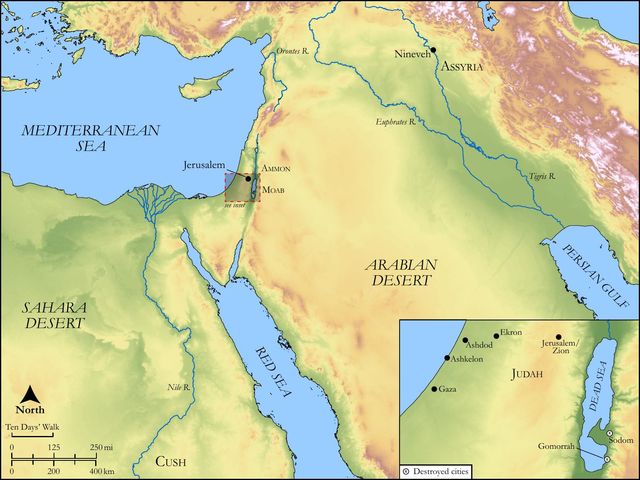
See on the biblical-era map
Study this verse
Public-domain commentary
Matthew Henry
From his Commentary on the Whole Bible. Henry comments on passages, not single verses — this entry covers Zephaniah 3:8–13. His three-level outline is real structure in the source text, so it is rendered as structure.
Things looked very bad with Jerusalem in the foregoing verses; she has got into a very bad name, and seems to be incorrigible, incurable, mercy-proof and judgment-proof. Now one would think it should follow, Therefore expect no other but that she should be utterly abandoned and rejected as reprobate silver; since they will not be wrought upon by prophets or providences, let them be made a desolation as their neighbours have been. But behold and wonder at the riches of divine grace, which takes occasion from man's badness to appear so much the more illustrious. They still grew worse and worse, therefore wait you upon me, saith the Lord, Zep 3:8. "Since the law, it seems, will make nothing perfect, the bringing in of a better hope shall. Let those that lament the corruptions of the church wait upon God, till he send his Son into the world, to save his people from their sins, till he send his gospel to reform and refine his church, and to purify to himself a peculiar people both of Jews and Gentiles." And there were those who, according to this direction and encouragement, waited for redemption, for this redemption in Jerusalem; and long-looked-for came at last, Luk 2:38. For judgment Christ will come into this world, Joh 9:39.
I.To avenge what has been done amiss against his church, to bring down and destroy the enemies of it, its spiritual enemies, of which the destruction of Babylon, and other oppressors of God's people, in the Old Testament times, was a type, and would be a happy presage. He will rise up to the prey, to lead captivity captive (Psa 68:18), to conquer and spoil the powers of darkness, and the powers on earth that set themselves against the Lord and his anointed; he will break them with a rod of iron (Psa 2:5, Psa 2:9; Psa 11:5, Psa 11:6); his determination is to gather the nations and to assemble the kingdoms. By the gospel of Christ preached to every creature all nations are summoned, as it were, to appear in a body before the Lord Jesus, who is about to set up his kingdom in the world. But, since the greatest part of mankind will not obey the summons, he will pour upon them his indignation, for he that believes not is condemned already. At the time of the setting up of the kingdom of the Messiah, there shall be on earth distress of nations with perplexity (Luk 21:25), great tribulation, such as never was, nor ever shall be, Mat 24:21. Then God pours upon the nations his indignation, even all his fierce anger, for their indignation and fierce anger against the Messiah and his kingdom, Psa 2:1, Psa 2:2. Then all the earth shall be devoured with the fire of his jealousy; both Jews and Gentiles shall be reckoned with for their enmity to the gospel. Principalities and powers shall be spoiled, and made a show of openly, and the victorious Redeemer shall triumph over them. The end of those that continue to be of the earth, and to mind earthly things, after God has set up the kingdom of heaven among men, shall be destruction (Phi 3:19); they shall be devoured with the fire of God's jealousy.
II.To amend what he finds amiss in his church.
When God intends the restoration of Israel, and the revival of their peace and prosperity, he makes way for the accomplishment of his purpose by their reformation and the revival of their virtue and piety; for this is God's method, both with particular persons and with communities, first to make them holy and then to make them happy. These promises were in part accomplished after the return of the Jews out of Babylon, when by their captivity they were thoroughly cured of their idolatry; and this was all the fruit, even the taking away of sin. But they look further, to the blessed effects of the gospel and the grace of it, to those times of reformation in which we live, Heb 9:10.
1.It is promised that there shall be a reformation in men's discourse, which had been generally corrupt, but should now be with grace seasoned with salt (Zep 3:9): "Then will I turn to the people a pure language; I will turn the people to such a language from that evil communication which has almost ruined all good manners among them." Note, Converting grace refines the language, not by making the phrases witty, but the substance wise. Among the Jews, after the captivity, there needed a reformation of the dialect, for they had mingled the language of Canaan with that of Ashdod (Neh 13:24), and that grievance shall be redressed. But that is not all: their language shall be purified from all profaneness, filthiness, and falsehood. I will turn them to a choice language (so some read it); they shall not speak rashly, but with caution and deliberation; they shall choose out their words. Note, An air of purity and piety in common conversation is a very happy omen to any people; other graces, other blessings, shall be given where God gives a pure language to those who have been a people of unclean lips.
2.That the worship of God, according to his will, shall be more closely applied to, and more unanimously concurred in. Instead of sacrifice and incense, they shall call upon the name of the Lord. Prayer is the spiritual offering with which God must be honoured; and, to prepare and fit us for that duty, it is necessary that we have a pure language. We are utterly unfit to take God's name into our lips, unless they be pure lips. The purifying of the language in common conversation is necessary to the acceptableness of the words of our mouth and the meditation of our heart on our devotion; for how can sweet waters and bitter come out of the same fountain? Jam 3:9-12. It is likewise promised that their language being thus purified they shall serve God with one consent, with one shoulder (so the word is), alluding to oxen in the yoke, that draw even. When Christians are unanimous in the service of God the work goes on cheerfully. This is the effect of the pure language, purified from passion, envy, and censoriousness. Note, Purity is the way to unity; the reformation of manners is the way to a comprehension. The wisdom from above is first pure, then peaceable.
3.That those that were driven from God shall return to him and be accepted of him (Zep 3:10): From beyond the rivers of Ethiopia, that is, from Egypt (so described, Isa 18:1) or from some other very remote country - my suppliants, even the daughter of my dispersed, shall bring my offering. Those that by reason of their distance had almost forgotten God, their obligations to him, shall be put in mind of him, as the prodigal son was of his father's house, in the far country. Those that by reason of their dispersion, under the tokens of his displeasure, might be afraid of coming to him, yet even they shall be gathered under his wings; the daughter of his dispersed, that is afar off, will be found among those whom the Lord our God shall call; and, though they are dispersed, he will own them for his; his calling them my dispersed puts honour upon them, sufficient to counterbalance all the disgrace of their dispersion. These shall come,
(1.)With their humble petitions: They are my suppliants. Note, True converts are suppliants to God; they do not plead, but make supplication to their Judge (Job 9:15); and wherever they are, though beyond the rivers of Ethiopia, a great way off from his house of prayer, he has his eye upon them and his ear open to them; they are his suppliants.
(2.)With their spiritual sacrifices: They shall bring my offering, shall bring themselves as spiritual sacrifices to God (Rom 12:1); the conversion of the Gentiles is called the offering up of the Gentiles (Rom 15:16); and with themselves they shall bring the gospel-sacrifices of prayer, and praise, and alms, with which God is well pleased.
4.That sin and sinners shall be purged out from among them, Zep 3:11. God will take away,
(1.)Their just reproach: In that day shalt thou not be ashamed for all thy doings. They shall be ashamed as penitents, and shall continue to be so (see Eze 16:63), but they shall not be ashamed as sinners that return to folly again. "Thou shalt not be ashamed, that is, thou shalt no more do a shameful thing, as thou hast done." The guilt of sin being taken away by pardoning mercy, the reproach of it shall be rolled away from the sinner's own conscience, that being purified, and pacified, and cleansed from dead works. When wickedness and wicked people abound in a nation those few in it that are good are ashamed of them and of their land; but when sinners are converted, and the land reformed, that shame and the cause of it are removed.
(2.)Their unjust glorying: "I will take away out of the midst of thee, not only the profane, who are a shame to thy land, but the hypocrites, who appear beautiful outwardly, and rejoice in thy pride, in the holy city, the holy house." These were indeed Israel's glory, but they made them their pride, and rejoiced in them, as if they were an invincible bulwark to secure them in their sinful ways; they relied on them as their righteousness and strength, boasting of the temple of the Lord, the temple of the Lord (Jer 7:4); they were haughty because of the holy mountain, were conceited of themselves, scornful of others, and set even the judgments of God at defiance. Note, Church-privileges, when they are not duly improved as they ought to be, are often made the matter of men's pride and the ground of their security. But that haughtiness is the most offensive to God which is supported and fed by the pretensions of holiness. This God will silence and take away.
5.That God will have a remnant of holy, humble, serious people among them, that shall have the comfort of their relation to him and interest in him (Zep 3:12): I will leave in the midst of thee an afflicted and poor people. When the Chaldeans carried away the Jews into captivity they left of the poor of the land for vine-dressers and husbandmen, a type and figure of God's distinguished remnant, whom he sets apart for himself. They are afflicted and poor, low in the world; such God has chosen, Jam 2:5. The poor are evangelized, low in their own eyes, afflicted for sin, poor in spirit. They are God's leaving, for it is a remnant according to the election of grace. I have reserved them to myself, says God (Rom 11:4, Rom 11:5), and they shall trust in the name of the Lord. Note, Those whom God designs for the glory of his name he enables to trust in his name; and the greater their affliction and poverty in the world are the more reason they see to trust in God, having nothing else to trust to, Ti1 5:5.
6.That this select remnant shall be blessed with purity and peace, Zep 3:13.
(1.)They shall be blessed with purity, both in words and actions: They shall neither do iniquity nor speak lies. Justice and veracity shall command them and govern them, though they be ever so much against their secular interest. They shall not only not speak a direct deliberate lie, but there shall not be a deceitful tongue found in their mouth, not in the mouth of any of them; not the least equivocation shall come from them.
(2.)They shall be blessed with peace. They shall, as the sheep of God's pasture, feed and lie down, and none shall make them afraid. They shall not be fearful themselves, nor shall any about them be frightful to them. Note, Those that are careful not to do iniquity need not be afraid of any calamity, for it cannot hurt them, and therefore should not terrify them.
Historical interpretation
Historical reception
1 surviving comment on this verse from the historical church.
(Verse 10 onwards) Beyond the rivers of Ethiopia, there my scattered children, the offspring of my dispersed ones, will bring a gift to me. On that day you will no longer be ashamed of all your rebellious acts against me, for then I will remove from your midst those who proudly boast of their arrogance, and you will no longer exalt yourself on my holy mountain. I will leave in your midst a humble and oppressed people, and they will trust in the name of the Lord. The remnant of Israel will not commit injustice or speak falsehood, and no deceitful tongue will be found in their mouths. They will feed and lie down, and no one will make them afraid. LXX: Concerning the boundaries of the rivers of Ethiopia, I will gather my dispersed ones. They will bring sacrifices to me. On that day, you will not be ashamed of all your inventions, in which you have acted impiously towards me, for then I will remove from you the arrogance of your insults, and you will no longer exalt yourself upon my holy mountain. I will leave in you a gentle and humble people, and they will revere the name of the Lord, those who remain of Israel. They will not commit iniquity, nor speak falsehoods, nor will there be deceitful language found in their mouths, for they will be nourished and lie down, and no one will make them afraid. When the Lord returns the chosen lip to the people of the believers, and all invoke the name of the Lord, and bear his yoke, then even beyond the rivers of Ethiopia (where the queen of Sheba came to hear the wisdom of Solomon) they will bring offerings to the Lord. And Ethiopia will stretch out its hand to God. And truly, the Ethiopian woman, who the lawgiver struck Egypt with ten plagues, will marry, while the Hebrew synagogue looks on with envy. But what he says according to the Hebrew: From there my supplicants, the daughter of my scattered ones, will bring me a gift of this kind: O Israel, formerly the assembly of daughters, whom I dispersed throughout the whole world, although you may envy, although you may be tormented by emulation, nevertheless from Ethiopia sacrifices will be brought to me, that is, from the Gentile people. In that day, that is, when the multitude of the Gentiles believes, even you will not be completely confounded above all your errors, by which you transgressed against me, choosing Barabbas and crucifying the Son of God (John 6). Then I will remove from your midst the scribes, and the priests, and the Pharisees, proud of your arrogance, and you will no longer boast on my holy mountain; but you will have a poor people, uneducated men, and fishermen, who will hope in the name of the Lord. The remnants of Israel, not the multitude that cried out, 'Crucify him, crucify him' (John 19:6): not the priests and the nobles; but the remnants will not commit iniquity, nor speak falsehood against Christ, believing in the truth: nor will deceitful language be found in their mouths, knowing that every lie is from the devil (John 8); for they themselves will be shepherded and will say: The Lord shepherds me, and I shall lack nothing; in the place of pasture, there he has placed me. He has led me beside still waters, he restores my soul (Psalm 23:1): and there will be no one to frighten, the pride of the persecutors being conquered by the faith of the believers. Let it be understood that this refers to the first coming of Christ, which the Jews promise to themselves in the end, and hope to dwell in Jerusalem, and to be satisfied and nourished with bodily gifts and Jewish resources like sheep, and with green herbs, and with all nations destroyed and subjected to themselves, so that no one can frighten them. But we, taking from this fable an opportunity for a true story, say that, by washing our stained and sinful souls, and by our lips being restored to their chosen and pure state (as Symmachus has explained), we have left behind us in the rivers of Ethiopia the masters of perverse doctrines, with whom we were once associated, and we will bear the gifts to Christ, the scattered Israel. On that day, in which the light of Christ rose for us, it will be said to each of us: you will not be ashamed of all your inventions, namely, the worst thoughts with which we acted impiously against the Lord, and all pride and contempt through which we exalted ourselves against the Lord and against His holy mountain, our Lord and Savior, and for proud and empty names there will be left in us a gentle and humble people, so that we may think of nothing arrogant, nothing boastful, nothing that displeases God. At the same time, consider that on the day of judgment and at the end of the world, all names of dignities will be taken away, and only one people will remain, and a flock under a good shepherd, who is meek and humble. Then even the people of Israel, as the fullness of the gentiles enters (For God has concluded them all in unbelief, that he may have mercy on all. - Romans 11:32), will fear the name of the Lord. And the remnant of Israel will no longer commit iniquity, having denied the Lord exceedingly, nor will they speak vanity, promising themselves foolish stories. And in their mouth, the tongue of deceit will not be found, while Christ, who is truth, speaks through them. For then they will feed, both themselves and in one flock, and they will recline in the Church, and they will not fear the true attacks of Nebuchadnezzar. Seeing and reading such great mysteries, let us cry out with the Apostle and say: O the depth of the riches of the wisdom and knowledge of God! How unsearchable are His judgments and His ways past finding out! (Rom. XI, 33). Which indeed the prophet, sensing and pondering within himself, suspects concerning the judgments of God. In the night, while I was meditating in my heart, and my spirit was tormented, I said: Is God going to cast off forever, or will he no longer show his mercy? Or will he keep his mercy locked up in his anger? And I said: Now I begin: this is the change of the right hand of the Most High (Psalm 76:7, following). And the meaning is this: I understood that what I thought, that the Lord would abandon sinners forever and hold back his mercy with anger succeeding, was done for this reason, so that by the change of his right hand, which is the right hand of the Most High, he would change everything and have mercy on those whom he had previously cast away. And we, both ourselves and the rest of Israel, knowing that we shall render an account for every idle word (Matthew 12), and that the Lord will destroy all lips that speak falsehood, let us not speak vanity. For vanity of vanities, and all is vanity (Ecclesiastes 1:2). And also: All the vanity of every living man (Psalm 38). Let us not speak lies with our mouths; but having received the power to tread upon serpents and scorpions, and upon all the power of the enemy (Luke 10), let us fear no terror, neither let us dread the snares of wolves with Christ as our guardian. But let us say, 'The Lord is my light and my salvation; whom shall I fear?' (Psalm 27:1). And so forth, which are contained in the twenty-sixth psalm.
Continue studying Zephaniah 3:11 across the web’s major study libraries — every link below opens this exact verse, chapter, or book on the destination site.
Read & Compare
 BibleGatewayThis verse in more than 200 translations and 70 languages.
 Bible.comThe YouVersion reader — hundreds of translations, reading plans, and highlights.
 ESV.orgCrossway's official English Standard Version reader.
 NET BibleThe NET translation with 60,000+ translators' notes on every rendering decision.
 STEP BibleTyndale House's free study tool — original text, vocabulary, and scholarly resources.
 BibliaLogos Bible Software's free web reader.
 USCCBThe New American Bible (Revised Edition) with the U.S. bishops' study notes.
Commentaries
 BibleHub CommentariesDozens of classic commentaries on this verse, gathered on one page.
 StudyLightMore than 100 commentary sets — the largest collection on the web.
 BibleRefPlain-English commentary on what this verse means, verse by verse.
 Enduring WordDavid Guzik's free commentary on this chapter, widely used by Bible teachers.
 Bible Study ToolsVerse commentary alongside Greek and Hebrew study aids.
Original Language & Research
- BibleHub InterlinearThe verse word by word — original language, transliteration, and English.
- BibleHub LexiconEvery word's original-language definition and Strong's entry.
 Blue Letter BibleDeep-study tools — Strong's numbers, concordance, and word studies.
 SefariaThe Hebrew text with Rashi and centuries of Jewish commentary.
Sermons, Hymns & Audio


TrulyRandomVerse is not affiliated with these sites and doesn’t control their content. They’re linked because they’re genuinely useful.
Summary
Zephaniah 3:11 is a prophetic declaration of God's future restoration and purification of His people, particularly Jerusalem. It envisions a day when the shame of past transgressions will be utterly removed, and the deep-seated pride and arrogance that characterized the nation will be purged from their midst. This divine cleansing will lead to a humble people, no longer boasting in their own status or religious privilege, but living in right relationship with God on His holy mountain.
Context
ShowHideLiterary Context
Zephaniah 3:11 stands as a pivotal verse within the concluding section of the book of Zephaniah (Zephaniah 3:9-20). The preceding chapters (Zephaniah 1-2) are dominated by severe pronouncements of judgment against Judah and surrounding nations, detailing the impending "Day of the Lord" as a time of wrath and destruction due to widespread idolatry, injustice, and spiritual apathy. However, beginning in Zephaniah 3:9, there is a dramatic shift to a message of hope, restoration, and salvation for a purified remnant. This verse specifically addresses the internal transformation of Jerusalem, moving from a state of guilt and pride to one of humility and freedom from shame, setting the stage for God's dwelling among them.
Historical & Cultural Context
Zephaniah prophesied during the reign of King Josiah (640-609 BC), a period marked by a brief but significant religious reform following decades of idolatry under Manasseh and Amon. Despite Josiah's efforts, deep-seated corruption and syncretism persisted in Judah, especially in Jerusalem. The "pride" (H1346, gaʼăvâh) and "haughtiness" (H1361, gâbahh) mentioned in the verse reflect the spiritual arrogance of the people, who often boasted in their status as God's chosen nation and the presence of the Temple in Jerusalem, rather than genuinely obeying God's covenant. This pride manifested in oppression, religious hypocrisy, and a false sense of security. The "holy mountain" (H2022, har qôdesh) refers to Mount Zion, where the Temple stood, symbolizing God's dwelling place and the center of Israelite worship.
Key Themes
ShowHideThis verse powerfully contributes to several overarching themes in Zephaniah and the broader prophetic literature. It highlights the theme of Divine Judgment and Purification, where God's wrath, though severe, ultimately serves a redemptive purpose to refine His people, removing their impurities, especially pride. It also emphasizes Restoration and Forgiveness, promising a future where the shame of past "doings" and "transgressions" is lifted, signifying God's profound grace and willingness to reconcile with a repentant remnant, as seen in the promise of a new covenant in Jeremiah 31:31-34. Crucially, the verse introduces the theme of Humility as a Prerequisite for Blessing, contrasting the haughtiness of the past with a future state where a humble people will dwell securely with God, reflecting the wisdom found in Proverbs 16:18 that "pride goeth before destruction."
Exposition and Analysis
ShowHideKey Word Analysis
ShowHideMeaning "a day (as the warm hours), whether literal (from sunrise to sunset, or from one sunset to the next), or figurative (a space of time defined by an associated term)." In this context, "In that day" signifies a specific, divinely appointed future period, often referring to the eschatological "Day of the Lord" which encompasses both judgment and ultimate salvation. It denotes a decisive turning point in redemptive history.
Meaning "to pale, i.e., by implication to be ashamed; also (by implication) to be disappointed or delayed." Here, it refers to the removal of the deep humiliation, guilt, and disgrace associated with past sins and rebellion against God. The promise is that God's people will no longer experience the internal or external consequences of their transgressions.
Meaning "arrogance or majesty; by implication, (concretely) ornament; excellency, haughtiness, highness, pride, proudly, swelling." This word captures the self-exaltation, boasting, and inflated sense of importance that characterized Jerusalem's spiritual state. It is a deep-seated spiritual malady that God promises to eradicate.
Meaning "to soar, i.e. be lofty; figuratively, to be haughty." This verb reinforces the noun "pride," describing the active state of being elevated in one's own eyes, looking down on others, and presuming upon God's favor without genuine obedience. It signifies an arrogant posture that God will remove.
Verse Breakdown
ShowHide"In that day shalt thou not be ashamed for all thy doings, wherein thou hast transgressed against me:"
This opening clause introduces a future era of divine grace. The phrase "In that day" points to the eschatological time of God's final intervention and restoration. The promise that Jerusalem will "not be ashamed" speaks to a complete removal of the guilt, humiliation, and public disgrace resulting from their past "doings" – their sinful actions – specifically identified as "transgressed against me," highlighting the personal nature of their rebellion against God's covenant. This signifies a profound forgiveness and a new beginning free from the burden of their past.
"for then I will take away out of the midst of thee them that rejoice in thy pride,"
This clause reveals the means by which the shame is removed: God's active intervention to purify His people. The phrase "take away out of the midst of thee" indicates a thorough cleansing, a removal from within the community itself. Those "that rejoice in thy pride" are not merely the proud, but those who find satisfaction and delight in their arrogance, perhaps boasting in their religious status, wealth, or perceived invincibility. God promises to purge these individuals or this pervasive attitude from the heart of Jerusalem.
"and thou shalt no more be haughty because of my holy mountain."
This final clause describes the ultimate outcome of God's purification: the eradication of haughtiness. The phrase "no more be haughty" emphasizes a permanent transformation of character. The source of this specific pride is identified as "because of my holy mountain," referring to Mount Zion and the Temple. This indicates that even religious privilege or the presence of God's sanctuary had become a source of sinful boasting and false security, rather than inspiring humility and worship. God will remove this misplaced pride, ensuring that His people approach Him with genuine reverence and humility.
Literary Devices
ShowHideZephaniah 3:11 employs several powerful literary devices. Prophecy is central, as the verse foretells a future state of restoration and transformation for Jerusalem, marked by divine intervention. Contrast is evident in the stark difference between the past state of shame and transgression and the future state of freedom from shame and pride. The phrase "my holy mountain" functions as Symbolism, representing not just a physical location (Mount Zion and the Temple) but also the spiritual identity and covenant relationship of God's people. The purging of those who "rejoice in thy pride" and the cessation of being "haughty" can be seen as a form of Metonymy, where the removal of the proud individuals signifies the removal of the sin of pride itself from the community. The overall tone shifts from the harshness of earlier judgments to one of hopeful Promise, emphasizing God's ultimate redemptive purpose.
Theological and Thematic Connections
ShowHideZephaniah 3:11 offers profound theological insights into God's character and His redemptive plan. It underscores God's unwavering commitment to His covenant people, even in their rebellion, demonstrating His ultimate desire for their purification and restoration. The removal of shame highlights God's complete forgiveness and His capacity to wipe away the stain of sin, allowing for a renewed relationship. Furthermore, the emphasis on purging pride reveals God's opposition to human self-exaltation and His demand for humility as the foundation for true worship and communal flourishing. This divine cleansing is not merely punitive but transformative, aimed at creating a people who rightly honor Him.
Reflection and Application
ShowHideZephaniah 3:11 provides a powerful lens through which to examine our own lives and communities. The promise of freedom from shame for past transgressions is a profound comfort, reminding us that through God's grace, our deepest failures can be forgiven and forgotten. This should inspire genuine repentance and a willingness to accept God's cleansing. Simultaneously, the verse serves as a stark warning against pride in all its forms. Whether it's boasting in our accomplishments, our spiritual knowledge, our social status, or even our religious affiliations, pride is an affront to God and a barrier to true communion with Him. We are called to cultivate humility, recognizing that all good things come from God and that our righteousness is found only in Him. This verse encourages us to continually examine our hearts, seeking God's help to root out any lingering arrogance so that we might live as a people wholly devoted to Him, free from self-exaltation, and truly reflecting His glory.
Questions for Reflection
ShowHideFAQ
ShowHideWhat does "In that day" refer to in Zephaniah 3:11?
ShowHide"In that day" (H3117, yôwm) in Zephaniah 3:11 refers to a future, divinely appointed time of restoration and salvation. While it has immediate implications for the post-exilic return of Judah, its ultimate fulfillment is eschatological, pointing to the comprehensive work of God in the Messianic age and the establishment of His kingdom. It signifies a decisive turning point in history when God intervenes to purify and redeem His people, transforming their character and dwelling among them. This concept of "the Day of the Lord" is a prominent theme throughout prophetic literature, encompassing both judgment for the wicked and salvation for the righteous remnant, as seen in passages like Joel 2:31-32.
Christ-Centered Fulfillment
ShowHideZephaniah 3:11 finds its ultimate and most profound fulfillment in Jesus Christ and the new covenant He inaugurated. The promise that God's people "shalt thou not be ashamed for all thy doings, wherein thou hast transgressed against me" is perfectly realized in Christ, who bore our shame and sin on the cross, offering complete forgiveness and justification to all who believe. Through His atoning sacrifice, we are declared righteous and stand before God without condemnation, as articulated in Romans 8:1. Furthermore, the prophecy that God "will take away out of the midst of thee them that rejoice in thy pride, and thou shalt no more be haughty because of my holy mountain" speaks to the spiritual transformation wrought by the Holy Spirit in the lives of believers. Christ's work not only removes the penalty of sin but also breaks its power, including the pervasive sin of pride. The new covenant empowers believers to live in humility, recognizing that all boasting is excluded, and our glory is found only in Christ Jesus, as Philippians 2:3-8 beautifully illustrates. The "holy mountain" now finds its spiritual reality in the church, the new Jerusalem, where God dwells among a people purified by Christ's blood, called to live in humility and unity, no longer relying on their own merits but on the grace of God through Christ, the true cornerstone of God's spiritual temple (Ephesians 2:19-22).