


Acts 22:2
Bible text: King James Version (1769 Blayney text) · Public domain
Bible text: Berean Standard Bible · Public domain
Bible text: American Standard Version (1901) · Public domain
Bible text: World English Bible, Messianic edition · Public domain
Bible text: Geneva Bible (1599) · Public domain
Bible text: Young's Literal Translation · Public domain
- ἀκούσαντεςakousantesHaving heardG191V-AAP-NPMVerb Aorist Active Participle Nominative Plural Masculine
- δὲdethenG1161CONJConjunction
- ὅτιhotithatG3754CONJConjunction
- τῇtēain theG3588T-DSFDefinite article Dative Singular Feminine
- ἙβραΐδιHebraidiHebrewG1446A-DSF-TAdjective Dative Singular Feminine Type
- διαλέκτῳdialektōlanguageG1258N-DSFNoun Dative Singular Feminine
- προσεφώνειprosephōneihe was addressingG4377V-IAI-3SVerb Imperfect Active Indicative 3rd Singular
- αὐτοῖςautoisthemG846P-DPMPersonal pronoun Dative Plural Masculine
- μᾶλλονmalloneven moreG3123ADVAdverb
- παρέσχονpareschonthey becameG3930V-2AAI-3PVerb 2nd Aorist Active Indicative 3rd Plural
- ἡσυχίανhēsuchianquietG2271N-ASFNoun Accusative Singular Feminine
- ΚαὶKaiAndG2532CONJConjunction
- φησίν·phēsinhe saysG5346V-PAI-3SVerb Present Active Indicative 3rd Singular
English is a literal word-by-word gloss of the Greek, not the KJV's wording. Why?
This is the original text the KJV's translators worked from — each Greek word with its own literal English meaning in this verse, prepared by scholars at Tyndale House, Cambridge. The KJV translates whole sentences, not word by word, so its wording differs: one Greek word can become several English words, and the KJV may choose “charity” where the gloss reads “love”. Both are faithful — they answer different questions. For the KJV's own rendering, switch to the KJV text.
Details
See on the biblical-era maps
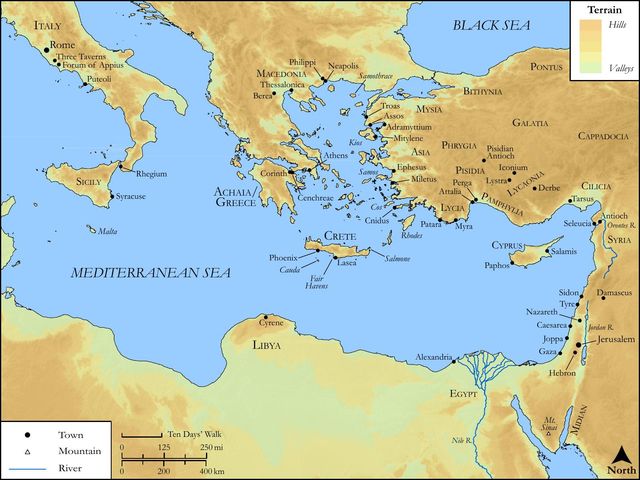
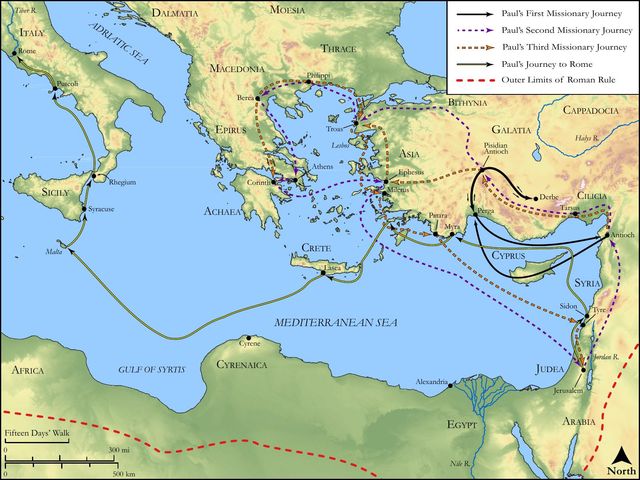
Study this verse
Public-domain commentary
Matthew Henry
From his Commentary on the Whole Bible. Henry comments on passages, not single verses — this entry covers Acts 22:1–2. His two-level outline is real structure in the source text, so it is rendered as structure.
Paul had, in the last verse of the foregoing chapter, gained a great point, by commanding so profound a silence after so loud a clamour. Now here observe,
I.With what an admirable composure and presence of mind he addresses himself to speak.
Never was poor man set upon in a more tumultuous manner, nor with more rage and fury; and yet, in what he said,
1.There appears o fright, but his mind is sedate and composed. Thus he makes his own words good, None of these things move me; and David's (Psa 3:6), I will not be afraid of ten thousands of people that have set themselves against me round about.
2.There appears no passion. Though the suggestions against him were all frivolous and unjust, though it would have vexed any man alive to be charged with profaning the temple just then when he was contriving and designing to show his respect to it, yet he breaks out into no angry expressions, but is led as a lamb to the slaughter.
II.What respectful titles he gives even to those who thus abused him, and how humbly he craves their attention:
"Men, brethren, and fathers, Act 22:1. To you, O men, I call; men, that should hear reason, and be ruled by it; men, from whom one may expect humanity. You, brethren of the common people; you, fathers of the priests." Thus he lets them know that he was one of them, and had not renounced his relation to the Jewish nation, but still had a kindness and concern for it. Note, Though we must not give flattering titles to any, yet we ought to give titles of due respect to all; and those we would do good to we should endeavour not to provoke. Though he was rescued out of their hands, and was taken under the protection of the chief captain, yet he does not fall foul upon them, with, Hear now, you rebels; but compliments them with, Men, brethren, and fathers. And observe, he does not exhibit a charge against them, does not recriminate, Hear now what I have to say against you, but, Hear now what I have to say for myself: Hear you my defence; a just and reasonable request, for every man that is accused has a right to answer for himself, and has not justice done him if his answer be not patiently and impartially heard.
III.The language he spoke in, which recommended what he said to the auditory; He spoke in the Hebrew tongue, that is, the vulgar language of the Jews, which, at this time, was not the pure Old Testament Hebrew, but the Syriac, a dialect of the Hebrew, or rather a corruption of it, as the Italian of the Latin. However,
1.It showed his continued respect to his countrymen, the Jews. Though he had conversed so much with the Gentiles, yet he still retained the Jews' language, and could talk it with ease; by this it appears he is a Jew, for his speech betrayeth him.
2.What he said was the more generally understood, for that was the language every body spoke, and therefore to speak in that language was indeed to appeal to the people, by which he might have somewhat to insinuate into their affections; and therefore, when they heard that he spoke in the Hebrew tongue, they kept the more silence. How can it be thought people should give any attention to that which is spoken to them in a language they do not understand? The chief captain was surprised to hear him speak Greek (Act 21:37), the Jews were surprised to hear him speak Hebrew, and both therefore think the better of him. But how would they have been surprised if they had enquired, as they ought to have done, and found in what variety of tongues the Spirit gave him utterance! Co1 14:18, I speak with tongues more than you all. But the truth is, many wise and good men are therefore slighted only because they are not known.
Historical interpretation
Historical reception
1 surviving comment on this verse from the historical church.
"And when they heard that he spake in the Hebrew tongue to them, they kept the more silence." Do you observe how the using the same tongue subdued them? In fact, they had a sort of awe for that language.
Continue studying Acts 22:2 across the web’s major study libraries — every link below opens this exact verse, chapter, or book on the destination site.
Read & Compare
 BibleGatewayThis verse in more than 200 translations and 70 languages.
 Bible.comThe YouVersion reader — hundreds of translations, reading plans, and highlights.
 ESV.orgCrossway's official English Standard Version reader.
 NET BibleThe NET translation with 60,000+ translators' notes on every rendering decision.
 STEP BibleTyndale House's free study tool — original text, vocabulary, and scholarly resources.
 BibliaLogos Bible Software's free web reader.
 USCCBThe New American Bible (Revised Edition) with the U.S. bishops' study notes.
Commentaries
 BibleHub CommentariesDozens of classic commentaries on this verse, gathered on one page.
 StudyLightMore than 100 commentary sets — the largest collection on the web.
 BibleRefPlain-English commentary on what this verse means, verse by verse.
 Enduring WordDavid Guzik's free commentary on this chapter, widely used by Bible teachers.
 Bible Study ToolsVerse commentary alongside Greek and Hebrew study aids.
Original Language & Research
- BibleHub InterlinearThe verse word by word — original language, transliteration, and English.
- BibleHub LexiconEvery word's original-language definition and Strong's entry.
 Blue Letter BibleDeep-study tools — Strong's numbers, concordance, and word studies.
 CNTR CollationThe earliest Greek manuscripts of this verse, collated letter by letter.
Sermons, Hymns & Audio


TrulyRandomVerse is not affiliated with these sites and doesn’t control their content. They’re linked because they’re genuinely useful.
Summary
Acts 22:2 captures a pivotal moment in Paul's defense before a hostile Jerusalem crowd, revealing the profound impact of his strategic communication. Following his arrest and rescue by Roman soldiers, Paul, granted permission to speak, addresses the enraged multitude in their native Aramaic, a decision that instantly transforms their violent clamor into attentive silence. This act not only disarms their prejudice and establishes a shared cultural identity but also powerfully demonstrates the wisdom and divine enablement guiding Paul's mission to proclaim the Gospel, setting the stage for his compelling testimony.
Context
ShowHideLiterary Context
Acts 22:2 is situated immediately after a tumultuous event where Paul is seized by an angry mob in the Temple courts, accused of defiling the holy site and teaching against Jewish law (Acts 21:27-30). The Roman commander, Claudius Lysias, intervenes to rescue Paul from being torn apart, bringing him to the barracks. As Paul is being led away, he requests permission to speak to the crowd, which Lysias grants, surprised by Paul's ability to speak Greek (Acts 21:37-40). This verse, Acts 22:2, marks the precise moment Paul begins his address, highlighting the immediate effect of his choice of language on the volatile audience, transitioning from violent shouts to profound silence before he even utters his first substantive word (Acts 22:1).
Historical & Cultural Context
First-century Jerusalem was a melting pot of cultures, but deeply rooted in Jewish tradition. The primary languages spoken were Aramaic (the common vernacular), Greek (the lingua franca of the Roman Empire), and Hebrew (primarily for religious texts and scholarly discourse). Paul, a Hellenistic Jew from Tarsus, was fluent in both Greek and Aramaic/Hebrew (Acts 21:39). The crowd, composed of devout Jews, would have been highly sensitive to cultural and linguistic nuances. Their fury stemmed from accusations that Paul had abandoned Jewish customs and brought Gentiles into the Temple (Acts 21:28). By choosing to speak in the "Hebrew tongue" (likely Aramaic, the common Semitic dialect of Judea), Paul strategically tapped into their shared heritage, signaling his solidarity and demonstrating he was not a foreign intruder or a fully Hellenized apostate, but one of them. This linguistic choice was a powerful act of cultural identification.
Key Themes
ShowHidePaul's decision to speak in Aramaic powerfully illustrates the theme of Strategic Communication in evangelism. It demonstrates his profound understanding of his audience and his willingness to adapt his approach to gain a hearing, echoing his later principle of "becoming all things to all people" (1 Corinthians 9:20-22). This act also underscores the theme of Cultural Identity and Solidarity; Paul, despite his Roman citizenship and extensive missionary journeys among Gentiles, reaffirms his Jewish roots, seeking to bridge the chasm of misunderstanding and hostility. The resulting "silence" highlights the theme of De-escalation and Respect, showing how a simple, culturally sensitive gesture can transform a volatile situation into an opportunity for dialogue and testimony, allowing the powerful message of the Gospel to be heard (Acts 22:3ff).
Exposition and Analysis
ShowHideKey Word Analysis
ShowHideThis primary verb signifies not merely the physical act of hearing, but often implies attentive listening, comprehension, and even obedience. In this context, it denotes the crowd's initial reception of Paul's voice and, more significantly, their recognition of the language he chose, which prompted a change in their disposition.
This term refers to the Hebraistic or Jewish language, which in the first century Judean context predominantly meant Aramaic, the common vernacular Semitic language. Paul's use of this language was a profound cultural signal, indicating his shared identity and heritage with his Jewish listeners.
Derived from dialégomai (to converse), this noun refers to a mode of discourse or a specific dialect/language. Its use here emphasizes that Paul spoke in the particular dialect familiar and native to the Jerusalem Jews, distinguishing it from Greek or classical Hebrew, and underscoring the intimacy and authenticity of his address.
This word denotes stillness, quietness, or desistance from bustle or language. In Acts 22:2, it describes the dramatic cessation of the crowd's angry shouts and clamor, replaced by a profound quietude that signifies not just an absence of noise, but a newfound willingness to listen and an acknowledgment of Paul's authority or connection.
Verse Breakdown
ShowHide"And when they heard that he spake in the Hebrew tongue to them"
This clause describes the immediate reaction of the Jewish crowd to Paul's opening words. The phrase "Hebrew tongue" (Ἑβραΐδι διαλέκτῳ, Hebraïdi dialektō) indicates Paul's deliberate choice to address them in Aramaic, their common language. This linguistic pivot was instantly recognizable and profoundly impactful, signaling to the agitated crowd that Paul was not a foreign agitator or a Roman sympathizer, but one of their own, capable of speaking their native dialect. This recognition was crucial in shifting their perception of him.
"they kept the more silence"
This phrase highlights the dramatic and immediate effect of Paul's linguistic choice. The word "more" (μᾶλλον, mâllon) emphasizes a heightened degree of silence, indicating that the angry shouts and clamor that had previously filled the air (Acts 21:34-36) ceased abruptly and completely. This profound quietude was not merely an absence of noise but a powerful demonstration of respect, attention, and a willingness to hear Paul's defense, a testament to the effectiveness of his strategic communication.
"and he saith,"
This concluding phrase serves as a narrative transition, indicating that following the crowd's attentive silence, Paul then began his formal address. It sets the stage for the detailed defense of his life and ministry that follows in Acts 22:3-21. The pause between the crowd's reaction and Paul's speech underscores the significance of the silence he had just commanded.
Literary Devices
ShowHideActs 22:2 masterfully employs several literary devices to convey the dramatic shift in the narrative. Dramatic Irony is present, as the crowd, intent on killing Paul, is unwittingly silenced by his very act of cultural identification, which they initially perceive as a sign of commonality, not as a prelude to a defense of the Christian faith. Foreshadowing is evident in the sudden silence; it hints at the power of Paul's subsequent testimony and the potential for the Gospel message to penetrate even the most hardened hearts, albeit temporarily in this case. The entire scene is a powerful example of Rhetorical Strategy and Pathos. Paul's choice of language is a deliberate rhetorical move designed to appeal to the crowd's emotions and cultural identity, effectively disarming their hostility and creating an opening for his message. The abrupt transition from chaos to Silence itself acts as a powerful literary device, emphasizing the profound impact of Paul's decision and building suspense for the speech that follows.
Theological and Thematic Connections
ShowHideActs 22:2 underscores the theological truth of divine providence and the strategic wisdom granted to God's messengers. Paul's ability to command such a volatile crowd's attention through a simple linguistic choice speaks to a wisdom beyond his own, suggesting divine enablement for the proclamation of the Gospel. This moment highlights the importance of cultural sensitivity and contextualization in evangelism, demonstrating that effective communication often requires meeting people where they are, both linguistically and culturally, to create an open door for truth. It also foreshadows the ongoing tension between Paul's Jewish heritage and his apostolic calling to the Gentiles, a central theme throughout Acts.
Reflection and Application
ShowHideActs 22:2 offers profound insights into the art of communication, especially in challenging or hostile environments. Paul's example teaches us the critical importance of understanding our audience and adapting our approach to effectively convey our message. In our own lives, whether sharing our faith, resolving conflict, or simply engaging in meaningful dialogue, we are called to discern the most effective way to connect with others. This might involve setting aside our own preferences, learning new ways of expressing ourselves, or simply listening empathetically to build rapport. The sudden "silence" Paul achieved reminds us that true communication begins not just with speaking, but with creating an environment where others are willing to listen. It challenges us to consider how we can de-escalate tension and foster an atmosphere of respect, even when faced with opposition, allowing truth and grace to find a hearing.
Questions for Reflection
ShowHideFAQ
ShowHideWhat was the "Hebrew tongue" Paul spoke, and why was it significant?
ShowHideThe "Hebrew tongue" (Greek: Hebraïdi dialektō) in Acts 22:2 most likely refers to Aramaic, the common Semitic language spoken by Jews in Judea during the first century, rather than classical Hebrew, which was primarily used for religious texts. Paul's choice to speak in Aramaic was profoundly significant because it immediately disarmed the hostile Jewish crowd. They had been enraged, accusing him of defiling the Temple and abandoning Jewish law (Acts 21:28). By speaking in their vernacular, Paul demonstrated his deep connection to their shared heritage and culture, signaling that he was one of them, not a foreign intruder or a Roman sympathizer. This act of cultural identification instantly transformed their violent clamor into attentive silence, creating an opening for him to present his defense (Acts 22:3ff).
How does Paul's communication strategy in Acts 22:2 apply to modern evangelism or cross-cultural communication?
ShowHidePaul's strategy in Acts 22:2 provides a timeless model for effective communication, particularly in evangelism and cross-cultural contexts. It highlights the importance of contextualization – adapting one's message and approach to resonate with the audience's cultural and linguistic framework. Instead of imposing a foreign language or style, Paul met the crowd where they were, speaking in a way that affirmed his shared identity with them. This teaches us to: 1) Understand our audience: Research and empathize with their worldview, values, and concerns. 2) Build bridges, not walls: Find common ground, whether cultural, linguistic, or experiential, to establish rapport. 3) Prioritize clarity and receptivity: The goal is not just to speak, but to be heard and understood. Paul's example reminds us that sometimes, a simple, culturally sensitive gesture can be more powerful than elaborate rhetoric in opening hearts and minds to the Gospel message (1 Corinthians 9:19-23).
Christ-Centered Fulfillment
ShowHideWhile Acts 22:2 focuses on Paul's strategic communication, it ultimately points to Christ in profound ways. Paul's ability to bridge a seemingly insurmountable cultural and linguistic divide to present his testimony mirrors the ultimate work of Christ, who, though divine, "emptied himself, by taking the form of a servant, being born in the likeness of men" (Philippians 2:7). Jesus, the Word made flesh, condescended to speak in human language, living among us to make God known (John 1:14). Just as Paul's Aramaic address prepared the way for his defense, Christ's incarnation prepared the way for the ultimate revelation of God's redemptive plan. Furthermore, the power of Paul's words to command silence and attention is a faint echo of the authority of Jesus, who could calm storms with a word (Mark 4:39) and whose teaching astonished the crowds (Matthew 7:28-29). The Gospel message, which Paul was about to proclaim, is inherently universal, transcending all linguistic and cultural barriers through the power of the Holy Spirit, as powerfully demonstrated at Pentecost where people from every nation heard the mighty works of God in their own languages (Acts 2:4-11). Thus, Paul's strategic act in Acts 22:2 is a beautiful, Spirit-empowered illustration of the incarnational principle of the Gospel, which seeks to meet humanity where it is, in order to lead it to Christ.