


Acts 22:6
Bible text: King James Version (1769 Blayney text) · Public domain
Bible text: King James Version with Strong's numbers · Public domain
Bible text: Berean Standard Bible · Public domain
Bible text: American Standard Version (1901) · Public domain
Bible text: World English Bible, Messianic edition · Public domain
Bible text: Geneva Bible (1599) · Public domain
Bible text: Young's Literal Translation · Public domain
- ἐγένετοegenetoIt happenedG1096V-2ADI-3SVerb 2nd Aorist Middle Deponent Indicative 3rd Singular
- δέdehoweverG1161CONJConjunction
- μοιmoito meG3165P-1DSPersonal pronoun Dative 1st Singular
- πορευομένῳporeuomenōjourneyingG4198V-PNP-DSMVerb Present Middle Or Passive Deponent Participle Dative Singular Masculine
- καὶkaiandG2532CONJConjunction
- ἐγγίζοντιengizontidrawing nearG1448V-PAP-DSMVerb Present Active Participle Dative Singular Masculine
- τῇtēa<the>G3588T-DSFDefinite article Dative Singular Feminine
- ΔαμασκῷDamaskōto DamascusG1154N-DSF-LNoun Dative Singular Feminine Location
- περὶperiaboutG4012PREPPreposition
- μεσημβρίανmesēmbriannoonG3314N-ASFNoun Accusative Singular Feminine
- ἐξαίφνηςexaiphnēssuddenlyG1810ADVAdverb
- ἐκekout ofG1537PREPPreposition
- τοῦtou<the>G3588T-GSMDefinite article Genitive Singular Masculine
- οὐρανοῦouranouheavenG3772N-GSMNoun Genitive Singular Masculine
- περιαστράψαιperiastrapsaishiningG4015V-AANVerb Aorist Active Infinitive
- φῶςphōsa lightG5457N-ASNNoun Accusative Singular Neuter
- ἱκανὸνhikanongreatG2425A-ASNAdjective Accusative Singular Neuter
- περὶperiaroundG4012PREPPreposition
- ἐμέ·ememe myselfG1473P-1ASPersonal pronoun Accusative 1st Singular
English is a literal word-by-word gloss of the Greek, not the KJV's wording. Why?
This is the original text the KJV's translators worked from — each Greek word with its own literal English meaning in this verse, prepared by scholars at Tyndale House, Cambridge. The KJV translates whole sentences, not word by word, so its wording differs: one Greek word can become several English words, and the KJV may choose “charity” where the gloss reads “love”. Both are faithful — they answer different questions. For the KJV's own rendering, switch to the KJV text.
Details
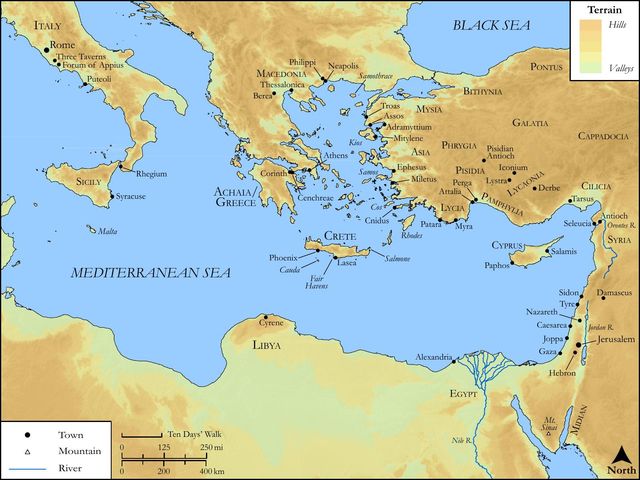
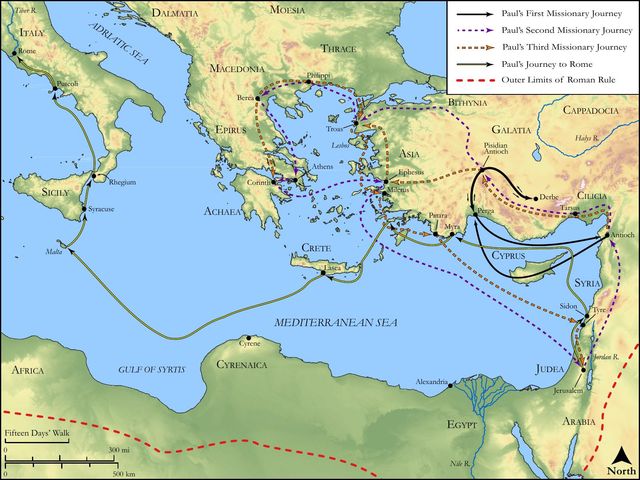
See on the biblical-era maps
Study this verse
Public-domain commentary
Matthew Henry
From his Commentary on the Whole Bible. Henry comments on passages, not single verses — this entry covers Acts 22:3–21. His four-level outline is real structure in the source text, so it is rendered as structure.
Paul here gives such an account of himself as might serve not only to satisfy the chief captain that he was not that Egyptian he took him to be, but the Jews also that he was not that enemy to their church and nation, to their law and temple, they took him to be, and that what he did in preaching Christ, and particularly in preaching him to the Gentiles, he did by a divine commission. He here gives them to understand,
I.What his extraction and education were.
1. That he was one of their own nation, of the stock of Israel, of the seed of Abraham, a Hebrew of the Hebrews, not of any obscure family, or a renegado of some other nation: "No, I am verily a man who is a Jew, anēr Ioudaios - a Jewish man; I am a man, and therefore ought not to be treated as a beast; a man who is a Jew, not a barbarian; I am a sincere friend to your nation, for I am one of it, and should defile my own nest if I should unjustly derogate from the honour of your law and your temple." 2. That he was born in a creditable reputable place, in Tarsus, a city of Cilicia, and was by his birth a freeman of that city. He was not born in servitude, as some of the Jews of the dispersion, it is likely, were; but he was a gentleman born, and perhaps could produce his certificate of his freedom in that ancient and honourable city. This was, indeed, but a small matter to make any boast of, and yet it was needful to be mentioned at this time to those who insolently trampled upon him, as if he were to be ranked with the children of fools, yea, the children of base men, Job 30:8. 3. That he had a learned and liberal education. He was not only a Jew, and a gentleman, but a scholar. He was brought up in Jerusalem, the principal seat of the Jewish learning, and at the feet of Gamaliel, whom they all knew to be an eminent doctor of the Jewish law, of which Paul was designed to be himself a teacher; and therefore he could not be ignorant of their law, nor be thought to slight it because he did not know it. His parents had brought him very young to this city, designing him for a Pharisee; and some think his being brought up at the feet of Gamaliel intimates, not only that he was one of his pupils, but that he was, above any other, diligent and constant in attending his lectures, observant of him, and obsequious to him, in all he said, as Mary, that sat at Jesus' feet, and heard his word. 4. That he was in his early days a very forward and eminent professor of the Jews' religion; his studies and learning were all directed that way. So far was he from being principled in his youth with any disaffection to the religious usages of the Jews that there was not a young man among them who had a greater and more entire veneration for them than he had, was more strict in observing them himself, or more hot in enforcing them upon others. (1.) He was an intelligent professor of their religion, and had a clear head. He minded his business at Gamaliel's feet, and was there taught according to the perfect manner of the law of the fathers. What departures he had made from the law were not owing to any confused or mistaken notions of it, for he understood it to a nicety, kata akribeian - according to the most accurate and exact method. He was not trained up in the principles of the latitudinarians, had nothing in him of a Sadducee, but was of that sect that was most studious in the law, kept most close to it, and, to make it more strict than it was, added to it the traditions of the elders, the law of the fathers, the law which was given to them, and which they gave to their children, and so it was handed down to us. Paul had as great a value for antiquity, and tradition, and the authority of the church, as any of them had; and there was never a Jew of them all that understood his religion better than Paul did, or could better give an account of it or a reason for it. (2.) He was an active professor of their religion, and had a warm heart: I was zealous towards God, as you all are this day. Many that are very well skilled in the theory of religion are willing to leave the practice of it to others, but Paul was as much a zealot as a rabbi. He was zealous against every thing that the law prohibited, and for every thing that the law enjoined; and this was zeal towards God, because he thought it was for the honour of God and the service of his interests; and here he compliments his hearers with a candid and charitable opinion of them, that they all were this day zealous towards God; he bears them record (Rom 10:2), that they have a zeal for God, but not according to knowledge. In hating him, and casting him out, they said, Let the Lord be glorified (Isa 66:5), and, though this did by no means justify their rage, yet it enabled those that prayed, Father, forgive them, to plead, as Christ did, For they know not what they do. And when Paul owns that he had been zealous for God in the law of Moses, as they were this day, he intimates his hope that they might be zealous for God, in Christ, as he was this day.
II.What a fiery furious persecutor he had been of the Christian religion in the beginning of his time, Act 22:4, Act 22:5.
He mentions this to make it the more plainly and evidently to appear that the change which was wrought upon him, when he was converted to the Christian faith, was purely the effect of a divine power; for he was so far from having any previous inclinations to it, or favourable opinions of it, that immediately before that sudden change was wrought in him he had the utmost antipathy imaginable to Christianity, and was filled with rage against it to the last degree. And perhaps he mentions it to justify God in his present trouble; how unrighteous soever those were that persecuted him, God was righteous, who permitted them to do it, for time was when he was a persecutor; and he may have a further view in it to invite and encourage those people to repent, for he himself had been a blasphemer, and a persecutor, and yet obtained mercy. Let us view Paul's picture of himself when he was a persecutor.
1.He hated Christianity with a mortal enmity: I persecuted this way unto the death, that is, "Those that walked in this way I aimed, if possible, to be the death of." He breathed out slaughter against them, Act 9:1. When they were put to death, he gave his voice against them, Act 26:10. Nay, he persecuted not only those that walked in this way, but the way itself, Christianity, which was branded as a byway, a sect; he aimed to persecute this to the death, to be the ruin of this religion. He persecuted it to the death, that is, he could have been willing himself to die in his opposition to Christianity, so some understand it. He would contentedly have lost his life, and would have thought it well laid out, in defence of the laws and traditions of the fathers.
2.He did all he could to frighten people from this way, and out of it, by binding and delivering into prison both men and women; he filled the jails with Christians. Now that he himself was bound, he lays a particular stress upon this part of his charge against himself, that he had bound the Christians, and carried them to prison; he likewise reflects upon it with a special regret that he had imprisoned not only the men, but the women, the weaker sex, who ought to be treated with particular tenderness and compassion.
3.He was employed by the great sanhedrim, the high priest, and all the estate of the elders, as an agent for them, in suppressing this new sect; so much had he already signalized himself for his zeal against it, Act 22:5. The high priest can witness for him that he was ready to be employed in any service against the Christians. When they heard that many of the Jews at Damascus had embraced the Christian faith, to deter others from doing the like they resolved to proceed against them with the utmost severity, and could not think of a fitter person to be employed in that business, nor one more likely to go through with it, than Paul. They therefore sent him, and letters by him, to the Jews at Damascus, here called the brethren, because they all descended from one common stock, and were of one family in religion too, ordering them to be assisting to Paul in seizing those among them that had turned Christians, and bringing them up prisoners to Jerusalem, in order to their being punished as deserters from the faith and worship of the God of Israel; and so might either be compelled to retract, or be put to death for a terror to others. Thus did Saul make havoc of the church, and was in a fair way, if he had gone on awhile, to ruin it, and root it out. "Such a one," says Paul, "I was at first, just such as you now are. I know the heart of a persecutor, and therefore pity you, and pray that you may know the heart of a convert, as God soon made me to do. And who was I that I could withstand God?"
III.In what manner he was converted and made what he now was.
It was not from any natural or external causes; he did not change his religion from an affectation of novelty, for he was then as well affected to antiquity as he used to be; nor did it arise from discontent because he was disappointed in his preferment, for he was now, more than ever, in the way of preferment in the Jewish church; much less could it arise from covetousness, or ambition, or any hope of mending his fortune in the world by turning Christian, for it was to expose himself to all manner of disgrace and trouble; nor had he any conversation with the apostles or any other Christians, by whose subtlety and sophistry he might be thought to have been wheedled into this change. No, it was the Lord's doing, and the circumstances of the doing of it were enough to justify him in the change, to all those who believe there is a supernatural power; and none can condemn him for it, without reflecting upon that divine energy by which he was herein overruled. He relates the story of his conversion here very particularly, as we had it before (ch. 9), aiming to show that it was purely the act of God.
1.He was a fully bent upon persecuting the Christians just before Christ arrested him as ever. He made his journey, and was come nigh to Damascus (Act 22:6), and had no other thought than to execute the cruel design he was sent upon; he was not conscious of the least compassionate relentings towards the poor Christians, but still represented them to himself as heretics, schismatics, and dangerous enemies both to church and state.
2.It was a light from heaven that first startled him, a great light, which shone suddenly round about him, and the Jews knew that God is light, and his angels angels of light, and that such a light as this shining at noon, and therefore exceeding that of the sun, must be from God. Had it shone in upon him into some private room, there might have been a cheat in it, but it shone upon him in the open road, at high noon, and so strongly that it struck him to the ground (Act 22:7), and all that were with him, Act 26:14. They could not deny but that surely the Lord was in this light.
3.It was a voice from heaven that first begat in him awful thoughts of Jesus Christ, of whom before he had had nothing but hateful spiteful thoughts. The voice called to him by name, to distinguish him from those that journeyed with him, Saul, Saul, why persecutest thou me? And when he asked, Who art thou, Lord? it was answered, I am Jesus of Nazareth, whom thou persecutest, Act 22:8. By which it appeared that this Jesus of Nazareth, whom they also were now persecuting, was one that spoke from heaven, and they knew it was dangerous resisting one that did so, Heb 12:25.
4.Lest it should be objected, "How came this light and voice to work such a change upon him, and not upon those that journeyed with him?" (though, it is very probable, it had a good effect upon them, and that they thereupon became Christians), he observes that his fellow travellers saw indeed the light, and were afraid they should be consumed with fire from heaven, their own consciences, perhaps, now telling them that the way they were in was not good, but like Balaam's when he was going to curse Israel, and therefore they might expect to meet an angel with a flaming glittering sword; but, though the light made them afraid, they heard not the voice of him that spoke to Paul, that is, they did not distinctly hear the words. Now faith comes by hearing, and therefore that change was now presently wrought upon him that heard the words, and heard them directed to himself, which was not wrought upon those who only saw the light; and yet it might afterwards be wrought upon them too.
5.He assures them that when he was thus startled he referred himself entirely to a divine guidance; he did not hereupon presently cry out, "Well, I will be a Christian," but, "What shall I do, Lord? Let the same voice from heaven that has stopped me in the wrong way guide me into the right way, Act 22:10. Lord, tell me what I shall do, and I will do it." And immediately he had directions to go to Damascus, and there he should hear further from him that now spoke to him: "No more needs to be said from heaven, there it shall be told thee, by a man like thyself, in the name of him that now speaks to thee, all things which are appointed for thee to do." The extraordinary ways of divine revelation, by visions, and voices, and the appearance of angels, were designed, both in the Old Testament and in the New, only to introduce and establish the ordinary method by the scriptures and a standing ministry, and therefore were generally superseded when these were settled. The angel did not preach to Cornelius himself, but bade him send for Peter; so the voice here tells not Paul what he shall do, but bids him go to Damascus, and there it shall be told him.
6.As a demonstration of the greatness of that light which fastened upon him, he tells them of the immediate effect it had upon his eye-sight (Act 22:11): I could not see for the glory of that light. It struck him blind for the present. Nimium sensibile laedit sensum - Its radiance dazzled him. Condemned sinners are struck blind, as the Sodomites and Egyptians were, by the power of darkness, and it is a lasting blindness, like that of the unbelieving Jews; but convinced sinners are struck blind, as Paul here was, not by darkness, but by light: they are for the present brought to be at a loss within themselves, but it is in order to their being enlightened, as the putting of clay upon the eyes of the blind man was the designed method of his cure. Those that were with Paul had not the light so directly darted into their faces as Paul had unto his, and therefore they were not blinded, as he was; yet, considering the issue, who would not rather have chosen his lot than theirs? They, having their sight, led Paul by the hand into the city. Paul, being a Pharisee, was proud of his spiritual eyesight. The Pharisees said, Are we blind also? Joh 9:40. Nay, they were confident that they themselves were guides to the blind, and lights to those that were in darkness, Rom 2:19. Now Paul was thus struck with bodily blindness to make him sensible of his spiritual blindness, and his mistake concerning himself, when he was alive without the law, Rom 7:9.
IV.How he was confirmed in the change he had made, and further directed what he should do, by Ananias who lived at Damascus.
Observe, 1. The character here given of Ananias. He was not a man that was any way prejudiced against the Jewish nation or religion, but was himself a devout man according to the law; if not a Jew by birth, yet one that had been proselyted to the Jewish religion, and therefore called a devout man, and thence advanced further to the faith of Christ; and he conducted himself so well that he had a good report of all the Jews that dwelt at Damascus. This was the first Christian that Paul had any friendly communication with, and it was not likely that he should instil into him any such notions as they suspected him to espouse, injurious to the law or to this holy place.
2.The cure immediately wrought by him upon Paul's eyes, which miracle was to confirm Ananias's mission to Paul, and to ratify all that he should afterwards say to him. He came to him (Act 22:13); and, to assure him that he came to him from Christ (the very same who had torn and would heal him, had smitten, but would bind him up, had taken away his sight, but would restore it again, with advantage), he stood by him, and said, Brother Saul, receive thy sight. Power went along with this word, and the same hour, immediately, he recovered his sight, and looked up upon him, ready to receive from him the instructions sent by him.
3.The declaration which Ananias makes to him of the favour, the peculiar favour, which the Lord Jesus designed him above any other.
(1.)In the present manifestation of himself to him (Act 22:14): The God of our fathers has chosen thee. This powerful call is the result of a particular choice; his calling God the God of our fathers intimates that Ananias was himself a Jew by birth, that observed the law of the fathers, and lived upon the promise made unto the fathers; and he gives a reason why he said Brother Saul, when he speaks of God as the God of our fathers: This God of our fathers has chosen thee that thou shouldst,
[1.]Know his will, the will of his precept that is to be done by thee, the will of his providence that is to be done concerning thee. He hath chosen thee that thou shouldst know it in a more peculiar manner; not of man nor by man, but immediately by the revelation of Christ, Gal 1:1, Gal 1:12. Those whom God hath chosen he hath chosen to know his will, and to do it.
[2.]That thou shouldst see that Just One, and shouldst hear the voice of his mouth, and so shouldst know his will immediately from himself. This was what Paul was, in a particular manner, chosen to above others; it was a distinguishing favour, that he should see Christ here upon earth after his ascension into heaven. Stephen saw him standing at the right hand of God, but Paul saw him standing at his right hand. This honour none had but Paul. Stephen saw him, but we do not find that he heard the voice of his mouth, as Paul did, who says, he was last of all seen of me, as of one born out of due time, Co1 15:8. Christ is here called that Just One; for he is Jesus Christ the righteous, and suffered wrongfully. Observe, Those whom God has chosen to know his will must have an eye to Christ, and must see him, and hear the voice of his mouth; for it is by him that God has made known his will, his good-will to us, and he has said, Hear you him.
(2.)In the after-manifestation of himself by him to others (Act 22:15): "Thou shalt be his witness, not only a monument of his grace, as a pillar may be, but a witness viva voce - by word of mouth; thou shalt publish his gospel, as that which thou hast experienced the power of, and been delivered into, the mould of; thou shalt be his witness unto all men, Gentiles as well as Jews, of what thou hast seen and heard, now at the very first." And finding Paul so particularly relating the manner of his conversation in his apologies for himself, here and ch. 26, we have reason to think that he frequently related the same narrative in his preaching for the conversion of others; he told them what God had done for his soul, to encourage them to hope that he would do something for their souls.
4.The counsel and encouragement he gave him to join himself to the Lord Jesus by baptism (Act 22:16): Arise, and be baptized, He had in his circumcision been given up to God, but he must now by baptism be given up to God in Christ - must embrace the Christian religion and the privileges of it, in submission to the precepts of it. This must now be done immediately upon his conversion, and so was added to his circumcision: but to the seed of the faithful it comes in the room of it; for it is, as that was to Abraham and his believing seed, a seal of the righteousness which is by faith.
(1.)The great gospel privilege which by baptism we have sealed to us is the remission of sins: Be baptized and wash away thy sins; that is, "Receive the comfort of the pardon of thy sins in the through Jesus Christ and lay hold of his righteousness for that purpose, and receive power against sin for the mortifying of thy corruption;" for our being washed includes our being both justified and sanctified, Co1 6:11. Be baptized, and rest not in the sign, but make sure of the thing signified, the putting away of the filth of sin.
(2.)The great gospel duty which by our baptism we are bound to is to call on the name of the Lord, the Lord Jesus; to acknowledge him to be our Lord and our God, and to apply to him accordingly; to give honour to him, to put all our petitions in his hand. To call on the name of Jesus Christ our Lord (Son of David, have mercy on us) is the periphrasis of a Christian, Co1 1:2. We must wash away our sins, calling on the name of the Lord; that is, we must seek for the pardon of our sins in Christ's name, and in dependence on him and his righteousness. In prayer, we must not any longer call God the God of Abraham, but the Father of our Lord Jesus Christ, and in him our Father; in every prayer, our eye must be to Christ.
(3.)We must do this quickly. Why tarriest thou? Our covenanting with God in Christ is needful work, that must not be deferred. The case is so plain that it is needless to deliberate; and the hazard so great that it is folly to delay. Why should not that be done at the present time that must be done some time, or we are undone?
V.How he was commissioned to go and preach the gospel to the Gentiles.
This was the great thing for which they were so angry at him, and therefore it was requisite he should for this, in a special manner, produce a divine warrant; and here he does it. This commission he did not receive presently upon his conversion, for this was at Jerusalem, whither he did not go till three years after, or more (Gal 1:18); and whether it was then, or afterwards, that he had this vision here spoken of, we are not certain. But, to reconcile them, if possible, to his preaching the gospel among the Gentiles, he tells them,
1.That he received his orders to do it when he was at prayer, begging of God to appoint him his work and to show him the course he should steer; and (which was a circumstance that would have some weight with those he was now speaking to) he was at prayer in the temple, which was to be called a house of prayer for all people; not only in which all people should pray, but in which all people should be prayed for. Now as Paul's praying in the temple was an evidence, contrary to their malicious suggestion, that he had a veneration for the temple, though he did not make an idol of it as they did; so God's giving him this commission there in the temple was an evidence that the sending him to the Gentiles would be no prejudice to the temple, unless the Jews by their infidelity made it so. Now it would be a great satisfaction to Paul afterwards, in the execution of this commission, to reflect upon it that he received it when he was at prayer.
2.He received it in a vision. He fell into a trance (Act 22:17), his external senses, for the present, locked up; he was in an ecstasy, as when he was caught up into the third heaven, and was not at that time sensible whether he was in the body or out of the body. In this trance he saw Jesus Christ, not with the eyes of his body, as at his conversion, but represented to the eye of his mind (Act 22:18): I saw him saying unto me. Our eye must be upon Christ when we are receiving the law from his mouth; and we must not only hear him speak, but see him speaking to us.
3.Before Christ gave him a commission to go to the Gentiles, he told him it was to no purpose for him to think of doing any good at Jerusalem; so that they must not blame him, but themselves, if he be sent to the Gentiles. Paul came to Jerusalem full of hopes that, by the grace of God, he might be instrumental to bring those to the faith of Christ who had stood it out against the ministry of the other apostles; and perhaps this was what he was now praying for, that he, having had his education at Jerusalem and being well known there, might be employed in gathering the children of Jerusalem to Christ that were not yet gathered, which he thought he had particular advantages for doing of. But Christ crosses the measures he had laid: "Make haste," says he, "and get thee quickly out of Jerusalem;" for, though thou thinkest thyself more likely to work upon them than others, thou wilt find they are more prejudiced against thee than against any other, and therefore "will not receive thy testimony concerning me." As God knows before who will receive the gospel, so he knows who will reject it.
4.Paul, notwithstanding this, renewed his petition that he might be employed at Jerusalem, because they knew, better than any did, what he had been before his conversion, and therefore must ascribe so great a change in him to the power of almighty grace, and consequently give the greater regard to his testimony; thus he reasoned, both with himself and with the Lord, and thought he reasoned justly (Act 22:19, Act 22:20): "Lord," says he, "they know that I was once of their mind, that I was as bitter an enemy as any of them to such as believed on thee, that I irritated the civil power against them, and imprisoned them, and turned the edge of the spiritual power against them too, and beat them in every synagogue." And therefore they will not impute my preaching Christ to education nor to any prepossession in his favour (as they do that of other ministers), but will the more readily regard what I say because they know I have myself been one of them: particularly in Stephen's case; they know that when he was stoned I was standing by, I was aiding and abetting and consenting to his death, and in token of this kept the clothes of those that stoned him. Now "Lord," says he, "if I appear among them, preaching the doctrine that Stephen preached and suffered for, they will no doubt receive my testimony." "No," says Christ to him, "they will not; but will be more exasperated against thee as a deserter fRom. than against others whom they look upon only as strangers to, their constitution." 5. Paul's petition for a warrant to preach the gospel at Jerusalem is overruled, and he has peremptory orders to go among the Gentiles (Act 22:21): Depart, for I will send thee far hence, unto the Gentiles. Note, God often gives gracious answers to the prayers of his people, not in the thing itself that they pray for, but in something better. Abraham prays, O that Ishmael may live before thee; and God hears him for Isaac. So Paul here prays that he may be an instrument of converting souls at Jerusalem: "No," says Christ, "but thou shalt be employed among the Gentiles, and more shall be the children of the desolate than those of the married wife." It is God that appoints his labourers both their day and their place, and it is fit they should acquiesce in his appointment, though it may cross their own inclinations. Paul hankers after Jerusalem: to be a preacher there was the summit of his ambition; but Christ designs him greater preferment. He shall not enter into other men's labours (as the other apostles did, Joh 4:38), but shall break up new ground, and preach the gospel where Christ was not named, Rom 15:20. So often does Providence contrive better for us than we for ourselves; to the guidance of that we must therefore refer ourselves. He shall choose our inheritance for us. Observe, Paul shall not go to preach among the Gentiles without a commission: I will send thee. And, if Christ send him, his Spirit will go along with him, he will stand by him, will carry him on, and bear him out, and give him to see the fruit of his labours. Let not Paul set his heart upon Jerusalem, for he must be sent far hence; his call must be quite another way, and his work of another kind. And it might be a mitigation of the offence of this to the Jews that he did not set up a Gentile church in the neighbouring nations; others did this in their immediate vicinity; he was sent to places at a distance, a vast way off, where what he did could not be thought an annoyance to them.
Now, if they would lay all this together, surely they would see that they had no reason to be angry with Paul for preaching among the Gentiles, or construe it as an act of ill-will to his own nation, for he was compelled to it, contrary to his own mind, by an overruling command from heaven.
Historical interpretation
Historical reception
2 surviving comments on this verse. Each one is dated, so this reads as a timeline rather than a list.
Select a marker to jump to its quote. Markers stagger vertically where authors wrote within a few decades of each other.
The rest, however, was without witnesses: "From whom also I received letters unto the brethren, and went to Damascus, to bring them which were there bound unto Jerusalem, for to be punished. And it came to pass, that, as I made my journey, and was come nigh unto Damascus about noon, suddenly there shone from heaven a great light round about me." Why then, these very things ought to have been held worthy of credit, from those that went before: otherwise he would not have undergone such a revolution. How if he is only making a fine story of it, say you? Answer me, Why did he suddenly fling away all this zeal? Because he looked for honor? And yet he got just the contrary. But an easy life, perhaps? No, nor that either. Well but something else? Why it is not in the power of thought to invent any other object. So then, leaving it to themselves to draw the inference, he narrates the facts. "As I came nigh," he says, "unto Damascus, about noonday." See how great was the excess of the light. What if he is only making a fine story, say you? Those who were with him are witnesses, who led him by the hand, who saw the light.
[Daniel 10:7] "And I, Daniel, alone saw the vision, for the men who were with me saw it not; but an exceeding great terror fell upon them, and they fled away and hid themselves." The Apostle Paul had a similar experience in the Book of Acts, in that while the others could see nothing, he alone beheld the vision (Acts 22:6-9).
Continue studying Acts 22:6 across the web’s major study libraries — every link below opens this exact verse, chapter, or book on the destination site.
Read & Compare
 BibleGatewayThis verse in more than 200 translations and 70 languages.
 Bible.comThe YouVersion reader — hundreds of translations, reading plans, and highlights.
 ESV.orgCrossway's official English Standard Version reader.
 NET BibleThe NET translation with 60,000+ translators' notes on every rendering decision.
 STEP BibleTyndale House's free study tool — original text, vocabulary, and scholarly resources.
 BibliaLogos Bible Software's free web reader.
 USCCBThe New American Bible (Revised Edition) with the U.S. bishops' study notes.
Commentaries
 BibleHub CommentariesDozens of classic commentaries on this verse, gathered on one page.
 StudyLightMore than 100 commentary sets — the largest collection on the web.
 BibleRefPlain-English commentary on what this verse means, verse by verse.
 Enduring WordDavid Guzik's free commentary on this chapter, widely used by Bible teachers.
 Bible Study ToolsVerse commentary alongside Greek and Hebrew study aids.
Original Language & Research
- BibleHub InterlinearThe verse word by word — original language, transliteration, and English.
- BibleHub LexiconEvery word's original-language definition and Strong's entry.
 Blue Letter BibleDeep-study tools — Strong's numbers, concordance, and word studies.
 CNTR CollationThe earliest Greek manuscripts of this verse, collated letter by letter.
Sermons, Hymns & Audio


TrulyRandomVerse is not affiliated with these sites and doesn’t control their content. They’re linked because they’re genuinely useful.
Summary
Acts 22:6 recounts the Apostle Paul's dramatic, life-altering encounter with the risen Christ on the road to Damascus, as he testifies before a hostile Jewish crowd in Jerusalem. This pivotal moment, occurring at midday, describes a sudden, overwhelming light from heaven that enveloped him, marking the divine initiation of his conversion from a zealous persecutor of Christians to an ardent follower and apostle of Jesus Christ.
Context
ShowHideLiterary Context
Acts 22:6 is embedded within Paul's defense speech delivered to a furious Jewish mob in Jerusalem, following his arrest in the temple (Acts 21). This is Paul's second of three personal accounts of his conversion experience within the book of Acts, serving as his primary argument to explain his radical transformation and his mission to the Gentiles, which was the very cause of the crowd's outrage. It directly follows his declaration of being a Jew, born in Tarsus, but educated in Jerusalem under Gamaliel, establishing his impeccable Jewish credentials before recounting the supernatural event that irrevocably changed his life's trajectory. This narrative strategically aims to justify his actions and beliefs by rooting them in a direct, divine revelation.
Historical & Cultural Context
At the time of this event, Saul (Paul) was a zealous Pharisee, deeply committed to Jewish law and traditions, viewing the nascent Christian movement as a dangerous heresy that threatened the purity of Judaism. He was traveling to Damascus with official letters from the high priest, authorizing him to arrest followers of "the Way" and bring them back to Jerusalem for trial. Damascus was a prominent city in Syria, home to a significant Jewish population, making it a key target for Saul's persecution. The detail "about noon" is crucial; it highlights the supernatural nature of the light, as it outshone the brightest part of the day, making it unmistakably divine rather than a natural phenomenon. For a Jewish audience, a powerful light from heaven would immediately evoke associations with divine glory (Shekinah) and revelation, such as that experienced by Moses at Sinai or in prophetic visions.
Key Themes
ShowHideThis verse powerfully illustrates several overarching themes. Firstly, it underscores Divine Sovereignty and Initiative, demonstrating that God's transformative power can intercept anyone, regardless of their opposition or past actions. Paul's conversion was not a gradual realization but an immediate, overwhelming act of God. Secondly, it highlights the Nature of Divine Revelation, where God breaks into human experience in an undeniable and often disruptive manner, as seen in the "great light" that transcends ordinary perception. This encounter serves as the foundational event for Paul's subsequent apostleship and his understanding of the risen Christ. The account also contributes to the theme of Radical Transformation, showcasing how a life dedicated to persecuting Christ's followers can be utterly reoriented to proclaiming Him. This pivotal moment is recounted in detail not only here but also in Acts 9 and Acts 26, emphasizing its profound significance.
Exposition and Analysis
ShowHideKey Word Analysis
ShowHideThis verb, translated "it came to pass," signifies an event that "comes into being" or "happens," often implying a divine orchestration or a significant occurrence. In this context, it emphasizes that Paul's encounter was not coincidental but a divinely appointed moment, an event that unfolded according to God's sovereign plan, leading to a profound shift in his life.
Meaning "suddenly" or "unexpectedly," this adverb underscores the abrupt and immediate nature of the divine intervention. It highlights that the light appeared without warning, catching Paul completely off guard and leaving no room for gradual contemplation or human initiation. This suddenness amplifies the overwhelming and undeniable power of the revelation.
Translated "shone round about," this compound verb (from "around" and "to flash") vividly describes the all-encompassing nature of the light. It wasn't merely a directional beam but an enveloping brilliance that surrounded Paul, signifying the absolute and inescapable presence of the divine. This intense, pervasive light left no part of him untouched, symbolizing the totality of the spiritual experience.
Verse Breakdown
ShowHide"And it came to pass, that, as I made my journey"
This clause sets the scene, emphasizing the ordinary context of Paul's travel. The phrase "it came to pass" (from gínomai) subtly hints at a divinely appointed event, suggesting that this was not a random occurrence but a moment ordained by God within the course of Paul's mission of persecution.
"and was come nigh unto Damascus about noon"
This provides precise geographical and temporal details. "Nigh unto Damascus" specifies the location of the encounter, a strategic point for Saul's anti-Christian mission. "About noon" is a critical detail, as it highlights the supernatural intensity of the light. At midday, the sun is at its strongest, yet this light was so powerful that it outshone the sun, making its divine origin unmistakable.
"suddenly there shone from heaven a great light round about me."
This is the core event. "Suddenly" (from exaíphnēs) emphasizes the unexpected and immediate nature of the divine intervention. The light originates "from heaven," signifying its celestial, divine source. It is described as "great," indicating its immense power and intensity, and it "shone round about me" (from periastráptō), implying an all-encompassing, overwhelming brilliance that left Paul completely enveloped and exposed.
Literary Devices
ShowHideActs 22:6 employs several powerful Literary Devices. The most prominent is Symbolism, where the "great light from heaven" functions as a profound symbol of divine revelation, truth, and the overwhelming presence of God. This light is not merely illumination but a manifestation of God's power and glory, capable of both blinding and enlightening. There is also a strong element of Irony present in the narrative. Saul, a zealous persecutor of the Way, is met by the very Christ he opposes, and this encounter, intended to stop his persecution, ultimately transforms him into the greatest advocate for the faith. His physical blindness, caused by the light, ironically precedes his spiritual enlightenment. Furthermore, the entire passage is an example of Personal Testimony, a rhetorical device used by Paul to establish his authority and the divine origin of his mission. By recounting this intensely personal and supernatural experience, Paul seeks to persuade his audience of the legitimacy of his message and his calling, even in the face of their hostility.
Theological and Thematic Connections
ShowHideActs 22:6 stands as a monumental testament to God's sovereign and irresistible grace, demonstrating His ability to intervene directly and dramatically in human lives. This encounter highlights that conversion is fundamentally a divine work, initiated by God rather than human effort or merit. The "great light" from heaven signifies the breaking in of divine truth and reality, shattering Paul's preconceived notions and zealous but misguided understanding of God's will. It underscores that true spiritual sight often begins with a profound encounter with God's glory, which can initially be disorienting or even blinding, yet ultimately leads to clarity and purpose. This moment not only transformed Paul but also set the course for the expansion of the Gospel to the Gentile world, illustrating God's unexpected methods for fulfilling His redemptive plan.
Reflection and Application
ShowHidePaul's experience on the Damascus road, as recounted in Acts 22:6, offers profound lessons for believers today. It serves as a powerful reminder that no one is beyond the reach of God's transformative grace. Regardless of past actions, deep-seated prejudices, or even active opposition to Christ, God possesses the power to intervene suddenly and decisively, turning the most unlikely individuals into His devoted servants. This verse challenges us to consider that God's methods are often unexpected and can involve dramatic, overwhelming encounters that reorient our entire lives. While not every conversion is accompanied by a blinding light, the principle remains: a genuine encounter with the living Christ profoundly changes one's direction, purpose, and perception of reality. It calls us to remain open to God's surprising work in our own lives and in the lives of others, and to never give up hope for those who seem most resistant to the Gospel. Furthermore, Paul's willingness to share this intensely personal and vulnerable testimony, even to a hostile crowd, underscores the enduring importance of bearing witness to God's transformative power in our lives, regardless of the audience or circumstances.
Questions for Reflection
ShowHideFAQ
ShowHideWas this light a physical phenomenon or a spiritual one?
ShowHideThe "great light" described in Acts 22:6 was both a physical and spiritual phenomenon. It was physically real enough to cause Paul to fall to the ground and to blind him for three days, and his companions also saw a light (though they did not hear the voice clearly, as stated in Acts 22:9). However, its primary purpose was spiritual: it was a manifestation of God's glory and the presence of the risen Christ, intended to reveal spiritual truth to Paul and initiate his conversion. It transcended natural light, as it occurred at "about noon" and outshone the sun, indicating its divine and supernatural origin.
Why did Paul recount this story multiple times in the book of Acts?
ShowHidePaul recounts his conversion experience three times in the book of Acts (in Acts 9, Acts 22, and Acts 26) for several strategic reasons. Each retelling serves a specific rhetorical purpose for a different audience. In Acts 9, Luke provides the initial narrative account for the early church. In Acts 22, Paul uses it as his defense before a hostile Jewish crowd in Jerusalem, emphasizing his Jewish credentials and the divine mandate for his mission. In Acts 26, he presents it before King Agrippa and Festus, highlighting God's call to him as an apostle to the Gentiles. The repetition underscores the pivotal nature of the event, validates his apostleship, explains his radical transformation from persecutor to preacher, and demonstrates the divine authority behind his ministry, particularly his controversial mission to the Gentiles.
Christ-Centered Fulfillment
ShowHideThe "great light" that shone around Paul on the road to Damascus is profoundly Christ-centered, serving as a powerful manifestation of the risen Lord Himself. This light is not merely a generic symbol of divine presence but the glorious radiance of Jesus Christ, who is the "true light that gives light to everyone" (John 1:9). Paul's encounter is a direct fulfillment of Christ's ongoing work to call and transform individuals, breaking into the darkness of their lives with His illuminating truth. The physical blindness Paul experienced, caused by the overwhelming brilliance of Christ, powerfully symbolizes his prior spiritual blindness as a persecutor. Just as Christ restored his physical sight through Ananias, He also granted Paul new spiritual vision, enabling him to see Jesus not as a blasphemer but as the glorified Son of God. This transformative encounter on the road to Damascus is the foundational moment for Paul's apostleship, revealing Christ's personal identification with His persecuted followers ("Why do you persecute me?" Acts 9:4) and commissioning Paul to be a "light to the Gentiles" (Acts 26:23). Thus, Acts 22:6 is a vivid illustration of Christ, the Light of the World (John 8:12), shining into the darkness, raising the spiritually dead, and empowering them to "wake up from your slumber, and Christ will give you light" (Ephesians 5:14).