


Acts 26:12
Bible text: King James Version (1769 Blayney text) · Public domain
Bible text: Berean Standard Bible · Public domain
Bible text: American Standard Version (1901) · Public domain
Bible text: World English Bible, Messianic edition · Public domain
Bible text: Geneva Bible (1599) · Public domain
Bible text: Young's Literal Translation · Public domain
- ἐνenduringG1722PREPPreposition
- οἷςhoiswhichG3739R-DPNRelative pronoun Dative Plural Neuter
- καὶkaiandG2532CONJConjunction
- πορευόμενοςporeuomenosjourneyingG4198V-PNP-NSMVerb Present Middle Or Passive Deponent Participle Nominative Singular Masculine
- εἰςeistoG1519PREPPreposition
- τὴνtēn<the>G3588T-ASFDefinite article Accusative Singular Feminine
- ΔαμασκὸνDamaskonDamascusG1154N-ASF-LNoun Accusative Singular Feminine Location
- μετ᾽met᾽withG3326PREPPreposition
- ἐξουσίαςexousias[the] authorityG1849N-GSFNoun Genitive Singular Feminine
- καὶkaiandG2532CONJConjunction
- ἐπιτροπῆςepitropēscommissionG2011N-GSFNoun Genitive Singular Feminine
- τῆςtēswhich [is]G3588T-GSFDefinite article Genitive Singular Feminine
- παρὰparafromG3844PREPPreposition
- τῶνtōntheG3588T-GPMDefinite article Genitive Plural Masculine
- ἀρχιερέωνarchiereōnchief priestsG749N-GPMNoun Genitive Plural Masculine
English is a literal word-by-word gloss of the Greek, not the KJV's wording. Why?
This is the original text the KJV's translators worked from — each Greek word with its own literal English meaning in this verse, prepared by scholars at Tyndale House, Cambridge. The KJV translates whole sentences, not word by word, so its wording differs: one Greek word can become several English words, and the KJV may choose “charity” where the gloss reads “love”. Both are faithful — they answer different questions. For the KJV's own rendering, switch to the KJV text.
Details
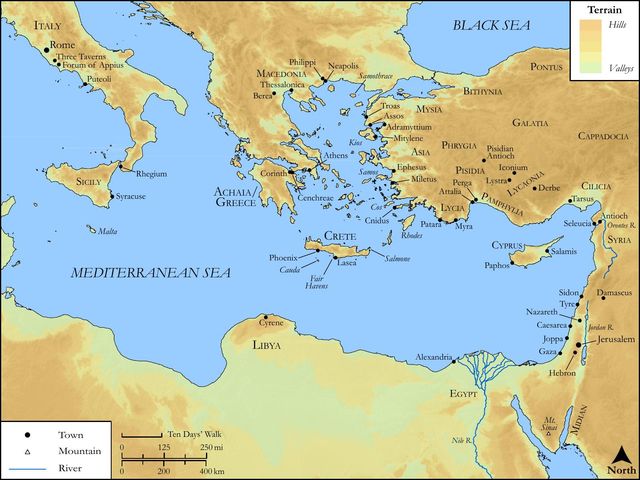
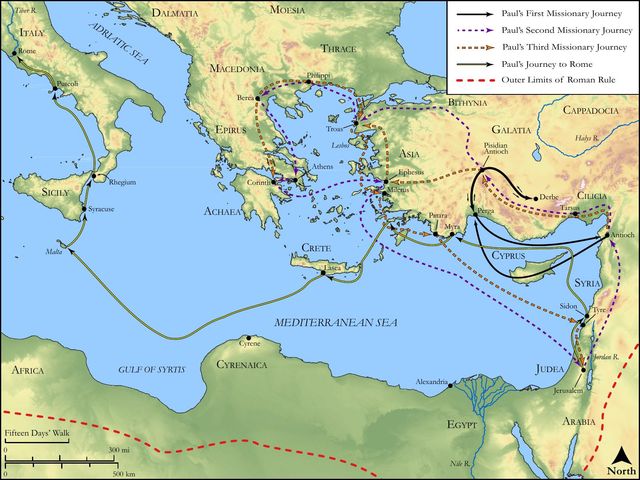
See on the biblical-era maps
Study this verse
Public-domain commentary
Matthew Henry
From his Commentary on the Whole Bible. Henry comments on passages, not single verses — this entry covers Acts 26:12–23. His four-level outline is real structure in the source text, so it is rendered as structure.
All who believe a God, and have a reverence for his sovereignty, must acknowledge that those who speak and act by his direction, and by warrant from him, are not to be opposed; for that is fighting against God. Now Paul here, by a plain and faithful narrative of matters of fact, makes it out to this august assembly that he had an immediate call from heaven to preach the gospel of Christ to the Gentile world, which was the thing that exasperated the Jews against him. He here shows,
I.That he was made a Christian by a divine power, notwithstanding all his prejudices against that way.
He was brought into it on a sudden by the hand of heaven; not compelled to confess Christ by outward force, as he had compelled others to blaspheme him, but by a divine and spiritual energy, by a revelation of Christ from above, both to him and in him: and this when he was in the full career of his sin, going to Damascus, to suppress Christianity by persecuting the Christians there, as hot as ever in the cause, his persecuting fury not in the least spent nor tired, nor was he tempted to give it up by the failing of his friends, for he had at this time as ample an authority and commission from the chief priests to persecute Christianity as ever he had, when he was obliged by a superior power to give up that, and accept another commission to preach up Christianity. Two things bring about this surprising change, a vision from heaven and a voice from heaven, which conveyed the knowledge of Christ to him by the two learning senses of seeing and hearing.
1.He saw a heavenly vision, the circumstances of which were such that it could not be a delusion - deciptio visus, but it was without doubt a divine appearance.
(1.)He saw a great light, a light from heaven, such as could not be produced by any art, for it was not in the night, but at mid day; it was not in a house where tricks might have been played with him, but it was in the way, in the open air; it was such a light as was above the brightness of the sun, outshone and eclipsed that (Isa 24:23), and this could not be the product of Paul's own fancy, for it shone round about those that journeyed with him: they were all sensible of their being surrounded with this inundation of light, which made the sun itself to be in their eyes a less light. The force and power of this light appeared in the effects of it; they all fell to the earth upon the sight of it, such a mighty consternation did it put them into; this light was lightning for its force, yet did not pass away as lightning, but continued to shine round about them. In Old Testament times God commonly manifested himself in the thick darkness, and made that his pavilion, Ch2 6:1. He spoke to Abraham in a great darkness (Gen 15:12), for that was a dispensation of darkness; but now that life and immortality were brought to light by the gospel Christ appeared in a great light. In the creation of grace, as of the world, the first thing created is light, Co2 4:6.
(2.)Christ himself appeared to him (Act 26:16): I have appeared to thee for this purpose. Christ was in this light, though those that travelled with Paul saw the light only, and not Christ in the light. It is not every knowledge that will serve to make us Christians, but it must be the knowledge of Christ.
2.He heard a heavenly voice, an articulate one, speaking to him; it is here said to be in the Hebrew tongue (which was not taken notice of before), his native language, the language of his religion, to intimate to him that though he must be sent among the Gentiles, yet he must not forget that he was a Hebrew, nor make himself a stranger to the Hebrew language. In what Christ said to him we may observe,
(1.)That he called him by his name, and repeated it (Saul, Saul), which would surprise and startle him; and the more because he was now in a strange place, where he thought nobody knew him.
(2.)That he convinced him of sin, of that great sin which he was now in the commission of, the sin of persecuting the Christians, and showed him the absurdity of it.
(3.)That he interested himself in the sufferings of his followers: Thou persecutest me (Act 26:14), and again, It is Jesus whom thou persecutest, Act 26:15. Little did Paul think, when he was trampling upon those that he looked upon as the burdens and blemishes of this earth, that he was insulting one that was so much the glory of heaven.
(4.)That he checked him for his wilful resistance of those convictions: It is hard for thee to kick against the pricks, or goads, as a bullock unaccustomed to the yoke. Paul's spirit at first perhaps began to rise, but he is told it is at his peril, and then he yields. Or, it was spoken by way of caution: "Take heed lest thou resist these convictions, for they are designed to affect thee, not to affront thee." (5.) That, upon his enquiry, Christ made himself known to him. Paul asked (Act 26:15), "Who art thou, Lord? Let me know who it is that speaks to me from heaven, that I may answer him accordingly?" And he said, "I am Jesus; he whom thou hast despised, and hated, and vilified; I bear that name which thou hast made so odious, and the naming of it criminal." Paul thought Jesus was buried in the earth, and, though stolen out of his own sepulchre, yet laid in some other. All the Jews were taught to say so, and therefore he is amazed to hear him speak from heaven, to see him surrounded with all this glory whom he had loaded with all possible ignominy. This convinced him that the doctrine of Jesus was divine and heavenly, and not only not to be opposed, but to be cordially embraced: That Jesus is the Messiah, for he has not only risen from the dead, but he has received from God the Father honour and glory; and this is enough to make him a Christian immediately, to quit the society of the persecutors, whom the Lord from heaven thus appears against, and to join himself with the society of the persecuted, whom the Lord from heaven thus appears for.
II.That he was made a minister by a divine authority:
That the same Jesus that appeared to him in that glorious light ordered him to go and preach the gospel to the Gentiles; he did not run without sending, nor was he sent by men like himself, but by him whom the Father sent, Joh 20:21. What is said of his being an apostle is here joined immediately to that which was said to him by the way, but it appears by Act 9:15, and Act 22:15, Act 22:17, etc., that it was spoken to him afterwards; but he puts the two together for brevity-sake: Rise, and stand upon thy feet. Those whom Christ, by the light of his gospel, casts down in humiliation for sin, shall find that it is in order to their rising and standing upon their feet, in spiritual grace, strength, and comfort. If Christ has torn, it is that he may heal; if he has cast down, it is that he may raise up. Rise then, and shake thyself from the dust (Isa 52:2), help thyself, and Christ shall help thee. He must stand up, for Christ shall help thee. He must stand up, for Christ has work for him to do - has an errand, and a very great errand, to send him upon: I have appeared to thee to make thee a minister. Christ has the making of his own ministers; they have both their qualifications and their commissions from him. Paul thanks Christ Jesus who put him into the ministry, Ti1 1:12. Christ appeared to him to make him a minister. One way or other, Christ will manifest himself to all those whom he makes his ministers; for how can those preach him who do not know him? And how can those know him to whom he does not by his spirit make himself known? Observe,
1.The office to which Paul is appointed: he is made a minister, to attend on Christ, and act for him, as a witness - to give evidence in his cause, and attest the truth of his doctrine. He must testify the gospel of the grace of God; Christ appeared to him that he might appear for Christ before men.
2.The matter of Paul's testimony: he must give an account to the world,
(1.)Of the things which he had seen, now at this time, must tell people of Christ's manifesting himself to him by the way, and what he said to him. He saw these things that he might publish them, and he did take all occasions to publish them, as here, and before, ch. 22.
(2.)Of those things in which he would appear to him. Christ now settled a correspondence with Paul, which he designed afterwards to keep up, and only told him now that he should hear further from him. Paul at first had but confused notions of the gospel, till Christ appeared to him and gave him fuller instructions. The gospel he preached he received from Christ immediately (Gal 1:12); but he received it gradually, some at one time and some at another, as there was occasion. Christ often appeared to Paul, oftener, it is likely, than is recorded, and still taught him, that he might still teach the people knowledge.
3.The spiritual protection he was taken under, while he was thus employed as Christ's witness: all the powers of darkness could not prevail against him till he had finished his testimony (Act 26:17), delivering thee from the people of the Jews and from the Gentiles. Note, Christ's witnesses are under his special care, and, though they may fall into the hands of the enemies, yet he will take care to deliver them out of their hands, and he knows how to do it. Christ had shown Paul at this time what great things he must suffer (Act 9:16), and yet tells him here he will deliver him from the people. Note, Great sufferings are reconcilable to the promise of the deliverance of God's people, for it is not promised that they shall be kept from trouble, but kept through it; and sometimes God delivers them into the hands of their persecutors that he may have the honour of delivering them out of their hands.
4.The special commission given him to go among the Gentiles, and the errand upon which he is sent to them; it was some years after Paul's conversion before he was sent to the Gentiles, or (for aught that appears) knew any thing of his being designed for that purpose (see Act 22:21); but at length he is ordered to steer his course that way.
(1.)There is great work to be done among the Gentiles, and Paul must be instrumental in doing it. Two things must be done, which their case calls for the doing of: - [1.] A world that sits in darkness must be enlightened; those must be brought to know the things that belong to their everlasting peace who are yet ignorant of them, to know God as their end, and Christ as their way, who as yet know nothing of either. He is sent to open their eyes, and to turn them from darkness to light. His preaching shall not only make known to them those things which they had not before heard of, but shall be the vehicle of that divine grace and power by which their understandings shall be enlightened to receive those things, and bid them welcome. Thus he shall open their eyes, which before were shut against the light, and they shall be willing to understand themselves, their own case and interest. Christ opens the heart by opening the eyes, does not lead men blindfold, but gives them to see their own way. He is sent not only to open their eyes for the present, but to keep them open, to turn them from darkness to light, that is, from following false and blind guides, their oracles, divinations, and superstitious usages, received by tradition from their fathers, and the corrupt notions and ideas they had of their gods, to follow a divine revelation of unquestionable certainty and truth. This was turning them from darkness to light, from the ways of darkness to those on which the light shines. The great design of the gospel is to instruct the ignorant, and to rectify the mistakes of those who are in error, that things may be set and seen in a true light. [2.] A world that lies in wickedness, in the wicked one, must be sanctified and reformed; it is not enough for them to have their eyes opened, they must have their hearts renewed; not enough to be turned from darkness to light, but they must be turned from the power of Satan unto God, which will follow of course; for Satan rules by the power of darkness, and God by the convincing evidence of light. Sinners are under the power of Satan; idolaters were so in a special manner, they paid their homage to devils. All sinners are under the influence of his temptations, yield themselves captives to him, are at his beck; converting grace turns them from under the dominion of Satan, and brings them into subjection to God, to conform to the rules of his word and comply with the dictates and directions of his Spirit, translates them out of the kingdom of darkness into the kingdom of his dear Son. When gracious dispositions are strong in the soul (as corrupt and sinful dispositions had been), it is then turned from the power of Satan unto God.
(2.)There is a great happiness designed for the Gentiles by this work - that they may receive forgiveness of sins, and inheritance among those who are sanctified; they are turned from the darkness of sin to the light of holiness, from the slavery of Satan to the service of God; not that God may be a gainer by them, but that they may be gainers by him.
[1.]That they may be restored to his favour, which by sin they have forfeited and thrown themselves out of: That they may receive forgiveness of sins. They are delivered from the dominion of sin, that they may be saved from that death which is the wages of sin. Not that they may merit forgiveness as a debt of reward, but that they may receive it as a free gift, that they may be qualified to receive the comfort of it. They are persuaded to lay down their arms, and return to their allegiance, that they may have the benefit of the act of indemnity, and may plead it in arrest of the judgment to be given against them.
[2.]That they may be happy in the fruition of him; not only that they may have their sins pardoned, but that they may have an inheritance among those who are sanctified by faith that is in me. Note, First, Heaven is an inheritance, it descends to all the children of God; for, if children, then heirs. That they may have, klēron - a lot (so it might be read), alluding to the inheritances of Canaan, which were appointed by lot, and that also is the act of God, the disposal thereof is of the Lord. That they may have a right, so some read it; not by merit, but purely by grace. Secondly, All that are effectually turned from sin to God are not only pardoned, but preferred - have not only their attainder reversed, but a patent of honour given to them, and a grant of a rich inheritance. And the forgiveness of sins makes way for this inheritance, by taking that out of the way which alone hindered. Thirdly, All that shall be saved hereafter are sanctified now; those that have the heavenly inheritance must have it in this way, they must be prepared and made meet for it. None can be happy that are not holy; nor shall any be saints in heaven that are not first saints on earth. Fourthly, We need no more to make us happy than to have our lot among those that are sanctified, to fare as they fare; this is having our lot among the chosen, for they are chosen to salvation through sanctification. Those who are sanctified shall be glorified. Let us therefore now cast in our lot among them, by coming into the communion of saints, and be willing to take our lot with them, and share with them in their afflictions, which (how grievous soever) our lot with them in the inheritance will abundantly make amends for. Fifthly, We are sanctified and saved by faith in Christ. Some refer it to the word next before, sanctified by faith, for faith purifies the heart, and applies to the soul those precious promises, and subjects the soul to the influence of that grace, by which we partake of a divine nature. Others refer it to the receiving of both pardon and the inheritance; it is by faith accepting the grant: it comes all to one; for it is by faith that we are justified, sanctified, and glorified. By faith, tē eis eme - that faith which is in me; it is emphatically expressed. That faith which not only receives divine revelation in general, but which in a particular manner fastens upon Jesus Christ and his mediation, by which we rely upon Christ as the Lord our righteousness, and resign ourselves to him as the Lord our ruler. This is that by which we receive the remission of sins, the gift of the Holy Ghost, and eternal life.
III.That he had discharged his ministry, pursuant to his commission, by divine aid, and under divine direction and protection.
God, who called him to be an apostle, owned him in his apostolical work, and carried him on in it with enlargement and success.
1.God gave him a heart to comply with the call (Act 26:19): I was not disobedient to the heavenly vision, for any one would say he ought to be obedient to it. Heavenly visions have a commanding power over earthly counsels, and it is at our peril if we be disobedient to them; yet if Paul had conferred with flesh and blood, and been swayed by his secular interest, he would have done as Jonah did, gone any where rather than upon this errand; but God opened his ear, and he was not rebellious. He accepted the commission, and, having with it received his instructions, he applied himself to act accordingly.
2.God enabled him to go through a great deal of work, though in it he grappled with a great deal of difficulty, Act 26:20. He applied himself to the preaching of the gospel with all vigour.
(1.)He began at Damascus, where he was converted, for he resolved to lose no time, Act 9:20.
(2.)When he came to Jerusalem, where he had his education, he there witnessed for Christ, where he had most furiously set himself against him, Act 9:29.
(3.)He preached throughout all the coasts of Judea, in the country towns and villages, as Christ had done; he made the first offer of the gospel to the Jews, as Christ had appointed, and did not leave them till they had wilfully thrust the gospel from them; and laid out himself for the good of their souls, labouring more abundantly than any of the apostles, nay perhaps then all put together.
3.His preaching was all practical. He did not go about to fill people's heads with airy notions, did not amuse them with nice speculations, nor set them together by the ears with matters of doubtful disputation, but he showed them, declared it, demonstrated it, that they ought,
(1.)To repent of their sins, to be sorry for them and to confess them, and enter into covenant against them; they ought to bethink themselves, so the word metanoein properly signifies; they ought to change their mind and change their way, and undo what they had done amiss.
(2.)To turn to God. They must not only conceive an antipathy to sin, but they must come into a conformity to God - must not only turn from that which is evil, but turn to that which is good; they must turn to God, in love and affection, and return to God in duty and obedience, and turn and return from the world and the flesh; this is that which is required from the whole revolted degenerate race of mankind, both Jews and Gentiles; epistrephein epi ton Theon - to turn back to God, even to him: to turn to him as our chief good and highest end, as our ruler and portion, turn our eye to him, turn our heart to him, and turn our feet unto his testimonies.
(3.)To do works meet for repentance. This was what John preached, who was the first gospel preacher, Mat 3:8. Those that profess repentance must practise it, must live a life of repentance, must in every thing carry it as becomes penitents. It is not enough to speak penitent words, but we must do works agreeable to those words. As true faith, so true repentance, will work. Now what fault could be found with such preaching as this? Had it not a direct tendency to reform the world, and to redress its grievances, and to revive natural religion?
4.The Jews had no quarrel with him but upon this account, that he did all he could to persuade people to be religious, and to bring them to God by bringing them to Christ (Act 26:21): It was for these causes, and no other, that the Jews caught me in the temple, and went about to kill me; and let any one judge whether these were crimes worthy of death or of bonds. He suffered ill, not only for doing well himself, but for doing good to others. They attempted to kill him; it was his precious life that they hunted for, and hated, because it was a useful life; they caught him in the temple worshipping God, and there they set upon him, as if the better place the better deed
5.He had no help but from heaven; supported and carried on by that, he went on in this great work (Act 26:22): "Having therefore obtained help of God, I continue unto this day; hestēka - I have stood, my life has been preserved, and my work continued; I have stood my ground, and have not been beaten off; I have stood to what I said, and have not been afraid nor ashamed to persist in it." It was now above twenty years since Paul was converted, and all that time he had been very busy preaching the gospel in the midst of hazards; and what was it that bore him up? Not any strength of his own resolutions, but having obtained help of God; for therefore, because the work was so great and he had so much opposition, he could not otherwise have gone on in it, but by help obtained of God. Note, Those who are employed in work for God shall obtain help from God; for he will not be wanting in necessary assistances to his servants. And our continuance to this day must be attributed to help obtained of God; we had sunk, if he had not borne us up - had fallen off, if he had not carried us on; and it must be acknowledged with thankfulness to his praise. Paul mentions it as an evidence that he had his commission from God that from him he had ability to execute it. The preachers of the gospel could never have done, and suffered, and prospered, as they did, if they had not had immediate help from heaven, which they would not have had if it had not been the cause of God that they were now pleading.
6.He preached no doctrine but what agreed with the scriptures of the Old Testament: He witnessed both to small and great, to young and old, rich and poor, learned and unlearned, obscure and illustrious, all being concerned in it. It was an evidence of the condescending grace of the gospel that it was witnessed to the meanest, and the poor were welcome to the knowledge of it; and of the incontestable truth and power of it that it was neither afraid nor ashamed to show itself to the greatest. The enemies of Paul objected against him that he preached something more than that men should repent, and turn to God, and do works meet for repentance. These indeed were but what the prophets of the old Testament had preached; but, besides these, he had preached Christ, and his death, and his resurrection, and this was what they quarrelled with him for, as appears by Act 25:19, that he affirmed Jesus to be alive: "And so I did," says Paul, "and so I do, but therein also I say no other than that which Moses and the prophets said should come; and what greater honour can be done to them than to show that what they foretold is accomplished, and in the appointed season too - that what they said should come is come, and at the time they prefixed?" Three things they prophesied, and Paul preached: - (1.) That Christ should suffer, that the Messiah should be a sufferer - pathētos; not only a man, and capable of suffering, but that, as Messiah, he should be appointed to sufferings; that his ignominious death should be not only consistent with, but pursuant of, his undertaking. The cross of Christ was a stumbling-block to the Jews, and Paul's preaching it was the great thing that exasperated them; but Paul stands to it that, in preaching that, he preached the fulfilling of the Old Testament predictions, and therefore they ought not only not to be offended at what he preached, but to embrace it, and subscribe to it. (2.) That he should be the first that should rise from the dead; not the first in time, but the first in influence - that he should be the chief of the resurrection, the head, or principal one, prōtos ex anastaseōs, in the same sense that he is called the first-begotten from the dead (Rev 1:5), and the first-born from the dead, Col 1:18. He opened the womb of the grave, as the first-born are said to do, and made way for our resurrection; and he is said to be the first-fruits of those that slept (Co1 15:20), for he sanctified the harvest. He was the first that rose from the dead to die no more; and, to show that the resurrection of all believers is in virtue of his, just when he arose many dead bodies of saints arose, and went into the holy city, Mat 27:52, Mat 27:53. (3.) That he should show light unto the people, and to the Gentiles, to the people of the Jews in the first place, for he was to be the glory of his people Israel. To them he showed light by himself, and then to the Gentiles by the ministry of his apostles, for he was to be a light to enlighten those who sat in darkness. In this Paul refers to his commission (Act 26:18), To turn them from darkness to light. He rose from the dead on purpose that he might show light to the people, that he might give a convincing proof of the truth of his doctrine, and might send it with so much the greater power, both among Jews and Gentiles. This also was foretold by the Old Testament prophets, that the Gentiles should be brought to the knowledge of God by the Messiah; and what was there in all this that the Jews could justly be displeased at?
Historical interpretation
Historical reception
1 surviving comment on this verse from the historical church.
Then again the witnesses, those who were with him: next he shows what just cause he had to be persuaded, both from the light, and from the prophets, and from the results, and from the things which have now taken place. See accordingly, how both from the prophets, and from these particulars, he confirms the proof to them. For that he may not seem to be broaching some novelty, although he had great things to say, yet he again takes refuge with the prophets, and puts this as a question for discussion.
Continue studying Acts 26:12 across the web’s major study libraries — every link below opens this exact verse, chapter, or book on the destination site.
Read & Compare
 BibleGatewayThis verse in more than 200 translations and 70 languages.
 Bible.comThe YouVersion reader — hundreds of translations, reading plans, and highlights.
 ESV.orgCrossway's official English Standard Version reader.
 NET BibleThe NET translation with 60,000+ translators' notes on every rendering decision.
 STEP BibleTyndale House's free study tool — original text, vocabulary, and scholarly resources.
 BibliaLogos Bible Software's free web reader.
 USCCBThe New American Bible (Revised Edition) with the U.S. bishops' study notes.
Commentaries
 BibleHub CommentariesDozens of classic commentaries on this verse, gathered on one page.
 StudyLightMore than 100 commentary sets — the largest collection on the web.
 BibleRefPlain-English commentary on what this verse means, verse by verse.
 Enduring WordDavid Guzik's free commentary on this chapter, widely used by Bible teachers.
 Bible Study ToolsVerse commentary alongside Greek and Hebrew study aids.
Original Language & Research
- BibleHub InterlinearThe verse word by word — original language, transliteration, and English.
- BibleHub LexiconEvery word's original-language definition and Strong's entry.
 Blue Letter BibleDeep-study tools — Strong's numbers, concordance, and word studies.
 CNTR CollationThe earliest Greek manuscripts of this verse, collated letter by letter.
Sermons, Hymns & Audio


TrulyRandomVerse is not affiliated with these sites and doesn’t control their content. They’re linked because they’re genuinely useful.
Summary
Acts 26:12 serves as a foundational statement in Paul's defense before King Agrippa II and Governor Festus, setting the stage for his dramatic conversion experience. In this verse, Paul recounts the precise circumstances of his journey to Damascus, emphasizing that he traveled under the explicit and formal authorization of the Jewish chief priests, highlighting his zealous, yet misguided, mission to persecute followers of "the Way" before his divine encounter with the risen Christ.
Context
ShowHideLiterary Context
Acts 26:12 is situated within Paul's third and most detailed account of his conversion, delivered as part of his defense speech before King Agrippa II and Governor Festus in Caesarea. This speech, beginning in Acts 26:1, follows Paul's previous testimonies in Acts 9:1-19 and Acts 22:1-21. In this particular narrative, Paul is systematically laying out his life's trajectory, moving from his zealous Pharisaic background and persecution of Christians to his radical transformation and subsequent apostolic calling. Verse 12 specifically transitions from his pre-conversion fervor to the direct circumstances of his journey to Damascus, which immediately precedes his encounter with the glorified Christ. It establishes the official nature of his mission, underscoring the severity of his actions against the early church.
Historical & Cultural Context
Paul's journey to Damascus was undertaken during a period of intense persecution of the nascent Christian community by the Jewish religious establishment in Jerusalem. The "chief priests" (ἀρχιερεῖς) held significant religious and political authority under Roman rule, particularly concerning matters of Jewish law and tradition. Their "authority and commission" would have been official letters or mandates, granting Saul the power to arrest and extradite Jewish Christians from synagogues in Damascus back to Jerusalem for trial and punishment. Damascus, a major city in Syria, had a significant Jewish population and, consequently, a growing number of Christian converts. Traveling from Jerusalem to Damascus was a multi-day journey (approximately 135 miles or 217 km), indicating the extensive reach of the Sanhedrin's efforts to suppress "the Way" and Saul's personal commitment to this cause. This context highlights the institutional backing behind the persecution and the perceived threat that Christianity posed to traditional Judaism.
Key Themes
ShowHideThis verse contributes to several overarching themes within the book of Acts and Paul's narrative. Firstly, it powerfully illustrates the theme of Divine Sovereignty and Unforeseen Transformation. Paul, acting with full human authority to suppress a movement, is divinely interrupted and redirected by Christ Himself, demonstrating God's ultimate control over human plans, as seen in Proverbs 16:9. Secondly, it underscores the theme of Zealous, but Misguided, Religious Fervor. Paul's actions, though sincerely motivated by his understanding of God's law, were profoundly mistaken, reflecting a zeal "not based on knowledge" as he later describes in Romans 10:2-3. Finally, the verse highlights the Official Nature of Early Christian Persecution, showing that it was not merely mob violence but sanctioned by the highest religious authorities, emphasizing the immense challenges faced by the early church and the courage required of its members, mirroring the persecution faced by Jesus himself from the same religious leaders, as prophesied in John 15:20.
Exposition and Analysis
ShowHideKey Word Analysis
ShowHideThis refers to the ancient city in Syria, a significant center for trade and Jewish population. Its mention immediately identifies the specific destination of Paul's mission, underscoring the geographical extent of the early church's spread and the Sanhedrin's efforts to suppress it even beyond Judea. The journey to Damascus was a well-known, arduous undertaking, signifying the intensity of Paul's commitment to his mission of persecution.
Derived from a word meaning "ability" or "privilege," exousía denotes power, right, or jurisdiction. In this context, it signifies that Paul possessed the legal standing and official permission from the chief priests to carry out his mission. It was not a personal vendetta but an officially sanctioned operation, granting him the right to act on behalf of the Jewish religious leadership. This word highlights the institutional backing behind his persecution of Christians.
This term signifies "permission" or "full power," akin to a warrant or delegation. It implies a formal mandate, giving Paul the delegated power to act as an agent for the chief priests. Together with exousía, epitropḗ emphasizes the comprehensive and official nature of the power vested in Paul, making his mission to arrest and bring Christians back to Jerusalem legally binding under the Jewish religious framework.
Verse Breakdown
ShowHide"Whereupon as I went to Damascus"
This phrase establishes the immediate setting for Paul's pivotal encounter. It marks the specific journey that was interrupted by divine intervention, indicating Paul's active participation in the persecution of Christians. The destination, Damascus, signifies a significant center of early Christian growth outside of Jerusalem, demonstrating the widespread nature of the early church and the reach of the Sanhedrin's efforts to suppress it.
"with authority and commission"
This critical phrase highlights the official and formal nature of Paul's mission. "Authority" (exousía) denotes the legal right or jurisdiction he possessed, while "commission" (epitropḗ) refers to the full power or mandate delegated to him. Together, these terms underscore that Paul was not acting on a personal whim but as a fully empowered agent of the Jewish religious establishment, authorized to arrest and extradite believers. This detail emphasizes the institutionalized persecution faced by the early church.
"from the chief priests"
This specifies the source of Paul's authority and commission. The "chief priests" were the highest religious and political authorities within the Jewish Sanhedrin. Their endorsement of Paul's mission lends immense weight and legitimacy (from a human perspective) to his actions against Christians. It reveals the deep-seated opposition of the established religious leadership to the burgeoning Christian movement, viewing it as a dangerous heresy that needed to be eradicated.
Literary Devices
ShowHideThe verse employs Foreshadowing by setting the scene for the dramatic and life-altering encounter Paul is about to describe. The description of his official "authority and commission" from the "chief priests" builds tension, emphasizing the formidable opposition he represented, only to be completely subverted by the divine intervention that follows. This creates a powerful Irony, as the one sent with full power to destroy the church becomes its most ardent advocate. The phrase "authority and commission" also functions as Metonymy, where the abstract concepts represent the official documents or mandates that Paul carried, underscoring the institutional weight behind his actions.
Theological and Thematic Connections
ShowHideActs 26:12 provides a crucial theological insight into the nature of God's transformative power and His ability to redirect even the most zealous opponents for His purposes. It demonstrates that human plans, even those executed with significant worldly authority, are ultimately subject to divine sovereignty. Paul's journey, undertaken with full human sanction to persecute, becomes the very path through which God reveals His Son and calls Paul to an entirely new, redemptive mission. This highlights that God's grace is not limited by human sin or opposition but can powerfully intervene to bring about His will, turning instruments of destruction into vessels of salvation.
Reflection and Application
ShowHideActs 26:12 stands as a powerful testament to the sovereign and transformative grace of God. It reminds us that no one is beyond the reach of divine intervention, and that God can use even the most unlikely individuals, regardless of their past opposition or misguided zeal, for His glorious purposes. For believers, this verse offers immense hope and encouragement, affirming that God's power to save and transform is absolute. It also serves as a cautionary tale against human zeal untempered by divine truth, prompting us to constantly examine our motivations and actions to ensure they align with God's revealed will, not merely our own convictions or institutional mandates. We are called to humility, recognizing that true authority and wisdom come from God alone, and that our greatest service lies in submitting to His transformative call, even when it radically alters our preconceived paths.
Questions for Reflection
ShowHideFAQ
ShowHideWhat was the "authority and commission" Paul received from the chief priests?
ShowHideThe "authority and commission" Paul received refers to official letters or warrants issued by the Jewish Sanhedrin, specifically by the chief priests. These documents granted him the legal right and delegated power (exousía and epitropḗ in Greek) to arrest followers of "the Way" (early Christians) in Damascus and bring them back to Jerusalem for trial and punishment under Jewish law. This was a formal, institutionalized effort to suppress the burgeoning Christian movement, indicating its perceived threat to traditional Judaism.
Why was Paul going to Damascus specifically?
ShowHidePaul was going to Damascus because it was a significant city with a large Jewish population, and consequently, a growing community of Christian converts. The Sanhedrin's reach extended beyond Judea, and they sought to eradicate the Christian movement wherever it had taken root. Damascus, being a major center, was a logical target for their efforts to arrest and prosecute those who followed Christ, whom they considered heretics.
Christ-Centered Fulfillment
ShowHideActs 26:12, though describing Paul's pre-conversion zeal against Christ, profoundly foreshadows the ultimate triumph of Christ's authority over all human opposition. Paul's journey, undertaken with "authority and commission" from earthly religious leaders to destroy the church, was divinely intercepted by the true and ultimate authority of the risen Christ. This dramatic encounter on the road to Damascus, where Jesus reveals Himself as the one Paul was persecuting (Acts 9:4-5), demonstrates that Christ's power transcends all human power structures. The very one who sought to bind and persecute Christ's followers was himself bound by the overwhelming glory of Christ, leading to his transformation into Christ's most fervent apostle. This narrative perfectly illustrates the truth that Jesus holds "all authority in heaven and on earth" (Matthew 28:18), and that His sovereign will can turn the greatest enemies into His most devoted servants, fulfilling His promise to build His church against which "the gates of hell shall not prevail" (Matthew 16:18). Paul's conversion, initiated by Christ's direct intervention, is a powerful testament to the Lamb of God's limitless grace and His ability to redeem and repurpose even the most hostile hearts for the glory of His kingdom (John 1:29).