


2 Corinthians 10:15
Bible text: King James Version (1769 Blayney text) · Public domain
Bible text: King James Version with Strong's numbers · Public domain
Bible text: Berean Standard Bible · Public domain
Bible text: American Standard Version (1901) · Public domain
Bible text: World English Bible, Messianic edition · Public domain
Bible text: Geneva Bible (1599) · Public domain
Bible text: Young's Literal Translation · Public domain
- οὐκouknotG3756PRT-NNegative Particle Negative
- εἰςeistoG1519PREPPreposition
- τὰtathe [things]G3588T-APNDefinite article Accusative Plural Neuter
- ἄμετραametrabeyond measureG280A-APNAdjective Accusative Plural Neuter
- καυχώμενοιkauchōmenoiboastingG2744V-PNP-NPMVerb Present Middle Or Passive Deponent Participle Nominative Plural Masculine
- ἐνeninG1722PREPPreposition
- ἀλλοτρίοιςallotrioisothers’G245A-DPMAdjective Dative Plural Masculine
- κόποιςkopoislaborsG2873N-DPMNoun Dative Plural Masculine
- ἐλπίδαelpidahopeG1680N-ASFNoun Accusative Singular Feminine
- δὲdehoweverG1161CONJConjunction
- ἔχοντεςechonteshavingG2192V-PAP-NPMVerb Present Active Participle Nominative Plural Masculine
- αὐξανομένηςauxanomenēsincreasingG837V-PPP-GSFVerb Present Passive Participle Genitive Singular Feminine
- τῆςtēstheG3588T-GSFDefinite article Genitive Singular Feminine
- πίστεωςpisteōsfaithG4102N-GSFNoun Genitive Singular Feminine
- ὑμῶνhumōnof youG4771P-2GPPersonal pronoun Genitive 2nd Plural
- ἐνenamongG1722PREPPreposition
- ὑμῖνhuminyouG4771P-2DPPersonal pronoun Dative 2nd Plural
- μεγαλυνθῆναιmegalunthēnaito be enlargedG3170V-APNVerb Aorist Passive Infinitive
- κατὰkataaccording toG2596PREPPreposition
- τὸνtontheG3588T-ASMDefinite article Accusative Singular Masculine
- κανόναkanonaareaG2583N-ASMNoun Accusative Singular Masculine
- ἡμῶνhēmōnof usG3165P-1GPPersonal pronoun Genitive 1st Plural
- εἰςeistoG1519PREPPreposition
- περισσείανperisseianexcessG4050N-ASFNoun Accusative Singular Feminine
English is a literal word-by-word gloss of the Greek, not the KJV's wording. Why?
This is the original text the KJV's translators worked from — each Greek word with its own literal English meaning in this verse, prepared by scholars at Tyndale House, Cambridge. The KJV translates whole sentences, not word by word, so its wording differs: one Greek word can become several English words, and the KJV may choose “charity” where the gloss reads “love”. Both are faithful — they answer different questions. For the KJV's own rendering, switch to the KJV text.
Details
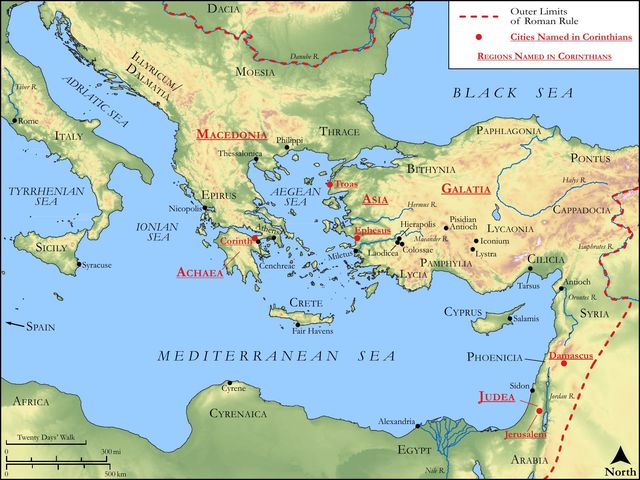
See on the biblical-era maps

Study this verse
Public-domain commentary
Matthew Henry
From his Commentary on the Whole Bible. Henry comments on passages, not single verses — this entry covers 2 Corinthians 10:12–18.
In these verses observe,
I.The apostle refuses to justify himself, or to act by such rules as the false apostles did, Co2 10:12.
He plainly intimates that they took a wrong method to commend themselves, in measuring themselves by themselves, and comparing themselves among themselves, which was not wise. They were pleased, and did pride themselves, in their own attainments, and never considered those who far exceeded them in gifts and graces, in power and authority; and this made them haughty and insolent. Note, If we would compare ourselves with others who excel us, this would be a good method to keep us humble; we should be pleased and thankful for what we have of gifts or graces, but never pride ourselves therein, as if there were none to be compared with us or that did excel us. The apostle would not be of the number of such vain men: let us resolve that we will not make ourselves of that number.
II.He fixes a better rule for his conduct, namely, not to boast of things without his measure, which was the measure God had distributed to him, Co2 10:13. His meaning is, either that he would not boast of more gifts or graces, or power and authority, than God had really bestowed on him; or, rather, that he would not act beyond his commission as to persons or things, nor go beyond the line prescribed to him, which he plainly intimates the false apostles did, while they boasted of other men's labors. The apostle's resolution was to keep within his own province, and that compass of ground which God had marked out for him. His commission as an apostle was to preach the gospel every where, especially among the Gentiles, and he was not confined to one place; yet he observed the directions of Providence, and the Holy Spirit, as to the particular places whither he went or where he did abide.
III.He acted according to this rule:
We stretch not ourselves beyond our measure, Co2 10:14. And, particularly, he acted according to this rule in preaching at Corinth, and in the exercise of his apostolical authority there; for he came thither by divine direction, and there he converted many to Christianity; and, therefore, in boasting of them as his charge, he acted not contrary to his rule, he boasted not of other men's labours, Co2 10:15.
IV.He declares his success in observing this rule.
His hope was that their faith was increased, and that others beyond them, even in the remoter parts of Achaia, would embrace the gospel also; and in all this he exceeded not his commission, nor acted in another man's line.
V.He seems to check himself in this matter, as if he had spoken too much in his own praise.
The unjust accusations and reflections of his enemies had made it needful he should justify himself; and the wrong methods they took gave him good occasion to mention the better rule he had observed: yet he is afraid of boasting, or taking any praise to himself, and therefore he mentions two things which ought to be regarded: - 1. He that glorieth should glory in the Lord, Co2 10:17. If we are able to fix good rules for our conduct, or act by them, or have any good success in so doing, the praise and glory of all are owing unto God. Ministers in particular must be careful not to glory in their performances, but must give God the glory of their work, and the success thereof. 2. Not he that commendeth himself is approved, but he whom the Lord commendeth, Co2 10:18. Of all flattery, self-flattery is the worst, and self-applause is seldom any better than self-flattery and self-deceit. At the best, self-commendation is no praise, and it is oftentimes as foolish and vain as it is proud; therefore, instead of praising or commending ourselves, we should strive to approve ourselves to God, and his approbation will be our best commendation.
Historical interpretation
Two Centuries of Reception
3 surviving comments on this verse. Each one is dated, so this reads as a timeline rather than a list.
Select a marker to jump to its quote. Markers stagger vertically where authors wrote within a few decades of each other.
The primacy of knowledge the apostle shows to those capable of reflection, in writing to those Greeks of Corinth, in the following terms: "But having hope, when your faith is increased, that we shall be magnified in you according to our rule abundantly, to preach the Gospel beyond you." He does not mean the extension of his preaching locally: for he says also that in Achaia faith abounded; and it is related also in the Acts of the Apostles that he preached the word in Athens. But he teaches that knowledge (gnosis), which is the perfection of faith, goes beyond catechetical instruction, in accordance with the magnitude of the Lord's teaching and the rule of the Church.
Someone who takes pride in his own work is not being excessively proud of himself. A prudent man does not rely on the labors of others. This is why Paul does not claim any credit for those who have come to faith by the preaching of other evangelists.
"Not glorying beyond" our "measure," that is, "in other men's labors, but having hope that as your faith groweth, we shall be magnified in you according to our province unto further abundance, so as to preach the Gospel even unto the parts beyond you, and not to glory in another's province in regard of things ready to our hand."
He sets forth a large accusation of them on these grounds, both that they boasted of things without their measure, and of other men's labors; and that whilst the whole of the toil was the Apostles', they plumed themselves upon their labors. 'But we,' says he, 'showed these things in our deeds. We will not imitate those men therefore, but will say such things where our deeds bear us witness. And why,' saith he, 'do I say, you?' "for I have hope that as your faith groweth;" for he doth not assert absolutely, preserving his own character, but, 'I hope,' he says, 'if you make progress, that our province will be extended even farther, "to preach the Gospel in the regions beyond." For we shall advance farther yet,' he says, 'so as to preach and labor, not so as to boast in words of what other men have labored.' And well did he call it "province and measure," as though he had come into possession of the world, and a rich inheritance; and showing that the whole was wholly God's. 'Having then such works,' he says, 'and expecting greater, we do not boast as they do who have nothing, nor do we ascribe any part to ourselves, but the whole to God.'
Continue studying 2 Corinthians 10:15 across the web’s major study libraries — every link below opens this exact verse, chapter, or book on the destination site.
Read & Compare
 BibleGatewayThis verse in more than 200 translations and 70 languages.
 Bible.comThe YouVersion reader — hundreds of translations, reading plans, and highlights.
 ESV.orgCrossway's official English Standard Version reader.
 NET BibleThe NET translation with 60,000+ translators' notes on every rendering decision.
 STEP BibleTyndale House's free study tool — original text, vocabulary, and scholarly resources.
 BibliaLogos Bible Software's free web reader.
 USCCBThe New American Bible (Revised Edition) with the U.S. bishops' study notes.
Commentaries
 BibleHub CommentariesDozens of classic commentaries on this verse, gathered on one page.
 StudyLightMore than 100 commentary sets — the largest collection on the web.
 BibleRefPlain-English commentary on what this verse means, verse by verse.
 Enduring WordDavid Guzik's free commentary on this chapter, widely used by Bible teachers.
 Bible Study ToolsVerse commentary alongside Greek and Hebrew study aids.
Original Language & Research
- BibleHub InterlinearThe verse word by word — original language, transliteration, and English.
- BibleHub LexiconEvery word's original-language definition and Strong's entry.
 Blue Letter BibleDeep-study tools — Strong's numbers, concordance, and word studies.
 CNTR CollationThe earliest Greek manuscripts of this verse, collated letter by letter.
Sermons, Hymns & Audio


TrulyRandomVerse is not affiliated with these sites and doesn’t control their content. They’re linked because they’re genuinely useful.
Summary
In 2 Corinthians 10:15, the Apostle Paul articulates a foundational principle of legitimate apostolic ministry, distinguishing his approach from that of his opponents in Corinth. He asserts that his boasting is not in achievements outside his divinely appointed sphere or in taking credit for the labors of others. Instead, Paul expresses a hopeful anticipation that as the faith of the Corinthian believers grows, his own God-given sphere of ministry will be expanded, allowing him to further the gospel into new regions, thereby magnifying God's work rather than his own ego.
Context
ShowHideLiterary Context
This verse is situated within a highly polemical section of 2 Corinthians (chapters 10-13), where Paul vigorously defends his apostolic authority and ministry against "super-apostles" or false teachers who had infiltrated the Corinthian church. These opponents likely boasted of their eloquence, worldly credentials, and perhaps even claimed credit for the spiritual growth of the Corinthians, undermining Paul's foundational work. Paul's argument in 2 Corinthians 10 contrasts his humble appearance and reliance on divine power with their worldly boasting and self-promotion. He emphasizes that his spiritual weapons are mighty through God (2 Corinthians 10:4) and that true boasting is in the Lord (2 Corinthians 10:17). Verse 15 specifically addresses the geographical and ministerial boundaries of his calling, asserting his commitment to operate within the sphere God had assigned him, rather than encroaching on others' established ministries.
Historical & Cultural Context
The city of Corinth was a bustling, cosmopolitan hub, known for its wealth, diverse population, and a strong emphasis on rhetoric and public speaking. In this environment, charismatic orators who could impress with their eloquence and worldly wisdom were highly esteemed. Paul's opponents likely capitalized on these cultural preferences, presenting themselves as superior to Paul, whose physical presence was "weak" and speech "contemptible" (2 Corinthians 10:10). There was a common practice among ancient philosophers and rhetoricians to "poach" students or followers from rivals. Paul's statement about "other men's labours" directly counters this competitive and self-aggrandizing spirit, aligning himself instead with a principle of orderly, divinely-directed expansion of the gospel, respecting the established work of others. His "rule" or "measure" was not a self-imposed limitation but a recognition of God's specific assignment for him as the apostle to the Gentiles.
Key Themes
ShowHideThe verse significantly contributes to several key themes in 2 Corinthians and Paul's broader theology. Firstly, it highlights the theme of Legitimate Apostolic Authority and Ministry Boundaries. Paul consistently affirmed his unique calling from God, and here he defines the scope of that calling, refusing to boast beyond his divinely appointed "measure" or "rule." This contrasts sharply with the unprincipled expansionism of his opponents, who seemed to disregard such boundaries. Secondly, the verse underscores Interdependence in the Body of Christ and Gospel Expansion. Paul's hope for enlargement is contingent on the Corinthians' increased faith, illustrating that the spiritual maturity of one group of believers can directly facilitate the outreach and impact of another's ministry. This emphasizes a collaborative, rather than competitive, model of ministry, where the growth of the church empowers further gospel advance. Finally, it reinforces the theme of Humility and Dependence on God. Unlike those who boasted in their own accomplishments, Paul's aspiration for an "enlarged" ministry is rooted in the spiritual growth of others, ultimately dependent on God's work in them. This aligns with his overarching message that true strength and authority come from God, not human prowess (2 Corinthians 12:9-10).
Exposition and Analysis
ShowHideKey Word Analysis
ShowHideMeaning "immoderate" or "without measure." In this context, Paul uses it to describe the improper boasting of his opponents who operate outside their divinely appointed sphere of influence or claim credit for work they did not initiate. It signifies a lack of proper boundary or limit.
Referring to expectation or confidence, usually with pleasure. Paul expresses a confident anticipation that the spiritual growth of the Corinthians will lead to the legitimate expansion of his ministry, not a mere wishful thinking but a firm conviction based on God's design for the spread of the gospel.
Meaning "to make (or declare) great, i.e., increase or (figuratively) extol." Here, it denotes an expansion or magnification of Paul's legitimate sphere of ministry. This enlargement is not for personal glory but for the greater spread of the gospel into new territories, enabled by the maturing faith of the Corinthian church.
Meaning a standard, a rule, or a sphere of activity. For Paul, this "rule" represents his God-given apostolic assignment, his divinely established sphere of influence and activity, particularly as the apostle to the Gentiles. It is the established principle or boundary within which he operates and seeks to expand.
Verse Breakdown
ShowHide"Not boasting of things without [our] measure, [that is], of other men's labours;"
Paul begins by clarifying what his boasting is not. He refutes the practice of claiming credit for work that falls outside his divinely appointed "measure" or sphere of ministry. This directly addresses the accusations of his opponents who might have accused him of overstepping or who themselves were taking credit for the Corinthians' conversion, which was largely due to Paul's initial evangelism. He explicitly states his refusal to boast in "other men's labours," highlighting his commitment to building on no one else's foundation, a principle he articulates elsewhere (Romans 15:20).
"but having hope, when your faith is increased,"
This clause introduces a stark contrast ("but") to the previous negative statement. Paul shifts from what he doesn't do to what he does hope for. His hope is anchored in the spiritual growth of the Corinthian believers. The phrase "when your faith is increased" signifies their spiritual maturity, deeper understanding, and stronger commitment to Christ. This increase in faith is presented as a prerequisite or catalyst for the subsequent enlargement of his ministry.
"that we shall be enlarged by you according to our rule abundantly,"
Here, Paul articulates the positive outcome of the Corinthians' increased faith. Their spiritual growth will "enlarge" or expand his legitimate sphere of ministry. This enlargement is "by you," indicating that their maturity will enable him to move beyond Corinth to new, unreached areas. Crucially, this expansion is "according to our rule," meaning it will still be within the boundaries and principles of his God-given apostolic calling, not an unrestrained or opportunistic expansion. The adverb "abundantly" (G1519 + G4050) emphasizes the generous and overflowing nature of this divinely orchestrated expansion.
Literary Devices
ShowHidePaul employs several literary devices to convey his message effectively. Contrast is central, as he meticulously distinguishes his legitimate, God-ordained ministry from the self-aggrandizing practices of his opponents. He contrasts "boasting of things without our measure" with his "hope" for enlargement based on the Corinthians' faith, setting up a clear dichotomy between worldly and spiritual principles of ministry. The concepts of "measure" (ámetros) and "rule" (kanṓn) function as Metaphors for divinely appointed boundaries and spheres of ministry, illustrating that God assigns specific fields of labor to His servants. The phrase "enlarged... abundantly" uses Hyperbole to emphasize the desired extensive and fruitful expansion of his gospel outreach, fueled by the spiritual vitality of the Corinthian church. Furthermore, the idea of the Corinthians' "faith" increasing and thereby enabling Paul's ministry can be seen as a form of Synecdoche, where "faith" represents the broader spiritual maturity and responsiveness of the entire community, which then facilitates the collective mission.
Theological and Thematic Connections
ShowHidePaul's articulation in 2 Corinthians 10:15 offers profound theological insights into the nature of true ministry and the interconnectedness of the body of Christ. It underscores the principle that effective gospel expansion is not driven by human ambition or competitive boasting, but by divine assignment and the spiritual maturity of believers. God, in His sovereignty, grants specific "measures" or "rules" of ministry, defining the scope and boundaries of each servant's labor. This promotes order and unity, preventing unhealthy competition and the undermining of others' foundational work. The verse beautifully illustrates the symbiotic relationship within the church: the spiritual growth of individual believers (the Corinthians' increased faith) directly empowers and enables the broader mission of the church (Paul's enlarged ministry). This highlights that every believer's spiritual journey contributes to the collective advance of God's kingdom, making the church a dynamic, interdependent organism.
Reflection and Application
ShowHidePaul's words in 2 Corinthians 10:15 provide a powerful framework for evaluating our own ministries, callings, and interactions within the Christian community. It challenges us to honestly assess whether our efforts are driven by a desire for personal recognition or by a faithful stewardship of the specific "measure" or "rule" God has given us. We are called to celebrate and support the work of others, rather than to envy, compete with, or take credit for their "labours." This verse encourages a profound sense of interdependence: our individual spiritual growth, our deepening faith, and our increasing maturity in Christ are not merely for our personal benefit but are vital catalysts for the expansion of the gospel through the ministries of others. When we grow in faith, we empower the collective mission, enabling the church to reach further and more abundantly into the world. This perspective fosters humility, collaboration, and a shared vision for God's kingdom, reminding us that true impact is a collective endeavor, rooted in faithfulness to our divine assignment and nurtured by the spiritual vitality of the entire body.
Questions for Reflection
ShowHideFAQ
ShowHideWhat does Paul mean by "without our measure" and "our rule"?
ShowHideIn 2 Corinthians 10:15, Paul uses "without our measure" (Greek: ámetros) and "our rule" (Greek: kanṓn) to refer to the divinely appointed boundaries and sphere of his apostolic ministry. "Measure" implies a limit or extent of activity, while "rule" signifies a standard, principle, or a defined territory of operation. Paul is asserting that he does not boast about achievements or claim authority in areas where God has not specifically assigned him to work, nor does he take credit for the evangelistic or discipleship work initiated by other apostles or ministers. His ministry is not opportunistic or self-serving, but operates strictly within the divine commission and geographical boundaries God has established for him, particularly as the apostle to the Gentiles (Romans 15:20).
How can the "increase" of the Corinthians' faith lead to Paul's ministry being "enlarged"?
ShowHideThe "increase" of the Corinthians' faith refers to their spiritual maturity, growth in understanding, and strengthened commitment to Christ. This spiritual vitality would have several practical implications that would "enlarge" Paul's ministry. Firstly, a more mature church would be more stable, requiring less direct oversight from Paul, thus freeing him to move on to unreached areas. Secondly, their increased faith would likely manifest in greater financial support, prayer, and even personnel, enabling Paul to fund and staff new missionary endeavors. Thirdly, a strong, vibrant church in Corinth would serve as a powerful testimony and base of operations, providing a launching pad for further evangelism into the regions beyond them. Paul envisioned a domino effect: as the Corinthian church matured, it would become a self-sustaining and outward-focused community, allowing him to extend his "rule" or sphere of influence further into new territories where Christ had not yet been proclaimed (Romans 15:23-24).
Christ-Centered Fulfillment
ShowHideWhile 2 Corinthians 10:15 speaks directly to Paul's apostolic ministry and its legitimate boundaries, its deeper Christ-centered fulfillment lies in how it reflects the very nature and mission of Christ, and how all true ministry flows from Him. Paul's commitment to operating within his "measure" and "rule" mirrors Christ's perfect submission to the Father's will and His defined mission. Jesus Himself did not boast of things outside His divine commission but perfectly fulfilled the work given to Him (John 4:34). His "labors" were uniquely His, culminating in the ultimate work of redemption on the cross. Furthermore, the "enlargement" of Paul's ministry, contingent on the increase of faith, finds its ultimate source and goal in Christ. It is faith in Christ that grows, and it is the Kingdom of Christ that is expanded. The humility Paul exemplifies, refusing to take credit for others' work, echoes Christ's own self-emptying love (Philippians 2:5-8). All true Christian ministry, including Paul's, is ultimately built upon Christ as the sole foundation (1 Corinthians 3:11), and its expansion is the outworking of the Great Commission given by the resurrected Christ Himself (Matthew 28:18-20). Thus, Paul's aspiration for an enlarged ministry is fundamentally about the magnification of Christ's name and the spread of His glorious gospel.