


Romans 8:27
Bible text: King James Version (1769 Blayney text) · Public domain
Bible text: King James Version with Strong's numbers · Public domain
Bible text: Berean Standard Bible · Public domain
Bible text: American Standard Version (1901) · Public domain
Bible text: World English Bible, Messianic edition · Public domain
Bible text: Geneva Bible (1599) · Public domain
Bible text: Young's Literal Translation · Public domain
- ὁhoThe [One]G3588T-NSMDefinite article Nominative Singular Masculine
- δὲdenowG1161CONJConjunction
- ἐραυνῶνeraunōnsearchingG2045V-PAP-NSMVerb Present Active Participle Nominative Singular Masculine
- τὰςtas<the>G3588T-APFDefinite article Accusative Plural Feminine
- καρδίαςkardiasheartsG2588N-APFNoun Accusative Plural Feminine
- οἶδενoidenknowsG1492V-RAI-3SVerb Perfect Active Indicative 3rd Singular
- τίtiwhat [is]G5101I-ASNInterrogative pronoun Accusative Singular Neuter
- τὸtotheG3588T-NSNDefinite article Nominative Singular Neuter
- φρόνημαphronēmamindsetG5427N-NSNNoun Nominative Singular Neuter
- τοῦtouof theG3588T-GSNDefinite article Genitive Singular Neuter
- πνεύματοςpneumatosSpiritG4151N-GSNNoun Genitive Singular Neuter
- ὅτιhotibecauseG3754CONJConjunction
- κατὰkataaccording toG2596PREPPreposition
- θεὸνtheonGodG2316N-ASM-TNoun Accusative Singular Masculine Title
- ἐντυγχάνειentugchaneiHe intercedesG1793V-PAI-3SVerb Present Active Indicative 3rd Singular
- ὑπὲρhuperforG5228PREPPreposition
- ἁγίωνhagiōn[the] saintsG40A-GPMAdjective Genitive Plural Masculine
English is a literal word-by-word gloss of the Greek, not the KJV's wording. Why?
This is the original text the KJV's translators worked from — each Greek word with its own literal English meaning in this verse, prepared by scholars at Tyndale House, Cambridge. The KJV translates whole sentences, not word by word, so its wording differs: one Greek word can become several English words, and the KJV may choose “charity” where the gloss reads “love”. Both are faithful — they answer different questions. For the KJV's own rendering, switch to the KJV text.
Details
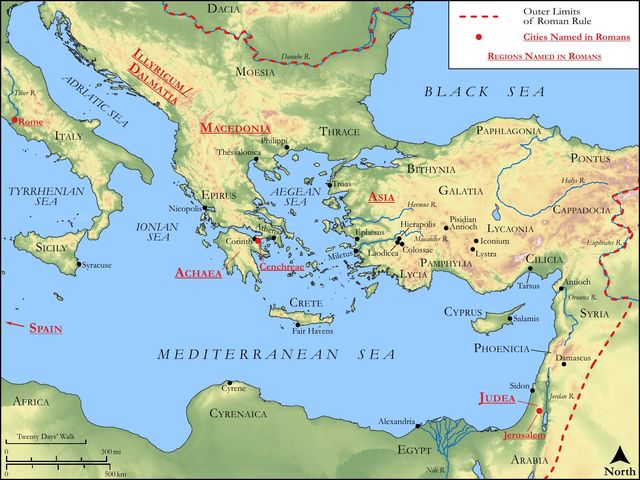
See on the biblical-era maps

Study this verse
Public-domain commentary
Matthew Henry
From his Commentary on the Whole Bible. Henry comments on passages, not single verses — this entry covers Romans 8:26–28. His three-level outline is real structure in the source text, so it is rendered as structure.
The apostle here suggests two privileges more to which true Christians are entitled: -
I.The help of the Spirit in prayer.
While we are in this world, hoping and waiting for what we see not, we must be praying. Hope supposes desire, and that desire offered up to God is prayer; we groan. Now observe,
1.Our weakness in prayer: We know not what we should pray for as we ought.
(1.)As to the matter of our requests, we know not what to ask. We are not competent judges of our own condition. Who knows what is good for a man in this life? Ecc 6:12. We are short-sighted, and very much biassed in favour of the flesh, and apt to separate the end from the way. You know not what you ask, Mat 20:22. We are like foolish children, that are ready to cry for fruit before it is ripe and fit for them; see Luk 9:54, Luk 9:55.
(2.)As to the manner, we know not how to pray as we ought. It is not enough that we do that which is good, but we must do it well, seek in a due order; and here we are often at a loss - graces are weak, affections cold, thoughts wandering, and it is not always easy to find the heart to pray, Sa2 7:27. The apostle speaks of this in the first person: We know not. He puts himself among the rest. Folly, and weakness, and distraction in prayer, are what all the saints are complaining of. If so great a saint as Paul knew not what to pray for, what little reason have we to go forth about that duty in our own strength!
2.The assistances which the Spirit gives us in that duty. He helps our infirmities, meant especially of our praying infirmities, which most easily beset us in that duty, against which the Spirit helps. The Spirit in the world helps; many rules and promises there are in the word for our help. The Spirit in the heart helps, dwelling in us, working in us, as a Spirit of grace and supplication, especially with respect to the infirmities we are under when we are in a suffering state, when our faith is most apt to fail; for this end the Holy Ghost was poured out. Helpeth, sumantilambanetai - heaves with us, over against us, helps as we help one that would lift up a burden, by lifting over against him at the other end - helps with us, that is, with us doing our endeavour, putting forth the strength we have. We must not sit still, and expect that the Spirit should do all; when the Spirit goes before us we must bestir ourselves. We cannot without God, and he will not without us. What help? Why, the Spirit itself makes intercession for us, dictates our requests, indites our petitions, draws up our plea for us. Christ intercedes for us in heaven, the Spirit intercedes for us in our hearts; so graciously has God provided for the encouragement of the praying remnant. The Spirit, as an enlightening Spirit, teaches us what to pray for, as a sanctifying Spirit works and excites praying graces, as a comforting Spirit silences our fears, and helps us over all our discouragements. The Holy Spirit is the spring of all our desires and breathings towards God. Now this intercession which the Spirit makes is,
(1.)With groanings that cannot be uttered. The strength and fervency of those desires which the Holy Spirit works are hereby intimated. There may be praying in the Spirit where there is not a word spoken; as Moses prayed (Exo 14:15), and Hannah, Sa1 1:13. It is not the rhetoric and eloquence, but the faith and fervency, of our prayers, that the Spirit works, as an intercessor, in us. Cannot be uttered; they are so confused, the soul is in such a hurry with temptations and troubles, we know not what to say, nor how to express ourselves. Here is the Spirit interceding with groans that cannot be uttered. When we can but cry, Abba, Father, and refer ourselves to him with a holy humble boldness, this is the work of the Spirit.
(2.)According to the will of God, Rom 8:27. The Spirit in the heart never contradicts the Spirit in the word. Those desires that are contrary to the will of God do not come from the Spirit. The Spirit interceding in us evermore melts our wills into the will of God. Not as I will, but as thou wilt.
3.The sure success of these intercessions: He that searches the heart knoweth what is the mind of the Spirit, Rom 8:27. To a hypocrite, all whose religion lies in his tongue, nothing is more dreadful than that God searches the heart and sees through all his disguises. To a sincere Christian, who makes heart-work of his duty, nothing is more comfortable than that God searches the heart, for then he will hear and answer those desires which we want words to express. He knows what we have need of before we ask, Mat 6:8. He knows what is the mind of his own Spirit in us. And, as he always hears the Son interceding for us, so he always hears the Spirit interceding in us, because his intercession is according to the will of God. What could have been done more for the comfort of the Lord's people, in all their addresses to God? Christ had said, "Whatever you ask the Father according to his will he will give it you." But how shall we learn to ask according to his will? Why, the Spirit will teach us that. Therefore it is that the seed of Jacob never seek in vain.
II.The concurrence of all providences for the good of those that are Christ's, Rom 8:28.
It might be objected that, notwithstanding all these privileges, we see believers compassed about with manifold afflictions; though the Spirit makes intercession for them, yet their troubles are continued. It is very true; but in this the Spirit's intercession is always effectual, that, however it goes with them, all this is working together for their good. Observe here.
1.The character of the saints, who are interested in this privilege; they are here described by such properties as are common to all that are truly sanctified.
(1.)They love God. This includes all the out-goings of the soul's affections towards God as the chief good and highest end. It is our love to God that makes every providence sweet, and therefore profitable. Those that love God make the best of all he does, and take all in good part.
(2.)They are the called according to his purpose, effectually called according to the eternal purpose. The call is effectual, not according to any merit or desert of ours, but according to God's own gracious purpose.
2.The privilege of the saints, that all things work together for good to them, that is, all the providences of God that concern them. All that God performs he performs for them, Psa 57:2. Their sins are not of his performing, therefore not intended here, though his permitting sin is made to work for their good, Ch2 32:31. But all the providences of God are theirs - merciful providences, afflicting providences, personal, public. They are all for good; perhaps for temporal good, as Joseph's troubles; at least, for spiritual and eternal good. That is good for them which does their souls good. Either directly or indirectly, every providence has a tendency to the spiritual good of those that love God, breaking them off from sin, bringing them nearer to God, weaning them from the world, fitting them for heaven. Work together. They work, as physic works upon the body, various ways, according to the intention of the physician; but all for the patient's good. They work together, as several ingredients in a medicine concur to answer the intention. God hath set the one over against the other (Ecc 7:14): sunergei, a very singular, with a noun plural, denoting the harmony of Providence and its uniform designs, all the wheels as one wheel, Eze 10:13. He worketh all things together for good; so some read it. It is not from any specific quality in the providences themselves, but from the power and grace of God working in, with, and by, these providences. All this we know - know it for a certainty, from the word of God, from our own experience, and from the experience of all the saints.
Historical interpretation
Three Centuries of Reception
7 surviving comments on this verse. Each one is dated, so this reads as a timeline rather than a list.
Select a marker to jump to its quote. Markers stagger vertically where authors wrote within a few decades of each other.
Paul shows here that God pays less attention to the words we use in prayer than he does to what is in our heart and mind.
It is clear that the prayer of every spirit is known to God, from whom nothing is secret or hidden. How much more then should [the Father] know what the Holy Spirit, who is the same essence as himself, is saying?
"But He that searcheth the hearts." You see that it is not about the Comforter that he is speaking, but about the spiritual heart. Since if this were not so, he ought to have said, "He that searcheth" the Spirit. But that thou mayest learn that the language is meant of a spiritual man, who has the gift of prayer, he proceeds, "And he that searcheth the hearts knoweth what is the mind of the Spirit," that is, of the spiritual man.
"Because he maketh intercession for the saints according to the will of God." Not (he means) that he informs God as if ignorant, but this is done that we may learn to pray for proper things, and to ask of God what is pleasing to Him. For this is what the "according to God" is. And so this was with a view to solace those that came to Him, and to yield them excellent instruction. For He that furnished the gifts, and gave besides blessings without number, was the Comforter. Hence it says, "all these things worketh one and the self-same Spirit." And it is for our instruction that this takes place, and to show the love of the Spirit, it condescendeth even to this. And it is from this that the person praying getteth heard, because the prayer is made "according to the will of God."
You see from how many points he instructs them in the love that was shown them and the honor that was done them. And what is there that God hath not done for us? The world He hath made corruptible for us, and again for us incorruptible. He suffered His Prophets to be ill-treated for our sake, sent them into captivity for us, let them fall into the furnace, and undergo ills without number. Nay, He made them prophets for us, and the Apostles also He made for us. He gave up for us His Only-Begotten, He punisheth the devil for us, He hath seated us on the Right Hand, He was reproached for us. "For the reproaches of them that reproached thee," it says, "fell upon me."
Paul has called a gift of the Spirit “the Spirit.” … He makes us request with groans which cannot be described, just as God is said to tempt us in order to know, i.e., in order to make us know, what kind of people we are. Even in popular usage the master is said to accomplish what he orders to be done by others, as in statements like “he built a house” or “he wrote a book,” though he neither built nor wrote.
“Spirit” here does not mean the substance of the Spirit but rather the grace which is given to believers. By this grace we are encouraged to struggle, we are inflamed to pray more earnestly, and with ineffable sighings we implore God the Savior. The holy apostle wrote this out of the experience of his own suffering. For he himself had asked to be set free from evils, not once or twice but three times, but he did not get what he asked for. Rather, he heard God say: “My grace is sufficient for you, for my power is made perfect in weakness.” But when he learned this, he willingly embraced the things which he had asked to be set free from and said: “I will all the more gladly boast of my weaknesses, that the power of Christ may rest upon me.”
You see that all the good promptings which bring us to repentance result from the activity of the Spirit, and pure prayer, which brings all these good promptings to completion, is also stirred up in our soul as the result of the Spirit’s activity. He too, in a hidden way, initially arouses us to groans at the memory of our sins.
By the inspiration of the Holy Spirit in silence, the shouting of the saints is heard in the presence of God.
Continue studying Romans 8:27 across the web’s major study libraries — every link below opens this exact verse, chapter, or book on the destination site.
Read & Compare
 BibleGatewayThis verse in more than 200 translations and 70 languages.
 Bible.comThe YouVersion reader — hundreds of translations, reading plans, and highlights.
 ESV.orgCrossway's official English Standard Version reader.
 NET BibleThe NET translation with 60,000+ translators' notes on every rendering decision.
 STEP BibleTyndale House's free study tool — original text, vocabulary, and scholarly resources.
 BibliaLogos Bible Software's free web reader.
 USCCBThe New American Bible (Revised Edition) with the U.S. bishops' study notes.
Commentaries
 BibleHub CommentariesDozens of classic commentaries on this verse, gathered on one page.
 StudyLightMore than 100 commentary sets — the largest collection on the web.
 BibleRefPlain-English commentary on what this verse means, verse by verse.
 Enduring WordDavid Guzik's free commentary on this chapter, widely used by Bible teachers.
 Bible Study ToolsVerse commentary alongside Greek and Hebrew study aids.
Original Language & Research
- BibleHub InterlinearThe verse word by word — original language, transliteration, and English.
- BibleHub LexiconEvery word's original-language definition and Strong's entry.
 Blue Letter BibleDeep-study tools — Strong's numbers, concordance, and word studies.
 CNTR CollationThe earliest Greek manuscripts of this verse, collated letter by letter.
Sermons, Hymns & Audio


TrulyRandomVerse is not affiliated with these sites and doesn’t control their content. They’re linked because they’re genuinely useful.
Summary
Romans 8:27 offers profound comfort and assurance to believers by revealing the intricate and perfect partnership within the Godhead concerning prayer. It declares that God the Father, who possesses exhaustive knowledge of all hearts, perfectly comprehends the deep intentions and desires of the Holy Spirit, who in turn intercedes for believers in accordance with God's divine and perfect will. This verse underscores the believer's security, knowing that their deepest needs are perfectly understood and presented to God, even when they cannot articulate them themselves.
Context
ShowHideLiterary Context
Romans 8:27 is nestled within the triumphant eighth chapter of Paul's letter to the Romans, often celebrated as the pinnacle of Christian doctrine concerning the Holy Spirit and the believer's security in Christ. Paul has meticulously laid out the freedom from condemnation for those in Christ (Romans 8:1), the indwelling of the Spirit as the power for righteous living (Romans 8:9-11), and the adoption of believers as children of God, heirs with Christ (Romans 8:14-17). The immediate preceding verses, Romans 8:18-25, discuss the groaning of creation and believers as they await future glory amidst present suffering. Romans 8:26 then introduces the Holy Spirit's role in helping believers in their weakness, specifically in prayer, interceding with "groanings which cannot be uttered." Verse 27 serves as the divine explanation and assurance for this mysterious intercession: God Himself understands these Spirit-led prayers because they are perfectly aligned with His will.
Historical & Cultural Context
Paul wrote to a diverse church in Rome, comprising both Jewish and Gentile believers, likely facing internal tensions and external pressures from a pagan society. The concept of a personal God who "searches the hearts" would have resonated deeply with Jewish believers familiar with Old Testament teachings (e.g., 1 Samuel 16:7, Jeremiah 17:10). For all believers, the assurance of divine intercession would have been profoundly comforting in a world where they often felt weak, misunderstood, or persecuted. The Roman context, with its emphasis on patronage and advocacy, would have made the idea of the Spirit acting as an "intercessor" or "advocate" particularly meaningful, highlighting the divine support available to them. This divine understanding and advocacy provided a stark contrast to the impersonal and often capricious nature of pagan deities.
Key Themes
ShowHideThis verse contributes significantly to several key themes within Romans 8 and the broader Pauline corpus. Firstly, it powerfully reinforces the theme of Divine Omniscience and Sovereignty, emphasizing God's perfect and exhaustive knowledge not only of human hearts but also of the deepest intentions of the Holy Spirit. Secondly, it highlights the Active Ministry of the Holy Spirit, portraying Him not as an abstract force but as a divine Person actively engaged in the lives of believers, particularly in their prayer life, acting as a divine Helper and Advocate. Thirdly, it undergirds the theme of Believer's Security and Assurance, as it guarantees that even when believers are weak and unable to pray effectively, their true needs are being perfectly communicated to God and aligned with His perfect will. This divine alignment ensures the efficacy and ultimate benefit of Spirit-led prayer, fostering an unshakeable confidence in God's care and plan for His children, a theme central to Romans 8:28-39.
Exposition and Analysis
ShowHideKey Word Analysis
ShowHideThis verb implies a diligent, thorough investigation or inquiry. When applied to God, it signifies His perfect and exhaustive knowledge of the innermost being, leaving nothing hidden or unknown. It's not a search for discovery, but a search that confirms existing, perfect knowledge.
More than just a thought, phrónēma refers to a mental inclination, purpose, or disposition. It denotes the deep-seated intention or aim of the Spirit. God knows not just what the Spirit "thinks," but the very essence of His purpose and desire in interceding for the saints.
This word means "to chance upon," and by implication, "to confer with" or "to entreat on behalf of." It describes the act of coming alongside someone to plead their case or to make a request for them. Here, it vividly portrays the Holy Spirit as an advocate, actively presenting the needs of believers to God the Father.
Verse Breakdown
ShowHide"And he that searcheth the hearts"
This refers to God the Father, emphasizing His divine attribute of omniscience. He possesses an intimate, penetrating knowledge of the deepest recesses of all hearts—human and divine. This establishes the foundation for the Father's perfect understanding of the Spirit's work.
"knoweth what [is] the mind of the Spirit"
Building on the Father's omniscience, this clause asserts that God perfectly comprehends the Holy Spirit's intentions, purposes, and desires. This is crucial because the Spirit's intercession often involves "groanings which cannot be uttered" (Romans 8:26), yet God fully understands the profound meaning behind these inarticulate expressions.
"because he maketh intercession for the saints"
This explains why God knows the mind of the Spirit: the Spirit is actively engaged in the work of intercession on behalf of believers ("the saints"). The Spirit acts as a divine advocate, presenting the true, often unspoken, needs and desires of God's people to the Father.
"according to [the will of] God"
This final phrase is pivotal, providing the ultimate assurance. It guarantees that the Holy Spirit's intercession is not arbitrary or based on human whim, but is always in perfect alignment with God's sovereign, wise, and good will. This ensures that the prayers facilitated by the Spirit are always righteous, effective, and ultimately for the believer's good and God's glory.
Literary Devices
ShowHideRomans 8:27 employs several powerful literary devices. Anthropomorphism is evident in the phrase "he that searcheth the hearts," attributing a human action of deep investigation to God, thereby emphasizing His profound and intimate knowledge of the innermost being. This device makes God's omniscience more relatable. Personification is clearly used for the Holy Spirit, who is depicted as an active agent "maketh intercession," engaging in a communicative and advocacy role on behalf of believers. This highlights the Spirit's personal and active involvement in the lives of God's people. The verse also functions as a profound statement of Divine Assurance, providing immense comfort and security to the reader. By detailing the seamless, perfectly aligned work of the Father and the Spirit in prayer, it guarantees the efficacy and divine alignment of the believer's deepest, Spirit-inspired needs, reinforcing the unshakeable foundation of their faith.
Theological and Thematic Connections
ShowHideRomans 8:27 profoundly enriches our understanding of the Trinity's unified work in salvation and sanctification. It unveils a beautiful, seamless cooperation between God the Father and God the Holy Spirit in the believer's prayer life. The Father's omniscience is perfectly matched by the Spirit's perfect intercession, ensuring that the deepest, often inexpressible, needs of believers are not only heard but also presented in perfect harmony with God's sovereign will. This divine orchestration assures believers that even in their weakness and ignorance, their spiritual well-being is divinely secured. This verse also implicitly connects to the broader theme of God's unwavering commitment to His people, demonstrating His active involvement in their daily struggles and spiritual growth, ultimately working all things for their good as promised in the subsequent verse, Romans 8:28.
Reflection and Application
ShowHideRomans 8:27 offers immense practical encouragement and profound peace for the Christian's prayer life. It serves as a powerful antidote to feelings of inadequacy, confusion, or despair when we struggle to pray. Knowing that the Holy Spirit, who indwells us, actively intercedes on our behalf, translating our inarticulate groans and deepest longings into perfect, God-aligned prayers, liberates us from the burden of "getting it right" every time. We can rest assured that even when our words fail, or our understanding is limited, our true needs, as perfectly discerned by the Spirit, are being presented to the Father in a way that is always heard and always in accordance with His sovereign, good, and loving will. This truth fosters a deep sense of security and confidence, allowing us to approach God with boldness, not based on our eloquence, but on the flawless intercession of the Spirit and the perfect understanding of the Father. It invites us to lean more fully into the Spirit's ministry, trusting that God's plan for us is being perfectly executed, even through our weakest moments of prayer.
Questions for Reflection
ShowHideFAQ
ShowHideWho is "he that searcheth the hearts" in this verse?
ShowHide"He that searcheth the hearts" refers to God the Father. This phrase emphasizes His divine omniscience and perfect knowledge, particularly His ability to understand the innermost thoughts, intentions, and desires of all beings, including the Holy Spirit and human hearts. This attribute is consistently ascribed to God throughout Scripture, highlighting His intimate and comprehensive understanding.
What does it mean that the Spirit "maketh intercession" for the saints?
ShowHideTo "make intercession" means to act as an advocate or to plead on someone's behalf. In the context of Romans 8:27, it means that the Holy Spirit actively presents the needs, desires, and even the inexpressible "groanings" (Romans 8:26) of believers to God the Father. When believers are weak, confused, or unsure how to pray, the Spirit steps in to articulate their true spiritual needs perfectly, ensuring their prayers are heard and aligned with God's divine purpose.
Why is it important that the Spirit's intercession is "according to the will of God"?
ShowHideThis phrase is crucial because it guarantees the efficacy and divine alignment of the Spirit's intercession. It means that the prayers facilitated by the Holy Spirit are not based on human error or imperfect understanding, but are always in perfect harmony with God's sovereign, wise, and good will. This ensures that what the Spirit prays for on our behalf is precisely what God intends to grant, leading to beneficial and righteous outcomes for believers and ultimately glorifying God. It provides profound assurance that our deepest, Spirit-inspired desires are always heard and are always in line with God's perfect plan.
Christ-Centered Fulfillment
ShowHideRomans 8:27, while focusing on the Holy Spirit's intercession, finds its ultimate Christ-centered fulfillment in the broader Trinitarian work of redemption and the believer's secure standing in Christ. The Spirit's intercession is not an isolated act but an integral part of the divine plan to conform believers to the image of Christ (Romans 8:29). Just as the Spirit intercedes for us from within our weakness, Christ Himself intercedes for us at the right hand of the Father (Romans 8:34). This dual intercession—from within by the Spirit and from above by the Son—demonstrates the comprehensive and perfect advocacy that secures the believer's salvation and sanctification. The Father's perfect knowledge of the Spirit's "mind" ensures that this intercession aligns perfectly with the redemptive purposes established by Christ's finished work on the cross. The Spirit, whom Jesus promised as the "Helper" or "Advocate" (John 14:16-17), continues Christ's work of bringing believers into full communion with God, granting them access to the Father through Him (Ephesians 2:18). Thus, the Spirit's intercession "according to the will of God" is ultimately for the purpose of bringing believers into the fullness of their inheritance in Christ, securing their eternal union with Him.