


Isaiah 32:20
- אַשְׁרֵיכֶם'ash·rei·Khemhow blessed [are]! youH835N-mpc ¦ 2mpNoun Plural Masculine Constructאַשְׁרֵיhow blessed [are]!כֶםyou
- זֹרְעֵיzo·re·'EiO [those who] sowH2232V-Qal-Prtcpl-mpVerb Qal Participle Plural Masculine Construct
- עַל'alatH5921PrepPreposition
- כָּלkoleveryH3605N-mscNoun Singular Masculine Construct
- מָיִםMa·yimwaterH4325N-mpNoun Plural Masculine Absolute
- מְשַׁלְּחֵיme·sha·le·CheiO [those who] let looseH7971V-Piel-Prtcpl-mpVerb Piel Participle Plural Masculine Construct
- רֶגֶלre·gel[the] foot ofH7272N-fscNoun Singular Feminine Construct
- הַשּׁוֹרha·Shorthe oxH7794Art ¦ N-msNoun Singular Masculine Absoluteהַtheשּׁוֹרox
- וְהַחֲמוֹרve·ha·cha·Morand the donkeyH2543Conj-w ¦ Art ¦ N-csNoun Singular common gender Absoluteוְandהַtheחֲמוֹרdonkey
English is a literal word-by-word gloss of the Hebrew, not the KJV's wording. Why?
This is the original text the KJV's translators worked from — each Hebrew word with its own literal English meaning in this verse, prepared by scholars at Tyndale House, Cambridge. The KJV translates whole sentences, not word by word, so its wording differs: one Hebrew word can become several English words, and the KJV may choose “the LORD” where the gloss reads “Yahweh”. Both are faithful — they answer different questions. For the KJV's own rendering, switch to the KJV text.
Details
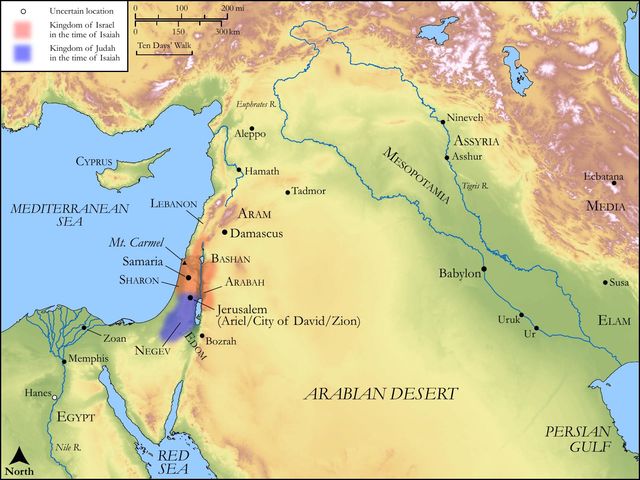
See on the biblical-era map
Study this verse
Public-domain commentary
Matthew Henry
From his Commentary on the Whole Bible. Henry comments on passages, not single verses — this entry covers Isaiah 32:9–20. His four-level outline is real structure in the source text, so it is rendered as structure.
In these verses we have God rising up to judgment against the vile persons, to punish them for their villainy; but at length returning in mercy to the liberal, to reward them for their liberality.
I.When there was so great a corruption of manners, and so much provocation given to the holy God, bad times might well be expected, and here is a warning given of such times coming. The alarm is sounded to the women that were at ease (Isa 32:9) and the careless daughters, to feed whose pride, vanity, and luxury, their husbands and fathers were tempted to starve the poor. Let them hear what the prophet has to say to them in God's name: "Rise up, and hear with reverence and attention."
1.Let them know that God was about to bring wasting desolating judgments upon the land in which they lived in pleasure and were wanton. This seems to refer primarily to the desolations made by Sennacherib's army when he seized all the fenced cities of Judah: but then those words, many days and years, must be rendered (as the margin reads them) days above a year, that is, something above a year shall this havock be in the making: so long it was from the first entrance of that army into the land of Judah to the overthrow of it. But it is applicable to the wretched disappointment which those will certainly meet with, first or last, that set their hearts upon the world and place their happiness in it: You shall be troubled, you careless women. It will not secure us from trouble to cast away care when we are at ease; nay, to those who affect to live carelessly even little troubles will be great vexations and press hard upon them. They were careless and at ease because they had money enough and mirth enough; but the prophet here tells them,
(1.)That the country whence they had their tents and dainties should shortly be laid waste: "The vintage shall fail; and then what will you do for wine to make merry with? The gathering of fruit shall not come, for there shall be none to be gathered, and you will find the want of them, Isa 32:10. You will want the teats, the good milk from the cows, the pleasant fields and their productions:" the useful fields that are serviceable to human life are the pleasant ones. "You will want the fruitful vine, and the grapes it used to yield you." The abuse of plenty is justly punished with scarcity; and those deserve to be deprived of the supports of life who make them the food and fuel of lust and prepare them for Baal.
(2.)That the cities too, the cities of Judah, where they lived at ease, spent their rents, and made themselves merry with their dainties, should be laid waste (Isa 32:13, Isa 32:14): Briers and thorns, the fruits of sin and the curse, shall come up, not only upon the land of my people, which shall lie uncultivated, but upon all the houses of joy - the play-houses, the gaming-houses, the taverns - in the joyous cities. When a foreign army was ravaging the country the houses of joy, no doubt, became houses of mourning; then the palaces, or noblemen's houses, were forsaken by their owners, who perhaps fled to Egypt for refuge; the multitude of the city were left by their leaders to shift for themselves. Then the stately houses shall be for dens for ever, which had been as forts and towers for strength and magnificence. They shall be abandoned; the owners shall never return to them; every body shall look upon them to be like Jericho, an anathema; so that, even when peace returns, they shall not be rebuilt, but shall be thrown to the waste: A joy of wild asses and a pasture of flocks. Thus is many a house brought to ruin by sin. Jam seges est ubi Troja fuit - Corn grows on the site of Troy.
2.In the foresight of this let them tremble and be troubled, strip themselves, and gird sackcloth upon their loins, Isa 32:11. This intimates not only that when the calamity comes they shall thus be made to tremble and be forced to strip themselves, that then God's judgments would strip them and make them bare, but,
(1.)That the best prevention of the trouble would be to repent and humble themselves for their sin, and lie in the dust before God in true remorse and godly sorrow, which would be the lengthening out of their tranquillity. This is meeting God in the way of his judgments, and saving a correction by correcting our own mistakes. Those only shall break that will not bend.
(2.)That the best preparation for the trouble would be to deny themselves and live a life of mortification, and to sit loose to all the delights of sense. Those that have already by a holy contempt of this world stripped themselves can easily bear to be stripped when trouble and death come.
II.While there was still a remnant that kept their integrity they had reason to hope for good times at length and such times the prophet here gives them a pleasant prospect of. Such times they saw in the latter end of the reign of Hezekiah; but the prophecy may well be supposed to look further, to the days of the Messiah, who is King of righteousness and King of peace, and to whom all the prophets bear witness. Now observe,
1.How those blessed times shall be introduced-by the pouring out of the Spirit from on high (Isa 32:15), which speaks not only of the good-will of God towards us, but the good work of God in us; for then, and not till then, there will be good times, when God by his grace gives men good hearts; and therefore God's giving his Holy Spirit to those that ask him is in effect his giving them all good things, as appears by comparing Luk 11:13 with Mat 7:11. This is the great thing that God's people comfort themselves with the hopes of, that the Spirit shall be poured out upon them, that there shall be a more plentiful effusion of the Spirit of grace than formerly, according as the necessity of the church, in its desolate estate, calls for. This comes from on high, and therefore they look up to their Father in heaven for it. When God designs favours for his church he pours out his Spirit, both to prepare his people to receive his favours and to qualify and give success to those whom he designs to employ as instruments of his favour; for their endeavours to repair the desolations of the church are all fruitless until the Spirit be poured out upon them and then the work is done suddenly. The kingdom of the Messiah was brought in, and set up, by the pouring out of the Spirit (Acts 2), and so it is still kept up, and will be to the end.
2.What a wonderfully happy change shall then be made. That which was a wilderness, dry and barren, shall become a fruitful field, and that which we now reckon a fruitful field, in comparison with what it shall be then, shall be counted for a forest. Then shall the earth yield her increase. It is promised that in the days of the Messiah the fruit of the earth shall shake like Lebanon, Psa 72:16. Some apply this to the admission of the Gentiles into the gospel church (which made the wilderness a fruitful field), and the rejection and exclusion of the Jews, which made that a forest which had been a fruitful field. On the Gentiles was poured out a spirit of life, but on the Jews a spirit of slumber. See what is the evidence and effect of the pouring out of the Spirit upon any soul; it is thereby made fruitful, and has its fruit unto holiness. Three things go to make these times happy: -
(1.)Judgment and righteousness, Isa 32:16. When the Spirit is poured out upon a land, then judgment shall dwell in the wilderness and turn it into a fruitful field, and righteousness shall remain in the fruitful field and make it yet more fruitful. Ministers shall expound the law and magistrates execute it, and both so judiciously and faithfully that by both the bad shall be made good and the good made better. Among all sorts of people, the poor and low and unlearned, that are neglected as the wilderness, and the rich and great and learned, that are valued as the fruitful field, there shall be right thoughts of things, good principles commanding, and conscience made of good and evil, sin and duty. Or in all parts of the land, both champaign and enclosed, country and city, the ruder parts and those that are more cultivated and refined, justice shall be duly administered. The law of Christ introduces a judgment or rule by which we must be governed, and the gospel of Christ a righteousness by which we must be saved; and, wherever the Spirit is poured out, both these dwell and remain as an everlasting righteousness.
(2.)Peace and quietness, Isa 32:17, Isa 32:18. The peace here promised is of two kinds: -
[1.]Inward peace, Isa 32:17. This follows upon the indwelling of righteousness, Isa 32:16. Those in whom that work is wrought shall experience this blessed product of it. It is itself peace, and the effect of it is quietness and assurance for ever, that is, a holy serenity and security of mind, by which the soul enjoys itself and enjoys its God, and it is not in the power of this world to disturb it in those enjoyments. Note, Peace, and quietness, and everlasting assurance may be expected, and shall be found, in the way and work of righteousness. True satisfaction is to be had only in true religion, and there it is to be had without fail. Those are the quiet and peaceable lives that are spent in all godliness and honesty, Ti1 2:2. First, Even the work of righteousness shall be peace. In the doing of our duty we shall find abundance of true pleasure, a present great reward of obedience in obedience. Though the work of righteousness may be toilsome and costly, and expose us to contempt, yet it is peace, such peace as is sufficient to bear our charges. Secondly, The effect of righteousness shall be quietness and assurance, not only to the end of time, of our time, and in the end, but to the endless ages of eternity. Real holiness is real happiness now and shall be perfect happiness, that is, perfect holiness, for ever.
[2.]Outward peace, Isa 32:18. It is a great mercy when those who by the grace of God have quiet and peaceable spirits are by the providence of God made to dwell in quiet and peaceable habitations, not disturbed in their houses or solemn assemblies. When the terror of Sennacherib's invasion was over, the people, no doubt, were more sensible than ever of the mercy of a quiet habitation, not disturbed with the alarms of war. Let every family study to keep itself quiet from strifes and jars within, not two against three and three against two in the house, and then put itself under God's protection to dwell safely, and to be quiet from the fear of evil without. Jerusalem shall be a peaceable habitation; compare Isa 33:20. Even when it shall hail, and there shall be a violent battering storm coming down on the forest that lies bleak, then shall Jerusalem be a quiet resting-place, for the city shall be low in a low place, under the wind, not exposed (as those cities are that stand high) to the fury of the storm, but sheltered by the mountains that are round about Jerusalem, Psa 125:2. The high forts and towers are brought down (Isa 32:14), but the city that lies low shall be a quiet resting-place. Those are most safe, and may dwell most at ease, that are humble, and are willing to dwell low, Isa 32:19. Those that would dwell in a peaceable habitation must be willing to dwell low, and in a low place. Some think here is an allusion to the preservation of the land of Goshen from the plague of hail, which made great destruction in the land of Egypt.
(3.)Plenty and abundance. There shall be such good crops gathered in every where, and every year, that the husbandmen shall be commended, and though happy, who sow beside all water (Isa 32:20), who sow all the grounds that are fit for seedness, who cast their bread, or bread-corn, upon the water, Ecc 11:1. God will give the increase, but then the husbandman must be industrious, and mind his business, and sow beside all waters; and, if he do this, the corn shall come up so thick and rank that he shall turn in his cattle, even the ox and the ass, to eat the tops of it and keep it under. This is applicable,
[1.]To the preaching of the word. Some think it points at the ministry of the apostles, who, as husbandmen, went forth to sow their seed (Mat 13:3); they sowed beside all waters; they preached the gospel wherever they came. Waters signify people, and they preached to multitudes. Wherever they found men's hearts softened, and moistened, and disposed to receive the word, they cast in the good seed. And whereas, by the law of Moses, the Jews were forbidden to plough with an ox and an ass together (Deu 22:10), which intimated that Jews and Gentiles should not intermix, now that distinction shall be taken away, and both the ox and the ass, both Jews and Gentiles, shall be employed in, and enjoy the benefit of, the gospel husbandry.
[2.]To works of charity. When God sends these happy times blessed are those that improve them in doing good with what they have, that sow beside all waters, that embrace all opportunities of relieving the necessitous; for in due season they shall reap.
Historical interpretation
Four Centuries of Reception
7 surviving comments on this verse. Each one is dated, so this reads as a timeline rather than a list.
Select a marker to jump to its quote. Markers stagger vertically where authors wrote within a few decades of each other.
The prophet says, “Blessed is he that sows into all waters, whose ox and donkey tread,” [that is] the people, from the law and from the Gentiles, gathered into one faith.
Only let us not be condemned for frivolity by asking for little, and for what is unworthy of the giver. Blessed is he from whom Jesus asks drink, as he did from that Samaritan woman, and gives a well of water springing up unto eternal life. Blessed is he that sows beside all waters, and upon every soul, tomorrow to be ploughed and watered, which today the ox and the donkey tread, while it is dry and without water, and oppressed with lack of rationality. And blessed is he who, though he be a “valley of rushes,” is watered out of the house of the Lord; for he is made fruit-bearing instead of rush-bearing and produces that which is for the food of man, not that which is rough and unprofitable. And for the sake of this we must be very careful not to miss the grace.
Accordingly, like a perfect man learned in the law and made firm in the gospel, accept the faith of both Testaments, for, as we read today, “Blessed is he who sows upon every water, where the ox and the donkey tread,” that is, who sows upon the people who follow the teaching of both Testaments. This is the ploughman’s ox, wearing the yoke of the law, of which the law says, “You shall not muzzle the ox that treads out your corn,” for this ox has the horns of holy Scripture. But in the Gospel the Lord, representing the people of the Gentiles, mounts the colt of a donkey.
Let them take as much pleasure as they please in their Gallican geldings; we will be satisfied with the simple “donkey” of Zechariah, loosed from its halter and made ready for the Savior’s service, which received the Lord on its back and so fulfilled Isaiah’s prediction: “Blessed is he that sows beside all waters, where the ox and the donkey tread under foot.”
(Verse 9 and following) Women of wealth, rise up and listen to my voice: confident daughters, hear my words. After days and years, you will be troubled, O confident ones: for the harvest is complete, and there will be no more gathering. O women of wealth, be astounded, be troubled: strip yourselves and be ashamed. As Symmachus interpreted, expose yourselves: it continues. Gird your loins, beat your breasts, over the desirable region, over the fertile vineyard: over the ground of my people, thorns and thistles will grow: how much more over all the houses of the joyful city? For the house was abandoned: the multitude of the city was left behind: darkness and groping became over caves forever: the joy of wild donkeys the pasture of flocks. Until the spirit is poured out upon us from on high: and the wilderness becomes a fruitful field, and the fruitful field is counted as a forest. Then justice will dwell in the wilderness, and righteousness will remain in the fruitful field. The work of righteousness will be peace, and the service of righteousness quietness and confidence forever. And my people shall dwell in the beauty of peace, and in tabernacles of trust, and in abundant rest. But there shall be hail in the descent of the forest, and with humility the city shall be humbled. Blessed are those who sow over all waters, sending forth the foot of the ox and the donkey. Seventy, for darkness and groping, which were made over the caves forever, they were transferred, and your cities shall be caves forever: which in Hebrew is called Ophel and Been, which the Hebrews think to be two towers in Jerusalem, lofty and very sturdy, which are called by these names. The first of these is interpreted as darkness or clouds, because it raised its head up to the clouds. The second is the proof and strength, or as Symmachus translates it, the inquiry: because the eyes were deceived in contemplating its summit. In the end, the chapters are interpreted as follows: Blessed are they who sow over all waters, where the ox and the donkey tread. After the calling of the Gentiles, when Christ the king shall rule with justice, and his princes, the apostles and apostolic men shall govern believers in judgment, the prophetic discourse will be directed to rich women, whom we should understand to be either the cities of Judea, or the synagogues of that time, or as most people think, the wealthy matrons of the former Jewish people, who are spoken of as if they were lying down after the ruin: Arise; and yet they are also called confident daughters, or hopeful: and it is commanded to them that they listen to the words of the Lord, and remember the days and years, about which we shall speak in what follows, the Savior himself saying: The spirit of the Lord is upon me, for which reason he has anointed me: he has sent me to bring good news to the poor, to proclaim release to captives, and recovery of sight to the blind: to call the year of the Lord acceptable (Luke IV, 18, 19), and let this remembrance be for them according to the Septuagint, in sorrow with hope, that they may lament that the Lord denied them, and have hope of salvation, if they repent. For he says that the vintage is finished, and after the final devastation, which happened under Vespasian and Titus and Hadrian, there will by no means be another captivity, nor will there remain grapes on the vines that need to be gathered afterward. Hence they are prompted to lamentation, and are commanded to bare their chests and gird their loins, because once a desirable region and a fruitful vineyard, of which it is written: I have planted you a fruitful vineyard, the whole of it true: how have you turned into the bitterness of a strange vine (Jer. II, 21)? Being destroyed, he said, the land of my people shall be overgrown with thorns and briars, or it shall be covered with hay. And the meaning is this: If the land of Judea, which is the promised land, is overgrown with thorns and briars, how much more so other cities that are filled with joy, and those that will achieve that evangelical promise; Woe to you who are rejoicing now, for you shall mourn (Luke 6:25)! For the Lord (or, the House) has been forsaken, as I said to the Apostles: Arise, let us go hence (John 14:31); and to the unbelievers: Your house shall be left desolate (Luke 13:35). The secret chambers of the Temple and the hidden mysteries have been taken over by palpable darkness, and the cellars of the Lord's vessels have become caves forever. For they had heard from the Lord and Savior (Matthew 21:13): My Father's house shall be called a house of prayer, but you have made it a den of thieves. He says: The joy of wild donkeys, the grazing grounds of the flocks. This can be understood either literally, because all things are deserted, or spiritually, because after Israel was driven out, wild men, lacking knowledge of God, inhabit Judea. And let this be done until the Spirit from on high is poured out upon us, whom the Savior, ascending to the Father, promised to believers, saying: Behold, I go, and I will send you the Advocate, the Spirit of truth (John 16). And again: Until you receive power from on high (Luke 24:49). And what he said above: Yet a little while, and Lebanon shall be turned into a fruitful field, and the fruitful field shall be esteemed as a forest. And in that day the deaf shall hear the words of the book, and out of darkness and obscurity the eyes of the blind shall see (Isaiah 29); he now repeats in other words the same thing, that the wilderness of the nations shall be turned into the riches of Israel, and Israel shall be esteemed as the nations. At that time the Lord and Savior, to whom the Father has given all judgment, will dwell in the desert. And justice will rest in Carmel, of which it was said above: And it will be in Carmel, a desert in which judgment and justice reside, and it will rest in Carmel, which was previously called a desert. The work of justice is also peace, which, according to the Apostle, surpasses all understanding (Philippians 4). And the worship of justice is silence, so that they may not worship the Lord with excessive words like the Jews, but with the brevity of faith; and may they rest in eternal peace, and may wealth be in their dwellings, about which the Apostle spoke (1 Corinthians 1:5): I give thanks to my God through Jesus Christ, because in everything you have been enriched in Him, in all speech and all knowledge. But when the Christian people have settled or dwelled in beauty, as the LXX translated, in the city of peace, undoubtedly in the Church; then hail and storm, and the anger of the Lord raging, will descend in a leap, of which it was said above: And Charmel will be considered a leap; and the city of Jerusalem will be humbled, and according to another Scripture, it will speak from the earth. When these things are so, and we have learned from the prophetic prophecy how much good the Church will possess, and how many evils Jerusalem will suffer: blessed are you, Apostles, and other Teachers, who sow above all waters of holy Scripture, in which the ox and the donkey tread. The world is a dirty place because of the choices of the fathers, the donkey is unclean because of the idolatry of the former pagans, so that both the Church of the Lord may be assembled concerning Circumcision and concerning the Uncircumcision. That which is said above, according to the Septuagint, is: On the earth of my people thorns and hay shall come up. It can be understood as referring both to heretics and to simple believers who do not understand Holy Scripture as it befits its majesty. Therefore, we have connected each thing to its corresponding thing, so that the land of the people of God may bring thorns to the heretics and hay to the ignorant ones.
What else is meant by “seed” but the word of preaching? It is as the truth says in the Gospel, “A sower went forth to sow”; and the prophet says, “Blessed are you who sow upon all waters.” What else but the church ought to be understood by the threshing floor? Of this it is said by the voice of the forerunner: “And he will thoroughly purge his floor.”
By water, peoples are denoted, as it is said by John, “Now the waters are peoples.” By water likewise, not only the tide of peoples drifting away, but also the minds of good men who follow the preachings of faith are denoted, as the prophet says, “Blessed are you who sow upon all waters.” And it is said by the psalmist, “The voice of the Lord is upon the waters.”
Continue studying Isaiah 32:20 across the web’s major study libraries — every link below opens this exact verse, chapter, or book on the destination site.
Read & Compare
 BibleGatewayThis verse in more than 200 translations and 70 languages.
 Bible.comThe YouVersion reader — hundreds of translations, reading plans, and highlights.
 ESV.orgCrossway's official English Standard Version reader.
 NET BibleThe NET translation with 60,000+ translators' notes on every rendering decision.
 STEP BibleTyndale House's free study tool — original text, vocabulary, and scholarly resources.
 BibliaLogos Bible Software's free web reader.
 USCCBThe New American Bible (Revised Edition) with the U.S. bishops' study notes.
Commentaries
 BibleHub CommentariesDozens of classic commentaries on this verse, gathered on one page.
 StudyLightMore than 100 commentary sets — the largest collection on the web.
 BibleRefPlain-English commentary on what this verse means, verse by verse.
 Enduring WordDavid Guzik's free commentary on this chapter, widely used by Bible teachers.
 Bible Study ToolsVerse commentary alongside Greek and Hebrew study aids.
Original Language & Research
- BibleHub InterlinearThe verse word by word — original language, transliteration, and English.
- BibleHub LexiconEvery word's original-language definition and Strong's entry.
 Blue Letter BibleDeep-study tools — Strong's numbers, concordance, and word studies.
 SefariaThe Hebrew text with Rashi and centuries of Jewish commentary.
Sermons, Hymns & Audio


TrulyRandomVerse is not affiliated with these sites and doesn’t control their content. They’re linked because they’re genuinely useful.
Summary
Isaiah 32:20 presents a vivid prophetic vision of profound blessing and flourishing, portraying an era of divine favor marked by abundant agricultural prosperity and unhindered, secure labor. Set within a larger prophecy of a righteous king's reign and the outpouring of the Spirit, this verse depicts a transformed land where divine provision ensures fertile ground and stable conditions, allowing farmers to sow effortlessly and deploy their working animals freely, symbolizing comprehensive peace, provision, and spiritual flourishing under God's righteous and benevolent rule.
Context
ShowHideLiterary Context
Isaiah 32 is strategically placed within a section of Isaiah (chapters 28-33) that masterfully weaves together pronouncements of judgment against Judah and surrounding nations with glorious promises of future restoration and divine blessing. Specifically, chapter 32 marks a significant shift from the preceding warnings of spiritual blindness, desolation, and the consequences of unfaithfulness to a vibrant prophetic vision of a righteous king's reign and the subsequent transformation of the land and its people. Verses Isaiah 32:1-2 introduce the just ruler who will govern with equity and provide refuge, while verses Isaiah 32:15-20 describe the transformative outpouring of the Spirit, leading to a new era characterized by righteousness, peace, and security. Verse 20 serves as a culminating, tangible image of the agricultural prosperity and unhindered freedom that will characterize this blessed era, standing in stark contrast to the fear, famine, and desolation often associated with periods of divine judgment or foreign invasion described elsewhere in the book.
Historical & Cultural Context
Ancient Israel was fundamentally an agrarian society, where the rhythms of life, economic stability, and even religious festivals were intricately tied to the agricultural seasons. Water was, without question, the most vital resource in a land prone to drought and dependent on seasonal rains. The ability to "sow beside all waters" would have signified not just exceptional fertility but also extraordinary divine favor, implying a constant, reliable water supply that transcended normal climatic limitations. Oxen and asses were the indispensable backbone of agricultural labor—oxen for heavy plowing and threshing, and asses for lighter work, transport, and treading out grain. The freedom to "send forth the feet of the ox and the ass" without restraint implies a secure and stable environment, entirely free from the pervasive threats of war, raiding parties, or oppressive taxation that could otherwise disrupt, hinder, or utterly destroy agricultural efforts. This imagery would have profoundly resonated with an audience whose very livelihood and survival depended entirely on the land's fruitfulness and the security of their labor.
Key Themes
ShowHideThis verse powerfully contributes to several overarching themes pervasive throughout the book of Isaiah. Firstly, it vividly underscores the theme of Divine Blessing and Abundance, portraying a future where God's favor results in unparalleled material prosperity and ease, a stark contrast to the scarcity and hardship often experienced due to sin or judgment. Secondly, it highlights Peace and Security, as the unhindered deployment of essential farm animals implies a land free from the ravages of invasion and internal strife, aligning perfectly with the broader vision of a just and stable society flourishing under the righteous king described in Isaiah 32:1. Thirdly, and perhaps most profoundly, it speaks to Spiritual Transformation and Renewal, as this agricultural flourishing is explicitly linked in Isaiah to the outpouring of the Spirit and a renewed, vibrant relationship with God, as clearly articulated in Isaiah 32:15. The verse ultimately paints a holistic picture of comprehensive well-being—material, social, and spiritual—all realized under God's benevolent and sovereign rule.
Exposition and Analysis
ShowHideKey Word Analysis
ShowHideThis term, derived from a root signifying "happiness" or "prosperity," is used here in an interjectional form, emphasizing "how happy!" or "oh, the happiness of you!" It conveys a profound state of well-being, contentment, and divine favor, indicating a deep, comprehensive satisfaction that flows from God's provision and the peace He bestows. This is not merely good fortune, but a divinely bestowed state of flourishing that encompasses all aspects of life.
A primitive root meaning "to sow," but also figuratively "to disseminate," "plant," or "fructify." In this agricultural context, it refers to the essential act of planting seeds, signifying productive and diligent labor. The blessing is specifically directed towards those engaged in this foundational work, implying that their efforts will be met with extraordinary and unprecedented fruitfulness, far beyond typical yields.
This is a dual form of a primitive noun, literally meaning "water." In an arid climate like ancient Israel, abundant and accessible water sources were synonymous with life, fertility, and prosperity. The phrase "beside all waters" suggests not just proximity to a single stream, but widespread, easily accessible irrigation, indicating an unparalleled level of agricultural ease and productivity that transcends normal limitations.
A primitive root meaning "to send away, for, or out," often implying freedom of movement or deployment. Here, it signifies the free and unhindered deployment of the working animals. There is no restraint, no fear of danger, and no scarcity of resources preventing the full utilization of their labor. This word powerfully underscores the security, freedom, and uninhibited productivity enjoyed by the people in this blessed era.
Verse Breakdown
ShowHide"Blessed [are] ye"
This opening declaration immediately establishes a tone of profound divine favor and deep happiness. It is a direct, emphatic pronouncement of blessing upon a specific group, highlighting their privileged status and the positive, comprehensive outcome of their actions. This blessing encompasses holistic well-being, material prosperity, and secure living conditions.
"that sow beside all waters"
This clause vividly describes the ideal and divinely provided conditions for agricultural success. "Sowing beside all waters" implies an abundance of water sources, making irrigation effortless and widespread across all fields. This imagery suggests highly fertile land that yields bountiful harvests with remarkable ease, standing in sharp contrast to the often arduous and uncertain farming practices in a rain-dependent, arid region. It speaks of divine provision that transcends normal environmental limitations.
"that send forth [thither] the feet of the ox and the ass"
This phrase depicts unhindered, secure, and highly productive labor. Oxen were essential for heavy plowing and threshing, while asses were used for lighter work, carrying burdens, and treading out grain. The ability to "send forth" these animals freely, without any fear of theft, invasion, or scarcity of fodder, signifies a state of profound peace and security. It means that the necessary resources for work are readily available and can be deployed fully, leading to flourishing endeavors and a secure livelihood for all involved in agricultural pursuits.
Literary Devices
ShowHideIsaiah 32:20 is rich in Imagery, painting a vivid and idyllic picture of a flourishing agricultural landscape. The phrases "sow beside all waters" and "send forth... the feet of the ox and the ass" evoke clear mental images of fertile fields, abundant and easily accessible water, and industrious, unhindered farm animals. This imagery serves to convey a powerful sense of peace, prosperity, and profound divine favor. The verse employs Metonymy in the phrase "the feet of the ox and the ass," where "feet" stands in for the entire animals and, by extension, their labor and the full range of agricultural activities they facilitate. This highlights the comprehensive nature of the blessing, extending to all aspects of productive work. Furthermore, there is an element of Idealism or even Hyperbole in the expansive phrase "all waters," suggesting a utopian level of irrigation and abundance that surpasses typical natural conditions, thereby emphasizing the extraordinary nature of the promised blessing under God's righteous rule. This verse also implicitly employs Contrast, standing against the backdrop of desolation and hardship described elsewhere in Isaiah, thereby amplifying the profound and transformative nature of the promised restoration.
Theological and Thematic Connections
ShowHideIsaiah 32:20 offers a profound theological statement about God's desire for the holistic flourishing of His people, particularly under the reign of a righteous king. It intrinsically connects the concepts of divine blessing, peace, and prosperity directly to diligent and unhindered labor. The vivid imagery of abundant water and freely deployed animals speaks to a restored creation where the effects of the curse are mitigated, and human effort is bountifully rewarded by God's grace. This vision of an ideal agricultural society is a tangible manifestation of God's unwavering covenant faithfulness and His ultimate eschatological plan for a world characterized by shalom—a comprehensive, holistic peace and well-being that encompasses all dimensions of existence: spiritual, social, and material. It underscores that true blessing from God includes not only spiritual renewal but also tangible material provision and security, enabling humanity to thrive in their God-given vocations and experience the goodness of His creation.
Reflection and Application
ShowHideIsaiah 32:20 offers a powerful and enduring encouragement for believers today, inviting us to consider our own "sowing" in both spiritual and practical realms. Just as the ancient farmer diligently worked the soil, we are called to be diligent in our vocations, our relationships, our stewardship of resources, and our pursuit of God's Kingdom. The promise of "sowing beside all waters" serves as a profound reminder that God, in His boundless grace, provides the fertile ground and abundant resources—His Word, His Spirit, His wisdom, and His sustaining presence—for our efforts to bear fruit. We are encouraged to "send forth the feet of the ox and the ass," which can be understood metaphorically as deploying our God-given gifts, talents, resources, and opportunities without fear, trusting that God will provide the security, freedom, and favorable conditions necessary for our labor to be productive for His glory. This verse calls us to cultivate a life of faithful obedience, diligent work, and expectant trust, knowing that true flourishing comes from aligning our efforts with His divine purposes and resting in the comprehensive peace found under His sovereign and benevolent rule, even amidst the challenges of a fallen world.
Questions for Reflection
ShowHideFAQ
ShowHideWhat does "sow beside all waters" mean literally and figuratively?
ShowHideLiterally, "sow beside all waters" describes an ideal and highly blessed agricultural condition where fields are abundantly watered, either by natural springs, rivers, or extensive, easily accessible irrigation systems. In ancient Israel, a land often dependent on unpredictable rainfall, this imagery signifies exceptional fertility, ease of cultivation, and a guaranteed bountiful harvest, representing a state of unprecedented agricultural prosperity. Figuratively, it represents a state of profound divine blessing and provision, where human efforts are met with extraordinary fruitfulness due to God's favor. Spiritually, it can signify the act of sowing the seeds of faith, truth, and good works in an environment made fertile and productive by God's grace and the abundant outpouring of His Spirit, ensuring spiritual growth and impact.
Why are "ox and ass" specifically mentioned in this verse?
ShowHideOxen and asses were the primary working animals in ancient agrarian societies, absolutely essential for farming and transport. Oxen were indispensable for heavy tasks like plowing, breaking up hard soil, and threshing grain, symbolizing arduous, foundational labor. Asses were used for lighter work, carrying burdens, and treading out grain, representing more versatile and accessible labor. Their specific mention in Isaiah 32:20 highlights the comprehensive nature of the agricultural activity and the blessing. The ability to "send forth" both types of animals freely, without any fear of invasion, theft, or scarcity of fodder, signifies a state of complete peace and security. It means that the necessary resources for work are readily available and can be deployed fully, leading to flourishing endeavors and a secure livelihood and abundant provision for the entire community.
Christ-Centered Fulfillment
ShowHideIsaiah 32:20 finds its ultimate and most profound fulfillment in the person and redemptive work of Jesus Christ, who is the righteous King foretold in Isaiah 32:1 and throughout Old Testament prophecy. He is the one through whom the Spirit is poured out without measure (Isaiah 32:15), transforming the spiritual wilderness of the human heart into a fertile field capable of bearing fruit for God's glory. The "waters" beside which we are blessed to sow are fully realized in Christ, who declares Himself the inexhaustible source of "living water" that eternally quenches spiritual thirst and flows out from within believers to others (John 4:10 and John 7:38). The comprehensive blessing of this verse is experienced by those who are "in Christ," for He is our ultimate peace and security (Ephesians 2:14), enabling us to "sow" the seeds of the Gospel, righteousness, and good works in a world made fertile by His grace, without fear of ultimate failure or opposition. The "sending forth the feet of the ox and the ass" beautifully symbolizes the freedom, empowerment, and spiritual resources given to believers to engage in the vital work of the Kingdom—spreading the good news, serving others with love, and living righteously—knowing with full assurance that our labor in the Lord is never in vain (1 Corinthians 15:58). In Him, we find the true abundance, security, and spiritual fruitfulness that Isaiah's prophecy foreshadowed, as He is the one who makes us truly "blessed" in every spiritual blessing (Matthew 5:3-12 and Ephesians 1:3).