


2 Chronicles 34:4
Bible text: King James Version (1769 Blayney text) · Public domain
Bible text: King James Version with Strong's numbers · Public domain
Bible text: Berean Standard Bible · Public domain
Bible text: American Standard Version (1901) · Public domain
Bible text: World English Bible, Messianic edition · Public domain
Bible text: Geneva Bible (1599) · Public domain
Bible text: Young's Literal Translation · Public domain
- וַיְנַתְּצוּvay·na·te·Tzuand people pulled downH5422Conj-w ¦ V-Piel-ConsecImperf-3mpVerb Piel Consecutive Imperfect 3rd Plural Masculineוַandיְנַתְּצוּpeople pulled down
- לְפָנָיוle·fa·Nav<to> before himH6440Prep-l ¦ N-mpc ¦ 3msNoun Plural Masculine Constructלְ<to>פָנָיbeforeוhim
- אֵת'et<obj.>H853DirObjMParticle Object Indicator
- מִזְבְּחוֹתmiz·be·Chot[the] altars ofH4196N-fpcNoun Plural Feminine Construct
- הַבְּעָלִיםha·be·'a·Limthe BaalsH1168Art ¦ N-mpNoun Title Plural Masculine AbsoluteהַtheבְּעָלִיםBaals
- וְהַחַמָּנִיםve·ha·cha·ma·Nimand the incense altarsH2553Conj-w ¦ Art ¦ N-mpNoun Plural Masculine Absoluteוְandהַtheחַמָּנִיםincense altars
- אֲשֶׁר'a·SherwhichH834RelParticle Relative
- לְמַעְלָהle·Ma'·lah[were] <to> upwards <towards>H4605Prep-l ¦ Adj-cs ¦ SfxAdjective Numerical Singular common gender Absoluteלְ[were] <to>מַעְלָupwardsה<towards>
- מֵעֲלֵיהֶםme·'a·lei·Hem<from> above <the> themH5921Prep-m ¦ Prep ¦ 3mpPreposition Definiteמֵ<from>עֲלֵיabove <the>הֶםthem
- גִּדֵּעַgi·De·a'he cut downH1438V-Piel-Perf-3msVerb Piel Perfect 3rd Singular Masculine
- וְהָאֲשֵׁרִיםVe·ha·'a·she·rimand the Asherah polesH842Conj-w ¦ Art ¦ N-mpNoun Title Plural Masculine AbsoluteוְandהָtheאֲשֵׁרִיםAsherah poles
- וְהַפְּסִלִיםve·ha·pe·si·Limand the idolsH6456Conj-w ¦ Art ¦ N-mpNoun Plural Masculine Absoluteוְandהַtheפְּסִלִיםidols
- וְהַמַּסֵּכוֹתve·ham·ma·se·khOtand the molten imagesH4541Conj-w ¦ Art ¦ N-fpNoun Plural Feminine Absoluteוְandהַtheמַּסֵּכוֹתmolten images
- שִׁבַּרshi·Barhe broke in piecesH7665V-Piel-Perf-3msVerb Piel Perfect 3rd Singular Masculine
- וְהֵדַקve·he·Dakand he pulverized [them]H1854Conj-w ¦ V-Hiphil-Perf-3msVerb Hiphil Perfect 3rd Singular Masculineוְandהֵדַקhe pulverized [them]
- וַיִּזְרֹקvai·yiz·Rokand he sprinkled [them]H2236Conj-w ¦ V-Qal-ConsecImperf-3msVerb Qal Consecutive Imperfect 3rd Singular Masculineוַandיִּזְרֹקhe sprinkled [them]
- עַל'alonH5921PrepPreposition
- פְּנֵיpe·Nei[the] surface ofH6440N-mpcNoun Plural Masculine Construct
- הַקְּבָרִיםha·ke·va·Rimthe gravesH6913Art ¦ N-mpNoun Plural Masculine Absoluteהַtheקְּבָרִיםgraves
- הַזֹּבְחִיםha·zoe·Chimwho sacrificedH2076Art ¦ V-Qal-Prtcpl-mpVerb Qal Participle Plural Masculine Absoluteהַwhoזֹּבְחִיםsacrificed
- לָהֶםla·Hemto themPrep-l ¦ 3mpSuffix Personal 3rd Plural Masculineלָtoהֶםthem
English is a literal word-by-word gloss of the Hebrew, not the KJV's wording. Why?
This is the original text the KJV's translators worked from — each Hebrew word with its own literal English meaning in this verse, prepared by scholars at Tyndale House, Cambridge. The KJV translates whole sentences, not word by word, so its wording differs: one Hebrew word can become several English words, and the KJV may choose “the LORD” where the gloss reads “Yahweh”. Both are faithful — they answer different questions. For the KJV's own rendering, switch to the KJV text.
Details
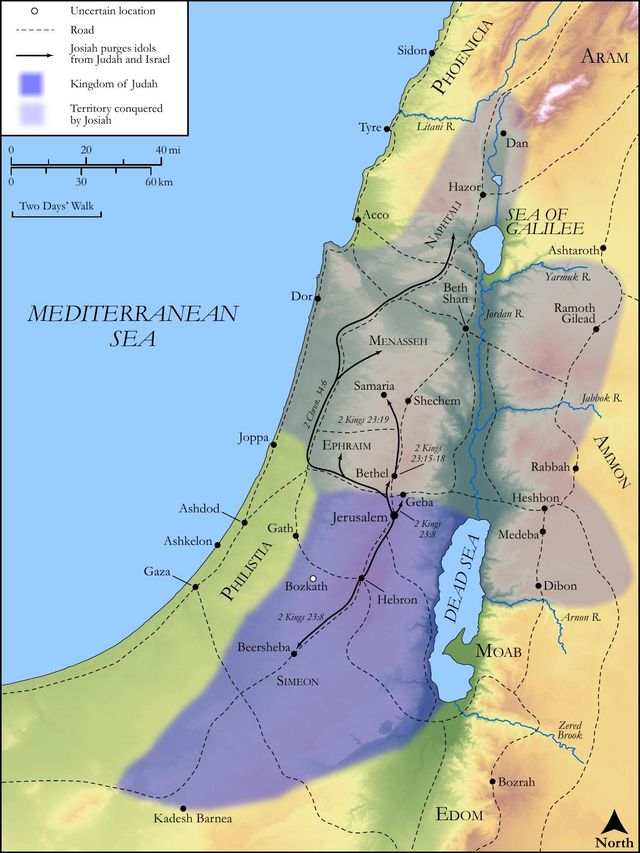
See on the biblical-era map
Study this verse
Public-domain commentary
Matthew Henry
From his Commentary on the Whole Bible. Henry comments on passages, not single verses — this entry covers 2 Chronicles 34:1–7.
Concerning Josiah we are here told, 1. That he came to the crown when he was very young, only eight years old (yet his infancy did not debar him from his right), and he reigned thirty-one years (Ch2 34:1), a considerable time. I fear, however, that in the beginning of his reign things went much as they had done in his father's time, because, being a child, he must have left the management of them to others; so that it was not till his twelfth year, which goes far in the number of his years, that the reformation began, Ch2 34:3. He could not, as Hezekiah did, fall about it immediately. 2. That he reigned very well (Ch2 34:2), approved himself to God, trod in the steps of David, and did not decline either to the right hand of to the left: for there are errors on both hands. 3. That while he was young, about sixteen years old, he began to seek after God, Ch2 34:3. We have reason to think he had not so good an education as Manasseh had (it is well if those about him did not endeavour to corrupt and debauch him); yet he thus sought God when he was young. It is the duty and interest of young people, and will particularly be the honour of young gentlemen, as soon as they come to years of understanding, to begin to seek God; for those that seek him early shall find him. 4. That in the twelfth year of his reign, when it is probable he took the administration of the government entirely into his own hands, he began to purge his kingdom from the remains of idolatry; he destroyed the high places, groves, images, altars, all the utensils of idolatry, v. 3, 4. He not only cast them out as Manasseh did, but broke them to pieces, and made dust of them. This destruction of idolatry is here said to be in his twelfth year, but it was said (Kg2 23:23) to be in his eighteenth year. Something was probably done towards it in his twelfth year; then he began to purge out idolatry, but that good work met with opposition, so that it was not thoroughly done till they had found the book of the law six years afterwards. But here the whole work is laid together briefly which was much more largely and particularly related in the Kings. His zeal carried him out to do this, not only in Judah and Jerusalem, but in the cities of Israel too, as far as he had any influence upon them.
Historical interpretation
Historical reception
1 surviving comment on this verse from the historical church.
With zeal immense, Josiah,
Himself a prince, acted in such a way
As no one before or after him had ever done!—Idols he
Dethroned; destroyed unhallowed temples; burned
With fire priests on their altars; all the bones
Of false prophets were dug up; the altars burned,
The carcasses to be consumed did serve
For fuel!
Continue studying 2 Chronicles 34:4 across the web’s major study libraries — every link below opens this exact verse, chapter, or book on the destination site.
Read & Compare
 BibleGatewayThis verse in more than 200 translations and 70 languages.
 Bible.comThe YouVersion reader — hundreds of translations, reading plans, and highlights.
 ESV.orgCrossway's official English Standard Version reader.
 NET BibleThe NET translation with 60,000+ translators' notes on every rendering decision.
 STEP BibleTyndale House's free study tool — original text, vocabulary, and scholarly resources.
 BibliaLogos Bible Software's free web reader.
 USCCBThe New American Bible (Revised Edition) with the U.S. bishops' study notes.
Commentaries
 BibleHub CommentariesDozens of classic commentaries on this verse, gathered on one page.
 StudyLightMore than 100 commentary sets — the largest collection on the web.
 BibleRefPlain-English commentary on what this verse means, verse by verse.
 Enduring WordDavid Guzik's free commentary on this chapter, widely used by Bible teachers.
 Bible Study ToolsVerse commentary alongside Greek and Hebrew study aids.
Original Language & Research
- BibleHub InterlinearThe verse word by word — original language, transliteration, and English.
- BibleHub LexiconEvery word's original-language definition and Strong's entry.
 Blue Letter BibleDeep-study tools — Strong's numbers, concordance, and word studies.
 SefariaThe Hebrew text with Rashi and centuries of Jewish commentary.
Sermons, Hymns & Audio


TrulyRandomVerse is not affiliated with these sites and doesn’t control their content. They’re linked because they’re genuinely useful.
Summary
2 Chronicles 34:4 meticulously chronicles King Josiah's sweeping and uncompromising campaign to purify Judah and Jerusalem from the pervasive idolatry that had defiled the land for generations. This verse details the systematic destruction of various pagan worship objects, including altars dedicated to Baalim, sun-images, Asherah poles, and both carved and molten idols. Josiah not only shattered these objects but ground them into dust, scattering the resulting powder upon the graves of those who had sacrificed to them, an act that profoundly desecrated and humiliated the false worship and its adherents, signifying a radical spiritual reversal.
Context
ShowHideLiterary Context
This verse is strategically placed at the outset of the Chronicler's account of Josiah's monumental reforms, immediately following the mention of his early spiritual awakening. 2 Chronicles 34:3 establishes that Josiah, though ascending to the throne at age eight, began to "seek the God of David his father" in his sixteenth year and initiated the purification of Judah and Jerusalem in his twentieth year. Verse 4, therefore, serves as the concrete, physical manifestation of this spiritual commitment, detailing the initial, aggressive phase of cleansing. It precedes the pivotal discovery of the Book of the Law in the temple (2 Chronicles 34:8), thereby emphasizing that Josiah's zeal for Yahweh was not merely a reaction to finding the covenant, but a divinely inspired, proactive pursuit of righteousness. The comprehensive enumeration of destroyed items here underscores the thoroughness of his initial purge, laying the groundwork for the deeper spiritual and covenantal reforms that would follow.
Historical & Cultural Context
Judah, prior to Josiah's reign, had suffered under decades of profound spiritual apostasy, particularly through the reigns of his grandfather Manasseh and father Amon. Manasseh, in particular, had systematically reintroduced and institutionalized pagan practices, rebuilding high places, erecting altars to Baal and Asherah, worshipping celestial bodies, practicing child sacrifice, and engaging in divination (2 Kings 21:3-9; 2 Chronicles 33:3-7). This had deeply entrenched syncretism and polytheism within Judean society, making Josiah's actions in 2 Chronicles 34:4 a remarkably courageous and counter-cultural stand. His reforms also coincided with a period of significant decline in Assyrian imperial power, which had previously exerted strong cultural and religious influence over Judah. This political vacuum likely provided Josiah with the autonomy and opportunity to implement such radical religious reforms without immediate external interference.
Key Themes
ShowHide2 Chronicles 34:4 powerfully illustrates several core theological themes central to the Chronicler's narrative. Firstly, it highlights radical obedience and comprehensive reformation. Josiah's actions were not superficial; he utterly destroyed the idols, grinding them to dust, reflecting God's repeated and stringent commands in the Law to completely abolish pagan worship and its symbols, as articulated in passages like Deuteronomy 7:5 and Deuteronomy 12:2-3. Secondly, the verse underscores God's absolute abhorrence of idolatry and the imperative of exclusive worship. The active demolition of "altars of Baalim," "images," "groves," "carved images," and "molten images" demonstrates an uncompromising stance against anything that diverted worship from Yahweh, the one true God, echoing the foundational principle of the first commandment (Exodus 20:3). Finally, the act of "strowed [it] upon the graves of them that had sacrificed unto them" emphasizes desecration and humiliation. This deliberate act ritually defiled the sacred sites of idolaters and publicly shamed the memory of those who participated in such worship, further solidifying the complete rejection of these practices and remarkably fulfilling a specific prophecy given centuries earlier concerning a king named Josiah, found in 1 Kings 13:2.
Exposition and Analysis
ShowHideKey Word Analysis
ShowHideThis term, appearing in its plural form, refers to "Baal," a prominent Phoenician and Canaanite deity. Baal was primarily worshipped as a storm and fertility god, and his cult often involved abhorrent practices such as sacred prostitution, ritualistic fertility rites, and even child sacrifice. The use of the plural "Baalim" signifies the worship of various local manifestations or aspects of this deity across Judah, or perhaps a collective reference to multiple pagan "lords" or gods.
Translated as "images, that were on high above them," the Hebrew term chammân specifically denotes "sun-pillars" or "incense altars" dedicated to sun worship. These were typically erected on elevated sites alongside altars to Baal or Asherah, serving as conspicuous symbols of pagan idolatry and syncretism. Their systematic destruction by Josiah signifies a comprehensive assault on all forms of false worship that had permeated the land.
This word refers to sacred poles or stylized trees erected in honor of Asherah, a significant Canaanite mother goddess often associated as the consort of Baal or El. These "groves" were central to Canaanite fertility cults and were frequently linked with immoral and idolatrous rituals. Their destruction by Josiah represents a direct and forceful assault on the very heart of the pervasive pagan worship system.
Verse Breakdown
ShowHide"And they brake down the altars of Baalim in his presence;"
This opening clause immediately establishes the primary target of Josiah's thorough reform: the physical structures dedicated to the worship of pagan deities. The plural "Baalim" underscores the widespread and entrenched nature of this idolatry throughout Judah. The phrase "in his presence" highlights Josiah's direct oversight, active participation, and personal commitment to this cleansing, demonstrating his kingly authority and unwavering zeal for Yahweh.
"and the images, that [were] on high above them, he cut down;"
Following the altars, the focus shifts to specific cultic objects. "The images, that were on high above them" refers to the ḥammānîm (sun-pillars or incense altars), which were typically found on elevated pagan worship sites, symbolizing their prominence. The action "cut down" implies the forceful dismantling and removal of these towering symbols of false worship, indicating a deliberate effort to eradicate their visible presence.
"and the groves, and the carved images, and the molten images, he brake in pieces,"
This segment of the verse further enumerates the diverse categories of idolatrous objects targeted, emphasizing the comprehensive nature of Josiah's destruction. "Groves" (Asherim) were sacred poles dedicated to the goddess Asherah. "Carved images" (Hebrew: pesilim) were idols shaped from wood or stone, while "molten images" (Hebrew: massekhot) were idols cast from metal. The repeated action "he brake in pieces" conveys the violent, uncompromising, and total demolition, ensuring that no idol remained intact or recognizable.
"and made dust [of them], and strowed [it] upon the graves of them that had sacrificed unto them."
This final, powerful clause describes the ultimate act of desecration and humiliation. Reducing the idols to "dust" signifies their utter annihilation, worthlessness, and powerlessness, demonstrating that they were mere inert matter, not divine beings. Scattering this dust "upon the graves of them that had sacrificed unto them" was a deliberate and profound act of ritual defilement. Graves were considered ritually unclean, and this act ensured that both the idols and the memory of their former worshippers were publicly shamed and rendered impure, preventing any potential future veneration or resurgence of these idolatrous practices.
Literary Devices
ShowHideThe Chronicler masterfully employs several potent literary devices in 2 Chronicles 34:4 to convey the intensity, significance, and thoroughness of King Josiah's reforms. The most prominent is enumeration, where the detailed listing of various idolatrous objects ("altars of Baalim," "images," "groves," "carved images," "molten images") emphasizes the comprehensive and systematic nature of the cleansing. This exhaustive catalog underscores that no form of pagan worship was overlooked or left untouched. Hyperbole is powerfully evident in the phrase "made dust [of them]," which vividly conveys the extreme thoroughness of the destruction, reducing the idols to their most insignificant and contemptible form. This act is also deeply symbolic, representing the complete eradication of spiritual rebellion and the restoration of Yahweh's exclusive sovereignty over the land and its people. Finally, the act of "strowed [it] upon the graves of them that had sacrificed unto them" is a profound act of desecration and humiliation, serving as a public declaration of utter contempt for idolatry and those who practiced it, thereby reinforcing the severity of God's judgment against false worship and the absolute triumph of His holiness.
Theological and Thematic Connections
ShowHide2 Chronicles 34:4 stands as a profound theological declaration on the nature of true worship and God's uncompromising demand for exclusive devotion. It underscores that idolatry is not merely a ritualistic error but a profound betrayal of the covenant relationship with God, deserving of radical and complete eradication. Josiah's actions embody the principle that fidelity to Yahweh necessitates the active and thorough removal of anything that competes for His rightful place in the hearts and lives of His people. This verse also highlights the theme of divine sovereignty: the false gods are shown to be utterly powerless, unable to protect themselves from destruction, thereby affirming the absolute supremacy of the Lord. The desecration of the graves further emphasizes God's judgment against those who persist in rebellion, ensuring that even their memory is shamed in the face of His holiness and purity.
Reflection and Application
ShowHideWhile we may not encounter physical altars to Baal or Asherah poles in our daily lives, the spiritual principles embedded in 2 Chronicles 34:4 remain profoundly relevant for believers today. This passage calls us to a similar radical and uncompromising spiritual cleansing within our own hearts and lives. It compels us to identify and utterly destroy any "idols" that compete for God's supreme place—whether they manifest as materialism, self-reliance, the pursuit of worldly approval, addiction to technology, unhealthy relationships, or even good things that have become ultimate things. Josiah's thoroughness challenges us to move beyond superficial adjustments and engage in a deep, transformative purging of anything that subtly or overtly diverts our worship, time, and affection from the one true God. His example encourages a complete and uncompromising commitment to ensuring that our devotion and allegiance are solely directed towards the Lord, reflecting a true and undivided heart that finds its ultimate satisfaction and purpose in Him alone.
Questions for Reflection
ShowHideFAQ
ShowHideWhy was Josiah so thorough in destroying the idols, even grinding them to dust and scattering them on graves?
ShowHideJosiah's extreme thoroughness, including grinding idols to dust and scattering them on graves, served multiple crucial purposes, demonstrating his profound zeal for the Lord. First, it represented absolute obedience to God's commands in the Law (e.g., Deuteronomy 7:5), which mandated the complete destruction of pagan objects. Second, reducing them to dust proved their utter powerlessness and worthlessness; they were not deities but inert matter, unable to protect themselves. Third, scattering the dust on graves was a deliberate act of desecration and humiliation. Graves were considered ritually unclean, and this act ensured that the idols and the memory of their worshippers were utterly defiled and held in contempt, preventing any future veneration or resurgence of these practices. It was a powerful public statement of rejection and a remarkable fulfillment of prophecy (as seen in 1 Kings 13:2).
Christ-Centered Fulfillment
ShowHideThe radical cleansing performed by King Josiah in 2 Chronicles 34:4, while a powerful historical act of national purification, ultimately points forward to the ultimate and perfect purifier, Jesus Christ. Josiah physically destroyed idols made of wood and stone, but Christ came to dismantle the spiritual strongholds of idolatry within the human heart. He is the one who truly "makes dust" of our self-worship, our pursuit of worldly gods, and our reliance on anything other than God Himself, as we are called to "put to death therefore what is earthly in you: sexual immorality, impurity, passion, evil desire, and covetousness, which is idolatry" (Colossians 3:5). Through His atoning sacrifice on the cross, Christ cleanses us from the defilement of sin and idolatry, not by scattering dust on graves, but by washing us clean with His own precious blood, making us new creations in Him (2 Corinthians 5:17). He establishes a new covenant where worship is no longer tied to physical altars or specific locations, but is offered "in spirit and truth" (John 4:23-24), transcending all earthly limitations. Thus, Josiah's zealous and thorough reforms foreshadow Christ's ultimate victory over all false gods and the power of sin, enabling believers to live lives of undivided devotion to the one true God, free from the bondage of idolatry.