


2 Chronicles 34:32
Bible text: King James Version (1769 Blayney text) · Public domain
Bible text: King James Version with Strong's numbers · Public domain
Bible text: Berean Standard Bible · Public domain
Bible text: American Standard Version (1901) · Public domain
Bible text: World English Bible, Messianic edition · Public domain
Bible text: Geneva Bible (1599) · Public domain
Bible text: Young's Literal Translation · Public domain
- וַיַּעֲמֵדvai·ya·'a·Medand he made standH5975Conj-w ¦ V-Hiphil-ConsecImperf-3msVerb Hiphil Consecutive Imperfect 3rd Singular Masculineוַandיַּעֲמֵדhe made stand
- אֵת'et<obj.>H853DirObjMParticle Object Indicator
- כָּלkoleveryH3605N-msNoun Singular Masculine Absolute
- הַנִּמְצָאha·nim·Tza'<the> [one who] was foundH4672Art ¦ V-Niphal-Prtcpl-msVerb Niphal Participle Singular Masculine Absoluteהַ<the>נִּמְצָא[one who] was found
- בִירוּשָׁלִַםvi·ru·sha·Limin JerusalemH3389Prep-b ¦ N-properNoun Proper LocationבִinירוּשָׁלִַםJerusalem
- וּבִנְיָמִןu·vin·ya·Minand BenjaminH1144Conj-w ¦ N-proper-mNoun Proper MasculineוּandבִנְיָמִןBenjamin
- וַיַּעֲשׂוּvai·ya·'a·Suand they didH6213Conj-w ¦ V-Qal-ConsecImperf-3mpVerb Qal Consecutive Imperfect 3rd Plural Masculineוַandיַּעֲשׂוּthey did
- יֹשְׁבֵיyo·she·Vei[the] inhabitants ofH3427V-Qal-Prtcpl-mpVerb Qal Participle Plural Masculine Construct
- יְרוּשָׁלִַםye·ru·sha·LimJerusalemH3389N-properNoun Proper Location
- כִּבְרִיתkiv·Ritaccording to [the] covenant ofH1285Prep-k ¦ N-fscNoun Singular Feminine Constructכִּaccording toבְרִית[the] covenant of
- אֱלֹהִים'E·lo·HimGodH430N-mpNoun Plural Masculine Absolute
- אֱלֹהֵי'e·lo·Hei[the] God ofH430N-mpcNoun Plural Masculine Construct
- אֲבוֹתֵיהֶם'a·vo·tei·Hemtheir ancestorsH1N-fpc ¦ 3mpNoun Plural Feminine Constructאֲבוֹתֵיancestorsהֶםtheir
English is a literal word-by-word gloss of the Hebrew, not the KJV's wording. Why?
This is the original text the KJV's translators worked from — each Hebrew word with its own literal English meaning in this verse, prepared by scholars at Tyndale House, Cambridge. The KJV translates whole sentences, not word by word, so its wording differs: one Hebrew word can become several English words, and the KJV may choose “the LORD” where the gloss reads “Yahweh”. Both are faithful — they answer different questions. For the KJV's own rendering, switch to the KJV text.
Details
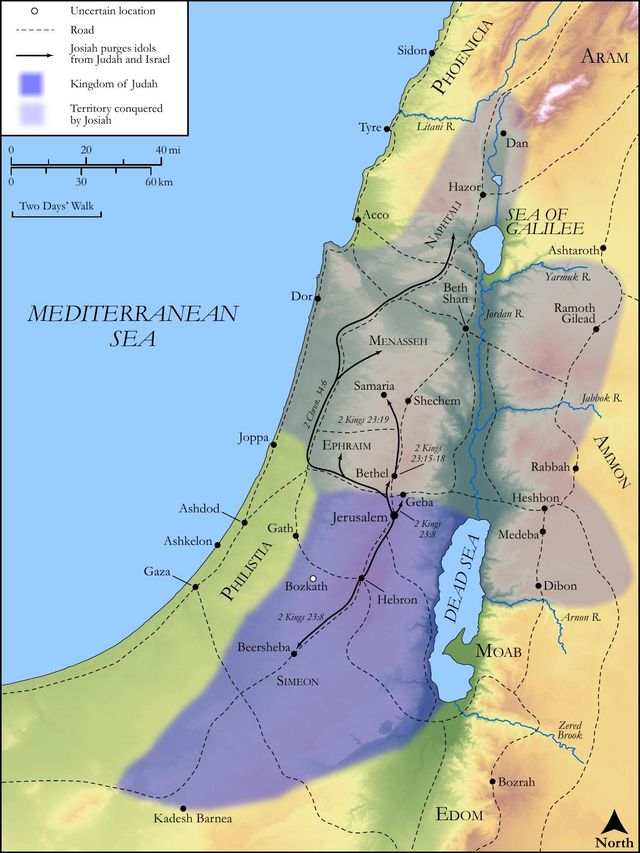
See on the biblical-era map
Study this verse
Public-domain commentary
Matthew Henry
From his Commentary on the Whole Bible. Henry comments on passages, not single verses — this entry covers 2 Chronicles 34:29–33.
We have here an account of the further advances which Josiah made towards the reformation of his kingdom upon the hearing of the law read and the receipt of the message God sent him by the prophetess. Happy the people that had such a king; for here we find that, 1. They were well taught. He did not go about to force them to do their duty, till he had first instructed them in it. He called all the people together, great and small, young and old, rich and poor, high and low. He that hath ears to hear, let him hear the words of the book of the covenant; for they are all concerned in those words. To put an honour upon the service, and to engage attention the more, though there were priests and Levites present, the king himself read the book to the people (Ch2 34:30), and he read it, no doubt, in such a manner as to show that he was himself affected with it, which would be a means of affecting the hearers. 2. They were well fixed. The articles of agreement between God and Israel being read, that they might intelligently covenant with God, both king and people with great solemnity did as it were subscribe the articles. The king in his place covenanted to keep God's commandments with all his heart and soul, according to what was written in the book (Ch2 34:31), and urged the people to declare their consent likewise to this covenant, and solemnly to promise that they would faithfully perform, fulfil, and keep, all and every thing that was on their part to be done, according to this covenant: this they did; they could not for shame do otherwise. He caused all that were present to stand to it (Ch2 34:32), and made them all to serve, even to serve the Lord their God (Ch2 34:33), to do it and to make a business of it. he did all he could to bring them to it - to serve, even to serve; the repetition denotes that this was the only thing his heart was set on; he aimed at nothing else in what he did but to engage them to God and their duty. 3. They were well tended, were honest with good looking to. All his days they departed not from following the Lord; he kept them, with much ado, from running into idolatry again. All his days were days of restraint upon them; but this intimated that there was in them a bent to backslide, a strong inclination to idolatry. Many of them wanted nothing but to have him out of the way, and then they would have their high places and their images up again. And therefore we find that in the days of Josiah (Jer 3:6) God charged it upon treacherous Judah that she had not returned to him with all her heart, but feignedly (Ch2 34:10), nay, had played the harlot (Ch2 34:8) and thereby had even justified backsliding Israel, Ch2 34:11. In the twenty-third year of this reign, four or five years after this, they had gone on to provoke God to anger with the works of their hands (Jer 25:3-7); and, which is very observable, it is from the beginning of Josiah's reformation, his twelfth or thirteenth year, that the iniquity of the house of Judah, which brought ruin upon them, and which the prophet was to bear lying on his right side, was dated (Eze 4:6), for thence to the destruction of Jerusalem was just forty years. Josiah was sincere in what he did, but the generality of the people were averse to it and hankered after their idols still; so that the reformation, though well designed and well prosecuted by the prince, had little or no effect upon the people. It was with reluctancy that they parted with their idols; still they were in heart joined to them, and wished for them again. This God saw, and therefore from that time, when one would have thought the foundations had been laid for a perpetual security and peace, from that very time did the decree go forth for their destruction. Nothing hastens the ruin of a people nor ripens them for it more than the baffling of hopeful attempts for reformation and a hypocritical return to God. Be not deceived, God is not mocked.
Continue studying 2 Chronicles 34:32 across the web’s major study libraries — every link below opens this exact verse, chapter, or book on the destination site.
Read & Compare
 BibleGatewayThis verse in more than 200 translations and 70 languages.
 Bible.comThe YouVersion reader — hundreds of translations, reading plans, and highlights.
 ESV.orgCrossway's official English Standard Version reader.
 NET BibleThe NET translation with 60,000+ translators' notes on every rendering decision.
 STEP BibleTyndale House's free study tool — original text, vocabulary, and scholarly resources.
 BibliaLogos Bible Software's free web reader.
 USCCBThe New American Bible (Revised Edition) with the U.S. bishops' study notes.
Commentaries
 BibleHub CommentariesDozens of classic commentaries on this verse, gathered on one page.
 StudyLightMore than 100 commentary sets — the largest collection on the web.
 BibleRefPlain-English commentary on what this verse means, verse by verse.
 Enduring WordDavid Guzik's free commentary on this chapter, widely used by Bible teachers.
 Bible Study ToolsVerse commentary alongside Greek and Hebrew study aids.
Original Language & Research
- BibleHub InterlinearThe verse word by word — original language, transliteration, and English.
- BibleHub LexiconEvery word's original-language definition and Strong's entry.
 Blue Letter BibleDeep-study tools — Strong's numbers, concordance, and word studies.
 SefariaThe Hebrew text with Rashi and centuries of Jewish commentary.
Sermons, Hymns & Audio


TrulyRandomVerse is not affiliated with these sites and doesn’t control their content. They’re linked because they’re genuinely useful.
Summary
2 Chronicles 34:32 encapsulates a profound moment in King Josiah's sweeping religious reforms, depicting the corporate commitment of the people of Jerusalem and Benjamin to the renewed covenant with God. Following the impactful rediscovery and public reading of the Book of the Law, Josiah led the nation in a pivotal act of repentance and dedication, culminating in this verse where the core populace publicly affirmed their allegiance and actively began to live in accordance with the divine covenant established with their ancestors.
CONTEXT
ShowHideExposition and Analysis
ShowHideKey Word Analysis
ShowHideThis verb (H5975) literally means to stand, but in various relations. In the Hiphil causative form used here ("caused... to stand"), it implies a solemn, public declaration of commitment, an oath, or a pledge of allegiance. It signifies not passive presence but an active, intentional affirmation, akin to "taking a stand for" or "upholding" something. This term is used elsewhere for standing before God in worship or judgment, indicating a posture of readiness, responsibility, and unwavering resolve.
A foundational theological concept (H1285) in the Old Testament, referring to a solemn agreement or treaty between two parties, often involving promises, obligations, and consequences (blessings for obedience, curses for disobedience). Here, it specifically refers to the Mosaic Covenant, the foundational relationship between Yahweh and Israel, established at Sinai. The phrase "covenant of God, the God of their fathers" emphasizes its divine origin and its continuity through generations, linking Josiah's reform to the original, foundational relationship with Abraham, Isaac, and Jacob, underscoring its timeless and binding nature.
This primitive root (H6213) is a broad verb meaning to do or make, encompassing the widest range of applications. In this context, "did according to" signifies active obedience and practical adherence to the stipulations of the covenant. It moves beyond mere verbal assent to practical implementation, indicating that their pledge was followed by concrete action. This word highlights the practical outworking of their renewed commitment, demonstrating that their spiritual transformation was manifested in their collective behavior.
Verse Breakdown
ShowHide"And he caused all that were present in Jerusalem and Benjamin to stand [to it]."
This clause highlights Josiah's active and decisive role as a godly leader. The verb "caused... to stand" (Hiphil of ʿâmad) indicates that Josiah actively orchestrated this public demonstration of commitment. It was not merely a suggestion but a royal decree that the people publicly affirm their allegiance to the newly rediscovered covenant. The geographical specification "Jerusalem and Benjamin" signifies the core remnant of the kingdom of Judah, indicating a widespread, if not universal, participation within the immediate sphere of royal influence. This "standing to it" implies a solemn oath or pledge, a public declaration of agreement to the terms of the covenant, signifying a collective, binding commitment.
"And the inhabitants of Jerusalem did according to the covenant of God, the God of their fathers."
This second clause describes the immediate and tangible outcome of the public affirmation. The phrase "did according to" (Hebrew: ʿāśû kĕ) signifies active obedience and practical adherence to the stipulations of the covenant. It moves beyond mere verbal assent to practical implementation, indicating that their pledge was followed by action. The repetition of "covenant of God, the God of their fathers" underscores the divine authority and historical continuity of this sacred agreement, reminding the people that they were returning to the foundational principles established by God with their ancestors, not adopting a new, human-made religion. This demonstrates a genuine, corporate spiritual transformation that manifested in their collective behavior.
Literary Devices
ShowHideThe verse employs Emphasis through the specific choice of verbs and the repetition of a key phrase. The causative verb "caused... to stand" emphasizes Josiah's strong, decisive leadership in orchestrating this national commitment, highlighting his zeal for the Lord. The phrase "covenant of God, the God of their fathers" is repeated, underscoring the divine origin, historical continuity, and supreme authority of the agreement, reinforcing its foundational importance. Furthermore, there is an element of Synecdoche, where "Jerusalem and Benjamin" represent the entire remaining kingdom of Judah, signifying that the covenant renewal extended beyond the capital to the surrounding, foundational territory, indicating a comprehensive, if not total, national participation. This collective action highlights the profound theme of Corporate Responsibility, where the entire community is bound by the covenant and expected to live in accordance with its terms.
Theological and Thematic Connections
ShowHide2 Chronicles 34:32 powerfully illustrates the principles of corporate covenant and the transformative power of God's Word when embraced by a community. It demonstrates that true revival involves not just individual repentance but a collective turning to God, led by faithful leadership, and expressed through public commitment and practical obedience to divine revelation. The verse underscores God's persistent desire for His people to live in covenant relationship with Him, offering grace and opportunity for restoration even after severe apostasy. It serves as a testament to the enduring nature of God's covenant promises and the reciprocal obligations they entail for His people, emphasizing that God's desire is for His people to "do according to" His revealed will.
Reflection and Application
ShowHideThis verse offers profound lessons for contemporary believers and the church. Just as Josiah led his people to a renewed dedication, we are called to actively engage with God's Word and live in accordance with His will, both individually and corporately. The public "standing to" the covenant reminds us that faith is not a purely private affair but has a communal dimension, calling for shared commitment and accountability within the body of Christ. Our churches are called to be communities that collectively "do according to the covenant," demonstrating our allegiance to Christ through our lives, worship, and service. This passage encourages us to consider the depth of our own commitment to the New Covenant in Christ, urging us not just to hear God's Word but to actively obey it, allowing it to transform our lives and our communities. True spiritual vitality flows from a collective resolve to honor God's truth and live out its implications, manifesting in tangible acts of obedience and faithfulness.
Questions for Reflection
ShowHideFAQ
ShowHideWhat does "stand [to it]" mean in this context?
ShowHideThe phrase "stand [to it]" signifies a solemn, public act of affirmation, agreement, and commitment to the covenant. In Israel, standing often indicated readiness, allegiance, or taking an oath. Here, it means that the people of Jerusalem and Benjamin, at Josiah's command, publicly and formally pledged themselves to uphold the terms of the covenant that had been rediscovered and read to them. It was a corporate declaration of loyalty and obedience to God's law, moving beyond passive listening to active, binding commitment, much like a modern-day oath of office or a public vow. This collective "standing" was a foundational step in their renewed relationship with God, as described in 2 Chronicles 34:31, where Josiah himself made a similar pledge before the Lord.
How significant was this covenant renewal under Josiah?
ShowHideThe covenant renewal under Josiah was profoundly significant, representing one of the most comprehensive and sincere spiritual revivals in Judah's history since the time of David or Solomon. It was catalyzed by the rediscovery of the Book of the Law, which brought about national repentance and a concerted effort to purge idolatry and re-establish pure worship. Unlike some previous reforms that were more superficial or short-lived, Josiah's revival involved a deep personal conviction on the king's part (see 2 Chronicles 34:27), leading to a widespread, corporate commitment from the people. This period of obedience brought a measure of divine favor and delayed God's judgment on Judah, as prophesied by Huldah in 2 Chronicles 34:28. It demonstrated the power of God's Word to transform a nation when it is truly embraced and acted upon, leading to a period of sustained faithfulness during Josiah's reign.
Christ-Centered Fulfillment
ShowHideWhile 2 Chronicles 34:32 describes a renewal of the Old Covenant, it powerfully foreshadows the ultimate and perfect covenant established through Jesus Christ. Josiah's act of causing the people to "stand to" the covenant points to the New Covenant, where God's law is not merely written on tablets of stone but is inscribed upon the hearts of believers by the Holy Spirit (as promised in Jeremiah 31:33). Just as the Book of the Law was rediscovered and led to national repentance, the gospel of Jesus Christ reveals God's perfect will and calls humanity to a deeper, more profound repentance and faith. Christ Himself is the mediator of this superior covenant, whose sacrifice on the cross fully atones for sin and enables true, Spirit-empowered obedience (as explained in Hebrews 8:6-13). The corporate commitment seen in Jerusalem and Benjamin finds its ultimate fulfillment in the church, the body of Christ, which is called to live in collective allegiance to Him, walking in newness of life according to His perfect will (as described in Romans 6:4). Thus, Josiah's revival, though temporary and ultimately followed by Judah's downfall, serves as a powerful type, pointing to the lasting spiritual transformation and genuine obedience made possible only through the person and work of the Lamb of God, who takes away the sin of the world.