


2 Chronicles 29:29
Bible text: King James Version (1769 Blayney text) · Public domain
Bible text: Berean Standard Bible · Public domain
Bible text: American Standard Version (1901) · Public domain
Bible text: World English Bible, Messianic edition · Public domain
Bible text: Geneva Bible (1599) · Public domain
Bible text: Young's Literal Translation · Public domain
- וּכְכַלּוֹתu·khe·kha·Lotand just as finishedH3615Conj-w ¦ Prep-k ¦ V-Piel-InfVerb Piel Infinitive Constructוּandכְjust asכַלּוֹתfinished
- לְהַעֲלוֹתle·ha·'a·Lotto offer upH5927Prep-l ¦ V-Hiphil-InfVerb Hiphil Infinitive Constructלְtoהַעֲלוֹתoffer up
- כָּרְעוּka·re·'Uthey bowed downH3766V-Qal-Perf-3cpVerb Qal Perfect 3rd Plural common gender
- הַמֶּלֶךְha·Me·lekhthe kingH4428Art ¦ N-msNoun Singular Masculine Absoluteהַtheמֶּלֶךְking
- וְכָלve·kholand allH3605Conj-w ¦ N-msNoun Singular Masculine Absoluteוְandכָלall
- הַנִּמְצְאִיםha·nim·tze·'Imthose [who] were foundH4672Art ¦ V-Niphal-Prtcpl-mpVerb Niphal Participle Plural Masculine Absoluteהַthoseנִּמְצְאִים[who] were found
- אִתּוֹ'i·Towith himH854Prep ¦ 3msPrepositionאִתּwithוֹhim
- וַיִּשְׁתַּחֲווּvai·Yish·ta·cha·Vuand they bowed downH7812Conj-w ¦ V-Hishtaphel-ConsecImperf-3mpVerb Hishtaphel Consecutive Imperfect 3rd Plural Masculineוַandיִּשְׁתַּחֲווּthey bowed down
English is a literal word-by-word gloss of the Hebrew, not the KJV's wording. Why?
This is the original text the KJV's translators worked from — each Hebrew word with its own literal English meaning in this verse, prepared by scholars at Tyndale House, Cambridge. The KJV translates whole sentences, not word by word, so its wording differs: one Hebrew word can become several English words, and the KJV may choose “the LORD” where the gloss reads “Yahweh”. Both are faithful — they answer different questions. For the KJV's own rendering, switch to the KJV text.
Details
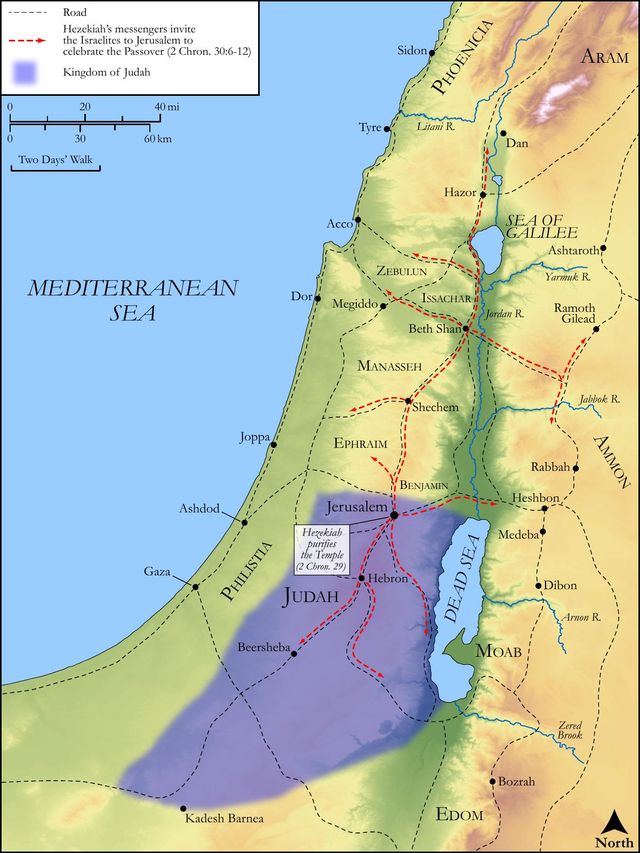
See on the biblical-era map
Study this verse
Public-domain commentary
Matthew Henry
From his Commentary on the Whole Bible. Henry comments on passages, not single verses — this entry covers 2 Chronicles 29:20–36. His three-level outline is real structure in the source text, so it is rendered as structure.
The temple being cleansed, we have here an account of the good use that was immediately made of it. A solemn assembly was called to meet the king at the temple, the very next day (Ch2 29:20); and very glad, no doubt, all the good people in Jerusalem were, when it was said, Let us go up to the house of the Lord, Psa 122:1. As soon as Hezekiah heard that the temple was ready for him he lost no time, but made it appear that he was ready for it. He rose early to go up to the house of the Lord, earlier on that day than on other days, to show that his heart was upon his work there. Now this day's work was to look two ways: -
I.Atonement must be made for the sins of the last reign.
They thought it not enough to lament and forsake those sins, but they brought a sin-offering. Even our repentance and reformation will not obtain pardon but in and through Christ, who was made sin (that is, a sin-offering) for us. No peace but through his blood, no, not for penitents. Observe,
1.The sin-offering was for the kingdom, for the sanctuary, and for Judah (Ch2 29:21), that is, to make atonement for the sins of princes, priests, and people, for they had all corrupted their way. The law of Moses appointed sacrifices to make atonement for the sins of the whole congregation (Lev 4:13, Lev 4:14; Num 15:24, Num 15:25), that the national judgments which their national sins deserved might be turned away. For this purpose we must now have an eye to Christ the great propitiation, as well as for the remission and salvation of particular persons.
2.The law appointed only one goat for a sin-offering, as on the day of atonement (Lev 16:15) and on such extraordinary occasions as this, Num 15:24. But they here offered seven (Ch2 29:21), because the sins of the congregation had been very great and long continued in. Seven is a number of perfection. Our great sin-offering is but one, yet that one perfects for ever those that are sanctified.
3.The king and the congregation (that is, the representatives of the congregation) laid their hands on the heads of the goats that were for the sin-offering (Ch2 29:23), thereby owning themselves guilty before God and expressing their desire that the guilt of the sinner might be transferred to the sacrifice. By faith we lay our hands on the Lord Jesus, and so receive the atonement, Rom 5:11.
4.Burnt-offerings were offered with the sin-offerings, seven bullocks, seven rams, and seven lambs. The intention of the burnt-offerings was to give glory to the God of Israel, whom they owned as the only true God, which it was proper to do at the same time that they were by the sin-offering making atonement for their offences. The blood of those, as well as of the sin-offering, was sprinkled upon the altar (Ch2 29:22), to make reconciliation for all Israel (Ch2 29:24), and not for Judah only. Christ is a propitiation, not for the sins of Israel only, but of the whole world, Jo1 2:1, Jo1 2:2.
5.While the offerings were burning upon the altar the Levites sang the song of the Lord (Ch2 29:27), the Psalms composed by David and Asaph (Ch2 29:30), accompanied by the musical instruments which God by his prophets had commanded the use of (Ch2 29:25), and which had been long neglected. Even sorrow for sin must not put us out of tune for praising God. By faith we must rejoice in Christ Jesus as our righteousness; and our prayers and praises must ascend with his offering, to be accepted only in virtue of it.
6.The king and all the congregation testified their consent to and concurrence in all that was done, by bowing their heads and worshipping, expressing an awful veneration of the divine Majesty, by postures of adoration. This is taken notice of, Ch2 29:28-30. It is not enough for us to be where God is worshipped, if we do not ourselves worship him, and that not with bodily exercise only, which profits little, but with the heart.
II.The solemnities of this day did likewise look forward.
The temple service was to be set up again, that it might be continually kept up; and this Hezekiah calls them to, Ch2 29:31. "Now that you have consecrated yourselves to the Lord - have both made an atonement and made a covenant by sacrifice, are solemnly reconciled and engaged to him - now come near, and bring sacrifices." Note, Our covenant with God must be pursued and improved in communion with him. Having consecrated ourselves, in the first place, to the Lord, we must bring the sacrifices of prayer, and praise, and alms, to his house. Now, in this work, it was found.
1.That the people were free. Being called to it by the king, they brought in their offerings, though not in such abundance as in the glorious days of Solomon (for Judah was now diminished, impoverished, and brought low), but according to what they had, and as much as one could expect considering their poverty and the great decay of piety among them.
(1.)Some were so generous as to bring burnt-offerings, which were wholly consumed to the honour of God, and of which the offerer had no part. Of this sort there were seventy bullocks, 100 rams, and 200 lambs, Ch2 29:32.
(2.)Others brought peace-offerings and thank-offerings, the fat of which was burnt upon the altar, and the flesh divided between the priests and the offerers, Ch2 29:35. Of this sort there were 600 oxen and 3000 sheep, Ch2 29:33. Perhaps the remembrance of their sin in sacrificing on the high places made them more willing to bring their sacrifices now to God's altar.
2.That the priests were few, too few for the service, Ch2 29:34. Many of them, it is likely, were suspended and laid aside as polluted and uncanonical, for having sacrificed to idols in the last reign, and the rest had not the zeal that one might have expected upon such an occasion. They thought that the king needed not to be so forward, that there was no necessity for such haste in opening the doors of the temple, and therefore they took no care to sanctify themselves, and being unsanctified, and so unqualified, they made that their excuse for being absent from the service; as if their offence would be their defence. It is recorded here, to the perpetual shame of the priests, that, though they were so well provided for out of the offerings of the Lord made by fire, yet they did not mind their business. Here was work to do, and there wanted proper hands to do it.
3.That the Levites were forward. They had been more upright in heart to sanctify themselves than the priests (Ch2 29:34), were better affected to the work and better prepared and qualified for it. This was their praise, and, in recompence for it, they had the honour to be employed in that which was the priests' work: they helped them to flay the offerings. This was not according to the law (Lev 1:5, Lev 1:6), but the irregularity was dispensed with in cases of necessity, and thus encouragement was given to the faithful zealous Levites and a just disgrace put upon the careless priests. What the Levites wanted in the ceremonial advantages of their birth and consecration was abundantly made up in their eminent qualifications of skill and will to do the work.
4.That all were pleased. The king and all the people rejoiced in this blessed turn of affairs and the new face of religion which the kingdom had put on, Ch2 29:36. Two things in this matter pleased them: - (1.) That it was soon brought about: The thing was done suddenly, in a little time, with a great deal of ease, and without any opposition. Those that go about the work of God in faith and with resolution will find that there is not that difficulty in it which they sometimes imagine, but it will be a pleasing surprise to them to see how soon it is done. (2.) That the hand of God was plainly in it: God had prepared the people by the secret influences of his grace, so that many of those who had in the last reign doted on the idolatrous altars were now as much in love with God's altar. This change, which God wrought on their minds, did very much expedite and facilitate the work. Let magistrates and ministers do their part towards the reforming of a land, and ascribe to him the glory of what is done, especially when it is done suddenly and is a pleasing surprise. This is the Lord's doing, and it is marvellous.
Continue studying 2 Chronicles 29:29 across the web’s major study libraries — every link below opens this exact verse, chapter, or book on the destination site.
Read & Compare
 BibleGatewayThis verse in more than 200 translations and 70 languages.
 Bible.comThe YouVersion reader — hundreds of translations, reading plans, and highlights.
 ESV.orgCrossway's official English Standard Version reader.
 NET BibleThe NET translation with 60,000+ translators' notes on every rendering decision.
 STEP BibleTyndale House's free study tool — original text, vocabulary, and scholarly resources.
 BibliaLogos Bible Software's free web reader.
 USCCBThe New American Bible (Revised Edition) with the U.S. bishops' study notes.
Commentaries
 BibleHub CommentariesDozens of classic commentaries on this verse, gathered on one page.
 StudyLightMore than 100 commentary sets — the largest collection on the web.
 BibleRefPlain-English commentary on what this verse means, verse by verse.
 Enduring WordDavid Guzik's free commentary on this chapter, widely used by Bible teachers.
 Bible Study ToolsVerse commentary alongside Greek and Hebrew study aids.
Original Language & Research
- BibleHub InterlinearThe verse word by word — original language, transliteration, and English.
- BibleHub LexiconEvery word's original-language definition and Strong's entry.
 Blue Letter BibleDeep-study tools — Strong's numbers, concordance, and word studies.
 SefariaThe Hebrew text with Rashi and centuries of Jewish commentary.
Sermons, Hymns & Audio


TrulyRandomVerse is not affiliated with these sites and doesn’t control their content. They’re linked because they’re genuinely useful.
Summary
This verse captures the climactic moment of spiritual revival under King Hezekiah, immediately following the extensive purification of the Temple and the completion of numerous sacrificial offerings. It depicts a profound, unified act of humble adoration and worship by both the king and all those present, signifying the nation's sincere repentance, the acceptance of their atonement, and their renewed covenant relationship with the Lord.
Context
ShowHideLiterary Context
This verse is situated at the culmination of a significant spiritual restoration initiated by King Hezekiah in 2 Chronicles 29. Having inherited a kingdom marred by idolatry and neglect under his father, King Ahaz (as detailed in 2 Chronicles 28), Hezekiah immediately prioritized the cleansing and reconsecration of the Lord's Temple. The preceding verses (2 Chronicles 29:20-28) describe the elaborate process of sin offerings, burnt offerings, and peace offerings made by the Levites and priests, accompanied by music and instruments, all designed to atone for the sins of the nation and re-establish proper worship. Verse 29 marks the point where these extensive ritual acts have been "made an end of," leading directly to the spontaneous and heartfelt response of worship.
Historical & Cultural Context
King Hezekiah reigned in Judah from approximately 715-686 BC, a period marked by significant political and spiritual challenges, including the looming threat of the Assyrian Empire. His reign stands in stark contrast to the apostasy of his father, Ahaz, who had closed the Temple doors and promoted pagan worship. In ancient Israel, the Temple was the central place of worship and the dwelling place of God's presence. Sacrifices were the divinely ordained means of atonement and fellowship. The act of bowing and prostrating oneself was a universal sign of profound respect, submission, and adoration among the nations, particularly before a king or a god. For the king and the entire assembly to perform this act collectively after the offerings underscored the corporate nature of their sin, repentance, and renewed devotion to Yahweh, rejecting the syncretism that had plagued Judah.
Key Themes
ShowHideThis verse powerfully contributes to several overarching themes within 2 Chronicles and the broader biblical narrative. Firstly, it highlights the restoration of true worship, moving from the defilement and neglect under Ahaz to a renewed commitment to God's prescribed rituals and sincere adoration. Secondly, it emphasizes humility and reverence before God, as seen in the physical posture of bowing and the spiritual act of worship. This posture acknowledges God's absolute sovereignty and holiness, a theme echoed in passages like Psalm 95:6. Thirdly, the participation of "the king and all that were present with him" underscores the theme of corporate devotion and unity in worship, demonstrating a collective spiritual turning. Finally, the sequence of offerings followed by worship suggests a profound sense of divine acceptance and reconciliation, indicating that their sacrifices were pleasing to God and their fellowship restored, foreshadowing the ultimate reconciliation offered through Christ, as seen in Romans 5:11.
Exposition and Analysis
ShowHideKey Word Analysis
ShowHideThis primitive root signifies completion, finishing, or bringing to an end. In this context, it emphasizes that the extensive and demanding process of purifying the Temple and offering the prescribed sacrifices was fully accomplished. It implies a thoroughness and finality to their ritual acts, setting the stage for the spiritual response that follows. The completion of the external acts of worship then allows for the internal, heartfelt response.
This primitive root describes the physical act of bending the knee, sinking, or prostrating oneself. It is a posture of deep humility, respect, and submission. In a religious context, it signifies acknowledging the superior authority and majesty of God. The use of the reflexive form ("bowed themselves") highlights that this was a deliberate, self-initiated act by the king and the people, not something coerced.
This primitive root is a foundational Hebrew term for worship, meaning "to depress," "to prostrate oneself," "to do homage," or "to bow down." While often involving a physical posture, it encompasses the broader spiritual act of adoration, reverence, and submission to a deity. The pairing of kâraʻ ("bowed themselves") and shâchâh ("worshipped") in this verse creates a powerful emphasis, indicating that their physical posture of humility was a direct manifestation of their inner spiritual reverence and adoration for God. It was a holistic act of body and spirit.
Verse Breakdown
ShowHide"And when they had made an end of offering"
This clause establishes the temporal context, indicating that the act of worship was a direct response to the completion of the sacrificial rituals. The "offering" refers to the extensive sin offerings, burnt offerings, and peace offerings detailed in the preceding verses, which were made to atone for the nation's sins and consecrate them anew to God. The completion signifies that the necessary steps for reconciliation and purification had been taken according to God's law.
"the king and all that were present with him"
This highlights the corporate nature of the worship. It was not just a private act by Hezekiah but a unified, communal response involving the entire assembly. This emphasizes the shared spiritual experience and the collective turning of the nation back to God, underscoring the importance of corporate worship and the leader's role in guiding the people in devotion.
"bowed themselves, and worshipped"
This climactic phrase describes the profound spiritual and physical response. "Bowed themselves" denotes the physical posture of humility and submission, while "worshipped" encompasses the deeper spiritual act of adoration, reverence, and homage to God. The combination emphasizes the sincerity and totality of their devotion, a complete surrender and acknowledgment of God's sovereignty and holiness after witnessing the efficacy of the atonement.
Literary Devices
ShowHideThe verse employs several impactful literary devices. The most prominent is Repetition and Emphasis through the pairing of "bowed themselves" (kâraʻ) and "worshipped" (shâchâh). While both terms relate to prostration and homage, their conjunction intensifies the sense of profound humility, reverence, and complete submission to God. This dual expression underscores the totality of their physical and spiritual surrender. Furthermore, the verse utilizes Symbolism, where the physical act of bowing serves as a visible manifestation of an internal spiritual state of awe, respect, and adoration. The collective action of "the king and all that were present with him" also employs Synecdoche, where the king and the assembly represent the entire nation of Judah, signifying a corporate turning back to God. Finally, the verse functions as a Climax in the narrative of Hezekiah's reforms, serving as the culminating spiritual response to the successful completion of the Temple purification and sacrificial offerings, bringing the ritual acts to their intended spiritual fulfillment.
Theological and Thematic Connections
ShowHideThis verse beautifully illustrates the proper response to divine grace and atonement: humble worship. After the elaborate and costly process of cleansing the Temple and making sacrifices for sin, the king and the people did not merely disperse but immediately engaged in a profound act of corporate worship. This demonstrates that true worship is not just about ritualistic performance but about a heart posture of humility, gratitude, and adoration in response to God's provision for sin. It underscores the biblical principle that genuine reconciliation with God leads inevitably to reverent worship, acknowledging His holiness and sovereignty. The collective nature of their response highlights the importance of communal worship and shared spiritual experience in the life of God's people.
Reflection and Application
ShowHideThe scene in 2 Chronicles 29:29 offers a powerful blueprint for our own spiritual lives. It reminds us that our acts of service, obedience, and even repentance should culminate in heartfelt worship. Just as the people of Judah responded with adoration after their sins were atoned for, we too are called to approach God with humility and reverence, especially in light of the ultimate sacrifice made for us. True worship is not merely a formality but a profound, holistic response of our entire being – body, mind, and spirit – to the goodness and holiness of God. It is a recognition that all our efforts and blessings flow from Him, and our proper response is to bow in awe and gratitude. This verse challenges us to consider if our worship is truly sincere, collective, and a natural outpouring of a heart reconciled to God.
Questions for Reflection
ShowHideFAQ
ShowHideWhat is the significance of the king and "all that were present with him" bowing and worshipping?
ShowHideThe participation of "the king and all that were present with him" is highly significant because it demonstrates a corporate, unified act of national repentance and devotion. King Hezekiah, as the spiritual leader, set the example, and the entire assembly followed, indicating a widespread spiritual revival and a collective turning back to God. This highlights the importance of communal worship and the shared spiritual journey of a people, where leaders and congregants alike humble themselves before the Lord. It signifies that the atonement offered was for the entire nation, and their worship was a collective expression of gratitude and renewed covenant. This corporate response is a recurring theme in Israel's history when they return to the Lord, as seen in Nehemiah 8:6 where the people respond to Ezra's blessing by bowing and worshipping.
Christ-Centered Fulfillment
ShowHideThe profound act of worship in 2 Chronicles 29:29 serves as a powerful foreshadowing of the ultimate reconciliation and access to God made possible through Jesus Christ. The Old Testament sacrifices, though necessary and divinely ordained, were temporary and had to be repeated, pointing to a greater, once-for-all atonement. Hezekiah and the people bowed in worship after the offerings had been made, signifying that their reconciliation with God was complete and accepted. Similarly, through the singular, perfect sacrifice of the Lamb of God, who takes away the sin of the world, believers are granted full and permanent access to God's presence. We do not offer repeated sacrifices, but rather, we worship in spirit and truth because Christ has "made an end" of sin's power and guilt on the cross (Hebrews 10:10-14). Our worship, therefore, is not merely a response to a completed ritual but a joyous and humble adoration of the One who has perfectly accomplished our redemption. Just as the king and people bowed, we are called to bow our hearts and lives before the resurrected Lord, recognizing His supreme authority and the finished work that grants us peace with God (Romans 5:1). Our worship is a continuous, Spirit-empowered response to the glorious grace of God in Christ Jesus.