


2 Chronicles 29:24
Bible text: King James Version (1769 Blayney text) · Public domain
Bible text: King James Version with Strong's numbers · Public domain
Bible text: Berean Standard Bible · Public domain
Bible text: American Standard Version (1901) · Public domain
Bible text: World English Bible, Messianic edition · Public domain
Bible text: Geneva Bible (1599) · Public domain
Bible text: Young's Literal Translation · Public domain
- וַיִּשְׁחָטוּםvai·yish·cha·Tumand they slaughtered themH7819Conj-w ¦ V-Qal-ConsecImperf-3mp ¦ 3mpVerb Qal Consecutive Imperfect 3rd Plural Masculineוַandיִּשְׁחָטוּthey slaughteredםthem
- הַכֹּהֲנִיםha·Ko·ha·Nimthe priestsH3548Art ¦ N-mpNoun Plural Masculine Absoluteהַtheכֹּהֲנִיםpriests
- וַיְחַטְּאוּvay·cha·te·'Uand they made a sin offeringH2398Conj-w ¦ V-Piel-ConsecImperf-3mpVerb Piel Consecutive Imperfect 3rd Plural Masculineוַandיְחַטְּאוּthey made a sin offering
- אֶת'et<obj.>H853DirObjMParticle Object Indicator
- דָּמָםda·Mamtheir bloodH1818N-msc ¦ 3mpNoun Singular Masculine Constructדָּמָbloodםtheir
- הַמִּזְבֵּחָהha·miz·Be·chahthe altar towardsH4196Art ¦ N-ms ¦ SfxNoun Singular Masculine Absoluteהַtheמִּזְבֵּחָaltarהtowards
- לְכַפֵּרle·kha·Perto make atonementH3722Prep-l ¦ V-Piel-InfVerb Piel Infinitive Constructלְtoכַפֵּרmake atonement
- עַל'alonH5921PrepPreposition
- כָּלkolallH3605N-mscNoun Singular Masculine Construct
- יִשְׂרָאֵלYis·ra·'ElIsraelH3478N-properNoun Proper Location
- כִּיkiforH3588PrtParticle Conditional
- לְכָלle·kholfor allH3605Prep-l ¦ N-mscNoun Singular Masculine Constructלְforכָלall
- יִשְׂרָאֵלYis·ra·'ElIsraelH3478N-properNoun Proper Location
- אָמַר'a·Marhe had saidH559V-Qal-Perf-3msVerb Qal Perfect 3rd Singular Masculine
- הַמֶּלֶךְha·Me·lekhthe kingH4428Art ¦ N-msNoun Singular Masculine Absoluteהַtheמֶּלֶךְking
- הָעוֹלָהha·'o·Lahthe burnt offeringH5930Art ¦ N-fsNoun Singular Feminine Absoluteהָtheעוֹלָהburnt offering
- וְהַחַטָּאתve·ha·cha·Tatand the sin offeringH2403Conj-w ¦ Art ¦ N-fsNoun Singular Feminine Absoluteוְandהַtheחַטָּאתsin offering
English is a literal word-by-word gloss of the Hebrew, not the KJV's wording. Why?
This is the original text the KJV's translators worked from — each Hebrew word with its own literal English meaning in this verse, prepared by scholars at Tyndale House, Cambridge. The KJV translates whole sentences, not word by word, so its wording differs: one Hebrew word can become several English words, and the KJV may choose “the LORD” where the gloss reads “Yahweh”. Both are faithful — they answer different questions. For the KJV's own rendering, switch to the KJV text.
Details
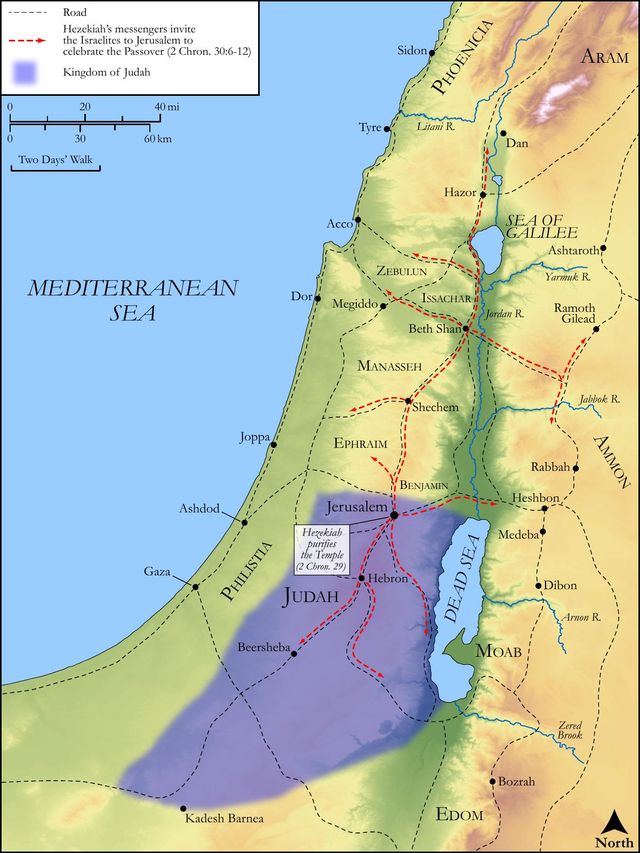
See on the biblical-era map
Study this verse
Public-domain commentary
Matthew Henry
From his Commentary on the Whole Bible. Henry comments on passages, not single verses — this entry covers 2 Chronicles 29:20–36. His three-level outline is real structure in the source text, so it is rendered as structure.
The temple being cleansed, we have here an account of the good use that was immediately made of it. A solemn assembly was called to meet the king at the temple, the very next day (Ch2 29:20); and very glad, no doubt, all the good people in Jerusalem were, when it was said, Let us go up to the house of the Lord, Psa 122:1. As soon as Hezekiah heard that the temple was ready for him he lost no time, but made it appear that he was ready for it. He rose early to go up to the house of the Lord, earlier on that day than on other days, to show that his heart was upon his work there. Now this day's work was to look two ways: -
I.Atonement must be made for the sins of the last reign.
They thought it not enough to lament and forsake those sins, but they brought a sin-offering. Even our repentance and reformation will not obtain pardon but in and through Christ, who was made sin (that is, a sin-offering) for us. No peace but through his blood, no, not for penitents. Observe,
1.The sin-offering was for the kingdom, for the sanctuary, and for Judah (Ch2 29:21), that is, to make atonement for the sins of princes, priests, and people, for they had all corrupted their way. The law of Moses appointed sacrifices to make atonement for the sins of the whole congregation (Lev 4:13, Lev 4:14; Num 15:24, Num 15:25), that the national judgments which their national sins deserved might be turned away. For this purpose we must now have an eye to Christ the great propitiation, as well as for the remission and salvation of particular persons.
2.The law appointed only one goat for a sin-offering, as on the day of atonement (Lev 16:15) and on such extraordinary occasions as this, Num 15:24. But they here offered seven (Ch2 29:21), because the sins of the congregation had been very great and long continued in. Seven is a number of perfection. Our great sin-offering is but one, yet that one perfects for ever those that are sanctified.
3.The king and the congregation (that is, the representatives of the congregation) laid their hands on the heads of the goats that were for the sin-offering (Ch2 29:23), thereby owning themselves guilty before God and expressing their desire that the guilt of the sinner might be transferred to the sacrifice. By faith we lay our hands on the Lord Jesus, and so receive the atonement, Rom 5:11.
4.Burnt-offerings were offered with the sin-offerings, seven bullocks, seven rams, and seven lambs. The intention of the burnt-offerings was to give glory to the God of Israel, whom they owned as the only true God, which it was proper to do at the same time that they were by the sin-offering making atonement for their offences. The blood of those, as well as of the sin-offering, was sprinkled upon the altar (Ch2 29:22), to make reconciliation for all Israel (Ch2 29:24), and not for Judah only. Christ is a propitiation, not for the sins of Israel only, but of the whole world, Jo1 2:1, Jo1 2:2.
5.While the offerings were burning upon the altar the Levites sang the song of the Lord (Ch2 29:27), the Psalms composed by David and Asaph (Ch2 29:30), accompanied by the musical instruments which God by his prophets had commanded the use of (Ch2 29:25), and which had been long neglected. Even sorrow for sin must not put us out of tune for praising God. By faith we must rejoice in Christ Jesus as our righteousness; and our prayers and praises must ascend with his offering, to be accepted only in virtue of it.
6.The king and all the congregation testified their consent to and concurrence in all that was done, by bowing their heads and worshipping, expressing an awful veneration of the divine Majesty, by postures of adoration. This is taken notice of, Ch2 29:28-30. It is not enough for us to be where God is worshipped, if we do not ourselves worship him, and that not with bodily exercise only, which profits little, but with the heart.
II.The solemnities of this day did likewise look forward.
The temple service was to be set up again, that it might be continually kept up; and this Hezekiah calls them to, Ch2 29:31. "Now that you have consecrated yourselves to the Lord - have both made an atonement and made a covenant by sacrifice, are solemnly reconciled and engaged to him - now come near, and bring sacrifices." Note, Our covenant with God must be pursued and improved in communion with him. Having consecrated ourselves, in the first place, to the Lord, we must bring the sacrifices of prayer, and praise, and alms, to his house. Now, in this work, it was found.
1.That the people were free. Being called to it by the king, they brought in their offerings, though not in such abundance as in the glorious days of Solomon (for Judah was now diminished, impoverished, and brought low), but according to what they had, and as much as one could expect considering their poverty and the great decay of piety among them.
(1.)Some were so generous as to bring burnt-offerings, which were wholly consumed to the honour of God, and of which the offerer had no part. Of this sort there were seventy bullocks, 100 rams, and 200 lambs, Ch2 29:32.
(2.)Others brought peace-offerings and thank-offerings, the fat of which was burnt upon the altar, and the flesh divided between the priests and the offerers, Ch2 29:35. Of this sort there were 600 oxen and 3000 sheep, Ch2 29:33. Perhaps the remembrance of their sin in sacrificing on the high places made them more willing to bring their sacrifices now to God's altar.
2.That the priests were few, too few for the service, Ch2 29:34. Many of them, it is likely, were suspended and laid aside as polluted and uncanonical, for having sacrificed to idols in the last reign, and the rest had not the zeal that one might have expected upon such an occasion. They thought that the king needed not to be so forward, that there was no necessity for such haste in opening the doors of the temple, and therefore they took no care to sanctify themselves, and being unsanctified, and so unqualified, they made that their excuse for being absent from the service; as if their offence would be their defence. It is recorded here, to the perpetual shame of the priests, that, though they were so well provided for out of the offerings of the Lord made by fire, yet they did not mind their business. Here was work to do, and there wanted proper hands to do it.
3.That the Levites were forward. They had been more upright in heart to sanctify themselves than the priests (Ch2 29:34), were better affected to the work and better prepared and qualified for it. This was their praise, and, in recompence for it, they had the honour to be employed in that which was the priests' work: they helped them to flay the offerings. This was not according to the law (Lev 1:5, Lev 1:6), but the irregularity was dispensed with in cases of necessity, and thus encouragement was given to the faithful zealous Levites and a just disgrace put upon the careless priests. What the Levites wanted in the ceremonial advantages of their birth and consecration was abundantly made up in their eminent qualifications of skill and will to do the work.
4.That all were pleased. The king and all the people rejoiced in this blessed turn of affairs and the new face of religion which the kingdom had put on, Ch2 29:36. Two things in this matter pleased them: - (1.) That it was soon brought about: The thing was done suddenly, in a little time, with a great deal of ease, and without any opposition. Those that go about the work of God in faith and with resolution will find that there is not that difficulty in it which they sometimes imagine, but it will be a pleasing surprise to them to see how soon it is done. (2.) That the hand of God was plainly in it: God had prepared the people by the secret influences of his grace, so that many of those who had in the last reign doted on the idolatrous altars were now as much in love with God's altar. This change, which God wrought on their minds, did very much expedite and facilitate the work. Let magistrates and ministers do their part towards the reforming of a land, and ascribe to him the glory of what is done, especially when it is done suddenly and is a pleasing surprise. This is the Lord's doing, and it is marvellous.
Continue studying 2 Chronicles 29:24 across the web’s major study libraries — every link below opens this exact verse, chapter, or book on the destination site.
Read & Compare
 BibleGatewayThis verse in more than 200 translations and 70 languages.
 Bible.comThe YouVersion reader — hundreds of translations, reading plans, and highlights.
 ESV.orgCrossway's official English Standard Version reader.
 NET BibleThe NET translation with 60,000+ translators' notes on every rendering decision.
 STEP BibleTyndale House's free study tool — original text, vocabulary, and scholarly resources.
 BibliaLogos Bible Software's free web reader.
 USCCBThe New American Bible (Revised Edition) with the U.S. bishops' study notes.
Commentaries
 BibleHub CommentariesDozens of classic commentaries on this verse, gathered on one page.
 StudyLightMore than 100 commentary sets — the largest collection on the web.
 BibleRefPlain-English commentary on what this verse means, verse by verse.
 Enduring WordDavid Guzik's free commentary on this chapter, widely used by Bible teachers.
 Bible Study ToolsVerse commentary alongside Greek and Hebrew study aids.
Original Language & Research
- BibleHub InterlinearThe verse word by word — original language, transliteration, and English.
- BibleHub LexiconEvery word's original-language definition and Strong's entry.
 Blue Letter BibleDeep-study tools — Strong's numbers, concordance, and word studies.
 SefariaThe Hebrew text with Rashi and centuries of Jewish commentary.
Sermons, Hymns & Audio


TrulyRandomVerse is not affiliated with these sites and doesn’t control their content. They’re linked because they’re genuinely useful.
Summary
Second Chronicles 29:24 records a pivotal moment in King Hezekiah's comprehensive spiritual reforms, detailing the priestly execution of burnt offerings and sin offerings. These sacrifices, performed with the application of blood upon the altar, were specifically commanded by the king to achieve reconciliation and make atonement for the entire nation of Israel, signifying a profound act of national repentance and purification before the Lord.
Context
ShowHideLiterary Context
This verse is situated within the broader narrative of King Hezekiah's immediate and decisive actions upon ascending the throne of Judah, as chronicled in 2 Chronicles 29. Unlike his father, King Ahaz, who had led Judah into deep apostasy by shutting and defiling the Temple, Hezekiah began his reign with a fervent commitment to restoring the pure worship of Yahweh. The chapter meticulously details the reopening and cleansing of the Temple, the consecration of the Levites and priests, and the subsequent command for sacrifices. Verse 24 specifically follows Hezekiah's instruction to offer burnt offerings and sin offerings for the kingdom, the sanctuary, and Judah, as outlined in 2 Chronicles 29:20-21, leading directly into the detailed execution of these rituals by the priests and Levites. The immediate context emphasizes the national scope and the meticulous adherence to Mosaic law in these acts of purification.
Historical & Cultural Context
Hezekiah's reign (c. 715–686 BC) followed a period of significant spiritual decline and political turmoil under his father, Ahaz. Ahaz had introduced foreign idolatry, closed the Temple, and even sacrificed his own son, leading Judah into deep spiritual defilement. The nation was also under the oppressive shadow of the Assyrian Empire, which often influenced religious practices. In this context, Hezekiah's reforms were radical and counter-cultural, representing a bold return to the covenant with Yahweh. The sacrificial system, as prescribed in the Torah (e.g., Leviticus 1 through Leviticus 7), was central to Israelite worship, providing the divinely ordained means for addressing sin and maintaining a relationship with a holy God. The concept of corporate sin and corporate atonement was deeply embedded in Israelite thought, meaning the sins of individuals or leaders could affect the entire nation, and likewise, national acts of repentance and atonement were necessary for communal well-being.
Key Themes
ShowHideSeveral major themes converge in 2 Chronicles 29:24. Foremost is the theme of Atonement and Reconciliation, rooted in the Hebrew concept of kaphar (כָּפַר), which signifies "to cover," "to purge," or "to make propitiation." The shedding and application of blood were the divinely appointed means by which sin could be covered, and the breach between a holy God and sinful humanity could be mended, as seen throughout the Mosaic Law (e.g., Leviticus 17:11). This verse also highlights Divine Mandate and Obedience, as Hezekiah's command was not arbitrary but an act of faithful adherence to God's covenant laws concerning sacrifices, demonstrating his commitment to leading the nation back to proper worship. The phrase "for all Israel" underscores the theme of Corporate Responsibility and National Unity, emphasizing that the sacrifices were for the entire community, transcending tribal divisions and highlighting the collective need for purification and God's desire for a unified people. Finally, the entire event signifies the Restoration of True Worship, marking a pivotal moment in Hezekiah's spiritual revival, where the prescribed rituals were meticulously followed to re-establish a right relationship with God after years of apostasy and neglect, as detailed throughout 2 Chronicles 29.
Exposition and Analysis
ShowHideKey Word Analysis
ShowHideThis term refers to the vital fluid, representing life itself. In the sacrificial system, its shedding symbolized the giving of a life to cover sin, indicating the seriousness of sin and the cost required for its remission. Its application on the altar purified the sacred space and the people, mediating between God's holiness and human sinfulness.
(châṭâʼ) which means "to miss" or "to sin," and H3722 (kâphar) which means "to cover," "to expiate," or "to placate." In this context, the priests "made reconciliation" by performing the ritual act of covering or expiating sin through the blood, thereby restoring a broken relationship between God and His people. This action removed the barrier of defilement, allowing God's presence to dwell among them without consuming them due to their impurity.
While sharing the same root (H3722) as "reconciliation," "atonement" here emphasizes the outcome or effect of the reconciliation process. It is the state of being "at one" with God, achieved through the prescribed ritual. The purpose of the blood application was to effect this atonement, a covering for the sins of the people that satisfied God's righteous demands and allowed for His continued favor and presence.
Verse Breakdown
ShowHide"And the priests killed them"
This phrase refers to the sacrificial animals (burnt offerings and sin offerings mentioned in the latter part of the verse, and specifically mandated in 2 Chronicles 29:21). It highlights the active role of the priests, who were the divinely appointed intermediaries responsible for executing the sacrificial rituals according to Mosaic law. Their action of killing the animals was the initial step in the process of offering a life for atonement.
"and they made reconciliation with their blood upon the altar"
Following the killing of the animals, the priests collected the blood and applied it to the altar. This act was the core of the reconciliation process. The altar, as the focal point of sacrifice, became the sacred place where the life-blood of the innocent substitute was offered to God, symbolically covering the sins of the people and restoring their relationship with Him. This ritual was not merely symbolic but was the divinely ordained means for expiation and propitiation.
"to make an atonement for all Israel"
The ultimate purpose of these sacrifices was to achieve atonement for the entire nation. This underscores the corporate nature of sin and the need for a corporate cleansing. After years of national apostasy and defilement under Ahaz, a comprehensive act of atonement was required to purify the land, the sanctuary, and the people, restoring them to a right standing before God. The phrase "all Israel" emphasizes the national scope of Hezekiah's spiritual revival, encompassing all twelve tribes in principle, even if only Judah was physically present.
"for the king commanded [that] the burnt offering and the sin offering [should be made] for all Israel"
This final clause provides the divine impetus and authority behind the entire process. King Hezekiah, acting as a righteous leader, initiated and commanded these specific sacrifices. His command was not arbitrary but rooted in obedience to God's law regarding the types of offerings necessary for comprehensive purification (e.g., Leviticus 1 for burnt offerings and Leviticus 4 for sin offerings). His leadership was crucial in guiding the nation back to God's prescribed path of worship and reconciliation.
Literary Devices
ShowHideThe passage employs several literary devices to enhance its meaning and impact. Symbolism is paramount, with the blood representing the life offered in substitution for sin, and the altar serving as the sacred point of encounter between God and humanity, where reconciliation is effected. The sacrifices themselves are symbolic of God's provision for dealing with sin and the seriousness of sin requiring such a costly remedy. There is also an implicit Contrast between the previous reign of Ahaz, characterized by defilement and neglect, and Hezekiah's reign, marked by zealous purification and restoration. The repetition of the phrase "for all Israel" or the concept of national scope throughout 2 Chronicles 29 emphasizes the corporate nature of sin and atonement, highlighting God's desire for a unified and holy people.
Theological and Thematic Connections
ShowHideThe Old Testament sacrificial system, vividly depicted in 2 Chronicles 29:24, serves as a profound theological precursor to the ultimate work of redemption. These animal sacrifices, though divinely mandated and effective for their time, were inherently temporary and had to be repeated, pointing to their inadequacy in permanently resolving the problem of sin. They underscored the holiness of God, the gravity of human sin, and the absolute necessity of a blood offering for atonement. The concept of substitutionary atonement—an innocent life given in place of the guilty—is clearly established here, laying the groundwork for a deeper understanding of God's redemptive plan. This passage reminds us that reconciliation with God is not achieved through human effort or merit, but through a divinely provided means of expiation.
Reflection and Application
ShowHideThe detailed account of atonement in 2 Chronicles 29:24 offers timeless principles for believers today. It powerfully illustrates God's unwavering commitment to providing a way for reconciliation, even when His people have strayed far from Him. Just as Hezekiah recognized the profound defilement of the Temple and the nation, we are called to acknowledge the pervasive nature of sin—both individual and corporate—and its alienating effect on our relationship with a holy God. This passage compels us to consider the seriousness of sin and the costly nature of its remedy, which in the Old Covenant required the shedding of innocent blood. It also highlights the critical role of righteous leadership in guiding a community towards spiritual health and obedience. For the contemporary believer, this translates into a call for personal and communal repentance, a deep appreciation for the definitive work of Christ, and a commitment to living in the purity and reconciliation His sacrifice has secured.
Questions for Reflection
ShowHideFAQ
ShowHideWhat is the significance of "all Israel" in this verse, considering the divided kingdom?
ShowHideThe phrase "for all Israel" is highly significant, especially given that the northern kingdom of Israel had long been separated from Judah and had largely fallen into idolatry, eventually being carried into Assyrian captivity. Hezekiah's command for sacrifices "for all Israel" reflects a theological and eschatological hope for the reunification and spiritual restoration of the entire covenant people of God. It demonstrates his vision that the atonement and cleansing were not just for Judah, but for the whole nation, acknowledging their shared heritage and covenant relationship with Yahweh, despite their political and spiritual divisions (see 1 Kings 12 for the division of the kingdom). This national scope underscores God's enduring covenant faithfulness to all His people, regardless of their current spiritual state.
How do the burnt offering and sin offering differ, and why were both necessary here?
ShowHideThe burnt offering (Hebrew: עֹלָה, olah) and the sin offering (Hebrew: חַטָּאת, chattat) served distinct but complementary purposes in the Israelite sacrificial system. The burnt offering (detailed in Leviticus 1) was primarily an offering of complete devotion and surrender to God, signifying general atonement for unintentional sins or general uncleanness, and expressing worship and dedication. The entire animal, except the hide, was consumed on the altar. The sin offering (detailed in Leviticus 4) was specifically for purification from specific sins or ritual impurities that rendered a person or the community unclean and separated from God's presence. It focused on cleansing and purging defilement. Both were necessary in 2 Chronicles 29:24 because the nation of Israel, under Ahaz, had experienced widespread and profound defilement, requiring both a general act of reconciliation and devotion (burnt offering) and specific purification from the cumulative effect of their many sins and the defilement of the sanctuary (sin offering). Together, they provided a comprehensive cleansing and restoration for the entire nation.
Christ-Centered Fulfillment
ShowHideThe vivid scene of priestly reconciliation through blood on the altar in 2 Chronicles 29:24 serves as a profound Old Testament shadow pointing directly to the ultimate and perfect sacrifice of Jesus Christ. While the blood of bulls and goats could temporarily cover sin and provide ceremonial cleansing, it could never truly take away sin or perfect the conscience (Hebrews 10:4). These repeated sacrifices foreshadowed the "once for all" sacrifice of the Lamb of God, Jesus Christ, whose own precious blood was shed on the cross. He is both the perfect High Priest who offers the sacrifice and the spotless Lamb who is offered (Hebrews 9:11-14). Through His death, Christ accomplished a complete and eternal atonement, not just for "all Israel" in a national sense, but for all who believe, reconciling humanity to God and purifying our consciences from dead works to serve the living God (Hebrews 9:22-28 and Colossians 1:20). The reconciliation achieved by the priests in Hezekiah's day finds its glorious and permanent fulfillment in the perfect work of Christ, who truly takes away the sin of the world and offers eternal redemption (Romans 5:11).