


2 Chronicles 29:20
Bible text: King James Version (1769 Blayney text) · Public domain
Bible text: Berean Standard Bible · Public domain
Bible text: American Standard Version (1901) · Public domain
Bible text: World English Bible, Messianic edition · Public domain
Bible text: Geneva Bible (1599) · Public domain
Bible text: Young's Literal Translation · Public domain
- וַיַּשְׁכֵּםvai·yash·Kemand he rose earlyH7925Conj-w ¦ V-Hiphil-ConsecImperf-3msVerb Hiphil Consecutive Imperfect 3rd Singular Masculineוַandיַּשְׁכֵּםhe rose early
- יְחִזְקִיָּהוּye·chiz·ki·Ya·huHezekiahH2396N-proper-mNoun Proper Masculine
- הַמֶּלֶךְha·Me·lekhthe kingH4428Art ¦ N-msNoun Singular Masculine Absoluteהַtheמֶּלֶךְking
- וַיֶּאֱסֹףvai·ye·'e·Sofand he gatheredH622Conj-w ¦ V-Qal-ConsecImperf-3msVerb Qal Consecutive Imperfect 3rd Singular Masculineוַandיֶּאֱסֹףhe gathered
- אֵת'et<obj.>H853DirObjMParticle Object Indicator
- שָׂרֵיsa·Rei[the] officials ofH8269N-mpcNoun Plural Masculine Construct
- הָעִירha·'Irthe cityH5892Art ¦ N-fsNoun Singular Feminine Absoluteהָtheעִירcity
- וַיַּעַלvai·Ya·'aland he went upH5927Conj-w ¦ V-Qal-ConsecImperf-3msVerb Qal Consecutive Imperfect 3rd Singular Masculineוַandיַּעַלhe went up
- בֵּיתbeit[the] house ofH1004N-mscNoun Singular Masculine Construct
- יְהוָהYah·wehYahwehH3068N-properNoun Proper Title
English is a literal word-by-word gloss of the Hebrew, not the KJV's wording. Why?
This is the original text the KJV's translators worked from — each Hebrew word with its own literal English meaning in this verse, prepared by scholars at Tyndale House, Cambridge. The KJV translates whole sentences, not word by word, so its wording differs: one Hebrew word can become several English words, and the KJV may choose “the LORD” where the gloss reads “Yahweh”. Both are faithful — they answer different questions. For the KJV's own rendering, switch to the KJV text.
Details
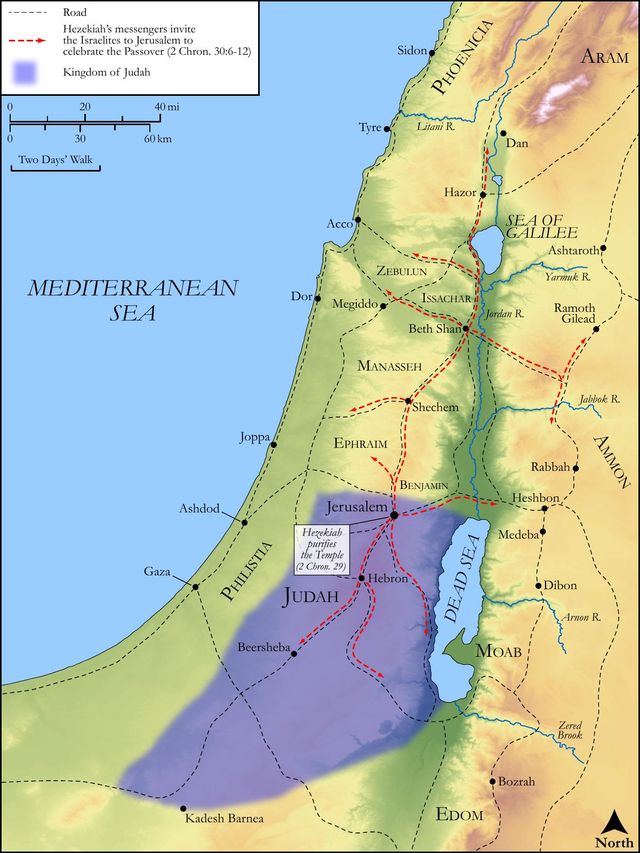
See on the biblical-era map
Study this verse
Public-domain commentary
Matthew Henry
From his Commentary on the Whole Bible. Henry comments on passages, not single verses — this entry covers 2 Chronicles 29:20–36. His three-level outline is real structure in the source text, so it is rendered as structure.
The temple being cleansed, we have here an account of the good use that was immediately made of it. A solemn assembly was called to meet the king at the temple, the very next day (Ch2 29:20); and very glad, no doubt, all the good people in Jerusalem were, when it was said, Let us go up to the house of the Lord, Psa 122:1. As soon as Hezekiah heard that the temple was ready for him he lost no time, but made it appear that he was ready for it. He rose early to go up to the house of the Lord, earlier on that day than on other days, to show that his heart was upon his work there. Now this day's work was to look two ways: -
I.Atonement must be made for the sins of the last reign.
They thought it not enough to lament and forsake those sins, but they brought a sin-offering. Even our repentance and reformation will not obtain pardon but in and through Christ, who was made sin (that is, a sin-offering) for us. No peace but through his blood, no, not for penitents. Observe,
1.The sin-offering was for the kingdom, for the sanctuary, and for Judah (Ch2 29:21), that is, to make atonement for the sins of princes, priests, and people, for they had all corrupted their way. The law of Moses appointed sacrifices to make atonement for the sins of the whole congregation (Lev 4:13, Lev 4:14; Num 15:24, Num 15:25), that the national judgments which their national sins deserved might be turned away. For this purpose we must now have an eye to Christ the great propitiation, as well as for the remission and salvation of particular persons.
2.The law appointed only one goat for a sin-offering, as on the day of atonement (Lev 16:15) and on such extraordinary occasions as this, Num 15:24. But they here offered seven (Ch2 29:21), because the sins of the congregation had been very great and long continued in. Seven is a number of perfection. Our great sin-offering is but one, yet that one perfects for ever those that are sanctified.
3.The king and the congregation (that is, the representatives of the congregation) laid their hands on the heads of the goats that were for the sin-offering (Ch2 29:23), thereby owning themselves guilty before God and expressing their desire that the guilt of the sinner might be transferred to the sacrifice. By faith we lay our hands on the Lord Jesus, and so receive the atonement, Rom 5:11.
4.Burnt-offerings were offered with the sin-offerings, seven bullocks, seven rams, and seven lambs. The intention of the burnt-offerings was to give glory to the God of Israel, whom they owned as the only true God, which it was proper to do at the same time that they were by the sin-offering making atonement for their offences. The blood of those, as well as of the sin-offering, was sprinkled upon the altar (Ch2 29:22), to make reconciliation for all Israel (Ch2 29:24), and not for Judah only. Christ is a propitiation, not for the sins of Israel only, but of the whole world, Jo1 2:1, Jo1 2:2.
5.While the offerings were burning upon the altar the Levites sang the song of the Lord (Ch2 29:27), the Psalms composed by David and Asaph (Ch2 29:30), accompanied by the musical instruments which God by his prophets had commanded the use of (Ch2 29:25), and which had been long neglected. Even sorrow for sin must not put us out of tune for praising God. By faith we must rejoice in Christ Jesus as our righteousness; and our prayers and praises must ascend with his offering, to be accepted only in virtue of it.
6.The king and all the congregation testified their consent to and concurrence in all that was done, by bowing their heads and worshipping, expressing an awful veneration of the divine Majesty, by postures of adoration. This is taken notice of, Ch2 29:28-30. It is not enough for us to be where God is worshipped, if we do not ourselves worship him, and that not with bodily exercise only, which profits little, but with the heart.
II.The solemnities of this day did likewise look forward.
The temple service was to be set up again, that it might be continually kept up; and this Hezekiah calls them to, Ch2 29:31. "Now that you have consecrated yourselves to the Lord - have both made an atonement and made a covenant by sacrifice, are solemnly reconciled and engaged to him - now come near, and bring sacrifices." Note, Our covenant with God must be pursued and improved in communion with him. Having consecrated ourselves, in the first place, to the Lord, we must bring the sacrifices of prayer, and praise, and alms, to his house. Now, in this work, it was found.
1.That the people were free. Being called to it by the king, they brought in their offerings, though not in such abundance as in the glorious days of Solomon (for Judah was now diminished, impoverished, and brought low), but according to what they had, and as much as one could expect considering their poverty and the great decay of piety among them.
(1.)Some were so generous as to bring burnt-offerings, which were wholly consumed to the honour of God, and of which the offerer had no part. Of this sort there were seventy bullocks, 100 rams, and 200 lambs, Ch2 29:32.
(2.)Others brought peace-offerings and thank-offerings, the fat of which was burnt upon the altar, and the flesh divided between the priests and the offerers, Ch2 29:35. Of this sort there were 600 oxen and 3000 sheep, Ch2 29:33. Perhaps the remembrance of their sin in sacrificing on the high places made them more willing to bring their sacrifices now to God's altar.
2.That the priests were few, too few for the service, Ch2 29:34. Many of them, it is likely, were suspended and laid aside as polluted and uncanonical, for having sacrificed to idols in the last reign, and the rest had not the zeal that one might have expected upon such an occasion. They thought that the king needed not to be so forward, that there was no necessity for such haste in opening the doors of the temple, and therefore they took no care to sanctify themselves, and being unsanctified, and so unqualified, they made that their excuse for being absent from the service; as if their offence would be their defence. It is recorded here, to the perpetual shame of the priests, that, though they were so well provided for out of the offerings of the Lord made by fire, yet they did not mind their business. Here was work to do, and there wanted proper hands to do it.
3.That the Levites were forward. They had been more upright in heart to sanctify themselves than the priests (Ch2 29:34), were better affected to the work and better prepared and qualified for it. This was their praise, and, in recompence for it, they had the honour to be employed in that which was the priests' work: they helped them to flay the offerings. This was not according to the law (Lev 1:5, Lev 1:6), but the irregularity was dispensed with in cases of necessity, and thus encouragement was given to the faithful zealous Levites and a just disgrace put upon the careless priests. What the Levites wanted in the ceremonial advantages of their birth and consecration was abundantly made up in their eminent qualifications of skill and will to do the work.
4.That all were pleased. The king and all the people rejoiced in this blessed turn of affairs and the new face of religion which the kingdom had put on, Ch2 29:36. Two things in this matter pleased them: - (1.) That it was soon brought about: The thing was done suddenly, in a little time, with a great deal of ease, and without any opposition. Those that go about the work of God in faith and with resolution will find that there is not that difficulty in it which they sometimes imagine, but it will be a pleasing surprise to them to see how soon it is done. (2.) That the hand of God was plainly in it: God had prepared the people by the secret influences of his grace, so that many of those who had in the last reign doted on the idolatrous altars were now as much in love with God's altar. This change, which God wrought on their minds, did very much expedite and facilitate the work. Let magistrates and ministers do their part towards the reforming of a land, and ascribe to him the glory of what is done, especially when it is done suddenly and is a pleasing surprise. This is the Lord's doing, and it is marvellous.
Continue studying 2 Chronicles 29:20 across the web’s major study libraries — every link below opens this exact verse, chapter, or book on the destination site.
Read & Compare
 BibleGatewayThis verse in more than 200 translations and 70 languages.
 Bible.comThe YouVersion reader — hundreds of translations, reading plans, and highlights.
 ESV.orgCrossway's official English Standard Version reader.
 NET BibleThe NET translation with 60,000+ translators' notes on every rendering decision.
 STEP BibleTyndale House's free study tool — original text, vocabulary, and scholarly resources.
 BibliaLogos Bible Software's free web reader.
 USCCBThe New American Bible (Revised Edition) with the U.S. bishops' study notes.
Commentaries
 BibleHub CommentariesDozens of classic commentaries on this verse, gathered on one page.
 StudyLightMore than 100 commentary sets — the largest collection on the web.
 BibleRefPlain-English commentary on what this verse means, verse by verse.
 Enduring WordDavid Guzik's free commentary on this chapter, widely used by Bible teachers.
 Bible Study ToolsVerse commentary alongside Greek and Hebrew study aids.
Original Language & Research
- BibleHub InterlinearThe verse word by word — original language, transliteration, and English.
- BibleHub LexiconEvery word's original-language definition and Strong's entry.
 Blue Letter BibleDeep-study tools — Strong's numbers, concordance, and word studies.
 SefariaThe Hebrew text with Rashi and centuries of Jewish commentary.
Sermons, Hymns & Audio


TrulyRandomVerse is not affiliated with these sites and doesn’t control their content. They’re linked because they’re genuinely useful.
Summary
2 Chronicles 29:20 marks a pivotal moment in the reign of King Hezekiah of Judah, signaling his immediate and resolute commitment to spiritual reform and the restoration of proper worship. Following his father Ahaz's profound apostasy and desecration of the Temple, Hezekiah, in the very first month of his reign, demonstrates proactive and diligent leadership by gathering the city's rulers and personally leading them to the House of the LORD, initiating a profound national revival and a decisive break from the spiritual decline of the previous era.
Context
ShowHideLiterary Context
This verse immediately follows Hezekiah's initial decree to the Levites to sanctify themselves and cleanse the Temple, which had been defiled and shut by his father, King Ahaz. In 2 Chronicles 29:3, Hezekiah commands the opening and repair of the Temple doors. This verse, 2 Chronicles 29:20, transitions the narrative from the physical cleansing of the sanctuary to the re-establishment of corporate worship and sacrificial atonement. It sets the stage for the extensive purification rituals, the offering of sacrifices, and the joyful celebration of the Passover that unfold in the remainder of 2 Chronicles 29 and 2 Chronicles 30. The king's personal initiative and the involvement of the city's leadership underscore the gravity and national scope of the impending spiritual renewal, showcasing a deliberate, divinely-guided process of restoration.
Historical & Cultural Context
Hezekiah ascended the throne of Judah after the reign of his father, King Ahaz, who had led the nation into deep idolatry, even closing the doors of the Temple and setting up pagan altars throughout Jerusalem (2 Chronicles 28:24-25). This period was marked by significant Assyrian influence and the syncretism of Yahwistic worship with foreign cults, threatening the very spiritual identity of Judah. Hezekiah's actions in this verse represent a radical departure from his father's policies and a deliberate, covenantal return to the Mosaic Law. The phrase "rose early" is a common biblical idiom signifying diligence, urgency, and earnestness, often associated with important undertakings, such as Abraham's prompt obedience in Genesis 22:3 or the Israelites' readiness to depart Egypt in Exodus 32:6. Gathering "the rulers of the city" was crucial for securing the cooperation and participation of the civic leadership, signaling that this was a national, not merely a personal, religious endeavor. The Temple, the "house of the LORD," was the spiritual and often political center of Judah, representing God's dwelling among His people and the place of atonement and communion.
Key Themes
ShowHideThis verse powerfully illustrates several key themes central to the book of Chronicles and biblical theology. Foremost is the theme of Righteous Leadership and Divine Favor, where a king's obedience to God directly correlates with national blessing and spiritual restoration, contrasting sharply with the apostasy of previous kings. It highlights Diligent and Proactive Action in spiritual matters; Hezekiah does not delay but immediately addresses the spiritual decay, embodying the principle of seeking first the kingdom of God and His righteousness. The gathering of "the rulers of the city" emphasizes Corporate Responsibility and National Revival, underscoring that spiritual renewal is not solely an individual pursuit but requires collective effort and leadership from the top down, a principle echoed in Nehemiah's rebuilding efforts. Finally, the act of "went up to the house of the LORD" underscores the Prioritization of God's Presence and Worship, signifying a national re-orientation towards the covenant and the centrality of the Temple in the life of God's people, reflecting the deep desire for communion with God found in the Psalms, such as Psalm 27:4.
Exposition and Analysis
ShowHideKey Word Analysis
ShowHideThis verb signifies more than just waking up at dawn; it conveys a sense of urgency, diligence, and eager anticipation. In biblical contexts, it often denotes a deliberate and immediate action taken without delay, indicating Hezekiah's fervent commitment and proactive initiative in addressing the spiritual crisis of Judah from the very beginning of his reign. It stands in stark contrast to the spiritual lethargy that characterized his father's rule, emphasizing the king's zeal for God's glory.
This verb implies a formal convocation or assembly for a specific purpose. Hezekiah's action was not a solitary one, but a deliberate act to involve the civic leadership of Jerusalem. This highlights the corporate nature of the impending spiritual reform, indicating that the king understood the need for broad support and participation from those in authority to effect national change and restore proper worship, ensuring the reform's legitimacy and widespread impact.
This word refers primarily to a physical dwelling but here specifically denotes the Temple in Jerusalem, the central sanctuary where God's presence (H3068, Yᵉhôvâh) was uniquely manifested among His people. Its desecration and closure under Ahaz symbolized the nation's spiritual alienation from God. Hezekiah's immediate act of going to the Temple signifies the paramount importance of restoring true worship and re-establishing the covenant relationship with Yahweh as the first order of business for the nation, marking a return to the very heart of their identity.
Verse Breakdown
ShowHide"Then Hezekiah the king rose early"
This initial clause powerfully emphasizes Hezekiah's personal diligence, initiative, and urgency. It highlights his immediate and unhesitating commitment to spiritual reform at the very outset of his reign, setting a tone of earnestness and determination that contrasts sharply with the spiritual negligence of his predecessor, King Ahaz. His proactive leadership is a key element of the narrative, demonstrating a king who prioritizes God's will above all else.
"and gathered the rulers of the city"
This phrase reveals the corporate dimension of Hezekiah's reform. He understood that national spiritual renewal required the involvement and buy-in of the civic leadership. By assembling these influential figures, Hezekiah ensured that the restoration of Temple worship would be a collective, national endeavor, not merely a private religious act, thereby multiplying its impact, legitimacy, and ensuring its sustainability throughout the kingdom.
"and went up to the house of the LORD"
This climactic action symbolizes the spiritual re-orientation of the entire nation. The physical act of ascending to the Temple, which had been shut and defiled, signifies the prioritization of God and His worship above all other concerns. It marks the beginning of the re-establishment of proper sacrificial worship and communion with God, serving as a powerful visual and theological statement of Judah's return to its covenant responsibilities and a re-centering of their national life on God's presence.
Literary Devices
ShowHideThe verse employs several potent literary devices. Contrast is evident in the immediate juxtaposition of Hezekiah's zealous actions with the apostasy and neglect of his father, Ahaz, setting Hezekiah apart as a righteous king and highlighting the dramatic shift in national policy. The phrase "rose early" functions as symbolism, representing not just the time of day but Hezekiah's unwavering diligence, urgency, and proactive commitment to spiritual matters, embodying his fervent zeal. The act of "went up to the house of the LORD" is also highly symbolic, representing the nation's spiritual re-orientation, the prioritization of God's presence, and a return to covenant faithfulness. The inclusion of "the rulers of the city" highlights synecdoche, where a part (the leaders) represents the whole (the nation), emphasizing the corporate and national scope of the revival. Furthermore, the swift, decisive action described contributes to the narrative pacing, establishing a sense of momentum and determination that characterizes the entire account of Hezekiah's reforms in 2 Chronicles 29 and beyond.
Theological and Thematic Connections
ShowHideThis verse serves as a powerful theological statement on the necessity of righteous leadership and the corporate nature of spiritual renewal. Hezekiah's immediate and diligent action demonstrates that true reform begins with a decisive turning towards God, prioritizing His dwelling place and His commands. It underscores the biblical principle that when leaders commit themselves wholeheartedly to God, it can catalyze a widespread spiritual awakening among the people, demonstrating the profound impact of godly authority. The gathering of the "rulers of the city" highlights that spiritual health is not merely an individual concern but a communal responsibility, requiring the active participation of those in authority to guide a nation back to covenant faithfulness. This act of "going up to the house of the LORD" is a profound theological affirmation of the centrality of corporate worship and the importance of God's presence as the foundation for national well-being and blessing, echoing the ancient longing for divine communion.
Reflection and Application
ShowHideKing Hezekiah's actions in 2 Chronicles 29:20 offer profound and enduring lessons for individuals and communities today. His "rising early" challenges us to cultivate a spirit of urgency and diligence in our spiritual lives, refusing to delay in addressing areas of neglect or sin, whether personal or corporate. It calls us to be proactive in pursuing righteousness and initiating positive change, demonstrating a genuine zeal for God's will. His decision to "gather the rulers of the city" reminds us that spiritual growth and the renewal of society are often best achieved through collective effort and shared responsibility. We are called not only to personal piety but also to engage and influence those in positions of leadership, fostering a corporate commitment to God's purposes and recognizing the interconnectedness of our spiritual journeys. Finally, Hezekiah's immediate ascent to "the house of the LORD" underscores the paramount importance of prioritizing God's presence, worship, and engagement with His community in our lives. It compels us to ask where our "firstfruits" of time, energy, and resources are directed, ensuring that our lives and communities are centered on God's glory and His redemptive purposes.
Questions for Reflection
ShowHideFAQ
ShowHideWhy is "rising early" significant in this context?
ShowHide"Rising early" (Hebrew: shâkam) is highly significant because it conveys Hezekiah's immediate, unhesitating, and earnest commitment to spiritual reform. It's not merely about the time of day but about his proactive diligence and zeal to address the spiritual decay in Judah without delay, setting a powerful example for his people and contrasting sharply with the spiritual negligence of his father, Ahaz. It signals that the restoration of God's worship was his absolute top priority from the very beginning of his reign, demonstrating a king who put God first.
Who were the "rulers of the city" and why were they gathered?
ShowHideThe "rulers of the city" were likely the prominent civic and perhaps some religious leaders of Jerusalem, including elders, officials, and heads of families. Hezekiah gathered them to ensure that the spiritual reform was not just a personal initiative but a corporate, national endeavor. By involving these influential figures, Hezekiah secured their buy-in, participation, and leadership in the extensive process of cleansing the Temple and re-establishing proper worship, thereby fostering a unified national effort towards revival and ensuring the reforms would be implemented throughout the city and potentially the wider kingdom.
What was the state of the "house of the LORD" at this time, and what did Hezekiah do about it?
ShowHideUnder Hezekiah's father, King Ahaz, the "house of the LORD" (the Temple) had been severely desecrated. Ahaz had removed the sacred articles, cut up the vessels, and even closed the Temple doors (2 Chronicles 28:24). This act effectively halted legitimate worship and communion with God. Hezekiah's first act of reform, even before this verse, was to command the Levites to sanctify themselves and to open and repair the Temple doors (2 Chronicles 29:3), initiating its cleansing and preparing it for the restoration of proper worship and sacrifices, thereby reversing his father's apostasy.
Christ-Centered Fulfillment
ShowHideHezekiah's diligent and proactive leadership in restoring the Temple and leading his people back to God serves as a powerful foreshadowing of Jesus Christ, the ultimate King and High Priest. Just as Hezekiah "rose early" to initiate a physical and spiritual cleansing, so too did Jesus, in His earthly ministry, demonstrate unparalleled diligence and urgency in fulfilling His Father's will, often rising early to pray and teach (Mark 1:35) and never delaying in His mission to seek and save the lost (Luke 19:10). Hezekiah "gathered the rulers of the city" to participate in the restoration; similarly, Jesus gathered His disciples, the foundational "rulers" and apostles of the new covenant community, commissioning them to extend His kingdom and purify hearts through the Gospel (Mark 3:13-15). Most profoundly, Hezekiah "went up to the house of the LORD" to re-establish worship. Jesus, however, is the true and ultimate "House of the LORD," the very dwelling place of God among humanity, the Temple not made with hands (John 2:19-21). Through His sacrificial death on the cross and His glorious resurrection, Jesus performed the ultimate cleansing, not of a physical temple, but of the human heart, opening the way to the true Holy of Holies (Hebrews 10:19-22), and establishing a new covenant where believers themselves become the living Temple of the Holy Spirit (1 Corinthians 6:19-20). Hezekiah's revival was temporary; Christ's work brings eternal restoration, perfect communion with God, and a spiritual kingdom that will never end (Daniel 7:14).