


Joshua 6:12
Bible text: King James Version (1769 Blayney text) · Public domain
Bible text: Berean Standard Bible · Public domain
Bible text: American Standard Version (1901) · Public domain
Bible text: World English Bible, Messianic edition · Public domain
Bible text: Geneva Bible (1599) · Public domain
Bible text: Young's Literal Translation · Public domain
- וַיַּשְׁכֵּםvai·yash·Kemand he rose earlyH7925Conj-w ¦ V-Hiphil-ConsecImperf-3msVerb Hiphil Consecutive Imperfect 3rd Singular Masculineוַandיַּשְׁכֵּםhe rose early
- יְהוֹשֻׁעַye·ho·Shu·a'JoshuaH3091N-proper-mNoun Proper Masculine
- בַּבֹּקֶרba·Bo·kerin the morningH1242Prep-b ¦ N-msNoun Singular Masculine Absoluteבַּin theבֹּקֶרmorning
- וַיִּשְׂאוּvai·yis·'Uand they liftedH5375Conj-w ¦ V-Qal-ConsecImperf-3mpVerb Qal Consecutive Imperfect 3rd Plural Masculineוַandיִּשְׂאוּthey lifted
- הַכֹּהֲנִיםha·ko·ha·Nimthe priestsH3548Art ¦ N-mpNoun Plural Masculine Absoluteהַtheכֹּהֲנִיםpriests
- אֶת'et<obj.>H853DirObjMParticle Object Indicator
- אֲרוֹן'a·Ron[the] ark ofH727N-mscNoun Singular Masculine Construct
- יְהוָהYah·wehYahwehH3068N-properNoun Proper Title
English is a literal word-by-word gloss of the Hebrew, not the KJV's wording. Why?
This is the original text the KJV's translators worked from — each Hebrew word with its own literal English meaning in this verse, prepared by scholars at Tyndale House, Cambridge. The KJV translates whole sentences, not word by word, so its wording differs: one Hebrew word can become several English words, and the KJV may choose “the LORD” where the gloss reads “Yahweh”. Both are faithful — they answer different questions. For the KJV's own rendering, switch to the KJV text.
Details
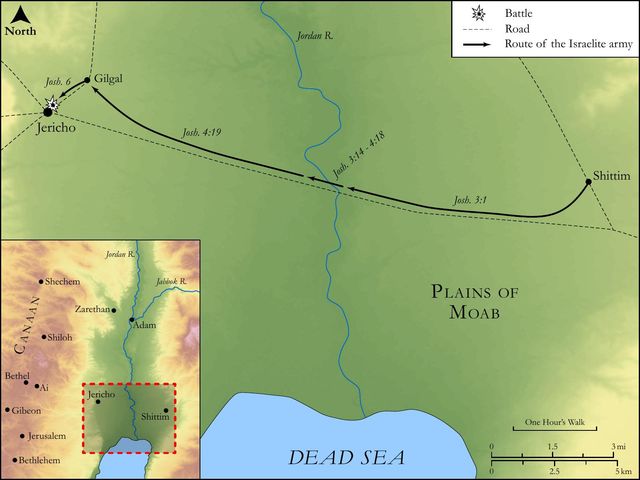
See on the biblical-era map
Study this verse
Public-domain commentary
Matthew Henry
From his Commentary on the Whole Bible. Henry comments on passages, not single verses — this entry covers Joshua 6:6–16.
We have here an account of the cavalcade which Israel made about Jericho, the orders Joshua gave concerning it, as he had received them from the Lord and their punctual observance of these orders. We do not find that he gave the people the express assurances God had given him that he would deliver the city into their hands; but he tried whether they would obey orders with a general confidence that it would end well, and we find them very observant both of God and Joshua.
I.Wherever the ark went the people attended it, Jos 6:9.
The armed men went before it to clear the way, not thinking it any disparagement to them, though they were men of war, to be pioneers to the ark of God. If any obstacle should be found in crossing the roads that led to the city (which they must do in walking round it) they would remove it; if any opposition should be made by the enemy, they would encounter it, that the priests' march with the ark might be easy and safe. It is an honour to the greatest men to do any good office to the ark and to serve the interests of religion in their country. The rereward, either another body of armed men, or Dan's squadron, which marched last through the wilderness, or, as some think, the multitude of the people who were not armed or disciplined for war (as many of them as would) followed the ark, to testify their respect to it, to grace the solemnity, and to be witnesses of what was done. Every faithful zealous Israelite would be willing to undergo the same fatigues and run the same hazard with the priests that bore the ark.
II.Seven priests went immediately before the ark, having trumpets in their hands, with which they were continually sounding, Jos 6:4, Jos 6:5, Jos 6:9, Jos 6:13. The priests were God's ministers, and thus in his name, 1. They proclaimed war with the Canaanites, and so stuck a terror upon them; for by terrors upon their spirits they were to be conquered and subdued. Thus God's ministers, by the solemn declarations of his wrath against all ungodliness and unrighteousness of men, must blow the trumpet in Zion, and sound an alarm in the holy mountain, that the sinners in Zion may be afraid. They are God's heralds to denounce war against all those that go on still in their trespasses, but say, "We shall have peace, though we go on." 2. They proclaimed God's gracious presence with Israel, and so put life and courage into them. It was appointed that when they went to war the priests should encourage them with the assurance of God's presence with them, Deu 20:2-4. And particularly their blowing with trumpets was to be a sign to the people that they should be remembered before the Lord Their God in the day of battle, Num 10:9. It encouraged Abijah, Ch2 13:12. Thus God's ministers, by sounding the Jubilee trumpet of the everlasting gospel, which proclaims liberty and victory, must encourage the good soldiers of Jesus Christ in their spiritual warfare.
III.The trumpets they used were not those silver trumpets which were appointed to be made for their ordinary service, but trumpets of rams' horns, bored hollow for the purpose, as some think. These trumpets were of the basest matter, dullest sound, and least show, that the excellency of the power might be of God. Thus by the foolishness of preaching, fitly compared to the sounding of these rams' horns, the devil's kingdom is thrown down; and the weapons of our warfare, though they are not carnal nor seem to a carnal eye likely to bring any thing to pass, are yet mighty through God to the pulling down of strong-holds, Co2 10:4, Co2 10:5. The word here is trumpets of Jobel, that is, such trumpets as they used to blow withal in the year of jubilee; so many interpreters understand it, as signifying the complete liberty to which Israel was now brought, and the bringing of the land of Canaan into the hands of its just and rightful owners.
IV.All the people were commanded to be silent, not to speak a word, nor make any noise (Jos 6:10), that they might the more carefully attend to the sound of the sacred trumpets, which they were now to look upon as the voice of God among them; and it does not become us to speak when God is speaking. It likewise intimates their reverent expectation of the event. Zac 2:13, Be silent, O all flesh, before the Lord. Exo 14:14, God shall fight, and you shall hold your peace.
V.They were to do this once a day for six days together and seven times the seventh day, and they did so, Jos 6:14, Jos 6:15.
God could have caused the walls of Jericho to fall upon the first surrounding of them, but they must go round them thirteen times before they fall, that they might be kept waiting patiently for the Lord. Though they had lately come into Canaan, and their time was very precious (for they had a great deal of work before them), yet they must linger so many days about Jericho, seeming to do nothing, nor to make any progress in their business. As promised deliverances must be expected in God's way, so they must be expected in his time. He that believes does not make haste, not more haste than God would have him make. Go yet seven times, before any thing hopeful appears, Kg1 18:43.
VI.One of these days must needs be a sabbath day, and the Jews say that it was the last, but this is not certain; however, if he that appointed them to rest on the other sabbath days appointed them to walk on this, that was sufficient to justify them in it; he never intended to bind himself by his own laws, but that when he pleased he might dispense with them. The impotent man went upon this principle when he argued (Joh 5:11), He that made me whole (and therefore has a divine power) said unto me, Take up thy bed. And, in this case here, it was an honour to the sabbath day, by which our time is divided into weeks, that just seven days were to be spent in this work, and seven priests were employed to sound seven trumpets, this number being, on this occasion, as well as many others, made remarkable, in remembrance of the six day's work of creation and the seventh day's rest from it. And, besides, the law of the sabbath forbids our own work, which is servile and secular, but this which they did was a religious act. It is certainly no breach of the sabbath rest to do the sabbath work, for the sake of which the rest was instituted; and what is the sabbath work but to attend the ark in all its motions?
VII.They continued to do this during the time appointed, and seven times the seventh day, though they saw not any effect of it, believing that at the end the vision would speak and not lie, Hab 2:3. If we persevere in the way of duty, we shall lose nothing by it in the long run. It is probable they walked at such a distance from the walls as to be out of the reach of the enemies' arrows and out of the hearing of their scoffs. We may suppose the oddness of the thing did at first amuse the besieged, but by the seventh day they had grown secure, feeling no harm from that which perhaps they looked upon as an enchantment. Probably they bantered the besiegers, as those mentioned in Neh 4:2, "What do these feeble Jews? Is this the people we thought so formidable? Are these their methods of attack?" Thus they cried peace and safety, that the destruction might be the more terrible when it came. Wicked men (says bishop Hall) think God in jest when he is preparing for their judgment; but they will be convinced of their mistake when it is too late.
VIII.At last they were to give a shout, and did so, and immediately the walls fell, Jos 6:16.
This was a shout for mastery, a triumphant shout; the shout of a king is among them, Num 23:21. This was a shout of faith; they believed that the walls of Jericho would fall, and by this faith the walls were thrown down. It was a shot of prayer, an echo to the sound of the trumpets which proclaimed the promise that God would remember them; with one accord, as one man, they cry to heaven for help, and help comes in. Some allude to this to show that we must never expect a complete victory over our own corruptions till the very evening of our last day, and then we shall shout in triumph over them, when we come to the number and measure of our perfection, as bishop Hall expresses it. A good heart (says he) groans under the sense of his infirmities, fain would be rid of them, and strives and prays, but, when all is done, until the end of the seventh day it cannot be; then judgment shall be brought forth unto victory. And at the end of time, when our Lord shall descend from heaven with a shout, and the sound of a trumpet, Satan's kingdom shall be completely ruined, and not till then, when all opposing rule, principality, and power, shall be effectually and eternally put down.
Continue studying Joshua 6:12 across the web’s major study libraries — every link below opens this exact verse, chapter, or book on the destination site.
Read & Compare
 BibleGatewayThis verse in more than 200 translations and 70 languages.
 Bible.comThe YouVersion reader — hundreds of translations, reading plans, and highlights.
 ESV.orgCrossway's official English Standard Version reader.
 NET BibleThe NET translation with 60,000+ translators' notes on every rendering decision.
 STEP BibleTyndale House's free study tool — original text, vocabulary, and scholarly resources.
 BibliaLogos Bible Software's free web reader.
 USCCBThe New American Bible (Revised Edition) with the U.S. bishops' study notes.
Commentaries
 BibleHub CommentariesDozens of classic commentaries on this verse, gathered on one page.
 StudyLightMore than 100 commentary sets — the largest collection on the web.
 BibleRefPlain-English commentary on what this verse means, verse by verse.
 Enduring WordDavid Guzik's free commentary on this chapter, widely used by Bible teachers.
 Bible Study ToolsVerse commentary alongside Greek and Hebrew study aids.
Original Language & Research
- BibleHub InterlinearThe verse word by word — original language, transliteration, and English.
- BibleHub LexiconEvery word's original-language definition and Strong's entry.
 Blue Letter BibleDeep-study tools — Strong's numbers, concordance, and word studies.
 SefariaThe Hebrew text with Rashi and centuries of Jewish commentary.
Sermons, Hymns & Audio


TrulyRandomVerse is not affiliated with these sites and doesn’t control their content. They’re linked because they’re genuinely useful.
Summary
Joshua 6:12 marks the pivotal commencement of the second day of the Jericho siege, immediately following God's precise and unconventional instructions for the city's capture. This verse powerfully illustrates the prompt and unwavering obedience of Joshua, who rises "early in the morning," and the priests, who diligently take up the sacred Ark of the LORD. This immediate, disciplined, and faith-filled action by the Israelite leadership sets the stage for the miraculous events that would unfold, underscoring their profound trust in God's unique strategy and their absolute reliance on His divine presence for ultimate victory.
Context
ShowHideLiterary Context
This verse is strategically positioned at the very beginning of the second day of the seven-day siege of Jericho, serving as a critical narrative transition. It directly follows God's detailed and seemingly illogical instructions given to Joshua in Joshua 6:2-5, which outlined the daily marching ritual. The previous day had seen the Israelites complete their first silent circuit around the formidable city. Joshua 6:12 thus signals the disciplined continuation of their obedience, emphasizing the immediate and unwavering response of both Joshua and the priestly leadership. It moves the narrative from divine command to human action, setting a tone of diligent execution that culminates in the miraculous collapse of Jericho's walls on the seventh day, as recorded in Joshua 6:20.
Historical & Cultural Context
The conquest of Canaan, following Israel's forty years of wilderness wandering, represented a defining moment in their national identity and their inheritance of the Promised Land. Jericho, as the first major fortified city encountered, presented a significant strategic and psychological barrier. The method of its capture, as detailed from Joshua 6:1 onwards, deliberately defied conventional military tactics, emphasizing divine intervention over human might. The "Ark of the LORD" was the most sacred object in Israelite worship, embodying God's covenant presence, His throne, and His active leadership among His people. Its prominent role, carried by priests rather than warriors, powerfully underscored that this was fundamentally God's battle, not merely Israel's. Joshua's act of rising "early in the morning" was a common idiom in Scripture, as when Abraham rose up early in the morning and went unto the place of which God had told him, signifying diligence, earnestness, and a readiness for important tasks, particularly those of divine significance, reflecting a leader fully committed to God's agenda.
Key Themes
ShowHideJoshua 6:12 powerfully illustrates several core themes central to the book of Joshua and the broader biblical narrative. First, Obedience and Faith are paramount; Joshua's prompt action, rising "early in the morning," signifies his unwavering commitment and readiness to obey God's specific, even unusual, commands without delay. This immediate and complete obedience, demonstrated by both Joshua and the priests, is consistently presented as a prerequisite for divine blessing and success, echoing the promises found in Deuteronomy 28:1-2. Second, the theme of Divine Presence and Sovereignty is central; the "Ark of the LORD" was the tangible symbol of God's covenant presence among His people, and its leading role in the procession around Jericho underscored that this was God's battle, not merely Israel's. It served as a visible reminder of God's active leadership and power, assuring the Israelites that the Lord Himself was leading them to victory, a theme deeply rooted in the Exodus narrative (e.g., Exodus 33:14). Third, the verse highlights Disciplined Leadership and Diligence; Joshua's early rising suggests a leader who is not only obedient but also diligent, prepared, and eager to carry out divine instructions, setting a powerful example for the entire nation.
Exposition and Analysis
ShowHideKey Word Analysis
ShowHideFrom the root meaning "to break forth," this word refers to the dawn or the early part of the day. In biblical contexts, "rising early in the morning" (often using the verb shakam) frequently denotes diligence, earnestness, and a proactive readiness to engage in significant tasks, especially those related to divine commands or important events. Here, it emphasizes Joshua's prompt and dedicated response to God's instructions, signifying a lack of hesitation and a full commitment to the task at hand.
This primitive root carries a wide range of meanings, including "to lift," "to bear," "to carry," or "to take up." In this context, it describes the physical act of the priests lifting and carrying the Ark of the LORD. The verb choice emphasizes the deliberate and reverent action involved in handling this sacred object, highlighting the priests' specific role as custodians of God's presence and their active participation in God's unconventional military strategy.
This is the Tetragrammaton, the personal, covenantal name of God, often translated as "Yahweh" or "Jehovah." It signifies God as the self-existent, eternal, and covenant-keeping God. Its presence in the phrase "Ark of the LORD" underscores that the Ark is not merely a box, but the symbol of the sovereign, active, and personal God who is leading His people in battle and fulfilling His promises. It emphasizes divine authority and power behind the entire operation.
Verse Breakdown
ShowHide"And Joshua rose early in the morning"
This clause immediately establishes Joshua's exemplary leadership and personal discipline. His promptness, signified by rising "early in the morning," demonstrates a complete lack of hesitation or doubt regarding God's unconventional instructions. It portrays him as a leader fully committed to executing divine commands with diligence and readiness, setting a precedent of immediate obedience for the entire Israelite army. This detail highlights the crucial human element of faithful response to God's revealed will.
"and the priests took up the ark of the LORD"
This second clause identifies the specific agents (the priests, distinct from military commanders) and the central object (the Ark of the LORD) of the day's actions. The priests, as custodians of the sacred, carrying the Ark, immediately shifts the focus from a conventional military operation to a divinely orchestrated, sacred act. It underscores that the battle was fundamentally spiritual, led by God's presence and authority, rather than by human strategy or strength. The Ark's movement signifies God's active leading of His people into battle, emphasizing His sovereignty over the conquest.
Literary Devices
ShowHideJoshua 6:12 employs several literary devices to enhance its meaning and impact. Symbolism is profoundly evident, with the "Ark of the LORD" serving as the preeminent symbol of God's tangible presence, covenant fidelity, and active leadership among His people. Its central role in the procession around Jericho symbolizes that the battle is God's, and victory will come through His power, not human might. The phrase "rose early in the morning" functions as a form of Emphasis, highlighting Joshua's diligence, readiness, and unwavering obedience. This detail underscores his exemplary leadership and commitment to God's commands, setting a tone for the entire narrative. There is also an element of Foreshadowing in this verse; the disciplined obedience of Joshua and the priests, following God's seemingly illogical instructions, foreshadows the miraculous and unconventional victory that will soon follow, reinforcing the theme that God works in mysterious ways to accomplish His purposes. The verse also implicitly uses Contrast, juxtaposing the seemingly simple, repetitive act of marching with the immense power of the God symbolized by the Ark, thereby highlighting the disparity between human effort and divine omnipotence.
Theological and Thematic Connections
ShowHideJoshua 6:12 serves as a profound theological statement on the nature of divine-human partnership in accomplishing God's purposes. It teaches that while God is sovereign and orchestrates miraculous victories, He often calls for human obedience and diligence as a prerequisite. Joshua's prompt action and the priests' reverent handling of the Ark demonstrate a profound trust in God's unconventional methods, even when they defy human logic. This reliance on God's presence, symbolized by the Ark, rather than on military strategy, underscores that true victory in spiritual battles is achieved through divine power, not human strength. The verse thus connects to the broader biblical narrative of God's faithfulness to His covenant people and His expectation of their faithful response, reminding us that God's presence is our ultimate strength and guide.
Reflection and Application
ShowHideJoshua 6:12 offers powerful lessons for contemporary believers, challenging us to examine our own responsiveness to God's revealed will. Joshua's immediate and diligent obedience, rising "early in the morning" to fulfill God's command, prompts us to ask: Do we delay, question, or rationalize when God calls us to seemingly unconventional or difficult tasks? This verse reminds us that true faith is demonstrated not just in belief, but in prompt, disciplined action, even when the path ahead seems illogical or requires extraordinary trust. Furthermore, the central role of the Ark of the LORD reminds us that our battles, whether spiritual, personal, or communal, are ultimately God's. Our strength and strategy are secondary to His active presence and leadership. We are called to align ourselves with His purposes, carry His presence (metaphorically, through our lives and witness), and trust that He will bring about the victory. Our part is faithful obedience; His part is the miraculous.
Questions for Reflection
ShowHideFAQ
ShowHideWhy did Joshua rise "early in the morning"?
ShowHideJoshua's act of rising "early in the morning" (Hebrew: shakam) is not merely a detail about the time of day; it is a significant idiom in biblical literature. It signifies diligence, earnestness, and readiness to act without delay, particularly in matters of importance or divine instruction. It emphasizes Joshua's proactive and dedicated leadership, demonstrating his immediate and unwavering commitment to fulfilling God's will. This detail sets an example of prompt obedience and preparedness, underscoring that he was eager to execute God's plan for the conquest of Jericho.
What was the significance of the priests carrying the Ark of the LORD?
ShowHideThe priests carrying the Ark of the LORD was profoundly significant. The Ark was the most sacred object in Israel, symbolizing God's covenant presence, His throne, and His active leadership among His people. By having the priests, who were custodians of the sacred, carry it, rather than the warriors, the narrative emphasizes that the battle of Jericho was fundamentally a spiritual one, orchestrated and won by divine power, not by human military might or strategy. It reinforced the idea that God Himself was leading the charge, and Israel's role was one of faithful obedience and reliance on His presence. This contrasts sharply with typical military engagements and highlights God's unique methods of warfare, as further detailed in Joshua 6.
Was the Ark of the LORD considered a good luck charm by the Israelites?
ShowHideWhile the Ark symbolized God's presence and was associated with His power, it was not a magical charm that guaranteed victory irrespective of Israel's obedience or God's will. Its power was contingent on God's active involvement and Israel's faithfulness. A clear example of this is seen in 1 Samuel 4, where the Israelites presumed the Ark would automatically grant them victory against the Philistines, but due to their sin and lack of true repentance, the Ark was captured, and Israel suffered a devastating defeat. In Joshua 6, the Ark's presence was powerful precisely because it was carried in direct obedience to God's command, signifying His active and willing participation in the battle, a testament to His covenant faithfulness when His people obey.
Christ-Centered Fulfillment
ShowHideThe events of Joshua 6:12, centered on Joshua's obedience and the Ark's presence, find profound Christ-centered fulfillment. Joshua, whose very name (Yeshua) is the Hebrew equivalent of Jesus, serves as a powerful type of Christ—a faithful leader who brings God's people into their promised inheritance. Just as Joshua led Israel in unwavering obedience to God's unconventional plan for Jericho, so too did Christ perfectly obey the Father's will, even to the point of death on a cross, to secure our eternal inheritance and bring us into the true Promised Land of God's presence (Philippians 2:8). The Ark of the LORD, representing God's tangible presence among His people, powerfully foreshadows Jesus Christ, who is the ultimate embodiment of God dwelling among us, the Word made flesh (John 1:14). In Christ, the veil between God and humanity is torn, and we have direct access to the divine presence, entering the true Holy of Holies through His atoning sacrifice (Hebrews 10:19-20). The battle of Jericho, won not by human might but by divine power through obedient faith, prefigures Christ's decisive victory over sin, death, and the powers of darkness. Through His crucifixion and resurrection, Jesus triumphed over all spiritual adversaries, disarming them and leading captivity captive (Colossians 2:15). Our "marching" today is not around a physical city, but an "obedience of faith" to the Gospel, relying not on our own strength but on the indwelling Spirit of Christ, who empowers us to overcome the world (Romans 1:5; 1 John 5:4). Christ is our ultimate Ark, the very presence of God who leads us into spiritual victory and the fullness of our inheritance in Him.