


Colossians 1:21
- καὶkaiAndG2532CONJConjunction
- ὑμᾶςhumasyouG4771P-2APPersonal pronoun Accusative 2nd Plural
- ποτεpoteonceG4218PRTParticle or Disjunctive
- ὄνταςontasbeingG1510V-PAP-APMVerb Present Active Participle Accusative Plural Masculine
- ἀπηλλοτριωμένουςapēllotriōmenousalienatedG526V-RPP-APMVerb Perfect Passive Participle Accusative Plural Masculine
- καὶkaiandG2532CONJConjunction
- ἐχθροὺςechthroushostileG2190N-APMNoun Accusative Plural Masculine
- τῇtēa<the>G3588T-DSFDefinite article Dative Singular Feminine
- διανοίᾳdianoiain mindG1271N-DSFNoun Dative Singular Feminine
- ἐνeninG1722PREPPreposition
- τοῖςtoistheG3588T-DPNDefinite article Dative Plural Neuter
- ἔργοιςergoisdeedsG2041N-DPNNoun Dative Plural Neuter
- τοῖςtois<the>G3588T-DPNDefinite article Dative Plural Neuter
- πονηροῖςponēroisevilG4190A-DPNAdjective Dative Plural Neuter
- νυνὶnuninowG3570ADVAdverb
- δὲdehoweverG1161CONJConjunction
- ἀποκατήλλαξενapokatēllaxenHe has reconciled [You]G604V-AAI-3SVerb Aorist Active Indicative 3rd Singular
English is a literal word-by-word gloss of the Greek, not the KJV's wording. Why?
This is the original text the KJV's translators worked from — each Greek word with its own literal English meaning in this verse, prepared by scholars at Tyndale House, Cambridge. The KJV translates whole sentences, not word by word, so its wording differs: one Greek word can become several English words, and the KJV may choose “charity” where the gloss reads “love”. Both are faithful — they answer different questions. For the KJV's own rendering, switch to the KJV text.
Details
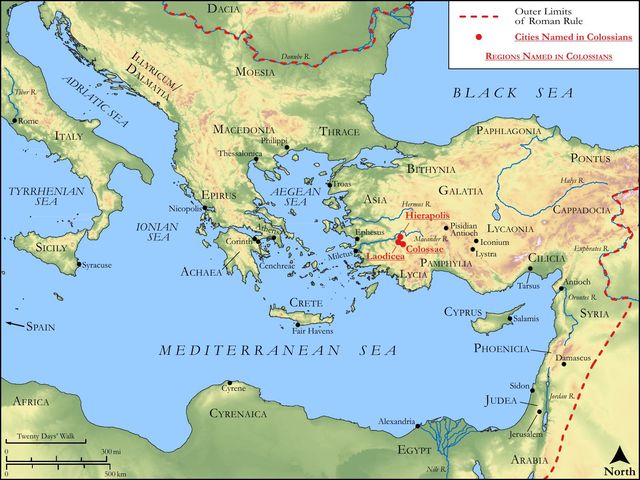
See on the biblical-era maps

Study this verse
Public-domain commentary
Matthew Henry
From his Commentary on the Whole Bible. Henry comments on passages, not single verses — this entry covers Colossians 1:12–29. His four-level outline is real structure in the source text, so it is rendered as structure.
Here is a summary of the doctrine of the gospel concerning the great work of our redemption by Christ. It comes in here not as the matter of a sermon, but as the matter of a thanksgiving; for our salvation by Christ furnishes us with abundant matter of thanksgiving in every view of it: Giving thanks unto the Father, Col 1:12. He does not discourse of the work of redemption in the natural order of it; for then he would speak of the purchase of it first, and afterwards of the application of it. But here he inverts the order, because, in our sense and feeling of it, the application goes before the purchase. We first find the benefits of redemption in our hearts, and then are led by those streams to the original and fountain-head. The order and connection of the apostle's discourse may be considered in the following manner: -
I.He speaks concerning the operations of the Spirit of grace upon us.
We must give thanks for them, because by these we are qualified for an interest in the mediation of the Son: Giving thanks to the Father, etc., Col 1:12, Col 1:13. It is spoken of as the work of the Father, because the Spirit of grace is the Spirit of the Father, and the Father works in us by his Spirit. Those in whom the work of grace is wrought must give thanks unto the Father. If we have the comfort of it, he must have the glory of it. Now what is it which is wrought for us in the application of redemption? 1. "He hath delivered us from the power of darkness, Col 1:13. He has rescued us from the state of heathenish darkness and wickedness. He hath saved us from the dominion of sin, which is darkness (Jo1 1:6), from the dominion of Satan, who is the prince of darkness (Eph 6:12), and from the damnation of hell, which is utter darkness," Mat 25:30. They are called out of darkness, Pe1 2:9. 2. "He hath translated us into the kingdom of his dear Son, brought us into the gospel-state, and made us members of the church of Christ, which is a state of light and purity." You were once darkness, but now are you light in the Lord, Eph 5:8. Who hath called you out of darkness into his marvellous light, Pe1 2:9. Those were made willing subjects of Christ who were the slaves of Satan. The conversion of a sinner is the translation of a soul into the kingdom of Christ out of the kingdom of the devil. The power of sin is shaken off, and the power of Christ submitted to. The law of the Spirit of life in Christ Jesus makes them free from the law of sin and death; and it is the kingdom of his dear Son, or the Son of his peculiar love, his beloved Son (Mat 3:17), and eminently the beloved, Eph 1:6. 3. "He hath not only done this, but hath made us meet to partake of the inheritance of the saints in light, Col 1:12. He hath prepared us for the eternal happiness of heaven, as the Israelites divided the promised land by lot; and has given us the earnest and assurance of it." This he mentions first because it is the first indication of the future blessedness, that by the grace of God we find ourselves in some measure prepared for it. God gives grace and glory, and we are here told what they both are. (1.) What that glory is. It is the inheritance of the saints in light. It is an inheritance, and belongs to them as children, which is the best security and the sweetest tenure: If children, then heirs, Rom 8:17. And it is an inheritance of the saints-proper to sanctified souls. Those who are not saints on earth will never be saints in heaven. And it is an inheritance in light; the perfection of knowledge, holiness, and joy, by communion with God, who is light, and the Father of lights, Jam 1:17; Joh 1:5. (2.) What this grace is. It is a meetness for the inheritance: "He hath made us meet to be partakers, that is, suited and fitted us for the heavenly state by a proper temper and habit of soul; and he makes us meet by the powerful influence of his Spirit." It is the effect of the divine power to change the heart, and make it heavenly. Observe, All who are designed for heaven hereafter are prepared for heaven now. As those who live and die unsanctified go out of the world with their hell about them, so those who are sanctified and renewed go out of the world with their heaven about them. Those who have the inheritance of sons have the education of sons and the disposition of sons: they have the Spirit of adoption, whereby they cry, Abba, Father. Rom 8:15. And, because you are sons, God hath sent forth the Spirit of his Son into your hearts, crying, Abba, Father, Gal 4:6. This meetness for heaven is the earnest of the Spirit in our heart, which is part of payment, and assures the full payment. Those who are sanctified shall be glorified (Rom 8:30), and will be for ever indebted to the grace of God, which hath sanctified them.
II.Concerning the person of the Redeemer.
Glorious things are here said of him; for blessed Paul was full of Christ, and took all occasions to speak honourably of him. He speaks of him distinctly as God, and as Mediator. 1. As God he speaks of him, Col 1:15-17. (1.) He is the image of the invisible God. Not as man was made in the image of God (Gen 1:27), in his natural faculties and dominion over the creatures: no, he is the express image of his person, Heb 1:3. He is so the image of God as the son is the image of his father, who has a natural likeness to him; so that he who has seen him has seen the Father, and his glory was the glory of the only-begotten of the Father, Joh 1:14; Joh 14:9. (2.) He is the first-born of every creature. Not that he is himself a creature; for it is prōtotokos pasēs ktiseōs - born or begotten before all the creation, or before any creature was made, which is the scripture-way of representing eternity, and by which the eternity of God is represented to us: I was set up from everlasting, from the beginning, or ever the earth was; when there was no depth, before the mountains were settled, while as yet he had not made the earth, Pro 8:23-26. It signifies his dominion over all things, as the first-born in a family is heir and lord of all, so he is the heir of all things, Heb 1:2. The word, with only the change of the accent, prōtotokos, signifies actively the first begetter or producer of all things, and so it well agrees with the following clause. Vid. Isidor. Peleus. epist. 30 lib. 3. (3.) He is so far from beginning himself a creature that he is the Creator: For by him were all things created, which are in heaven and earth, visible and invisible, Col 1:16. He made all things out of nothing, the highest angel in heaven, as well as men upon earth. He made the world, the upper and lower world, with all the inhabitants of both. All things were made by him, and without him was not any thing made which was made, Joh 1:3. He speaks here as if there were several orders of angels: Whether thrones, or dominions, or principalities, or powers, which must signify either different degrees of excellence or different offices and employments. Angels, authorities, and powers, Pe1 3:22. Christ is the eternal wisdom of the Father, and the world was made in wisdom. He is the eternal Word, and the world was made by the word of God. He is the arm of the Lord, and the world was made by that arm. All things are created by him and for him; di' autou kai eis auton. Being created by him, they were created for him; being made by his power, they were made according to his pleasure and for his praise. He is the end, as well as the cause of all things. To him are all things, Rom 11:36; eis auton ta panta. (4.) He was before all things. He had a being before the world was made, before the beginning of time, and therefore from all eternity. Wisdom was with the Father, and possessed by him in the beginning of his ways, before his works of old, Pro 8:22. And in the beginning the Word was with God and was God, Joh 1:1. He not only had a being before he was born of the virgin, but he had a being before all time. (5.) By him all things consist. They not only subsist in their beings, but consist in their order and dependences. He not only created them all at first, but it is by the word of his power that they are still upheld, Heb 1:3. The whole creation is kept together by the power of the Son of God, and made to consist in its proper frame. It is preserved from disbanding and running into confusion.
2.The apostle next shows what he is as Mediator, Col 1:18, Col 1:19.
(1.)He is the head of the body the church: not only a head of government and direction, as the king is the head of the state and has right to prescribe laws, but a head of vital influence, as the head in the natural body: for all grace and strength are derived from him: and the church is his body, the fulness of him who filleth all in all, Eph 1:22, Eph 1:23.
(2.)He is the beginning, the first-born from the dead, archē, prōtotokos - the principle, the first-born from the dead; the principle of our resurrection, as well as the first-born himself. All our hopes and joys take their rise from him who is the author of our salvation. Not that he was the first who ever rose from the dead, but the first and only one who rose by his own power, and was declared to be the Son of God, and Lord of all things. And he is the head of the resurrection, and has given us an example and evidence of our resurrection from the dead. He rose as the first-fruits, Co1 15:20.
(3.)He hath in all things the pre-eminence. It was the will of the Father that he should have all power in heaven and earth, that he might be preferred above angels and all the powers in heaven (he has obtained a more excellent name than they, Heb 1:4), and that in all the affairs of the kingdom of God among men he should have the pre-eminence. He has the pre-eminence in the hearts of his people above the world and the flesh; and by giving him the pre-eminence we comply with the Father's will, That all men should honour the Son even as they honour the Father, Joh 5:23.
(4.)All fulness dwells in him, and it pleased the Father it should do so (Col 1:19), not only a fulness of abundance for himself, but redundance for us, a fulness of merit and righteousness, of strength and grace. As the head is the seat and source of the animal spirits, so is Christ of all graces to his people. It pleased the Father that all fulness should dwell in him; and we may have free resort to him for all that grace for which we have occasion. He not only intercedes for it, but is the trustee in whose hands it is lodged to dispense to us: Of his fulness we receive, and grace for grace, grace in us answering to that grace which is in him (Joh 1:16), and he fills all in all, Eph 1:23.
III.Concerning the work of redemption.
He speaks of the nature of it, or wherein it consists; and of the means of it, by which it was procured.
1.Wherein it consists. It is made to lie in two things: - (1.) In the remission of sin: In whom we have redemption, even the forgiveness of sins, Col 1:14. It was sin which sold us, sin which enslaved us: if we are redeemed, we must be redeemed from sin; and this is by forgiveness, or remitting the obligation to punishment. So Eph 1:7, In whom we have redemption, the forgiveness of sins, according to the riches of his grace. (2.) In reconciliation to God. God by him reconciled all things to himself, Col 1:20. He is the Mediator of reconciliation, who procures peace as well as pardon for sinners, who brings them into a state of friendship and favour at present, and will bring all holy creatures, angels as well as men, into one glorious and blessed society at last: things in earth, or things in heaven. So Eph 1:10, He will gather together in one all things in Christ, both which are in heaven and which are on earth. The word is anakephalaiōsasthai - he will bring them all under one head. The Gentiles, who were alienated, and enemies in their minds by wicked works, yet now hath he reconciled, Col 1:21. Here see what was their condition by nature, and in their Gentile state-estranged from God, and at enmity with God: and yet this enmity is slain, and, notwithstanding this distance, we are now reconciled. Christ has laid the foundation for our reconciliation; for he has paid the price of it, has purchased the proffer and promise of it, proclaims it as a prophet, applies it as a king. Observe, The greatest enemies to God, who have stood at the greatest distance and bidden him defiance, may be reconciled, if it by not their own fault.
2.How the redemption is procured: it is through his blood (Col 1:14); he has made peace through the blood of his cross (Col 1:20), and it is in the body of his flesh through death, Col 1:22. It was the blood which made an atonement, for the blood is the life; and without the shedding of blood there is no remission, Heb 9:22. There was such a value in the blood of Christ that, on account of Christ's shedding it, God was willing to deal with men upon new terms to bring them under a covenant of grace, and for his sake, and in consideration of his death upon the cross, to pardon and accept to favour all who comply with them.
IV.Concerning the preaching of this redemption. Here observe,
1.To whom it was preached: To every creature under heaven (Col 1:23), that is, it was ordered to be preached to every creature, Mar 16:15. It may be preached to every creature; for the gospel excludes none who do not exclude themselves. More or less it has been or will be preached to every nation, though many have sinned away the light of it and perhaps some have never yet enjoyed it.
2.By whom it was preached: Whereof I Paul am made a minister. Paul was a great apostle; but he looks upon it as the highest of his titles of honour to be a minister of the gospel of Jesus Christ. Paul takes all occasions to speak of his office; for he magnified his office, Rom 11:13. And again in Col 1:25, Whereof I am made a minister. Observe here,
(1.)Whence Paul had his ministry: it was according to the dispensation of God which was given to him (Col 1:25), the economy or wise disposition of things in the house of God. He was steward and master-builder, and this was given to him: he did not usurp it, nor take it to himself; and he could not challenge it as a debt. He received it from God as a gift, and took it as a favour.
(2.)For whose sake he had his ministry: "It is for you, for your benefit: ourselves your servants for Jesus' sake, Co2 4:5. We are Christ's ministers for the good of his people, to fulfil the word of God (that is, fully to preach it), of which you will have the greater advantage. The more we fulfil our ministry, or fill up all the parts of it, the greater will be the benefit of the people; they will be the more filled with knowledge, and furnished for service."
(3.)What kind of preacher Paul was. This is particularly represented.
[1.]He was a suffering preacher: Who now rejoice in my sufferings for you, Col 1:24. He suffered in the cause of Christ, and for the good of the church. He suffered for preaching the gospel to them. And, while he suffered in so good a cause, he could rejoice in his sufferings, rejoice that he was counted worthy to suffer, and esteem it an honour to him. And fill up that which is behind of the afflictions of Christ in my flesh. Not that the afflictions of Paul, or any other, were expiations for sin, as the sufferings of Christ were. There was nothing wanting in them, nothing which needed to be filled up. They were perfectly sufficient to answer the intention of them, the satisfaction of God's justice, in order to the salvation of his people. But the sufferings of Paul and other good ministers made them conformable to Christ; and they followed him in his suffering state: so they are said to fill up what was behind of the sufferings of Christ, as the wax fills up the vacuities of the seal, when it receives the impression of it. Or it may be meant not of Christ's sufferings, but of his suffering for Christ. He filled that which was behind. He had a certain rate and measure of suffering for Christ assigned him; and, as his sufferings were agreeable to that appointment, so he was still filling up more and more what was behind, or remained of them to his share.
[2.]He was a close preacher: he preached not only in public, but from house to house, from person to person. Whom we preach, warning every man, and teaching every man in all wisdom, Col 1:28. Every man has need to be warned and taught, and therefore let every man have his share. Observe, First, When we warn people of what they do amiss, we must teach them to do better: warning and teaching must go together. Secondly, Men must be warned and taught in all wisdom. We must choose the fittest seasons, and use the likeliest means, and accommodate ourselves to the different circumstances and capacities of those we have to do with, and teach them as they are able to bear. That which he aimed at was to present every man perfect in Christ Jesus, teleios, either perfect in the knowledge of the Christian doctrine (Let us therefore, as many as are perfect, be thus minded, Phi 3:15; Ti2 3:17), or else crowned with a glorious reward hereafter, when he will present to himself a glorious church (Eph 5:27), and bring them to the spirits of just men made perfect, Heb 12:23. Observe, Ministers ought to aim at the improvement and salvation of every particular person who hears them. Thirdly, He was a laborious preacher, and one who took pains: he was no loiter, and did not do his work negligently (Col 1:29): Whereunto I also labour, striving according to his working, which worketh in me mightily. He laboured and strove, used great diligence and contended with many difficulties, according to the measure of grace afforded to him and the extraordinary presence of Christ which was with him. Observe, As Paul laid out himself to do much good, so he had this favour, that the power of God wrought in him the more effectually. The more we labour in the work of the Lord the greater measures of help we may expect from him in it (Eph 3:7): According to the gift of the grace of God given unto me, by the effectual working of his power.
3.The gospel which was preached. We have an account of this: Even the mystery which hath been hid from ages, and from generations, but is now made manifest to his saints, Col 1:26, Col 1:27. Observe,
(1.)The mystery of the gospel was long hidden: it was concealed from ages and generations, the several ages of the church under the Old Testament dispensation. They were in a state of minority, and training up for a more perfect state of things, and could not look to the end of those things which were ordained, Co2 3:13.
(2.)This mystery now, in the fulness of time, is made manifest to the saints, or clearly revealed and made apparent. The veil which was over Moses's face is done away in Christ, Co2 3:14. The meanest saint under the gospel understands more than the greatest prophets under the law. He who is least in the kingdom of heaven is greater than they. The mystery of Christ, which in other ages was not made known unto the sons of men, is now revealed unto his holy apostles and prophets by the Spirit, Eph 3:4, Eph 3:5. And what is this mystery? It is the riches of God's glory among the Gentiles. The peculiar doctrine of the gospel was a mystery which was before hidden, and is now made manifest and made known. But the great mystery here referred to is the breaking down of the partition-wall between the Jew and Gentile, and preaching the gospel to the Gentile world, and making those partakers of the privileges of the gospel state who before lay in ignorance and idolatry: That the Gentiles should be fellow-heirs, and of the same body, and partakers together of his promise in Christ by the gospel, Eph 3:6. This mystery, thus made known, is Christ in you (or among you) the hope of glory. Observe, Christ is the hope of glory. The ground of our hope is Christ in the word, or the gospel revelation, declaring the nature and methods of obtaining it. The evidence of our hope is Christ in the heart, or the sanctification of the soul, and its preparation for the heavenly glory.
4.The duty of those who are interested in this redemption: If you continue in the faith, grounded and settled, and be not moved away from the hope of the gospel which you have heard, Col 1:23. We must continue in the faith grounded and settled, and not be moved away from the hope of the gospel; that is, we must be so well fixed in our minds as not to be moved from it by any temptations. We must be stedfast and immovable (Co1 15:58) and hold fast the profession of our faith without wavering, Heb 10:23. Observe, We can expect the happy end of our faith only when we continue in the faith, and are so far grounded and settled in it as not to be moved from it. We must not draw back unto perdition, but believe unto the saving of the soul, Heb 10:39. We must be faithful to death, through all trials, that we may receive the crown of life, and receive the end of our faith, the salvation of our souls, Pe1 1:9.
Historical interpretation
Two Centuries of Reception
8 surviving comments on this verse. Each one is dated, so this reads as a timeline rather than a list.
Select a marker to jump to its quote. Markers stagger vertically where authors wrote within a few decades of each other.
And for this cause the apostle, in the Epistle to the Colossians, says, "And though ye were formerly alienated, and enemies to His knowledge by evil works, yet now ye have been reconciled in the body of His flesh, through His death, to present yourselves holy and chaste, and without fault in His sight."
For how is He before all, if He is not before all things? How, again, is He before all things, if He is not "the first-born of every creature"-if He is not the Word of the Creator? Now how will he be proved to have been before all things, who appeared after all things? Who can tell whether he had a prior existence, when he has found no proof that he had any existence at all? In what way also could it have "pleased (the Father) that in Him should all fulness dwell? " For, to begin with, what fulness is that which is not comprised of the constituents which Marcion has removed from it,-even those that were "created in Christ, whether in heaven or on earth," whether angels or men? which is not made of the things that are visible and invisible? which consists not of thrones and dominions and principalities and powers? If, on the other hand, our false apostles and Judaizing gospellers have introduced all these things out of their own stores, and Martian has applied them to constitute the fulness of his own god, (this hypothesis, absurd though it be, alone would justify him; ) for how, on any other supposition, could the rival and the destroyer of the Creator have been willing that His fulness should dwell in his Christ? To whom, again, does He "reconcile all things by Himself, making peace by the blood of His cross," but to Him whom those very things had altogether offended, against whom they had rebelled by transgression, (but) to whom they had at last returned? Conciliated they might have been to a strange god; but reconciled they could not possibly have been to any other than their own God. Accordingly, ourselves "who were sometime alienated and enemies in our mind by wicked works" does He reconcile to the Creator, against whom we had committed offence-worshipping the creature to the prejudice of the Creator.
The apostle indeed teaches, in his Epistle to the Colossians, that we were once dead, alienated, and enemies to the Lord in our minds, whilst we were living in wicked works; that we were then buried with Christ in baptism, and also raised again with Him through the faith of the operation of God, who hath raised Him from the dead.
Are His words displeasing, and are you offended when you hear them? Count them as but a soothsayer's empty tales. Does He speak very stupidly, and promise foolish gifts? Laugh with scorn as wise men, and leave Him in His folly to be tossed about among His errors. What means this fierceness, to repeat what has been said more than once; what a passion, so murderous? to declare implacable hostility towards one who has done nothing to deserve it at your hands; to wish, if it were allowed you, to tear Him limb from limb, who not only did no man any harm, but with uniform kindness told His enemies what salvation was being brought to them from God Supreme, what must be done that they might escape destruction and obtain an immortality which they knew not of? And when the strange and unheard-of things which were held out staggered the minds of those who heard Him, and made them hesitate to believe, though master of every power and destroyer of death itself He suffered His human form to be slain, that from the result they might know that the hopes were safe which they had long entertained about the soul's salvation, and that in no other way could they avoid the danger of death.
As he recalls God’s gift to the Gentiles, Paul shows by how much more they are debtors with respect to God’s grace. For they were enemies of his counsel, by which he had decided to visit the human race through his servant Moses. They did not receive his teaching and power but worshiped their own idols, even the evil works. They adored the works which they themselves had fabricated. .
"Yet now hath He reconciled in the body of His flesh through death to present you holy and without blemish and unreprovable before Him." Again he lays down also the manner of the reconciliation, that it was "in the Body," not by being merely beaten, nor scourged, nor sold, but even by dying a death the most shameful. Again he makes mention of the Cross, and again lays down another benefit. For He did not only "deliver," but, as he says above, "Who made us meet," to the same he alludes here also. "Through" His "death," he says, "to present you holy and without blemish and unreprovable before Him." For truly, He hath not only delivered from sins, but hath also placed amongst the approved. For, not that He might deliver us from evils only, did He suffer so great things, but that also we might obtain the first rewards; as if one should not only free a condemned criminal from his punishment, but also advance him to honor. And he hath ranked you with those who have not sinned, yea rather not with those who have done no sin only, but even with those who have wrought the greatest righteousness; and, what is truly a great thing, hath given the holiness which is before Him, and the being unreprovable. Now an advance upon unblamable is unreprovable, when we have done nothing either to be condemned for, or charged with. But, since he ascribed the whole to Him, because through His death He achieved these things; "what then, says one, is it to us? we need nothing." Therefore he added,
Here he goes to show that He reconciled those even who were unworthy of reconciliation. For by the saying that they were under the power of darkness, he shows the calamity in which they were. But lest, on hearing of "the power of darkness," thou shouldest consider it Necessity, he adds, "And you that were alienated," so that though it appear to be the same thing that he says, yet it is not so; for it is not the same thing to deliver out of the evils him that through necessity came to suffer, and him that of his own will endures. For the former indeed is worthy to be pitied, but the latter hated. But nevertheless, he saith, you that are not against your wills, nor from compulsion, but with your wills, and wishes, sprang away from Him, and are unworthy of it, He hath reconciled. And seeing he had made mention of the "things in the heavens," he shows, that all the enmity had its origin from hence, not thence. For they indeed were long ago desirous, and God also, but ye were not willing.
And throughout he is showing that the Angels had no power in the successive times, forasmuch as men continued enemies; they could neither persuade them, nor, if persuaded, could they deliver them from the devil. For neither would persuading them be any gain, except he that held them were bound; nor would binding him have been of any service, except they whom he detained were willing to return. But both of these were needed, and they could do neither of them, but Christ did both. So that even more marvelous than loosing death, is the persuading them. For the former was wholly of Himself, and the power lay wholly in Himself, but of the latter, not in Himself alone, but in us also; but we accomplish those things more easily of which the power lies in ourselves. Therefore, as being the greater, he puts it last. And he said not simply "were at enmity," but "were alienated," which denotes great enmity, nor yet "alienated" only, but without any expectation even of returning. "And enemies in your mind," he says; then the alienation had not proceeded so far as purpose only-but what? "in your wicked works" also. Ye were both enemies, he saith, and ye did the works of enemies.
Continue studying Colossians 1:21 across the web’s major study libraries — every link below opens this exact verse, chapter, or book on the destination site.
Read & Compare
 BibleGatewayThis verse in more than 200 translations and 70 languages.
 Bible.comThe YouVersion reader — hundreds of translations, reading plans, and highlights.
 ESV.orgCrossway's official English Standard Version reader.
 NET BibleThe NET translation with 60,000+ translators' notes on every rendering decision.
 STEP BibleTyndale House's free study tool — original text, vocabulary, and scholarly resources.
 BibliaLogos Bible Software's free web reader.
 USCCBThe New American Bible (Revised Edition) with the U.S. bishops' study notes.
Commentaries
 BibleHub CommentariesDozens of classic commentaries on this verse, gathered on one page.
 StudyLightMore than 100 commentary sets — the largest collection on the web.
 BibleRefPlain-English commentary on what this verse means, verse by verse.
 Enduring WordDavid Guzik's free commentary on this chapter, widely used by Bible teachers.
 Bible Study ToolsVerse commentary alongside Greek and Hebrew study aids.
Original Language & Research
- BibleHub InterlinearThe verse word by word — original language, transliteration, and English.
- BibleHub LexiconEvery word's original-language definition and Strong's entry.
 Blue Letter BibleDeep-study tools — Strong's numbers, concordance, and word studies.
 CNTR CollationThe earliest Greek manuscripts of this verse, collated letter by letter.
Sermons, Hymns & Audio


TrulyRandomVerse is not affiliated with these sites and doesn’t control their content. They’re linked because they’re genuinely useful.
Summary
Colossians 1:21 profoundly declares the radical transformation of humanity from a state of spiritual alienation and active hostility towards God, brought about by sinful thoughts and actions, to a glorious condition of full reconciliation. This verse encapsulates the core of the Gospel, highlighting God's sovereign initiative in bridging the chasm of sin through Christ, thereby restoring a broken relationship and establishing peace where there was once enmity.
Context
ShowHideLiterary Context
Colossians 1:21 is a pivotal verse within Paul's opening thanksgiving and prayer (Colossians 1:3-23). Following a doxological declaration of Christ's supremacy as Creator, Sustainer, and Head of the Church (Colossians 1:15-20), Paul directly applies this cosmic truth to the Colossian believers' personal experience. This verse serves as a powerful reminder of their former spiritual predicament and the profound, personal impact of Christ's work, setting the stage for Paul's subsequent warnings against false teachings that threatened to diminish Christ's all-sufficiency and the completeness of salvation found in Him. It transitions from the universal scope of Christ's work to its specific redemptive effect on individuals.
Historical & Cultural Context
The church in Colossae faced a unique blend of syncretistic challenges, often referred to as "the Colossian heresy." This was not a single, cohesive false teaching but likely a fusion of Jewish legalism (insisting on circumcision, dietary laws, and Sabbath observance), ascetic practices (severe self-discipline), angel worship, and philosophical speculations that promoted a diminished view of Christ's deity and sufficiency. These teachings claimed to offer a "fullness" (pleroma) that Christ alone supposedly lacked, leading believers away from the simplicity of the Gospel. Paul's emphasis on their former alienation and present reconciliation directly counters these errors by asserting that Christ has already accomplished everything necessary for salvation and spiritual completeness, leaving no room for human additions or intermediaries.
Key Themes
ShowHideThis verse powerfully contributes to several overarching themes in Colossians. Firstly, it underscores the radical nature of salvation, portraying a complete reversal from a state of utter separation and active opposition to one of intimate communion with God. Secondly, it highlights God's sovereign initiative in reconciliation, emphasizing that it is "He" (God through Christ) who accomplishes this work, not human effort or merit, directly refuting any reliance on works or rituals promoted by the false teachers. This theme is foundational to Paul's argument for Christ's supremacy and sufficiency, as seen throughout Colossians 1. Finally, it establishes the believer's new identity and standing in Christ, moving from "alienated and enemies" to "reconciled," which is a foundational truth for understanding the Christian life and resisting theological deviations. This transformation is a direct result of Christ's work, as further elaborated in Colossians 2:9-10.
Exposition and Analysis
ShowHideKey Word Analysis
ShowHideFrom ἀπό (apo, "from") and a derivative of ἀλλότριος (allotrios, "belonging to another"). This word signifies to estrange away, to be non-participant, or to be an alien. It conveys a strong sense of being cut off, separated, or made foreign from something or someone to whom one previously belonged or should have belonged. Here, it denotes humanity's deep spiritual separation from God.
From a primary root meaning "to hate." This term describes one who is hateful (passively, odious) or actively hostile. As a noun, it refers to an adversary or foe. It emphasizes not merely a state of separation but an active, antagonistic opposition, stemming from a disposition of animosity towards God.
From ἀπό (apo, "from") and καταλλάσσω (katallassō, "to reconcile"). This compound verb means to reconcile fully or completely. The prefix ἀπό intensifies the action, implying a decisive and thorough change from hostility to friendship, from enmity to peace, and from separation to full restoration of favor. It highlights the completeness and finality of God's work in bridging the divide created by sin.
Verse Breakdown
ShowHide"And you, that were sometime alienated and enemies in your mind by wicked works"
This opening clause vividly describes the former spiritual condition of the Colossian believers (and by extension, all humanity before Christ). The phrase "sometime alienated" (G4218 poté + G526 apallotrióō) emphasizes a past state of being cut off and estranged from God. This separation was not merely passive but active, as they were also "enemies" (G2190 echthrós), implying a hostile disposition. The source of this enmity is explicitly stated: "in your mind by wicked works." This highlights that the alienation and hostility were rooted in the inner disposition ("mind" - G1271 diánoia, deep thought, understanding) and manifested outwardly through "wicked works" (G4190 ponērós - hurtful, evil, culpable actions; G2041 érgon - toil, act). It signifies a comprehensive state of rebellion against God, affecting both thought and deed.
"yet now hath he reconciled"
This powerful contrasting clause introduces the divine solution. The adversative particle "yet" (G1161 dé) and the temporal "now" (G3570 nyní) sharply pivot from the bleak past to the glorious present. The agent of this transformation is "he," referring to God, who through Christ, has taken the initiative to "reconcile" (G604 apokatallássō) humanity. This reconciliation is a complete and decisive act, changing the relationship from one of enmity and separation to one of peace and restored communion. It is an accomplished fact, a finished work of God's grace.
Literary Devices
ShowHideColossians 1:21 masterfully employs several literary devices to convey its profound theological truth. The most prominent is Antithesis, creating a stark contrast between humanity's former state and its current condition. The phrases "sometime alienated and enemies" are set in direct opposition to "yet now hath he reconciled," emphasizing the radical nature of the change wrought by God. This antithesis highlights the magnitude of God's grace and the completeness of Christ's work. Furthermore, the verse uses Metaphor to describe spiritual states: "alienated" and "enemies" are metaphorical terms for humanity's relationship with God, portraying a legal and relational estrangement. The "mind" is presented as the seat of this enmity, where "wicked works" originate, functioning as a Metonymy where the effect (wicked works) stands for the cause (sinful disposition). Finally, the concise declaration "yet now hath he reconciled" functions as a powerful Climax, delivering the ultimate resolution to the dire situation described in the first part of the verse, underscoring the decisive and complete nature of God's redemptive act.
THEOLOGICAL AND THEMATIC CONNECTIONS
ShowHideColossians 1:21 is a cornerstone for understanding the doctrine of reconciliation, revealing humanity's inherent spiritual brokenness and God's gracious initiative to restore relationship. It underscores that humanity, by nature, is not merely distant from God but actively hostile, a state rooted in the mind and expressed through sin. This verse powerfully asserts that reconciliation is a divine act, not a human achievement, emphasizing God's unilateral decision and action to bring peace where there was war. It highlights the completeness of this reconciliation through Christ, providing a foundation for peace with God and a new identity for believers. This truth dismantles any notion that human effort or external rituals can bridge the gap created by sin, pointing solely to God's redemptive work.
Reflection and Application
ShowHideColossians 1:21 offers profound implications for every believer's life, serving as a constant wellspring of gratitude and a firm foundation for identity. To truly grasp that we "were sometime alienated and enemies" but "now hath he reconciled" should humble us deeply, reminding us of the immense chasm that separated us from a holy God and the immeasurable cost of bridging that divide. This truth fosters profound gratitude for God's unmerited grace, compelling us to live lives that honor such a costly and complete reconciliation. Our identity is no longer defined by our past rebellion or spiritual deadness, but by our present peace and intimate relationship with God through Christ. This new standing empowers us to walk in freedom from guilt and shame, embracing the security of being fully accepted and loved by God. It calls us to live out this reconciliation in our daily lives, striving for peace not only with God but also with others, extending the grace we have received.
Questions for Reflection
ShowHideFAQ
ShowHideWhat does it mean that we were "alienated and enemies in your mind by wicked works"?
ShowHideThis phrase describes humanity's natural spiritual condition before salvation. "Alienated" means estranged or cut off from God, indicating a fundamental separation and non-participation in His life and promises. "Enemies" means actively hostile or adversarial towards God. The text specifies that this state was "in your mind" (referring to the inner disposition, thoughts, and understanding) and manifested "by wicked works" (outward sinful actions). This highlights that humanity's rebellion against God is comprehensive, affecting both inner disposition and outward behavior, leading to a state of spiritual death and active opposition to the Creator. It underscores that our separation from God was not merely a misunderstanding but a deep-seated, active antagonism stemming from our sinful nature, as further detailed in Romans 8:7.
Who is the "he" who reconciled us, and how was this reconciliation accomplished?
ShowHideThe "he" who reconciled us is God the Father, acting through His Son, Jesus Christ. This reconciliation was accomplished entirely by God's initiative and through the sacrificial work of Christ. Jesus' death on the cross served as the atonement for sin, satisfying divine justice and removing the barrier of sin that separated humanity from God. His resurrection confirmed His victory over sin and death, establishing the basis for a new, living relationship. Therefore, God, in Christ, took the necessary steps to bridge the chasm created by sin, transforming a relationship of enmity into one of peace and communion. This divine act is a central theme of the Gospel, as seen in passages like Romans 5:10 and 2 Corinthians 5:18-19.
Christ-Centered Fulfillment
ShowHideColossians 1:21 finds its ultimate fulfillment and meaning in the person and work of Jesus Christ. He is the divine agent through whom God accomplished this profound reconciliation. Humanity was utterly incapable of bridging the chasm of sin and enmity that separated it from a holy God; it was Christ alone who could "reconcile fully." As the unique God-man, Jesus entered into our alienated human condition, taking on flesh to identify with humanity's fallen state (Hebrews 2:14-17). His sinless life perfectly fulfilled God's righteous demands, and His sacrificial death on the cross served as the propitiation for our sins, absorbing the divine wrath we deserved and thereby removing the very cause of our alienation and enmity (Romans 3:25). Through His shed blood, Christ made peace, breaking down the dividing wall of hostility and bringing those who were far off near to God (Ephesians 2:13-16). Thus, the "he" who reconciled is God acting decisively in Christ, making it possible for alienated enemies to become beloved children, fully restored to relationship and standing in His presence by grace through faith in the Lamb of God (John 1:29).