


2 Chronicles 29:31
Bible text: King James Version (1769 Blayney text) · Public domain
Bible text: King James Version with Strong's numbers · Public domain
Bible text: Berean Standard Bible · Public domain
Bible text: American Standard Version (1901) · Public domain
Bible text: World English Bible, Messianic edition · Public domain
Bible text: Geneva Bible (1599) · Public domain
Bible text: Young's Literal Translation · Public domain
- וַיַּעַןvai·Ya·'anand he answeredH6030Conj-w ¦ V-Qal-ConsecImperf-3msVerb Qal Consecutive Imperfect 3rd Singular Masculineוַandיַּעַןhe answered
- יְחִזְקִיָּהוּye·chiz·ki·Ya·huHezekiahH2396N-proper-mNoun Proper Masculine
- וַיֹּאמֶרvai·Yo·merand he saidH559Conj-w ¦ V-Qal-ConsecImperf-3msVerb Qal Consecutive Imperfect 3rd Singular Masculineוַandיֹּאמֶרhe said
- עַתָּה'a·TahnowH6258AdvAdverb
- מִלֵּאתֶםmi·le·Temyou have filledH4390V-Piel-Perf-2mpVerb Piel Perfect 2nd Plural Masculine
- יֶדְכֶםyed·Khemyour handH3027N-csc ¦ 2mpNoun Singular common gender Constructיֶדְhandכֶםyour
- לַיהוָהla·Yah·wehto YahwehH3068Prep-l ¦ N-properNoun Proper TitleלַtoיהוָהYahweh
- גֹּשׁוּGo·shudraw nearH5066V-Qal-Imp-2mpVerb Qal Imperative 2nd Plural Masculine
- וְהָבִיאוּve·ha·Vi·'uand bringH935Conj-w ¦ V-Hiphil-Imp-2mpVerb Hiphil Imperative 2nd Plural Masculineוְandהָבִיאוּbring
- זְבָחִיםze·va·ChimsacrificesH2077N-mpNoun Plural Masculine Absolute
- וְתוֹדוֹתve·to·Dotand thank-offeringsH8426Conj-w ¦ N-fpNoun Plural Feminine Absoluteוְandתוֹדוֹתthank-offerings
- לְבֵיתle·Veitto [the] house ofH1004Prep-l ¦ N-mscNoun Singular Masculine Constructלְtoבֵית[the] house of
- יְהוָהYah·wehYahwehH3068N-properNoun Proper Title
- וַיָּבִיאוּvai·ya·Vi·'uand they broughtH935Conj-w ¦ V-Hiphil-ConsecImperf-3mpVerb Hiphil Consecutive Imperfect 3rd Plural Masculineוַandיָּבִיאוּthey brought
- הַקָּהָלha·ka·Halthe assemblyH6951Art ¦ N-msNoun Singular Masculine Absoluteהַtheקָּהָלassembly
- זְבָחִיםze·va·ChimsacrificesH2077N-mpNoun Plural Masculine Absolute
- וְתוֹדוֹתve·to·Dotand thank-offeringsH8426Conj-w ¦ N-fpNoun Plural Feminine Absoluteוְandתוֹדוֹתthank-offerings
- וְכָלve·kholand everyH3605Conj-w ¦ N-mscNoun Singular Masculine Constructוְandכָלevery
- נְדִיבne·Div[person] willing ofH5081N-mscNoun Singular Masculine Construct
- לֵבlevheartH3820N-msNoun Singular Masculine Absolute
- עֹלוֹתo·Lotburnt offeringsH5930N-fpNoun Plural Feminine Absolute
English is a literal word-by-word gloss of the Hebrew, not the KJV's wording. Why?
This is the original text the KJV's translators worked from — each Hebrew word with its own literal English meaning in this verse, prepared by scholars at Tyndale House, Cambridge. The KJV translates whole sentences, not word by word, so its wording differs: one Hebrew word can become several English words, and the KJV may choose “the LORD” where the gloss reads “Yahweh”. Both are faithful — they answer different questions. For the KJV's own rendering, switch to the KJV text.
Details
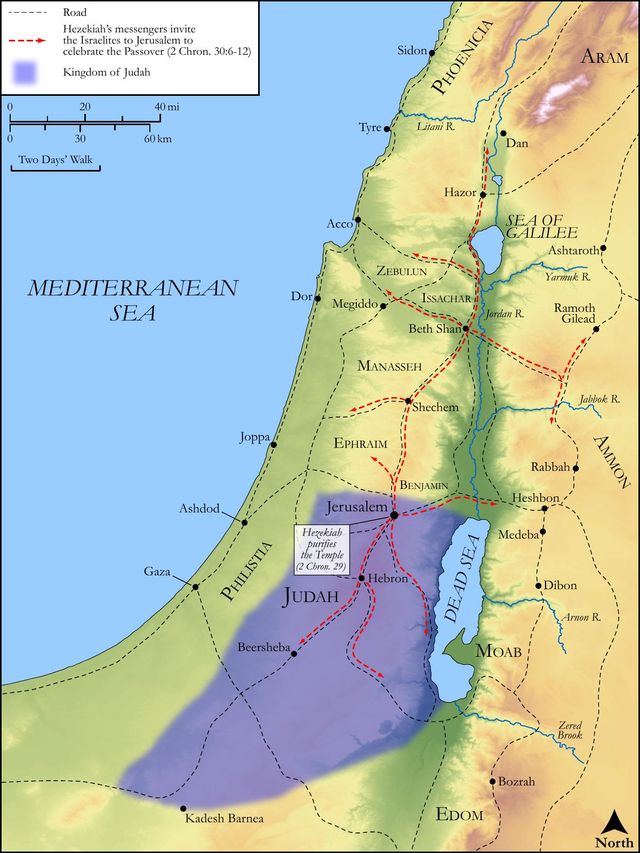
See on the biblical-era map
Study this verse
Public-domain commentary
Matthew Henry
From his Commentary on the Whole Bible. Henry comments on passages, not single verses — this entry covers 2 Chronicles 29:20–36. His three-level outline is real structure in the source text, so it is rendered as structure.
The temple being cleansed, we have here an account of the good use that was immediately made of it. A solemn assembly was called to meet the king at the temple, the very next day (Ch2 29:20); and very glad, no doubt, all the good people in Jerusalem were, when it was said, Let us go up to the house of the Lord, Psa 122:1. As soon as Hezekiah heard that the temple was ready for him he lost no time, but made it appear that he was ready for it. He rose early to go up to the house of the Lord, earlier on that day than on other days, to show that his heart was upon his work there. Now this day's work was to look two ways: -
I.Atonement must be made for the sins of the last reign.
They thought it not enough to lament and forsake those sins, but they brought a sin-offering. Even our repentance and reformation will not obtain pardon but in and through Christ, who was made sin (that is, a sin-offering) for us. No peace but through his blood, no, not for penitents. Observe,
1.The sin-offering was for the kingdom, for the sanctuary, and for Judah (Ch2 29:21), that is, to make atonement for the sins of princes, priests, and people, for they had all corrupted their way. The law of Moses appointed sacrifices to make atonement for the sins of the whole congregation (Lev 4:13, Lev 4:14; Num 15:24, Num 15:25), that the national judgments which their national sins deserved might be turned away. For this purpose we must now have an eye to Christ the great propitiation, as well as for the remission and salvation of particular persons.
2.The law appointed only one goat for a sin-offering, as on the day of atonement (Lev 16:15) and on such extraordinary occasions as this, Num 15:24. But they here offered seven (Ch2 29:21), because the sins of the congregation had been very great and long continued in. Seven is a number of perfection. Our great sin-offering is but one, yet that one perfects for ever those that are sanctified.
3.The king and the congregation (that is, the representatives of the congregation) laid their hands on the heads of the goats that were for the sin-offering (Ch2 29:23), thereby owning themselves guilty before God and expressing their desire that the guilt of the sinner might be transferred to the sacrifice. By faith we lay our hands on the Lord Jesus, and so receive the atonement, Rom 5:11.
4.Burnt-offerings were offered with the sin-offerings, seven bullocks, seven rams, and seven lambs. The intention of the burnt-offerings was to give glory to the God of Israel, whom they owned as the only true God, which it was proper to do at the same time that they were by the sin-offering making atonement for their offences. The blood of those, as well as of the sin-offering, was sprinkled upon the altar (Ch2 29:22), to make reconciliation for all Israel (Ch2 29:24), and not for Judah only. Christ is a propitiation, not for the sins of Israel only, but of the whole world, Jo1 2:1, Jo1 2:2.
5.While the offerings were burning upon the altar the Levites sang the song of the Lord (Ch2 29:27), the Psalms composed by David and Asaph (Ch2 29:30), accompanied by the musical instruments which God by his prophets had commanded the use of (Ch2 29:25), and which had been long neglected. Even sorrow for sin must not put us out of tune for praising God. By faith we must rejoice in Christ Jesus as our righteousness; and our prayers and praises must ascend with his offering, to be accepted only in virtue of it.
6.The king and all the congregation testified their consent to and concurrence in all that was done, by bowing their heads and worshipping, expressing an awful veneration of the divine Majesty, by postures of adoration. This is taken notice of, Ch2 29:28-30. It is not enough for us to be where God is worshipped, if we do not ourselves worship him, and that not with bodily exercise only, which profits little, but with the heart.
II.The solemnities of this day did likewise look forward.
The temple service was to be set up again, that it might be continually kept up; and this Hezekiah calls them to, Ch2 29:31. "Now that you have consecrated yourselves to the Lord - have both made an atonement and made a covenant by sacrifice, are solemnly reconciled and engaged to him - now come near, and bring sacrifices." Note, Our covenant with God must be pursued and improved in communion with him. Having consecrated ourselves, in the first place, to the Lord, we must bring the sacrifices of prayer, and praise, and alms, to his house. Now, in this work, it was found.
1.That the people were free. Being called to it by the king, they brought in their offerings, though not in such abundance as in the glorious days of Solomon (for Judah was now diminished, impoverished, and brought low), but according to what they had, and as much as one could expect considering their poverty and the great decay of piety among them.
(1.)Some were so generous as to bring burnt-offerings, which were wholly consumed to the honour of God, and of which the offerer had no part. Of this sort there were seventy bullocks, 100 rams, and 200 lambs, Ch2 29:32.
(2.)Others brought peace-offerings and thank-offerings, the fat of which was burnt upon the altar, and the flesh divided between the priests and the offerers, Ch2 29:35. Of this sort there were 600 oxen and 3000 sheep, Ch2 29:33. Perhaps the remembrance of their sin in sacrificing on the high places made them more willing to bring their sacrifices now to God's altar.
2.That the priests were few, too few for the service, Ch2 29:34. Many of them, it is likely, were suspended and laid aside as polluted and uncanonical, for having sacrificed to idols in the last reign, and the rest had not the zeal that one might have expected upon such an occasion. They thought that the king needed not to be so forward, that there was no necessity for such haste in opening the doors of the temple, and therefore they took no care to sanctify themselves, and being unsanctified, and so unqualified, they made that their excuse for being absent from the service; as if their offence would be their defence. It is recorded here, to the perpetual shame of the priests, that, though they were so well provided for out of the offerings of the Lord made by fire, yet they did not mind their business. Here was work to do, and there wanted proper hands to do it.
3.That the Levites were forward. They had been more upright in heart to sanctify themselves than the priests (Ch2 29:34), were better affected to the work and better prepared and qualified for it. This was their praise, and, in recompence for it, they had the honour to be employed in that which was the priests' work: they helped them to flay the offerings. This was not according to the law (Lev 1:5, Lev 1:6), but the irregularity was dispensed with in cases of necessity, and thus encouragement was given to the faithful zealous Levites and a just disgrace put upon the careless priests. What the Levites wanted in the ceremonial advantages of their birth and consecration was abundantly made up in their eminent qualifications of skill and will to do the work.
4.That all were pleased. The king and all the people rejoiced in this blessed turn of affairs and the new face of religion which the kingdom had put on, Ch2 29:36. Two things in this matter pleased them: - (1.) That it was soon brought about: The thing was done suddenly, in a little time, with a great deal of ease, and without any opposition. Those that go about the work of God in faith and with resolution will find that there is not that difficulty in it which they sometimes imagine, but it will be a pleasing surprise to them to see how soon it is done. (2.) That the hand of God was plainly in it: God had prepared the people by the secret influences of his grace, so that many of those who had in the last reign doted on the idolatrous altars were now as much in love with God's altar. This change, which God wrought on their minds, did very much expedite and facilitate the work. Let magistrates and ministers do their part towards the reforming of a land, and ascribe to him the glory of what is done, especially when it is done suddenly and is a pleasing surprise. This is the Lord's doing, and it is marvellous.
Continue studying 2 Chronicles 29:31 across the web’s major study libraries — every link below opens this exact verse, chapter, or book on the destination site.
Read & Compare
 BibleGatewayThis verse in more than 200 translations and 70 languages.
 Bible.comThe YouVersion reader — hundreds of translations, reading plans, and highlights.
 ESV.orgCrossway's official English Standard Version reader.
 NET BibleThe NET translation with 60,000+ translators' notes on every rendering decision.
 STEP BibleTyndale House's free study tool — original text, vocabulary, and scholarly resources.
 BibliaLogos Bible Software's free web reader.
 USCCBThe New American Bible (Revised Edition) with the U.S. bishops' study notes.
Commentaries
 BibleHub CommentariesDozens of classic commentaries on this verse, gathered on one page.
 StudyLightMore than 100 commentary sets — the largest collection on the web.
 BibleRefPlain-English commentary on what this verse means, verse by verse.
 Enduring WordDavid Guzik's free commentary on this chapter, widely used by Bible teachers.
 Bible Study ToolsVerse commentary alongside Greek and Hebrew study aids.
Original Language & Research
- BibleHub InterlinearThe verse word by word — original language, transliteration, and English.
- BibleHub LexiconEvery word's original-language definition and Strong's entry.
 Blue Letter BibleDeep-study tools — Strong's numbers, concordance, and word studies.
 SefariaThe Hebrew text with Rashi and centuries of Jewish commentary.
Sermons, Hymns & Audio


TrulyRandomVerse is not affiliated with these sites and doesn’t control their content. They’re linked because they’re genuinely useful.
Summary
King Hezekiah, having diligently overseen the thorough purification and consecration of the Levitical priests and the Temple itself, now issues a direct and pivotal command to the people of Judah to bring their offerings. This moment marks the profound resumption of proper worship in Jerusalem after years of neglect and widespread idolatry under his father, King Ahaz. The verse powerfully highlights the congregation's immediate and enthusiastic response, bringing both the commanded sacrifices and thank offerings, alongside a significant number of freewill burnt offerings, demonstrating a deep spiritual revival and genuine devotion to the LORD.
Context
ShowHideLiterary Context
This verse is strategically placed at a critical juncture within King Hezekiah's extensive religious reforms, detailed comprehensively in 2 Chronicles 29. Following his ascension to the throne, Hezekiah immediately prioritized the restoration of true worship, commencing with the cleansing and consecration of the Temple (2 Chronicles 29:3-19) and the purification of the Levites and priests (2 Chronicles 29:20-30). Having meticulously completed these essential preparatory steps—the phrase "Now ye have consecrated yourselves" in the verse specifically refers to the Levites' purification—Hezekiah transitions from the foundational rituals to the active participation of the entire congregation. The verse thus serves as the crucial bridge between the priestly work of cleansing and the communal act of worship, setting the stage for the massive and abundant sacrifices that follow in 2 Chronicles 29:32-36.
Historical & Cultural Context
Hezekiah's reign (c. 715-686 BC) represented a radical theological and political shift from the deeply idolatrous and apostate rule of his father, King Ahaz. Ahaz had not only neglected the Temple but actively promoted pagan worship, even closing the Temple doors and erecting altars to foreign gods throughout Jerusalem (2 Chronicles 28:24-25). Judah was also under significant political and military pressure from the formidable Assyrian Empire. In this dire context, Hezekiah's actions were a bold reassertion of Judah's covenant relationship with Yahweh. The Temple was the spiritual, social, and cultural heart of the nation, and its defilement symbolized the nation's spiritual sickness. The call for sacrifices and thank offerings was a profound return to the core tenets of the Mosaic Law, which prescribed various types of offerings for atonement, thanksgiving, and dedication, central to Israelite identity and their relationship with God.
Key Themes
ShowHideThe passage powerfully articulates several foundational themes. First, it underscores the restoration of true worship and the imperative of obedience to God's commands after a prolonged period of spiritual decline. Hezekiah's decisive leadership is portrayed as instrumental in guiding the nation back to covenant faithfulness. Second, the emphasis on the Levites having "consecrated yourselves" highlights the theme of spiritual preparation and purity as an indispensable prerequisite for approaching God in worship, a principle consistently found throughout the Old Testament, such as in the preparations for encountering God at Sinai (Exodus 19:10-11). Third, the distinction between commanded "sacrifices and thank offerings" and the "burnt offerings" given "of a free heart" introduces the profound theme of voluntary and sincere giving. While obligation was an inherent part of the Law, genuine devotion is powerfully demonstrated through freewill offerings, echoing the spirit of generous giving seen in the construction of the tabernacle (Exodus 35:29). Finally, the immediate and abundant response of the congregation demonstrates the theme of corporate revival and unity in worship, a powerful testament to God's transformative work in the hearts of His people.
Exposition and Analysis
ShowHideKey Word Analysis
ShowHideThe phrase "consecrated yourselves" translates the Hebrew idiom "filled your hand" (מָלֵא יָדֶךָ), signifying a ritual act of ordination or dedication, particularly for priests and Levites. Mâlêʼ (H4390) means "to fill" or "be full of," and yâd (H3027) refers to the "hand." In this context, it refers to the Levites having completed the prescribed purification and dedication rites, making them ceremonially fit for service in the Temple. This emphasizes the necessity of proper spiritual and ritual preparation for those who approach God in sacred service.
Derived from the root meaning "to slaughter," zebach (H2077) refers to an animal slaughter, specifically for the purpose of a sacrifice or offering. While it can broadly refer to any offering, in the context of peace offerings or fellowship offerings, it implies a communal meal shared between God, the priests, and the worshippers, symbolizing reconciliation and communion. Its inclusion here indicates a return to the prescribed covenant rituals for maintaining relationship with God.
This phrase combines nâdîyb (H5081), meaning "voluntary" or "generous," and lêb (H3820), referring to the "heart" as the seat of emotions, will, and intellect. Together, "free heart" denotes an offering that is not given out of obligation or compulsion, but from a willing, generous, and magnanimous spirit. This highlights a profound spiritual transformation, where individuals are moved by genuine devotion and gratitude to give beyond what is required, signifying a deep and personal commitment to the LORD.
Verse Breakdown
ShowHide"Then Hezekiah answered and said, Now ye have consecrated yourselves unto the LORD"
This opening clause establishes King Hezekiah's authoritative role as the divinely appointed leader, initiating the next crucial phase of the spiritual revival. His declaration confirms that the essential preparatory work of purification and dedication, meticulously undertaken by the priests and Levites (as described in the preceding verses), has been completed and accepted by the LORD. This consecration was absolutely crucial for establishing the proper spiritual and ritual conditions necessary for the entire community to engage in acceptable worship.
"come near and bring sacrifices and thank offerings into the house of the LORD"
This is Hezekiah's direct and urgent command to the entire congregation of Judah. "Sacrifices" (Hebrew: zevakhim) here primarily refers to peace offerings, which often involved communal feasting and symbolized fellowship with God. "Thank offerings" (Hebrew: todot) were a specific type of peace offering brought to express profound gratitude for God's blessings and deliverance. The command serves as an invitation for the entire community to actively participate in the restored worship, bringing offerings that acknowledge both their covenant relationship with God and His abundant goodness.
"And the congregation brought in sacrifices and thank offerings"
This clause immediately highlights the swift, unified, and obedient response of the people. It demonstrates a widespread willingness to participate in the spiritual renewal, indicating that Hezekiah's reforms resonated deeply with the populace and that God's Spirit was at work among them. The prompt and collective action underscores the success of the revival and the people's earnest readiness to return to God's ways.
"and as many as were of a free heart burnt offerings"
This final phrase adds a significant and profound layer of meaning to the congregation's response. While the "sacrifices and thank offerings" might have included elements of prescribed obligation, the "burnt offerings" (Hebrew: olah, meaning "that which goes up," entirely consumed on the altar) given "of a free heart" were purely voluntary. This signifies an extraordinary outpouring of devotion, going far beyond the minimum requirement. It indicates a profound spiritual awakening where individuals are moved by genuine love, gratitude, and a desire for complete dedication to offer themselves and their possessions entirely to God, symbolizing full surrender and atonement.
Literary Devices
ShowHideThe verse employs several effective literary devices that enhance its message and impact. There is a clear Call and Response structure, with Hezekiah's authoritative command immediately followed by the congregation's eager and immediate action, emphasizing their obedience and enthusiasm. The Repetition of "sacrifices and thank offerings" serves to highlight the specific types of worship being restored, thereby reinforcing the nation's return to the Mosaic ordinances and covenant faithfulness. Furthermore, the inclusion of "and as many as were of a free heart burnt offerings" creates a powerful Contrast between offerings that might be seen as obligatory and those that spring from voluntary, overflowing devotion, underscoring the depth and authenticity of the spiritual revival. This phrase also functions as a form of Emphasis on Abundance, indicating that the congregational response was not merely compliant but exceptionally generous and widespread, reflecting a genuine and profound spiritual transformation occurring within the community.
Theological and Thematic Connections
ShowHideThis passage profoundly illustrates the principles of acceptable worship and the nature of true spiritual revival. It teaches that approaching God requires both divine initiative (manifested through Hezekiah's Spirit-led leadership and the Spirit's work in the people's hearts) and a genuine human response, characterized by intentional preparation, faithful obedience, and heartfelt devotion. The consecration of the priests underscores God's absolute holiness and the necessity of purity for those who mediate or participate in worship. The congregation's immediate and generous response highlights the power of a unified community returning to God, not out of mere ritualistic adherence, but from a genuine desire to honor Him. This willingness to offer beyond obligation, particularly with the freewill burnt offerings, signifies a profound understanding that true worship involves the complete dedication of oneself and one's resources to the LORD, reflecting deep gratitude for His blessings and an earnest desire for His presence and favor.
Reflection and Application
ShowHideThe account in 2 Chronicles 29:31 offers timeless and profound principles for believers today, reminding us that our approach to God should always be marked by intentional preparation and a sincere, wholehearted commitment. Just as the Temple and its ministers needed thorough cleansing, we are called to examine our lives and seek spiritual purification before engaging in worship, whether individually in prayer or corporately in the assembly of believers. This doesn't imply earning God's favor, but rather acknowledging His holiness, our own sinfulness, and our constant need for His cleansing grace. The congregation's enthusiastic response, especially their "free heart" offerings, serves as a powerful challenge to move beyond mere religious obligation to a place of joyful, voluntary giving of our time, talents, and financial resources. Our worship, whether expressed through fervent praise, dedicated service, or generous contributions, is most pleasing to God when it flows from a heart overflowing with love, gratitude, and genuine devotion, rather than from compulsion or a sense of duty. This passage encourages us to cultivate a spirit of generosity and wholeheartedness in all aspects of our walk with God, recognizing that true worship involves the complete dedication of our entire being.
Questions for Reflection
ShowHideFAQ
ShowHideWhy did Hezekiah emphasize "consecration" before bringing offerings?
ShowHideHezekiah's emphasis on "consecration" (referring specifically to the priests and Levites) before the people brought offerings was absolutely essential for several reasons rooted in the Mosaic Law and the very nature of God. Firstly, God is holy, and His presence demands purity and reverence from those who approach Him or mediate worship. The Temple, having been defiled by King Ahaz, needed ritual cleansing, and the Levites, who were to facilitate the sacrifices, also needed to be purified and set apart for their sacred duties, as meticulously detailed in 2 Chronicles 29:15-19. Without this prior consecration, any offerings brought would have been considered defiled and unacceptable to the LORD. This principle underscores that true worship is not merely about external acts but requires an internal state of readiness and purity, reflecting a deep reverence for God's character and His commands.
What is the difference between "sacrifices and thank offerings" and "burnt offerings" in this context?
ShowHideIn this context, "sacrifices and thank offerings" (Hebrew: zevakhim u'todot) generally refer to peace offerings. Peace offerings were often communal, involving a portion given to God, a portion to the priests, and a portion returned to the worshipper to be eaten in a celebratory meal. They could be brought for various reasons, including fellowship, the fulfillment of vows, or, as specified here, expressions of profound thanksgiving. "Burnt offerings" (Hebrew: olah) were distinct in that the entire animal was consumed by fire on the altar, symbolizing complete dedication to God and serving as an atonement for sin. The profound significance in 2 Chronicles 29:31 is that while the "sacrifices and thank offerings" were likely part of the commanded restoration of worship, the "burnt offerings" were specifically noted as coming from "a free heart." This highlights that the people not only fulfilled their obligations but also went above and beyond, demonstrating an extraordinary level of voluntary devotion and a deep spiritual hunger for complete surrender and atonement before God.
Christ-Centered Fulfillment
ShowHideThe powerful spiritual revival under King Hezekiah, culminating in the people's eager bringing of sacrifices and freewill offerings, serves as a profound and beautiful foreshadowing of the ultimate and perfect redemptive work of Christ. Hezekiah's meticulous cleansing of the defiled Temple and the rigorous consecration of the priests point directly to Jesus, who is both our Great High Priest—eternally pure and perfectly qualified—and the very Temple of God Himself, through whom all true access to the Father is now made possible. The Old Testament sacrifices, including the burnt offerings for atonement, find their complete and final fulfillment in the singular, perfect, and once-for-all sacrifice of the Lamb of God, Jesus Christ, whose precious blood cleanses us from all sin and provides eternal redemption (Hebrews 9:12). Our "consecration" is no longer a ritual purification but a glorious spiritual reality achieved solely through faith in Christ, by which we are set apart and made holy in Him (1 Corinthians 1:2). Consequently, our worship under the New Covenant is not primarily of animal sacrifices but of "spiritual sacrifices" (1 Peter 2:5), such as fervent praise, heartfelt thanksgiving, and lives offered in dedicated service, given from a truly "free heart" in response to the immeasurable grace and love we have received through Christ (Romans 12:1). Hezekiah's revival was a significant shadow; Christ is the glorious and perfect reality, enabling us to worship God in spirit and truth.