


2 Chronicles 34:29
Bible text: King James Version (1769 Blayney text) · Public domain
Bible text: Berean Standard Bible · Public domain
Bible text: American Standard Version (1901) · Public domain
Bible text: World English Bible, Messianic edition · Public domain
Bible text: Geneva Bible (1599) · Public domain
Bible text: Young's Literal Translation · Public domain
- וַיִּשְׁלַחvai·yish·Lachand he sentH7971Conj-w ¦ V-Qal-ConsecImperf-3msVerb Qal Consecutive Imperfect 3rd Singular Masculineוַandיִּשְׁלַחhe sent
- הַמֶּלֶךְha·Me·lekhthe kingH4428Art ¦ N-msNoun Singular Masculine Absoluteהַtheמֶּלֶךְking
- וַיֶּאֱסֹףvai·ye·'e·Sofand he gatheredH622Conj-w ¦ V-Qal-ConsecImperf-3msVerb Qal Consecutive Imperfect 3rd Singular Masculineוַandיֶּאֱסֹףhe gathered
- אֶת'et<obj.>H853DirObjMParticle Object Indicator
- כָּלkolallH3605N-mscNoun Singular Masculine Construct
- זִקְנֵיzik·Nei[the] elders ofH2205Adj-mpcAdjective Plural Masculine Construct
- יְהוּדָהye·hu·DahJudahH3063N-properNoun Proper Location
- וִירוּשָׁלִָםvi·ru·sha·Limand JerusalemH3389Conj-w ¦ N-properNoun Proper LocationוִandירוּשָׁלִָםJerusalem
English is a literal word-by-word gloss of the Hebrew, not the KJV's wording. Why?
This is the original text the KJV's translators worked from — each Hebrew word with its own literal English meaning in this verse, prepared by scholars at Tyndale House, Cambridge. The KJV translates whole sentences, not word by word, so its wording differs: one Hebrew word can become several English words, and the KJV may choose “the LORD” where the gloss reads “Yahweh”. Both are faithful — they answer different questions. For the KJV's own rendering, switch to the KJV text.
Details
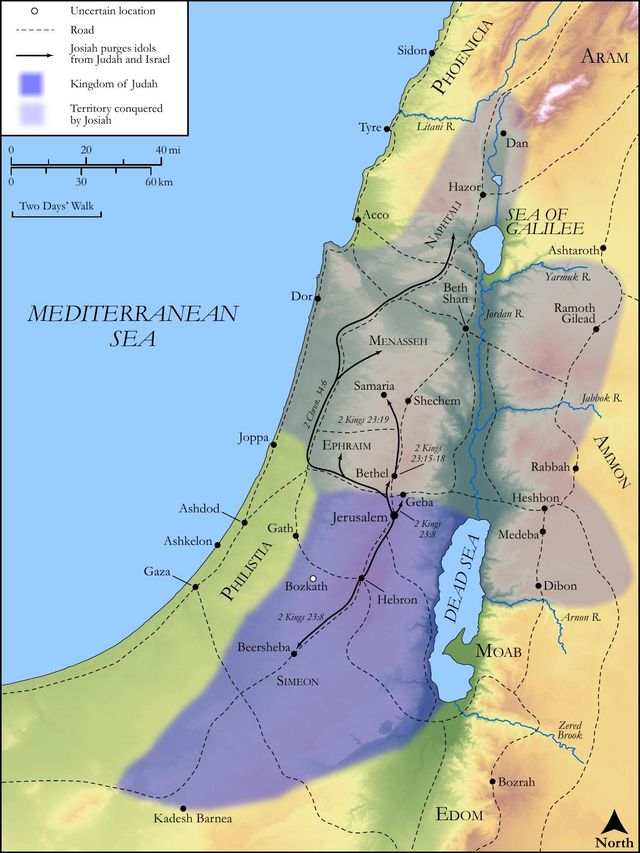
See on the biblical-era map
Study this verse
Public-domain commentary
Matthew Henry
From his Commentary on the Whole Bible. Henry comments on passages, not single verses — this entry covers 2 Chronicles 34:29–33.
We have here an account of the further advances which Josiah made towards the reformation of his kingdom upon the hearing of the law read and the receipt of the message God sent him by the prophetess. Happy the people that had such a king; for here we find that, 1. They were well taught. He did not go about to force them to do their duty, till he had first instructed them in it. He called all the people together, great and small, young and old, rich and poor, high and low. He that hath ears to hear, let him hear the words of the book of the covenant; for they are all concerned in those words. To put an honour upon the service, and to engage attention the more, though there were priests and Levites present, the king himself read the book to the people (Ch2 34:30), and he read it, no doubt, in such a manner as to show that he was himself affected with it, which would be a means of affecting the hearers. 2. They were well fixed. The articles of agreement between God and Israel being read, that they might intelligently covenant with God, both king and people with great solemnity did as it were subscribe the articles. The king in his place covenanted to keep God's commandments with all his heart and soul, according to what was written in the book (Ch2 34:31), and urged the people to declare their consent likewise to this covenant, and solemnly to promise that they would faithfully perform, fulfil, and keep, all and every thing that was on their part to be done, according to this covenant: this they did; they could not for shame do otherwise. He caused all that were present to stand to it (Ch2 34:32), and made them all to serve, even to serve the Lord their God (Ch2 34:33), to do it and to make a business of it. he did all he could to bring them to it - to serve, even to serve; the repetition denotes that this was the only thing his heart was set on; he aimed at nothing else in what he did but to engage them to God and their duty. 3. They were well tended, were honest with good looking to. All his days they departed not from following the Lord; he kept them, with much ado, from running into idolatry again. All his days were days of restraint upon them; but this intimated that there was in them a bent to backslide, a strong inclination to idolatry. Many of them wanted nothing but to have him out of the way, and then they would have their high places and their images up again. And therefore we find that in the days of Josiah (Jer 3:6) God charged it upon treacherous Judah that she had not returned to him with all her heart, but feignedly (Ch2 34:10), nay, had played the harlot (Ch2 34:8) and thereby had even justified backsliding Israel, Ch2 34:11. In the twenty-third year of this reign, four or five years after this, they had gone on to provoke God to anger with the works of their hands (Jer 25:3-7); and, which is very observable, it is from the beginning of Josiah's reformation, his twelfth or thirteenth year, that the iniquity of the house of Judah, which brought ruin upon them, and which the prophet was to bear lying on his right side, was dated (Eze 4:6), for thence to the destruction of Jerusalem was just forty years. Josiah was sincere in what he did, but the generality of the people were averse to it and hankered after their idols still; so that the reformation, though well designed and well prosecuted by the prince, had little or no effect upon the people. It was with reluctancy that they parted with their idols; still they were in heart joined to them, and wished for them again. This God saw, and therefore from that time, when one would have thought the foundations had been laid for a perpetual security and peace, from that very time did the decree go forth for their destruction. Nothing hastens the ruin of a people nor ripens them for it more than the baffling of hopeful attempts for reformation and a hypocritical return to God. Be not deceived, God is not mocked.
Continue studying 2 Chronicles 34:29 across the web’s major study libraries — every link below opens this exact verse, chapter, or book on the destination site.
Read & Compare
 BibleGatewayThis verse in more than 200 translations and 70 languages.
 Bible.comThe YouVersion reader — hundreds of translations, reading plans, and highlights.
 ESV.orgCrossway's official English Standard Version reader.
 NET BibleThe NET translation with 60,000+ translators' notes on every rendering decision.
 STEP BibleTyndale House's free study tool — original text, vocabulary, and scholarly resources.
 BibliaLogos Bible Software's free web reader.
 USCCBThe New American Bible (Revised Edition) with the U.S. bishops' study notes.
Commentaries
 BibleHub CommentariesDozens of classic commentaries on this verse, gathered on one page.
 StudyLightMore than 100 commentary sets — the largest collection on the web.
 BibleRefPlain-English commentary on what this verse means, verse by verse.
 Enduring WordDavid Guzik's free commentary on this chapter, widely used by Bible teachers.
 Bible Study ToolsVerse commentary alongside Greek and Hebrew study aids.
Original Language & Research
- BibleHub InterlinearThe verse word by word — original language, transliteration, and English.
- BibleHub LexiconEvery word's original-language definition and Strong's entry.
 Blue Letter BibleDeep-study tools — Strong's numbers, concordance, and word studies.
 SefariaThe Hebrew text with Rashi and centuries of Jewish commentary.
Sermons, Hymns & Audio


TrulyRandomVerse is not affiliated with these sites and doesn’t control their content. They’re linked because they’re genuinely useful.
Summary
Following the momentous discovery of the Book of the Law and the confirming prophecy of Huldah, 2 Chronicles 34:29 records King Josiah's decisive and humble leadership. This pivotal verse describes his immediate action to convene all the esteemed elders of Judah and Jerusalem, thereby initiating a comprehensive national response to God's revealed will and setting the foundational stage for a profound spiritual revival and a solemn covenant renewal across the kingdom.
Context
ShowHideLiterary Context
This verse is deeply embedded within the unfolding narrative of King Josiah's sweeping reforms. Prior to this event, Josiah had already initiated the purging of idolatry from Judah and Jerusalem in his early reign. However, the true catalyst for the events leading to this verse was the providential discovery of the Book of the Law in the Temple during its much-needed repair. Upon hearing its profound words read aloud, Josiah was deeply convicted, expressing his genuine repentance and humility by tearing his clothes. He then dispatched a delegation to inquire of the Lord through the prophetess Huldah, who confirmed God's impending judgment on Judah for their persistent disobedience but promised peace for Josiah due to his contrite heart, as detailed in 2 Chronicles 34:28. Josiah's immediate and strategic action, recorded in 2 Chronicles 34:29, was to gather the nation's key leaders, signaling his resolute intent to lead the entire populace in a national recommitment to God's commands, thereby meticulously preparing for the solemn covenant renewal described in 2 Chronicles 34:31-32.
Historical & Cultural Context
King Josiah reigned during a particularly tumultuous and spiritually compromised period in Judah's history, immediately following the deeply idolatrous reigns of his grandfather Manasseh and father Amon, who had plunged the nation into profound spiritual apostasy. The "elders" (Hebrew: זְקֵנִים, zeqenim) in ancient Israel were not merely individuals advanced in age but held revered and significant positions of authority, wisdom, and influence within their respective cities, tribes, and families. They functioned as local judges, administrators, and crucial representatives of the people. By gathering "all the elders of Judah and Jerusalem," Josiah was assembling the most influential and representative figures from across his entire kingdom. This comprehensive assembly was absolutely crucial for ensuring that any national reform or covenant renewal would possess broad legitimacy, understanding, and widespread support from the populace, as decisions made by such a representative body were considered binding upon the community. This strategic act also profoundly demonstrated Josiah's respect for established social structures and his earnest desire for a unified national response, rather than attempting to impose reform solely by royal decree.
Key Themes
ShowHideThis verse powerfully contributes to several overarching themes prominent in 2 Chronicles and the broader Deuteronomistic History. Firstly, it highlights Responsive Leadership, showcasing Josiah as a king who not only humbly hears God's revealed Word but acts decisively and without delay upon it, choosing not to keep the truth to himself but immediately involving the nation's key representatives. This stands in stark contrast to the unfaithful kings who preceded him. Secondly, it profoundly underscores the theme of National Repentance and Reform, as the comprehensive gathering of the elders was an indispensable prerequisite for a widespread spiritual awakening and a national covenant renewal, meticulously preparing the way for the profound reforms and spiritual cleansing described in the subsequent verses of 2 Chronicles 34. Finally, the entire sequence of events—from the Law's discovery to the inquiry to the assembly—powerfully demonstrates The Authority and Power of God's Word. The rediscovered Law of God served as the ultimate catalyst for this entire spiritual movement, proving its inherent capacity to bring about deep conviction, genuine repentance, and transformative change when received with an open heart and acted upon by faithful leadership, echoing the transformative power of God's voice in passages like Deuteronomy 30:1-10.
Exposition and Analysis
ShowHideKey Word Analysis
ShowHideHere, this term specifically refers to Josiah, whose character and actions are central to the transformative events of this chapter. The designation 'king' emphasizes his unique royal authority and inherent responsibility, which he conscientiously exercises not for personal gain or arbitrary rule, but in humble submission to divine revelation. His office grants him the singular capacity to initiate a national gathering of such profound magnitude and significance.
; [idiom] any wise, appoint, bring (on the way), cast (away, out), conduct, [idiom] earnestly, forsake, give (up), grow long, lay, leave, let depart (down, go, loose), push away, put (away, forth, in, out), reach forth, send (away, forth, out), set, shoot (forth, out), sow, spread, stretch forth (out).) This verb denotes a deliberate, decisive, and immediate action. It implies the dispatching of royal messengers or agents with a highly specific and urgent purpose. In this context, it powerfully highlights Josiah's proactive and unhesitating response to the prophetic word delivered by Huldah and the profound conviction brought by the rediscovered Law. He does not procrastinate but swiftly puts a comprehensive plan into motion to address the nation's spiritual crisis.
Elder(-est), old (man, men and...women), senator.) As thoroughly discussed in the context, these were the highly respected, authoritative, and representative leaders of the community, holding positions of significant influence in their respective cities and regions. The inclusion of 'all' (כֹּל, kol) in the original Hebrew text emphatically underscores the comprehensive and inclusive nature of the summons, indicating Josiah's earnest desire for a unified, national consensus and broad participation in the impending spiritual reforms and covenant renewal.
Verse Breakdown
ShowHide"¶ Then the king sent"
This opening phrase signifies King Josiah's immediate and decisive action, occurring directly after his profound conviction from the rediscovered Law and the receipt of Huldah's confirming prophecy. The adverb "Then" critically links this verse to the preceding narrative, particularly Huldah's pronouncements of impending judgment and the promise of peace for Josiah due to his contrite heart. His act of "sending" implies the dispatch of royal messengers throughout the kingdom, carrying the urgent summons to the designated leaders.
"and gathered together"
This clause indicates the successful and comprehensive execution of the king's command. The verb "gathered" (אָסַף, asaf) denotes a deliberate and purposeful assembly, bringing together disparate individuals from various geographical locations into a single, central place for a specific and grave purpose. It powerfully underscores both the king's inherent authority and the people's immediate obedience to his summons, recognizing the profound gravity of the national spiritual situation.
"all the elders of Judah and Jerusalem"
This specifies the precise and comprehensive target audience of the royal summons. The emphatic inclusion of "all" highlights the inclusive and exhaustive nature of the gathering, indicating that no significant representative or influential leader was to be excluded from this crucial convocation. "Elders" refers to the established, respected, and influential leaders of the community, serving as direct representatives of the entire populace. By explicitly naming both "Judah and Jerusalem," the text underscores the broad geographical scope of the assembly, encompassing both the capital city and the wider kingdom, thereby ensuring comprehensive national representation for the momentous covenant renewal that was to follow.
Literary Devices
ShowHideThe verse employs several potent literary devices to convey its profound significance and the urgency of the moment. Narrative Pacing is strikingly evident in the swift, almost immediate transition from Huldah's solemn prophecy in the preceding verse to Josiah's decisive and immediate action in 2 Chronicles 34:29. The opening phrase "Then the king sent" powerfully signals this rapid progression, creating an palpable sense of urgency and resolute decisiveness. Emphasis is strategically placed on the comprehensiveness of Josiah's action through the deliberate use of the phrase "all the elders," highlighting his earnest desire for a unified and complete national response rather than a partial or fragmented one. This comprehensive gathering also functions as a powerful Foreshadowing device, subtly hinting at and preparing the reader for the subsequent national covenant renewal and widespread spiritual reforms that will inevitably follow this crucial assembly. Furthermore, the specific mention of "Judah and Jerusalem" can be interpreted as a form of Synecdoche, where the capital city and the primary tribe represent the entirety of the kingdom under Josiah's righteous rule, thereby signifying a truly national rather than merely local or regional convocation.
Theological and Thematic Connections
ShowHideThis verse powerfully illustrates the profound theological principle of responsive leadership to divine revelation. King Josiah's immediate and comprehensive gathering of the nation's leaders underscores the vital truth that genuine spiritual revival, whether at an individual or corporate level, often begins with those in authority humbly acknowledging God's authoritative Word and taking decisive, intentional action to align the community with its precepts. It demonstrates a profound understanding of corporate responsibility before God; just as the nation had collectively sinned through generations of idolatry, a collective and unified response was deemed necessary for national repentance and profound renewal. This assembly was far more than a mere political maneuver; it was a sacred convocation, a solemn recognition that the Law of God held ultimate and supreme authority over both the king himself and the entire populace. It highlights the indispensable and transformative role of God's Word as the ultimate catalyst for conviction, deep repentance, and national transformation, affirming its living and active power to expose sin, call to righteousness, and bring about profound change.
Reflection and Application
ShowHideKing Josiah's exemplary response in 2 Chronicles 34:29 offers a timeless and profound model for both leadership and personal discipleship in any era. His immediate and resolute action, born out of deep conviction and profound humility before God's Word, serves as a powerful reminder that true spiritual transformation—whether individual or corporate—is never a passive endeavor but unequivocally requires decisive, intentional, and often courageous steps of obedience. When we are confronted with the unvarnished truth of God's Word, we are called to respond with humility, acknowledging its supreme authority over every facet of our lives, and then to act in prompt obedience, resisting any temptation to delay, rationalize, or compromise. For those entrusted with positions of influence—whether as parents, educators, church leaders, or community figures—Josiah's compelling example underscores the vital responsibility to lead by personal example, to faithfully share God's transformative truth, and to proactively facilitate environments where collective repentance and a renewed commitment to God's righteous ways can genuinely flourish. His strategic gathering of "all the elders" emphasizes the indispensable importance of broad participation, unity, and shared commitment in all spiritual endeavors, recognizing that the spiritual health and vitality of the entire body depend fundamentally on the faithful commitment of both its members and its leaders alike. This verse profoundly challenges each of us to honestly consider how we truly respond when God's truth is revealed to us and how we might more effectively lead others toward a deeper, more committed walk with Him.
Questions for Reflection
ShowHideFAQ
ShowHideWhy did Josiah gather "all the elders" specifically?
ShowHideKing Josiah strategically gathered "all the elders" to ensure that the monumental national covenant renewal and the subsequent sweeping reforms would possess broad representation, undeniable legitimacy, and widespread support from every corner of the kingdom. The elders were the highly respected, authoritative, and influential leaders of their respective communities, encompassing cities, tribes, and families. By convening every single one of them, Josiah ensured that the profound message of the rediscovered Law and the urgent call to national repentance would be disseminated effectively and comprehensively throughout the entire land, thereby fostering a unified and truly national response rather than merely a top-down imposition. This crucial act recognized their indispensable role in governing and representing the people, making them essential partners in any widespread spiritual transformation that aimed to restore the nation to God.
What was the "Book of the Law" that prompted Josiah's actions?
ShowHideThe "Book of the Law" discovered in the Temple during its repair (as recorded in 2 Chronicles 34:14) is widely believed by biblical scholars to be a significant portion of the book of Deuteronomy, or potentially the entire Pentateuch. Its providential rediscovery was profoundly significant because it vividly revealed the full extent of God's covenant demands and the severe consequences of disobedience, truths that had largely been forgotten or willfully ignored during generations of profound apostasy. Hearing its words, particularly the solemn curses for covenant breaking, brought deep and immediate conviction to King Josiah, leading to his dramatic tearing of clothes (2 Chronicles 34:19) and his subsequent resolute actions to restore the nation to faithful obedience to God.
What happened immediately after this gathering of elders?
ShowHideImmediately following this crucial gathering of the elders, King Josiah took further decisive action. He "read in their hearing all the words of the Book of the Covenant that had been found in the house of the Lord" (2 Chronicles 34:30). Following this public and solemn reading, Josiah himself "made a covenant before the Lord, to walk after the Lord and to keep His commandments and His testimonies and His statutes with all his heart and with all his soul, to perform the words of the covenant that were written in this book" (2 Chronicles 34:31). He then compelled all who were present in Jerusalem and Benjamin to stand by and commit to this covenant, thereby initiating a widespread and thorough removal of idolatry and a national commitment to serve the Lord God alone (2 Chronicles 34:33).
Christ-Centered Fulfillment
ShowHideThe profound events of 2 Chronicles 34:29, particularly King Josiah's humble and immediate response to God's revealed Word and his proactive initiative to gather the nation's leaders for repentance and covenant renewal, find their ultimate and perfect fulfillment in the person and work of Jesus Christ. Josiah, a righteous king who earnestly sought to restore his people to a right relationship with God, serves as a powerful type of the true and perfect King, Jesus, who not only perfectly fulfilled the Law in every detail (as He Himself declared in Matthew 5:17) but also embodies it as the very living Word of God made flesh (John 1:14). While Josiah gathered the elders to hear a written law that brought conviction, Christ Himself is the supreme and ultimate revelation of God, calling all humanity to genuine repentance and inaugurating a new and eternal covenant relationship. The "Book of the Law" that so powerfully convicted Josiah foreshadowed the glorious gospel—the good news of salvation found exclusively in Christ—which brings profound conviction of sin and calls for a radical turning to God. Just as Josiah gathered the representatives of Judah and Jerusalem to establish a covenant, Jesus, through His once-for-all atoning sacrifice on the cross, gathers a new and spiritual people—His Church—from every nation, tribe, and tongue, into a new and eternal covenant. This new covenant is not merely written on tablets of stone but is supernaturally inscribed on the hearts of believers by the Holy Spirit (Hebrews 8:6-13). He is the true Head of the Church, the ultimate Shepherd who perfectly leads His flock in complete obedience and brings about genuine, lasting spiritual transformation, far surpassing any earthly reform or temporary revival (Ephesians 1:22).