


2 Chronicles 34:30
- וַיַּעַלvai·Ya·'aland he went upH5927Conj-w ¦ V-Qal-ConsecImperf-3msVerb Qal Consecutive Imperfect 3rd Singular Masculineוַandיַּעַלhe went up
- הַמֶּלֶךְha·Me·lekhthe kingH4428Art ¦ N-msNoun Singular Masculine Absoluteהַtheמֶּלֶךְking
- בֵּיתbeit[the] house ofH1004N-mscNoun Singular Masculine Construct
- יְהוָהYah·wehYahwehH3068N-properNoun Proper Title
- וְכָלve·kholand everyH3605Conj-w ¦ N-mscNoun Singular Masculine Constructוְandכָלevery
- אִישׁ'ish<the> person ofH376N-mscNoun Singular Masculine Construct
- יְהוּדָהye·hu·DahJudahH3063N-properNoun Proper Location
- וְיֹשְׁבֵיve·yo·she·Veiand [the] inhabitants ofH3427Conj-w ¦ V-Qal-Prtcpl-mpVerb Qal Participle Plural Masculine Constructוְandיֹשְׁבֵי[the] inhabitants of
- יְרוּשָׁלִַםye·ru·sha·LimJerusalemH3389N-properNoun Proper Location
- וְהַכֹּהֲנִיםve·ha·ko·ha·Nimand the priestsH3548Conj-w ¦ Art ¦ N-mpNoun Plural Masculine Absoluteוְandהַtheכֹּהֲנִיםpriests
- וְהַלְוִיִּםve·hal·vi·Yimand the LevitesH3881Conj-w ¦ Art ¦ N-mpNoun Gentilic Plural Masculine AbsoluteוְandהַtheלְוִיִּםLevites
- וְכָלve·kholand allH3605Conj-w ¦ N-mscNoun Singular Masculine Constructוְandכָלall
- הָעָםha·'Amthe peopleH5971Art ¦ N-msNoun Singular Masculine Absoluteהָtheעָםpeople
- מִגָּדוֹלmi·ga·Dolfrom greatH1419Prep-m ¦ Adj-msAdjective Singular Masculine Absoluteמִfromגָּדוֹלgreat
- וְעַדve·'adand untoH5704Conj-w ¦ PrepPrepositionוְandעַדunto
- קָטָןka·TansmallH6996Adj-msAdjective Singular Masculine Absolute
- וַיִּקְרָאvai·yik·Ra'and he read aloudH7121Conj-w ¦ V-Qal-ConsecImperf-3msVerb Qal Consecutive Imperfect 3rd Singular Masculineוַandיִּקְרָאhe read aloud
- בְאָזְנֵיהֶםve·'a·ze·nei·Hemin their earsH241Prep-b ¦ N-fdc ¦ 3mpNoun Dual Feminine Constructבְinאָזְנֵיearsהֶםtheir
- אֶת'et<obj.>H853DirObjMParticle Object Indicator
- כָּלkolallH3605N-mscNoun Singular Masculine Construct
- דִּבְרֵיdiv·Rei[the] words ofH1697N-mpcNoun Plural Masculine Construct
- סֵפֶרSe·fer[the] scroll ofH5612N-mscNoun Singular Masculine Construct
- הַבְּרִיתha·be·Ritthe covenantH1285Art ¦ N-fsNoun Singular Feminine Absoluteהַtheבְּרִיתcovenant
- הַנִּמְצָאha·nim·Tza'which had been foundH4672Art ¦ V-Niphal-Prtcpl-msVerb Niphal Participle Singular Masculine Absoluteהַwhichנִּמְצָאhad been found
- בֵּיתbeit[the] house ofH1004N-mscNoun Singular Masculine Construct
- יְהוָהYah·wehYahwehH3068N-properNoun Proper Title
English is a literal word-by-word gloss of the Hebrew, not the KJV's wording. Why?
This is the original text the KJV's translators worked from — each Hebrew word with its own literal English meaning in this verse, prepared by scholars at Tyndale House, Cambridge. The KJV translates whole sentences, not word by word, so its wording differs: one Hebrew word can become several English words, and the KJV may choose “the LORD” where the gloss reads “Yahweh”. Both are faithful — they answer different questions. For the KJV's own rendering, switch to the KJV text.
Details
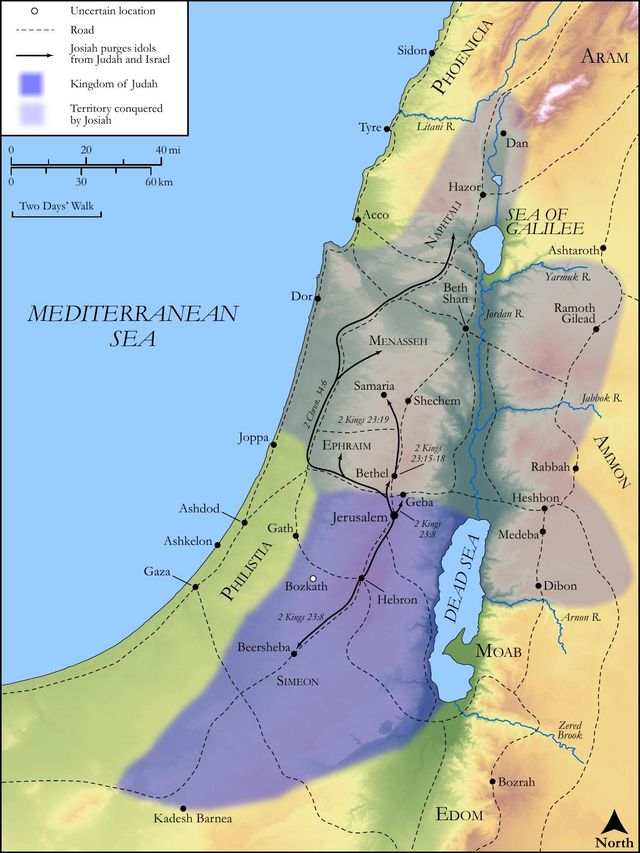
See on the biblical-era map
Study this verse
Public-domain commentary
Matthew Henry
From his Commentary on the Whole Bible. Henry comments on passages, not single verses — this entry covers 2 Chronicles 34:29–33.
We have here an account of the further advances which Josiah made towards the reformation of his kingdom upon the hearing of the law read and the receipt of the message God sent him by the prophetess. Happy the people that had such a king; for here we find that, 1. They were well taught. He did not go about to force them to do their duty, till he had first instructed them in it. He called all the people together, great and small, young and old, rich and poor, high and low. He that hath ears to hear, let him hear the words of the book of the covenant; for they are all concerned in those words. To put an honour upon the service, and to engage attention the more, though there were priests and Levites present, the king himself read the book to the people (Ch2 34:30), and he read it, no doubt, in such a manner as to show that he was himself affected with it, which would be a means of affecting the hearers. 2. They were well fixed. The articles of agreement between God and Israel being read, that they might intelligently covenant with God, both king and people with great solemnity did as it were subscribe the articles. The king in his place covenanted to keep God's commandments with all his heart and soul, according to what was written in the book (Ch2 34:31), and urged the people to declare their consent likewise to this covenant, and solemnly to promise that they would faithfully perform, fulfil, and keep, all and every thing that was on their part to be done, according to this covenant: this they did; they could not for shame do otherwise. He caused all that were present to stand to it (Ch2 34:32), and made them all to serve, even to serve the Lord their God (Ch2 34:33), to do it and to make a business of it. he did all he could to bring them to it - to serve, even to serve; the repetition denotes that this was the only thing his heart was set on; he aimed at nothing else in what he did but to engage them to God and their duty. 3. They were well tended, were honest with good looking to. All his days they departed not from following the Lord; he kept them, with much ado, from running into idolatry again. All his days were days of restraint upon them; but this intimated that there was in them a bent to backslide, a strong inclination to idolatry. Many of them wanted nothing but to have him out of the way, and then they would have their high places and their images up again. And therefore we find that in the days of Josiah (Jer 3:6) God charged it upon treacherous Judah that she had not returned to him with all her heart, but feignedly (Ch2 34:10), nay, had played the harlot (Ch2 34:8) and thereby had even justified backsliding Israel, Ch2 34:11. In the twenty-third year of this reign, four or five years after this, they had gone on to provoke God to anger with the works of their hands (Jer 25:3-7); and, which is very observable, it is from the beginning of Josiah's reformation, his twelfth or thirteenth year, that the iniquity of the house of Judah, which brought ruin upon them, and which the prophet was to bear lying on his right side, was dated (Eze 4:6), for thence to the destruction of Jerusalem was just forty years. Josiah was sincere in what he did, but the generality of the people were averse to it and hankered after their idols still; so that the reformation, though well designed and well prosecuted by the prince, had little or no effect upon the people. It was with reluctancy that they parted with their idols; still they were in heart joined to them, and wished for them again. This God saw, and therefore from that time, when one would have thought the foundations had been laid for a perpetual security and peace, from that very time did the decree go forth for their destruction. Nothing hastens the ruin of a people nor ripens them for it more than the baffling of hopeful attempts for reformation and a hypocritical return to God. Be not deceived, God is not mocked.
Continue studying 2 Chronicles 34:30 across the web’s major study libraries — every link below opens this exact verse, chapter, or book on the destination site.
Read & Compare
 BibleGatewayThis verse in more than 200 translations and 70 languages.
 Bible.comThe YouVersion reader — hundreds of translations, reading plans, and highlights.
 ESV.orgCrossway's official English Standard Version reader.
 NET BibleThe NET translation with 60,000+ translators' notes on every rendering decision.
 STEP BibleTyndale House's free study tool — original text, vocabulary, and scholarly resources.
 BibliaLogos Bible Software's free web reader.
 USCCBThe New American Bible (Revised Edition) with the U.S. bishops' study notes.
Commentaries
 BibleHub CommentariesDozens of classic commentaries on this verse, gathered on one page.
 StudyLightMore than 100 commentary sets — the largest collection on the web.
 BibleRefPlain-English commentary on what this verse means, verse by verse.
 Enduring WordDavid Guzik's free commentary on this chapter, widely used by Bible teachers.
 Bible Study ToolsVerse commentary alongside Greek and Hebrew study aids.
Original Language & Research
- BibleHub InterlinearThe verse word by word — original language, transliteration, and English.
- BibleHub LexiconEvery word's original-language definition and Strong's entry.
 Blue Letter BibleDeep-study tools — Strong's numbers, concordance, and word studies.
 SefariaThe Hebrew text with Rashi and centuries of Jewish commentary.
Sermons, Hymns & Audio


TrulyRandomVerse is not affiliated with these sites and doesn’t control their content. They’re linked because they’re genuinely useful.
Summary
2 Chronicles 34:30 meticulously chronicles a pivotal moment in Judah's spiritual history: King Josiah's solemn assembly in the Temple, where he personally read the recently rediscovered "book of the covenant" to an unprecedented gathering. This comprehensive audience, encompassing all social strata from priests and Levites to the common people, "great and small," bore witness to the public proclamation of God's law. This act served as the foundational catalyst for a sweeping national recommitment to the divine covenant, initiating a profound spiritual reformation and revival across the land of Judah.
Context
ShowHideLiterary Context
This verse serves as the climactic and immediate response to the monumental discovery of "the book of the law of the LORD given by Moses" by Hilkiah the high priest during the Temple restoration project, as detailed in 2 Chronicles 34:14. Josiah's profound conviction upon hearing its words, evidenced by his tearing his clothes, led him to seek divine counsel from the prophetess Huldah (2 Chronicles 34:19-28). Huldah's message affirmed the impending judgment on Judah for its deep-seated idolatry but also promised Josiah peace in his lifetime due to his humble and responsive heart. Thus, 2 Chronicles 34:30 depicts Josiah's decisive and public action to align the nation with God's revealed will, setting the stage for the comprehensive covenant renewal and the systematic eradication of idolatry that immediately follow in 2 Chronicles 34:31-33. This account finds a significant parallel in the book of 2 Kings 23:2.
Historical & Cultural Context
King Josiah's reign (640-609 BC) occurred during a period of significant geopolitical upheaval. The once-dominant Assyrian Empire was in decline, creating a power vacuum that allowed Judah a window of opportunity to reassert its religious and political identity. This context is crucial, as Josiah's predecessors, particularly Manasseh and Amon, had plunged Judah into profound apostasy, introducing widespread Baal worship, Asherah cults, and even child sacrifice, defiling the very Temple of the LORD (2 Chronicles 33:1-9). Against this backdrop of generations of spiritual decay, Josiah's reforms were revolutionary. The public reading of a covenant document was a well-established practice in the ancient Near East, often associated with treaty renewals between a suzerain and his vassal states. For Israel, this ritual took on profound theological significance, serving as a national reaffirmation of their unique covenant relationship with Yahweh, their true divine King. The deliberate inclusion of "all the people, great and small" underscored the communal and inclusive nature of the covenant, emphasizing the king's sacred responsibility as the spiritual shepherd of the entire nation.
Key Themes
ShowHideThe central theme powerfully underscored in 2 Chronicles 34:30 is The Unquestionable Authority and Transformative Power of God's Word. The rediscovery and public proclamation of the "book of the covenant" demonstrate that divine revelation, even when neglected for generations, retains its inherent power to convict, transform, and draw a nation back into a right relationship with God. Josiah's actions exemplify Righteous Leadership and Royal Responsibility, as he does not merely delegate but personally embodies and facilitates the spiritual instruction of his people. This sets a profound standard for obedience to God's commands, echoing the mandate for future kings to personally engage with the Law (Deuteronomy 17:18-20). Furthermore, this event signifies a profound National Covenant Renewal and Revival, where the entire community is called to reaffirm their foundational agreement with Yahweh, harkening back to the original covenant established at Sinai (Exodus 24:7) and subsequent renewals. Finally, the universal reach of the audience—"all the people, great and small"—highlights the Communal Nature of Faith and Obedience, emphasizing that the covenant's demands and blessings extend to every member of society, fostering a shared responsibility for national righteousness and spiritual well-being.
Exposition and Analysis
ShowHideKey Word Analysis
ShowHideRefers to the "house of the LORD," which is the Temple in Jerusalem. According to H1004, bayith signifies "a house (in the greatest variation of applications, especially family, etc.)" but here specifically denotes the sacred dwelling place of God, the central hub of Israelite worship and the repository of divine truth. Its presence as the setting underscores the spiritual gravity and divine sanction of Josiah's actions.
bᵉrîyth means "a compact (because made by passing between pieces of flesh); confederacy, (con-) feder(-ate), covenant, league." In this context, it refers to the foundational agreement between God and Israel, outlining His promises and their obligations. The "book of the covenant" contained the stipulations of this divine-human relationship, particularly emphasizing the blessings for obedience and curses for disobedience, likely reflecting the core tenets of Deuteronomy. Its rediscovery was a divine summons to remember and re-enter this life-giving, binding agreement.
dâbâr signifies "a word; by implication, a matter (as spoken of) or thing." Here, it refers to the specific divine utterances, commands, and statutes contained within the book of the covenant. The emphasis on "all the words" highlights the comprehensive nature of God's revelation and the necessity of hearing and heeding every part of His instruction, not just select portions. These words carried inherent authority and transformative power.
Verse Breakdown
ShowHide"And the king went up into the house of the LORD"
This opening phrase establishes the solemn and sacred setting for the momentous event. The Temple, God's designated dwelling place among His people, was the only fitting venue for such a profound religious assembly. Josiah's deliberate "ascent" signifies his reverence, humility, and the immense gravity of the occasion, underscoring that this was a divinely ordained action, not merely a political maneuver. It highlights the king's role as a mediator between God and the people.
"and all the men of Judah, and the inhabitants of Jerusalem, and the priests, and the Levites, and all the people, great and small"
This comprehensive enumeration stresses the universal scope and universal reach of the assembly. It encompasses the entire kingdom of Judah, specifically highlighting the capital city, Jerusalem, and meticulously detailing every social and religious stratum: the spiritual leaders (priests and Levites) and the general populace, from the most prominent to the most humble ("great and small," signifying all ages, social standings, and levels of influence). This universal reach underscores that the covenant applied to everyone, and the call to repentance and obedience was for the entire nation, leaving no one exempt from its demands or its blessings.
"and he read in their ears all the words of the book of the covenant that was found in the house of the LORD"
This is the central action of the verse, demonstrating Josiah's exemplary leadership. His personal act of reading, rather than delegating, conveys his profound commitment and sets a powerful example. The phrase "in their ears" emphasizes that the message was not merely displayed or silently observed but audibly proclaimed, ensuring direct, personal, and unavoidable reception by every listener. The "book of the covenant," explicitly identified as that "found in the house of the LORD," reinforces its divine origin, authenticity, and inherent authority, having been preserved (or rediscovered) within God's own sanctuary. This public proclamation was absolutely essential for national understanding, conviction, and the subsequent acts of repentance and spiritual renewal.
Literary Devices
ShowHideThe Chronicler masterfully employs several literary devices to amplify the significance of this pivotal event. Emphasis through enumeration is prominently featured in the meticulous listing of the diverse attendees: "all the men of Judah, and the inhabitants of Jerusalem, and the priests, and the Levites, and all the people, great and small." This exhaustive catalog underscores the universal and comprehensive nature of the assembly, highlighting that the covenant's reach extended to every individual within the nation. The setting, "the house of the LORD," functions as potent Symbolism, representing the sacred space where God's presence resided, thereby imbuing the public reading with divine authority, solemnity, and gravity. Josiah's personal act of reading the Law serves as a powerful instance of Leadership by Example, a recurring and highly valued motif in the Chronicler's portrayal of righteous kings. The entire scene, from the rediscovery to the public proclamation and the national response, operates as a profound Theological Statement, asserting the supreme and transformative authority of God's Word as the indispensable catalyst for national repentance, spiritual revival, and a return to covenant faithfulness, standing in stark contrast to the generations of neglect and widespread idolatry that preceded it.
Theological and Thematic Connections
ShowHideThe public reading of the "book of the covenant" in 2 Chronicles 34:30 stands as an enduring testament to the inherent authority and transformative power of God's revealed Word. It powerfully illustrates the biblical principle that genuine spiritual renewal, whether at an individual or corporate level, is fundamentally predicated upon a fresh encounter with and humble submission to divine truth. Josiah's actions provide a paradigm for righteous leadership, demonstrating that true governance extends beyond political administration to encompass a profound commitment to guiding the people in the ways of the Lord, making God's commands accessible, intelligible, and binding upon all. This event serves as a foundational model for revival, illustrating that when God's people genuinely hear, understand, and respond to His Word with humility and repentance, it inevitably leads to covenant renewal, a turning away from idolatry, and a wholehearted devotion to the Lord.
Reflection and Application
ShowHideThe profound scene depicted in 2 Chronicles 34:30 offers timeless and vital lessons for contemporary believers and communities. It vividly illustrates that spiritual vitality and flourishing are directly proportional to our engagement with and obedience to God's Word. Just as the rediscovery of the "book of the covenant" ignited a sweeping national revival in Judah, so too does a renewed commitment to the Scriptures catalyze profound personal and corporate transformation in our day. We are powerfully reminded that God's Word is not merely an ancient historical text but a living, active, and authoritative guide for every aspect of life, uniquely capable of exposing sin, prompting genuine repentance, and directing us toward righteousness and flourishing. This passage challenges us to honestly consider if we, both individually and as communities of faith, are truly "reading in their ears" the words of the covenant—not just passively hearing, but diligently studying, meditating upon, and earnestly applying God's truth to our lives. It calls all leaders to emulate Josiah's example of humble, personal devotion to the Word and to actively facilitate its widespread understanding and embrace among those they lead, fostering an environment where God's voice is clearly heard, deeply cherished, and faithfully obeyed.
Questions for Reflection
ShowHideFAQ
ShowHideWhat was "the book of the covenant" that was found?
ShowHideWhile its exact contents are not explicitly detailed, biblical scholars widely agree that "the book of the covenant" (also referred to as "the book of the law of the LORD given by Moses" in 2 Chronicles 34:14) was most likely a significant portion of the Pentateuch. There is a strong scholarly consensus that it primarily comprised the book of Deuteronomy. Deuteronomy is uniquely structured as a covenant document, containing extensive stipulations, warnings, and blessings, which would have profoundly impacted Josiah and the people upon hearing its words, particularly the severe curses for disobedience (as powerfully evidenced by Josiah's immediate and dramatic reaction in 2 Chronicles 34:19). Its rediscovery after generations of neglect and apostasy was a powerful and timely divine intervention, setting the stage for national repentance and reform.
Christ-Centered Fulfillment
ShowHideWhile 2 Chronicles 34:30 vividly portrays a pivotal moment of national covenant renewal under the righteous King Josiah, its ultimate fulfillment and deeper theological significance are profoundly realized in Jesus Christ. Josiah's act of publicly reading the "book of the covenant" foreshadows Jesus, who is not merely a proclaimer or interpreter of the covenant, but the very embodiment and fulfillment of the New Covenant itself. The Law, as read by Josiah, served to reveal Israel's inherent sinfulness and their inability to perfectly keep God's commands, thereby ultimately pointing to humanity's desperate need for a greater deliverer. Jesus, however, perfectly fulfilled every requirement of the Law (Matthew 5:17) and, through His atoning sacrifice on the cross, established a new and infinitely better covenant. This new covenant is not written on perishable tablets of stone but is supernaturally inscribed upon the hearts of His people by the Holy Spirit (Jeremiah 31:31-34 and Hebrews 8:6-13). Josiah's exemplary leadership in bringing the people to hear God's Word prefigures Christ as the ultimate Prophet and Teacher, who not only proclaimed the good news of the kingdom with unparalleled authority (Mark 1:14-15) but also became the "Lamb of God who takes away the sin of the world" (John 1:29), thereby making true repentance, forgiveness, and reconciliation with God eternally possible for all who believe. The communal gathering around the Law under Josiah finds its spiritual and eternal parallel in the church, the body of Christ, which is united by the Holy Spirit and continually gathered around the living Word, Jesus Himself, who continues to speak, transform lives, and build His kingdom through the power of His Spirit and the inspired Scriptures.