


Zephaniah 2:1
Bible text: King James Version (1769 Blayney text) · Public domain
Bible text: Berean Standard Bible · Public domain
Bible text: American Standard Version (1901) · Public domain
Bible text: World English Bible, Messianic edition · Public domain
Bible text: Geneva Bible (1599) · Public domain
Bible text: Young's Literal Translation · Public domain
- הִתְקוֹשְׁשׁוּhit·ko·she·Shugather yourselves togetherH7197V-Hithpael-Imp-2mpVerb Hithpael Imperative 2nd Plural Masculine
- וָקוֹשּׁוּva·Ko·o·shuand gather togetherH7197Conj-w ¦ V-Qal-Imp-2mpVerb Qal Imperative 2nd Plural Masculineוָandקוֹשּׁוּgather together
- הַגּוֹיha·GoyO nationH1471Art ¦ N-msNoun Singular Masculine AbsoluteהַOגּוֹיnation
- לֹאlo'notH3808NegParticle Negative
- נִכְסָףnikh·SafashamedH3700V-Niphal-Prtcpl-msVerb Niphal Participle Singular Masculine Absolute
English is a literal word-by-word gloss of the Hebrew, not the KJV's wording. Why?
This is the original text the KJV's translators worked from — each Hebrew word with its own literal English meaning in this verse, prepared by scholars at Tyndale House, Cambridge. The KJV translates whole sentences, not word by word, so its wording differs: one Hebrew word can become several English words, and the KJV may choose “the LORD” where the gloss reads “Yahweh”. Both are faithful — they answer different questions. For the KJV's own rendering, switch to the KJV text.
Details
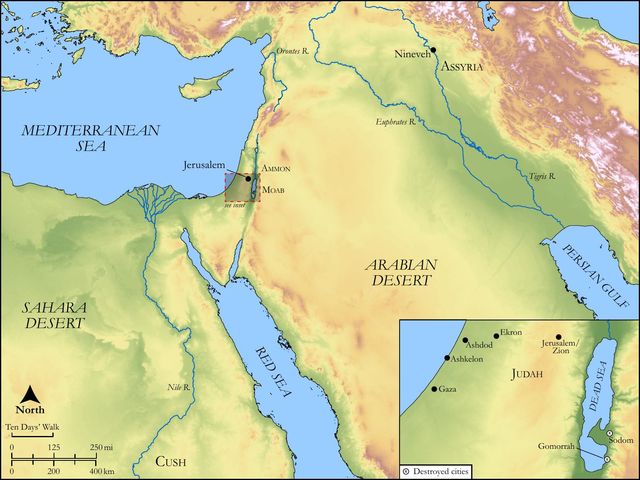
See on the biblical-era map
Study this verse
Public-domain commentary
Matthew Henry
From his Commentary on the Whole Bible. Henry comments on passages, not single verses — this entry covers Zephaniah 2:1–3. His three-level outline is real structure in the source text, so it is rendered as structure.
Here we see what the prophet meant in that terrible description of the approaching judgments which we had in the foregoing chapter. From first to last his design was, not to drive the people to despair, but to drive them to God and to their duty - not to frighten them out of their wits, but to frighten them out of their sins. In pursuance of that he here calls them to repentance, national repentance, as the only way to prevent national ruin. Observe,
I.The summons given them to a national assembly (Zep 2:1):
Gather yourselves together. He had told them, in the last words of the foregoing chapter, that God would make a speedy riddance of all that dwelt in the land, upon which, one would think, it should follow, "Disperse yourselves, and flee for shelter where you can find a place." When the decree had absolutely gone forth for the last destruction of Jerusalem by the Romans, that was the advice given (Mat 24:16), Then let those who are in Judea flee into the mountains; but here it is otherwise. God warns, that he may not wound, threatens, that he may not strike, and therefore calls to the people to use means for the turning away of his wrath. The summons is given to a nation not desired. The word signifies either,
1.Not desiring, that has not any desires towards God or the remembrance of his name, is not desirous of his favour or grace, but very indifferent to it, has no mind to repent and reform. "Yet come together, and see if you can stir up desires in one another." Thus God is often found of those that sought him not, nor asked for him, Isa 65:1. Or,
2.Not desirable, no ways lovely, nor having any thing in them amiable, or which might recommend them to God. The land of Israel had been a pleasant land, a land of delight (Dan 11:41); but now it is unlovely, it is a nation not desired, to which God might justly say, Depart from me; but he says, "Gather together to me, and let us see if any expedient can be found out for the preventing of the ruin. Gather together, that you may in a body humble yourselves before God, may fast, and pray, and seek his face. Gather together, to consult among yourselves what is to be done in this critical juncture, that every one may consider of it, may give and take advice, and speak his mind, and that what is done may be done by consent and so may be a national act." Some read it, "Enquire into yourselves, yea, enquire into yourselves; examine your consciences; look into your hearts; search and try your ways; enquire into yourselves, that you may find out the sin by which God has been provoked to this displeasure against you, and may find out the way of returning to him." Note, When God is contending with us it concerns us to enquire into ourselves.
II.Arguments urged to press them to the utmost seriousness and expedition herein (Zep 2:2):
"Do it in earnest; do it with all speed before it is too late, before the decree bring forth, before the day pass." The manner of speaking here is very lively and awakening, designed to make them apprehensive, as all sinners are concerned to be, 1. That their danger is very great, that their all lies at stake, that it is a matter of life and death, which therefore well requires and well deserves the closest application of mind that can be. It is not a trifle, and therefore is not a thing to be trifled about. It is the fierce anger of the Lord that is kindled against them, and is just ready to kindle upon them, that devouring fire which none can dwell with, which none can make head against or hold up their head under. "It is the day of the Lord's anger, the day set for the pouring out of the full vials of it, that you are threatened with, that great day of the Lord" spoken of, Zep 1:14. "Are you not concerned to prepare for that day?" 2. That it is very imminent: "Bestir yourselves now quickly, before the decree bring forth, and then it will be too late, the opportunity will be lost and never retrieved. The decree is as it were big with child, and it will bring forth the day, the terrible day, which shall pass as chaff, which shall hurry you away into captivity as chaff before the wind." We know not what a day may bring forth (Pro 27:1), but we do know what the decree will bring forth against impenitent sinners, whom therefore it highly concerns to repent in time, in the accepted time. Note, It is the wisdom of those whom God has a controversy with to agree with him quickly, while they are in the way, before his fierce anger comes upon them, not to be turned away. In a case of this nature delays are highly dangerous and may be fatal; they will be so if by them the heart is hardened. How solicitous should we all be to make our peace with God before the Spirit withdraw from us, or cease to strive with us, before the day of grace be over or the day of life, before our everlasting state shall be determined on the other side of the great gulf fixed!
III.Directions prescribed for the doing of this effectually.
It is not enough to gather together in a consternation, but they must seriously and calmly apply to the duty of the day (Zep 2:3): Seek you the Lord. That they might find mercy with God, they are here put upon seeking; for so is the rule - Seek, and you shall find. A general call was given to the whole nation to gather together, but little good is to be expected from the far greater part of them; if the land be saved, it must be by the interest and intercession of the pious few, and therefore to them the exhortation here is particularly directed. And observe,
1.How they are described - they are the meek of the earth, or of the land. It is the distinguishing character of the people of God that they are the meek ones of the earth; this is their badge; it is their livery. They are modest, and humble, and low in their own eyes; they are mild, and gentle, and yielding to others, not soon angry, not very angry, not long angry; they are the quiet in the land, Psa 35:20. And they are subject and submissive to their God, to all his precepts and all his providences. Actuated by this principle and disposition, they have wrought his judgments, that is, have obeyed his laws, observed his institutions, have made conscience of their duty to him, and have laid out themselves for the advancement of his honour and interest in the world.
2.What they are required to do; they must seek, which denotes both a careful enquiry and a constant endeavour, that they may know and do their duty.
(1.)They must seek the Lord, seek his favour and grace, address him upon all occasions, ask of him what they need, seek him early, seek him diligently, and continue seeking him.
(2.)They must seek righteousness. "Seek to God for the performance of his promises to you, and see to it that you abound yet more in duty to him; seek for the righteousness of Christ to be imputed to you, for the graces of God's Spirit to be implanted in you; hunger and thirst after them." (3.) They must seek meekness. This is a grace they were so eminent for that they were denominated the meek of the land, and yet this they must seek. Note, Those that are ever so good must still strive to be better, those that have ever so much grace must be still praying and labouring for more. Nay, those that excel in any particular grace must still seek to excel yet more in that, because in that most assaults will be made upon them by their enemies, in that most is expected from them by their friends, and in that they are most apt to be themselves secure. Si dixisti, Sufficit, periisti - Say but, I am all that I ought to be, and you are undone. In the difficult trying times approaching, the meek will find exercise for all the meekness they have, and all little enough, and therefore should seek it earnestly, and pray that when God in his providence gives them occasion for it he would by his grace enable them to exercise it, to show all meekness to all men, in all instances, that, as the day is, so may the strength be.
IV.Encouragements given to take these directions:
It may be, you shall be hid in the day of the Lord's anger. 1. "You particularly that are the meek of the earth. Though the day of the Lord's anger do come upon the land, yet you shall be safe, you shall be taken under special protection. Verily it shall be well with thy remnant, Jer 15:11. Thy life will I give unto thee for a prey, Jer 45:5. I will deliver thee in that day, Jer 39:17. It may be, you shall be hid; if any be hid, you shall." Good men cannot be sure of temporal preservation, for all things come alike to all, but they are most likely to be hid, and stand fairest for a distinguishing care of Providence. It is expressed thus doubtfully to try if they will trust the goodness of God's nature, though they have but the it may be of a promise, and to keep up in them a holy fear and watchfulness lest they should seem to come short, and should do any thing to throw themselves out of the divine protection. Note, those that hold fast their integrity, in times of common iniquity, have reason to hope that God will find out a hiding-place for them, where they shall be safe and easy, in times of common calamity. They shall be hid (as Luther says) aut in coelo, aut sub coelo - either in heaven or under heaven, either in the possession of heaven or under the protection of heaven. Or, 2. "You of this nation, though it be a nation not desired, yet, in the day of the Lord's anger with the neighbouring nations, when his judgments are abroad, you shall be hid; your land shall be preserved for the sake of those few meek ones that stand in the gap to turn away the wrath of God." It concerns us all to make it sure to ourselves that we shall be hid in the great day of God's wrath; and, if we hide ourselves in the chambers of duty, God will hide us in chambers of safety, Isa 26:20. If we prepare an ark, that shall be our hiding-place, Gen 7:1.
Historical interpretation
Historical reception
3 surviving comments on this verse. Each one is dated, so this reads as a timeline rather than a list.
Select a marker to jump to its quote. Markers stagger vertically where authors wrote within a few decades of each other.
Struggle, my beloved, for the time is near and the days have been shortened. There is no father who instructs his children, there is no child who obeys his father; good virgins are no longer; the holy fathers have died on all sides; the mothers and the widows are no longer, and we have become like orphans; the humble are crushed underfoot; and blows are showered upon the head of the poor. Therefore there is little to hold back the wrath of God from grieving us, with no one to console us. All this has befallen us because we have not practiced mortification.
(Chapter 2, verses 1, 2.) Come together, gather, o unlovable nation: before the command gives birth, like passing dust, to the day: before the wrath of the fury of the Lord comes upon you, before the anger of the indignation of the Lord comes upon you. LXX: Gather and collect, o unlearned nation: before you become like a passing flower of the day: before the wrath of the Lord comes upon you: before the day of the anger of the fury of the Lord comes upon you. After the description of the evils that are to come on the Lord's day (according to the double exposition of captivity which we mentioned above), the people are called to repentance and it is said to them: Come together and gather, or as it is written in the Septuagint, be gathered, that is, be united by the bond of love (according to the Apostle): an unlovable people, who are unworthy of God's love, or an unlearned people, of whom it is said in Deuteronomy: A foolish and senseless people (Deut. XXXII, 6). And in Jeremiah: You have struck your children without cause; you have not received discipline (Jer. II, 30), before what has been prophesied comes to pass, before the prescribed command takes effect (which will come as easily as dust blown by), before the fury of the Lord is fulfilled upon you. At the same time, behold the mercy of God: it was enough for the wise to have described the onslaught of the impending evils; but because He does not want to impose punishment, but only to frighten those who will suffer, He himself prompts them to repentance, so that He does not do what He has threatened. But in general, the entire multitude of believers, and those who are called the people of God, gathers in the Church, and it is said to them: Come together in the Church, join us with love and peace, O uninstructed people, who do not want to receive God's discipline, nor have knowledge of His commandments; but you delight in the riches and physical well-being and beauty of this world, and also in the pleasures of the flesh, which pass away like a flower that withers in a single day. Therefore I say to you, come together, unite, so that when the time of judgment comes and all your glory has passed away, you may be willing to repent, when there is no longer a place for repentance, but only for punishment. Someone may ask, how can this be understood as each person passes from the world? Therefore, it is said to each individual: O you, who are occupied with the affairs of the world, running in different directions, return to the Church of the saints and join yourself to their life and community, which you see pleases God, and gather the scattered parts of your soul, which do not cohere with each other, into the unity of wisdom, and cling to its embrace, and listen in a mystic way: Take courage, weak hands; strengthen your feeble knees (Isaiah 40:7); do not boast in the good things of the flesh and its fleeting beauty; for all flesh is like grass, and all its glory like the flower of the grass. The hay withers and the flower falls, but the word of the Lord remains forever. We can use this chapter for a time: if ever we see someone dedicated to worldly honors and amassing wealth, coming to the Church rarely or never, we can say to him, gather and join the people of God, you who do not hear the Lord's commandments, before your glory passes away, before the day of the Lord's wrath comes upon you.
One of the prophets rightly spoke of this relation to those who had fallen into negligence: “Be gathered again and tied back together, you undisciplined nation, before you become like the flower that passes away.” A disciple can also be said to “attach” himself to a teacher in terms of a love of study, and we too can attach ourselves to one another not in one fashion only but in many. In short, when someone assists another in a task, should we not consider that he has been conjoined by will to the one who receives his assistance? It seems to us that this is exactly what these innovators mean by conjunction. You must have heard how they stupidly maintain that God the Word assumed a man, as if he were a different Son to himself, and then proposed him as a kind of assistant to his designs so that he underwent the trial and death, came to life again, rose up to heaven, and even sat upon the throne of the ineffable Godhead? With arguments such as these have they not completely and utterly proven that this man is altogether different from the true and natural son?
Continue studying Zephaniah 2:1 across the web’s major study libraries — every link below opens this exact verse, chapter, or book on the destination site.
Read & Compare
 BibleGatewayThis verse in more than 200 translations and 70 languages.
 Bible.comThe YouVersion reader — hundreds of translations, reading plans, and highlights.
 ESV.orgCrossway's official English Standard Version reader.
 NET BibleThe NET translation with 60,000+ translators' notes on every rendering decision.
 STEP BibleTyndale House's free study tool — original text, vocabulary, and scholarly resources.
 BibliaLogos Bible Software's free web reader.
 USCCBThe New American Bible (Revised Edition) with the U.S. bishops' study notes.
Commentaries
 BibleHub CommentariesDozens of classic commentaries on this verse, gathered on one page.
 StudyLightMore than 100 commentary sets — the largest collection on the web.
 BibleRefPlain-English commentary on what this verse means, verse by verse.
 Enduring WordDavid Guzik's free commentary on this chapter, widely used by Bible teachers.
 Bible Study ToolsVerse commentary alongside Greek and Hebrew study aids.
Original Language & Research
- BibleHub InterlinearThe verse word by word — original language, transliteration, and English.
- BibleHub LexiconEvery word's original-language definition and Strong's entry.
 Blue Letter BibleDeep-study tools — Strong's numbers, concordance, and word studies.
 SefariaThe Hebrew text with Rashi and centuries of Jewish commentary.
Sermons, Hymns & Audio


TrulyRandomVerse is not affiliated with these sites and doesn’t control their content. They’re linked because they’re genuinely useful.
Summary
Zephaniah 2:1 issues an urgent, repeated summons from the Lord through the prophet Zephaniah to the nation of Judah, calling them to assemble and engage in deep introspection. This divine plea is directed at a people described as "not desired," highlighting their spiritual apathy and the imminent threat of God's judgment. It serves as a final, desperate invitation for corporate repentance and humility before the full outpouring of divine wrath.
Context
ShowHideLiterary Context
Zephaniah 2:1 stands as a pivotal transition within the prophet's message. Chapter 1 vividly describes the impending "Day of the Lord" as a day of wrath, distress, and desolation upon Judah for their idolatry and unfaithfulness, culminating in a declaration of universal judgment upon the earth Zephaniah 1:18. Following this dire warning, Zephaniah 2:1-3 offers a glimmer of hope and a final opportunity for repentance, specifically addressing Judah and urging them to seek the Lord before the judgment is fully executed. This call to "gather" serves as a bridge, moving from the declaration of judgment to a conditional promise of deliverance for the humble remnant.
Historical & Cultural Context
Zephaniah prophesied during the reign of King Josiah (c. 640-609 BC), a period marked by significant religious reforms aimed at purging idolatry and restoring Mosaic worship. However, despite Josiah's efforts, the spiritual state of Judah remained deeply compromised. Many people participated in the reforms outwardly but harbored unrepentant hearts, engaging in syncretism and oppression. Jerusalem, the capital, was a hub of spiritual rebellion. The call to "gather yourselves together" would have resonated with ancient Israelite practices of national assembly for repentance, fasting, and seeking divine intervention, often in times of national crisis or impending disaster, as seen in Joel 2:15-17. The phrase "nation not desired" powerfully conveys God's profound disappointment and alienation from a people who had repeatedly rejected His covenant.
Key Themes
ShowHideThis verse powerfully contributes to several overarching themes in Zephaniah. Firstly, it underscores the Urgency of Repentance, emphasizing that the window for turning back to God is rapidly closing. The repeated imperative highlights the critical nature of the moment. Secondly, it portrays the Severity of God's Judgment, indicating that the nation's persistent sin has rendered them "not desired" by God, leading to their impending desolation. This judgment is not arbitrary but a just response to their unfaithfulness. Thirdly, it subtly introduces the theme of Hope for a Remnant, as the subsequent verses in Zephaniah 2:2-3 extend an invitation for the humble and righteous to seek the Lord, suggesting that not all are beyond redemption. The prophet's message, while dire, is ultimately aimed at eliciting a salvific response.
Exposition and Analysis
ShowHideKey Word Analysis
ShowHideThis primitive root primarily means "to become sapless through drought" or "to forage for straw, stubble or wood." Figuratively, it means "to assemble." The imagery of gathering dry stubble suggests a hasty, urgent collection, perhaps before it is swept away or consumed by fire. In this context, it implies a desperate, last-minute assembly for introspection and repentance, akin to gathering what little remains before complete destruction.
While often used for foreign nations or Gentiles, here it refers to Judah. The use of this term for God's chosen people is highly significant, implying that Judah has, by its unfaithfulness, effectively alienated itself from its covenant relationship, becoming like any other "foreign nation" in God's eyes, subject to the same judgments.
This root means "to become pale" or "to pine after," implying a strong longing or desire. The negative construction "not desired" (or "without desire") suggests a nation that has lost its appeal or desirability in God's sight due not to a lack of God's love, but to its own spiritual apathy and lack of shame. It can also carry the nuance of "not blushing" or "without shame," indicating a people so hardened in sin that they no longer feel remorse, making them undesirable to God.
Verse Breakdown
ShowHide"Gather yourselves together, yea, gather together,"
This is an urgent, emphatic double imperative. The repetition underscores the critical nature and immediacy of the call. It is a summons for the nation of Judah to assemble, not for battle, but for a solemn, corporate act of introspection, humility, and seeking God's face. The underlying sense of "gathering stubble" implies a desperate, final collection before inevitable destruction.
"O nation not desired;"
This poignant address identifies the recipient of the summons. "Nation" (gôwy) here refers to Judah, emphasizing their spiritual alienation. The phrase "not desired" (or "without shame") vividly describes Judah's spiritual condition: they have become an object of divine displeasure due to their persistent sin and lack of remorse. They have rendered themselves undesirable to the God who once chose them, highlighting the gravity of their rebellion and the impending judgment.
Literary Devices
ShowHideZephaniah 2:1 employs several powerful literary devices. The most prominent is Repetition, specifically the doubling of the imperative "Gather yourselves together, yea, gather together." This emphatic repetition serves to heighten the urgency and gravity of the divine summons, ensuring the audience grasps the critical nature of the moment. It functions as a desperate plea, a final warning before the inevitable judgment. Apostrophe is also evident, as the prophet directly addresses the "O nation not desired." This direct address creates a sense of immediacy and personal accountability, bringing the divine message directly to the people. Finally, the phrase "nation not desired" functions as a profound Metaphor or Symbolism. It is not merely a statement of fact but a symbolic representation of Judah's spiritual state—a people who have, through their unfaithfulness and lack of shame, become an object of God's displeasure, alienated from their covenant relationship and ripe for judgment.
Theological and Thematic Connections
ShowHideZephaniah 2:1 powerfully articulates a fundamental theological truth: God's patience, while vast, is not infinite. His call to "gather" is a testament to His enduring desire for His people's repentance, even when they have become "not desired" due to their sin. This verse underscores the principle that divine judgment is often preceded by a clear warning and an opportunity for a change of heart. It highlights the profound consequences of spiritual apathy and unrepentance, demonstrating that a nation's moral and spiritual health directly impacts its relationship with God and its destiny. Ultimately, it reveals God as both a righteous judge who must punish sin and a compassionate Father who earnestly calls His wayward children back to Himself, even at the eleventh hour.
Reflection and Application
ShowHideZephaniah 2:1 serves as a timeless mirror for individuals and communities today. Just as ancient Judah was called to confront its spiritual apathy, we too are summoned to a profound self-examination. Are we, in our personal lives or as a collective, becoming a "nation not desired"—a people so desensitized to sin and spiritual truth that we no longer feel shame or urgency to seek God? This verse challenges us to consider whether we are truly listening to God's warnings, which are always given out of love and a desire for our restoration, not merely condemnation. It compels us to respond with humility and genuine repentance, recognizing that opportunities to turn back to God are precious and finite. The call to "gather yourselves together" can be understood as an invitation to corporate and individual spiritual revival, urging us to prioritize our relationship with God above all else, before the consequences of our indifference become irreversible.
Questions for Reflection
ShowHideFAQ
ShowHideWhat does "nation not desired" mean in Zephaniah 2:1?
ShowHideThe phrase "nation not desired" refers to Judah, indicating their spiritual state of being undesirable or unappealing to God due to their persistent sin, idolatry, and lack of repentance. The Hebrew word for "desired" (kâçaph) can also carry the nuance of "to blush" or "to be ashamed." Thus, "not desired" can also be rendered as "without shame" or "shameless." This highlights Judah's profound moral insensitivity and spiritual callousness, where they no longer felt remorse for their rebellion against God, making them an object of His displeasure and judgment. It signifies a profound breakdown in their covenant relationship with God.
Christ-Centered Fulfillment
ShowHideWhile Zephaniah 2:1 is a direct call to national repentance for ancient Judah, its ultimate fulfillment and deeper meaning are found in Christ. The "Day of the Lord" that Zephaniah prophesied finds its ultimate expression in the eschatological judgment that Christ will execute, but also in the present reality of the cross, where the righteous judgment of God against sin was poured out upon His Son. The urgent call to "gather yourselves together" foreshadows the universal call to repentance issued by John the Baptist Matthew 3:7-8 and echoed by Jesus Himself Luke 13:3. No longer is the call limited to a single "nation not desired" but extends to all humanity, who are naturally alienated from God by sin. Christ is the ultimate refuge and the only means by which humanity can become "desired" by God again, through His atoning sacrifice. Those who respond to His call to repent and believe are gathered into His church, becoming a "chosen race, a royal priesthood, a holy nation, a people for His own possession" 1 Peter 2:9-10, no longer "not desired" but deeply beloved and reconciled to God through the blood of the Lamb. The urgency of Zephaniah's warning finds its echo in the New Testament's admonition not to refuse the One who speaks from heaven Hebrews 12:25, for Christ's return will usher in the final, unalterable Day of the Lord for all who have rejected His gracious invitation. Even His rebukes to the churches in Revelation are a loving call to repent Revelation 3:19, demonstrating God's persistent desire for reconciliation through Christ.