


Judges 4:10
Bible text: King James Version (1769 Blayney text) · Public domain
Bible text: Berean Standard Bible · Public domain
Bible text: American Standard Version (1901) · Public domain
Bible text: World English Bible, Messianic edition · Public domain
Bible text: Geneva Bible (1599) · Public domain
Bible text: Young's Literal Translation · Public domain
- וַיַּזְעֵקvai·yaz·'Ekand he summonedH2199Conj-w ¦ V-Hiphil-ConsecImperf-3msVerb Hiphil Consecutive Imperfect 3rd Singular Masculineוַandיַּזְעֵקhe summoned
- בָּרָקba·RakBarakH1301N-proper-mNoun Proper Masculine
- אֶת'et<obj.>H853DirObjMParticle Object Indicator
- זְבוּלֻןze·vu·LunZebulunH2074N-proper-mNoun Proper Masculine
- וְאֶתve·'Etand <obj.>H853Conj-w ¦ DirObjMParticle Object Indicatorוְandאֶת<obj.>
- נַפְתָּלִיnaf·ta·LiNaphtaliH5321N-proper-mNoun Proper Masculine
- קֶדְשָׁהKed·shahKedesh towardsH6943N-proper ¦ SfxNoun Proper LocationקֶדְשָׁKedeshהtowards
- וַיַּעַלvai·Ya·'aland it went upH5927Conj-w ¦ V-Qal-ConsecImperf-3msVerb Qal Consecutive Imperfect 3rd Singular Masculineוַandיַּעַלit went up
- בְּרַגְלָיוbe·rag·Lavat his feetH7272Prep-b ¦ N-fdc ¦ 3msNoun Dual Feminine Constructבְּatרַגְלָיfeetוhis
- עֲשֶׂרֶת'a·Se·rettenH6235N-fscNoun Singular Feminine Construct
- אַלְפֵי'al·Feithousand<s>H505N-cpcNoun Plural common gender Construct
- אִישׁ'IshmanH376N-msNoun Singular Masculine Absolute
- וַתַּעַלva·Ta·'aland she went upH5927Conj-w ¦ V-Qal-ConsecImperf-3fsVerb Qal Consecutive Imperfect 3rd Singular Feminineוַandתַּעַלshe went up
- עִמּוֹi·Mowith himH5973Prep ¦ 3msPreposition Definiteעִמּwithוֹhim
- דְּבוֹרָהde·vo·RahDeborahH1683N-proper-fNoun Proper Feminine
English is a literal word-by-word gloss of the Hebrew, not the KJV's wording. Why?
This is the original text the KJV's translators worked from — each Hebrew word with its own literal English meaning in this verse, prepared by scholars at Tyndale House, Cambridge. The KJV translates whole sentences, not word by word, so its wording differs: one Hebrew word can become several English words, and the KJV may choose “the LORD” where the gloss reads “Yahweh”. Both are faithful — they answer different questions. For the KJV's own rendering, switch to the KJV text.
Details
See on the biblical-era maps
Study this verse
Public-domain commentary
Matthew Henry
From his Commentary on the Whole Bible. Henry comments on passages, not single verses — this entry covers Judges 4:10–16. His three-level outline is real structure in the source text, so it is rendered as structure.
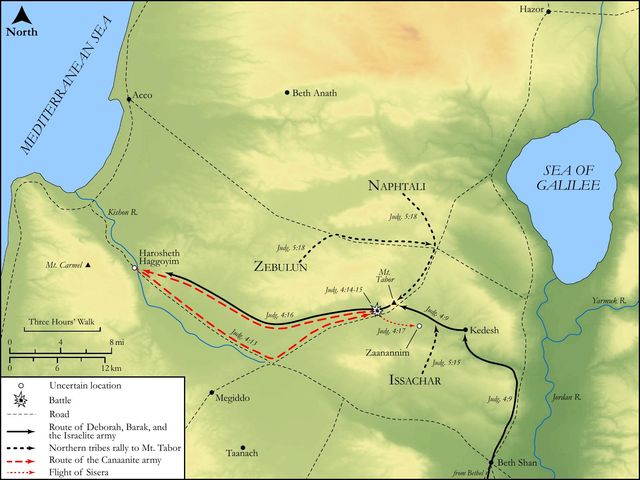
Here, I. Barak beats up for volunteers, and soon has his quota of men ready, Jdg 4:10. Deborah had appointed him to raise an army of 10,000 men (Jdg 4:6), and so many he has presently at his feet, following him, and subject to his command. God is said to call us to his feet (Isa 41:2), that is, into obedience to him. Some think it intimates that they were all footmen, and so the armies of the Jews generally were, which made the disproportion of strength between them and the enemy (who had horses and chariots) very great, and the victory the more illustrious; but the presence of God and his prophetess was abundantly sufficient to balance that disproportion. Barak had his men at his feet, which intimates their cheerfulness and readiness to attend him whithersoever he went, Rev 14:4. Though the tribes of Zebulun and Naphtali were chiefly depended on, yet it appears by Deborah's song that some had come in to him from other tribes (Manasseh and Issachar), and more were expected that came not, from Reuben, Dan, and Asher, Jdg 5:14-17. But these are overlooked here; and we are only told that to make his 10,000 men effective indeed Deborah went up with him. The Jdg 4:11, concerning the removal of Heber, one of the families of the Kenites, out of the wilderness of Judah, in the south, where those families had fixed themselves (Jdg 1:16), into the northern country, comes in for the sake of what was to follow concerning the exploit of Jael, a wife of that family.
II.Sisera, upon notice of Barak's motions, takes the field with a very numerous and powerful army (Jdg 4:12, Jdg 4:13):
They showed Sisera, that is, it was shown to him. Yet some think it refers to the Kenites, mentioned immediately before, Jdg 4:11. They gave Sisera notice of Barak's rendezvous, there being peace at this time between Jabin and that family, Jdg 4:17. Whether they intended it as a kindness to him or no, it served to accomplish what God had said by Deborah (Jdg 4:7): I will draw unto thee Sisera. Sisera's confidence was chiefly in his chariots; therefore particular notice is taken of them, 900 chariots of iron, which, with the scythes fastened to their axle-trees, when they were driven into an army of footmen, did terrible execution. So ingenious have men been in inventing methods of destroying one another, to gratify those lusts from which come wars and fightings.
III.Deborah gives orders to engage the enemy, Jdg 4:14.
Josephus says that when Barak saw Sisera's army drawn up, and attempting to surround the mountain on the top of which he and his forces lay encamped, his heart quite failed him, and he determined to retire to a place of greater safety; but Deborah animated him to make a descent upon Sisera, assuring him that this was the day marked out in the divine counsels for his defeat. "Now they appear most threatening they are ripe for ruin. The thing is as sure to be done as if it were done already: The Lord hath delivered Sisera into thy hand." See how the work and honour of this great action are divided between Deborah and Barak; she, as the head, gives the word, he, as the hand, does the work. Thus does God dispense his gifts variously, Co1 12:4, etc. But, though ordinarily the head of the woman is the man (Co1 11:3), he that has the residue of the Spirit was pleased to cross hands, and to put the head upon the woman's shoulders, choosing the weak things of the world to shame the mighty, that no flesh might glory in his presence. It was well for Barak that he had Deborah with him; for she made up what was defective,
1.In his conduct, by telling him, This is the day.
2.In his courage, by assuring him of God's presence: "Has not the Lord gone out before thee? Darest not thou follow when thou hast God himself for thy leader?" Note,
(1.)In every undertaking it is good to be satisfied that God goes before us, that we are in the way of our duty and under his direction.
(2.)If we have ground to hope that God goes before us, we ought to go on with courage and cheerfulness. Be not dismayed at the difficulties thou meetest with in resisting Satan, in serving God, or suffering for him; for has not the Lord gone out before thee? Follow him fully then.
IV.God himself routs the enemy's army, Jdg 4:15.
Barak, in obedience to Deborah's orders, went down into the valley, though there upon the plain the iron chariots would have so much the more advantage against him, quitting his fastnesses upon the mountain in dependence upon the divine power; for in vain is salvation hoped for from hills and mountains; in the Lord alone is the salvation of his people, Jer 3:23. And he was not deceived in his confidence: The Lord discomfited Sisera. It was not so much the bold and surprising alarm which Barak gave their camp that dispirited and dispersed them, but God's terror seized their spirits and put them into an unaccountable confusion. The stars, it seems, fought against them, Jdg 5:20. Josephus says that a violent storm of hail which beat in their faces gave them this rout, disabled them, and drove them back; so that they became a very easy prey to the army of Israel, and Deborah's words were made good: "The Lord has delivered them into thy hand; it is now in thy power to do what thou wilt with them."
V.Barak bravely improves his advantage, follows the blow with undaunted resolution and unwearied diligence, prosecutes the victory, pursues the scattered forces, even to their general's head-quarters at Harosheth (Jdg 4:16), and spares none whom God had delivered into his hand to be destroyed: There was not a man left. When God goes before us in our spiritual conflicts we must bestir ourselves; and, when by grace he gives us some success against the enemies of our souls, we must improve it by watchfulness and resolution, and carry on the holy war with vigour.
Continue studying Judges 4:10 across the web’s major study libraries — every link below opens this exact verse, chapter, or book on the destination site.
Read & Compare
 BibleGatewayThis verse in more than 200 translations and 70 languages.
 Bible.comThe YouVersion reader — hundreds of translations, reading plans, and highlights.
 ESV.orgCrossway's official English Standard Version reader.
 NET BibleThe NET translation with 60,000+ translators' notes on every rendering decision.
 STEP BibleTyndale House's free study tool — original text, vocabulary, and scholarly resources.
 BibliaLogos Bible Software's free web reader.
 USCCBThe New American Bible (Revised Edition) with the U.S. bishops' study notes.
Commentaries
 BibleHub CommentariesDozens of classic commentaries on this verse, gathered on one page.
 StudyLightMore than 100 commentary sets — the largest collection on the web.
 BibleRefPlain-English commentary on what this verse means, verse by verse.
 Enduring WordDavid Guzik's free commentary on this chapter, widely used by Bible teachers.
 Bible Study ToolsVerse commentary alongside Greek and Hebrew study aids.
Original Language & Research
- BibleHub InterlinearThe verse word by word — original language, transliteration, and English.
- BibleHub LexiconEvery word's original-language definition and Strong's entry.
 Blue Letter BibleDeep-study tools — Strong's numbers, concordance, and word studies.
 SefariaThe Hebrew text with Rashi and centuries of Jewish commentary.
Sermons, Hymns & Audio


TrulyRandomVerse is not affiliated with these sites and doesn’t control their content. They’re linked because they’re genuinely useful.
Summary
Judges 4:10 marks a pivotal moment in Israel's deliverance from Canaanite oppression, detailing Barak's obedient response to Deborah's divine summons. It precisely describes the mustering of ten thousand men from the tribes of Zebulun and Naphtali at Kedesh, a strategically important location, with the prophetess Deborah faithfully accompanying Barak. This verse underscores the immediate and decisive preparation for battle, highlighting the critical elements of human obedience, divine leadership, and tribal unity that were essential for the impending victory against Sisera's formidable forces.
Context
ShowHideLiterary Context
This verse immediately follows the crucial dialogue between Deborah, Israel's judge and prophetess, and Barak, the designated military commander. In Judges 4:6, Deborah, speaking with undeniable divine authority, commands Barak to gather ten thousand men from Naphtali and Zebulun and lead them to Mount Tabor to confront Sisera's army. Barak's initial hesitation, expressed in Judges 4:8, reveals his need for tangible divine assurance, which Deborah provides by agreeing to accompany him, though prophesying that the ultimate glory of Sisera's defeat would fall to a woman (Judges 4:9). Judges 4:10, therefore, depicts Barak's faithful and immediate execution of the divine command, setting the stage for the climactic battle described in the subsequent verses and the triumphal "Song of Deborah" in Judges 5. This act of gathering forces is a direct fulfillment of the Lord's word through Deborah, demonstrating the transition from divine decree to human action and preparation for war.
Historical & Cultural Context
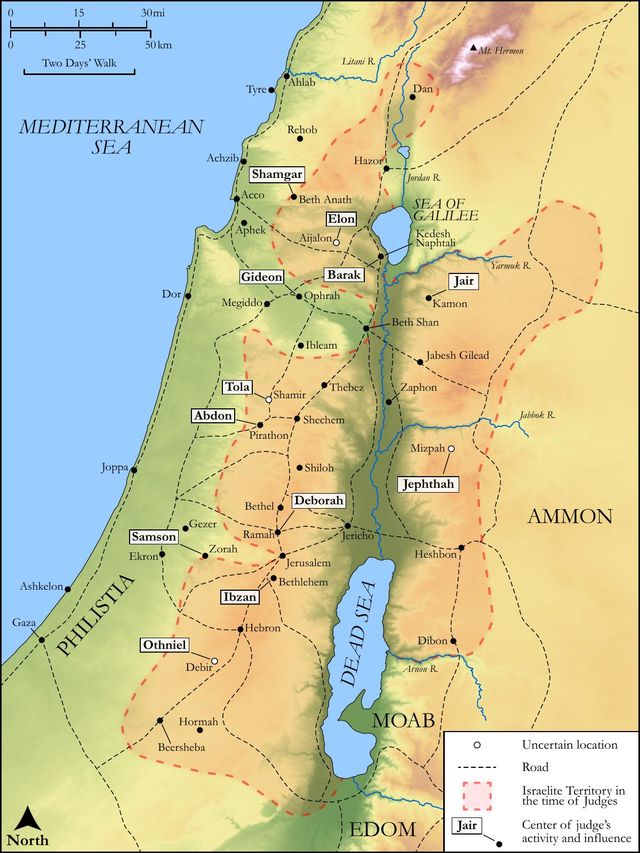
The period of the Judges was characterized by a recurring cycle of Israelite apostasy, subsequent oppression by foreign powers, and eventual divine deliverance through a divinely raised "judge." At this time, Israel was suffering under the harsh dominion of Jabin, the king of Hazor, whose military commander, Sisera, possessed a formidable army, notably including nine hundred iron chariots (Judges 4:3). This oppression was particularly severe, lasting twenty years and causing great distress. Kedesh, located in the territory of Naphtali in the northern part of Israel, was a strategic gathering point, offering a defensible position before descending into the Jezreel Valley (also known as the Esdraelon Plain), where Sisera's forces were likely arrayed. The specific mention of Zebulun and Naphtali is significant; these tribes were known for their fierce fighting spirit and their proximity to the conflict zone, and their bravery is specifically lauded in the later "Song of Deborah" (Judges 5:18). Culturally, the presence of a prophetess and judge like Deborah leading a military campaign was highly unusual, underscoring the extraordinary circumstances and God's willingness to use unconventional means to achieve His purposes, particularly when traditional male leadership faltered.
Key Themes
ShowHideJudges 4:10 contributes to several overarching themes within the book of Judges and the broader biblical narrative. Firstly, it highlights Obedience and Action in response to divine command. Despite his initial hesitation, Barak's act of calling the tribes demonstrates his ultimate submission to God's will, mediated through Deborah. His immediate mobilization is a testament to faith translated into practical action. Secondly, the verse emphasizes Divine Leadership and Presence. Deborah's accompaniment of Barak is not merely moral support but a tangible symbol of God's active involvement and endorsement of the military endeavor, bolstering the faith and courage of the Israelite forces. This resonates with the principle that the Lord fights for His people, as seen in Deuteronomy 20:4. Thirdly, it showcases Tribal Unity and Response in the face of a common enemy. The specific mention of Zebulun and Naphtali highlights the willingness of these tribes to answer the call to arms, demonstrating a crucial, albeit often lacking, unity among the fragmented tribes of Israel during this period. Finally, the strategic gathering at Kedesh underscores the theme of Divine Strategy and Human Preparation, where God's plan is executed through human agents who must still engage in practical military preparations.
Exposition and Analysis
ShowHideKey Word Analysis
ShowHideThe verb "called" (H2199, zâʻaq') signifies more than a casual invitation; it denotes a formal summons, a public announcement, or a convening. It carries the nuance of a herald proclaiming a gathering, often in response to danger or for a specific purpose. In this context, it underscores Barak's authoritative act of mustering the specified tribes for war, indicating his role as the designated military leader under Deborah's divine guidance. This "calling" is a direct and immediate response to Deborah's command, initiating the physical assembly of the army.
The verb "went up" (H5927, ʻâlâh') is a versatile term in Hebrew, frequently used to describe movement towards a higher place, whether geographically (e.g., ascending a mountain or a city on a hill) or metaphorically (e.g., going up to Jerusalem for a festival). Here, it likely refers to the ascent to Kedesh, which was situated in the hill country of Naphtali, and subsequently to Mount Tabor, a strategic elevation. This verb indicates a purposeful and decisive movement towards the designated battleground, signifying the initiation of the military campaign.
The phrase "at his feet" (H7272, regel') is an idiomatic expression in Hebrew, often signifying being under one's command, following closely, or being subject to one's authority. It does not necessarily mean literally walking behind him, but rather that the ten thousand men were fully assembled, prepared, and ready to follow Barak's lead into battle. It conveys a strong sense of immediate readiness, disciplined subordination, and unwavering loyalty, indicating a cohesive fighting force poised for action.
Verse Breakdown
ShowHide"And Barak called Zebulun and Naphtali to Kedesh;"
This initial clause details Barak's first act of obedience to Deborah's command. He summons the specific tribes of Zebulun and Naphtali, known for their martial prowess and geographical proximity to the northern threat posed by Sisera. Kedesh, located in Naphtali, serves as the designated assembly point, a strategic location for rallying forces before engaging the Canaanite army in the lowlands. This act demonstrates Barak's commitment to the divine directive and the crucial initial step in mobilizing Israel's defense.
"and he went up with ten thousand men at his feet:"
This part of the verse confirms the successful mustering of a significant fighting force. The "ten thousand men" represent the full complement commanded by Deborah, indicating a substantial and unified response from the tribes. The idiom "at his feet" emphasizes their readiness and subordination to Barak's command, signifying a disciplined and prepared army poised for action. This numerical strength, though seemingly small against Sisera's chariots, was divinely ordained and sufficient for God's purposes.
"and Deborah went up with him."
This final clause is profoundly significant, fulfilling Deborah's promise to Barak (Judges 4:9) and underscoring the divine nature of the campaign. Deborah's presence is not merely moral support but a visible manifestation of God's presence and approval. Her accompanying Barak served to bolster the morale and faith of the Israelite soldiers, assuring them that their leader was acting under direct divine authority and that God Himself was with them in battle, guaranteeing victory.
Literary Devices
ShowHideThe verse employs several literary techniques to enhance its narrative impact and theological depth. Narrative Progression is prominently evident as the verse swiftly moves the story forward from the divine command and Barak's initial hesitation to the active and obedient preparation for battle. It marks a pivotal moment where the abstract call to arms becomes a concrete assembly of forces, building anticipation for the impending conflict. The presence of Deborah "with him" is a powerful instance of Symbolism; she embodies divine presence, wisdom, and authority, signifying that this is not merely a human military endeavor but a holy war sanctioned and led by God. Her presence serves as a constant, visible reminder of God's active involvement and endorsement. Furthermore, the verse uses Conciseness to convey a great deal of crucial information—who, what, where, and with whom—in a compact and impactful manner, maintaining a brisk pace towards the inevitable confrontation. The phrase "at his feet" can also be seen as a form of Synecdoche, where a part (feet, representing movement and submission) represents the whole (the men fully under his command and ready to follow).
Theological and Thematic Connections
ShowHideJudges 4:10 powerfully illustrates the divine-human partnership in God's redemptive work. It reveals that while God initiates and empowers, He often calls His people to active participation, even when facing overwhelming odds. Barak's obedience, despite his initial fear, demonstrates that faith is often expressed through decisive action, and that courage is frequently found in the act of stepping out in reliance on God's presence. Deborah's accompaniment underscores the indispensable role of spiritual leadership and divine enablement in overcoming challenges. The unity displayed by Zebulun and Naphtali, albeit limited to these tribes, points to the importance of corporate obedience and solidarity within the community of faith for achieving God's purposes. This verse sets the stage for God to display His power, not primarily through human might alone, but through His Spirit working through willing, though imperfect, vessels who heed His call.
Reflection and Application
ShowHideJudges 4:10 offers profound and enduring lessons for contemporary believers. It challenges us to consider our own responses when God calls us to daunting tasks or uncomfortable situations, particularly those that require stepping outside our comfort zones. Like Barak, we may initially feel inadequate or fearful, but the narrative reminds us that God's unwavering presence and clear guidance, often mediated through wise counsel or spiritual leaders, are more than sufficient to empower us for any task. The unity displayed by Zebulun and Naphtali underscores the immense power of collective action and mutual support within the body of Christ. When we unite under God's leadership, laying aside individual preferences for the greater divine purpose, even seemingly insurmountable obstacles can be overcome. This verse encourages us to step out boldly in faith, trusting that God is intimately with us in our spiritual and practical battles, providing both the divine command and the necessary enablement. It reminds us that true victory comes not from our inherent strength or strategic brilliance, but from our humble obedience to His call and our unwavering reliance on His unfailing presence.
Questions for Reflection
ShowHideFAQ
ShowHideWhy were only Zebulun and Naphtali mentioned as being called by Barak?
ShowHideZebulun and Naphtali were specifically chosen due to their geographical location in the northern region, making them the most directly affected by Sisera's oppressive rule and strategically positioned for the battle near Mount Tabor. Furthermore, these tribes were renowned for their bravery and fierce willingness to engage in battle, as later celebrated in the "Song of Deborah" in Judges 5:18. Their proximity to Kedesh, the designated assembly point, also made their mobilization efficient and critical for the immediate conflict, demonstrating a localized but potent response to the divine call.
What is the significance of the phrase "ten thousand men at his feet"?
ShowHideThe phrase "at his feet" is a powerful idiomatic expression in Hebrew, meaning "under his command" or "following him closely." It signifies that the ten thousand men were not merely accompanying Barak but were fully assembled, disciplined, and ready to obey his every command. This emphasizes their complete submission to his authority as the military leader and their immediate readiness for engagement in battle, highlighting the cohesion and preparedness of the Israelite forces. It conveys a sense of disciplined readiness and unified purpose under Barak's leadership.
Why was Deborah's presence with Barak so crucial, given that Barak was the military commander?
ShowHideDeborah's presence was crucial for several profound reasons. Firstly, it was a direct fulfillment of her prophecy in Judges 4:9, which underscored the divine nature and certainty of the campaign. Secondly, and perhaps most importantly, her presence served as a tangible symbol of God's active involvement and approval, bolstering Barak's courage and the morale of the entire Israelite army. Barak had explicitly stated he would not go without her (Judges 4:8), indicating his deep reliance on divine assurance and presence. As a prophetess and judge, Deborah represented God's direct leadership, transforming a human military endeavor into a holy war, thereby assuring the Israelites of ultimate victory through divine power.
Christ-Centered Fulfillment
ShowHideJudges 4:10, though a narrative of ancient warfare and human leadership, finds its ultimate and profound fulfillment in the person and redemptive work of Jesus Christ. Barak, called to lead God's people into battle against an oppressive enemy, foreshadows Christ as the supreme Commander and Deliverer of His people. Just as Barak gathered an army to confront Sisera, Christ gathers His church, a spiritual army, to engage in spiritual warfare against the formidable forces of sin, death, and the devil (Ephesians 6:12). The reliance of Barak on Deborah's divine presence and prophetic word points to the believer's absolute dependence on Christ, who is not merely a prophetess but the very Word of God incarnate (John 1:1) and our ever-present Lord, promising to be with us always (Matthew 28:20). The decisive victory over Sisera, achieved through God's power working through human instruments, powerfully anticipates Christ's ultimate and decisive triumph on the cross, where He disarmed the spiritual rulers and authorities (Colossians 2:15) and conquered death itself, setting free those held in its bondage (Hebrews 2:14-15). Ultimately, the call to arms in Judges 4:10, for a specific battle and deliverance, finds its grander, universal echo in the Great Commission, where Christ commissions His followers to go forth, not with swords, but with the Gospel, knowing that all authority in heaven and on earth has been given to Him, empowering them for global spiritual conquest (Matthew 28:18-19).