


Matthew 19:24
Bible text: King James Version (1769 Blayney text) · Public domain
Bible text: King James Version with Strong's numbers · Public domain
Bible text: Berean Standard Bible · Public domain
Bible text: American Standard Version (1901) · Public domain
Bible text: World English Bible, Messianic edition · Public domain
Bible text: Geneva Bible (1599) · Public domain
Bible text: Young's Literal Translation · Public domain
- ΠάλινPalinAgainG3825ADVAdverb
- δὲdenowG1161CONJConjunction
- λέγωlegōI sayG3004V-PAI-1SVerb Present Active Indicative 1st Singular
- ὑμῖν·huminto youG4771P-2DPPersonal pronoun Dative 2nd Plural
- εὐκοπώτερόνeukopōteroneasier forG2123A-NSN-CAdjective Nominative Singular Neuter Comparative
- ἐστινestin[it] isG1510V-PAI-3SVerb Present Active Indicative 3rd Singular
- κάμηλονkamēlona camelG2574N-ASFNoun Accusative Singular Feminine
- διὰdiathrough [the]G1223PREPPreposition
- τρυπήματοςtrupēmatosan eyeG5169N-GSNNoun Genitive Singular Neuter
- ῥαφίδοςrhaphidosof a needleG4476N-GSFNoun Genitive Singular Feminine
- διελθεῖνdieltheinto go throughG1330V-2AANVerb 2nd Aorist Active Infinitive
- ἢēthanG2228CONJConjunction
- πλούσιονplousiona rich manG4145A-ASMAdjective Accusative Singular Masculine
- εἰσελθεῖνeiseltheinto enterG1525V-2AANVerb 2nd Aorist Active Infinitive
- εἰςeisintoG1519PREPPreposition
- τὴνtēntheG3588T-ASFDefinite article Accusative Singular Feminine
- βασιλείανbasileiankingdomG932N-ASFNoun Accusative Singular Feminine
- τοῦtou<the>G3588T-GSMDefinite article Genitive Singular Masculine
- θεοῦtheouof GodG2316N-GSM-TNoun Genitive Singular Masculine Title
English is a literal word-by-word gloss of the Greek, not the KJV's wording. Why?
This is the original text the KJV's translators worked from — each Greek word with its own literal English meaning in this verse, prepared by scholars at Tyndale House, Cambridge. The KJV translates whole sentences, not word by word, so its wording differs: one Greek word can become several English words, and the KJV may choose “charity” where the gloss reads “love”. Both are faithful — they answer different questions. For the KJV's own rendering, switch to the KJV text.
Details
See on the biblical-era maps
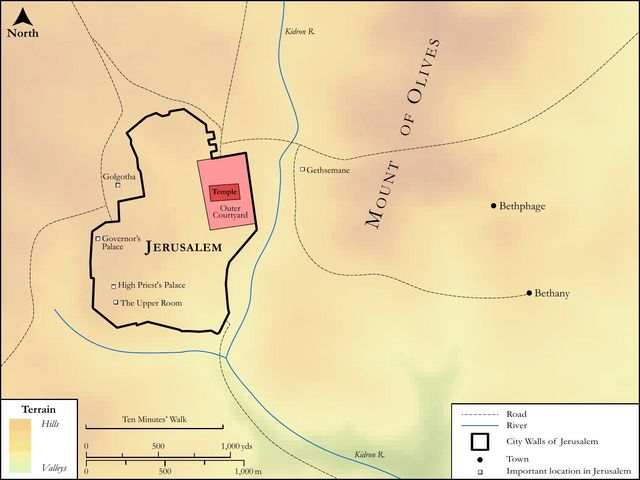
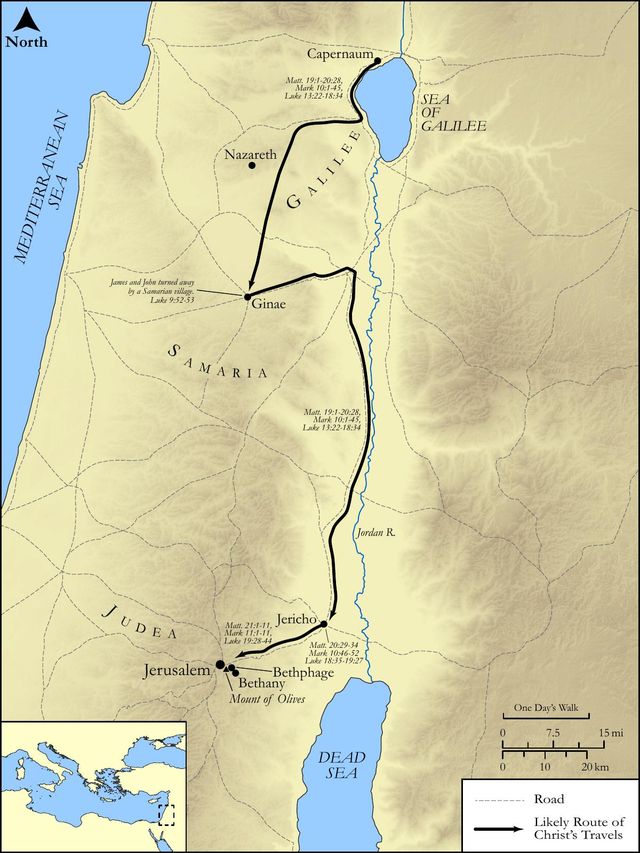
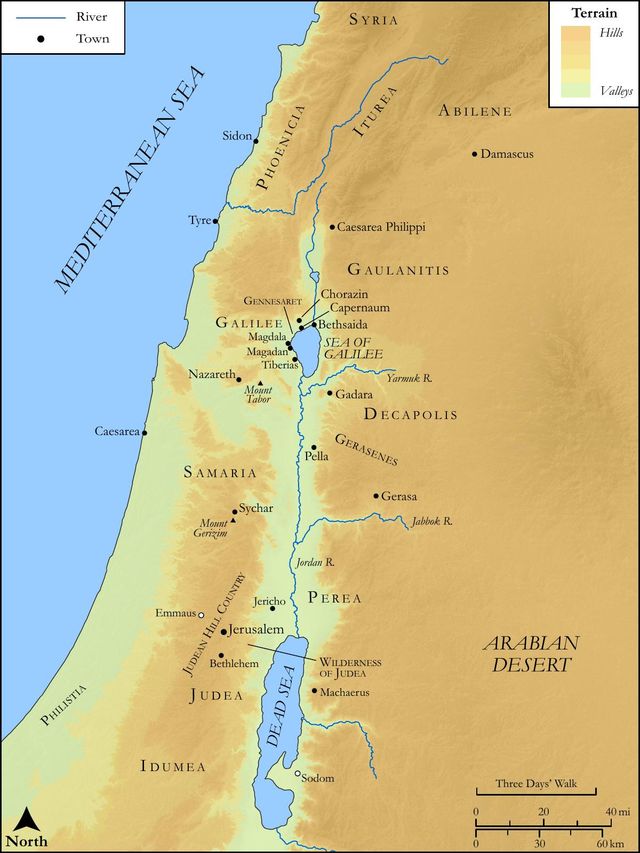
Study this verse
Historical interpretation
Nine Centuries of Reception
11 surviving comments on this verse. Each one is dated, so this reads as a timeline rather than a list.
Select a marker to jump to its quote. Markers stagger vertically where authors wrote within a few decades of each other.
The arrogant young man, when told to make good his failure to obey the law, is downcast and sad. To the people of which he is a prototype, the cross and Passion are a stumbling block. There is no salvation for this young man there. But he glories in the law, despises the Gentiles and refuses to cross into the freedom of the gospel; therefore it will be difficult for him to enter the kingdom of heaven. For few of them—and compared with the multitude of the Gentiles they are very rare—were those Jews who would believe. It was difficult for them to bend their will, long hardened under the law, to the gospel’s preaching of humility. But more easily will the camel pass through the eye of a needle. A camel cannot fit into the eye of a needle, nor can the bulk of the huge beast be received by the narrow mouth of the tiny hole. In the beginning of this book in discussing John’s clothing I pointed out that the camel signifies the Gentiles. For this beast obeys the word, is restrained by fear, is tolerant of fasting and kneels to take on its burden with a kind of ordered discipline. In this comparison the wildness of the Gentiles has been tamed by obedience to God’s commandments. These then enter the very narrow path of the heavenly kingdom, that is, the needle, which is the preaching of the gospel word. By it the wounds of the body are stitched together, the torn clothing is rewoven, and death itself is pricked. Therefore this is the route of this new preaching. Into it the weakness of the Gentiles will enter with less difficulty than the opulence of the rich man, that is, of the one taking pride in the law.
To have riches is no sin; but moderation is to be observed in our havings. For how shall we communicate to the necessities of the saints, if we have not out of what we may communicate?
It is a dangerous toil to become rich; and guiltlessness occupied in increasing its wealth has taken upon itself a sore burden; the servant of God gains not the things of the world, clear of the sins of the world. Hence is the difficulty of entering the kingdom of heaven.
But having said it was hard; as He proceeds, He shows that it is even impossible, and not merely impossible, but even in the highest degree impossible; and this He showed by the comparison concerning the camel and the needle.
"It is easier" saith He, "for a camel to enter in by the eye of a needle, than for a rich man to enter into the kingdom of Heaven." Whence it is shown, that there is no ordinary reward for them that are rich, and are able to practise self command. Wherefore also He affirmed it to be a work of God, that He might show that great grace is needed for him who is to achieve this.
What He spoke was not condemning riches in themselves, but those who were enslaved by them; also encouraging His disciples that being poor they should not be ashamed by reason of their poverty.
Having said that it was hard for a rich man to enter into the kingdom of heaven, He now proceeds to show that it is impossible, And again I say unto you, It is easier for a camel to go through the eye of a needle, than for a rich man to enter into the kingdom of heaven, (Is. 60:6.)
The disciples though poor are troubled for the salvation of others, beginning even now to have the bowels of doctors.
This therefore He proceeds to show is the work of God, there needing much grace to guide a man in the midst of riches; But Jesus beheld them, and said unto them, With men this is impossible, but with God all things are possible. By the word beheld them, the Evangelist conveys that He soothed their troubled soul by His merciful eye.
And this is not said that you should sit supinely, and let alone what may seem impossibilities; but considering the greatness of righteousness, you should strive to enter in with entreaty to God.
(Verse 24 and following) And again I say to you: It is easier for a camel to go through the eye of a needle than for a rich person to enter the kingdom of heaven. When the disciples heard this, they were greatly astonished, saying, 'Who then can be saved?' But Jesus looked at them and said, 'With man this is impossible, but with God all things are possible.' This statement shows that it is not difficult, but impossible. For if a camel cannot enter through the eye of a needle, so a rich person cannot enter the kingdom of heaven, no rich person will be saved. But if we read Isaiah, how the camels of Midian and Ephah come to Jerusalem with gifts and offerings (Isa. 60): and how those who were previously bent and distorted by the corruption of vices enter the gates of Jerusalem, we will see how even these camels, to whom the rich are compared, when they have unloaded the heavy burden of sins and the corruption of the whole body, are able to enter through the narrow gate and the narrow way that leads to life (Above 7). But when the disciples asked and were amazed at the severity of his words, he tempered the severity of his statement with his mercy, saying: What is impossible for men is possible for God.
Because riches once gained are hard to be despised, He saith not it is impossible, but it is hard. Difficulty does not imply the impossibility, but points out the infrequency of the occurrence.
According to this, no rich man can be saved. But if we read Isaiah, how the camels of Midian and Ephah came to Jerusalem with gifts and presents, and they who once were crooked and bowed down by the weight of their sins, enter the gates of Jerusalem, we shall see how these camels, to which the rich are likened when they have laid aside the heavy load of sins, and the distortion of their whole bodies, may then enter by that narrow and strait way that leads to life.
The Gentile souls are likened to the deformed body of the camel, in which is seen the humpback of idolatry; for the knowledge of God is the exaltation of the soul. The needle is the Son of God, the fine point of which is His divinity, and the thicker part what He is according to His incarnation. But it is altogether straight and without turning; and through the womb of His passion, the Gentiles have entered into life eternal. By this needle is sewn the robe of immortality; it is this needle that has sewn the flesh to the spirit, that has joined together the Jews and the Gentiles, and coupled man in friendship with angels. It is easier therefore for the Gentiles to pass through the needle's eye, than for the rich Jews to enter into the kingdom of heaven. For if the Gentiles are with such difficulty withdrawn from the irrational worship of idols, how much more hardly shall the Jews be withdrawn from the reasonable service of God?
Whence in Mark the Lord expounding the meaning of this saying, speaks thus, It is hard for them that trust in riches to enter into the kingdom of heaven (Mark 10:24.) They trust in riches, who build all their hopes on them.
This must not be so understood as though it were possible for God to cause that the rich, the covetous, the avaricious, and the proud should enter into the kingdom of heaven; but to cause him to be converted, and so enter.
(Mor. xxxv. 16.) Or, by the rich man He intends any one who is proud, by the camel he denotes the right humility. The camel passed through the needle's eye, when our Redeemer through the narrow way of suffering entered in to the taking upon Him death; for that passion was as a needle which pricked the body with pain. But the camel enters the needle's eye easier than the rich man enters the kingdom of heaven; because if He had not first shown us by His passion the form of His humility, our proud stiffness would never have bent itself to His lowliness.
But though there be a difference between having and loving riches, yet it is safer neither to have nor to love them.
(ap. Anselm.) The Lord took occasion from this rich man to hold discourse concerning the covetous; Then said Jesus unto his disciples, Verily I say unto you, &c.
(ap. Anselm.) It is explained otherwise; That at Jerusalem there was a certain gate, called, The needle's eye, through which a camel could not pass, but on its bended knees, and after its burden had been taken off; and so the rich should not be able to pass along the narrow way that leads to life, till he had put off the burden of sin, and of riches, that is, by ceasing to love them.
Continue studying Matthew 19:24 across the web’s major study libraries — every link below opens this exact verse, chapter, or book on the destination site.
Read & Compare
 BibleGatewayThis verse in more than 200 translations and 70 languages.
 Bible.comThe YouVersion reader — hundreds of translations, reading plans, and highlights.
 ESV.orgCrossway's official English Standard Version reader.
 NET BibleThe NET translation with 60,000+ translators' notes on every rendering decision.
 STEP BibleTyndale House's free study tool — original text, vocabulary, and scholarly resources.
 BibliaLogos Bible Software's free web reader.
 USCCBThe New American Bible (Revised Edition) with the U.S. bishops' study notes.
Commentaries
 BibleHub CommentariesDozens of classic commentaries on this verse, gathered on one page.
 StudyLightMore than 100 commentary sets — the largest collection on the web.
 BibleRefPlain-English commentary on what this verse means, verse by verse.
 Enduring WordDavid Guzik's free commentary on this chapter, widely used by Bible teachers.
 Bible Study ToolsVerse commentary alongside Greek and Hebrew study aids.
Original Language & Research
- BibleHub InterlinearThe verse word by word — original language, transliteration, and English.
- BibleHub LexiconEvery word's original-language definition and Strong's entry.
 Blue Letter BibleDeep-study tools — Strong's numbers, concordance, and word studies.
 CNTR CollationThe earliest Greek manuscripts of this verse, collated letter by letter.
Sermons, Hymns & Audio


TrulyRandomVerse is not affiliated with these sites and doesn’t control their content. They’re linked because they’re genuinely useful.
Summary
Jesus delivers a profoundly challenging and memorable metaphor, asserting that it is easier for a camel to pass through the eye of a needle than for a rich person to enter the kingdom of God. This striking hyperbole immediately follows the departure of a wealthy young man who was unwilling to relinquish his possessions to follow Christ, serving as a stark commentary on the spiritual perils of material wealth and the radical, humanly impossible demands of true discipleship, which can only be met through divine intervention.
Context
ShowHideLiterary Context
This verse is a direct and impactful pronouncement by Jesus, immediately following His encounter with the rich young ruler in Matthew 19:16-22. The ruler, having claimed to keep all the commandments, was challenged by Jesus to sell all his extensive possessions, give to the poor, and follow Him. His sorrowful departure, due to his great wealth, set the stage for Jesus's shocking statement. The disciples, astonished by this declaration, then ask, "Who then can be saved?" Jesus's subsequent response in Matthew 19:26—"With men this is impossible; but with God all things are possible"—provides the crucial theological counterpoint, emphasizing that salvation is ultimately a work of divine grace, not human effort or material status.
Historical & Cultural Context
In ancient Jewish society, wealth was often perceived as a sign of God's blessing and favor, a reward for righteousness. This perspective made Jesus's statement particularly counter-cultural and jarring to His disciples. They, like many of their contemporaries, likely assumed that the wealthy, being blessed by God, would have an easier path to the kingdom. Jesus's teaching directly challenged this widely held assumption, revealing that material abundance could, in fact, be a significant spiritual impediment. The imagery of a camel and a needle's eye was a common hyperbolic expression among the Jews, used to describe something utterly impossible. While some later traditions (lacking historical and archaeological support) suggested a narrow gate in Jerusalem called "the Needle's Eye," this interpretation significantly weakens the intended force of Jesus's hyperbole, which was to convey human impossibility, not mere difficulty.
Key Themes
ShowHideThe primary themes illuminated by this verse include the peril of riches, particularly when wealth becomes an object of trust or an idol that competes with devotion to God. It highlights the inherent human tendency to rely on material security rather than divine provision, as seen in the rich young ruler's inability to forsake his possessions. Furthermore, the verse underscores the radical demands of kingdom entry, which necessitate a complete reordering of priorities, a detachment from worldly comforts, and an absolute surrender to God's will. Finally, it sets the stage for the theme of divine possibility versus human impossibility, powerfully conveying that entry into God's kingdom is not achievable through human effort or merit, but is solely a work of God's grace, making salvation accessible only through divine intervention, as Jesus clarifies in Matthew 19:26.
Exposition and Analysis
ShowHideKey Word Analysis
ShowHideThis word is the comparative form of a compound meaning "better for toil" or "more facile." In this context, it emphasizes the relative ease of the camel's impossible feat compared to the rich man's entry into the kingdom. It underscores the profound difficulty, bordering on human impossibility, that wealth presents.
This refers to the large, familiar pack animal of Judaea. Its immense size, in stark contrast to the tiny opening of a sewing needle, is crucial to the hyperbole. Jesus chose the largest animal known to His audience to maximize the impact of the imagery, making the comparison as absurd and impossible as possible.
Derived from a root meaning "to sew" or "to puncture," this term specifically denotes a literal sewing needle. The "eye" (G5169, trýpēma) refers to the small hole through which thread passes. The combination of the massive camel and the minuscule needle's eye creates an image of absolute, undeniable impossibility, reinforcing the severity of Jesus's warning.
Verse Breakdown
ShowHide"And again I say unto you"
This introductory phrase (using G1161 dé and G3825 pálin) signals a renewed emphasis and a weighty pronouncement from Jesus, drawing the disciples' attention to a profound truth that builds upon the preceding interaction with the rich young ruler. It indicates that this teaching is not merely an aside but a central point of instruction.
"It is easier for a camel to go through the eye of a needle"
This is the core of Jesus's hyperbolic statement. The comparison of the largest known animal attempting to pass through the smallest of apertures creates a vivid, almost comical, image of utter impossibility. The term "easier" (G2123, eukopṓteros) here serves to highlight the extreme difficulty of the second part of the comparison by framing the first part, though impossible, as comparatively less difficult.
"than for a rich man to enter into the kingdom of God"
This clause reveals the shocking truth Jesus intends to convey. "Rich man" (G4145, ploúsios) refers to one who possesses significant material wealth. "Enter into" (G1525, eisérchomai and G1519, eis) signifies gaining access to or becoming a part of. The "kingdom of God" (G932, basileía and G2316, theós) refers to God's sovereign reign, both present (spiritual rule in the hearts of believers) and future (the consummated eschatological kingdom). Jesus declares that the rich man's entry into this divine reign is even more challenging, humanly speaking, than the absurd image of the camel and needle.
Literary Devices
ShowHideThe most prominent literary device in Matthew 19:24 is Hyperbole. Jesus uses intentional and extreme exaggeration—the image of a camel passing through the eye of a sewing needle—to emphasize the profound difficulty, indeed the human impossibility, for a rich person to enter the kingdom of God. This vivid imagery is not meant to be taken literally as a physical possibility, but rather to shock the audience and underscore the radical nature of kingdom requirements. The absurdity of the image serves to highlight the spiritual truth that human effort, especially when entangled with the love of wealth, is utterly insufficient for salvation. The device also employs Contrast, juxtaposing the immense size of the camel with the minuscule opening of the needle, and by extension, the perceived power and security of wealth with the humble, dependent nature required for kingdom entry.
Theological and Thematic Connections
ShowHideMatthew 19:24 profoundly challenges conventional human wisdom regarding wealth and salvation, asserting that material riches, far from being a guarantee of divine favor, can become a formidable spiritual obstacle. This verse underscores a fundamental theological truth: entry into God's kingdom is not based on human merit, status, or accumulation of possessions, but on radical surrender and divine grace. It exposes the idolatrous potential of wealth, where trust in riches supplants trust in God, and self-sufficiency replaces humble dependence. Jesus's statement serves as a stark reminder that the kingdom of God demands an unreserved commitment and a willingness to forsake all that hinders one's pursuit of Christ, revealing that true spiritual poverty, not material wealth, is the posture required for receiving God's unmerited favor.
Reflection and Application
ShowHideJesus's teaching in Matthew 19:24 remains profoundly relevant for believers today, prompting a critical examination of our relationship with material possessions and our ultimate allegiances. It challenges us to consider whether our financial security, career aspirations, or material comforts have subtly, or overtly, become idols that compete with our devotion to Christ. The verse does not condemn wealth itself, but rather the love of money and the trust placed in it, which can blind us to our spiritual need and hinder our full surrender to God. True discipleship calls for a radical detachment from the world's allurements, a willingness to prioritize the eternal over the temporary, and a deep recognition that our ultimate security and satisfaction are found only in God. This passage invites us to cultivate a spirit of generosity, stewardship, and humble dependence, recognizing that everything we possess is ultimately a gift from God to be used for His glory and the advancement of His kingdom.
Questions for Reflection
ShowHideFAQ
ShowHideDoes Jesus condemn all wealthy people or wealth itself in this verse?
ShowHideNo, Jesus does not condemn all wealthy people or wealth itself. The thrust of His teaching in Matthew 19:24 is against the love of money and the trust placed in riches, which can become an idol and an impediment to spiritual surrender. The rich young ruler, in the preceding verses, was unwilling to part with his possessions because his wealth held his heart. The issue is not the possession of wealth, but the spiritual posture towards it—whether one's heart is enslaved by it or free to follow Christ unreservedly. The Bible contains examples of wealthy individuals who were faithful followers of God, such as Abraham, Job, and Lydia (see Acts 16:14-15). The warning is against the spiritual danger that wealth often presents, making it "easier" for those who are poor in spirit to recognize their need for God.
Is there historical evidence for a narrow gate in Jerusalem called "the Needle's Eye" that camels would struggle to pass through?
ShowHideWhile this theory has been popular in some circles, there is no credible historical or archaeological evidence to support the existence of a gate in Jerusalem, or anywhere else, known as "the Needle's Eye" through which camels would pass with difficulty. This interpretation attempts to soften the radical nature of Jesus's statement by suggesting it's merely difficult, not impossible. However, the consistent use of "camel through the eye of a needle" in the proverbial language of the Jews was a well-understood hyperbole for something utterly impossible. Jesus's point was precisely to emphasize the human impossibility of salvation for those who cling to their wealth, thereby highlighting the absolute necessity of God's miraculous intervention, as He clarifies in Matthew 19:26.
Christ-Centered Fulfillment
ShowHideThe seemingly impossible scenario presented in Matthew 19:24—a camel passing through the eye of a needle—finds its profound fulfillment and resolution in the person and work of Jesus Christ. What is impossible for humanity, especially for those entangled by the deceptive allure of wealth, becomes gloriously possible through Him. Jesus Himself, though "He was rich, yet for your sakes He became poor, that you through His poverty might be rich." He perfectly exemplified the radical detachment from worldly status and possessions, humbling Himself to the point of death on a cross (see Philippians 2:5-8). His sacrifice on Calvary opened the way for all, rich or poor, to enter the kingdom of God, not through their own merit or ability to divest themselves of possessions, but solely through faith in His finished work. The "kingdom of God" is entered not by human striving but by God's grace, made available through Christ's perfect obedience and atoning death, offering salvation as a free gift to all who believe, as Ephesians 2:8-9 declares. Thus, the impossibility for the rich man is overcome by the all-sufficiency of Christ, who makes the impossible possible for all who trust in Him.