


Matthew 12:30
Bible text: King James Version (1769 Blayney text) · Public domain
Bible text: Berean Standard Bible · Public domain
Bible text: American Standard Version (1901) · Public domain
Bible text: World English Bible, Messianic edition · Public domain
Bible text: Geneva Bible (1599) · Public domain
Bible text: Young's Literal Translation · Public domain
- ὉHoThe [one]G3588T-NSMDefinite article Nominative Singular Masculine
- μὴmēnotG3361PRT-NNegative Particle Negative
- ὢνōnbeingG1510V-PAP-NSMVerb Present Active Participle Nominative Singular Masculine
- μετ᾽met᾽withG3326PREPPreposition
- ἐμοῦemouMeG1473S-1SGSNPossessive pronoun Genitive 1st Person Singular Neuter
- κατ᾽kat᾽againstG2596PREPPreposition
- ἐμοῦemouMeG1473S-1SGSNPossessive pronoun Genitive 1st Person Singular Neuter
- ἐστινestinisG1510V-PAI-3SVerb Present Active Indicative 3rd Singular
- καὶkaiandG2532CONJConjunction
- ὁhothe [one]G3588T-NSMDefinite article Nominative Singular Masculine
- μὴmēnotG3361PRT-NNegative Particle Negative
- συνάγωνsunagōngatheringG4863V-PAP-NSMVerb Present Active Participle Nominative Singular Masculine
- μετ᾽met᾽withG3326PREPPreposition
- ἐμοῦemouMeG1473S-1SGSNPossessive pronoun Genitive 1st Person Singular Neuter
- σκορπίζειskorpizeiscattersG4650V-PAI-3SVerb Present Active Indicative 3rd Singular
English is a literal word-by-word gloss of the Greek, not the KJV's wording. Why?
This is the original text the KJV's translators worked from — each Greek word with its own literal English meaning in this verse, prepared by scholars at Tyndale House, Cambridge. The KJV translates whole sentences, not word by word, so its wording differs: one Greek word can become several English words, and the KJV may choose “charity” where the gloss reads “love”. Both are faithful — they answer different questions. For the KJV's own rendering, switch to the KJV text.
Details
See on the biblical-era maps
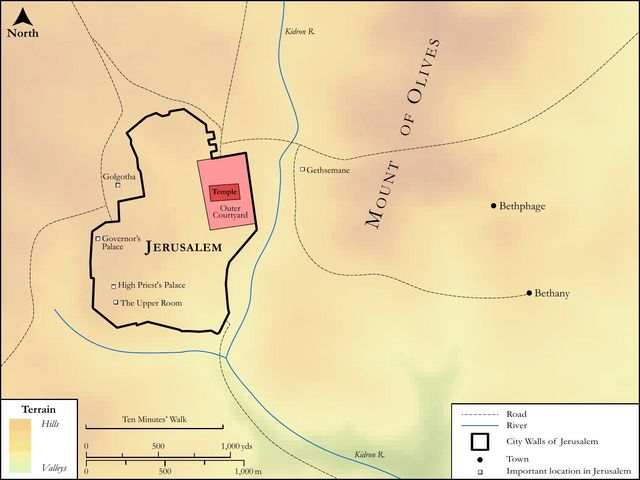
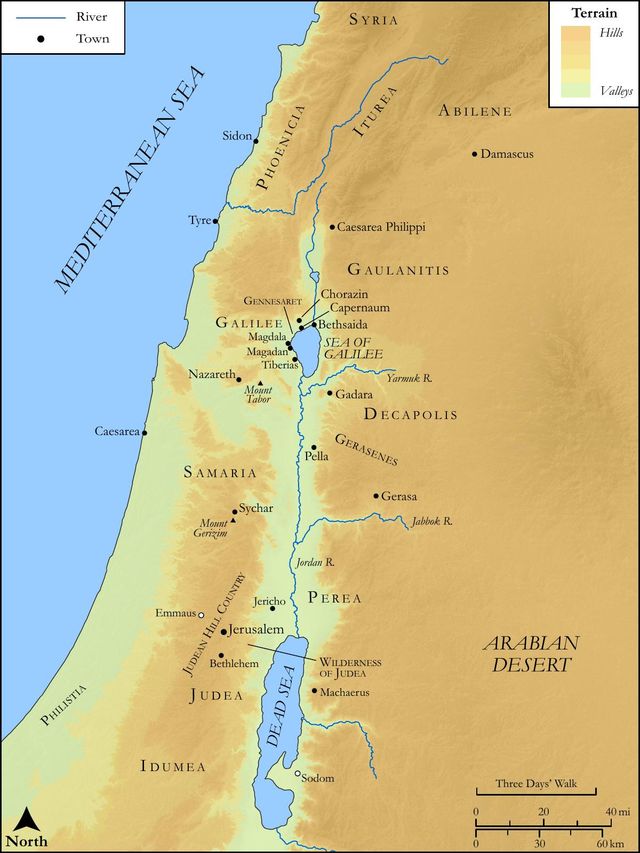
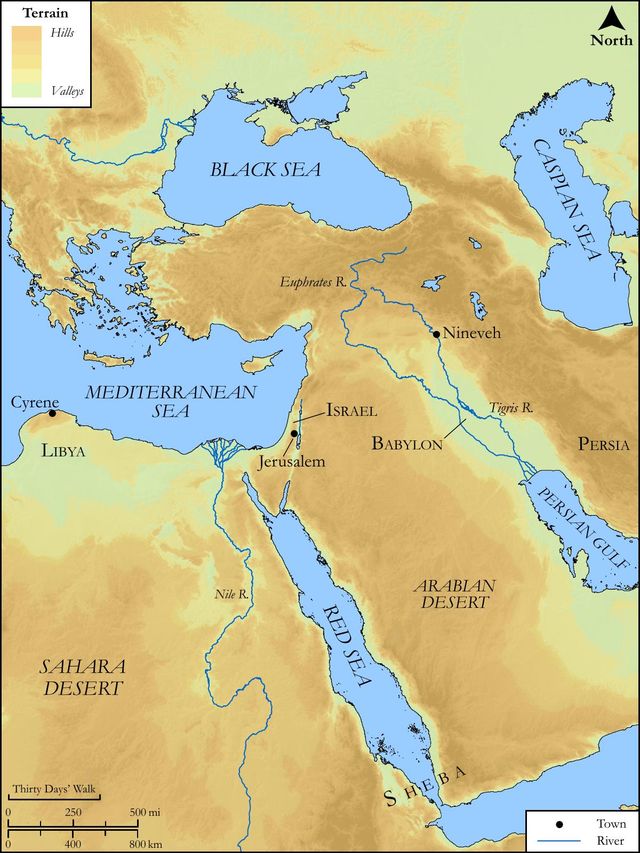
Study this verse
Public-domain commentary
Matthew Henry
From his Commentary on the Whole Bible. Henry comments on passages, not single verses — this entry covers Matthew 12:22–37. His four-level outline is real structure in the source text, so it is rendered as structure.
In these verses we have,
I.Christ's glorious conquest of Satan, in the gracious cure of one who, by the divine permission, was under his power, and in his possession, Mat 12:22. Here observe,
1.The man's case was very sad; he was possessed with a devil. More cases of this kind occurred in Christ's time than usual, that Christ's power might be the more magnified, and his purpose the more manifested, in opposing and dispossessing Satan; and that it might the more evidently appear, that he came to destroy the works of the devil. This poor man that was possessed was blind and dumb; a miserable case! he could neither see to help himself, nor speak to others to help him. A soul under Satan's power, and led captive by him, is blind in the things of God, and dumb at the throne of grace; sees nothing, and says nothing to the purpose. Satan blinds the eye of faith, and seals up the lips of prayer.
2.His cure was very strange, and the more so, because sudden; he healed him. Note, The conquering and dispossessing of Satan is the healing of souls. And the cause being removed, immediately the effect ceased; the blind and dumb both spake and saw. Note, Christ's mercy is directly opposite to Satan's malice; his favours, to the devil's mischiefs. When Satan's power is broken in the soul, the eyes are opened to see God's glory, and the lips opened to speak his praise.
II.The conviction which this gave to the people to all the people:
they were amazed. Christ had wrought divers miracles of this kind before; but his works are not the less wonderful, nor the less to be wondered at, for their being often repeated. They inferred from it, "Is not this the Son of David? The Messiah promised, that was to spring from the loins of David? Is not this he that should come?" We may take this, 1. As an enquiring question; they asked, Is not this the Son of David? But they did not stay for an answer: the impressions were cogent, but they were transient. It was a good question that they started; but, it should seem, it was soon lost, and was not prosecuted. Such convictions as these should be brought to a head, and then they are likely to be brought to the heart. Or, 2. as an affirming question; Is not this the Son of David? "Yes, certainly it is, it can be no other; such miracles as these plainly evince that the kingdom of the Messiah is now setting up." And they were the people, the vulgar sort of the spectators, that drew this inference from Christ's miracles. Atheists will say, "That was because they were less prying than the Pharisees;" no, the matter of fact was obvious, and required not much search: but it was because they were less prejudiced and biassed by worldly interest. So plain and easy was the way made to this great truth of Christ being the Messiah and Saviour of the world, that the common people could not miss it; the wayfaring men, though fools, could not err therein. See Isa 35:8. It was found of them that sought it. It is an instance of the condescensions of divine grace, that the things that were hid from the wise and prudent were revealed unto babes. The world by wisdom knew not God, and by the foolish things the wise were confounded.
III.The blasphemous cavil of the Pharisees, v.
24. The Pharisees were a sort of men that pretended to more knowledge in, and zeal for, the divine law, than other people; yet they were the most inveterate enemies to Christ and his doctrine. They were proud of the reputation they had among the people; that fed their pride, supported their power, and filled their purses; and when they heard the people say, Is not this the Son of David? they were extremely irritated, more at that than at the miracle itself; this made them jealous of our Lord Jesus, and apprehensive, that as his interest in the people's esteem increased, theirs must of course be eclipsed and diminished; therefore they envied him, as Saul did his father David, because of what the women sang of him, Sa1 18:7, Sa1 18:8. Note, Those who bind up their happiness in the praise and applause of men, expose themselves to a perpetual uneasiness upon every favourable word that they hear said of any other. The shadow of honour followed Christ, who fled from it, and fled from the Pharisees, who were eager in the pursuit of it. They said, "This fellow does not cast out devils, but by Beelzebub the prince of the devils, and therefore is not the Son of David." Observe,
1.How scornfully they speak of Christ, this fellow; as if that precious name of his, which is as ointment poured forth, were not worthy to be taken into their lips. It is an instance of their pride and superciliousness, and their diabolical envy, that the more people magnified Christ, the more industrious they were to vilify him. It is a bad thing to speak of good men with disdain because they are poor.
2.How blasphemously they speak of his miracles; they could not deny the matter of fact; it was as plain as the sun, that devils were cast out by the word of Christ; nor could they deny that it was an extraordinary thing, and supernatural. Being thus forced to grant the premises, they had no other way to avoid the conclusion, that this is the Son of David, than by suggesting that Christ cast out devils by Beelzebub; that there was a compact between Christ and the devil; pursuant to that, the devil was not cast out, but did voluntarily retire, and give back by consent and with design: or as if, by an agreement with the ruling devil, he had power to cast out the inferior devils. No surmise could be more palpably false and vile than this; that he, who is Truth itself, should be in combination with the father of lies, to cheat the world. This was the last refuge, or subterfuge rather, or an obstinate infidelity, that was resolved to stand it out against the clearest conviction. Observe, Among the devils there is a prince, the ringleader of the apostasy from God and rebellion against him; but this prince is Beelzebub - the god of a fly, or a dunghill god. How art thou fallen, O Lucifer! from an anger of light, to be a lord of flies! Yet this is the prince of the devils too, the chief of the gang of infernal spirits.
IV.Christ's reply to this base insinuation, Mat 12:25-30.
Jesus knew their thoughts. Note, Jesus Christ knows what we are thinking at any time, knows what is in man; he understands our thoughts afar off. It should seem that the Pharisees could not for shame speak it out, but kept it in their minds; they could not expect to satisfy the people with it; they therefore reserved it for the silencing of the convictions of their own consciences. Note, Many are kept off from their duty by that which they are ashamed to own, but which they cannot hide from Jesus Christ: yet it is probable that the Pharisees had whispered what they thought among themselves, to help to harden one another; but Christ's reply is said to be to their thoughts, because he knew with what mind, and from what principle, they said it; that they did not say it in their haste, but that it was the product of a rooted malignity.
Christ's reply to this imputation is copious and cogent, that every mouth may be stopped with sense and reason, before it be stopped with fire and brimstone. Here are three arguments by which he demonstrates the unreasonableness of this suggestion.
1.It would be very strange, and highly improbably, that Satan should be cast out by such a compact, because then Satan's kingdom would be divided against itself; which, considering his subtlety, is not a thing to be imagined, Mat 12:25, Mat 12:26.
(1.)Here is a known rule laid down, that in all societies a common ruin is the consequence of mutual quarrels: Every kingdom divided against itself is brought to desolation; and every family too: Quae enim domus tam stabilis est, quae tam firma civitas, quae non odiis atque dissidiis funditus everti possit? - For what family is so strong, what community so firm, as not to be overturned by enmity and dissension? Cic. Lael. 7. Divisions commonly end in desolations; if we clash, we break; if we divide one from another, we become an easy prey to a common enemy; much more if we bite and devour one another, shall we be consumed one of another, Gal 5:15. Churches and nations have known this by sad experience.
(2.)The application of it to the case in hand (Mat 12:26), If Satan cast out Satan; if the prince of the devils should be at variance with the inferior devils, the whole kingdom and interest would soon be broken; nay, if Satan should come into a compact with Christ, it must be to his own ruin; for the manifest design and tendency of Christ's preaching and miracles was to overthrow the kingdom of Satan, as a kingdom of darkness, wickedness, and enmity to God; and to set up, upon the ruins of it, a kingdom of light, holiness, and love. The works of the devil, as a rebel against God, and a tyrant over the souls of men, were destroyed by Christ; and therefore it was the most absurd thing imaginable, to think that Beelzebub should at all countenance such a design, or come into it: if he should fall in with Christ, how should then his kingdom stand? He would himself contribute to the overthrow of it. Note, The devil has a kingdom, a common interest, in opposition to God and Christ, which, to the utmost of his power, he will make to stand, and he will never come into Christ's interests; he must be conquered and broken by Christ, and therefore cannot submit and bend to him. What concord or communion can there be between light and darkness, Christ and Belial, Christ and Beelzebub? Christ will destroy the devil's kingdom, but he needs not do it by any such little arts and projects as that of a secret compact with Beelzebub; no, this victory must be obtained by nobler methods. Let the prince of the devils muster up all his forces, let him make use of all his powers and politics, and keep his interests in the closest confederacy, yet Christ will be too hard for his united force, and his kingdom shall not stand.
2.It was not at all strange, or improbable, that devils should be cast out by the Spirit of God; for,
(1.)How otherwise do your children cast them out? There were those among the Jews who, by invocation of the name of the most high God, or the God of Abraham, Isaac, and Jacob, did sometimes cast out devils. Josephus speaks of some in his time that did it; we read of Jewish exorcists (Act 19:13), and of some that in Christ's name cast out devils, though they did not follow him (Mar 9:38), or were not faithful to him, Mat 7:22. These the Pharisees condemned not, but imputed what they did to the Spirit of God, and valued themselves and their nation upon it. It was therefore merely from spite and envy to Christ, that they would own that others cast out devils by the Spirit of God, but suggest that he did it by compact with Beelzebub. Note, It is the way of malicious people, especially the malicious persecutors of Christ and Christianity, to condemn the same thing in those they hate, which they approve of and applaud in those they have a kindness for: the judgments of envy are made, not by things, but persons; not by reason, but prejudice. But those were very unfit to sit in Moses's seat, who knew faces, and knew nothing else in judgment: Therefore they shall be your judges; "This contradicting of yourselves will rise up in judgment against you at the last great day, and will condemn you." Note, In the last judgment, not only every sin, but every aggravation of it, will be brought into the account, and some of our notions that were right and good will be brought in evidence against us, to convict us of partiality.
(2.)This casting out of devils was a certain token and indication of the approach and appearance of the kingdom of God (Mat 7:28); "But if it be indeed that I cast out devils by the Spirit of God, as certainly I do, then you must conclude, that though you are unwilling to receive it, yet the kingdom of the Messiah is now about to be set up among you." Other miracles that Christ wrought proved him sent of God, but this proved him sent of God to destroy the devil's kingdom and his works. Now that great promise was evidently fulfilled, that the seed of the woman should break the serpent's head, Gen 3:15. "Therefore that glorious dispensation of the kingdom of God, which has been long expected, is now commenced; slight it at your peril." Note,
[1.]The destruction of the devil's power is wrought by the Spirit of God; that Spirit who works to the obedience of faith, overthrows the interest of that spirit who works in the children of unbelief and disobedience.
[2.]The casting out of devils is a certain introduction to the kingdom of God. If the devil's interest in a soul be not only checked by custom or external restraints, but sunk and broken by the Spirit of God, as a Sanctifier, no doubt but the kingdom of God is come to that soul, the kingdom of grace, a blessed earnest of the kingdom of the glory.
3.The comparing of Christ's miracles, particularly this of casting out devils, with his doctrine, and the design and tendency of his holy religion, evidenced that he was so far from being in league with Satan, that he was at open enmity and hostility against him (Mat 12:29); How can one enter into a strong man's house, and plunder his goods, and carry them away, except he first bind the strong man? And then he may do what he pleases with his goods. The world, that sat in darkness, and lay in wickedness, was in Satan's possession, and under his power, as a house in the possession and under the power of a strong man; so is every unregenerate soul; there Satan resides, there he rules. Now,
(1.)The design of Christ's gospel was to spoil the devil's house, which, as a strong man, he kept in the world; to turn the people from darkness to light, from sin to holiness, from this world to a better, from the power of Satan unto God (Act 26:18); to alter the property of souls.
(2.)Pursuant to this design, he bound the strong man, when he cast out unclean spirits by his word: thus he wrested the sword out of the devil's hand, that he might wrest the sceptre out of it. The doctrine of Christ teaches us how to construe his miracles, and when he showed how easily and effectually he could cast the devil out of people's bodies, he encouraged all believers to hope that, whatever power Satan might usurp and exercise in the souls of men, Christ by his grace would break it: he will spoil him, for it appears that he can bind him. When nations were turned from the service of idols to serve the living God, when some of the worst of sinners were sanctified and justified, and became the best of saints, then Christ spoiled the devil's house, and will spoil it more and more.
4.It is here intimated, that this holy war, which Christ was carrying on with vigour against the devil and his kingdom, was such as would not admit of a neutrality (Mat 12:30), He that is not with me is against me. In the little differences that may arise between the disciples of Christ among themselves, we are taught to lessen the matters in variance, and to seek peace, by accounting those who are not against us, to be with us (Luk 9:50); but in the great quarrel between Christ and the devil, no peace is to be sought, nor any such favourable construction to be made of any indifference in the matter; he that is not hearty for Christ, will be reckoned with as really against him: he that is cold in the cause, is looked upon as an enemy. When the dispute is between God and Baal, there is no halting between two (Kg1 18:21), there is no trimming between Christ and Belial; for the kingdom of Christ, as it is eternally opposite to, so it will be eternally victorious over, the devil's kingdom; and therefore in this cause there is no sitting still with Gilead beyond Jordan, or Asher on the sea-shore, (Jdg 4:16, Jdg 4:17), we must be entirely, faithfully, and immovably, on Christ's side; it is the right side, and will at last be the rising side. See Exo 32:26.
The latter clause is to the same purport: He that gathereth not with me scattereth. Note, (1.) Christ's errand into the world was to gather, to gather in his harvest, to gather in those whom the Father had given him, Joh 11:52; Eph 1:10. (2.) Christ expects and requires from those who are with him, that they gather with him; that they not only gather to him themselves, but do all they can in their places to gather others to him, and so to strengthen his interest. (3.) Those who will not appear, and act, as furtherers of Christ's kingdom, will be looked upon, and dealt with, as hinderers of it; if we gather not with Christ, we scatter; it is not enough, not to do hurt, but we must do good. Thus is the breach widened between Christ and Satan, to show that there was no such compact between them as the Pharisees whispered.
V.Here is a discourse of Christ's upon this occasion, concerning tongue-sins; Wherefore I say unto you.
He seems to turn from the Pharisees to the people, from disputing to instructing; and from the sin of the Pharisees he warns the people concerning three sorts of tongue-sins; for others' harms are admonitions to us.
1.Blasphemous words against the Holy Ghost are the worst kind of tongue-sins, and unpardonable, Mat 12:31, Mat 12:32.
(1.)Here is a gracious assurance of the pardon of all sin upon gospel terms: this Christ says to us, and it is a comfortable saying, that the greatness of sin shall be no bar to our acceptance with God, if we truly repent and believe the gospel: All manner of sin and blasphemy shall be forgiven unto men. Though the sin has been as scarlet and crimson (Isa 1:18), though ever so heinous in its nature, ever so much aggravated by its circumstances, and ever so often repeated, though it reach up to the heavens, yet with the Lord there is mercy, that reacheth beyond the heavens; mercy will be extended even to blasphemy, a sin immediately touching God's name and honour. Paul obtained mercy, who had been a blasphemer, Ti1 1:13. Well may we say, Who is a God like unto thee, pardoning iniquity? Mic 7:18. Even words spoken against the Son of man shall be forgiven; as theirs were who reviled him at his death, many of whom repented and found mercy. Christ herein has set an example to all the sons of men, to be ready to forgive words spoken against them: I, as a deaf man, heard not. Observe, They shall be forgiven unto men, not to devils; this is love to the whole world of mankind, above the world of fallen angels, that all sin is pardonable to them.
(2.)Here is an exception of the blasphemy against the Holy Ghost, which is here declared to be the only unpardonable sin. See here,
[1.]What this sin; it is speaking against the Holy Ghost. See what malignity there is in tongue-sins, when the only unpardonable sin is so. But Jesus knew their thoughts, Mat 12:25. It is not all speaking against the person or essence of the Holy Ghost, or some of his more private operations, or merely the resisting of his internal working in the sinner himself, that is here meant; for who then should be saved? It is adjudged in our law, that an act of indemnity shall always be construed in favour of that grace and clemency which is the intention of the act; and therefore the exceptions in the act are not to be extended further than needs must. The gospel is an act of indemnity; none are excepted by name, nor any by description, but those only that blaspheme the Holy Ghost; which therefore must be construed in the narrowest sense: all presuming sinners are effectually cut off by the conditions of the indemnity, faith and repentance; and therefore the other exceptions must not be stretched far: and this blasphemy is excepted, not for any defect of mercy in God or merit in Christ, but because it inevitably leaves the sinner in infidelity and impenitency. We have reason to think that none are guilty of this sin, who believe that Christ is the Son of God, and sincerely desire to have part in his merit and mercy: and those who fear they have committed this sin, give a good sign that they have not. The learned Dr. Whitby very well observes, that Christ speaks not of what should be (Mar 3:28; Luk 12:10); Whosoever shall blaspheme. As for those who blasphemed Christ when he was here upon earth, and called him a Winebibber, a Deceiver, a Blasphemer, and the like, they had some colour of excuse, because of the meanness of his appearance, and the prejudices of the nation against him; and the proof of his divine mission was not perfected till after his ascension; and therefore, upon their repentance, they shall be pardoned: and it is hoped that they may be convinced by the pouring out of the Spirit, as many of them were, who had been his betrayers and murderers. But if, when the Holy Ghost is given, in his inward gifts of revelation, speaking with tongues, and the like, such as were the distributions of the Spirit among the apostles, if they continue to blaspheme the Spirit likewise, as an evil spirit, there is no hope of them that they will ever be brought to believe in Christ; for First, Those gifts of the Holy Ghost in the apostles were the last proof that God designed to make use of for the confirming of the gospel, and were still kept in reserve, when other methods preceded. Secondly, This was the most powerful evidence, and more apt to convince than miracles themselves. Thirdly, Those therefore who blaspheme this dispensation of the Spirit, cannot possibly be brought to believe in Christ; those who shall impute them to a collusion with Satan, as the Pharisees did the miracles, what can convince them? This is such a strong hold of infidelity as a man can never be beaten out of, and is therefore unpardonable, because hereby repentance is hid from the sinner's eyes.
[2.]What the sentence is that is passed upon it; It shall not be forgiven, neither in this world, nor in the world to come. As in the then present state of the Jewish church, there was no sacrifice of expiation for the soul that sinned presumptuously; so neither under the dispensation of gospel grace, which is often in scripture called the world to come, shall there be any pardon to such as tread underfoot the blood of the covenant, and do despite to the Spirit of grace: there is no cure for a sin so directly against the remedy. It was a rule in our old law, No sanctuary for sacrilege. Or, It shall be forgiven neither now, in the sinner's own conscience, nor in the great day, when the pardon shall be published. Or, this is a sin that exposes the sinner both to temporal and eternal punishment, both to present wrath and the wrath to come.
2.Christ speaks here concerning other wicked words, the products of corruption reigning in the heart, and breaking out thence, Mat 12:33-35. It was said (Mat 12:25) that Jesus knew their thoughts, and here he spoke with an eye to them, showing that it was not strange that they should speak so ill, when their hearts were so full of enmity and malice; which yet they often endeavoured to cloak and cover, by feigning themselves just men. Our Lord Jesus therefore points to the springs and heals them; let the heart be sanctified and it will appear in our words.
(1.)The heart is the root, the language is the fruit (Mat 12:33); if the nature of the tree be good, it will bring forth fruit accordingly. Where grace is the reigning principle in the heart, the language will be the language of Canaan; and, on the contrary, whatever lust reigns in the heart it will break out; diseased lungs make an offensive breath: men's language discovers what country they are of, so likewise what manner of spirit they are of: "Either make the tree good, and then the fruit will be good; get pure hearts and then you will have pure lips and pure lives; or else the tree will be corrupt, and the fruit accordingly. you may make a crab-stock to become a good tree, by grafting into it a shoot from a good tree, and then the fruit will be good; but if the tree be still the same, plant it where you will, and water it how you will, the fruit will be still corrupt." Note, Unless the heart be transformed, the life will never be thoroughly reformed. These Pharisees were shy of speaking out their wicked thoughts of Jesus Christ; but Christ here intimates, how vain it was for them to seek to hide that root of bitterness in them, that bore this gall and wormwood, when they never sought to mortify it. Note, It should be more our care to be good really, than to seem good outwardly.
(2.)The heart is the fountain, the words are the streams (Mat 12:34); Out of the abundance of the heart the mouth speaks, as the streams are the overflowings of the spring. A wicked heart is said to send forth wickedness, as a fountain casts forth her waters, Jer 6:7. A troubled fountain, and a corrupt spring, such as Solomon speaks of (Pro 25:26), must needs send forth muddy and unpleasant streams. Evil words are the natural, genuine product of an evil heart. Nothing but the salt of grace, cast into the spring, will heal the waters, season the speech, and purify the corrupt communications. This they wanted, they were evil; and how can ye, being evil, speak good things? They were a generation of vipers; John Baptist had called them so (Mat 3:7), and they were still the same; for can the Ethiopian change his skin? The people looked upon the Pharisees as a generation of saints, but Christ calls them a generation of vipers, the seed of the serpent, that had an enmity to Christ and his gospel. Now what could be expected from a generation of vipers, but that which is poisonous and malignant? Can the viper be otherwise than venomous? Note, Bad things may be expected from bad people, as said the proverb of the ancients, Wickedness proceedeth from the wicked, Sa1 24:13. The vile person will speak villany, Isa 32:6. Those who are themselves evil, have neither skill nor will to speak good things, as they should be spoken. Christ would have his disciples know what sort of men they were to live among, that they might know what to look for. They are as Ezekiel among scorpions (Eze 2:6), and must not think it strange if they be stung and bitten.
(3.)The heart is the treasury, the words are the things brought out of that treasury (Mat 12:35); and from hence men's characters may be drawn, and may be judged of.
[1.]It is the character of a good man, that he has a good treasure in his heart, and from thence brings forth good things, as there is occasion. Graces, comforts, experiences, good knowledge, good affections, good resolutions, these are a good treasure in the heart; the word of God hidden there, the law of God written there, divine truths dwelling and ruling thee, are a treasure there, valuable and suitable, kept safe and kept secret, as the stores of the good householder, but ready for use upon all occasions. A good man, thus furnished, will bring forth, as Joseph out of his stores; will be speaking and doing that which is good, for God's glory, and the edification of others. See Pro 10:11, Pro 10:13, Pro 10:14, Pro 10:20, Pro 10:21, Pro 10:31, Pro 10:32. This is bringing forth good things. Some pretend to good expenses that have not a good treasure - such will soon be bankrupts: some pretend to have a good treasure within, but give no proof of it: they hope they have it in them, and thank God, whatever their words and actions are, they have good hearts; but faith without works is dead: and some have a good treasure of wisdom and knowledge, but they are not communicative, they do not bring forth out of it: they have a talent, but know not how to trade with it. The complete Christian in this bears the image of God, that he both is good, and does good.
[2.]It is the character of an evil man, that he has an evil treasure in his heart, and out of it bringeth forth evil things. Lusts and corruptions dwelling and reigning in the heart are an evil treasure, out of which the sinner brings forth bad words and actions, to the dishonour of God, and the hurt of others. See Gen 6:5, Gen 6:12; Mat 15:18-20; Jam 1:15. But treasures of wickedness (Pro 10:2) will be treasures of wrath.
3.Christ speaks here concerning idle words, and shows what evil there is in them (Mat 12:36, Mat 12:37); much more is there in such wicked words as the Pharisees spoke. It concerns us to think much of the day of judgment, that that may be a check upon our tongues; and let us consider,
(1.)How particular the account will be of tongue-sins in that day: even for every idle words, or discourse, that men speak, they shall give account. This intimates,
[1.]That God takes notice of every word we say, even that which we ourselves do not notice. See Psa 139:4. Not a word in my tongue but thou knowest it: though spoken without regard or design, God takes cognizance of it.
[2.]That vain, idle, impertinent talk is displeasing to God, which tends not to any good purpose, is not good to any use of edifying; it is the product of a vain and trifling heart. These idle words are the same with that foolish talking and jesting which is forbidden, Eph 5:4. This is that sin which is seldom wanting in the multitude of words, unprofitable talk, Job 15:3.
[3.]We must shortly account for these idle words; they will be produced in evidence against us, to prove us unprofitable servants, that have not improved the faculties of reason and speech, which are part of the talents we are entrusted with. If we repent not of our idle words, and our account for them be not balanced by the blood of Christ, we are undone.
(2.)How strict the judgment will be upon that account (Mat 12:37); By thy words thou shall be justified or condemned; a common rule in men's judgments, and here applied to God's. Note, The constant tenour of our discourse, according as it is gracious or not gracious, will be an evidence for us, or against us, at the great day. Those who seemed to be religious, but bridled not their tongue, will then be found to have put a cheat upon themselves with a vain religion, Jam 1:26. Some think that Christ here refers to that of Eliphaz (Job 15:6), Thine own mouth condemneth thee, and not I; or, rather, to that of Solomon (Pro 18:21), Death and life are in the power of the tongue.
Historical interpretation
Seven Centuries of Reception
8 surviving comments on this verse. Each one is dated, so this reads as a timeline rather than a list.
Select a marker to jump to its quote. Markers stagger vertically where authors wrote within a few decades of each other.
Wherein He shows how far He is from having borrowed any power from the Devil; teaching us how great the danger to think amiss of Him, not to be with Whom, is the same as to be against Him.
And rightly Jesus adds, “He who is not with me is against me. And he who does not gather with me scatters.” By this he meant that his work is one thing and the devil’s work another. For the devil is the enemy of human well being. It is proper for the devil to scatter to utter destruction and for Christ to gather to salvation. Hence it is clear that one who is against the Lord cannot be with the Lord. Therefore, although the Lord seems to be repudiating those Pharisees who, unwilling to gather with Christ, have remained the Lord’s enemies and adversaries, he speaks also of all heretics and schismatics. Drawing impious conclusions against the church or the Lord by way of unorthodox teachings or schismatic beliefs, they aim to tear asunder and ravage the incorrupt body of the church and the unity of peace and faith. They are oblivious to Solomon’s words: “He who splits a log is endangered by it.” Clearly those who cause separation in the church shall run the risk of eternal death.
"He that is not with me is against me, and he that gathereth not with me scattereth abroad."
Behold also a fourth refutation. For what is my desire? saith He. To bring men to God, to teach virtue, to proclaim the kingdom. What, that of the devil, and the evil spirits? The contrary to these. How then should he that gathers not with me, nor is at all with me, be likely to co-operate with me? And why do I say co-operate? Nay, on the contrary, his desire is rather to scatter abroad my goods. He then who is so far from cooperating that he even scatters abroad, how should he have exhited such unanimity with me, as with me to cast out the devils?
Now it is a natural surmise that He said this not of the devil only, but Himself also of Himself, as being for His part against the devil, and scattering abroad his goods. And how, one may say, is he that is not with me against me? By this very fact, of his not gathering. But if this be true, much more he that is against him. For if he that doth not co-operate is an enemy, much more he that wages war.
But all these things He saith, to indicate His enmity against the devil, how great and unspeakable it is. For tell me, if thou must go to war with any one, he that is not willing to fight on thy side, by this very fact is he not against thee? And if elsewhere He saith, "He that is not against you is for you," it is not contrary to this. For here He signified one actually against them, but there He points to one who in part is on their side: "For they cast out devils," it is said "in Thy name."
But to me He seems here to be hinting also at the Jews, setting them on the devil's side. For they too were against Him, and were scattering what He gathered. As to the fact that He was hinting at them also, He declared it by speaking thus,
"Therefore I say unto you, that all manner of sin and blasphemy shall be forgiven unto men."
After that third reply, here follows a fourth, He that is not with me is against me.
Therefore whoso gathereth not with me, nor is with me, may not be compared together with me, that with me he should cast out dæmons, but rather seeks to scatter what is mine. But tell me; If you were to have fought together with some one, and he should not be willing to come to your aid, is he not therefore against you? The Lord also Himself said in another place, He that is not against you is for you. (Luke 9:50) To which that which is here said is not contrary. For here He is speaking of the Devil who is our adversary—there of some man who was on their side, of whom it is said, We saw one casting out dæmons in thy name. Here He seems to allude to the Jews, classing them with the Devil; for they were against Him, and scattered what He would gather. But it is fair to allow that He spoke this of Himself; for He was against the Devil, and scattered abroad the things of the Devil.
But let none think that this is said of heretics and schismatics; though we may apply it besides to such; but it is shown by the context to refer to the Devil; in that the works of the Saviour cannot be compared with the works of Beelzebub. He seeks to hold men's souls in captivity, the Lord to set them free; he preaches idols, the Lord the knowledge of the true God; he draws men to sin, the Lord calls them back to virtues. How then can these have agreement together, whose works are so opposite?
(Verses 30, 31.) Whoever is not with me is against me, and whoever does not gather with me scatters. Therefore I say to you: every sin and blasphemy will be forgiven to men, but the blasphemy against the Spirit will not be forgiven. Let no one think that this is said about heretics and schismatics (although it can be understood in that way from what is said in excess), but it refers to the consequences and context of the discourse to the devil: because the works of the Savior cannot be compared to the works of Beelzebub. He desires to hold captive the souls of men; the Lord desires to set them free. He preaches idols; this one preaches the knowledge of the one God. He draws towards vices; this one calls back to virtues. How, then, can they have concord, whose actions are divided (or different)?
Therefore He has spoiled his house, in that them whom He foresaw should be His own, He set free from the snares of the Devil, and has joined to the Church. Or in that He has divided the whole world among His Apostles and their successors to be converted. By this plain parable therefore He shows that He does not join in a deceitful working with the dæmons as they falsely accused Him, but by the might of His divinity He frees men from the dæmons.
How, He says, could Beelzebub work with Me, when, on the contrary, he acts against Me? For I teach virtue, but he, evil. How then is he with Me? And I gather men unto salvation, but he scatters them. Christ also hints at the Pharisees, who, while He was teaching and bringing benefit to many, were dispersing the people so that they could not approach Him. He shows that in reality it is they who are demonic.
Continue studying Matthew 12:30 across the web’s major study libraries — every link below opens this exact verse, chapter, or book on the destination site.
Read & Compare
 BibleGatewayThis verse in more than 200 translations and 70 languages.
 Bible.comThe YouVersion reader — hundreds of translations, reading plans, and highlights.
 ESV.orgCrossway's official English Standard Version reader.
 NET BibleThe NET translation with 60,000+ translators' notes on every rendering decision.
 STEP BibleTyndale House's free study tool — original text, vocabulary, and scholarly resources.
 BibliaLogos Bible Software's free web reader.
 USCCBThe New American Bible (Revised Edition) with the U.S. bishops' study notes.
Commentaries
 BibleHub CommentariesDozens of classic commentaries on this verse, gathered on one page.
 StudyLightMore than 100 commentary sets — the largest collection on the web.
 BibleRefPlain-English commentary on what this verse means, verse by verse.
 Enduring WordDavid Guzik's free commentary on this chapter, widely used by Bible teachers.
 Bible Study ToolsVerse commentary alongside Greek and Hebrew study aids.
Original Language & Research
- BibleHub InterlinearThe verse word by word — original language, transliteration, and English.
- BibleHub LexiconEvery word's original-language definition and Strong's entry.
 Blue Letter BibleDeep-study tools — Strong's numbers, concordance, and word studies.
 CNTR CollationThe earliest Greek manuscripts of this verse, collated letter by letter.
Sermons, Hymns & Audio


TrulyRandomVerse is not affiliated with these sites and doesn’t control their content. They’re linked because they’re genuinely useful.
Summary
Matthew 12:30 delivers a profound and uncompromising declaration from Jesus, asserting the absolute nature of allegiance to Him and His divine mission. In the midst of a heated confrontation with His detractors, Jesus unequivocally states that there is no spiritual neutrality: one is either actively aligned with Him and His work of gathering, or one is implicitly opposed to Him and thereby contributes to scattering. This verse underscores the critical choice presented by the arrival of God's Kingdom, demanding a definitive stance that impacts one's eternal trajectory and participation in God's redemptive purposes.
Context
ShowHideLiterary Context
This potent declaration is situated within a significant narrative block in Matthew where Jesus's authority is challenged and His identity is revealed. Immediately preceding Matthew 12:30 are the Pharisees' blasphemous accusation that Jesus casts out demons by the power of Beelzebub, the ruler of demons (Matthew 12:24). Jesus brilliantly refutes this by pointing out the logical absurdity of a kingdom divided against itself (Matthew 12:25-26). He then asserts that His exorcisms, performed by the Spirit of God, are undeniable proof that the Kingdom of God has come upon them. Within this escalating conflict, Matthew 12:30 functions as a stark ultimatum, emphasizing that in the face of God's active redemptive work, there is no permissible middle ground or passive indifference; one's actions, or lack thereof, inevitably align with either Christ's unifying mission or the forces of spiritual opposition.
Historical & Cultural Context
The setting is first-century Galilee, where Jesus's ministry was gaining momentum but also encountering fierce opposition from religious leaders like the Pharisees. These leaders, steeped in Mosaic Law and rabbinic tradition, often viewed Jesus's unconventional methods and claims with suspicion, perceiving Him as a threat to their authority and interpretation of the Law. The concept of "gathering" and "scattering" would have resonated deeply with an agrarian society familiar with shepherding and harvesting. Shepherds "gathered" their flocks, protecting them from predators and leading them to pasture, while "scattering" implied dispersion, vulnerability, and destruction, often associated with judgment or enemy action (e.g., Zechariah 13:7). Furthermore, the Jewish expectation of the Messiah often included the idea of a "gathering" of the dispersed people of Israel. Jesus's statement thus taps into familiar imagery to convey a profound spiritual truth about the nature of His messianic work and the necessary response to it.
Key Themes
ShowHideThe verse significantly contributes to several major theological themes. Foremost is the theme of Absolute Allegiance and No Neutrality, asserting that in matters pertaining to Christ and His Kingdom, a passive or indifferent stance is impossible; it is, by default, an opposing one. This highlights the Decisive Nature of Christ's Ministry, which demands a clear and active response. The imagery of "gathering" versus "scattering" introduces the theme of Kingdom Building and Spiritual Warfare. Jesus's mission is to gather people into God's Kingdom, unifying them under His reign. Conversely, anything that hinders this work, whether active opposition or passive neglect, contributes to spiritual disunity and dispersal. This also underscores the Nature of True Discipleship, which is characterized by active participation and alignment with Christ's purposes, rather than mere intellectual assent or outward observance. The confrontation with the Pharisees also brings to the fore the theme of Spiritual Discernment, as they failed to recognize the divine power at work in Jesus and attributed it to demonic forces, demonstrating their fundamental opposition to God's redemptive plan unfolding before them.
Exposition and Analysis
ShowHideKey Word Analysis
ShowHideA primary particle, used prepositionally, denoting "down" (in place or time), but in composition or certain contexts, it frequently denotes opposition, distribution, or intensity. Here, it explicitly conveys antagonism or opposition, indicating a direct contrary stance to being "with" Christ. It signifies not merely a lack of support but an active, opposing force.
From syn (with) and agō (to lead), meaning "to lead together," i.e., to collect, convene, or assemble. In the context of Jesus's ministry, it refers to the act of bringing people into the Kingdom, unifying them under His authority, and building up His community. It implies a positive, constructive, and unifying action.
Apparently from the same root as skorpios (scorpion), through the idea of penetrating or dispersing. It means to dissipate, put to flight, waste, or disperse. This word stands in direct antithesis to "gathereth," signifying disunity, destruction, and the undoing of what Christ is building. It implies a negative, destructive, and divisive action.
Verse Breakdown
ShowHide"He that is not with me is against me;"
This initial clause establishes the fundamental principle of non-neutrality. "Not with me" (οὐκ μετ' ἐμοῦ ὤν) refers to anyone who does not actively align themselves with Jesus, His person, and His mission. The verb "is" (ἐστιν) makes this a definitive statement of identity and consequence. To be "against me" (κατ' ἐμοῦ) signifies a position of opposition, indicating that any lack of active support or alignment inherently places one in an adversarial stance against Christ's work. There is no third option of indifference or passive observation; one's orientation is either for or against the Kingdom of God as embodied in Jesus.
"and he that gathereth not with me scattereth abroad."
This second clause provides a concrete illustration of the principle stated in the first, using vivid agricultural or pastoral imagery. "Gathereth not with me" (μὴ συνάγων μετ' ἐμοῦ) describes those who do not participate in Jesus's work of bringing people together, collecting them into His fold, and building up His Kingdom. The consequence of this non-participation is "scattereth abroad" (σκορπίζει), meaning they cause dispersion, disunity, and destruction. This implies that inaction or passive non-alignment with Christ's unifying mission inevitably leads to the opposite effect—a fragmentation of what He seeks to build. The spiritual realm is dynamic; if one is not actively building, one is, by default, dismantling.
Literary Devices
ShowHideMatthew 12:30 is rich in Antithesis, employing stark contrasts to convey its message. The primary antithesis is between "with me" and "against me," establishing a binary choice with no middle ground. This is reinforced by the second clause's contrast between "gathereth" and "scattereth abroad," which are direct opposites in their actions and effects. This use of antithesis powerfully underscores the absolute nature of the commitment Jesus demands. Furthermore, the verse exhibits Parallelism, specifically Antithetical Parallelism, where the second line reinforces the first by presenting a contrasting idea. "He that is not with me is against me" is paralleled by "he that gathereth not with me scattereth abroad." Both clauses convey the same core message of non-neutrality through different but related actions. The use of Metaphor is also evident in the "gathering" and "scattering" imagery, drawing from familiar agricultural and pastoral contexts to illustrate spiritual realities. "Gathering" metaphorically represents the unifying work of the Kingdom, bringing souls to God and building the Church, while "scattering" represents the divisive and destructive work of spiritual opposition.
Theological and Thematic Connections
ShowHideMatthew 12:30 articulates a fundamental theological truth: the Kingdom of God, inaugurated by Jesus, demands an unequivocal response. There is no neutral territory in one's relationship with Christ and His mission. This principle underscores the radical nature of discipleship, which requires active alignment and participation in God's redemptive work. It highlights that spiritual reality is not static; one's life, by its very orientation and action (or inaction), either contributes to the building up of God's purposes or inadvertently works against them. This is not merely a call to abstain from overt opposition but a demand for active, positive engagement with the Lord's agenda. The verse reveals the exclusive claims of Christ, asserting that He is the central figure around whom all spiritual allegiance must revolve, and outside of active participation with Him, one is necessarily in opposition.
Reflection and Application
ShowHideMatthew 12:30 serves as a timeless and piercing challenge to every individual, especially those who claim to follow Christ. It shatters any illusion of passive Christianity or spiritual indifference, demanding a clear and active alignment with Jesus and His Kingdom work. This verse compels us to examine our lives: are we truly "with" Christ in our thoughts, words, and deeds, actively participating in His mission to gather souls and build His Church? Or, by our inaction, apathy, or pursuit of self-interest, are we inadvertently contributing to the "scattering"—the disunity, stagnation, or decline of God's work? True discipleship is not merely intellectual assent but a dynamic, engaged partnership with the Lord. This means intentionally seeking to live out the values of the Kingdom, sharing the Gospel, serving others, and fostering unity within the body of Christ. It calls for a constant self-assessment: Does my life demonstrate a clear commitment to Christ's purposes, or does it reflect a comfortable neutrality that, in reality, opposes Him? The implications extend to every sphere of life, urging us to ensure that our decisions, priorities, and efforts are consistently directed towards "gathering" with Christ.
Questions for Reflection
ShowHideFAQ
ShowHideDoes Matthew 12:30 mean that everyone who is not a Christian is automatically an enemy of God?
ShowHideMatthew 12:30, in its immediate context, addresses the Pharisees who were actively opposing Jesus's ministry and attributing His divine power to Satan. It highlights that in the spiritual battle between God's Kingdom and the forces of evil, there is no middle ground. From a theological perspective, anyone not aligned with Christ's redemptive work is indeed outside of His Kingdom and, by default, aligned with the opposing spiritual forces. This doesn't necessarily imply active, malicious enmity in every individual case, but rather a fundamental spiritual orientation. Jesus's statement underscores that His coming divides humanity into two camps: those who are "with" Him and those who are "against" Him. This aligns with other New Testament teachings, such as John 3:18, which states that "He that believeth on him is not condemned: but he that believeth not is condemned already." The call of the Gospel is to move from a position of being "against" (or outside) Christ to being "with" Him through faith and repentance.
Christ-Centered Fulfillment
ShowHideMatthew 12:30 finds its ultimate fulfillment and profoundest meaning in the person and work of Jesus Christ Himself. He is the quintessential "Gatherer," whose entire earthly ministry was dedicated to drawing humanity back to God. From His call to discipleship to His parables about the Kingdom, Jesus consistently sought to "gather" a people for Himself, as prophesied in passages like Isaiah 49:6. His life was a perfect embodiment of being "with" the Father, always doing the Father's will and never acting in opposition (John 8:29). The climax of His gathering work is seen in His atoning death and resurrection, through which He gathers His elect from every tribe and nation (Revelation 5:9) and builds His Church, against which the gates of hell will not prevail (Matthew 16:18). Conversely, Jesus's statement also foreshadows the ultimate "scattering" of those who reject Him, culminating in the final judgment where humanity will be definitively separated, like sheep from goats (Matthew 25:31-46). Thus, Matthew 12:30 is not merely a command but a declaration rooted in Christ's own identity as the divine Gatherer, making Him the sole criterion by which all allegiance is measured and the ultimate destination towards which all true gathering leads.