


Revelation 22:18
Bible text: King James Version (1769 Blayney text) · Public domain
Bible text: King James Version with Strong's numbers · Public domain
Bible text: Berean Standard Bible · Public domain
Bible text: American Standard Version (1901) · Public domain
Bible text: World English Bible, Messianic edition · Public domain
Bible text: Geneva Bible (1599) · Public domain
Bible text: Young's Literal Translation · Public domain
- ΜαρτυρῶMarturōTestifyG3140V-PAI-1SVerb Present Active Indicative 1st Singular
- ἐγὼegōI myselfG1473P-1NSPersonal pronoun Nominative 1st Singular
- παντὶpantito everyoneG3956A-DSMAdjective Dative Singular Masculine
- τῷtōwhoG3588T-DSMDefinite article Dative Singular Masculine
- ἀκούοντιakouontiis hearingG191V-PAP-DSMVerb Present Active Participle Dative Singular Masculine
- τοὺςtoustheG3588T-APMDefinite article Accusative Plural Masculine
- λόγουςlogouswordsG3056N-APMNoun Accusative Plural Masculine
- τῆςtēsof theG3588T-GSFDefinite article Genitive Singular Feminine
- προφητείαςprophēteiasprophecyG4394N-GSFNoun Genitive Singular Feminine
- τοῦtouof theG3588T-GSNDefinite article Genitive Singular Neuter
- βιβλίουbiblioubookG975N-GSNNoun Genitive Singular Neuter
- τούτου·toutouthisG3778D-GSNDemonstrative pronoun Genitive Singular Neuter
- ἐάνeanIfG1437CONDConjunction
- τιςtisanyoneG5100X-NSMIndefinite pronoun Nominative Singular Masculine
- ἐπιθῇepithēashall addG2007V-2AAS-3SVerb 2nd Aorist Active Subjunctive 3rd Singular
- ἐπ᾽ep᾽toG1909PREPPreposition
- αὐτάautathese thingsG846P-APNPersonal pronoun Accusative Plural Neuter
- ἐπιθήσειepithēseiwill addG2007V-FAI-3SVerb Future Active Indicative 3rd Singular
- ὁho<the>G3588T-NSMDefinite article Nominative Singular Masculine
- θεὸςtheosGodG2316N-NSM-TNoun Nominative Singular Masculine Title
- ἐπ᾽ep᾽untoG1909PREPPreposition
- αὐτὸνautonhimG846P-ASMPersonal pronoun Accusative Singular Masculine
- τὰςtastheG3588T-APFDefinite article Accusative Plural Feminine
- πληγὰςplēgasplaguesG4127N-APFNoun Accusative Plural Feminine
- τὰςtaswhichG3588T-APFDefinite article Accusative Plural Feminine
- γεγραμμέναςgegrammenaswrittenG1125V-RPP-APFVerb Perfect Passive Participle Accusative Plural Feminine
- ἐνeninG1722PREPPreposition
- τῷtō<the>G3588T-DSNDefinite article Dative Singular Neuter
- βιβλίῳbibliōbookG975N-DSNNoun Dative Singular Neuter
- τούτῳtoutōthisG3778D-DSNDemonstrative pronoun Dative Singular Neuter
English is a literal word-by-word gloss of the Greek, not the KJV's wording. Why?
This is the original text the KJV's translators worked from — each Greek word with its own literal English meaning in this verse, prepared by scholars at Tyndale House, Cambridge. The KJV translates whole sentences, not word by word, so its wording differs: one Greek word can become several English words, and the KJV may choose “charity” where the gloss reads “love”. Both are faithful — they answer different questions. For the KJV's own rendering, switch to the KJV text.
Details
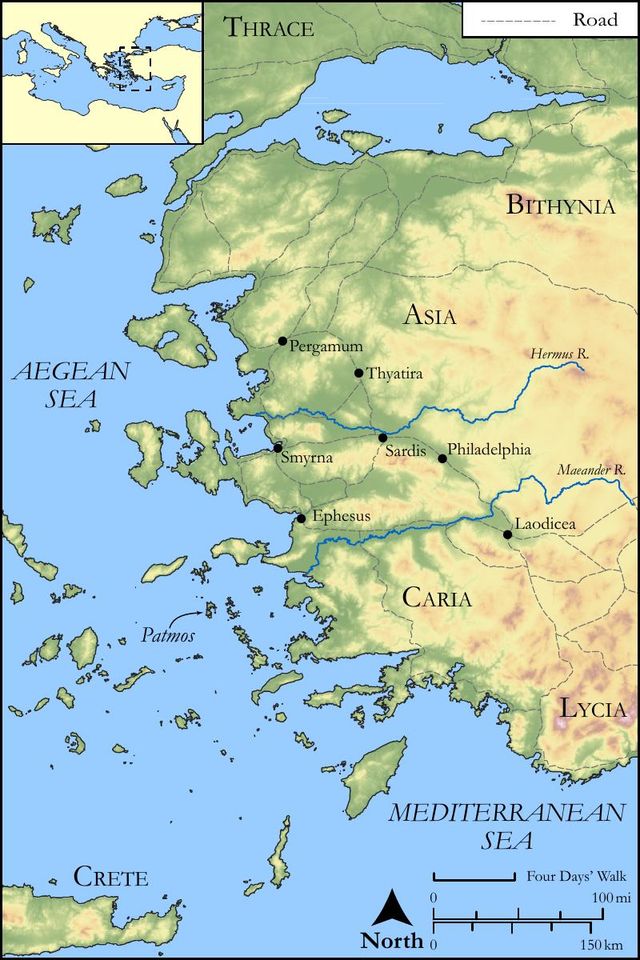
See on the biblical-era maps

Study this verse
Public-domain commentary
Matthew Henry
From his Commentary on the Whole Bible. Henry comments on passages, not single verses — this entry covers Revelation 22:6–19.
We have here a solemn ratification of the contents of this book, and particularly of this last vision (though some think it may not only refer to the whole book, but to the whole New Testament, yea, to the whole Bible, completing and confirming the canon of scripture); and here, 1. This is confirmed by the name and nature of that God who gave out these discoveries: he is the Lord God, faithful and true, and so are all his sayings. 2. By the messengers he chose, to reveal these things to the world; the holy angels showed them to holy men of God; and God would not employ his saints and angels in deceiving the world. 3. They will soon be confirmed by their accomplishment: they are things that must shortly be done; Christ will make haste, he will come quickly, and put all things out of doubt; and then those will prove the wise and happy men who have believed and kept his words. 4. By the integrity of that angel who had been the apostle's guide and interpreter in these visions; this integrity was such that he not only refused to accept religious adoration from John, but once and again reproved him for it. He who was so tender of the honour of God, and so displeased with what was a wrong to God, would never come in his name to lead the people of God into mere dreams and delusions; and it is a still further confirmation of the sincerity of this apostle that he confesses his own sin and folly, into which he had now again relapsed, and he leaves this his failing on perpetual record: this shows he was a faithful and an impartial writer. 5. By the order given to leave the book of the prophecy open, to be perused by all, that they might labour to understand it, that they might make their objections against it, and compare the prophecy with the events. God here deals freely and openly with all; he does not speak in secret, but calls every one to witness to the declarations here made, Rev 22:10. 6. By the effect this book, thus kept open, will have upon men; those that are filthy and unjust will take occasion thence to be more so, but it will confirm, strengthen, and further sanctify those that are upright with God; it will be a savour of life to some and of death to others, and so will appear to be from God, Rev 22:12. 7. It will be Christ's rule of judgment at the great day; he will dispense rewards and punishments to men according as their works agree or disagree with the word of God; and therefore that word itself must needs be faithful and true. 8. It is the word of him who is the author, finisher, and rewarder of the faith and holiness of his people, Rev 22:13, Rev 22:14. He is the first and the last, and the same from first to last, and so is his word too; and he will by this word give to his people, who conform themselves to it, a right to the tree of life, and an entrance into heaven; and this will be a full confirmation of the truth and authority of his word, since it contains the title and evidence of that confirmed state of holiness and happiness that remains for his people in heaven. 9. It is a book that condemns and excludes from heaven all wicked, unrighteous persons, and particularly those that love and make lies (Rev 22:15), and therefore can never be itself a lie. 10. It is confirmed by the testimony of Jesus, which is the Spirit of prophecy. And this Jesus, as God, is the root of David, though, as man, his offspring - a person in whom all uncreated and created excellencies meet, too great and too good to deceive his churches and the world. He is the fountain of all light, the bright and the morning star, and as such has given to his churches this morning light of prophecy, to assure them of the light of that perfect day which is approaching. 11. It is confirmed by an open and general invitation to all to come and partake of the promises and privileges of the gospel, those streams of the water of life; these are tendered to all who feel in their souls a thirst which nothing in this world can quench. 12. It is confirmed by the joint testimony of the Spirit of God, and that gracious Spirit that is in all the true members of the church of God; the Spirit and the bride join in testifying the truth and excellency of the gospel. 13. It is confirmed by a most solemn sanction, condemning and cursing all who should dare to corrupt or change the word of God, either by adding to it or taking from it, Rev 22:18, Rev 22:19. He that adds to the word of God draws down upon himself all the plagues written in this book; and he who takes any thing away from it cuts himself off from all the promises and privileges of it. This sanction is like a flaming sword, to guard the canon of the scripture from profane hands. Such a fence as this God set about the law (Deu 4:2), and the whole Old Testament (Mal 4:4), and now in the most solemn manner about the whole Bible, assuring us that it is a book of the most sacred nature, divine authority, and of the last importance, and therefore the peculiar care of the great God.
Historical interpretation
Eight Centuries of Reception
6 surviving comments on this verse. Each one is dated, so this reads as a timeline rather than a list.
Select a marker to jump to its quote. Markers stagger vertically where authors wrote within a few decades of each other.
In the gospel, moreover, I discover a Minister and Witness of the Creator, even His Word. But whether all things were made out of any underlying Matter, I have as yet failed anywhere to find. Where such a statement is written, Hermogenes' shop must tell us. If it is nowhere written, then let it fear the woe which impends on all who add to or take away from the written word.
Solomon said, “Do not add to his words, lest you be rebuked and be found a liar.” In this passage he also adds the terror of the plagues so that he might urge and warn not only by the weight of his authority but also that he might either move the idle with threats or restrain the reckless.
It is not that he denies that the words that he had spoken were not to be explained. Rather, around that very time in which the saint had his vision, the error of various teachers and heretics began to emerge and to take their rise. Therefore, in order that no one promoting error might through the usual deceit of their error intend either to add or to subtract from his words and in that way seek to confirm their views by the witness of this most holy man, he determined to conclude his book with this warning. And that no one might think that what he said was merely a human opinion, he now mentions [the Lord Jesus Christ] who is the author of these things.
The curse against those who falsify the divine Scriptures is terrible, since the daring insolence of such self-willed persons can deprive them of the blessings of the coming age. In order that we might not suffer that lot, he testifies to us who listen neither to add nor to subtract anything. Rather, we should regard the characteristics of the Scriptures as more trustworthy and venerable than Attic compositions and dialectical arguments. For even among those should anyone find anything that is contrary to the rules, he is referred to the trustworthiness of their poets and authors. How great the difference is between those who have a great reputation among them and those who are of repute among us is impossible to conceive. I would judge that it is greater than the difference between light and darkness.
If anyone adds to these things, God will add to him the plagues that are written in this book. He said this concerning falsifiers, not concerning those who simply say what they feel, without mutilating the prophecy in any way.
I testify, he says, to everyone who hears these present words; that is, I bear witness not to add anything, lest he bring upon himself the blows spoken here, nor to take away, so that the portion of the tree of life and of the inscribed holy city be not removed; both of which are contained in this little book. Then the evangelist makes his own account credible and reverent; see what he has added:
Continue studying Revelation 22:18 across the web’s major study libraries — every link below opens this exact verse, chapter, or book on the destination site.
Read & Compare
 BibleGatewayThis verse in more than 200 translations and 70 languages.
 Bible.comThe YouVersion reader — hundreds of translations, reading plans, and highlights.
 ESV.orgCrossway's official English Standard Version reader.
 NET BibleThe NET translation with 60,000+ translators' notes on every rendering decision.
 STEP BibleTyndale House's free study tool — original text, vocabulary, and scholarly resources.
 BibliaLogos Bible Software's free web reader.
 USCCBThe New American Bible (Revised Edition) with the U.S. bishops' study notes.
Commentaries
 BibleHub CommentariesDozens of classic commentaries on this verse, gathered on one page.
 StudyLightMore than 100 commentary sets — the largest collection on the web.
 BibleRefPlain-English commentary on what this verse means, verse by verse.
 Enduring WordDavid Guzik's free commentary on this chapter, widely used by Bible teachers.
 Bible Study ToolsVerse commentary alongside Greek and Hebrew study aids.
Original Language & Research
- BibleHub InterlinearThe verse word by word — original language, transliteration, and English.
- BibleHub LexiconEvery word's original-language definition and Strong's entry.
 Blue Letter BibleDeep-study tools — Strong's numbers, concordance, and word studies.
 CNTR CollationThe earliest Greek manuscripts of this verse, collated letter by letter.
Sermons, Hymns & Audio


TrulyRandomVerse is not affiliated with these sites and doesn’t control their content. They’re linked because they’re genuinely useful.
Summary
Revelation 22:18 delivers a profound and solemn warning from the Apostle John, speaking under divine inspiration, to all who encounter the prophetic words of this final book of Scripture. It declares a severe judgment—the addition of the very plagues described within the book—upon anyone who presumes to augment or alter the divinely revealed message contained within its pages. This serves as a powerful testament to the sacred integrity, finality, and unalterable nature of God's Word, particularly as it culminates in the eschatological disclosures of Revelation.
Context
ShowHideLiterary Context
This verse stands as a climactic and definitive warning within the concluding chapter of the Book of Revelation. It immediately follows the vivid descriptions of the New Jerusalem, the river of life, and the tree of life, emphasizing the blessedness of those who obey God's commands and have access to these eternal realities (Revelation 22:1-14). The preceding verses have also reiterated the imminent return of Christ and the certainty of these prophecies (Revelation 22:6-7). This warning, coupled with the similar admonition in the subsequent verse (Revelation 22:19), forms an emphatic inclusio, sealing the book's message and underscoring its divine authority and inviolability as a complete prophetic revelation.
Historical & Cultural Context
The practice of preserving sacred texts was paramount in Israel, often accompanied by warnings against alteration, as in Moses' charge that the people should not "add unto the word" nor "diminish ought from it." Among the Greeks and Romans, authors sometimes included colophons or epilogues to protect their works from corruption. However, John's warning transcends mere human authorship; it is a divine injunction. Early Christian communities were already grappling with false teachings and Gnostic influences that sought to "add" new revelations or reinterpretations to the apostolic tradition. This verse, therefore, served as a vital safeguard for the nascent church, affirming the sufficiency and finality of the apostolic testimony, particularly concerning the profound truths revealed about the end times and God's ultimate plan for humanity.
Key Themes
ShowHideRevelation 22:18 powerfully reinforces several overarching themes of the book and the broader biblical narrative. Firstly, it underscores the Sovereignty and Authority of God as the ultimate author of truth, whose word is immutable and perfect. Secondly, it highlights the Inviolability of Divine Revelation, particularly the prophetic word, asserting that it is not subject to human modification or supplementation. This theme resonates with earlier biblical warnings against tampering with God's law (Deuteronomy 4:2). Thirdly, it speaks to the Finality and Sufficiency of Scripture, implying that the prophetic vision granted to John completes a significant phase of God's revelation, particularly regarding eschatological events. Finally, it emphasizes Divine Justice and Retribution, demonstrating God's unwavering commitment to upholding the integrity of His word through severe consequences for those who defy it, linking directly to the plagues described throughout the book of Revelation.
Exposition and Analysis
ShowHideKey Word Analysis
ShowHideThis word, derived from a root meaning "to bear witness with," implies a joint or corroborative testimony. Here, it signifies John's solemn declaration, not merely as a human author, but as one who bears witness with the Holy Spirit or with Christ to the truth and authority of the prophecy. It conveys a profound sense of divine authentication and the gravity of the message being conveyed.
Composed of "upon" (epi) and "to place" (tithēmi), this verb means "to impose," "to lay upon," or "to add unto." In this context, it refers to the presumptuous act of introducing new material, doctrines, or interpretations into the established prophetic word, thereby attempting to enhance or alter its content. It highlights the human tendency to supplement what God has already declared complete.
This term literally means "a stroke" or "a wound," but figuratively, it denotes "a calamity" or "a plague." Throughout Revelation, "plagues" refer to the specific, divinely orchestrated judgments unleashed upon the earth and its inhabitants, such as the seven last plagues (Revelation 15:1). Its use here signifies a direct, retributive justice, where the punishment for tampering with God's word is directly linked to the very judgments described within that word.
Verse Breakdown
ShowHide"For I testify unto every man that heareth the words of the prophecy of this book,"
John, as the divinely appointed messenger, issues a solemn, authoritative declaration. This warning is directed universally ("unto every man") and specifically to those who actively engage with ("heareth") the content of the Book of Revelation, acknowledging their responsibility to receive and transmit its message faithfully. The phrase "the words of the prophecy of this book" emphasizes the specific, inspired nature of Revelation's message.
"If any man shall add unto these things,"
This clause presents the condition for divine judgment. The act of "adding" implies presumptuously introducing new doctrines, prophecies, or requirements that are not part of God's original revelation in Revelation. It speaks to any attempt to supplement, enhance, or distort the revealed truth, whether through human tradition, false prophecy, or theological innovation. The warning is against any form of human presumption that seeks to improve upon or complete God's perfect Word.
"God shall add unto him the plagues that are written in this book:"
This clause states the severe and direct consequence of such an act. The punishment is a precise, retributive justice: just as one "adds" to God's word, God will "add" to that person the very "plagues" or judgments described within the book itself. This highlights God's righteous indignation against those who tamper with His truth and underscores the terrifying reality of the judgments detailed throughout Revelation, which will be experienced by those who defy His authority.
Literary Devices
ShowHideRevelation 22:18 employs several potent literary devices to convey its urgent message. The primary device is a Solemn Warning or Divine Declaration, delivered with the weight of prophetic authority ("I testify"). This creates an immediate sense of gravity and finality. The verse also utilizes Lexical Repetition and Retributive Justice through the repeated use of "add" (G2007, epitíthēmi). The human act of "adding" to the word is met with God's reciprocal act of "adding" plagues, creating a direct, cause-and-effect relationship that underscores the severity and appropriateness of the divine judgment. Furthermore, the verse functions as part of an Inclusio or Framing Device when read in conjunction with the subsequent verse (Revelation 22:19), which warns against taking away from the prophecy. Together, these two verses form a powerful literary bracket around the entire book, emphasizing its complete and inviolable nature.
Theological and Thematic Connections
ShowHideThis powerful warning in Revelation 22:18 serves as a theological anchor, affirming the absolute authority, sufficiency, and integrity of God's revealed Word. It underscores that divine revelation is not a malleable human construct but a sacred trust, complete and unalterable by human hands. Theologically, it asserts God's sovereignty over His own communication, demonstrating that He has disclosed precisely what He intends for humanity to know, particularly concerning the culmination of His redemptive plan and the eschatological future. To "add" to this divine message is not merely a literary transgression but an act of profound theological rebellion, implying that God's revelation is incomplete or flawed, and that human wisdom can improve upon divine truth. Such an act invites divine judgment, precisely because it undermines the very foundation of faith: the trustworthy and uncorrupted Word of God.
Reflection and Application
ShowHideRevelation 22:18 calls believers to a profound reverence for the entirety of God's inspired Word. In an age where spiritual truths are often diluted, reinterpreted, or supplemented with human philosophies and traditions, this verse stands as a stark reminder of the sacred boundaries of divine revelation. It challenges us to approach Scripture with humility, seeking to understand and obey what God has already revealed, rather than presuming to add to it or invent new doctrines. For the church, it serves as a vital safeguard against false teachings, cults, and any movement that claims new, extra-biblical revelation that contradicts or supersedes the canonical Scriptures. Our faith and practice must be rooted firmly in the completed testimony of God's written Word, ensuring that our understanding of God, humanity, sin, and salvation remains faithful to His self-disclosure. This verse encourages diligent study, careful interpretation, and courageous defense of biblical truth, recognizing that to tamper with God's word is to invite His righteous judgment.
Questions for Reflection
ShowHideFAQ
ShowHideDoes this verse mean that no new revelation can ever occur after the Book of Revelation was written?
ShowHideWhile Revelation 22:18 specifically warns against adding to "the words of the prophecy of this book," its placement at the very end of the Christian biblical canon has led many theologians to understand it as a final, comprehensive warning against adding to the completed body of New Testament revelation. The primary concern is not merely about new personal prophecies, but about any new doctrines or writings that would claim canonical authority, thereby altering or supplementing the full, sufficient, and final revelation of God found in the Bible. The New Testament, culminating in Revelation, is generally considered the complete and final written Word of God for the church age, meaning no new Scripture is expected to be added to the canon. This verse serves to protect the integrity and sufficiency of the entire biblical text as God's authoritative self-disclosure.
Christ-Centered Fulfillment
ShowHideRevelation 22:18, while a warning against tampering with God's word, finds its ultimate Christ-centered fulfillment in the person and work of Jesus Christ Himself. Jesus is the Logos, the Word of God incarnate, the very embodiment of divine truth and revelation. To add to God's written word is, in essence, to imply that the revelation given through Christ, the fullness of God dwelling bodily, is somehow incomplete or insufficient. Christ is the Alpha and the Omega, the beginning and the end, signifying that in Him, God's redemptive plan and prophetic revelation reach their culmination and finality. The judgment pronounced in this verse is not merely an abstract consequence but a righteous decree from the Lamb who was slain, who is also the King of kings and Lord of lords. His authority guarantees the truth and completeness of the prophetic words, making any human addition an affront to His perfect and finished work, both in redemption and in revelation. Therefore, honoring this warning is an act of profound submission to Christ, the Living Word, who has perfectly revealed the Father and completed God's saving purposes.