


Matthew 5:18
Bible text: King James Version (1769 Blayney text) · Public domain
Bible text: King James Version with Strong's numbers · Public domain
Bible text: Berean Standard Bible · Public domain
Bible text: American Standard Version (1901) · Public domain
Bible text: World English Bible, Messianic edition · Public domain
Bible text: Geneva Bible (1599) · Public domain
Bible text: Young's Literal Translation · Public domain
- ἀμὴνamēnAmenG281INJ-HEBInterjection
- γὰρgarforG1063CONJConjunction
- λέγωlegōI sayG3004V-PAI-1SVerb Present Active Indicative 1st Singular
- ὑμῖν·huminto youG4771P-2DPPersonal pronoun Dative 2nd Plural
- ἕωςhe'ōsuntilG2193PREPPreposition
- ἂνanwhenG302PRTParticle or Disjunctive
- παρέλθῃparelthēmay pass awayG3928V-2AAS-3SVerb 2nd Aorist Active Subjunctive 3rd Singular
- ὁhotheG3588T-NSMDefinite article Nominative Singular Masculine
- οὐρανὸςouranosheavenG3772N-NSMNoun Nominative Singular Masculine
- καὶkaiandG2532CONJConjunction
- ἡhētheG3588T-NSFDefinite article Nominative Singular Feminine
- γῆgēearthG1093N-NSFNoun Nominative Singular Feminine
- ἰῶταiōtaiotaG2503N-NSNNoun Nominative Singular Neuter
- ἓνhenoneG1520A-NSNAdjective Nominative Singular Neuter
- ἢēorG2228CONJConjunction
- μίαmiaoneG1520A-NSFAdjective Nominative Singular Feminine
- κεραίαkeraiastroke of a letterG2762N-NSFNoun Nominative Singular Feminine
- οὐoucertainlyG3756PRT-NNegative Particle Negative
- μὴmēnotG3361PRT-NNegative Particle Negative
- παρέλθῃparelthēmay pass awayG3928V-2AAS-3SVerb 2nd Aorist Active Subjunctive 3rd Singular
- ἀπὸapofromG575PREPPreposition
- τοῦtoutheG3588T-GSMDefinite article Genitive Singular Masculine
- νόμουnomoulawG3551N-GSMNoun Genitive Singular Masculine
- ἕωςhe'ōsuntilG2193PREPPreposition
- ἂνanwhenG302PRTParticle or Disjunctive
- πάνταpantaeverythingG3956A-NPNAdjective Nominative Plural Neuter
- γένηταιgenētaimay happenG1096V-2ADS-3SVerb 2nd Aorist Middle Deponent Subjunctive 3rd Singular
English is a literal word-by-word gloss of the Greek, not the KJV's wording. Why?
This is the original text the KJV's translators worked from — each Greek word with its own literal English meaning in this verse, prepared by scholars at Tyndale House, Cambridge. The KJV translates whole sentences, not word by word, so its wording differs: one Greek word can become several English words, and the KJV may choose “charity” where the gloss reads “love”. Both are faithful — they answer different questions. For the KJV's own rendering, switch to the KJV text.
Details
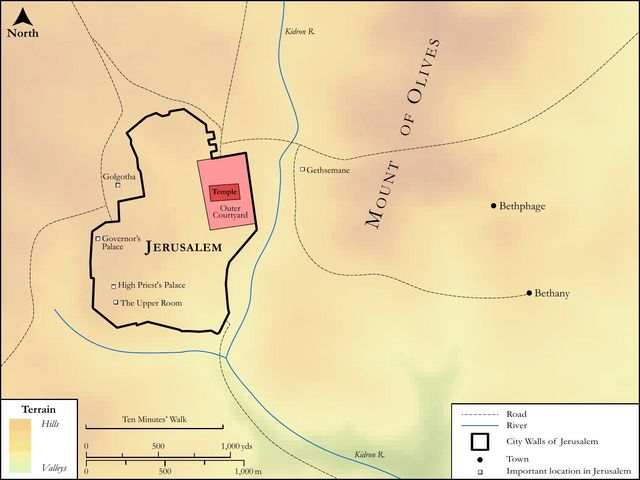
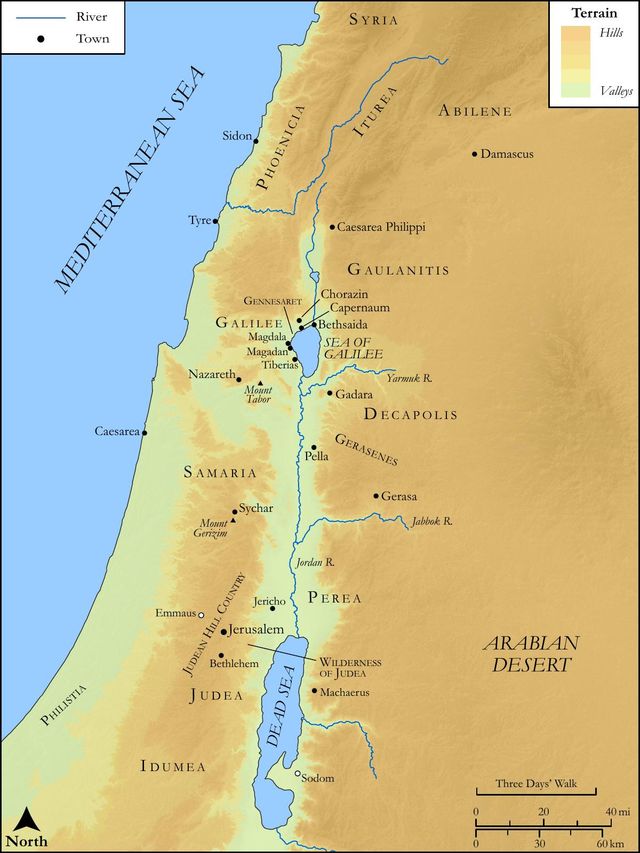
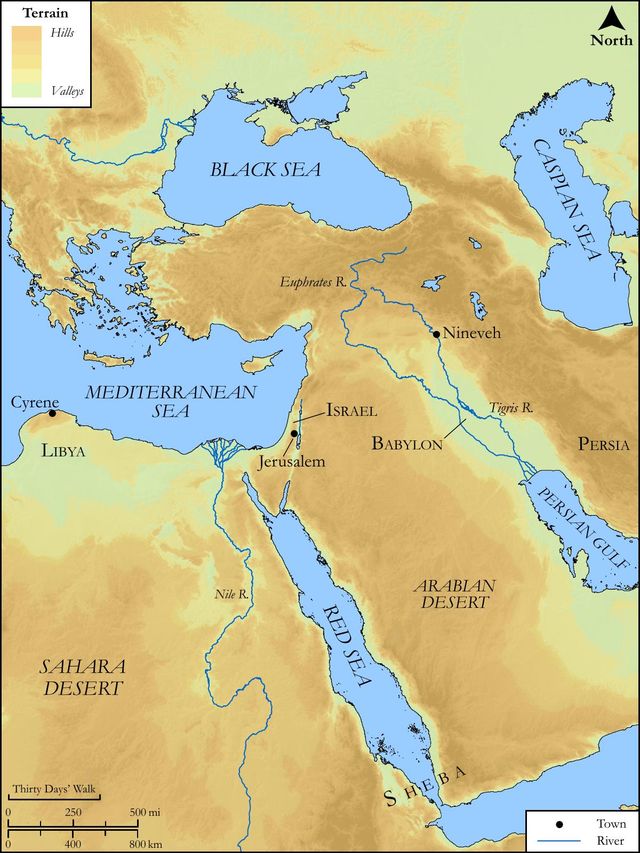
See on the biblical-era maps
Study this verse
Public-domain commentary
Matthew Henry
From his Commentary on the Whole Bible. Henry comments on passages, not single verses — this entry covers Matthew 5:17–20. His three-level outline is real structure in the source text, so it is rendered as structure.
Those to whom Christ preached, and for whose use he gave these instructions to his disciples, were such as in their religion had an eye, 1. To the scriptures of the Old Testament as their rule, and therein Christ here shows them they were in the right: 2. To the scribes and the Pharisees as their example, and therein Christ here shows them they were in the wrong; for,
I.The rule which Christ came to establish exactly agreed with the scriptures of the Old Testament, here called the law and the prophets.
The prophets were commentators upon the law, and both together made up that rule of faith and practice which Christ found upon the throne in the Jewish church, and here he keeps it on the throne.
1.He protests against the thought of cancelling and weakening the Old Testament; Think not that I am come to destroy the law and the prophets. (1.) "Let not the pious Jews, who have an affection for the law and the prophets, fear that I come to destroy them." Let them be not prejudiced against Christ and his doctrine, from a jealousy that this kingdom he came to set up, would derogate from the honour of the scriptures, which they had embraced as coming from God, and of which they had experienced the power and purity; no, let them be satisfied that Christ has no ill design upon the law and the prophets. "Let not the profane Jews, who have a disaffection to the law and the prophets, and are weary of that yoke, hope that I am come to destroy them." Let not carnal libertines imagine that the Messiah is come to discharge them from the obligation of divine precepts and yet to secure to them divine promises, to make the happy and yet to give them leave to live as they list. Christ commands nothing now which was forbidden either by the law of nature or the moral law, nor forbids any thing which those laws had enjoined; it is a great mistake to think he does, and he here takes care to rectify the mistake; I am not come to destroy. The Saviour of souls is the destroyer of nothing but the works of the devil, of nothing that comes from God, much less of those excellent dictates which we have from Moses and the prophets. No, he came to fulfil them. That is, [1.] To obey the commands of the law, for he was made under the law, Gal 4:4. He in all respects yielded obedience to the law, honoured his parents, sanctified the sabbath, prayed, gave alms, and did that which never any one else did, obeyed perfectly, and never broke the law in any thing. [2.] To make good the promises of the law, and the predictions of the prophets, which did all bear witness to him. The covenant of grace is, for substance, the same now that it was then, and Christ the Mediator of it. [3.] To answer the types of the law; thus (as bishop Tillotson expresses it), he did not make void, but make good, the ceremonial law, and manifested himself to be the Substance of all those shadows. [4.] To fill up the defects of it, and so to complete and perfect it. Thus the word plērōsai properly signifies. If we consider the law as a vessel that had some water in it before, he did not come to pour out the water, but to fill the vessel up to the brim; or, as a picture that is first rough-drawn, displays some outlines only of the piece intended, which are afterwards filled up; so Christ made an improvement of the law and the prophets by his additions and explications. [5.] To carry on the same design; the Christian institutes are so far from thwarting and contradicting that which was the main design of the Jewish religion, that they promote it to the highest degree. The gospel is the time of reformation (Heb 9:10), not the repeal of the law, but the amendment of it, and, consequently, its establishment.
2.He asserts the perpetuity of it; that not only he designed not the abrogation of it, but that it never should be abrogated (Mat 5:18); "Verily I say unto you, I, the Amen, the faithful Witness, solemnly declare it, that till heaven and earth pass, when time shall be no more, and the unchangeable state of recompences shall supersede all laws, one jot, or one tittle, the least and most minute circumstance, shall in no wise pass from the law till all be fulfilled;" for what is it that God is doing in all the operations both of providence and grace, but fulfilling the scripture? Heaven and earth shall come together, and all the fulness thereof be wrapped up in ruin and confusion, rather than any word of God shall fall to the ground, or be in vain. The word of the Lord endures for ever, both that of the law, and that of the gospel. Observe, The care of God concerning his law extends itself even to those things that seem to be of least account in it, the iotas and the tittles; for whatever belongs to God, and bears his stamp, be it ever so little, shall be preserved. The laws of men are conscious to themselves of so much imperfection, that they allow it for a maxim, Apices juris non sunt jura - The extreme points of the law are not the law, but God will stand by and maintain every iota and every tittle of his law.
3.He gives it in charge to his disciples, carefully to preserve the law, and shows them the danger of the neglect and contempt of it (Mat 5:19); Whosoever therefore shall break one of the least commandments of the law of Moses, much more any of the greater, as the Pharisees did, who neglected the weightier matters of the law, and shall teach men so as they did, who made void the commandment of God with their traditions (Mat 15:3), he shall be called the least in the kingdom of heaven. Though the Pharisees be cried up for such teachers as should be, they shall not be employed as teachers in Christ's kingdom; but whosoever shall do and teach them, as Christ's disciples would, and thereby prove themselves better friends to the Old Testament than the Pharisees were, they, though despised by men, shall be called great in the kingdom of heaven. Note,
(1.)Among the commands of God there are some less than others; none absolutely little, but comparatively so. The Jews reckon the least of the commandments of the law to be that of the bird's nest (Deu 22:6, Deu 22:7); yet even that had a significance and an intention very great and considerable.
(2.)It is a dangerous thing, in doctrine or practice, to disannul the least of God's commands; to break them, that is, to go about either to contract the extent, or weaken the obligation of them; whoever does so, will find it is at his peril. Thus to vacate any of the ten commandments, is too bold a stroke for the jealous God to pass by. it is something more than transgressing the law, it is making void the law, Psa 119:126.
(3.)That the further such corruptions as they spread, the worse they are. It is impudence enough to break the command, but is a greater degree of it to teach men so. This plainly refers to those who at this time sat in Moses' seat, and by their comments corrupted and perverted the text. Opinions that tend to the destruction of serious godliness and the vitals of religion, by corrupt glosses on the scripture, are bad when they are held, but worse when they are propagated and taught, as the word of God. He that does so, shall be called least in the kingdom of heaven, in the kingdom of glory; he shall never come thither, but be eternally excluded; or, rather, in the kingdom of the gospel-church. He is so far from deserving the dignity of a teacher in it, that he shall not so much as be accounted a member of it. The prophet that teaches these lies shall be the tail in that kingdom (Isa 9:15); when truth shall appear in its own evidence, such corrupt teachers, though cried up as the Pharisees, shall be of no account with the wise and good. Nothing makes ministers more contemptible and base than corrupting the law, Mal 2:8, Mal 2:11. Those who extenuate and encourage sin, and discountenance and put contempt upon strictness in religion and serious devotion, are the dregs of the church. But, on the other hand, Those are truly honourable, and of great account in the church of Christ, who lay out themselves by their life and doctrine to promote the purity and strictness of practical religion; who both do and teach that which is good; for those who do not as they teach, pull down with one hand what they build up with the other, and give themselves the lie, and tempt men to think that all religion is a delusion; but those who speak from experience, who live up to what they preach, are truly great; they honour God, and God will honour them (Sa1 2:30), and hereafter they shall shine as the stars in the kingdom of our Father.
II.The righteousness which Christ came to establish by this rule, must exceed that of the scribes and Pharisees, Mat 5:20.
This was strange doctrine to those who looked upon the scribes and Pharisees as having arrived at the highest pitch of religion. The scribes were the most noted teachers of the law, and the Pharisees the most celebrated professors of it, and they both sat in Moses' chair (Mat 23:2), and had such a reputation among the people, that they were looked upon as super-conformable to the law, and people did not think themselves obliged to be as good as they; it was therefore a great surprise to them, to hear that they must be better than they, or they should not go to heaven; and therefore Christ here avers it with solemnity; I say unto you, It is so. The scribes and Pharisees were enemies to Christ and his doctrine, and were great oppressors; and yet it must be owned, that there was something commendable in them. They were much in fasting and prayer, and giving of alms; they were punctual in observing the ceremonial appointments, and made it their business to teach others; they had such an interest in the people that they ought, if but two men went to heaven, one would be a Pharisee; and yet our Lord Jesus here tells his disciples, that the religion he came to establish, did not only exclude the badness, but excel the goodness, of the scribes and Pharisees. We must do more than they, and better than they, or we shall come short of heaven. They were partial in the law, and laid most stress upon the ritual part of it; but we must be universal, and not think it enough to give the priest his tithe, but must give God our hearts. They minded only the outside, but we must make conscience of inside godliness. They aimed at the praise and applause of men, but we must aim at acceptance with God: they were proud of what they did in religion, and trusted to it as a righteousness; but we, when we have done all, must deny ourselves, and say, We are unprofitable servants, and trust only to the righteousness of Christ; and thus we may go beyond the scribes and Pharisees.
Historical interpretation
Ten Centuries of Reception
16 surviving comments on this verse. Each one is dated, so this reads as a timeline rather than a list.
Select a marker to jump to its quote. Markers stagger vertically where authors wrote within a few decades of each other.
But the “one dot” is not only the iota of the Greeks but also that which among the Hebrews is called the yod. And the “one iota” or “one dot” can symbolically be said to be Jesus, since the beginning of his name is written not only by Greeks with an iota but also by Hebrews with a yod. So Jesus will be the one dot, the Word of God in the law which does not pass from the law until all is accomplished. But the iota might also be (as he himself says) the Ten Commandments of the law, for everything else passes away, but these do not pass away. But neither does Jesus pass away; if he “falls to the ground” he does so willingly, in order to bear much fruit. Again, the “one iota” or “one dot” has mastery over things both in heaven and on earth.
He means not that we should seek glory of men, but that though we conceal it, our work may shine forth in honour of God to those among whom we live.
From the expression here used pass, we may suppose that the constituting elements of heaven and earth shall not be annihilatedb.
Or, He calls the passion, and the cross, the least, which if one shall not confess openly, but be ashamed of them, he shall be least, that is, last, and as it were no man; but to him that confesses it He promises the great glory of a heavenly calling.
He fulfilled the law at the time by completing the sacrifices of the law and all the examples prefigured in himself … by accepting a body. Certainly he fulfilled the law at the time he confirmed with evangelical grace the precepts of the law he had given. He proceeds to demonstrate he had come to fulfill the law: “Until heaven and earth pass away, not one iota, not a dot, shall be lost from the law until all is accomplished.” Therefore we know from Christ’s teaching how true and divine is the preaching of the law. The Lord reveals that not a single iota or a dot will be lost.
(Hom. xvi.) Christ then fulfilled the Prophets by accomplishing what was therein foretold concerning Himself—and the Law, first, by transgressing none of its precepts; secondly, by justifying by faith, which the Law could not do by the letter.
He speaks not this of the old laws, but of those which He was now going to enact, of which he says, the least, though they were all great. For as He so oft spoke humbly of Himself, so does He now speak humbly of His precepts.
Or, when you hear the words, least in the kingdom of heaven, imagine nothing less than the punishment of hell. For He oft uses the word 'kingdom,' not only of the joys of heaven, but of the time of the resurrection, and of the terrible coming of Christ.
"For verily I say unto you, Till Heaven and earth pass, one jot or one tittle shall in no wise pass from the law, till all come to pass."
Now what He saith is like this: it cannot be that it should remain unaccomplished, but the very least thing therein must needs be fulfilled. Which thing He Himself performed, in that He completed it with all exactness.
And here He signifies to us obscurely that the fashion of the whole world is also being changed. Nor did He set it down without purpose, but in order to arouse the hearer, and indicate, that He was with just cause introducing another discipline; if at least the very works of the creation are all to be transformed, and mankind is to be called to another country, and to a higher way of practising how to live.
(Verse 18.) Until heaven and earth pass away. The new heavens and the new earth are promised to us, which the Lord God will create. Therefore, if new things are to be created, the old things will necessarily pass away. And what follows is:
One iota, or one iota, will not pass from the Law until all is done. It is shown from the figure of the letter, that even what are thought to be the least in the Law, are full of spiritual sacraments, and all are recapitulated in the Gospel. Whose, then, is the erudition and whose teaching, to demonstrate that even diverse sacrifices and those which appear superstitious are fulfilled in daily victims?
We are promised a new heaven and a new earth, which the Lord God will make. If new ones are to be created, the old ones will therefore pass away. As for what follows, “Not one iota, not a dot, shall be lost from the law until all is accomplished,” this literally shows that even what is considered least important in the law is full of spiritual sacraments, and it is all summed up in the gospel.
This head is closely connected with the preceding. It is directed against the Pharisees, who, despising the commandments of God, set up traditions of their own, and means that their teaching the people would not avail themselves, if they destroyed the very least commandment in the Law. We may take it in another sense. The learning of the master if joined with sin however small, loses him the highest place, nor does it avail any to teach righteousness, if he destroys it in his life. Perfect bliss is for him who fulfils in deed what he teaches in word.
For, if even those things which are added for completion are fulfilled, much more are those things fulfilled which are sent in advance as a commencement. Then, as to what He says, One iota or one tittle shall in nowise pass from the law, nothing else can be understood but a strong expression of perfection, since it is pointed out by means of single letters, among which letters iota is smaller than the others, for it is made by a single stroke; while a tittle is but a particle of some sort at the top of even that. And by these words He shows that in the law all the smallest particulars even are to be carried into effect.
(Serm. in Mont. i. 8.) By the words, one iota or one point shall not pass from the Law, we must understand only a strong metaphor of completeness, drawn from the letters of writing, iota being the least of the letters, made with one stroke of the pen, and a point being a slight dot at the end of the same letter. The words there show that the Law shall be completed to the very least matter.
And that for two reasons. First, that by these words He might admonish His disciples, that as He fulfilled the Law, so they should strive to fulfil it. Secondly, because the Jews would falsely accuse them as subverting the Law, therefore he answers the calumny beforehand, but in such a manner as that He should not be thought to come simply to preach the Law as the Prophets had done.
But since all things which should befal from the very beginning of the world to the end of it, were in type and figure foreshewn in the Law, that God may not be thought to be ignorant of any of those things that take place, He therefore here declares, that heaven and earth should not pass till all things thus foreshewn in the Law should have their actual accomplishment.
If even an honourable man blushes to be found in a falsehood, and a wise man lets not fall empty any word he has once spoken, how could it be that the words of heaven should fall to the ground empty? Hence He concludes, Whoso shall break the least of these commandments, &c. And, I suppose, the Lord goes on to reply Himself to the question, Which are the least commandments? Namely, these which I am now about to speak.
Otherwise; the precepts of Moses are easy to obey; Thou shall not kill. Thou shall not commit adultery. The very greatness of the crime is a check upon the desire of committing it; therefore the reward of observance is small, the sin of transgression great. But Christ's precepts, Thou shalt not be angry, Thou shalt not lust, are hard to obey, and therefore in their reward they are great, in their transgression, 'least.' It is thus He speaks of these precepts of Christ, such as Thou shall not be angry, Thou shalt not lust, as 'the least;' and they who commit these lesser sins, are the least in the kingdom of God; that is, he who has been angry and not sinned grievously is secure from the punishment of eternal damnation; yet he does not attain that glory which they attain who fulfil even these least.
He here asserts two things; He denies that He was come to subvert the Law, and affirms that He was come to fulfil it.
Amen is a Hebrew word, and may be rendered in Latin, 'vere,' 'fidenter,' or 'fiat;' that is, 'truly,' 'faithfully,' or 'so be it.' The Lord uses it either because of the hardness of heart of those who were slow to believe, or to attract more particularly the attention of those that did believe.
But shall abide in their essence, but pass through renewal.
(Hom. in Ev. xii. 1.) Or, by the kingdom of heaven is to be understood the Church, in which that teacher who breaks a commandment is called least, because he whose life is despised, it remains that his preaching be also despised.
He fitly mentions the Greek iota, and not the Hebrew jod, because the iota stands in Greek for the number ten, and so there is an allusion to the Decalogue of which the Gospel is the point and perfection.
The "amen" is an assurance, meaning, "Yes, truly I say unto you."
. He indicates here that the world passes away and undergoes a change in form. He is saying, therefore, that while the universe subsists, not the least letter of the law will pass away. Some say that the "jot" [i.e. the Greek letter iota] and the "tittle" [i.e. accent mark] signify the ten commandments of the law; others say that they indicate the Cross, for the iota is the upright beam of the Cross, and the accent, the transverse beam. Christ is saying, therefore, that everything that was spoken concerning the Cross will be fulfilled.
(ord.) Having now exhorted His hearers to undergo all things for righteousness' sake, and also not to hide what they should receive, but to learn more for others' sake, that they may teach others, He now goes on to tell them what they should teach, as though He had been asked, 'What is this which you would not have hid, and for which you would have all things endured? Are you about to speak any thing beyond what is written in the Law and the Prophets;' hence it is He says, Think not that I am come to subvert the Law or the Prophets.
(ord.) By 'break,' is meant, the not doing what one understands rightly, or the not understanding what one has corrupted, or the destroying the perfectness of Christ's additions.
Continue studying Matthew 5:18 across the web’s major study libraries — every link below opens this exact verse, chapter, or book on the destination site.
Read & Compare
 BibleGatewayThis verse in more than 200 translations and 70 languages.
 Bible.comThe YouVersion reader — hundreds of translations, reading plans, and highlights.
 ESV.orgCrossway's official English Standard Version reader.
 NET BibleThe NET translation with 60,000+ translators' notes on every rendering decision.
 STEP BibleTyndale House's free study tool — original text, vocabulary, and scholarly resources.
 BibliaLogos Bible Software's free web reader.
 USCCBThe New American Bible (Revised Edition) with the U.S. bishops' study notes.
Commentaries
 BibleHub CommentariesDozens of classic commentaries on this verse, gathered on one page.
 StudyLightMore than 100 commentary sets — the largest collection on the web.
 BibleRefPlain-English commentary on what this verse means, verse by verse.
 Enduring WordDavid Guzik's free commentary on this chapter, widely used by Bible teachers.
 Bible Study ToolsVerse commentary alongside Greek and Hebrew study aids.
Original Language & Research
- BibleHub InterlinearThe verse word by word — original language, transliteration, and English.
- BibleHub LexiconEvery word's original-language definition and Strong's entry.
 Blue Letter BibleDeep-study tools — Strong's numbers, concordance, and word studies.
 CNTR CollationThe earliest Greek manuscripts of this verse, collated letter by letter.
Sermons, Hymns & Audio


TrulyRandomVerse is not affiliated with these sites and doesn’t control their content. They’re linked because they’re genuinely useful.
Summary
In Matthew 5:18, Jesus emphatically declares the enduring authority and divine precision of the Old Testament Law, asserting that not even its minutest detail will pass away until its complete fulfillment. This statement, delivered within the foundational Sermon on the Mount, underscores Jesus' profound respect for the divine revelation that preceded Him, clarifying that His mission was not to abolish the Law but to bring it to its intended, ultimate culmination and perfect realization.
Context
ShowHideLiterary Context
This verse immediately follows Jesus' pivotal declaration in Matthew 5:17, where He states, "Do not think that I have come to abolish the Law or the Prophets; I have not come to abolish them but to fulfill them." Matthew 5:18 serves as a forceful reinforcement and elaboration of this preceding statement, emphasizing the absolute permanence of the Law down to its smallest components. It sets the stage for the rest of the Sermon on the Mount, where Jesus proceeds to expound upon and deepen the understanding of the Law's true intent, demonstrating that His teachings are not a departure from God's revealed will but rather its perfect embodiment and spiritual intensification. The audience, accustomed to the scribal interpretations of the Law, would have found this assertion both revolutionary and reassuring, as it affirmed the divine origin of their sacred texts while simultaneously preparing them for a more profound application.
Historical & Cultural Context
In first-century Judaism, the Torah (Law) was the bedrock of religious and national identity, meticulously studied and revered. Scribes and Pharisees dedicated their lives to its preservation and interpretation, often focusing on its precise letter. The "jot" (Greek: iota, representing the smallest Hebrew letter, yod) and "tittle" (Greek: keraia, a small stroke or projection distinguishing similar letters) were proverbial expressions for the absolute smallest details of the written text. This imagery would have resonated deeply with a Jewish audience, highlighting the meticulous care with which the Law was transmitted and understood. Jesus' use of this idiom demonstrates His profound respect for the Law's divine origin and its authoritative status, contrasting with any perception that He was a radical prophet seeking to dismantle established religious frameworks. His declaration affirmed the Law's immutability in a culture that held its sacred texts with utmost reverence.
Key Themes
ShowHideMatthew 5:18 contributes significantly to several overarching themes within the Sermon on the Mount and the broader Gospel of Matthew. Primarily, it establishes the divine authority and permanence of God's Word, asserting that the Law is not subject to human revision or temporal decay. This echoes Old Testament affirmations of God's enduring truth, as seen in Psalm 119:89 and Isaiah 40:8. Secondly, it highlights the continuity between the Old Covenant and the New Covenant, demonstrating that Jesus did not come to negate God's prior revelation but to bring it to its intended culmination. His mission is one of fulfillment, not abolition, which is central to understanding His role as the Messiah. This concept of fulfillment extends beyond merely obeying the Law; it encompasses His perfect embodiment of its righteous demands, His atoning sacrifice that satisfies its penalties, and His establishment of the New Covenant that writes the Law on hearts (Jeremiah 31:33). Thus, the verse underscores the integrity of God's redemptive plan across history, with Christ as its focal point.
Exposition and Analysis
ShowHideKey Word Analysis
ShowHideRefers to the smallest letter in the Hebrew alphabet, yod (י). Figuratively, it signifies a very small, almost imperceptible part of anything. Jesus uses this to emphasize the absolute minimum component of the Law, indicating that even the most insignificant detail holds divine significance and will not be disregarded.
Literally meaning "something horn-like," this refers to a small stroke, hook, or projection that distinguishes one Hebrew letter from another that might otherwise look identical (e.g., distinguishing a resh from a daleth). Like "jot," it is a proverbial expression for the minutest detail, reinforcing the idea of divine precision and the Law's meticulous integrity.
This word carries a broad semantic range, meaning "to come into being," "to become," "to be brought to pass," or "to be accomplished." In this context, it signifies the complete realization, accomplishment, or bringing to its intended purpose. Jesus is not merely saying the Law will be obeyed, but that its entire purpose, prophecies, and demands will be perfectly brought to fruition through His person and work.
Verse Breakdown
ShowHide"For verily I say unto you"
This solemn introductory phrase, often translated as "Truly, truly, I say to you" in other Gospels (e.g., John), is Jesus' characteristic way of introducing a weighty, authoritative declaration. "Verily" (Greek: amēn) emphasizes the certainty and truthfulness of what follows, establishing the divine authority behind His words.
"Till heaven and earth pass"
This is a powerful hyperbolic expression signifying an event of ultimate permanence. It means "never" or "for all eternity" in practical terms, as the passing of heaven and earth represents the end of the present heaven and earth. Jesus uses this imagery to convey the absolute and enduring nature of the Law's validity.
"one jot or one tittle shall in no wise pass from the law"
This is the core assertion of the verse. "Jot" and "tittle" represent the smallest, most insignificant elements of the written Law. The double negative "shall in no wise pass" (Greek: ou mē parérchomai) provides an emphatic denial, stressing that absolutely no part, however minute, of the Law will be annulled or cease to be valid until its complete purpose is achieved. This highlights the Law's divine origin, its meticulous perfection, and its enduring authority.
"till all be fulfilled"
This crucial phrase clarifies the condition for the Law's "passing" or, more accurately, its ultimate realization. "Fulfilled" (Greek: gínomai) here means brought to completion, accomplished, or perfectly enacted. It implies that the Law has a divine purpose and trajectory that culminates in Christ. This fulfillment is not its abolition but its perfect realization through Jesus' life, teachings, atoning death, and establishment of the New Covenant.
Literary Devices
ShowHideMatthew 5:18 employs several powerful literary devices to convey its profound message. The phrase "Till heaven and earth pass" is a striking example of hyperbole, a deliberate exaggeration used for emphasis. It underscores the absolute and seemingly unbreakable permanence of the Law, suggesting an eternal validity that outlasts the present heaven and earth. The expressions "one jot" and "one tittle" constitute a merism, a figure of speech in which two contrasting parts represent the whole. Here, the smallest possible components of the written text stand for the entirety of the Law, emphasizing its comprehensive and meticulous nature. This also functions as a proverbial expression, a common idiom understood by the audience to mean "not even the slightest detail." Together, these devices highlight Jesus' unwavering affirmation of the Law's divine origin, its enduring authority, and its meticulous precision, setting the stage for His subsequent reinterpretation and deeper exposition of its spiritual intent within the Sermon on the Mount.
Theological and Thematic Connections
ShowHideMatthew 5:18 stands as a profound theological statement on the nature of God's revelation and the person of Jesus Christ. It affirms the divine inspiration and enduring authority of the Old Testament Law, demonstrating that God's Word is not transient or subject to human revision, but rather eternally established and meticulously precise. This verse establishes a crucial continuity between the Old and New Covenants, asserting that Jesus did not come to discard the Law but to bring it to its ultimate, intended purpose. It highlights God's faithfulness in His redemptive plan, showing that the Law, with all its demands and prophecies, points forward to Christ, who perfectly embodies its righteousness and satisfies its requirements. Thus, the verse underscores the unity of God's saving work throughout history, culminating in the person and work of Jesus.
Reflection and Application
ShowHideMatthew 5:18 invites believers to a profound reverence for the entirety of God's Word, recognizing its divine origin and enduring authority. If Jesus Himself affirmed the meticulous precision of the Old Testament Law down to its smallest detail, how much more should we approach all of Scripture with awe and diligent study? This verse instills confidence in the Bible's reliability and trustworthiness, assuring us that God's truth is immutable and not subject to the shifting sands of human opinion or cultural trends. Furthermore, it clarifies Jesus' indispensable role as the ultimate interpreter and fulfiller of God's Law, reminding us that true righteousness is found not in our own efforts to perfectly keep the Law, but in Christ, who perfectly embodied and fulfilled its demands on our behalf. Our response, therefore, should be one of humble submission to God's revealed will, seeking to understand His heart as expressed in both the Old and New Testaments, and allowing the Spirit to empower us to live out the moral and spiritual principles that find their perfect expression in Christ.
Questions for Reflection
ShowHideFAQ
ShowHideDoes Matthew 5:18 mean that Christians are still under the Old Testament Law in its entirety?
ShowHideNo, Matthew 5:18 does not mean that Christians are still under the Old Testament Law in the same way as ancient Israel. Jesus' statement that the Law would not pass away "till all be fulfilled" is key. The New Testament teaches that Christ is the fulfillment of the Law (Romans 10:4). He perfectly obeyed its moral demands, offered Himself as the perfect sacrifice to satisfy its penalties, and inaugurated the New Covenant, which supersedes the Old Covenant's ceremonial and civil aspects (e.g., dietary laws, temple rituals, specific national regulations). Believers are no longer under the Law as a means of salvation or justification (Galatians 3:24-25), but are under grace (Romans 6:14). However, the moral principles underlying the Law, such as the Ten Commandments, remain eternally valid and are re-affirmed and deepened by Christ and the apostles, now written on our hearts by the Spirit (Jeremiah 31:33).
If "heaven and earth pass," does that imply the Law will eventually pass away?
ShowHideThe phrase "till heaven and earth pass" is a strong hyperbolic expression signifying an ultimate, seemingly impossible, or eternal duration. It means "never" in practical terms, as long as the present heaven and earth endure. However, the crucial qualifier "till all be fulfilled" clarifies that the Law's "passing" is not its abolition or disappearance, but rather its complete and perfect realization in Christ. When Jesus says "all be fulfilled," He refers to the culmination of God's redemptive plan, which He Himself embodies. The Law's purpose was to point to Him, reveal sin, and establish righteousness. Once Christ perfectly fulfills these purposes through His life, death, and resurrection, the Law's function as a temporary guardian or a system of rituals is completed. The moral essence of the Law, however, is not abolished but eternally upheld and perfectly expressed in Christ and the Spirit-led life of believers (Romans 8:4). So, the Law doesn't "pass away" in the sense of being discarded, but rather is perfectly accomplished and absorbed into the greater reality of Christ's finished work.
Christ-Centered Fulfillment
ShowHideMatthew 5:18 is profoundly Christ-centered, revealing Jesus not as a revolutionary who discards the past, but as the divine culmination of God's redemptive history. When Jesus declares that not "one jot or one tittle shall in no wise pass from the law, till all be fulfilled," He is unequivocally stating His unique relationship to the entirety of God's prior revelation. He is the ultimate "fulfillment" (Greek: gínomai) of the Law, meaning He perfectly embodies its righteous demands, satisfies its penalties, and brings its prophecies to their intended realization. His perfect life of obedience, even to the point of death on the cross, perfectly fulfills the Law's requirement for righteousness, which we could never achieve on our own (Romans 10:4). Furthermore, Christ's atoning sacrifice on the cross fully pays the penalty for sin that the Law exposed, thereby fulfilling its just demands for judgment (Colossians 2:13-14). Through His resurrection and the establishment of the New Covenant, Jesus inaugurates a new era where the Law is no longer an external code for justification, but its moral principles are written on the hearts of believers by the Holy Spirit (Hebrews 8:10). Thus, Jesus is not merely a teacher of the Law, but its living embodiment, its perfect interpreter, and the very means by which its divine purpose is eternally accomplished for all who believe (Matthew 3:15).