


Matthew 24:34
Bible text: King James Version (1769 Blayney text) · Public domain
Bible text: Berean Standard Bible · Public domain
Bible text: American Standard Version (1901) · Public domain
Bible text: World English Bible, Messianic edition · Public domain
Bible text: Geneva Bible (1599) · Public domain
Bible text: Young's Literal Translation · Public domain
- ἀμὴνamēnAmenG281INJ-HEBInterjection
- λέγωlegōI sayG3004V-PAI-1SVerb Present Active Indicative 1st Singular
- ὑμῖνhuminto youG4771P-2DPPersonal pronoun Dative 2nd Plural
- οὐoucertainlyG3756PRT-NNegative Particle Negative
- μὴmēnotG3361PRT-NNegative Particle Negative
- παρέλθῃparelthēmay have passed awayG3928V-2AAS-3SVerb 2nd Aorist Active Subjunctive 3rd Singular
- ἡhē<the>G3588T-NSFDefinite article Nominative Singular Feminine
- γενεὰgeneagenerationG1074N-NSFNoun Nominative Singular Feminine
- αὕτηhautēthisG3778D-NSFDemonstrative pronoun Nominative Singular Feminine
- ἕωςhe'ōsuntilG2193PREPPreposition
- ἂνanwhenG302PRTParticle or Disjunctive
- πάνταpantaallG3956A-NPNAdjective Nominative Plural Neuter
- ταῦταtautathese thingsG3778D-NPNDemonstrative pronoun Nominative Plural Neuter
- γένηταιgenētaimay happenG1096V-2ADS-3SVerb 2nd Aorist Middle Deponent Subjunctive 3rd Singular
English is a literal word-by-word gloss of the Greek, not the KJV's wording. Why?
This is the original text the KJV's translators worked from — each Greek word with its own literal English meaning in this verse, prepared by scholars at Tyndale House, Cambridge. The KJV translates whole sentences, not word by word, so its wording differs: one Greek word can become several English words, and the KJV may choose “charity” where the gloss reads “love”. Both are faithful — they answer different questions. For the KJV's own rendering, switch to the KJV text.
Details
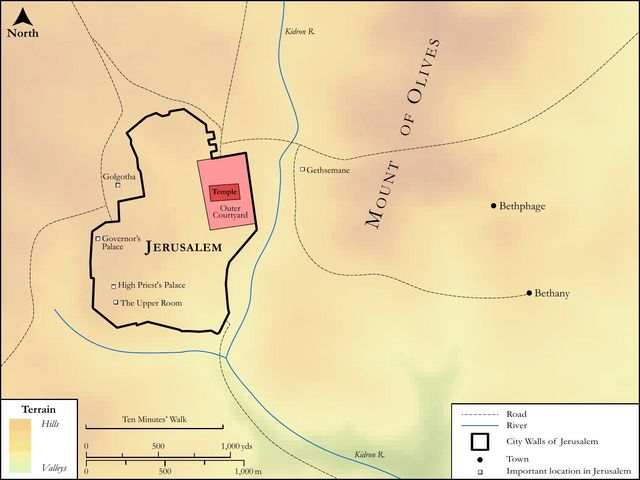
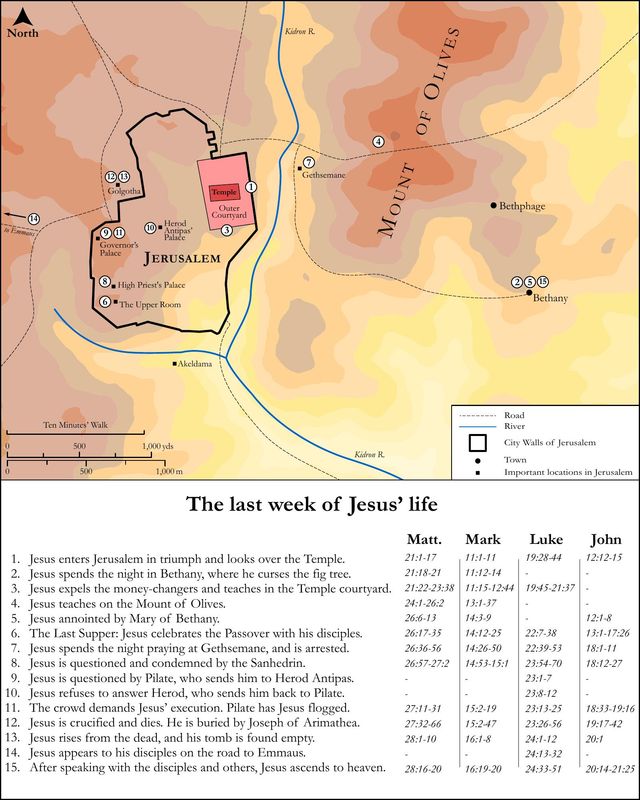
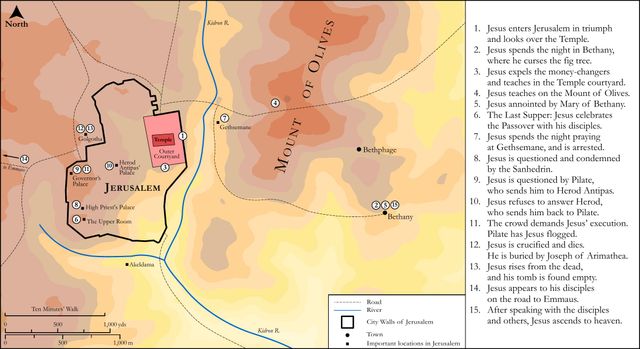
See on the biblical-era maps
Study this verse
Historical interpretation
Nineteen Centuries of Reception
12 surviving comments on this verse. Each one is dated, so this reads as a timeline rather than a list.
Select a marker to jump to its quote. Markers stagger vertically where authors wrote within a few decades of each other.
Watch for your life's sake. Let not your lamps be quenched, nor your loins unloosed; but be ye ready, for ye know not the hour in which our Lord cometh. But often shall ye come together, seeking the things which are befitting to your souls: for the whole time of your faith will not profit you, if ye be not made perfect in the last time. For in the last days false prophets and corrupters shall be multiplied, and the sheep shall be turned into wolves, and love shall be turned into hate; for when lawlessness increaseth, they shall hate and persecute and betray one another, and then shall appear the world-deceiver as Son of God, and shall do signs and wonders, and the earth shall be delivered into his hands, and he shall do iniquitous things which have never yet come to pass since the beginning. Then shall the creation of men come into the fire of trial, and many shall be made to stumble and shall perish; but they that endure in their faith shall be saved from under the curse itself. And then shall appear the signs of the truth; first, the sign of an out-spreading in heaven; then the sign of the sound of the trumpet; and the third, the resurrection of the dead; yet not of all, but as it is said: The Lord shall come and all His saints with Him. Then shall the world see the Lord coming upon the clouds of heaven.
The uninstructed refer the words to the destruction of Jerusalem, and suppose them to have been said of that generation which saw Christ's death, that it should not pass away before the city should be destroyed. But I doubt that they would succeed in thus expounding every word from that, one stone shall not be left upon another, to that, it is even at the door; in some perhaps they would succeed, in others not altogether.
Yet shall the generation of the Church survive the whole of this world, that it may inherit the world to come, yet it shall not pass away until all these things have come to pass.
Mystically; The Synagogue is likened to the fig treeg; its branch is Antichrist, the son of the Devil, the portion of sin, the maintainer of the law; when this shall begin to swell and to put forth leaves, then summer is nigh, i. e. the approach of the day of judgment shall be perceived.
To give sure credit to the things which should come to pass He adds, Verily I say unto you, this generation shall not pass away until all these things be fulfilled. By saying Verily, He gives asseveration to the truth.
For heaven and earth have in their constitution no necessity of existence, but Christ's words derived from eternity have in them such virtue that they must needs abide.
For in the last days false prophets shall be multiplied, and such as corrupt the word; and the sheep shall be changed into wolves, and love into hatred: for through the abounding of iniquity the love of many shall wax cold. For men shall hate, and persecute, and betray one another. And then shall appear the deceiver of the world, the enemy of the truth, the prince of lies, [2 Thessalonians 2:3-12] whom the Lord Jesus "shall destroy with the spirit of His mouth, who takes away the wicked with His lips; and many shall be offended at Him. But they that endure to the end, the same shall be saved. And then shall appear the sign of the Son of man in heaven;" [Isaiah 11:4; Matthew 24:1-51] and afterwards shall be the voice of a trumpet by the archangel; and in that interval shall be the revival of those that were asleep. And then shall the Lord come, and all His saints with Him, with a great concussion above the clouds, with the angels of His power, [Matthew 16:27] in the throne of His kingdom, to condemn the devil, the deceiver of the world, and to render to every one according to his deeds. "Then shall the wicked go away into everlasting punishment, but the righteous shall go into life eternal," [Matthew 25:46] to inherit those things "which eye has not seen, nor ear heard, nor have entered into the heart of man, such things as God has prepared for them that love Him;" [1 Corinthians 2:9] and they shall rejoice in the kingdom of God, which is in Christ Jesus.
After this, that they might not straightway return to it again, and say, "When?" he brings to their remembrance the things that had been said, saying, "Verily I say unto you, This generation shall not pass, till all these things be fulfilled!" All these things. What things? I pray thee. Those about Jerusalem, those about the wars, about the famines, about the pestilences, about the earthquakes, about the false Christs, about the false prophets, about the sowing of the gospel everywhere, the seditions, the tumults, all the other things, which we said were to occur until His coming. How then, one may ask, did He say, "This generation?" Speaking not of the generation then living, but of that of the believers. For He is wont to distinguish a generation not by times only, but also by the mode of religious service, and practice; as when He saith, "This is the generation of them that seek the Lord."
For what He said above, "All these must come to pass," and again, "the gospel shall be preached," this He declares here also, saying, All these things shall surely come to pass, and the generation of the faithful shall remain, cut off by none of the things that have been mentioned. For both Jerusalem shall perish, and the more part of the Jews shall be destroyed, but over this generation shall nothing prevail, not famine, not pestilence, not earthquake, nor the tumults of wars, not false Christs, not false prophets, not deceivers, not traitors, not those that cause to offend, not the false brethren, nor any other such like temptation whatever.
That the Lord calls His elect by His Angels pertains to the honour of the elect; and Paul also says that they shall be caught into the clouds; (1 Thes. 4:17.) that is, the Angels shall gather together those that have risen, and when they are gathered together, the clouds shall receive them.
(Hom. 77.) Because He had said that these things should come to pass immediately after the tribulation of those days, they might ask, How long time hence? He therefore gives them an instance in the fig
He shows that the interval of time shall not be great, but that the coming of Christ will be presently. By the comparison of the tree He signifies the spiritual summer and peace that the just shall enjoy after their winter, while sinners on the other hand shall have a winter after summer.
This analogy also adds credit to His foregoing discourse; for wherever He speaks of what must by all means come to pass, Christ ever brings forward parallel physical laws.
All these things therefore mean what was said of the end of Jerusalem, of the false prophets, and the false Christs, and all the rest which shall happen down to the time of Christ's coming. That He said, This generation, He meant not of the men then living, but of the generation of the faithful; for so Scripture uses to speak of generations, not of time only, but of place, life, and conversation; as it is said, This is the generation of them that seek the Lord. (Ps. 24:6.) Herein He teaches that Jerusalem shall perish, and the greater part of the Jews be destroyed, but that no trial shall overthrow the generation of the faithful.
He brings forward the elements of the earth to show that the Church is of more value than either heaven or earth, and that He is Maker of all things.
As much as to say, When the tender shoots first show themselves in the stem of the fig tree, and the bud bursts into flower, and the bark puts forth leaves, ye perceive the approach of summer and the season of spring and growth; so when ye shall see all these things that are written, do not suppose that the end of the world is immediate, but that certain monitory signs and precursors are showing its approach.
Or, by generation here He means the whole human race, and the Jews in particular. And He adds, Heaven and earth shall pass away, but my words shall not pass away, to confirm their faith in what has gone before; as though He had said, it is easier to destroy things solid and immovable, than that aught should fail of my words.
The heaven and the earth shall pass away by a change, not by annihilation; for how should the sun be darkened, and the moon not give her light, if earth and heaven in which these are should be no more?
(Verse 34) Truly I say to you, this generation will not pass away until all these things happen. Above, we mentioned the generations of the righteous and, on the contrary, the wicked being separate. Therefore, it either signifies all types of people or specifically the Jews.
Or, when this fig shall again bud, that is, when the synagogue shall receive the word of holy preaching, as the preaching of Enoch and Elias, then we ought to understand that the day of the consummation is at hand.
All these things are confirmed with great certainty when the sentence is added which says: "Amen I say to you, this generation shall not pass away until all things come to pass. Heaven and earth shall pass away, but my words shall not pass away."
The heaven which shall pass away is not the starry but the atmospheric heaven which of old was destroyed by the deluge.
But there is worse to come. Say what you like, we shall be told. The apocalyptic beliefs of the first Christians have been proved to be false. It is clear from the New Testament that they all expected the second coming in their own lifetime, and, worse still, they had a reason, and one which you will find very embarrassing. Their master had told them so. He shared, and indeed created, their delusion.
He said, in so many words, ‘This generation shall not pass till all these things be done.’ And he was wrong. He clearly knew no more about the end of the world than anyone else. It is certainly the most embarrassing verse in the Bible. Yet how teasing, also, that within fourteen words of it should come the statement, ‘But of that day and that hour knoweth no man, no, not the angels which are in heaven, neither the Son, but the Father.’ The one exhibition of error and the one confession of ignorance grow side by side.
That they stood thus in the mouth of Jesus Himself, and were not merely placed thus by the reporter, we surely need not doubt. Unless the reporter were perfectly honest, he would never have recorded the confession of ignorance at all. He could have had no motive for doing so except a desire to tell the whole truth. And unless later copyists were equally honest, they would never have preserved the apparently mistaken prediction about this generation after the passage of time had shown the apparent mistake.
This passage, Mark chapter 13, verses 30-32, and the cry, ‘Why hast Thou forsaken Me?’ Mark chapter 15, verse 34, together make up the strongest proof that the New Testament is historically reliable. The evangelists have the first great characteristic of honest witnesses. They mention facts which are, at first sight, damaging to their main contention.
The facts then are these, that Jesus professed Himself in some sense ignorant, and within a moment showed that He really was so. To believe in the Incarnation, to believe that He is God, makes it hard to understand how He could be ignorant, but also makes it certain that if He said He could be ignorant, then ignorant He could really be. For a God who can be ignorant is less baffling than a God who falsely professes ignorance.
The answer of theologians is that the God-Man was omniscient as God and ignorant as man. This, no doubt, is true, though it cannot be imagined. Nor, indeed, can the unconsciousness of Christ in sleep be imagined, nor the twilight of reason in His infancy. Still less is merely organic life in His mother’s womb.
But the physical sciences, no less than theology, propose for our belief much that cannot be imagined. A generation which has accepted the curvature of space need not boggle at the impossibility of imagining the consciousness of incarnate God. In that consciousness the temporal and the timeless were united. I think we can acquiesce in mystery at that point, provided we do not aggravate it by our tendency to picture the timeless life of God as simply another sort of time.
We are committing that blunder whenever we ask how Christ could be, at the same moment, ignorant and omniscient, or how He could be the God who neither slumbers nor sleeps while He slept. The italicized words conceal an attempt to establish a temporal relation between His timeless life as God and the days, months, and years of His life as man. And, of course, there is no such relation.
The incarnation is not an episode in the life of God. The Lamb is slain, and therefore presumably born, grown to maturity, and risen from all eternity. The taking up into God’s nature of humanity, with all its ignorance and limitations, is not itself a temporal event, though the humanity which is so taken up was, like our own, a thing living and dying in time.
And if limitation, and therefore ignorance, was thus taken up, we ought to expect that the ignorance should, at some time, be actually displayed. It would be difficult and, to me, repellent, to suppose that Jesus never asked a genuine question, that is, a question to which He did not know the answer. That would make of His humanity something so unlike ours as scarcely to deserve the name.
I find it easier to believe that when He said, ‘Who touched Me?’ Luke chapter 8, verse 45, He really wanted to know.
Continue studying Matthew 24:34 across the web’s major study libraries — every link below opens this exact verse, chapter, or book on the destination site.
Read & Compare
 BibleGatewayThis verse in more than 200 translations and 70 languages.
 Bible.comThe YouVersion reader — hundreds of translations, reading plans, and highlights.
 ESV.orgCrossway's official English Standard Version reader.
 NET BibleThe NET translation with 60,000+ translators' notes on every rendering decision.
 STEP BibleTyndale House's free study tool — original text, vocabulary, and scholarly resources.
 BibliaLogos Bible Software's free web reader.
 USCCBThe New American Bible (Revised Edition) with the U.S. bishops' study notes.
Commentaries
 BibleHub CommentariesDozens of classic commentaries on this verse, gathered on one page.
 StudyLightMore than 100 commentary sets — the largest collection on the web.
 BibleRefPlain-English commentary on what this verse means, verse by verse.
 Enduring WordDavid Guzik's free commentary on this chapter, widely used by Bible teachers.
 Bible Study ToolsVerse commentary alongside Greek and Hebrew study aids.
Original Language & Research
- BibleHub InterlinearThe verse word by word — original language, transliteration, and English.
- BibleHub LexiconEvery word's original-language definition and Strong's entry.
 Blue Letter BibleDeep-study tools — Strong's numbers, concordance, and word studies.
 CNTR CollationThe earliest Greek manuscripts of this verse, collated letter by letter.
Sermons, Hymns & Audio


TrulyRandomVerse is not affiliated with these sites and doesn’t control their content. They’re linked because they’re genuinely useful.
Summary
Matthew 24:34, a pivotal statement within Jesus's Olivet Discourse, serves as a critical interpretive key for understanding the timeframe and certainty of the prophecies He delivers concerning the end of the age and His glorious return. Through this emphatic declaration, Jesus assures His disciples that the unfolding of these significant eschatological events will occur within a specific, divinely appointed period, underscoring the absolute reliability of His prophetic words and the imminent nature of God's sovereign plan.
Context
ShowHideLiterary Context
Matthew 24:34 stands near the close of a significant section of Jesus's Olivet Discourse, which began with the disciples' questions about the destruction of the Temple and the signs of His coming and the end of the age (Matthew 24:3). Prior to this verse, Jesus describes a series of escalating tribulations and signs, including wars, famines, earthquakes, persecutions, the rise of false prophets, and the "abomination of desolation" (Matthew 24:15). These culminate in disturbances in the heavens and the glorious appearance of the Son of Man (Matthew 24:29-30). Immediately preceding verse 34, Jesus presents the parable of the fig tree (Matthew 24:32-33), illustrating that just as the budding fig tree signals the nearness of summer, so too will the unfolding of "all these things" signal the nearness of His coming. Verse 34 then provides a crucial temporal marker for these events.
Historical & Cultural Context
Jesus's discourse was delivered on the Mount of Olives, overlooking the magnificent Second Temple in Jerusalem, which the disciples had just admired (Matthew 24:1). The Jewish people of that era lived under Roman occupation, longing for the Messiah to deliver them and restore Israel's sovereignty. Their understanding of prophecy was deeply rooted in Old Testament texts, often anticipating a singular, cataclysmic "Day of the Lord" that would usher in the Messianic age. The destruction of the Temple, prophesied by Jesus, would have been an unthinkable catastrophe, as the Temple was the spiritual and national heart of Judaism. The disciples' questions reflect their immediate concerns about these momentous events and their connection to the end of the age, a concept deeply intertwined with Jewish apocalyptic expectations and the coming of God's kingdom.
Key Themes
ShowHideMatthew 24:34 contributes significantly to several overarching themes in the Olivet Discourse and the Gospel of Matthew. Foremost is the Certainty of Prophecy, as Jesus's emphatic "Verily I say unto you" underscores the absolute truth and reliability of His words, contrasting with the deception of false prophets He warned against earlier (Matthew 24:11). The verse also highlights the Imminence of God's Plan, emphasizing that while the exact day and hour remain unknown (Matthew 24:36), the unfolding of events will be swift and decisive once the signs begin. Furthermore, it speaks to the theme of Divine Sovereignty over History, assuring believers that God is in complete control of all historical developments, guiding them towards His ultimate redemptive purposes. Finally, the discourse, including this verse, calls for Vigilance and Readiness, urging disciples to be watchful and prepared for the Master's return, like the wise servants in the parables that follow (Matthew 24:45-51).
Exposition and Analysis
ShowHideKey Word Analysis
ShowHideFrom Hebrew origin, meaning "firm" or "trustworthy." As an adverb, it signifies "surely" or "truly." Here, Jesus uses it to introduce a statement of utmost certainty and solemnity, emphasizing the absolute truthfulness and reliability of what He is about to declare. It functions as a divine oath, guaranteeing the fulfillment of His words.
Derived from a word meaning "birth" or "race." It can refer to a group of people born at the same time (contemporaries), a particular lineage or race (like the Jewish people), or a specific kind or class of people, often with a moral connotation (e.g., "a wicked generation"). The ambiguity of this term is central to the interpretive debates surrounding Matthew 24:34.
A versatile verb meaning "to cause to be," "to become," or "to come into being." In this context, it signifies that "all these things" will "come to pass" or "be accomplished." It denotes the full realization and completion of the events and prophecies Jesus has just described, leaving no detail unfulfilled.
Verse Breakdown
ShowHide"Verily I say unto you"
This is Jesus's characteristic emphatic declaration, often translated as "Truly, truly, I say to you" in John's Gospel. It signals a statement of profound importance and absolute truth, demanding the disciples' full attention and belief in the certainty of what follows. It underscores the divine authority behind His prophecy.
"This generation shall not pass"
This clause introduces the crucial temporal element. "This generation" refers to the specific group of people Jesus is addressing or referring to, but its precise scope is debated. "Shall not pass" signifies that this generation will not cease to exist or die out before the subsequent events unfold. It establishes a fixed timeframe, indicating that the fulfillment will occur within the lifetime or existence of this designated "generation."
"till all these things be fulfilled"
This phrase defines the scope of the events that must come to pass before "this generation" passes away. "All these things" refers comprehensively to the signs, tribulations, and events in the heavens Jesus has just detailed in the preceding verses of the Olivet Discourse, culminating in the appearance of the Son of Man. The verb "be fulfilled" indicates their complete and comprehensive accomplishment.
Literary Devices
ShowHideMatthew 24:34 employs several potent literary devices. The phrase "Verily I say unto you" functions as an Emphatic Affirmation, a rhetorical device Jesus frequently uses to underscore the absolute truth and divine authority of His pronouncements. It elevates the statement to the level of undeniable certainty. The entire verse is an example of Prophetic Language, characteristic of biblical eschatology, where future events are declared with certainty, often employing symbolic or condensed phrasing that requires careful interpretation. The use of "this generation" and "all these things" creates a degree of Ambiguity, a common feature in prophetic texts that allows for multiple layers of fulfillment or for the message to resonate across different historical periods, while simultaneously challenging interpreters to discern the precise meaning intended by the speaker. This ambiguity, however, does not negate the certainty of the prophecy's fulfillment, but rather shapes the ongoing interpretive dialogue.
Theological and Thematic Connections
ShowHideMatthew 24:34 stands as a powerful testament to the infallibility of God's Word and the certainty of His redemptive plan. It assures believers that divine prophecy is not mere speculation but a guaranteed unfolding of God's will in history. The debates surrounding "this generation" highlight the tension between the "already" and the "not yet" of God's kingdom—the initial fulfillment in the first century and the ultimate consummation at Christ's return. Regardless of the specific interpretation of the timeframe, the verse firmly establishes Jesus's absolute authority over history and His ultimate triumph. It calls believers to a life of expectant watchfulness, not fear, knowing that all things are moving towards the glorious revelation of God's perfect plan.
Reflection and Application
ShowHideMatthew 24:34, while historically and theologically complex, offers profound spiritual nourishment for believers today. It calls us to live with a deep sense of trust in God's sovereign control over all of history. In a world often characterized by uncertainty, chaos, and fear, Jesus's declaration reminds us that His words are utterly reliable and His promises will be fulfilled. This should cultivate within us a patient endurance, knowing that the trials and tribulations of the present age are not random but are part of a divinely orchestrated plan leading to a glorious culmination. Rather than engaging in speculative date-setting, the verse urges us to cultivate a posture of active vigilance, living each day in light of Christ's certain return, striving to be faithful stewards of the gospel and His kingdom until He comes. It is a call to hope, perseverance, and unwavering faith in the One who holds all time in His hands.
Questions for Reflection
ShowHideFAQ
ShowHideWhat are the main interpretations of "this generation" in Matthew 24:34?
ShowHideThe phrase "this generation" (Greek: geneá) is the subject of significant scholarly debate, leading to several prominent interpretations. One view holds that it refers to the contemporary generation of Jesus's time, suggesting that "all these things" primarily refer to the destruction of Jerusalem and the Temple in AD 70, along with the initial signs and tribulations that preceded it. Another interpretation understands "this generation" as referring to the Jewish race or people, meaning that the Jewish nation would not pass away as a distinct entity until all the prophecies, including the Second Coming of Christ, are fulfilled. A third common view is that "this generation" refers to the generation that will be alive when the final signs of Christ's return begin to unfold, implying that once these signs appear, that particular generation will not pass away before the ultimate fulfillment of His coming. Finally, some interpret "this generation" as referring to a persistent "kind" of unbelieving or wicked people, suggesting that this moral "kind" of generation will continue to exist until all things are fulfilled.
What does "all these things" refer to in this verse?
ShowHide"All these things" refers to the comprehensive list of events and signs that Jesus describes in the preceding verses of the Olivet Discourse, specifically Matthew 24:4-31. This includes a variety of phenomena: the rise of false Christs and prophets, wars, famines, earthquakes, widespread persecution of believers, the preaching of the gospel to all nations, the "abomination of desolation" (Matthew 24:15), great tribulation, and disturbances in the heavens like the darkening of the sun and moon. The culmination of "all these things" is the glorious appearance of the Son of Man coming on the clouds with power and great glory (Matthew 24:30). The scope of "all these things" is therefore broad, encompassing both historical events and future eschatological climaxes.
Christ-Centered Fulfillment
ShowHideWhile Matthew 24:34 specifically addresses the timing of eschatological events, its ultimate fulfillment is profoundly Christ-centered. Jesus, as the divine Prophet and King, is the very embodiment of the prophecies He delivers. His first coming, marked by His birth, life, death, and resurrection, initiated the "last days" and set in motion the divine timetable for all subsequent events. The destruction of the Temple in AD 70, often seen as a partial fulfillment of "all these things," underscored Jesus's prophetic authority and the shift from the Old Covenant to the New Covenant established in His blood (Hebrews 8:6-13). Ultimately, "all these things" find their complete and final fulfillment in Christ's glorious second coming, when He will return as the triumphant Son of Man (Revelation 1:7) to judge the living and the dead, establish His eternal kingdom, and fully consummate His redemptive work (Revelation 11:15). Thus, Matthew 24:34 is not merely about a timeline but about the unwavering certainty of Christ's sovereign reign and His ultimate victory over all things, bringing to completion God's plan for humanity and creation.