


Luke 21:32
Bible text: King James Version (1769 Blayney text) · Public domain
Bible text: Berean Standard Bible · Public domain
Bible text: American Standard Version (1901) · Public domain
Bible text: World English Bible, Messianic edition · Public domain
Bible text: Geneva Bible (1599) · Public domain
Bible text: Young's Literal Translation · Public domain
- ἈμὴνAmēnAmenG281INJ-HEBInterjection
- λέγωlegōI sayG3004V-PAI-1SVerb Present Active Indicative 1st Singular
- ὑμῖνhuminto youG4771P-2DPPersonal pronoun Dative 2nd Plural
- ὅτιhotithatG3754CONJConjunction
- οὐoucertainlyG3756PRT-NNegative Particle Negative
- μὴmēnotG3361PRT-NNegative Particle Negative
- παρέλθῃparelthēmay have passed awayG3928V-2AAS-3SVerb 2nd Aorist Active Subjunctive 3rd Singular
- ἡhē<the>G3588T-NSFDefinite article Nominative Singular Feminine
- γενεὰgeneagenerationG1074N-NSFNoun Nominative Singular Feminine
- αὕτηhautēthisG3778D-NSFDemonstrative pronoun Nominative Singular Feminine
- ἕωςhe'ōsuntilG2193PREPPreposition
- ἂνanwhenG302PRTParticle or Disjunctive
- πάνταpantaall [these things]G3956A-NPNAdjective Nominative Plural Neuter
- γένηταιgenētaimay happenG1096V-2ADS-3SVerb 2nd Aorist Middle Deponent Subjunctive 3rd Singular
English is a literal word-by-word gloss of the Greek, not the KJV's wording. Why?
This is the original text the KJV's translators worked from — each Greek word with its own literal English meaning in this verse, prepared by scholars at Tyndale House, Cambridge. The KJV translates whole sentences, not word by word, so its wording differs: one Greek word can become several English words, and the KJV may choose “charity” where the gloss reads “love”. Both are faithful — they answer different questions. For the KJV's own rendering, switch to the KJV text.
Details
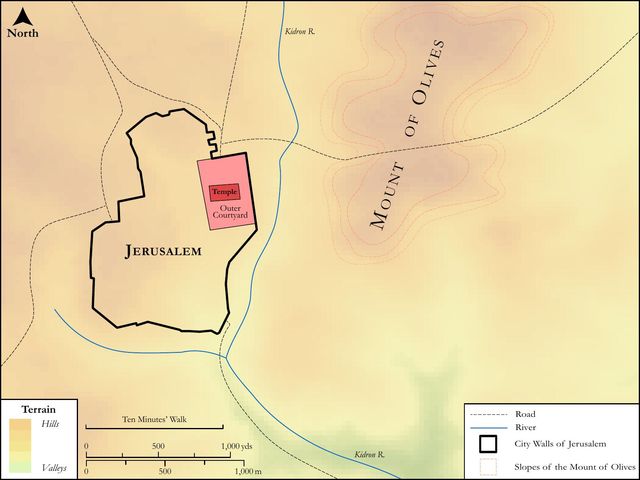
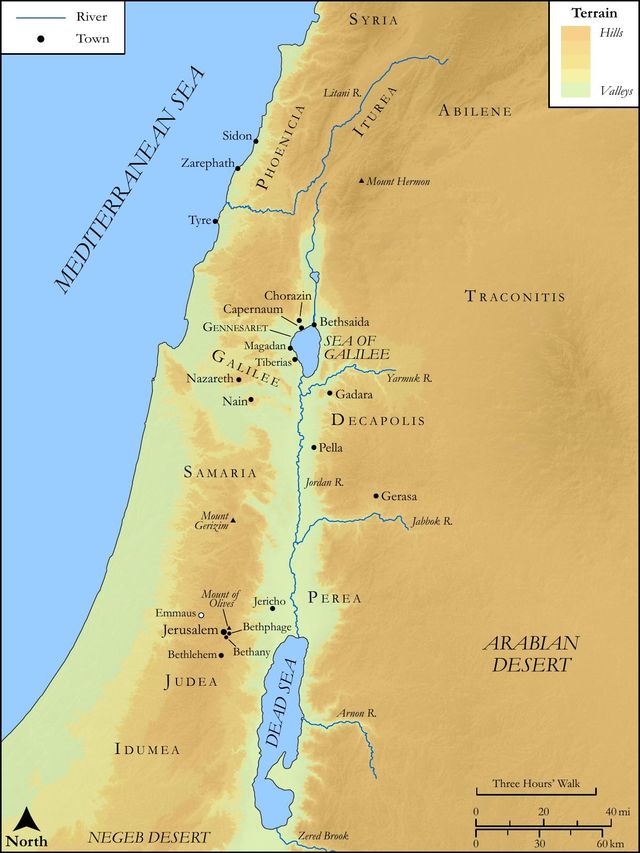
See on the biblical-era maps

Study this verse
Public-domain commentary
Matthew Henry
From his Commentary on the Whole Bible. Henry comments on passages, not single verses — this entry covers Luke 21:29–38. His two-level outline is real structure in the source text, so it is rendered as structure.
Here, in the close of this discourse,
I.Christ appoints his disciples to observe the signs of the times, which they might judge by, if they had an eye to the foregoing directions, with as much certainty and assurance as they could judge of the approach of summer by the budding forth of the trees, Luk 21:29-31. As in the kingdom of nature there is a chain of causes, so in the kingdom of providence there is a consequence of one event upon another. When we see a nation filling up the measure of their iniquity, we may conclude that their ruin is nigh; when we see the ruin of persecuting powers hastening on, we may thence infer that the kingdom of God is nigh at hand, that when the opposition given to it is removed it shall gain ground. As we may lawfully prognosticate the change of the seasons when second causes have begun to work, so we may, in the disposal of events, expect something uncommon when God is already raised up out of his holy habitation (Zac 2:13); then stand still and see his salvation.
II.He charges them to look upon those things as neither doubtful nor distant (for then they would not make a due impression on them), but as sure and very near. The destruction of the Jewish nation,
1.Was near (Luk 21:32): This generation shall not pass away till all be fulfilled. There were some now alive that should see it; some that now heard the prediction of it.
2.It was sure; the sentence was irreversible; it was a consumption determined; the decree was gone forth (Luk 21:33): "Heaven and earth shall pass away sooner than any word of mine: nay, they certainly shall pass away, but my words shall not; whether they take hold or no, they will take effect, and not one of them fall to the ground," Sa1 3:19.
III.He cautions them against security and sensuality, by which they would unfit themselves for the trying times that were coming on, and make them to be a great surprise and terror to them (Luk 21:34, Luk 21:35): Take heed to yourselves. This is the word of command given to all Christ's disciples: "Take heed to yourselves, that you be not overpowered by temptations, nor betrayed by your own corruptions." Note, We cannot be safe if we be secure. It concerns us at all times, but especially at some times, to be very cautious. See here,
1.What our danger is: that the day of death and judgment should come upon us unawares, when we do not expect it, and are not prepared for it, - lest, when we are called to meet our Lord, that be found the furthest thing from our thoughts which ought always to be laid nearest our hearts, lest it come upon us as a snare; for so it will come upon the most of men, who dwell upon the earth, and mind earthly things only, and have no converse with heaven; to them it will be as a snare. See Ecc 9:12. It will be a terror and a destruction to them; it will put them into an inexpressible fright, and hold them fast for a doom yet more frightful.
2.What our duty is, in consideration of this danger: we must take heed lest our hearts be overcharged, lest they be burdened and overloaded, and so unfitted and disabled to do what must be done in preparation for death and judgment. Two things we must watch against, lest our hearts be overcharged with them: - (1.) The indulging of the appetites of the body, and allowing of ourselves in the gratifications of sense to an excess: Take heed lest you be overcharged with surfeiting and drunkenness, the immoderate use of meat and drink, which burden the heart, not only with the guilt thereby contracted, but by the ill influence which such disorders of the body have upon the mind; they make men dull and lifeless to their duty, dead and listless in their duty; they stupify the conscience, and cause the mind to be unaffected with those things that are most affecting. (2.) The inordinate pursuit of the good things of this world. The heart is overcharged with the cares of this life. The former is the snare of those that are given to their pleasures: this is the snare of the men of business, that will be rich. We have need to guard on both hands, not only lest at the time when death comes, but lest at any time our hearts should be thus overcharged. Our caution against sin, and our care of our own souls, must be constant.
IV.He counsels them to prepare and get ready for this great day, Luk 21:36. Here see,
1.What should be our aim: that we may be accounted worthy to escape all these things; that, when the judgments of God are abroad, we may be preserved from the malignity of them; that either we may not be involved in the common calamity or it may not be that to us which it is to others; that in the day of death we may escape the sting of it, which is the wrath of God, and the damnation of hell. Yet we must aim not only to escape that, but to stand before the Son of man; not only to stand acquitted before him as our Judge (Psa 1:5), to have boldness in the day of Christ (that is supposed in our escaping all those things), but to stand before him, to attend on him as our Master, to stand continually before his throne, and serve him day and night in his temple (Rev 7:15), always to behold his face, as the angels, Mat 18:10. The saints are here said to be accounted worthy, as before, Luk 20:35. God, by the good work of his grace in them, makes them meet for this happiness, and, by the good will of his grace towards them, accounts them worthy of it: but, as Grotius here says, a great part of our worthiness lies in an acknowledgment of our own unworthiness.
2.What should be our actings in these aims: Watch therefore, and pray always. Watching and praying must go together, Neh 4:9. Those that would escape the wrath to come, and make sure of the joys to come, must watch and pray, and must do so always, must make it the constant business of their lives, (1.) To keep a guard upon themselves. "Watch against sin, watch to every duty, and to the improvement of every opportunity of doing good. Be awake, and keep awake, in expectation of your Lord's coming, that you may be in a right frame to receive him, and bid him welcome." (2.) To keep up their communion with God: "Pray always; be always in an habitual disposition to that duty; keep up stated times for it; abound in it; pray upon all occasions." Those shall be accounted worthy to live a life of praise in the other world that live a life of prayer in this world.
V.In the last two verses we have an account how Christ disposed of himself during those three or four days between his riding in triumph into Jerusalem and the night in which he was betrayed.
1.He was all day teaching in the temple. Christ preached on week-days as well as sabbath days. He was an indefatigable preacher; he preached in the face of opposition, and in the midst of those that he knew sought occasion against him.
2.At night he went out to lodge at a friend's house, in the mount of Olives, about a mile out of town. It is probable that he had some friends in the city that would gladly have lodged him, but he was willing to retire in the evening out of the noise of the town, that he might have more time for secret devotion, now that his hour was at hand.
3.Early in the morning he was in the temple again, where he had a morning lecture for those that were willing to attend it; and the people were forward to hear one that they saw forward to preach (Luk 21:38): They all came early in the morning, flocking to the temple, like doves to their windows, to hear him, though the chief priests and scribes did all they could to prejudice them against him. Sometimes the taste and relish which serious, honest, plain people have of good preaching are more to be valued and judged by than the opinion of the witty and learned, and those in authority.
Historical interpretation
Eight Centuries of Reception
11 surviving comments on this verse. Each one is dated, so this reads as a timeline rather than a list.
Select a marker to jump to its quote. Markers stagger vertically where authors wrote within a few decades of each other.
Beloved brothers and sisters, whoever serves as a soldier of God stationed in the camp of heaven already hopes for the divine things. He should recognize himself so that we should have no fear or dread at the storms and whirlwinds of the world. Through the encouragement of his provident voice, the Lord predicted that these things would come when he was instructing, teaching, preparing and strengthening the people of his church to endure everything to come. Christ foretold and prophesied that wars, famine, earthquakes and epidemics would arise in the various places. So that an unexpected and new fear of destructive agencies might not shake us, he forewarned that adversity would increase in the last times. Note that the things that were spoken of are happening. Since the things that were foretold are happening, whatever he promises will also follow. The Lord himself promises, “When you shall see these things come to pass, know that the kingdom of God is at hand.” The kingdom of God, beloved brothers and sisters, has drawn near. The reward of life, the joy of eternal salvation, the perpetual happiness and the possession of paradise once lost are now coming as the world passes away.
Or else, To those that have passed through the body and bodily things, shall be present spiritual and heavenly bodies: that is, they will have no more to pass the kingdom of the world, and then to those that are worthy shall be given the promises of salvation. For having received the promises of God which we look for, we who before were crooked shall be made upright, and we shall lift up our heads who were before bent low; because the redemption which we hoped for is at hand; that namely for which the whole creation waiteth.
He speaks these things to His disciples, not as to those who would continue in this life to the end of the world, but as if uniting in one body of believers in Christ both themselves and us and our posterity, even to the end of the world.
For as in this life, when winter dies away, and spring succeeds, the sun sending forth its warm rays cherishes and quickens the seeds hid in the ground, just laying aside their first form, and the young plants sprout forth, having put on different shades of green; so also the glorious coming of the Only-begotten of God, illuminating the new world with His quickening rays, shall bring forth into light from more excellent bodies than before the seeds that have long been hidden in the whole world, i. e. those who sleep in the dust of the earth. And having vanquished death, He shall reign from henceforth the life of the new world.
Or by generation He means the new generation of His holy Church, showing that the generation of the faithful would last up to that time, when it would see all things, and embrace with its eyes the fulfilment of our Saviour's words.
Or else, He says, the kingdom of God is at hand, meaning that when these things shall be, not yet shall all things come to their last end, but they shall be already tending towards it. For the very coming of our Lord itself, casting out every principality and power, is the preparation for the kingdom of God.
You see him in the clouds. I certainly do not think that Christ will come in the darkness of mist and the chill of rain. The clouds are visible and surely cover the heaven in foggy cold. How has he set his tabernacle in the sun if his coming brings the rain? Some clouds suitably cover the radiance of the heavenly mystery. Some clouds grow moist with the dew of spiritual grace. Consider the cloud in the Old Testament. “He spoke to them,” it says, “in a pillar of cloud.” … He comes in a calm cloud in the Song of Songs, shining with the joy of a bridegroom. He also comes in a swift light cloud, incarnate of the Virgin. The prophet saw him as a cloud coming from the east. He fittingly said, “a light cloud,” that earthly vices would not weigh down. See the cloud upon which the Holy Spirit came and the power of the Most High overshadowed. When Christ will appear in the clouds, the tribes of the earth will grieve over themselves.
Matthew speaks of the fig-tree only, Luke of all the trees. But the fig-tree shadows forth two things, either the ripening of what is hard, or the luxuriance of sin; that is, either that, when the fruit bursts forth in all trees and the fruitful fig-tree abounds, (that is, when every tongue confesses God, even the Jewish people confessing Him,) we ought to hope for our Lord's coming, in which shall be gathered in as at summer the fruits of the resurrection. Or, when the man of sin shall clothe himself in his light and fickle boasting as it were the leaves of the synagogue, we must then suppose the judgment to be drawing near. For the Lord hastens to reward faith, and to bring an end of sinning.
The fig tree therefore has a double meaning: when the wild is tamed or when sins abound. Like the believer’s faith that shriveled up before it will flower, so also sinners will glory through the grace of their transgressions. On the one hand is the fruit of faith, and on the other the lewdness of unbelief. The gardening of the Evangelist as farmer produces the fruit of the fig tree for me. We must not despair if sinners cover themselves with the leaves of the fig tree as with a garment of deceit, so that they may veil their conscience. Leaves without fruit are therefore suspicious.
All these things are confirmed with great certainty when the sentence is added which says: "Amen I say to you, this generation shall not pass away until all things come to pass. Heaven and earth shall pass away, but my words shall not pass away."
(ut sup.) For in power and majesty will men see Him, whom in lowly stations they refused to hear, that so much the more acutely they may feel His power, as they are now the less willing to bow the necks of their hearts to His sufferings.
(Hom. 1. in Ev.) Having in what has gone before spoken against the reprobate, He now turns His words to the consolation of the elect; for it is added, When these things begin to be, look up, and lift up your heads, for your redemption draweth nigh; as if he says, When the buffettings of the world multiply, lift up your heads, that is, rejoice your hearts, for when the world closes whose friends ye are not, the redemption is near which ye seek. For in holy Scripture the head is often put for the mind, for as the members are ruled by the head, so are the thoughts regulated by the mind. To lift up our heads then, is to raise up our minds to the joys of the heavenly country.
(ut sup.) That the world ought to be trampled upon and despised, He proves by a wise comparison, adding, Behold the fig tree and all the trees, when they now put forth fruit, ye know that summer is near. As if He says, As from the fruit of the tree the summer is perceived to be near, so from the fall of the world the kingdom of God is known to be at hand. Hereby is it manifested that the world's fall is our fruit. For hereunto it puts forth buds, that whomsoever it has fostered in the bud it may consume in slaughter. But well is the kingdom of God compared to summer; for then the clouds of our sorrow flee away, and the days of life brighten up under the clear light of the Eternal Sun.
(in Hom. 1. in Ev.) But all the things before mentioned are confirmed with great certainty, when He adds, Verily I say unto you, &c.
(ut sup.) Or else, The heaven and earth shall pass away, &c. As if He says, All that with us seems lasting, does not abide to eternity without change, and all that with Me seems to pass away is held fixed and immoveable, for My word which passeth away utters sentences which remain unchangeable, and abide for ever.
He strongly commends that which he thus foretels. And, if one may so speak, his oath is this, Amen, I say unto you. Amen is by interpretation "true." Therefore the truth says, I tell you the truth, and though He spoke not thus, He could by no means lie. But by generation he means either the whole human race, or especially the Jews.
But by the heaven which shall pass away we must understand not the æthereal or the starry heaven, but the air from which the birds are named "of heaven." But if the earth shall pass away, how does Ecclesiastes say, The earth standeth for ever? (Ecc. 1:4.) Plainly then the heaven and earth in the fashion which they now have shall pass away, but in essence subsist eternally.
Amen, I say to you, that this generation will not pass away until all these things take place. Indeed, the Lord greatly emphasizes what He thus pronounces. In a way, if it is permitted to say, it is His oath: Amen, I say to you. For Amen is interpreted as true, and yet it is not interpreted, since it could have been said "I tell you the truth," neither the Greek interpreter dared to do this, nor the Latin. Thus it remained, it is not interpreted, so that it might have the honor of a secret veil, not that it is denied, but lest it should be cheapened if exposed. Therefore "I tell you the truth" is said by the Truth, which indeed even if it did not say so, it could not lie altogether. Nevertheless, He emphasizes, He insists, He somehow awakens those who are asleep, He makes them attentive, He does not wish to be disregarded: "Amen," He says, "I say to you, that this generation will not pass away until all these things take place." Now He either means every human generation, or specifically the generation of the Jews.
That is, perfect liberty of body and soul. For as the first coming of our Lord was for the restoration of our souls, so will the second be manifested unto the restoration of our bodies.
For because He had foretold that there should be commotions, and wars, and changes, both of the elements and in other things, lest any one might suspect that Christianity itself also would perish, He adds, Heaven and earth shall pass away, but my words shall not pass away: as if He said, Though all things should be shaken, yet shall my faith fail not. Whereby He implies that He sets the Church before the whole creation. The creation shall suffer change, but the Church of the faithful and the words of the Gospel shall abide for ever.
Continue studying Luke 21:32 across the web’s major study libraries — every link below opens this exact verse, chapter, or book on the destination site.
Read & Compare
 BibleGatewayThis verse in more than 200 translations and 70 languages.
 Bible.comThe YouVersion reader — hundreds of translations, reading plans, and highlights.
 ESV.orgCrossway's official English Standard Version reader.
 NET BibleThe NET translation with 60,000+ translators' notes on every rendering decision.
 STEP BibleTyndale House's free study tool — original text, vocabulary, and scholarly resources.
 BibliaLogos Bible Software's free web reader.
 USCCBThe New American Bible (Revised Edition) with the U.S. bishops' study notes.
Commentaries
 BibleHub CommentariesDozens of classic commentaries on this verse, gathered on one page.
 StudyLightMore than 100 commentary sets — the largest collection on the web.
 BibleRefPlain-English commentary on what this verse means, verse by verse.
 Enduring WordDavid Guzik's free commentary on this chapter, widely used by Bible teachers.
 Bible Study ToolsVerse commentary alongside Greek and Hebrew study aids.
Original Language & Research
- BibleHub InterlinearThe verse word by word — original language, transliteration, and English.
- BibleHub LexiconEvery word's original-language definition and Strong's entry.
 Blue Letter BibleDeep-study tools — Strong's numbers, concordance, and word studies.
 CNTR CollationThe earliest Greek manuscripts of this verse, collated letter by letter.
Sermons, Hymns & Audio


TrulyRandomVerse is not affiliated with these sites and doesn’t control their content. They’re linked because they’re genuinely useful.
Summary
Luke 21:32, a pivotal verse within Jesus' Olivet Discourse, serves as a solemn declaration of the absolute certainty and imminent fulfillment of the prophecies He has just delivered. It assures His disciples that the events foretold—ranging from the destruction of Jerusalem to the signs in the heavens preceding His glorious return—will undeniably come to pass within a specific, though debated, timeframe encapsulated by the phrase "this generation." This statement underscores divine sovereignty and the unwavering reliability of God's prophetic word.
Context
ShowHideLiterary Context
Luke 21:32 is situated at the climax of Jesus' extensive prophetic discourse, often referred to as the Olivet Discourse, which begins in Luke 21:5 with His disciples' admiration for the Temple. Jesus immediately prophesies its destruction, then warns of future tribulations, persecutions, and global upheavals (Luke 21:7-19). He then gives a specific prophecy concerning the siege and destruction of Jerusalem, followed by descriptions of signs in the heavens and His glorious return as the Son of Man (Luke 21:25-28). Immediately preceding verse 32 is the parable of the fig tree (Luke 21:29-31), which illustrates that just as the budding of a fig tree signals the nearness of summer, so too will the appearance of these signs indicate the nearness of the Kingdom of God. Verse 32 acts as the emphatic conclusion to this prophetic sequence, affirming its certain fulfillment, before Jesus transitions to exhortations for watchfulness and prayer (Luke 21:33-36).
Historical & Cultural Context
Jesus delivered this discourse on the Mount of Olives, overlooking Jerusalem and its magnificent Temple, a structure that symbolized Jewish identity and God's presence. At the time, Judea was under Roman occupation, a reality that fueled messianic expectations and hopes for liberation among the Jewish people. Prophecies of national destruction and a coming Messiah were deeply embedded in Jewish thought, drawing from Old Testament prophets like Daniel and Isaiah. The idea of "this generation" would have resonated with the immediate audience, who were keenly aware of the political tensions and the potential for upheaval. The subsequent fulfillment of the prophecy regarding Jerusalem's destruction in A.D. 70 by the Roman general Titus, a mere 40 years after Jesus' words, provides a significant historical anchor for understanding at least part of this prophecy's scope.
Key Themes
ShowHideThis verse contributes significantly to several major theological and narrative themes within Luke's Gospel and biblical eschatology. First, it powerfully asserts the Divine Certainty of God's prophetic word, emphasizing that what Jesus declares will undoubtedly come to pass. This theme is reinforced by the authoritative introduction, "Verily I say unto you." Second, it introduces the complex and highly debated theme of The Enigma of "This Generation," which has led to diverse interpretations regarding the timing and scope of the prophecies, encompassing both near-term events (like Jerusalem's fall) and far-term events (like Christ's Second Coming). Third, the verse highlights the Inescapable Fulfillment of God's plan, regardless of human understanding or timeline, underscoring God's sovereignty over history. Finally, it implicitly calls for Watchfulness and Readiness, a theme explicitly developed in the verses immediately following Luke 21:33-36, as believers are to live in anticipation of these certain events.
Exposition and Analysis
ShowHideKey Word Analysis
ShowHideFrom Hebrew origin, meaning "firm," "trustworthy," or "surely." When Jesus uses "Amen" (translated "Verily") to introduce a statement, it functions as a solemn affirmation of absolute truth and authority, underscoring the unwavering certainty and divine origin of His words. It demands attention and belief.
This word, derived from génos (race, stock), can refer to a group of people living at the same time (a contemporary generation), a lineage or race (e.g., the Jewish people), or even a particular class of people. Its precise meaning in this context is the subject of considerable scholarly debate, leading to varying interpretations of the verse's timing.
This verb means "to come into being," "to become," "to happen," or "to be brought to pass." In the context of prophecy, it signifies the complete and certain accomplishment of what has been foretold, emphasizing that every detail will materialize precisely as declared.
Verse Breakdown
ShowHide"Verily I say unto you,"
This authoritative declaration, marked by the solemn "Verily" (Greek amēn), signals an absolute truth statement from Jesus. It emphasizes the divine certainty and unwavering reliability of the prophecy that follows, demanding the listener's full attention and belief.
"This generation"
This phrase is the interpretive crux of the verse. It refers to a specific group of people, but its precise scope is debated: some understand it as the contemporary generation of Jesus' time (who would witness the destruction of Jerusalem); others, as the generation that witnesses the beginning of the end-time signs; and still others, as the enduring Jewish people or race throughout history.
"shall not pass away,"
This signifies that the identified "generation" will not cease to exist, disappear, or die out. It conveys an assurance of continuity or endurance until the stated condition is met, highlighting the unalterable nature of the divine timetable.
"till all be fulfilled."
This clause indicates the culmination point. "All" refers comprehensively to the entire sequence of prophecies Jesus has just delivered in the Olivet Discourse—from the destruction of the Temple and Jerusalem to the signs in the heavens and His glorious Second Coming. It means that the designated "generation" will remain until every single one of these predicted events has come to pass.
Literary Devices
ShowHideLuke 21:32 employs several significant literary devices that amplify its meaning and impact. The most prominent is Prophecy, as the entire Olivet Discourse is a future-oriented declaration of events to come, with this verse serving as a powerful affirmation of their certainty. Emphasis is conveyed through the opening "Verily I say unto you," using the Greek amēn, which functions as an authoritative oath or solemn declaration, underscoring the absolute truthfulness and divine origin of Jesus' words. This rhetorical device compels the listener to pay close attention. Furthermore, the phrase "this generation" introduces a degree of Ambiguity, which has led to centuries of theological debate. Whether intentional or inherent in the nature of prophetic language, this ambiguity allows the prophecy to resonate across different historical periods and interpretations, keeping the church in a state of watchful expectation. Finally, there is an element of Hyperbole or strong assertion in the definitive nature of "shall not pass away," which powerfully conveys the unyielding nature of God's plan.
Theological and Thematic Connections
ShowHideLuke 21:32 stands as a profound testament to God's unwavering faithfulness and the absolute reliability of His prophetic word. It assures believers that divine promises and warnings are not idle threats or mere possibilities, but certainties that will unfold precisely according to God's sovereign timetable. The tension inherent in the interpretation of "this generation" serves to maintain a posture of ongoing watchfulness within the church, preventing complacency while discouraging rigid date-setting. This verse underscores that history is not random but is moving towards a divinely appointed climax, culminating in the full establishment of God's Kingdom. It calls believers to live with a deep trust in God's control, even amidst global turmoil and uncertainty, knowing that His ultimate plan will be perfectly fulfilled.
Reflection and Application
ShowHideLuke 21:32 calls us to a posture of profound trust and active watchfulness. The certainty of Jesus' words should instill in us an unshakeable confidence in God's sovereignty over all of history, from the rise and fall of nations to the signs in the heavens at the end of the age. This confidence liberates us from anxiety about the future, allowing us to rest in the assurance that God's plan is unfolding precisely as He intends. Rather than fueling speculative date-setting or sensationalism, this verse should inspire a deep spiritual readiness, prompting us to live lives of holiness, mission, and faithful stewardship. It reminds us that our primary call is not to decipher every detail of the prophetic timeline, but to be found faithful, serving Christ and loving our neighbors, as we await His glorious return. The imminence of "all being fulfilled" should motivate us to live each day with eternal perspective, prioritizing what truly matters in light of God's ultimate victory.
Questions for Reflection
ShowHideFAQ
ShowHideWhat are the main interpretations of "this generation" in Luke 21:32?
ShowHideThe phrase "this generation" (Greek: geneá) in Luke 21:32 is one of the most debated in biblical prophecy, leading to three primary interpretations:
Each interpretation grapples with the tension between the immediate historical fulfillment of some prophecies (like A.D. 70) and the yet-to-be-fulfilled eschatological events.
Christ-Centered Fulfillment
ShowHideLuke 21:32, while seemingly focused on a timeline, ultimately points to Christ as the central figure and ultimate fulfiller of all prophecy. Jesus is not merely the messenger of these certainties; He is the very subject and guarantor of their fulfillment. His authoritative "Verily I say unto you" underscores His divine nature and His absolute control over history, demonstrating that He is the Alpha and the Omega, the beginning and the end, who declares the end from the beginning (Revelation 1:8; Isaiah 46:10). The "all" that "shall be fulfilled" culminates in His glorious Second Coming, when He will return as the Son of Man with power and great glory (Luke 21:27), to establish His eternal kingdom definitively. Thus, the certainty of prophecy in Luke 21:32 is not a detached historical prediction, but a profound assurance rooted in the person and work of Jesus Christ, who is Himself the embodiment of God's faithful promises, and whose words, unlike heaven and earth, will never pass away (Matthew 24:35). He is the one who was, and is, and is to come (Revelation 1:4), ensuring the perfect accomplishment of God's redemptive plan.