


Revelation 8:1
Bible text: King James Version (1769 Blayney text) · Public domain
Bible text: Berean Standard Bible · Public domain
Bible text: American Standard Version (1901) · Public domain
Bible text: World English Bible, Messianic edition · Public domain
Bible text: Geneva Bible (1599) · Public domain
Bible text: Young's Literal Translation · Public domain
- ΚαὶKaiAndG2532CONJConjunction
- ὅτανhotanwhenG3752CONJConjunction
- ἤνοιξενēnoixenHe openedG455V-2AAI-3SVerb 2nd Aorist Active Indicative 3rd Singular
- τὴνtēntheG3588T-ASFDefinite article Accusative Singular Feminine
- σφραγῖδαsphragidasealG4973N-ASFNoun Accusative Singular Feminine
- τὴνtēn<the>G3588T-ASFDefinite article Accusative Singular Feminine
- ἑβδόμηνhebdomēnseventhG1442A-ASFAdjective Accusative Singular Feminine
- ἐγένετοegenetothere wasG1096V-2ADI-3SVerb 2nd Aorist Middle Deponent Indicative 3rd Singular
- σιγὴsigēsilenceG4602N-NSFNoun Nominative Singular Feminine
- ἐνeninG1722PREPPreposition
- τῷtō<the>G3588T-DSMDefinite article Dative Singular Masculine
- οὐρανῷouranōheavenG3772N-DSMNoun Dative Singular Masculine
- ὡςhōsfor aboutG5613PRTParticle or Disjunctive
- ἡμιώριονhēmiōrionhalf an hourG2256N-ASNNoun Accusative Singular Neuter
English is a literal word-by-word gloss of the Greek, not the KJV's wording. Why?
This is the original text the KJV's translators worked from — each Greek word with its own literal English meaning in this verse, prepared by scholars at Tyndale House, Cambridge. The KJV translates whole sentences, not word by word, so its wording differs: one Greek word can become several English words, and the KJV may choose “charity” where the gloss reads “love”. Both are faithful — they answer different questions. For the KJV's own rendering, switch to the KJV text.
Details
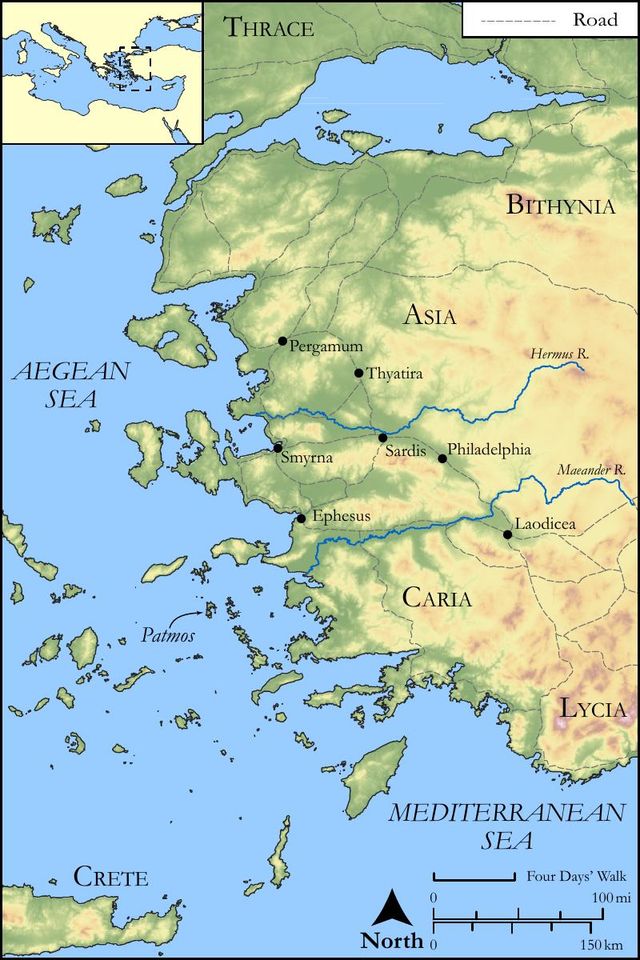
See on the biblical-era maps

Study this verse
Public-domain commentary
Matthew Henry
From his Commentary on the Whole Bible. Henry comments on passages, not single verses — this entry covers Revelation 8:1–6. His two-level outline is real structure in the source text, so it is rendered as structure.
In these verses we have the prelude to the sounding of the trumpets in several parts.
I.The opening of the last seal.
This was to introduce a new set of prophetical iconisms and events; there is a continued chain of providence, one part linked to another (where one ends another begins), and, though they may differ in nature and in time, they all make up one wise, well-connected, uniform design in the hand of God.
II.A profound silence in heaven for the space of half an hour, which may be understood either,
1.Of the silence of peace, that for this time no complaints were sent up to the ear of the Lord God of sabaoth; all was quiet and well in the church, and therefore all silent in heaven, for whenever the church on earth cries, through oppression, that cry comes up to heaven and resounds there; or,
2.A silence of expectation; great things were upon the wheel of providence, and the church of God, both in heaven and earth, stood silent, as became them, to see what God was doing, according to that of Zac 2:13, Be silent, O all flesh, before the Lord, for he has risen up out of his holy habitation. And elsewhere, Be still, and know that I am God.
III.The trumpets were delivered to the angels who were to sound them.
Still the angels are employed as the wise and willing instruments of divine Providence, and they are furnished with all their materials and instructions from God our Saviour. As the angels of the churches are to sound the trumpet of the gospel, the angels of heaven are to sound the trumpet of Providence, and every one has his part given him.
IV.To prepare for this, another angel must first offer incense, Rev 8:3.
It is very probable that this other angel is the Lord Jesus, the high priest of the church, who is here described in his sacerdotal office, having a golden censer and much incense, a fulness of merit in his own glorious person, and this incense he was to offer up, with the prayers of all the saints, upon the golden altar of his divine nature. Observe,
1.All the saints are a praying people; none of the children of God are born dumb, a Spirit of grace is always a Spirit of adoption and supplication, teaching us to cry, Abba, Father. Psa 32:6, For this shall every one that is godly pray unto thee.
2.Times of danger should be praying times, and so should times of great expectation; both our fears and our hopes should put us upon prayer, and, where the interest of the church of God is deeply concerned, the hearts of the people of God in prayer should be greatly enlarged.
3.The prayers of the saints themselves stand in need of the incense and intercession of Christ to make them acceptable and effectual, and there is provision made by Christ for that purpose; he has his incense, his censer, and his altar; he is all himself to his people.
4.The prayers of the saints come up before God in a cloud of incense; no prayer, thus recommended, was ever denied audience or acceptance.
5.These prayers that were thus accepted in heaven produced great changes upon earth in return to them; the same angel that in his censer offered up the prayers of the saints in the same censer took of the fire of the altar, and cast it into the earth, and this presently caused strange commotions, voices, and thunderings, and lightnings, and an earthquake; these were the answers God gave to the prayers of the saints, and tokens of his anger against the world and that he would do great things to avenge himself and his people of their enemies; and now, all things being thus prepared, the angels discharge their duty.
Historical interpretation
Seven Centuries of Reception
6 surviving comments on this verse. Each one is dated, so this reads as a timeline rather than a list.
Select a marker to jump to its quote. Markers stagger vertically where authors wrote within a few decades of each other.
"And when He had opened the seventh seal, there was silence in heaven for about half an hour." Whereby is signified the beginning of everlasting rest; but it is described as partial, because the silence being interrupted, he repeats it in order. For if the silence had continued, here would be an end of his narrative.
“In heaven” means in the church. The silence for half an hour shows the beginning of the eternal rest.
Often the number of seven is taken by this saint to correspond to this age and the sabbath rest of the saints. Therefore, also here at the loosing of the seventh seal, the dissolution of the earthly city is signified, the seven angels administering the torments against those people who are deserving of chastisement or punishment. The “silence” reveals the good order of the piety of the angels as well as the fact that the second coming of Christ is unknown even to angels. The “half hour” shows the shortness of time, for when the plagues come and the events of the consummation upon the earth are occurring, the kingdom of Christ will appear.
And when he had opened the seventh seal, etc. After the destruction of the Antichrist, a brief rest is believed to come in the Church, about which Daniel predicted thus: "Blessed is he who waits and comes to the thousand three hundred and thirty-five days" (Daniel XII). Which blessed Jerome explains thus: "Blessed," he says, "is he who, after the Antichrist is killed, awaits beyond the one thousand two hundred and ninety days, that is, three and a half years, forty-five days, during which the Lord and Savior is to come in his majesty." But why there is a silence of forty-five days after the killing of the Antichrist is known to divine knowledge. Unless we might say: the delay of the kingdom of the saints is a test of patience. Note that in the sixth seal he sees the greatest pressures on the Church, in the seventh he sees rest, because the Lord, crucified on the sixth day, rested on the Sabbath, waiting for the time of resurrection. Thus far about the opening of the sealed book and the six seals. Now he recapitulates from the beginning, intending to speak the same things differently.
And when he had opened the seventh seal, there was silence in heaven, as it were for half an hour. Heaven, as we have often said, means the Church, which produces, as it were, silence for God when, through some of its members, it departs from the abundance of material things to seek the retreat of inner contemplation; but because this silence cannot be perfect in this life, it is said to have lasted as it were for half an hour. Note also that he ended the recapitulation where he said, After this I saw a great multitude, [Rev. 7:9] and now he concludes the narration with the seventh seal.
Perhaps someone who is very meticulous might analyze what has been said and say to me: Oh you, what are you doing? Have you perhaps forgotten what was said in the prologues of this Revelation? For it was also said that the first voice I heard was like a trumpet speaking with me, saying, "Come up here, and I will show you what must take place after these things." (Rev. 4:1) And you have become a narrator to us of things not yet come to pass but already happened, recounting the birth of the Lord, the temptation, the teachings and divine signs, the lashes and bonds and the wounds inflicted by Pilate, the cross and the death, and the resurrection and the ascent, or rather, the return to Heaven. To this I would say: most certainly you have heard, my friend, and some of the things that will happen, whenever we recount the righteous among the nations together with Israel around the divine throne, and those who exist with the Lord.
And now you also hear in the breaking of the seventh seal. For the one who said to the evangelist, "Come up here, and I will show you what must take place after these things," (Rev. 4:1) did not remove from him the ability to see anything that had happened before, but along with those, he also revealed what was to come. Therefore, listen.
The breaking of the seventh seal has accomplished for us the most perfect glory; for no longer is the release from sins and the turning back to God and from God to us as before, but rather the indescribable blessings: to be called children of God, "heirs of God, and joint heirs with Christ," (Rom. 8:17) brothers and friends and children of Christ, to reign with Him (2 Tim. 2:12) and to be glorified together, (Rom. 8:17) and "what no eye has seen, nor ear heard, nor has entered into the heart of man, these good things." (1 Cor. 2:9) What then is the breaking of the seventh seal? It is the second coming of the Lord and the restoration of all good things. For although some are delivered to punishment for their sins, the purpose of Christ and the foundation of the Incarnation is that all become heirs of His kingdom.
Therefore, when the seventh seal was broken, it is said that there was silence for about half an hour, as the King of creation was about to come, and all angelic and supernatural powers were overwhelmed by the surpassing glory of the One arriving, and for this reason, there was silence.
Continue studying Revelation 8:1 across the web’s major study libraries — every link below opens this exact verse, chapter, or book on the destination site.
Read & Compare
 BibleGatewayThis verse in more than 200 translations and 70 languages.
 Bible.comThe YouVersion reader — hundreds of translations, reading plans, and highlights.
 ESV.orgCrossway's official English Standard Version reader.
 NET BibleThe NET translation with 60,000+ translators' notes on every rendering decision.
 STEP BibleTyndale House's free study tool — original text, vocabulary, and scholarly resources.
 BibliaLogos Bible Software's free web reader.
 USCCBThe New American Bible (Revised Edition) with the U.S. bishops' study notes.
Commentaries
 BibleHub CommentariesDozens of classic commentaries on this verse, gathered on one page.
 StudyLightMore than 100 commentary sets — the largest collection on the web.
 BibleRefPlain-English commentary on what this verse means, verse by verse.
 Enduring WordDavid Guzik's free commentary on this chapter, widely used by Bible teachers.
 Bible Study ToolsVerse commentary alongside Greek and Hebrew study aids.
Original Language & Research
- BibleHub InterlinearThe verse word by word — original language, transliteration, and English.
- BibleHub LexiconEvery word's original-language definition and Strong's entry.
 Blue Letter BibleDeep-study tools — Strong's numbers, concordance, and word studies.
 CNTR CollationThe earliest Greek manuscripts of this verse, collated letter by letter.
Sermons, Hymns & Audio


TrulyRandomVerse is not affiliated with these sites and doesn’t control their content. They’re linked because they’re genuinely useful.
Summary
Revelation 8:1 marks a profound and dramatic turning point in the apocalyptic narrative, as the opening of the seventh and final seal by the Lamb does not immediately unleash further devastation but rather introduces an unprecedented and awe-inspiring silence in heaven. This brief, divinely orchestrated pause serves as a solemn interlude, heightening the tension and anticipation for the next series of divine judgments about to be revealed, underscoring the immense gravity and sovereignty of God's unfolding plan.
Context
ShowHideLiterary Context
This verse serves as the climactic culmination of the seven seal judgments, which began in Revelation 6. Immediately preceding it, Revelation 6:12-17 describes cataclysmic disturbances in the heavens and the terror of humanity facing divine wrath. Following this, Revelation 7 provides a crucial interlude, focusing on the sealing of the 144,000 from Israel and the worship of a great multitude from every nation before the throne. The opening of the seventh seal, therefore, is not merely another judgment but a transitional moment, signaling the conclusion of one series of events and the imminent commencement of the trumpet judgments, which are introduced directly after this silence in Revelation 8:2. The silence itself stands in stark contrast to the ceaseless praise and activity typically depicted in heavenly scenes, such as those found in Revelation 4:8 and Revelation 5:11.
Historical & Cultural Context
The Book of Revelation is a work of apocalyptic literature, a genre common in Jewish tradition during periods of intense persecution and crisis. John, the author, was exiled to the island of Patmos, likely during the reign of the Roman Emperor Domitian, who initiated severe persecution against Christians. The vivid imagery and symbolism in Revelation would have resonated with its original audience, who were familiar with Old Testament prophetic visions (e.g., Daniel 7, Ezekiel 1). The concept of silence before divine judgment or revelation is also found in Scripture, often signifying awe, solemnity, or the preparation for a profound divine utterance or action, as seen in passages like Habakkuk 2:20 where all the earth is commanded to be silent before the Lord.
Key Themes
ShowHideThis verse contributes significantly to several major themes within Revelation and broader biblical theology. Firstly, it underscores the theme of Divine Sovereignty and Control, demonstrating that even amidst escalating judgments and upheaval in the heavens, God remains meticulously in charge, orchestrating every detail, including a deliberate pause. Secondly, it highlights the Profound Anticipation and Awe that precedes God's ultimate judgments; the silence is not an absence of activity but a pregnant, solemn quietness, as if all of heaven holds its breath in fearful expectation. Thirdly, it functions as a crucial Transition Point in Judgment, marking the culmination of the seal judgments and introducing the next, even more intense, series of trumpet judgments. Finally, the brevity of the silence ("about the space of half an hour") emphasizes the Immediacy and Inevitability of God's Righteous Wrath, serving as a powerful reminder that while there may be pauses, divine judgment against sin is certain and swiftly approaching. The Lamb, identified in Revelation 5:5 as the one worthy to open the scroll, is the central figure in this unfolding drama.
Exposition and Analysis
ShowHideKey Word Analysis
ShowHideThis word signifies an action of unveiling or revealing. Here, it emphasizes the authoritative act of the Lamb, who alone is worthy to unseal the scroll of God's decrees. The opening of the seventh seal is the final act in this series, leading to the revelation of what is to come.
A seal was used in antiquity to authenticate documents, to secure them, or to mark ownership. In Revelation, the seals represent divine decrees or judgments that are progressively revealed as they are broken. The seventh seal, being the last, signifies the full disclosure of God's will concerning the end times.
This term denotes a deep, profound quietness, not merely the absence of noise. In the context of heaven, which is typically filled with ceaseless worship and activity, this silence is exceptionally striking and impactful. It conveys a sense of awe, solemnity, and dread, indicating a moment of immense significance and reverence before a momentous divine action.
This precise, yet brief, measurement of time is significant. It suggests a divinely appointed, temporary pause. The short duration intensifies the anticipation and underscores the immediacy and inevitability of the judgments that are about to follow. It is a moment of holding breath before the storm.
Verse Breakdown
ShowHide"And when he had opened the seventh seal"
This clause highlights the culmination of the initial series of judgments. The "he" refers to the Lamb, Jesus Christ, who possesses the unique authority to open the scroll and its seals, signifying His sovereign control over the unfolding of God's redemptive and judgmental plan. This act completes the preliminary unveiling of divine decrees.
"there was silence in heaven"
This phrase describes a dramatic and unprecedented cessation of all activity and sound in the heavenly realm. In contrast to the continuous worship and acclamations typically heard in heaven, this profound quietness signifies a moment of immense gravity, awe, and solemnity. It is a deliberate, divinely ordained pause, indicating the supreme importance of what is about to transpire.
"about the space of half an hour."
This specific temporal indicator emphasizes the brevity and intentionality of the silence. It is not an indefinite pause but a precisely measured interval. The short duration serves to heighten the tension and anticipation, underscoring the dreadful and inevitable nature of the judgments that are poised to follow, reinforcing the sense of immediate impending divine action.
Literary Devices
ShowHideRevelation 8:1 masterfully employs several literary devices to convey its profound message. The primary device is Anticipation and Suspense, created by the sudden and unexpected cessation of all heavenly activity. After the cataclysmic events of the sixth seal and the interlude of chapter 7, the audience expects immediate, escalating judgment, but instead, they are met with an eerie quiet, building immense tension for what is to come. This is amplified by Contrast, as the silence stands in stark opposition to the normally vibrant, worship-filled atmosphere of heaven, making its presence all the more impactful. The "seal" itself is a powerful Symbolism, representing divine decrees, hidden knowledge, and the unfolding of God's sovereign will. The "silence" is also symbolic, signifying reverence, awe, the gravity of impending judgment, and the profound solemnity of God's presence. Finally, the specific mention of "half an hour" lends a sense of Precision to the divine timing, while also serving as a form of Dramatic Effect, underscoring that this pause, though brief, is a deliberate and significant part of God's carefully orchestrated plan.
Theological and Thematic Connections
ShowHideThe silence in heaven at the opening of the seventh seal is a profound theological statement on God's absolute sovereignty and the immense gravity of His impending judgments. It signifies that even the celestial realm, usually filled with ceaseless praise, holds its breath in awe before the final unveiling of God's righteous wrath. This pause is not a delay but a deliberate, pregnant moment, emphasizing the solemnity and certainty of what is to come. It underscores that God's actions are not chaotic but meticulously planned, even His judgments. The brevity of the silence also highlights the swiftness and inevitability of divine justice, serving as a stark reminder of the seriousness of sin and the holiness of God who must judge it.
Reflection and Application
ShowHideRevelation 8:1 serves as a powerful reminder for believers to cultivate a deep sense of reverence for God's holiness and His sovereign plan. The "silence in heaven" calls us to pause and reflect on the immense gravity of divine judgment and the certainty of Christ's return. In a world filled with noise and distraction, this heavenly quietude encourages us to seek moments of stillness to truly apprehend the magnitude of God's power and His perfect justice. It prompts us to live with spiritual preparedness, knowing that God's timetable is precise and His purposes will be fulfilled. We are called to trust His timing, even when His plans seem mysterious or delayed, recognizing that every moment, including a "half an hour" of silence, is part of His wise and deliberate orchestration. This verse should inspire both a holy fear of God's judgment and a confident trust in His ultimate control over all things, motivating us to live lives that honor Him and to share the message of His grace while there is still time.
Questions for Reflection
ShowHideFAQ
ShowHideWhy is there silence in heaven after the opening of the seventh seal?
ShowHideThe "silence in heaven" is a deliberate, divinely ordained pause that serves multiple profound purposes. Firstly, it signifies the immense gravity and solemnity of the events about to unfold. After the intense disturbances in the heavens of the sixth seal and the interlude of Revelation 7, this silence creates a moment of profound awe and anticipation, as if all of heaven holds its breath before the next stage of God's righteous wrath. Secondly, it highlights God's absolute sovereignty and control; this pause is not a moment of indecision but a meticulously timed interlude orchestrated by God. Finally, it acts as a dramatic transition point, marking the culmination of the seal judgments and preparing the way for the introduction of the even more intense trumpet judgments, which begin immediately after this silence in Revelation 8:2. It contrasts sharply with the usual ceaseless worship in heaven, emphasizing the unique significance of this moment.
Christ-Centered Fulfillment
ShowHideRevelation 8:1, with its dramatic silence preceding the next wave of divine judgments, is deeply Christ-centered. It is the Lamb, Jesus Christ, who is found worthy to open the seals (Revelation 5:5), demonstrating His unparalleled authority and His central role in executing God's redemptive and judgmental plan. The silence itself, a moment of profound awe and anticipation, foreshadows the solemnity of Christ's ultimate return, not as the humble servant of His first coming, but as the conquering King and righteous Judge. While His first advent was marked by the quiet humility of a manger, His second coming will be heralded by signs in the heavens and a profound stillness before the outpouring of His just wrath and the establishment of His eternal kingdom (Matthew 24:30). This silence underscores that all judgment has been committed to the Son (John 5:22), and He alone holds the keys to death and Hades (Revelation 1:18). For believers, this Christ, who orchestrates even the silence before judgment, is also their advocate (1 John 2:1) and the one who bore the full weight of God's judgment on the cross, becoming sin for us so that we might become the righteousness of God in Him (2 Corinthians 5:21). Thus, the silence, while portending judgment for the ungodly, simultaneously affirms the sovereign power of the Savior who has secured eternal salvation for His own.