


Genesis 28:21
Bible text: King James Version (1769 Blayney text) · Public domain
Bible text: Berean Standard Bible · Public domain
Bible text: American Standard Version (1901) · Public domain
Bible text: World English Bible, Messianic edition · Public domain
Bible text: Geneva Bible (1599) · Public domain
Bible text: Young's Literal Translation · Public domain
- וְשַׁבְתִּיve·shav·Tiand I will returnH7725Conj-w ¦ V-Qal-ConsecPerf-1csVerb Qal Consecutive Perfect 1st Singular common genderוְandשַׁבְתִּיI will return
- בְשָׁלוֹםve·sha·Lomin peaceH7965Prep-b ¦ N-msNoun Singular Masculine Absoluteבְinשָׁלוֹםpeace
- אֶל'eltoH413PrepPreposition
- בֵּיתbeit[the] house ofH1004N-mscNoun Singular Masculine Construct
- אָבִי'a·Vimy fatherH1N-msc ¦ 1csNoun Singular Masculine Constructאָבִfatherיmy
- וְהָיָהve·ha·Yahand he will becomeH1961Conj-w ¦ V-Qal-ConsecPerf-3msVerb Qal Consecutive Perfect 3rd Singular Masculineוְandהָיָהhe will become
- יְהוָהYah·wehYahwehH3068N-properNoun Proper Title
- לִיlifor <the> mePrep-l ¦ 1csSuffix Personal 1st Singular common genderלִfor <the>יme
- לֵאלֹהִיםle·lo·Him<into> GodH430Prep-l ¦ N-mpNoun Plural Masculine Absoluteלֵ<into>אלֹהִיםGod
English is a literal word-by-word gloss of the Hebrew, not the KJV's wording. Why?
This is the original text the KJV's translators worked from — each Hebrew word with its own literal English meaning in this verse, prepared by scholars at Tyndale House, Cambridge. The KJV translates whole sentences, not word by word, so its wording differs: one Hebrew word can become several English words, and the KJV may choose “the LORD” where the gloss reads “Yahweh”. Both are faithful — they answer different questions. For the KJV's own rendering, switch to the KJV text.
Details
See on the biblical-era maps


Study this verse
Public-domain commentary
Matthew Henry
From his Commentary on the Whole Bible. Henry comments on passages, not single verses — this entry covers Genesis 28:16–22. His four-level outline is real structure in the source text, so it is rendered as structure.
God manifested himself and his favour to Jacob when he was asleep and purely passive; for the spirit, like the wind, blows when and where he listeth, and God's grace, like the dew, tarrieth not for the sons of men, Mic 5:7. But Jacob applied himself to the improvement of the visit God had made him when he was awake; and we may well think he awaked, as the prophet did (Jer 31:26), and behold his sleep was sweet to him. Here is much of Jacob's devotion on this occasion.
I.He expressed a great surprise at the tokens he had of God's special presence with him in that place: Surely the Lord is in this place and I knew it not, Gen 28:16. Note,
1.God's manifestations of himself to his people carry their own evidence along with them. God can give undeniable demonstrations of his presence, such as give abundant satisfaction to the souls of the faithful that God is with them of a truth, satisfaction not communicable to others, but convincing to themselves.
2.We sometimes meet with God where we little thought of meeting with him. He is where we did not think he had been, is found where we asked not for him. No place excludes divine visits (Gen 16:13, here also); wherever we are, in the city or in the desert, in the house or in the field, in the shop or in the street, we may keep up our intercourse with Heaven if it be not our own fault.
II.It struck an awe upon him (Gen 28:17):
He was afraid; so far was he from being puffed up, and exalted above measure, with the abundance of the revelations (Co2 12:7), that he was afraid. Note, The more we see of God the more cause we see for holy trembling and blushing before him. Those to whom God is pleased to manifest himself are thereby laid, and kept, very low in their own eyes, and see cause to fear even the Lord and his goodness, Hos 3:5. He said, How dreadful is this place! that is, "The appearance of God in this place is never to be thought of, but with a holy awe and reverence. I shall have a respect for this place, and remember it by this token, as long as I live:" not that he thought the place itself any nearer the divine visions than other places; but what he saw there at this time was, as it were, the house of God, the residence of the divine Majesty, and the gate of heaven, that is, the general rendezvous of the inhabitants of the upper world, as the meetings of a city were in their gates; or the angels ascending and descending were like travellers passing and re-passing through the gates of a city. Note,
1.God is in a special manner present where his grace is revealed and where his covenants are published and sealed, as of old by the ministry of angels, so now by instituted ordinances, Mat 28:20.
2.Where God meets us with his special presence we ought to meet him with the most humble reverence, remembering his justice and holiness, and our own meanness and vileness.
III.He took care to preserve the memorial of it two ways:
1.He set up the stone for a pillar (Gen 28:18); not as if he thought the visions of his head were any way owing to the stone on which it lay, but thus he would mark the place against he came back, and erect a lasting monument of God's favour to him, and because he had not time now to build an altar here, as Abraham did in the places where God appeared to him, Gen 12:7. He therefore poured oil on the top of this stone, which probably was the ceremony then used in dedicating their altars, as an earnest of his building an altar when he should have conveniences for it, as afterwards he did, in gratitude to God for this vision, Gen 35:7. Note, Grants of mercy call for returns of duty, and the sweet communion we have with God ought ever to be remembered.
2.He gave a new name to the place, Gen 28:19. It had been called Luz, an almond-tree; but he will have it henceforward called Beth-el, the house of God. This gracious appearance of God to him put a greater honour upon it, and made it more remarkable, than all the almond-trees that flourished there. This is that Beth-el where, long after, it is said, God found Jacob, and there (in what he said to him) he spoke with us, Hos 12:4. In process of time, this Beth-el, the house of God, became Beth-aven, a house of vanity and iniquity, when Jeroboam set up one of his calves there.
IV.He made a solemn vow upon this occasion, Gen 28:20-22.
By religious vows we give glory to God, own our dependence upon him, and lay a bond upon our own souls to engage and quicken our obedience to him. Jacob was now in fear and distress; and it is seasonable to make vows in times of trouble, or when we are in pursuit of any special mercy, Jon 1:16; Psa 66:13, Psa 66:14; Sa1 1:11; Num 21:1-3. Jacob had now had a gracious visit from heaven. God had renewed his covenant with him, and the covenant is mutual. When God ratifies his promises to us, it is proper for us to repeat our promises to him. Now in this vow observe,
1.Jacob's faith. God had said (Gen 28:15), I am with thee, and will keep thee. Jacob takes hold of this, and infers, "Seeing God will be with me, and will keep me, as he hath said, and (which is implied in that promise) will provide comfortably for me, - and seeing he has promised to bring me again to this land, that is, to the house of my father, whom I hope to find alive at my return in peace" (so unlike was he to Esau who longed for the days of mourning for his father), - "I depend upon it." Note, God's promises are to be the guide and measure of our desires and expectations.
2.Jacob's modesty and great moderation in his desires. He will cheerfully content himself with bread to eat, and raiment to put on; and, though God's promise had now made him heir to a very great estate, yet he indents not for soft clothing and dainty meat. Agur's wish is his, Feed me with food convenient for me; and see Ti1 6:8. Nature is content with a little, and grace with less. Those that have most have, in effect, no more for themselves than food and raiment; of the overplus they have only either the keeping or the giving, not the enjoyment: if God give us more, we are bound to be thankful, and to use it for him; if he give us but this, we are bound to be content, and cheerfully to enjoy him in it.
3.Jacob's piety, and his regard to God, which appear here,
(1.)In what he desired, that God would be with him and keep him. Note, We need desire no more to make us easy and happy, wherever we are, than to have God's presence with us and to be under his protection. It is comfortable, in a journey, to have a guide in an unknown way, a guard in a dangerous way, to be well carried, well provided for, and to have good company in any way; and those that have God with them have all this in the best manner.
(2.)In what he designed. His resolution is,
[1.]In general, to cleave to the Lord, as his God in covenant: Then shall the Lord be my God. Not as if he would disown him and cast him off if he should want food and raiment; no, though he slay us, we must cleave to him; but "then I will rejoice in him as my God; then I will more strongly engage myself to abide with him." Note, Every mercy we receive from God should be improved as an additional obligation upon us to walk closely with him as our God.
[2.]In particular, that he would perform some special acts of devotion, in token of his gratitude. First, "This pillar shall keep possession here till I come back in peace, and then it shall be God's house," that is, "an altar shall be erected here to the honour of God." Secondly, "The house of god shall not be unfurnished, nor his altar without a sacrifice: Of all that thou shalt give me I will surely give the tenth unto thee, to be spent either upon God's altars or upon his poor," both which are his receivers in the world. Probably it was according to some general instructions received from heaven that Abraham and Jacob offered the tenth of their acquisitions to God. Note, 1. God must be honoured with our estates, and must have his dues out of them. When we receive more than ordinary mercy from God we should study to give some signal instances of gratitude to him. 2. The tenth is a very fit proportion to be devoted to God and employed for him, though, as circumstances vary, it may be more or less, as God prospers us, Co1 16:2; Co2 9:7.
Continue studying Genesis 28:21 across the web’s major study libraries — every link below opens this exact verse, chapter, or book on the destination site.
Read & Compare
 BibleGatewayThis verse in more than 200 translations and 70 languages.
 Bible.comThe YouVersion reader — hundreds of translations, reading plans, and highlights.
 ESV.orgCrossway's official English Standard Version reader.
 NET BibleThe NET translation with 60,000+ translators' notes on every rendering decision.
 STEP BibleTyndale House's free study tool — original text, vocabulary, and scholarly resources.
 BibliaLogos Bible Software's free web reader.
 USCCBThe New American Bible (Revised Edition) with the U.S. bishops' study notes.
Commentaries
 BibleHub CommentariesDozens of classic commentaries on this verse, gathered on one page.
 StudyLightMore than 100 commentary sets — the largest collection on the web.
 BibleRefPlain-English commentary on what this verse means, verse by verse.
 Enduring WordDavid Guzik's free commentary on this chapter, widely used by Bible teachers.
 Bible Study ToolsVerse commentary alongside Greek and Hebrew study aids.
Original Language & Research
- BibleHub InterlinearThe verse word by word — original language, transliteration, and English.
- BibleHub LexiconEvery word's original-language definition and Strong's entry.
 Blue Letter BibleDeep-study tools — Strong's numbers, concordance, and word studies.
 SefariaThe Hebrew text with Rashi and centuries of Jewish commentary.
Sermons, Hymns & Audio


TrulyRandomVerse is not affiliated with these sites and doesn’t control their content. They’re linked because they’re genuinely useful.
Summary
Genesis 28:21 encapsulates Jacob's profound vow at Bethel, a pivotal moment following his transformative dream of a ladder connecting heaven and earth. In direct response to God's unsolicited and unconditional covenant promises of divine presence, unwavering protection, and a guaranteed return to his homeland, Jacob pledges his allegiance. His declaration that "then shall the LORD be my God" signifies a deep personal commitment to Yahweh, establishing a foundational and exclusive relationship with the God who had just revealed Himself in such a powerful and personal manner.
Context
ShowHideLiterary Context
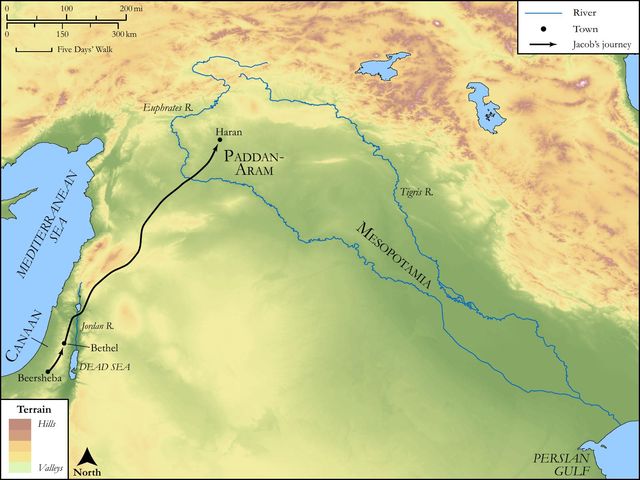
Genesis 28:21 is a crucial part of Jacob's vow, which immediately follows his encounter with God at Bethel. The preceding verses (Genesis 28:10-19) describe Jacob's flight from Esau and his profound dream. God's promises in Genesis 28:13-15—of land, numerous descendants, universal blessing, and especially divine presence and a safe return—are the direct catalyst for Jacob's response. His vow in Genesis 28:20-22 is not a negotiation but a personal commitment of allegiance, a foundational moment in his spiritual journey that sets the stage for his subsequent experiences in Haran and his eventual return to the land of Canaan.
Historical & Cultural Context
Jacob's journey to Haran was driven by the cultural imperative to find a wife from his own kin, as instructed by his parents, and to escape the immediate threat of his brother Esau's murderous rage (Genesis 27:43). In that day, such journeys were perilous, fraught with dangers from bandits, wild animals, and the harsh environment. To travel alone, without a retinue or significant resources, made Jacob particularly vulnerable. His act of setting up a stone pillar and anointing it with oil (Genesis 28:18) was a practice of the patriarchs' day, used to commemorate a significant event or to mark a sacred space, signifying a covenant or a dedication. His vow, though personal, also reflects the communal understanding of deity and covenant in that era, where a god's protection was sought and allegiance pledged in return.
Key Themes
ShowHideThis passage powerfully reiterates several overarching themes central to the book of Genesis and the broader biblical narrative. Firstly, it underscores God's unwavering covenant faithfulness, as He unilaterally reaffirms the Abrahamic covenant to Jacob, despite Jacob's deceptive past (see Genesis 12:1-3). Secondly, it highlights the theme of divine presence and providence, emphasized by God's promise, "I am with you and will watch over you wherever you go, and I will bring you back to this land" (Genesis 28:15). Thirdly, Jacob's response introduces the theme of human response to divine revelation, demonstrating how a profound encounter with God should elicit a personal commitment of faith and allegiance. Finally, the desire for "peace" (Hebrew: shalom) foreshadows the comprehensive well-being and flourishing that God desires for His people, a theme that resonates throughout the Old Testament and finds its ultimate expression in Christ.
Exposition and Analysis
ShowHideJacob's vow in Genesis 28:21 is a deeply personal and significant declaration, articulating his responsive commitment to God following the divine revelation at Bethel.
Key Word Analysis
ShowHideThis primitive root, translated as "come again," signifies "to turn back (hence, away) transitively or intransitively, literally or figuratively." It encompasses the idea of returning to a previous state or place. In Jacob's plea, it emphasizes his profound desire for a physical return to his family home, but also implicitly a return to a state of security and favor, away from his current fugitive status.
Translated as "the LORD," this is God's covenant name, Yahweh, signifying "the self-Existent or Eternal." It emphasizes God's personal, relational, and unchanging nature, particularly in His covenant dealings with His people. Jacob's declaration to take Yahweh as "my God" signifies a commitment to the specific, revealed God of his fathers, distinguishing Him from other deities.
This plural noun, translated here as "God," is used in the Hebrew Bible for both the supreme God and lesser deities. When used with the definite article or in reference to the God of Israel, as it is here, it refers to the one true, supreme God. Jacob's declaration "be my God" uses this broader term to acknowledge Yahweh as his ultimate, sovereign deity, the object of his exclusive worship and allegiance.
Rendered as "peace," this word is far richer than the English equivalent. It means "safe, well, happy, friendly," and abstractly, "welfare, health, prosperity, peace." Jacob's desire to return "in peace" is not merely for the absence of conflict, but for comprehensive well-being, wholeness, completeness, and flourishing in all aspects of his life—physical, relational, and spiritual.
Verse Breakdown
ShowHide"So that I come again to my father's house in peace"
This clause expresses Jacob's immediate and fervent desire. As a fugitive, vulnerable and alone, his primary longing is for a safe and prosperous return to the security and familiarity of his family home. The phrase "in peace" (Hebrew: b'shalom) signifies not just the absence of danger, but a holistic state of well-being, completeness, and flourishing, reflecting his hope for divine favor and protection throughout his journey and upon his return.
"then shall the LORD be my God"
This is Jacob's responsive declaration of allegiance and commitment. It is a personal and exclusive vow to acknowledge, worship, and serve Yahweh (the LORD, God's covenant name) as his supreme and only God. This statement marks a pivotal moment in Jacob's spiritual journey, moving from a somewhat nominal understanding of his family's God to a personal, active commitment to Yahweh as his own deity, establishing a covenant relationship on his part.
Literary Devices
ShowHideThe verse employs Conditional Language ("So that I come again... then shall the LORD be my God"), which, while appearing to set a condition, functions more as a declaration of responsive faith. God had already promised His unwavering presence and a safe return in Genesis 28:15. Jacob's "if...then" statement is therefore a pledge of allegiance because of God's prior grace and faithfulness, rather than an attempt to bargain. There is also significant Symbolism in the context, with the "father's house" symbolizing security, belonging, and the fulfillment of God's promise of return to the land. The phrase "the LORD be my God" is a powerful declaration of Covenant Language, echoing and anticipating the foundational covenant declarations throughout the Old Testament where God declares, "I will be your God, and you will be my people."
Theological and Thematic Connections
ShowHideJacob's vow in Genesis 28:21 is a profound theological statement, illustrating the nature of covenant relationship as a divine initiative met by human response. God's unsolicited revelation and promises at Bethel (Genesis 28:13-15) demonstrate His sovereign grace, reaching out to Jacob despite his flawed character. Jacob's vow, therefore, is not a demand for God's favor, but a grateful and committed response to God's already declared faithfulness. It underscores the personal and exclusive nature of the relationship God desires with His people, where He is acknowledged as the one true God, worthy of ultimate allegiance and worship. This interaction establishes a pattern for the covenant relationship: God initiates with grace and promise, and humanity responds with faith and commitment, leading to a deepening, transformative bond.
Reflection and Application
ShowHideJacob's transformative encounter at Bethel and his subsequent vow offer a rich tapestry for our own spiritual reflection and application. Like Jacob, we often find ourselves at crossroads, facing uncertainty, vulnerability, or the consequences of past choices. This passage reminds us that it is precisely in these moments that God often reveals Himself most profoundly, extending promises of presence, protection, and provision, not based on our merit, but on His steadfast love. Our response, like Jacob's, should be one of deep personal commitment and allegiance. It is a declaration that because God is faithful and has revealed Himself to us, we will, in turn, make Him our God—the supreme authority and object of our worship and devotion. This commitment is not a transactional bargain, but a grateful surrender that flows from a heart awakened to divine grace, leading to a life lived in responsive obedience and trust, even when the path ahead remains unclear.
Questions for Reflection
ShowHideFAQ
ShowHideIs Jacob's vow truly conditional, implying he was bargaining with God?
ShowHideWhile Jacob's vow in Genesis 28:20 begins with "If God will be with me...", it is generally understood not as an attempt to bargain or manipulate God, but rather as a declaration of responsive faith. God had already unconditionally promised Jacob His presence, protection, and a safe return (Genesis 28:15). Jacob's "if...then" statement is therefore a commitment to live in allegiance to God because God had already shown Himself faithful and initiated the covenant. It's a pledge of devotion in light of God's prior grace, solidifying a personal relationship and expressing his intention to live in faithful obedience to the God who had just revealed Himself so powerfully.
What does "peace" (shalom) truly mean in Genesis 28:21?
ShowHideIn Genesis 28:21, the Hebrew word for "peace" is shalom (שָׁלוֹם). This word encompasses much more than simply the absence of conflict or trouble. Shalom signifies completeness, wholeness, well-being, prosperity, harmony, and a state of flourishing. When Jacob prays to return "in peace," he is asking for a full restoration to his family, physical safety, emotional security, and a prosperous life, reflecting a comprehensive divine blessing and presence in all aspects of his existence. It speaks to God's desire for the holistic welfare of His people, a theme that resonates throughout Scripture.
Christ-Centered Fulfillment
ShowHideJacob's dream of a ladder connecting heaven and earth, immediately preceding his vow, finds its ultimate and profound fulfillment in Jesus Christ. As Jesus Himself declares to Nathanael in John 1:51, "Truly, truly, I say to you, you will see heaven opened, and the angels of God ascending and descending on the Son of Man." Christ is the true ladder, the sole mediator and bridge between God and humanity, through whom access to the Father is granted and divine communication flows. The "LORD" (YHWH) whom Jacob vows to be his God is fully revealed in Jesus, the very embodiment of God's covenant faithfulness and the bringer of ultimate shalom—peace with God and comprehensive well-being (Ephesians 2:14). Jacob's longing for peace and a safe return to his father's house points to the spiritual peace and eternal home found only in Christ, our true Bethel, the "House of God," where we are reconciled to the Father and find our ultimate rest and security (Hebrews 4:9-10). Through Christ, the promise of God's unwavering presence, which Jacob experienced, is realized perfectly in the person of Emmanuel, "God with us" (Matthew 1:23).