


Genesis 37:27
Bible text: King James Version (1769 Blayney text) · Public domain
Bible text: Berean Standard Bible · Public domain
Bible text: American Standard Version (1901) · Public domain
Bible text: World English Bible, Messianic edition · Public domain
Bible text: Geneva Bible (1599) · Public domain
Bible text: Young's Literal Translation · Public domain
- לְכוּle·KhucomeH1980V-Qal-Imp-2mpVerb Qal Imperative 2nd Plural Masculine
- וְנִמְכְּרֶנּוּve·nim·ke·Re·nuand let us sell himH4376Conj-w ¦ V-Qal-ConjImperf-1cp ¦ 3msVerb Qal Conjunction+Imperfect 1st Plural common genderוְandנִמְכְּרֶlet us sellנּוּhim
- לַיִּשְׁמְעֵאלִיםlai·yish·me·'e·Limto the IshmaelitesH3459Prep-l ¦ N-mpNoun Gentilic Plural Masculine Absoluteלַto theיִּשְׁמְעֵאלִיםIshmaelites
- וְיָדֵנוּve·ya·De·nuand our handH3027Conj-w ¦ N-csc ¦ 1cpNoun Singular common gender Constructוְandיָדֵhandנוּour
- אַל'almay notH408NegParticle Negative
- תְּהִיte·hiit beH1961V-Qal-Imperf-3fsVerb Qal Imperfect 3rd Singular Feminine
- בוֹvoon <the> himPrep-b ¦ 3msSuffix Personal 3rd Singular Masculineבon <the>וֹhim
- כִּיkiforH3588PrtParticle Conditional
- אָחִינוּ'a·Chi·nu[is] our brotherH251N-msc ¦ 1cpNoun Singular Masculine Constructאָחִי[is] brotherנוּour
- בְשָׂרֵנוּve·sa·Re·nuour fleshH1320N-msc ¦ 1cpNoun Singular Masculine Constructבְשָׂרֵfleshנוּour
- הוּאHu'heH1931Pro-3msPronoun Personal 3rd Singular Masculine
- וַיִּשְׁמְעוּvai·yish·me·'Uand they listenedH8085Conj-w ¦ V-Qal-ConsecImperf-3mpVerb Qal Consecutive Imperfect 3rd Plural Masculineוַandיִּשְׁמְעוּthey listened
- אֶחָיו'e·Chavhis brothersH251N-mpc ¦ 3msNoun Plural Masculine Constructאֶחָיbrothersוhis
English is a literal word-by-word gloss of the Hebrew, not the KJV's wording. Why?
This is the original text the KJV's translators worked from — each Hebrew word with its own literal English meaning in this verse, prepared by scholars at Tyndale House, Cambridge. The KJV translates whole sentences, not word by word, so its wording differs: one Hebrew word can become several English words, and the KJV may choose “the LORD” where the gloss reads “Yahweh”. Both are faithful — they answer different questions. For the KJV's own rendering, switch to the KJV text.
Details
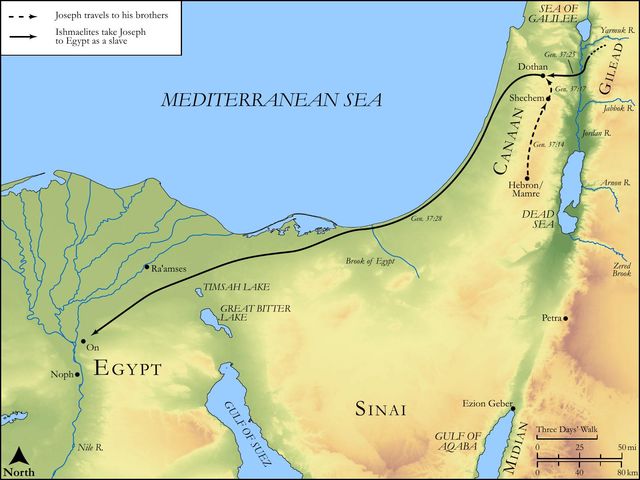
See on the biblical-era maps


Study this verse
Public-domain commentary
Matthew Henry
From his Commentary on the Whole Bible. Henry comments on passages, not single verses — this entry covers Genesis 37:23–30.
We have here the execution of their plot against Joseph. 1. They stripped him, each striving to seize the envied coat of many colours, Gen 37:23. Thus, in imagination, they degraded him from the birthright, of which perhaps this was the badge, grieving him, affronting their father, and making themselves sport, while they insulted over him. "Now, Joseph, where is the fine coat?" Thus our Lord Jesus was stripped of his seamless coat, and thus his suffering saints have first been industriously divested of their privileges and honours, and then made the off-scouring of all things. 2. They went about to starve him, throwing him into a dry pit, to perish there with hunger and cold, so cruel were their tender mercies, Gen 37:24. Note, Where envy reigns pity is banished, and humanity itself is forgotten, Pro 27:4. So full of deadly poison is malice that the more barbarous any thing is the more grateful it is. Now Joseph begged for his life, in the anguish of his soul (Gen 42:21), entreated, by all imaginable endearments, that they would be content with his coat and spare his life. He pleads innocence, relation, affection, submission; he weeps and makes supplication, but all in vain. Reuben alone relents and intercedes for him, Gen 42:22. But he cannot prevail to save Joseph from the horrible pit, in which they resolve he shall die by degrees, and be buried alive. Is this he to whom his brethren must do homage? Note, God's providences often seem to contradict his purposes, even then they are serving them, and working at a distance towards the accomplishment of them. 3. They slighted him when he was in distress, and were not grieved for the affliction of Joseph; for when he was pining away in the pit, bemoaning his own misery, and with a languishing cry calling to them for pity, they sat down to eat bread, Gen 37:25. (1.) They felt no remorse of conscience for the sin; if they had, it would have spoiled their appetite for their meat, and the relish of it. Note, A great force put upon conscience commonly stupefies it, and for the time deprives it both of sense and speech. Daring sinners are secure ones. But the consciences of Joseph's brethren, though asleep now, were roused long afterwards, Gen 42:21. (2.) They were now pleased to think how they were freed from the fear of their brother's dominion over them, and that, on the contrary, they had turned the wheel upon him. They made merry over him, as the persecutors over the two witnesses that had tormented them, Rev 11:10. Note, Those that oppose God's counsels may possibly prevail so far as to think they have gained their point, and yet be deceived. 4. They sold him. A caravan of merchants very opportunely passed by (Providence so ordering it), and Judah made the motion that they should sell Joseph to them, to be carried far enough off into Egypt, where, in all probability, he would be lost, and never heard of more. (1.) Judah proposed it in compassion to Joseph (Gen 37:26): "What profit is it if we slay our brother? it will be less guilt, and more gain, to sell him." Note, When we are tempted to sin, we should consider the unprofitableness of it. It is what there is nothing to be got by. (2.) They acquiesced in it, because they thought that if he were sold for a slave he would never be a lord, if sold into Egypt he would never be their lord; yet all this was working towards it. Note, The wrath of man shall praise God, and the remainder of wrath he will restrain, Psa 76:10. Joseph's brethren were wonderfully restrained from murdering him, and their selling him was as wonderfully turned to God's praise. As Joseph was sold by the contrivance of Judah for twenty pieces of silver, so was our Lord Jesus for thirty, and by one of the same name too, Judas. Reuben (it seems) had gone away from his brethren, when they sold Joseph, intending to come round some other way to the pit, and to help Joseph out of it, and return him safely to his father. This was a kind project, but, if it had taken effect, what had become of God's purpose concerning his preferment in Egypt? Note, There are many devices in man's heart, many devices of the enemies of God's people to destroy them and of their friends to help them, which perhaps are both disappointed, as these were; but the counsel of the Lord, that shall stand. Reuben thought himself undone, because the child was sold: I, whither shall I go? Gen 37:30. He being the eldest, his father would expect from him an accounts of Joseph; but, as it proved, they would all have been undone if he had not been sold.
Historical interpretation
Three Centuries of Reception
3 surviving comments on this verse. Each one is dated, so this reads as a timeline rather than a list.
Select a marker to jump to its quote. Markers stagger vertically where authors wrote within a few decades of each other.
Every kind of honour and happiness was bestowed upon you, and then was fulfilled that which is written, "My beloved ate and drank, and was enlarged and became fat, and kicked." [Deuteronomy 32:15] Hence flowed emulation and envy, strife and sedition, persecution and disorder, war and captivity. So the worthless rose up against the honoured, those of no reputation against such as were renowned, the foolish against the wise, the young against those advanced in years. For this reason righteousness and peace are now far departed from you, inasmuch as every one abandons the fear of God, and has become blind in His faith, neither walks in the ordinances of His appointment, nor acts a part becoming a Christian, but walks after his own wicked lusts, resuming the practice of an unrighteous and ungodly envy, by which death itself entered into the world. [Wisdom 2:24]
For thus it is written: "And it came to pass after certain days, that Cain brought of the fruits of the earth a sacrifice unto God; and Abel also brought of the firstlings of his sheep, and of the fat thereof. And God had respect to Abel and to his offerings, but Cain and his sacrifices He did not regard. And Cain was deeply grieved, and his countenance fell. And God said to Cain, Why are you grieved, and why is your countenance fallen? If you offer rightly, but do not divide rightly, have you not sinned? Be at peace: your offering returns to yourself, and you shall again possess it. And Cain said to Abel his brother, Let us go into the field. And it came to pass, while they were in the field, that Cain rose up against Abel his brother, and slew him." [Genesis 4:3-8] You see, brethren, how envy and jealousy led to the murder of a brother. Through envy, also, our father Jacob fled from the face of Esau his brother [Genesis 27:41-45]. Envy made Joseph be persecuted unto death, and to come into bondage. [Genesis 37:18-28] Envy compelled Moses to flee from the face of Pharaoh king of Egypt, when he heard these words from his fellow-countryman, "Who made you a judge or a ruler over us? Will you kill me, as you killed the Egyptian yesterday?" [Exodus 2:14] On account of envy, Aaron and Miriam had to make their abode without the camp. [Numbers 12:14-15] Envy brought down Dathan and Abiram alive to Hades, through the sedition which they excited against God's servant Moses. [Numbers 16:33] Through envy, David not only underwent the hatred of foreigners, but was also persecuted by Saul king of Israel. [1 Samuel 21:10-15]
And so that we may recognize that all this is a mystery in reference to the people and to the Lord Jesus, "Come, let us sell Joseph to the Ishmaelites." What is the interpretation of the name Joseph? Only that it means "God's grace" and "expression of God the highest." And so who is being sold? Only that man who "since he was in the form of God, thought it not robbery to be equal with God but emptied himself, taking the form of a servant." … They sold him to traders; the latter bought a good fragrance from traitors. Judah sold him, the Ishmaelites bought him, and in our tongue their name means "holding their own God in hatred." Therefore we find that Joseph was bought for twenty gold pieces by one account, for twenty-five by another and thirty by another, because Christ is not valued at the same price by all people. To some he is worth less, to others more. The faith of the buyer determines the increase in the price. To one who is more pious, God is more valuable; to a sinner a Redeemer is more valuable. He is also more valuable to the people who have more grace. But he is more valuable as well to the one to whom many things have been given, because he loves more to whom more has been forgiven. The Lord himself said just this in the Gospel in reference to the woman who poured ointment over his feet, bathed them with her tears, wiped them with her hair and dried them with her kisses. Of her Christ says to Simon, "Wherefore I say to you, her sins, many as they are, have been forgiven her, because she has loved much. But he to whom less is forgiven, loves less."
Here too, so that you may note the symbolic representation of the Lord's passion, the patriarch Judah says, "Let us sell Joseph to the Ishmaelites and let not our hands be laid upon him." And earlier he had done well to say, "Do not lay hands upon him," which is what the Jews said in the Lord's passion, "It is not lawful for us to put anyone to death." Thus the word of Jesus could be fulfilled, signifying by what death he was going to die.
Continue studying Genesis 37:27 across the web’s major study libraries — every link below opens this exact verse, chapter, or book on the destination site.
Read & Compare
 BibleGatewayThis verse in more than 200 translations and 70 languages.
 Bible.comThe YouVersion reader — hundreds of translations, reading plans, and highlights.
 ESV.orgCrossway's official English Standard Version reader.
 NET BibleThe NET translation with 60,000+ translators' notes on every rendering decision.
 STEP BibleTyndale House's free study tool — original text, vocabulary, and scholarly resources.
 BibliaLogos Bible Software's free web reader.
 USCCBThe New American Bible (Revised Edition) with the U.S. bishops' study notes.
Commentaries
 BibleHub CommentariesDozens of classic commentaries on this verse, gathered on one page.
 StudyLightMore than 100 commentary sets — the largest collection on the web.
 BibleRefPlain-English commentary on what this verse means, verse by verse.
 Enduring WordDavid Guzik's free commentary on this chapter, widely used by Bible teachers.
 Bible Study ToolsVerse commentary alongside Greek and Hebrew study aids.
Original Language & Research
- BibleHub InterlinearThe verse word by word — original language, transliteration, and English.
- BibleHub LexiconEvery word's original-language definition and Strong's entry.
 Blue Letter BibleDeep-study tools — Strong's numbers, concordance, and word studies.
 SefariaThe Hebrew text with Rashi and centuries of Jewish commentary.
Sermons, Hymns & Audio


TrulyRandomVerse is not affiliated with these sites and doesn’t control their content. They’re linked because they’re genuinely useful.
Summary
Genesis 37:27 captures Judah's pivotal proposal to his brothers: to sell Joseph to passing Ishmaelites instead of directly killing him. This suggestion, born of envy and a desire to avoid direct bloodguilt, was readily accepted by his brethren, ironically acknowledging Joseph's kinship even as they condemned him to slavery. This act of profound betrayal, however, unwittingly served as a crucial step in God's sovereign plan for the preservation of Jacob's family and the future nation of Israel.
Context
ShowHideLiterary Context
This verse is a critical turning point in the narrative of Joseph, following closely on the heels of his brothers' escalating hatred and their initial murderous plot. Joseph's favored status, symbolized by Jacob's special tunic, and his prophetic dreams of their subservience had fueled their intense jealousy. Their initial conspiracy to kill him and throw him into a pit is detailed in Genesis 37:18-20. Reuben, the eldest, had intervened to save Joseph's life, suggesting he be cast into a dry pit with the secret intention of rescuing him later (Genesis 37:21-24). While Reuben was absent, a caravan of nomadic traders, identified as Ishmaelites (and later Midianites), appeared, prompting Judah's pragmatic, yet still cruel, alternative to fratricide. This decision sets the stage for Joseph's descent into Egypt, a necessary prelude to his eventual rise and the preservation of his family.
Historical & Cultural Context
Among the nations of that day, selling individuals into slavery was a common, albeit harsh, practice, often driven by debt, capture in war, or, as in this case, a means of disposing of unwanted persons. The Ishmaelites (and Midianites) were nomadic trading groups, descendants of Abraham through Ishmael and Midian respectively, who traversed established trade routes between Canaan and Egypt. Their presence provided a convenient "solution" for the brothers. The phrase "our brother and our flesh" (Hebrew: achinu u'bsarenu) carries significant cultural weight, emphasizing deep familial bonds and shared lineage. In a tribal society, such kinship demanded loyalty and protection, making the act of selling a blood relative an egregious betrayal, highlighting the profound moral decay within Jacob's family. The brothers' desire to avoid direct "blood on their hands" reflects an awareness of the gravity of murder, which carried severe consequences, both socially and divinely, under ancient customs.
Key Themes
ShowHideGenesis 37:27 contributes significantly to several overarching themes within the book of Genesis and the broader biblical narrative. It underscores the destructive power of sibling rivalry and uncontrolled envy, which had previously manifested in Cain and Abel (Genesis 4) and Isaac and Ishmael (Genesis 21). The verse also introduces the theme of divine sovereignty working through human sin; despite the brothers' malicious intent, their actions unwittingly align with God's larger redemptive plan for Joseph and the nascent nation of Israel, a truth powerfully articulated by Joseph himself in Genesis 50:20. Furthermore, it marks the beginning of Joseph's journey of suffering and testing, a period of purification and preparation that ultimately leads to his exaltation and the salvation of his family, foreshadowing a pattern seen in many biblical figures and ultimately in Christ.
Exposition and Analysis
ShowHideJudah's proposal in Genesis 37:27 represents a critical shift from the brothers' initial murderous intent, offering a seemingly less direct, yet profoundly cruel, form of betrayal. This decision allowed them to remove Joseph from their lives without directly shedding his blood, a morally convenient option that satisfied their malice while maintaining a semblance of innocence.
Key Word Analysis
ShowHideThis primitive word signifies a brother in the widest sense, encompassing literal relationship and metaphorical affinity. In this context, it starkly highlights Joseph's undeniable blood tie to his betrayers. The brothers' use of "our brother" is deeply ironic, acknowledging the very bond that should have compelled their protection, yet instead is twisted to justify his sale into bondage. It underscores the perversion of familial duty driven by envy.
This word refers to flesh, by extension, the body or person, and signifies kinship or shared humanity. When paired with "brother" (achinu u'bsarenu), it profoundly emphasizes the deepest bonds of family, shared physical substance, and common lineage. Its invocation by the brothers is a chilling justification, using the very intimacy of their relationship to rationalize their heinous act, demonstrating a profound moral dissonance.
This primitive word refers to the hand, often indicating power, means, or action. In the phrase "let not our hand be upon him," it literally means to avoid direct physical violence or murder. Figuratively, it speaks to the brothers' desire to distance themselves from direct culpability and bloodguilt, seeking a "cleaner" way to dispose of Joseph that would not directly implicate them in a capital offense, thereby easing their consciences.
Verse Breakdown
ShowHide"Come, and let us sell him to the Ishmeelites"
Judah's initiative marks a shift from the initial plot of murder. This proposal is presented as a pragmatic alternative, allowing the brothers to profit from Joseph's removal while avoiding the direct act of fratricide. The mention of "Ishmeelites" (nomadic traders) provides a ready means for Joseph's disposal, moving him far away and out of their lives.
"and let not our hand be upon him"
This clause reveals the brothers' desire to avoid direct bloodguilt. While they wished Joseph gone, the thought of personally shedding his blood was a step too far, perhaps due to a lingering moral compass, fear of divine retribution, or social repercussions. This phrase highlights their attempt to mitigate their culpability by outsourcing the final act of cruelty.
"for he [is] our brother [and] our flesh"
This is the deeply ironic and morally perverse justification for selling Joseph. The acknowledgment of his kinship—"our brother and our flesh"—should have been a reason for protection and loyalty. Instead, it is twisted into a rationale for selling him into slavery, suggesting that because he is family, they should not kill him outright, but selling him is somehow acceptable. This reveals the profound hypocrisy and callousness of their hearts.
"And his brethren were content"
This final clause underscores the collective agreement and relief among the brothers. The Hebrew word for "content" (H8085, shamaʻ) implies they "heard" and "consented" or "agreed." They found Judah's proposal agreeable because it offered a solution that satisfied their malice without the direct stain of murder, illustrating their collective moral compromise and willingness to accept a "lesser" sin that still carried immense moral weight.
Literary Devices
ShowHideThe passage is rich with Irony, particularly in the brothers' justification for selling Joseph: "for he [is] our brother [and] our flesh." This statement, which should evoke familial love and protection, is instead used to rationalize an act of profound betrayal and cruelty. They acknowledge the deepest bond of kinship only to violate it in a way that is morally convenient for them. This highlights their twisted sense of morality. Additionally, the narrative employs Foreshadowing, as Joseph's descent into slavery, orchestrated by his own family, prefigures the later suffering and eventual exaltation of Christ, who was also betrayed by His own people. The entire Joseph narrative, set in motion by this act, serves as a grand Type for God's sovereign plan of salvation, working through human sin to bring about ultimate good.
Theological and Thematic Connections
ShowHideThis pivotal verse profoundly illustrates the destructive power of sin—specifically envy, hatred, and betrayal—within the most intimate of human relationships, the family. The brothers' decision to sell Joseph, while avoiding direct murder, exemplifies the human tendency toward moral compromise, choosing a "lesser" sin that still carries immense ethical weight and far-reaching, devastating consequences. Yet, beneath the surface of human depravity, the narrative subtly reveals the unwavering hand of divine sovereignty. God, in His infinite wisdom and power, orchestrates even the wicked intentions of men to fulfill His redemptive purposes, transforming an act of profound evil into a crucial step in His grand plan for the salvation of Israel and, ultimately, humanity.
Reflection and Application
ShowHideGenesis 37:27 serves as a powerful and sobering reminder of the insidious nature of envy and bitterness, particularly when allowed to fester within family or community. The brothers' actions demonstrate how easily a desire to avoid direct culpability can lead to profound moral compromise, where a "lesser" sin is chosen, yet its consequences are no less devastating. We are challenged to examine our own hearts for any seeds of resentment or jealousy that, if left unchecked, could lead to similar acts of betrayal, even if not as overtly dramatic. Conversely, this narrative offers profound hope, illustrating God's incredible capacity to redeem even the most profound human failures and betrayals, weaving them into His larger, perfect plan for good. It encourages believers to trust in God's overarching sovereignty, even when circumstances appear dire or unjust, knowing that He can transform evil intentions into instruments for His divine purposes, ultimately working all things for the good of those who love Him.
Questions for Reflection
ShowHideFAQ
ShowHideWhy did Judah propose selling Joseph instead of killing him?
ShowHideJudah's proposal was a pragmatic compromise aimed at achieving the brothers' goal of removing Joseph without incurring the direct bloodguilt of murder. From the days of Noah, and under divine law, murder was a grave sin with severe consequences. Selling Joseph offered a "cleaner" solution that appeased their consciences, allowing them to satisfy their malice while avoiding the direct act of fratricide and its associated repercussions. It was a morally convenient way to dispose of their resented brother.
What is the significance of the phrase "our brother and our flesh"?
ShowHideThis phrase, achinu u'bsarenu in Hebrew, profoundly emphasizes the deep blood kinship between Joseph and his brothers. Its use here is deeply ironic and highlights the brothers' profound moral depravity. While acknowledging their familial bond, which among the sons of Jacob should have demanded protection and loyalty, they twist it to rationalize a heinous act of betrayal. It underscores the perversion of their familial duty, using the very basis of their relationship as a twisted justification for selling him into bondage.
Are the Ishmaelites and Midianites the same group?
ShowHideIn the biblical narrative of Joseph's sale, the terms "Ishmaelites" and "Midianites" are used in close proximity, leading to some scholarly discussion. Genesis 37:27 mentions Ishmaelites, while Genesis 37:28 mentions Midianites. This suggests that they were either closely related nomadic trading groups who shared similar routes and customs, or perhaps the terms were used broadly to refer to a mixed caravan of desert merchants. The core point remains that Joseph was sold to merchants traveling to Egypt, regardless of the precise tribal composition of the caravan.
Christ-Centered Fulfillment
ShowHideThe narrative of Joseph, beginning with his brothers' betrayal in Genesis 37:27, serves as a profound type of Christ. Joseph, the beloved son of his father, was unjustly rejected and sold by his own brethren, mirroring how Jesus, the beloved Son of God, was rejected and betrayed by His own people (John 1:11). Joseph's suffering, though born of human sin and malice, was sovereignly orchestrated by God to bring about salvation for his family and many others, ultimately leading to his exaltation as a ruler in Egypt. Similarly, Christ's suffering and crucifixion, though the result of human wickedness and betrayal (including that of Judas, one of His own), were part of God's perfect, redemptive plan to secure eternal salvation for humanity. His humiliation and death led to His resurrection and ultimate exaltation as Lord over all creation (Philippians 2:8-11). Joseph's act of forgiveness and preservation of his family, encapsulated in his profound declaration in Genesis 50:20, powerfully prefigures Christ's ultimate redemptive work, turning the evil intentions of men into the means of divine grace, reconciliation, and eternal life.