


1 Chronicles 22:10
- הוּאhu'heH1931Pro-3msPronoun Personal 3rd Singular Masculine
- יִבְנֶהyiv·Nehhe will buildH1129V-Qal-Imperf-3msVerb Qal Imperfect 3rd Singular Masculine
- בַיִתva·yita houseH1004N-msNoun Singular Masculine Absolute
- לִשְׁמִיlish·Mifor my nameH8034Prep-l ¦ N-msc ¦ 1csNoun Singular Masculine Constructלִforשְׁמִnameיmy
- וְהוּאve·Hu'and heH1931Conj-w ¦ Pro-3msPronoun Personal 3rd Singular Masculineוְandהוּאhe
- יִהְיֶהyih·yehhe will becomeH1961V-Qal-Imperf-3msVerb Qal Imperfect 3rd Singular Masculine
- לִּיliof mePrep-l ¦ 1csSuffix Personal 1st Singular common genderלִּofיme
- לְבֵןle·Ven<into> a sonH1121Prep-l ¦ N-msNoun Singular Masculine Absoluteלְ<into>בֵןa son
- וַאֲנִיva·'a·niand IH589Conj-w ¦ Pro-1csPronoun Personal 1st Singular common genderוַandאֲנִיI
- לוֹloof himPrep-l ¦ 3msSuffix Personal 3rd Singular Masculineלofוֹhim
- לְאָבle·'Av<into> a fatherH1Prep-l ¦ N-msNoun Singular Masculine Absoluteלְ<into>אָבa father
- וַהֲכִינוֹתִיva·ha·Khi·no·Tiand I will establishH3559Conj-w ¦ V-Hiphil-ConsecPerf-1csVerb Hiphil Consecutive Perfect 1st Singular common genderוַandהֲכִינוֹתִיI will establish
- כִּסֵּאki·Se'[the] throne ofH3678N-mscNoun Singular Masculine Construct
- מַלְכוּתוֹmal·khu·Tohis kingdomH4438N-fsc ¦ 3msNoun Singular Feminine Constructמַלְכוּתkingdomוֹhis
- עַל'aloverH5921PrepPreposition
- יִשְׂרָאֵלYis·ra·'ElIsraelH3478N-properNoun Proper Location
- עַד'aduntilH5704PrepPreposition
- עוֹלָםo·LamperpetuityH5769N-msNoun Singular Masculine Absolute
English is a literal word-by-word gloss of the Hebrew, not the KJV's wording. Why?
This is the original text the KJV's translators worked from — each Hebrew word with its own literal English meaning in this verse, prepared by scholars at Tyndale House, Cambridge. The KJV translates whole sentences, not word by word, so its wording differs: one Hebrew word can become several English words, and the KJV may choose “the LORD” where the gloss reads “Yahweh”. Both are faithful — they answer different questions. For the KJV's own rendering, switch to the KJV text.
Details
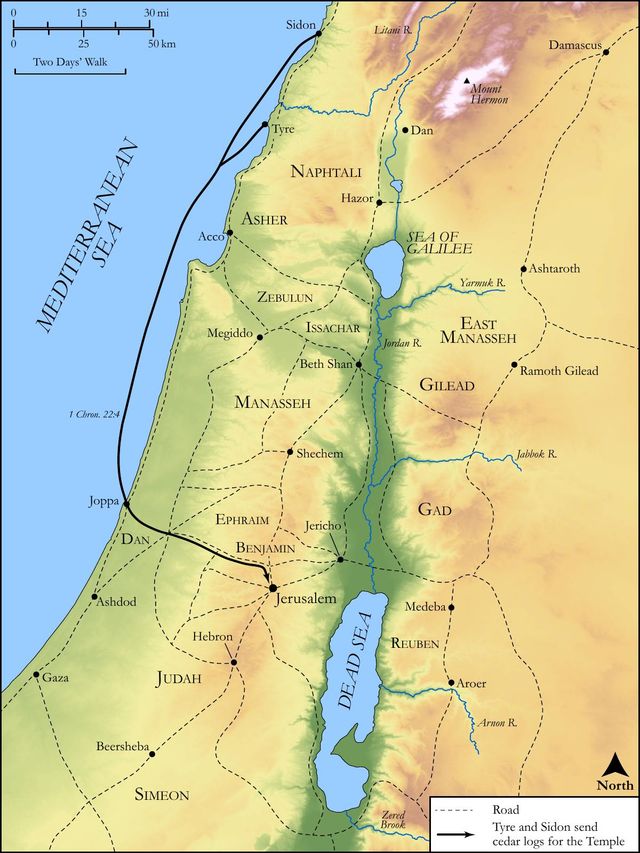
See on the biblical-era map
Study this verse
Public-domain commentary
Matthew Henry
From his Commentary on the Whole Bible. Henry comments on passages, not single verses — this entry covers 1 Chronicles 22:6–16. His two-level outline is real structure in the source text, so it is rendered as structure.
Though Solomon was young and tender, he was capable of receiving instructions, which his father accordingly gave him, concerning the work for which he was designed. When David came to the throne he had many things to do, for the foundations were all out of course; but Solomon had only one thing in charge, and that was to build a house for the Lord God of Israel, Ch1 22:6. Now,
I.David tells him why he did not do it himself.
It was in his mind to do it (Ch1 22:7), but God forbade him, because he had shed much blood, Ch1 22:8. Some think this refers to the blood of Uriah, which fastened such a reproach upon him as rendered him unworthy the honour of building the temple: but that honour was forbidden him before he had shed that blood; therefore it must be meant, as it is here explained, of the blood he shed in his wars (for he had been a man of war from his youth), which, though shed very justly and honourably in the service of God and Israel, yet made him unfit to be employed in this service, or rather less fit than another that had never been called to such bloody work. God, by assigning this as the reason of laying David aside from this work, showed how precious human life is to him, and intended a type of him who should build the gospel temple, not by destroying men's lives, but by saving them, Luk 9:56.
II.He gives him the reason why he imposed this task upon him.
1.Because God had designed him for it, nominated him as the man that should do it: A son shall be born to thee, that shall be called Solomon, and he shall build a house for my name, Ch1 22:9, Ch1 22:10. Nothing is more powerful to engage us to any service for God, and encourage us in it, than to know that hereunto we are appointed.
2.Because he would have leisure and opportunity to do it. He should be a man of rest, and therefore should not have his time, or thoughts, or wealth, diverted from this business. He should have rest from his enemies abroad (none of them should invade or threaten him, or give him provocation), and he should have peace and quietness at home; and therefore let him build the house. Note, Where God gives rest he expects work.
3.Because God had promised to establish his kingdom. Let this encourage him to honour God, that God had honour in store for him; let him build up God's house, and God will build up his throne. Note, God's gracious promises should quicken and invigorate our religious service.
III.He delivers him an account of the vast preparations he had made for this building (Ch1 22:14), not in a way of pride and vain glory (he speaks of it as a poor thing - I have, in my poverty, prepared, margin), but as an encouragement to Solomon to engage cheerfully in the work, for which so solid a foundation was laid. The treasure here mentioned of the 100,000 talents of gold, and 1,000,000 talents of silver, amounts to such an incredible sum that most interpreters either allow an error in the copy or think the talent here signifies no more than a plate or piece: ingots we call them. I am inclined to suppose that a certain number is here put for an uncertain, because it is said (Ch1 22:16) that of the gold and silver, as well as of the brass and iron, there was no number, and that David here includes all the dedicated things (Ch1 18:11) which he designed for the house of the Lord, that is, not only for the building of it, but for the treasure of it; and putting all together, it might come pretty near what is here spoken of. Hundreds and thousands are numbers which we often use to express that which is very much, when yet we would not be understood strictly.
IV.He charges them to keep God's commandments and to take heed to his duty in every thing, Ch1 22:13.
He must not think by building the temple to purchase a dispensation to sin; no, on the contrary, his doing that would not be accepted, nor accounted of, if he did not take heed to fulfil the statutes which the Lord charged Moses with, Ch1 22:13. Though he was to be king of Israel, he must always remember that he was a subject to the God of Israel.
V.He encourages him to go about this great work, and to go on in it (Ch1 22:13):
"Be strong, and of good courage, Though it is a vast undertaking, thou needest not fear coming under the reproach of the foolish builder, who began to build and was not able to finish it; it is God's work, and it shall come to perfection. Dread not, nor be dismayed." In our spiritual work, as well as in our spiritual warfare, we have need of courage and resolution.
VI.He quickens him not to rest in the preparations he had made, but to add thereto, Ch1 22:14.
Those that enter into the labours of others, and build upon their advantages, must still be improving.
VII.He prays for him:
The Lord give thee wisdom and understanding, and give thee charge concerning Israel, Ch1 22:12. Whatever charge we have, if we see God giving us the charge and calling us to it, we may hope he will give us wisdom for the discharge of it. Perhaps Solomon had an eye to this prayer of his father for him, in the prayer he offered for himself: Lord, give me a wise and understanding heart. He concludes (Ch1 22:16), Up, and be doing, and the Lord be with thee. Hope of God's presence must not slacken our endeavours. Though the Lord be with us, we must rise and be doing, and, if we do this, we have reason to believe he is and will be with us. Work out your salvation, and God will work in you.
Continue studying 1 Chronicles 22:10 across the web’s major study libraries — every link below opens this exact verse, chapter, or book on the destination site.
Read & Compare
 BibleGatewayThis verse in more than 200 translations and 70 languages.
 Bible.comThe YouVersion reader — hundreds of translations, reading plans, and highlights.
 ESV.orgCrossway's official English Standard Version reader.
 NET BibleThe NET translation with 60,000+ translators' notes on every rendering decision.
 STEP BibleTyndale House's free study tool — original text, vocabulary, and scholarly resources.
 BibliaLogos Bible Software's free web reader.
 USCCBThe New American Bible (Revised Edition) with the U.S. bishops' study notes.
Commentaries
 BibleHub CommentariesDozens of classic commentaries on this verse, gathered on one page.
 StudyLightMore than 100 commentary sets — the largest collection on the web.
 BibleRefPlain-English commentary on what this verse means, verse by verse.
 Enduring WordDavid Guzik's free commentary on this chapter, widely used by Bible teachers.
 Bible Study ToolsVerse commentary alongside Greek and Hebrew study aids.
Original Language & Research
- BibleHub InterlinearThe verse word by word — original language, transliteration, and English.
- BibleHub LexiconEvery word's original-language definition and Strong's entry.
 Blue Letter BibleDeep-study tools — Strong's numbers, concordance, and word studies.
 SefariaThe Hebrew text with Rashi and centuries of Jewish commentary.
Sermons, Hymns & Audio


TrulyRandomVerse is not affiliated with these sites and doesn’t control their content. They’re linked because they’re genuinely useful.
Summary
1 Chronicles 22:10 presents a pivotal divine declaration to David concerning his son Solomon, outlining God's specific mandate for the construction of the Temple, affirming a unique covenantal sonship between God and Solomon, and guaranteeing the perpetual establishment of David's royal throne. This prophecy, delivered through David to Solomon, serves as a foundational promise, ensuring the continuity of God's redemptive plan through the Davidic lineage and pointing ultimately to the Messiah.
Context
ShowHideLiterary Context
This verse is strategically placed within David's final preparations and instructions for the monumental task of building the Temple. David, a "man of war" (1 Chronicles 22:8), was divinely prohibited from constructing the Temple himself. Instead, God chose his son Solomon for this sacred duty. The preceding verses (1 Chronicles 22:6-9) detail David's explanation to Solomon of this divine prohibition and the specific, peaceful nature of Solomon's reign, which would enable him to build "a house for the name of the Lord his God" (1 Chronicles 22:7). Therefore, 1 Chronicles 22:10 functions as the explicit divine promise that undergirds Solomon's mission, echoing and reaffirming the core tenets of the Davidic Covenant first revealed in 2 Samuel 7. It solidifies Solomon's legitimacy, the divine backing for his reign, and the ultimate success of the Temple project, framing it as a direct fulfillment of God's word.
Historical & Cultural Context
In the ancient Near East, the construction of grand temples was a common practice among kings, serving to legitimize their rule, demonstrate their piety, and secure divine favor. However, the Temple in Jerusalem stood apart because its design, purpose, and even the choice of its builder were divinely ordained, not merely a human initiative. The concept of "sonship" for kings was also prevalent, where a monarch might be declared a "son" of a deity, signifying divine favor and authority. In Israel, this concept was uniquely transformed; while the king was indeed God's chosen representative, his sonship was covenantal, implying both privilege and profound responsibility under the one true God. The promise of an "eternal kingdom" would have resonated deeply with a people who had experienced periods of instability, foreign domination, and internal strife, offering a profound hope for enduring peace, security, and divine presence centered around the Temple and the Davidic dynasty.
Key Themes
ShowHideThis verse encapsulates several pivotal themes central to the Chronicler's theology and the broader biblical narrative. Firstly, it highlights the Divine Mandate for the Temple, underscoring that the Temple was not merely a human architectural feat but a sacred commission from God Himself, designed as a dwelling place for His "name"—His presence, character, and renown among His people. Secondly, it emphasizes Covenantal Sonship, establishing a unique, adoptive relationship between God and Solomon ("He shall be my son, and I will be his father"). This divine sonship elevates Solomon's kingship beyond mere human succession, placing him in a special position of divine favor and responsibility, a theme that finds its ultimate expression in the New Testament's understanding of Jesus as the Son of God, the true heir to David's throne, as seen in Hebrews 1:5. Thirdly, the promise of an Eternal Kingdom ("I will establish the throne of his kingdom over Israel for ever") is profoundly significant. While Solomon's kingdom eventually fractured due to his unfaithfulness, this promise extends beyond any single monarch, guaranteeing the perpetuity of David's dynasty and pointing to a future, everlasting reign. This enduring promise finds its ultimate and perfect fulfillment in the person and reign of Jesus Christ, the Messiah, whose kingdom truly has no end, as powerfully prophesied in Isaiah 9:7.
Exposition and Analysis
ShowHideKey Word Analysis
ShowHideThis word (H1004) carries a profound dual meaning in this context. Primarily, it refers to a physical structure, the Temple, which Solomon is commanded to build for God's name. However, in parallel with the Davidic Covenant (2 Samuel 7:11), "house" also refers to a dynasty or lineage. God promises to build David a "house" (dynasty), and in return, David's son will build God a "house" (Temple). This interplay highlights the reciprocal and covenantal nature of God's promise to David and his descendants.
While Solomon is David's biological son, the declaration "he shall be my son, and I will be his father" signifies a special, covenantal, and adoptive relationship (H1121). This is not merely biological descent but a divine election and affirmation of Solomon's status as God's chosen representative and heir to the throne. It establishes a unique bond of authority, intimacy, and obedience within the framework of the Davidic covenant, setting Solomon apart as divinely appointed.
This term (H5769) denotes perpetuity, eternity, or an indefinite duration, often referring to a vanishing point that extends beyond human comprehension. In the context of a divine promise or covenant, it signifies an enduring, unbreakable, and everlasting commitment from God. While the immediate fulfillment relates to the longevity of David's dynasty, its ultimate theological implication points to a truly eternal reign, transcending the limitations of human kingdoms and finding its perfect realization in the Messiah's everlasting dominion.
Verse Breakdown
ShowHide"He shall build an house for my name"
This clause explicitly assigns the specific, monumental task of constructing the Temple to Solomon. The phrase "for my name" emphasizes that the Temple is not merely a grand building but a sacred space dedicated to God's presence, character, and reputation. It is where God's glory would dwell, where His unique identity would be honored, and where His people would worship Him, signifying His unique covenantal relationship with Israel.
"and he shall be my son, and I [will be] his father"
This is a profound declaration of covenantal sonship, establishing a unique, intimate, and authoritative relationship between God and Solomon. God adopts Solomon as His son, granting him divine favor, protection, and legitimacy for his reign. In return, Solomon is expected to respond with filial obedience, faithfulness, and devotion. This relationship is foundational to the Davidic covenant, elevating the king to a divinely appointed status.
"and I will establish the throne of his kingdom over Israel for ever"
This final clause guarantees the enduring nature of David's royal line through Solomon. It is a divine promise of perpetual succession for the Davidic dynasty, ensuring that a descendant of David would always sit on the throne. While the immediate historical kingdom of Israel faced challenges, division, and eventual exile, the "for ever" aspect points to a far greater, ultimate fulfillment beyond Solomon's immediate reign, signaling the enduring nature of God's covenant and His overarching plan for an eternal kingdom that transcends earthly limitations.
Literary Devices
ShowHideThe verse employs several significant literary devices that enrich its meaning and impact. Covenant Formula is prominently evident in the declaration "he shall be my son, and I will be his father," mirroring ancient Near Eastern adoption and succession treaties, but here imbued with divine authority and grace. This formula establishes a binding relationship with mutual obligations, though God's faithfulness is paramount. The entire verse functions as a Prophecy, foretelling Solomon's specific role in Temple construction and the enduring nature of the Davidic throne. This prophecy is not merely predictive but declarative, reflecting God's sovereign will and unwavering commitment to His promises. Furthermore, Symbolism is present, particularly in the "house for my name," which symbolizes not just a physical structure but God's dwelling presence, His glory, and the central place of worship for His people. The "throne of his kingdom" also symbolizes divine authority, legitimate rule, and the continuity of God's rule through His chosen lineage.
Theological and Thematic Connections
ShowHide1 Chronicles 22:10 is a pivotal verse that firmly anchors the Chronicler's narrative in the enduring promises of God, particularly the Davidic Covenant. It highlights God's unwavering faithfulness to His word, His sovereign choice of instruments (Solomon), and His ultimate plan for a perpetual kingdom centered on His presence. The themes of divine sonship and an eternal throne resonate throughout biblical theology, pointing to a king who would perfectly embody God's rule and establish an everlasting dominion. While Solomon's reign provided a temporary and conditional fulfillment, the "for ever" aspect of the promise transcends any earthly kingdom, revealing a divine trajectory that culminates in the Messiah, whose reign truly knows no end.
Reflection and Application
ShowHideThis verse offers profound encouragement and challenges for believers today, revealing the steadfast character of God. It reminds us that God is a faithful, covenant-keeping God whose plans span generations and ultimately transcend human limitations and failures. Just as God chose Solomon for a specific task and promised an enduring kingdom, He continues to work through His people to accomplish His purposes in the world. We are called to be faithful stewards of the gifts and callings He has given us, knowing that our efforts, when aligned with His will, contribute to a larger, eternal story. The promise of an "eternal kingdom" should fill us with unwavering hope, reminding us that despite the transient nature of earthly powers, political upheavals, and personal struggles, God's ultimate reign is secure, sovereign, and everlasting. Our lives, therefore, should be lived with an eternal perspective, investing our time, talents, and resources in that which truly lasts—God's kingdom and His righteousness.
Questions for Reflection
ShowHideFAQ
ShowHideWhat is the significance of "house for my name" in this verse?
ShowHideThe phrase "house for my name" (Hebrew: bayit l'shemi) is highly significant. It means far more than just a physical building. "Name" in biblical Hebrew often represents the very essence, character, authority, and presence of God. So, the "house for my name" is a place where God's unique identity, glory, and authority are manifested, honored, and worshipped. It signifies that the Temple was to be the central place where God would dwell among His people, where His reputation would be upheld, and where His presence would be experienced in a unique way. It was to be a sacred space dedicated entirely to Him, distinct from pagan temples, and a tangible symbol of His covenant relationship with Israel, inviting His people to draw near.
How does this promise of an "eternal kingdom" relate to the historical reality of Israel's kingdom, which eventually fell?
ShowHideThe promise of an "eternal kingdom" (Hebrew: l'olam) in 1 Chronicles 22:10, echoing the more detailed promise in 2 Samuel 7:16, is a divine guarantee that the Davidic dynasty would never lack a ruler on the throne. While the earthly kingdom of Israel experienced division, exile, and the cessation of a physical king on the throne for centuries, the "for ever" aspect points to a fulfillment that transcends the immediate historical circumstances and the limitations of human rulers. This promise finds its ultimate and perfect realization not in any human king or earthly kingdom, but in the person of Jesus Christ, the Messiah. He is the true and eternal heir to David's throne, whose kingdom is spiritual, universal, and everlasting, as the New Testament clearly reveals. Thus, God's promise was not broken but fulfilled in a way that surpassed human expectations and historical limitations, pointing to a greater, divine reality.
Christ-Centered Fulfillment
ShowHide1 Chronicles 22:10, though spoken directly to Solomon concerning the building of the first Temple and the establishment of his earthly reign, finds its profoundest and ultimate fulfillment in Jesus Christ. The promise that Solomon "shall build an house for my name" is ultimately fulfilled in Christ, who is not only the builder of God's true spiritual house—the Church, built upon the foundation of the apostles and prophets, with Christ Jesus Himself as the chief cornerstone (Ephesians 2:20-22)—but also the very embodiment of God's presence, the Word made flesh dwelling among us (John 1:14). He is the true Temple, through whom all access to God is granted, even declaring, "Destroy this temple, and in three days I will raise it up," referring to His body (John 2:19-21). The declaration "he shall be my son, and I will be his father" is a direct and powerful foreshadowing of Christ's unique divine sonship, affirmed by the Father's voice at His baptism (Matthew 3:17) and transfiguration (Matthew 17:5). He is the ultimate "Son of David" who perfectly fulfills the covenantal relationship with God. Finally, the promise "I will establish the throne of his kingdom over Israel for ever" is perfectly realized in Jesus, whose kingdom is truly eternal and universal. The angel Gabriel's prophecy to Mary explicitly connects Jesus to this promise, stating, "He will reign over Jacob's descendants forever; his kingdom will never end" (Luke 1:32-33). Jesus, the resurrected Lord, now sits at the right hand of God, exercising all authority in heaven and on earth (Matthew 28:18), establishing an everlasting spiritual kingdom that will culminate in His glorious return and final reign (Revelation 11:15). Thus, Solomon's temporal reign and physical temple point beyond themselves to the eternal reign of Christ and the spiritual temple of His body, the Church, in whom God truly dwells.