


1 Chronicles 22:17
Bible text: King James Version (1769 Blayney text) · Public domain
Bible text: Berean Standard Bible · Public domain
Bible text: American Standard Version (1901) · Public domain
Bible text: World English Bible, Messianic edition · Public domain
Bible text: Geneva Bible (1599) · Public domain
Bible text: Young's Literal Translation · Public domain
- וַיְצַוvay·Tzavand he commandedH6680Conj-w ¦ V-Piel-ConsecImperf-3msVerb Piel Consecutive Imperfect 3rd Singular Masculineוַandיְצַוhe commanded
- דָּוִידda·VidDavidH1732N-proper-mNoun Proper Masculine
- לְכָלle·kholto allH3605Prep-l ¦ N-mscNoun Singular Masculine Constructלְtoכָלall
- שָׂרֵיsa·Rei[the] officials ofH8269N-mpcNoun Plural Masculine Construct
- יִשְׂרָאֵלYis·ra·'ElIsraelH3478N-properNoun Proper Location
- לַעְזֹרla'·Zorto helpH5826Prep-l ¦ V-Qal-InfVerb Qal Infinitive Constructלַtoעְזֹרhelp
- לִשְׁלֹמֹהlish·lo·Moh<to> SolomonH8010Prep-l ¦ N-proper-mNoun Proper Masculineלִ<to>שְׁלֹמֹהSolomon
- בְנוֹve·Nohis sonH1121N-msc ¦ 3msNoun Singular Masculine Constructבְנsonוֹhis
English is a literal word-by-word gloss of the Hebrew, not the KJV's wording. Why?
This is the original text the KJV's translators worked from — each Hebrew word with its own literal English meaning in this verse, prepared by scholars at Tyndale House, Cambridge. The KJV translates whole sentences, not word by word, so its wording differs: one Hebrew word can become several English words, and the KJV may choose “the LORD” where the gloss reads “Yahweh”. Both are faithful — they answer different questions. For the KJV's own rendering, switch to the KJV text.
Details
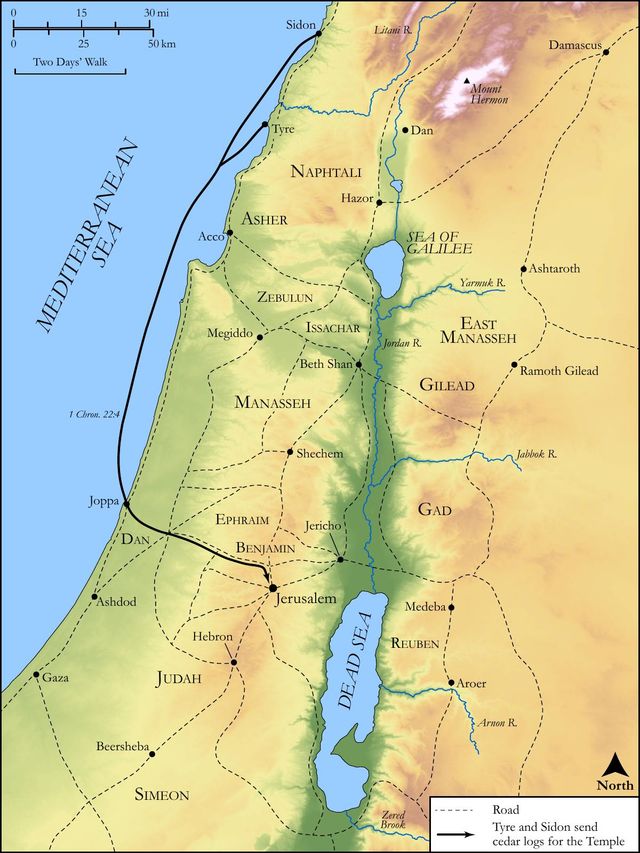
See on the biblical-era map
Study this verse
Public-domain commentary
Matthew Henry
From his Commentary on the Whole Bible. Henry comments on passages, not single verses — this entry covers 1 Chronicles 22:17–19.
David here engages the princes of Israel to assist Solomon in the great work he had to do, and every one to lend him a hand towards the carrying of it on. Those that are in the throne cannot do the good they would, unless those about the throne set in with them. David would therefore have the princes to advise Solomon and quicken him, and make the work as easy to him as they could, by promoting it every one in his place. 1. He shows them what obligations they lay under to be zealous in this matter, in gratitude to God for the great things he had done for them. He had given them victory, and rest, and a good land for an inheritance, Ch1 22:18. The more God has done for us the more we should study to do for him. 2. He presses that upon them which should make them zealous in it (Ch1 22:19): "Set your heart and soul to seek God, place your happiness in his favour, and keep your eye upon his glory. Seek him as your chief good and highest end, and this with your heart and soul. Make religion your choice and business; and then you will grudge no pains nor cost to promote the building of his sanctuary." Let but the heart be sincerely engaged for God, and the head and hand, the estate and interest, and all will be cheerfully employed for him.
Continue studying 1 Chronicles 22:17 across the web’s major study libraries — every link below opens this exact verse, chapter, or book on the destination site.
Read & Compare
 BibleGatewayThis verse in more than 200 translations and 70 languages.
 Bible.comThe YouVersion reader — hundreds of translations, reading plans, and highlights.
 ESV.orgCrossway's official English Standard Version reader.
 NET BibleThe NET translation with 60,000+ translators' notes on every rendering decision.
 STEP BibleTyndale House's free study tool — original text, vocabulary, and scholarly resources.
 BibliaLogos Bible Software's free web reader.
 USCCBThe New American Bible (Revised Edition) with the U.S. bishops' study notes.
Commentaries
 BibleHub CommentariesDozens of classic commentaries on this verse, gathered on one page.
 StudyLightMore than 100 commentary sets — the largest collection on the web.
 BibleRefPlain-English commentary on what this verse means, verse by verse.
 Enduring WordDavid Guzik's free commentary on this chapter, widely used by Bible teachers.
 Bible Study ToolsVerse commentary alongside Greek and Hebrew study aids.
Original Language & Research
- BibleHub InterlinearThe verse word by word — original language, transliteration, and English.
- BibleHub LexiconEvery word's original-language definition and Strong's entry.
 Blue Letter BibleDeep-study tools — Strong's numbers, concordance, and word studies.
 SefariaThe Hebrew text with Rashi and centuries of Jewish commentary.
Sermons, Hymns & Audio


TrulyRandomVerse is not affiliated with these sites and doesn’t control their content. They’re linked because they’re genuinely useful.
Summary
1 Chronicles 22:17 marks a pivotal moment in King David's meticulous preparations for the Temple's construction, shifting his focus from personal instruction to broad national mobilization. Having already charged his son Solomon with the sacred task and amassed vast resources, David now authoritatively commands the leading officials of Israel to provide unwavering support and active assistance to the future king in this monumental, divinely ordained undertaking. This verse powerfully underscores David's comprehensive leadership, his commitment to a unified national effort, and his strategic foresight in ensuring the successful execution of God's architectural blueprint through collaborative action.
Context
ShowHideLiterary Context
This verse serves as a crucial transition point in 1 Chronicles 22. Immediately preceding it, David delivers a deeply personal and comprehensive charge to his son Solomon, as detailed in 1 Chronicles 22:6-16. In this intimate counsel, David explains the divine mandate for the Temple, clarifies why he was prevented from building it, and recounts the immense material provisions he has gathered. He also provides Solomon with a powerful exhortation to be strong, courageous, and obedient to God's commands. Having thus laid the foundational spiritual and practical groundwork with his successor, David now strategically broadens his appeal to the national leadership. This verse sets the stage for his direct address to these "princes" in the subsequent verses, 1 Chronicles 22:18-19, where he articulates the specific ways they are to assist Solomon. This narrative progression demonstrates David's thoroughness in planning and his profound understanding that such a grand undertaking required unified national support, extending far beyond a mere royal decree.
Historical & Cultural Context
The setting for this command is the twilight of King David's reign, a period characterized by relative peace and the consolidation of the Israelite kingdom after years of warfare. David, as the established and highly revered monarch, wielded significant authority, yet the success of a major national project like the Temple's construction depended heavily on the willing cooperation of the "princes of Israel." These "princes" (Hebrew: śārîm) were not simply royal appointees; they often comprised powerful tribal heads, military commanders, and influential elders who represented the diverse factions and regions of Israel. Their support was absolutely crucial for maintaining national unity, mobilizing resources, and ensuring a smooth transition of power to Solomon, who was still young. Culturally, the construction of a central sanctuary was an act of profound religious and national significance, symbolizing God's enduring presence among His people and serving as the focal point of their worship. The Temple project was therefore not merely a construction endeavor but a theological statement, demanding the collective commitment of the entire nation, from the king down to the common laborer, all understood to be acting under divine mandate.
Key Themes
ShowHide1 Chronicles 22:17 significantly contributes to several overarching themes prominent throughout the book of Chronicles. Firstly, it powerfully highlights the theme of Succession and Legacy, demonstrating David's meticulous planning for the future and his unwavering determination to ensure the continuity of God's work through his chosen successor, Solomon. This concern for a stable, God-ordained dynasty is a central emphasis for the Chronicler, who frequently points to God's covenant with David, as seen in 1 Chronicles 17:11-14. Secondly, the verse underscores the vital theme of Unity and Cooperation, as David explicitly commands the national leaders to "help Solomon." This emphasis on collective effort for a divine purpose is paramount, reflecting the Chronicler's deep concern for a united Israel centered on true worship and obedience. Thirdly, it speaks directly to Leadership Responsibility, showcasing David as an exemplary leader who not only provides resources and vision but also actively mobilizes and directs the support of key stakeholders, thereby creating an environment conducive to Solomon's success and the ultimate fulfillment of God's will. Finally, the verse reinforces the Divine Mandate behind the Temple project, framing it not merely as a royal ambition but as a holy undertaking that required the collective commitment of the entire nation, signifying their devotion to God's presence and commands, as previously outlined in 1 Chronicles 22:7-10.
Exposition and Analysis
ShowHideKey Word Analysis
ShowHideThis verb (H6680) denotes a strong, authoritative directive, far beyond a mere suggestion or request. It signifies a binding instruction from a superior to a subordinate, reflecting David's royal authority and his earnest desire to ensure the Temple project's success. The use of "commanded" highlights the seriousness and non-negotiable importance David attached to the princes' cooperation, indicating a formal and weighty injunction.
This term (H8269) refers to high-ranking officials, leaders, or chiefs. In this context, it encompasses the influential tribal heads, military commanders, and other prominent figures within Israel's leadership structure. David's direct address to them signifies that their involvement was not optional but a crucial component of the national effort, given their authority and ability to mobilize resources and people within their respective spheres of influence. Their participation was essential for the project's broad acceptance and execution.
This word (H5826) means to assist, support, or aid. It implies active participation, collaboration, and succor. David is not merely informing the princes; he is enlisting their active support and partnership with Solomon. This "help" would involve various forms of assistance, from providing labor and materials to ensuring national stability and unity during the demanding construction phase, fostering a spirit of collective responsibility.
Verse Breakdown
ShowHide"David also commanded"
This phrase indicates a continuation of David's proactive and comprehensive leadership. It signifies a shift from his private, personal counsel to Solomon (as seen in the preceding verses) to a public, authoritative directive issued to the national leadership, emphasizing his thorough approach to the Temple project.
"all the princes of Israel"
This highlights the expansive scope of David's command, encompassing the entire leadership structure of the nation. It underscores the idea that the Temple was a national project, requiring unified effort and commitment from all segments of society, represented by their respective leaders, ensuring widespread participation and buy-in.
"to help Solomon his son"
This specifies the direct object of their assistance – Solomon, who has been divinely designated as the builder of the Temple. It reinforces the theme of succession and the transfer of immense responsibility. The "help" would involve practical support, political backing, and spiritual encouragement for the young, incoming king as he undertook this monumental task.
"[saying]"
This introductory particle indicates that the subsequent verses (1 Chronicles 22:18-19) contain the direct words of David's command and exhortation to these princes, where he would articulate the specific reasons for their assistance and the expected outcomes of their collective effort.
Literary Devices
ShowHideThe verse employs Foreshadowing by setting the immediate stage for David's explicit appeal to the princes in the verses that directly follow, signaling that their direct involvement and the nature of their assistance are imminent and crucial to the narrative's progression. It utilizes Synecdoche by referring to "all the princes of Israel" to represent the collective will, authority, and resources of the entire nation; their cooperation implicitly guarantees the cooperation of the people they lead. The phrase also functions as a Transition, skillfully moving the narrative from David's private instructions to Solomon to a broader public mobilization, signifying a significant shift in the scope of preparation for the Temple's construction. Furthermore, there is an element of Emphasis conveyed through the potent verb "commanded," highlighting the authoritative and non-negotiable nature of David's directive, thereby underscoring the paramount importance of unity and unwavering support for this divinely ordained project.
Theological and Thematic Connections
ShowHide1 Chronicles 22:17 serves as a profound theological statement about the nature of God's work and the indispensable role of human responsibility in its accomplishment. It teaches that even divinely appointed tasks, such as the building of a sacred dwelling for God, require human collaboration, faithful leadership, and national unity. David's authoritative command to the princes reflects a deep understanding that God's purposes are often fulfilled through the collective, harmonious efforts of His people, guided by faithful and visionary leadership. It underscores the vital principle that the success of spiritual endeavors is rarely achieved in isolation but through a harmonious alignment of diverse gifts, authorities, and resources, all directed towards a common, God-given goal. This verse implicitly affirms the value of intergenerational partnership and the critical importance of established leaders empowering and supporting the next generation in carrying forward God's commission, ensuring continuity and effectiveness in His kingdom work.
Reflection and Application
ShowHideDavid's final act of leadership in commanding the princes to "help Solomon" offers timeless and invaluable lessons for contemporary leadership and community engagement. It highlights the profound responsibility of those in positions of authority to not only cast a compelling vision and gather necessary resources but also to actively foster an environment of support, collaboration, and empowerment for those who will carry the torch forward. This isn't merely about delegating tasks; it's about strategically enlisting the influence, experience, and resources of key stakeholders to ensure the success of a shared, God-given mission. For us today, whether in the church, a family, a workplace, or a broader community, this verse challenges us to consider how we can intentionally empower and rally support for the next generation of leaders or for significant projects that serve God's purposes. It reminds us that great endeavors, especially those with spiritual significance, thrive on unity, shared commitment, and the active "helping" of one another, rather than relying solely on individual heroics or isolated efforts. Our collective strength, guided by divine purpose, is far greater than any single contribution.
Questions for Reflection
ShowHideFAQ
ShowHideWhy was it necessary for David to command "all the princes of Israel" to help Solomon? Couldn't Solomon just command them himself as the new king?
ShowHideWhile Solomon would indeed inherit royal authority, David's command was absolutely crucial for several strategic reasons. Firstly, it provided an authoritative endorsement from the reigning, revered king, legitimizing Solomon's future role and the monumental Temple project in the eyes of the established leadership. These "princes" were powerful, often entrenched figures, many of whom had served David for decades, and their loyalty and cooperation were not automatically guaranteed to a young, relatively inexperienced king like Solomon. David's direct command ensured a smoother transition of power and minimized potential resistance or factionalism, laying a strong foundation for Solomon's reign. Secondly, it underscored the national, rather than merely royal, significance of the Temple project, signaling that this was a collective undertaking for all Israel, requiring unified effort, not just Solomon's personal ambition. David's foresight ensured that the foundation for unity and widespread support was laid even before Solomon fully ascended the throne, setting him up for success in this divinely mandated task, as further detailed in 1 Chronicles 22:18-19.
Christ-Centered Fulfillment
ShowHideWhile 1 Chronicles 22:17 speaks of human leadership and collaboration in building a physical temple, it powerfully foreshadows the ultimate divine-human partnership in the building of God's eternal spiritual Temple, the Church, through Jesus Christ. David, as a type of Christ, meticulously prepared for the dwelling place of God, just as God the Father meticulously planned for the dwelling of His Spirit among humanity. The "help" commanded for Solomon finds its ultimate fulfillment in the Holy Spirit, the divine Helper John 14:26, who empowers believers—the "princes" of God's new covenant kingdom—to participate in the ongoing work of building His spiritual house. Jesus Himself declared, "I will build my church" Matthew 16:18, not through a physical structure of stone, but through living stones, His followers, united in Him 1 Peter 2:5. Just as David ensured unity for Solomon's task, Christ prays for the unity of His disciples John 17:20-23, knowing that the building of His kingdom requires the collective, Spirit-empowered effort of all who are called. Thus, David's command to help Solomon prefigures the call to every believer to participate, by the Spirit's power, in the construction of God's eternal dwelling, founded on the cornerstone, Jesus Christ Ephesians 2:20-22.