


Numbers 23:21
Bible text: King James Version (1769 Blayney text) · Public domain
Bible text: Berean Standard Bible · Public domain
Bible text: American Standard Version (1901) · Public domain
Bible text: World English Bible, Messianic edition · Public domain
Bible text: Geneva Bible (1599) · Public domain
Bible text: Young's Literal Translation · Public domain
- לֹאlo'notH3808NegParticle Negative
- הִבִּיטhi·Bithe has looked atH5027V-Hiphil-Perf-3msVerb Hiphil Perfect 3rd Singular Masculine
- אָוֶן'a·vendisasterH205N-msNoun Singular Masculine Absolute
- בְּיַעֲקֹבbe·ya·'a·Koin JacobH3290Prep-b ¦ N-proper-mNoun Proper MasculineבְּinיַעֲקֹבJacob
- וְלֹאve·lo'and notH3808Conj-w ¦ NegParticle Negativeוְandלֹאnot
- רָאָהra·'Ahhe has seenH7200V-Qal-Perf-3msVerb Qal Perfect 3rd Singular Masculine
- עָמָל'a·MaltroubleH5999N-csNoun Singular common gender Absolute
- בְּיִשְׂרָאֵלbe·Yis·ra·'Elin IsraelH3478Prep-b ¦ N-properNoun Proper LocationבְּinיִשְׂרָאֵלIsrael
- יְהוָהYah·wehYahwehH3068N-properNoun Proper Title
- אֱלֹהָיו'e·lo·Havhis GodH430N-mpc ¦ 3msNoun Plural Masculine ConstructאֱלֹהָיGodוhis
- עִמּוֹi·Mo[is] with himH5973Prep ¦ 3msPreposition Definiteעִמּ[is] withוֹhim
- וּתְרוּעַתu·te·ru·'Atand a shout ofH8643Conj-w ¦ N-fscNoun Singular Feminine Constructוּandתְרוּעַתa shout of
- מֶלֶךְMe·lekha kingH4428N-msNoun Singular Masculine Absolute
- בּוֹbo[is] among <the> himPrep-b ¦ 3msSuffix Personal 3rd Singular Masculineבּ[is] among <the>וֹhim
English is a literal word-by-word gloss of the Hebrew, not the KJV's wording. Why?
This is the original text the KJV's translators worked from — each Hebrew word with its own literal English meaning in this verse, prepared by scholars at Tyndale House, Cambridge. The KJV translates whole sentences, not word by word, so its wording differs: one Hebrew word can become several English words, and the KJV may choose “the LORD” where the gloss reads “Yahweh”. Both are faithful — they answer different questions. For the KJV's own rendering, switch to the KJV text.
Details
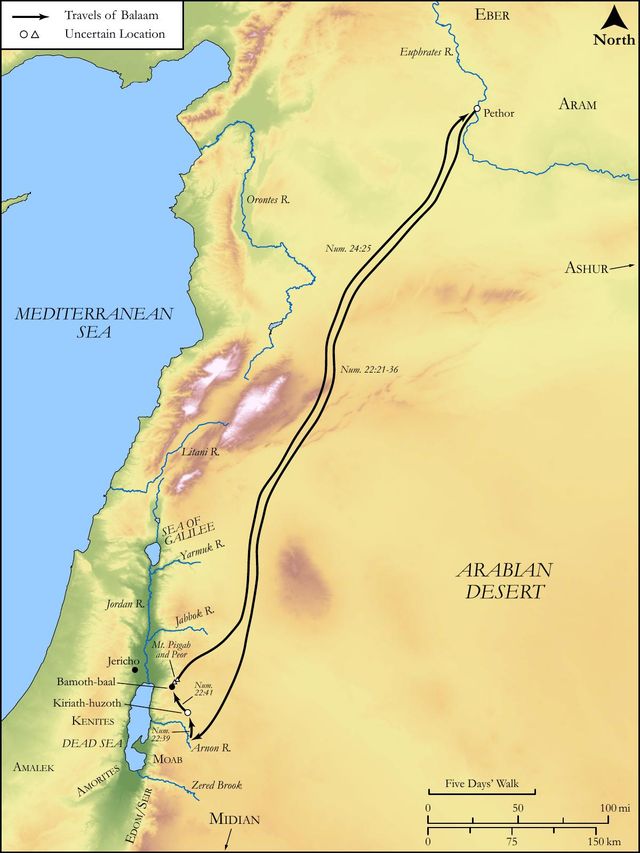
See on the biblical-era map
Study this verse
Public-domain commentary
Matthew Henry
From his Commentary on the Whole Bible. Henry comments on passages, not single verses — this entry covers Numbers 23:13–30. His four-level outline is real structure in the source text, so it is rendered as structure.
Here is, I. Preparation made the second time, as before, for the cursing of Israel. 1. The place is changed, Num 23:13. Balak fancied that Balaam, having so full a prospect of the whole camp of Israel, from the top of the rocks (Num 23:9), was either so enamoured with the beauty of it that he would not curse them or so affrighted with the terror of it that he durst not; and therefore he would bring him to another place, form which he might see only some part of them, which would appear more despicable, and that part at least which would lie in view he hoped he might obtain leave to curse, and so by degrees he should get ground against them, intending, no doubt, if he had gained this point, to make his attack on that part of the camp of Israel which Balaam now had in his eye, and into which he was to throw the fireballs of his curses. See how restless and unwearied the church's enemies are in their malicious attempts to ruin it; they leave no stone unturned, no project untried, to compass it. O that we were as full of contrivance and resolution in prosecuting good designs for the glory of God! 2. The sacrifices are repeated, new altars are built, a bullock and a ram offered on every altar, and Balak attends his sacrifice as closely as ever, Num 23:14, Num 23:15. Were we thus earnest to obtain the blessing as Balak was to procure a curse (designedly upon Israel, but really upon himself and his people), we should not grudge the return both of the charge and of the labour of religious exercises. 3. Balaam renews his attendance on God, and God meets him the second time, and puts another word into his mouth, not to reverse the former, but to ratify it, Num 23:16, Num 23:17. If God said not to Balaam, Seek in vain, much less will he say so to any of the seed of Jacob, who shall surely find him, not only as Balaam, their instructor and oracle, but their bountiful rewarder. When Balaam returned Balak was impatient to know what message he had: "What hath the Lord spoken? Are there any better tidings yet, any hopes of speeding?" This should be our enquiry when we come to hear the word of God. See Jer 23:35.
II.A second conversion of the curse into a blessing by the overruling power of God; and this blessing is both larger and stronger than the former, and quite cuts off all hopes of altering it. Balak having been so forward to ask what the Lord had spoken (Num 23:17), Balaam now addresses himself particularly to him (Num 23:18): Rise up, Balak, and hear. It was a message from God that he had to deliver, and it is required of Balak, though a king, that he attend (hear and hearken, with a close application of mind, let not a word slip), and also that he attend with reverence: Rise up, and hear. His successor Eglon, when he was to receive a message from God, rose out of his seat, Jdg 3:20.
1.Two things Balaam in this discourse informs Balak of, sorely to his grief and disappointment: -
(1.)That he had no reason to hope that he should ruin Israel.
[1.]It would be to no purpose to attempt to ruin them, and he would deceive himself if he expected it, for three reasons: -
First, Because God is unchangeable: God is not a man that he should lie, Num 23:19. Men change their minds, and therefore break their words; they lie, because they repent. But God does neither. He never changes his mind, and therefore never recalls his promise. Balaam had owned (Num 23:8) that he could not alter God's counsel, and thence he infers here that God himself would not alter it; such is the imperfection of man, and such the perfection of God. It is impossible for God to lie, Heb 6:18. And, when in scripture he is said to repent, it is not meant of any change of his mind (for he is in one mind, and who can turn him?) but only of the change of his way. This is a great truth, that with God there is no variableness nor shadow of turning. Now here, 1. He appeals to Balak himself concerning it: "Hath he said, and shall he not do it? Said it in his own purpose, and shall he not perform it in his providence, according to the counsel of his will? Hath he spoken in his word, in his promise, and shall he not make it good? Can we think otherwise of God than that he is unchangeably one with himself and true to his word? All his decrees are unalterable, and all his promises inviolable." 2. He applies this general truth to the case in hand (Num 23:20): He hath blessed and I cannot reverse it, that is, "I cannot prevail with him to reverse it." Israel were of old a blessed people, a seed that the Lord had blessed; the blessing of Abraham came upon them; they were born under the blessing of the covenant, and born to the blessing of Canaan, and therefore they could not be cursed, unless you could suppose that the God of eternal truth should break his word, and become false to himself and his people.
Secondly, Because Israel are at present unblamable: he has not beheld iniquity in Jacob, Num 23:21. Not but that there was iniquity in Jacob, and God saw it; but, 1. There was not such a degree of iniquity as might provoke God to abandon them and give them up to ruin. As bad as they were, they were not so bad as this. 2. There was no idolatry among them, which is in a particular manner called iniquity and perverseness; we have found nothing of that kind in Israel since the golden calf, and therefore, though they were in other instances very provoking, yet God would not cast them off. Balaam knew that nothing would separate between them and God but sin. While God saw no reigning sin among them, he would send no destroying curse among them; and therefore, as long as they kept in with God, he despaired of ever doing them any mischief. Note, While we keep from sin we keep from harm. Some give another sense of those words; they read it thus: He has not beheld wrong offered to Jacob, nor will he see any grievance done to Israel, that is, "He has not nor will he permit it, or allow it; he will not see Israel injured, but he will right them, and avenge their quarrel." Note, God will not bear to see any injury done to his church and people; for what is done against them he takes as done against himself, and will reckon for it accordingly.
Thirdly, Because the power of both was irresistible. He shows Balak that there was no contending with them, it was to no purpose to attempt it; for, 1. They had the presence of God with them: "The Lord his God is with him in a particular manner, and not provoked to withdraw from him." 2. They had the joy of that presence, and were always made to triumph in it: The shout or alarm of a king is among them. They shout against their enemies, as sure of victory and success, glorying continually in God as their King and conqueror for them. 3. They had had the experience of the benefit of God's presence with them, and his power engaged for them; for God brought them out of Egypt, Num 23:22. The power which had done that could never be restrained, never resisted; and, having begun so gloriously, he would no doubt finish gloriously. 4. While they had God's presence with them they had the strength of a unicorn, able to make head against all that opposed them. See Num 24:8. Such is the strength which the God of Israel gives unto his people.
[2.]From all this he infers that it was to no purpose for him to think of doing them a mischief by all the arts he could use, Num 23:23. First, He owns himself baffled. Surely there is no enchantment against Jacob so as to prevail. The curses of hell can never take place against the blessings of heaven. Not but that attempts of this kind would be made, but they would certainly be fruitless and ineffectual. Some observe that Jacob denotes the church low and afflicted, Israel denotes it prosperous and advanced; but be the church high or low, be her friends few or many, let second causes smile or frown, it comes all to one: no weapon formed against it shall prosper. Note, God easily can, and certainly will, baffle and disappoint all the devices and designs of the powers of darkness against his church, so that they shall not prevail to destroy it. Secondly, He foresees that this would be remembered in time to come. According to this time, that is, with reference to this we are now about, it shall be said concerning Jacob and Israel, and said by them, What hath God wrought! What great things hath God done for his people! It shall be said with wonder, joy, and thankfulness, and a challenge to the neighbouring nations to produce any similar instances of the care of their gods for them. Note, The defeating of the designs of the church's enemies ought to be had in everlasting remembrance to the glory of God. There is none like unto the God of Jeshurun. What Balaam says here concerning the pre-eminence of the God of Israel above all the gods of the Gentiles perhaps Moses refers to when he says (Deu 32:31), Their rock is not as our rock, even our enemies themselves being judges, Balaam particularly. Balak therefore has no hopes of ruining Israel. But,
(2.)Balaam shows him that he had more reason to fear being ruined by them, for they were likely to make bloody work among his neighbours; and, if he and his country escaped, it was not because he was too great for them to meddle with, but because he fell not within their commission Num 23:24. Behold, and tremble; the people that now have lain for some time closely encamped do but repose themselves for a while like a lion couchant, but shortly they shall rise up as a great lion, a lion rampant, that shall not lie down till he eat of the prey, and drink the blood of the slain. This seems to point at the victories he foresaw they would obtain over the Canaanites, that they would never lay down their arms till they had made a complete conquest of the land they had now in view; and, when his neighbour's house was on fire, he had reason to think his own in danger.
2.Now what was the issue of this disappointment?
(1.)Balak and Balaam were both of them sick of the cause.
[1.]Balak is now willing to have his conjurer silenced. Since he cannot say what he would have him, he wishes him to say nothing: "Neither curse them at all nor bless them at all, Num 23:25. If thous canst not curse them, I beseech thee not to bless them. If thou canst no assist and encourage my forces, yet do not oppose and dispirit them" Note, God can make those that depart from him weary of the multitude of their counsels, Isa 47:13; Isa 57:10.
[2.]Balaam is still willing to own himself overruled, and appeals to what he had said in the beginning of this enterprise (Num 22:38): All that the Lord speaketh, that I must do, Num 23:26. This sows, First, In general, that the way of man is not in himself; there are many devices in man's heart, but God's counsels shall stand. Secondly, In particular, that, as no weapon formed against the church shall prosper, so every tongue that rises against her in judgment god will control and condemn, Isa 54:17.
(2.)Yet they resolve to make another attempt. They think it scorn to be baffled, and therefore pursue the design, though it be only to their further confusion. And now the third time,
[1.]They change the place. Balak is at last convinced that it is not Balaam's fault, on whom, before, he had laid the blame, but that really he was under a divine check, and therefore now he hopes to bring him to a place whence God might at least permit him to curse them, v. 27. Probably he and Balaam were the more encouraged thus to repeat their attempt because God had the second time allowed Balaam to go, though he had forbidden him the first time. Since by repeated trials they had carried that point, they hope in like manner to carry this. Thus because sinners are borne with, and sentence against their evil works is not executed speedily, their hearts are the more fully set in them to do evil. The place to which Balak now took Balaam was the top of Peor, the most eminent high place in all his country, where, it is probable, Baal was worshipped, and it was thence called Baal-peor. He chose this place with a hope, either, First, That it being the residence (as he fancied) of Baal, the god of Moab, Jehovah the God of Israel would not, or could not, come hither to hinder the operation; or, Secondly, That, it being a place acceptable to his god, it would be so to the Lord, and there he would be brought into a good humour. Such idle conceits have foolish men of God, and so vain are their imaginations concerning him. Thus the Syrians fancied the Lord to be God of the hills, but not of the valleys (Kg1 20:28), as if he were more powerful in one place than he is in every place.
[2.]They repeat their sacrifice, seven bullocks and seven rams, upon seven altars, v. 29, 30. Thus do they persevere in their expensive oblations, though they had no promise on which to build their hopes of speeding. Let not us therefore, who have a promise that the vision at the end shall speak and not lie, be discouraged by delays, but continue instant in prayer, and not faint, Luk 18:1.
Continue studying Numbers 23:21 across the web’s major study libraries — every link below opens this exact verse, chapter, or book on the destination site.
Read & Compare
 BibleGatewayThis verse in more than 200 translations and 70 languages.
 Bible.comThe YouVersion reader — hundreds of translations, reading plans, and highlights.
 ESV.orgCrossway's official English Standard Version reader.
 NET BibleThe NET translation with 60,000+ translators' notes on every rendering decision.
 STEP BibleTyndale House's free study tool — original text, vocabulary, and scholarly resources.
 BibliaLogos Bible Software's free web reader.
 USCCBThe New American Bible (Revised Edition) with the U.S. bishops' study notes.
Commentaries
 BibleHub CommentariesDozens of classic commentaries on this verse, gathered on one page.
 StudyLightMore than 100 commentary sets — the largest collection on the web.
 BibleRefPlain-English commentary on what this verse means, verse by verse.
 Enduring WordDavid Guzik's free commentary on this chapter, widely used by Bible teachers.
 Bible Study ToolsVerse commentary alongside Greek and Hebrew study aids.
Original Language & Research
- BibleHub InterlinearThe verse word by word — original language, transliteration, and English.
- BibleHub LexiconEvery word's original-language definition and Strong's entry.
 Blue Letter BibleDeep-study tools — Strong's numbers, concordance, and word studies.
 SefariaThe Hebrew text with Rashi and centuries of Jewish commentary.
Sermons, Hymns & Audio


TrulyRandomVerse is not affiliated with these sites and doesn’t control their content. They’re linked because they’re genuinely useful.
Summary
Numbers 23:21 encapsulates Balaam's divinely compelled declaration, revealing God's unique and gracious perspective on Israel. Despite being summoned by Balak to curse them, Balaam is constrained by the Lord to pronounce a blessing, affirming that God does not behold Israel's iniquity or perverseness in a way that would negate His covenantal promises or allow their enemies to prevail. Instead, the verse powerfully asserts God's intimate, protective presence among His people and proclaims the triumphant acclamation of a king, signifying divine sovereignty, victorious leadership, and Israel's secure status under the Lord's unwavering rule.
Context
ShowHideLiterary Context
Numbers 23:21 is situated within the dramatic narrative of Balaam's oracles (Numbers 22-24), a pivotal section in the book of Numbers. Balak, the king of Moab, deeply apprehensive of the vast Israelite encampment on his borders, seeks to neutralize their threat by hiring Balaam, a renowned diviner of Mesopotamia, to curse them. However, God repeatedly intervenes, turning Balaam's intended maledictions into blessings, showcasing His absolute sovereignty over human intentions and even over pagan prophets. This specific verse is part of Balaam's second oracle, delivered from the field of Zophim on the top of Pisgah, after Balak's initial attempt to elicit a curse failed. Each successive oracle progressively unveils more profound truths about God's unwavering faithfulness to His covenant, His protective presence with Israel, and His ultimate plan for their future, culminating in significant messianic prophecies that point to a coming King. The verses immediately preceding Numbers 23:21 describe Balaam's ritual preparations and Balak's growing frustration, setting the stage for this surprising and powerful divine pronouncement.
Historical & Cultural Context
The historical backdrop for Numbers 23:21 is Israel's encampment in the plains of Moab, east of the Jordan River, as they near the culmination of their forty-year wilderness journey and prepare to enter the Promised Land. Balak's desperate act of hiring Balaam reflects a practice common among the nations where kings employed diviners, seers, or prophets to invoke divine curses or blessings upon adversaries or allies, believing such pronouncements held inherent, potent spiritual power. Balaam, though not an Israelite, is presented as an individual through whom Yahweh sovereignly chooses to speak, demonstrating God's authority extending beyond Israel to encompass all nations and spiritual powers. The imagery of a "king" and a "shout of a king" recalls the acclamation of a king, whose visible presence or victory was a paramount sign of a nation's strength, divine favor, and assured triumph. In Israel, however, the true King was Yahweh Himself, as Moses wrote, "he was king in Jeshurun", a foundational concept that would profoundly shape their national identity, their unique governance, and their ultimate destiny among the nations.
Key Themes
ShowHideNumbers 23:21 profoundly contributes to several overarching theological and narrative themes within the book of Numbers and the broader Pentateuch. Firstly, it powerfully underscores God's Unwavering Faithfulness and Covenantal Commitment. Despite Israel's well-documented history of grumbling, rebellion, and idolatry throughout their wilderness wanderings, God's perspective, as declared by Balaam, is one of steadfast commitment to His promises. This divine "not beholding" of iniquity speaks not to Israel's sinlessness, but to God's redemptive lens, choosing to look beyond their immediate failings to His ultimate purpose and the atonement He would provide. This echoes the enduring nature of God's covenant love, as seen in passages like Deuteronomy 7:7-8. Secondly, the verse highlights Divine Presence and Protection. The affirmation "the LORD his God [is] with him" is a recurring and vital motif throughout Israel's history, signifying their unique relationship with Yahweh and serving as the ultimate source of their strength, security, and distinction. This abiding presence ensures their preservation and ultimate victory against all adversaries, a truth consistently affirmed throughout their wilderness journey and eventual entry into Canaan, as promised in Isaiah 41:10. Finally, the "shout of a king" points to Divine Kingship and Israel's Royal Destiny. While Israel did not yet possess an earthly monarch, this phrase prophetically foreshadows their future as a kingdom and, more profoundly, points to Yahweh as their true, reigning King, leading them in triumph. It also subtly prepares the reader for the later messianic prophecies within Balaam's oracles (e.g., Numbers 24:17), which speak of a future King who would arise from Israel, bringing ultimate victory and dominion.
Exposition and Analysis
ShowHideKey Word Analysis
ShowHideThis term (H205, אָוֶן) originates from a root perhaps meaning "to pant," leading to concepts of exertion in vain, coming to naught, and strictly, "nothingness." It broadly encompasses trouble, vanity, wickedness, and evil. It can refer to moral evil, idolatry, or even the suffering that results from sin. In Numbers 23:21, Balaam's declaration that God "hath not beheld iniquity" does not suggest Israel's moral perfection, but rather God's sovereign choice to not impute their iniquity in a way that would invalidate His covenant or permit a curse to prevail. It speaks to a profound divine forbearance and a redemptive perspective, where God's ultimate purpose for His people transcends their immediate failings.
The word (H5999, עָמָל) denotes toil, wearing effort, worry, grievance, mischief, and wickedness. It often carries the connotation of oppressive labor or the fruit of wickedness. Similar to ʼâven, its use here emphasizes that God, from His divine vantage point and through the lens of His covenant, chooses not to "see" Israel's moral failings (their perverseness) as a basis for their destruction or for allowing the curses of their enemies to take effect. His focus remains steadfastly on His faithfulness to His promises rather than their immediate unfaithfulness.
This powerful phrase combines tᵉrûwʻâh (H8643) and melek (H4428). Tᵉrûwʻâh refers to clamor, acclamation of joy, a battle-cry, or the clangor of trumpets (as an alarm, jubilation, or loud noise). Melek simply means "king." Together, tᵉrûwʻâh melekh conveys the triumphant shout of a people whose king is present among them, leading them to victory; the joyful acclamation of a king's coronation or active presence; or even the battle cry of the divine King Himself. In this verse, it powerfully conveys the idea of God's active, victorious, and royal presence among Israel, guaranteeing their triumph and signifying their unique status as a nation under His direct, sovereign rule.
Verse Breakdown
ShowHide"He hath not beheld iniquity in Jacob"
This is a profound theological statement about God's unique perspective on His chosen people. It does not deny Israel's actual sins, which are extensively documented throughout the Pentateuch. Rather, it speaks to God's covenantal commitment and His redemptive gaze. From His sovereign vantage point, looking through the lens of His ultimate plan and the atonement He would provide, God chooses not to condemn them based on their daily failings in a way that would revoke His promises or allow their enemies to curse them. His focus remains on His unwavering faithfulness to His covenant with Abraham, Isaac, and Jacob.
"neither hath he seen perverseness in Israel"
This clause reiterates and reinforces the first, employing synonymous parallelism. "Israel" is another name for Jacob, emphasizing the collective identity and destiny of the nation. The repetition underscores the certainty and depth of God's unique way of viewing His people. He does not "see" their perverseness in the sense of allowing it to be the basis for their destruction or for the success of their adversaries' curses. This divine "blindness" to their sin is a testament to His grace, His steadfast love, and His unwavering purpose for them, demonstrating a profound commitment that transcends their human shortcomings.
"the LORD his God [is] with him"
This phrase provides the foundational reason for God's unique and gracious perspective on Israel. Their God, Yahweh (H3068), the self-existent and eternal One, is intimately and actively present among them. This divine presence (H430, ʼĕlôhîym - God) is the ultimate source of Israel's strength, security, and distinction among nations. It signifies God's covenant loyalty, His protective care, and His active intervention, assuring that no curse, no human scheme, and no opposing power can ultimately thwart His plan for His people. It is a powerful affirmation of the Immanuel principle – God with us.
"and the shout of a king [is] among them"
This final clause powerfully portrays the glorious outcome and assurance stemming from God's presence. The "shout of a king" can refer to the triumphant acclamation of Israel, celebrating the active presence of their divine King, Yahweh, who leads them to victory. It can also signify the battle cry of the King Himself, ensuring their triumph over all adversaries. This declaration elevates Israel's status, indicating that they are not a vulnerable, wandering people, but a nation under the direct, victorious reign of their sovereign God, whose presence guarantees their ultimate success and royal destiny.
Literary Devices
ShowHideNumbers 23:21 is rich with several significant literary devices that amplify its theological impact and prophetic weight. Parallelism is prominently featured in the opening clauses: "He hath not beheld iniquity in Jacob, neither hath he seen perverseness in Israel." This synonymous parallelism powerfully reinforces the central idea of God's unique, gracious perspective on His people, using two different but related terms for sin (ʼâven and ʻâmâl) and two names for the nation (Jacob and Israel) to emphasize the comprehensive nature and certainty of the divine declaration. Anthropomorphism is evident in the depiction of God "beholding" or "seeing" (or rather, "not seeing") iniquity and perverseness. While God is omniscient and fully aware of Israel's sins, the language attributes human sensory perception to God to convey His deliberate, covenantal choice to not account their sins against them in a condemning way that would undermine His promises or allow them to be cursed. Finally, Metaphor and Symbolism are powerfully employed in the phrase "the shout of a king is among them." This is not a literal description of an earthly monarch's shout at that moment, but it symbolizes God's active, victorious, and royal presence, ensuring triumph and sovereignty for His people. It is a potent metaphor for divine leadership, the guaranteed success of those under God's reign, and the ultimate destiny of Israel as a kingdom ruled by God Himself.
Theological and Thematic Connections
ShowHideNumbers 23:21 stands as a profound statement about God's unmerited favor and His unwavering commitment to His covenant people. It does not suggest Israel was sinless; indeed, their rebellion is a recurring theme in Numbers. Rather, it reveals God's sovereign choice to look upon them through the lens of His redemptive plan, choosing not to impute their iniquity in a way that would nullify His promises or allow them to be cursed. This divine perspective is rooted in His faithfulness and grace, not in Israel's performance. It underscores that God's covenant with Israel was based on His election and steadfast love, guaranteeing His presence and protection despite their failings. The "shout of a king" signifies God's active, victorious reign among them, ensuring their ultimate triumph and highlighting their unique status as a nation under divine kingship. This verse provides immense comfort, demonstrating that God's love and purposes for His chosen ones are steadfast, transcending their immediate shortcomings, and assuring them of His protective presence.
Reflection and Application
ShowHideNumbers 23:21 offers immense encouragement and a profound theological truth for believers today, revealing the very heart of God's grace: His willingness to look beyond our immediate failings to His ultimate redemptive purpose for us. Just as He did not "behold iniquity" in Israel in a condemnatory way that would void His covenant, so too, for those in Christ, God views us through the perfect righteousness of His Son. This liberating truth frees us from the burden of striving to earn His favor and instead invites us into a deeper trust in His unmerited love, steadfast faithfulness, and finished work on the cross. Knowing that "the LORD his God is with him" assures us of His constant, active presence, His unwavering protection, and His divine power at work in our lives, even amidst our weaknesses and the challenges we face. The "shout of a king" among us signifies the victorious reign of Jesus Christ, our Lord, who has triumphed decisively over sin, death, and all spiritual adversaries. This should inspire us to live with profound confidence, knowing that no curse, no accusation, and no challenge can ultimately prevail against us when the King of Kings is our defender, our guide, and the very source of our identity. It calls us to rest in His sovereign rule and to walk in the assurance of His victorious presence, living as citizens of His unshakable kingdom, empowered by His grace.
Questions for Reflection
ShowHideFAQ
ShowHideDoes Numbers 23:21 imply that ancient Israel was sinless, or that God overlooked their sins?
ShowHideNo, Numbers 23:21 does not imply that ancient Israel was sinless, nor does it suggest that God simply overlooked their sins in a passive sense. The Old Testament, particularly the books of Exodus, Numbers, and Deuteronomy, provides abundant and clear evidence of Israel's frequent rebellion, idolatry, and disobedience (e.g., the golden calf incident in Exodus 32, or their murmuring and rebellion at Kadesh Barnea in Numbers 14). Rather, the statement "He hath not beheld iniquity in Jacob, neither hath he seen perverseness in Israel" speaks to God's unique covenantal perspective and His sovereign grace. From His divine vantage point, looking through the lens of His ultimate redemptive plan and the atonement He would provide, God chose not to impute their sins in a way that would nullify His promises, revoke His covenant, or allow their enemies' curses to prevail. It signifies His steadfast faithfulness to His covenant, which was based on His election and grace, not on Israel's perfect performance. This declaration foreshadows a deeper truth about God's willingness to forgive and remember sin no more for those He has chosen and redeemed, a truth ultimately fulfilled in Christ.
Christ-Centered Fulfillment
ShowHideNumbers 23:21 finds its ultimate and most profound fulfillment in Jesus Christ, who is both the true Israel and the King whose "shout" brings ultimate victory and eternal triumph. The declaration that God "hath not beheld iniquity in Jacob, neither hath he seen perverseness in Israel" is not an endorsement of Israel's inherent sinlessness, but a powerful prophetic foreshadowing of the perfect righteousness God would provide through His Son. In Christ, God truly sees no iniquity in His redeemed people, for He "made Him who knew no sin to be sin for us, that we might become the righteousness of God in Him" (2 Corinthians 5:21). Through Christ's atoning sacrifice on the cross, believers are declared righteous and are seen by God as "new creations" (2 Corinthians 5:17), their sins having been fully paid for and remembered no more by God (Hebrews 8:12). Furthermore, the promise that "the LORD his God [is] with him" finds its ultimate reality in Jesus, Emmanuel, "God with us" (Matthew 1:23), who promised His disciples, "I am with you always, even to the end of the age" (Matthew 28:20). Finally, "the shout of a king [is] among them" points directly to Jesus Christ, the King of Kings and Lord of Lords (Revelation 19:16), whose triumphant resurrection and ascension established His eternal reign. His "shout" is the victorious cry of redemption, the call to salvation, and the assurance of His sovereign rule over all things, ensuring that no curse, no accusation, and no power can prevail against His redeemed people, who now live under the glorious banner of their conquering King.