


2 Samuel 19:10
- וְאַבְשָׁלוֹםve·'av·sha·lOmand AbsalomH53Conj-w ¦ N-proper-mNoun Proper MasculineוְandאַבְשָׁלוֹםAbsalom
- אֲשֶׁר'a·SherwhomH834RelParticle Relative
- מָשַׁחְנוּma·Shach·nuwe anointedH4886V-Qal-Perf-1cpVerb Qal Perfect 1st Plural common gender
- עָלֵינוּ'a·Lei·nuover usH5921Prep ¦ 1cpPreposition Definiteעָלֵיoverנוּus
- מֵתmethe has diedH4191V-Qal-Perf-3msVerb Qal Perfect 3rd Singular Masculine
- בַּמִּלְחָמָהba·mil·cha·Mahin the battleH4421Prep-b ¦ N-fsNoun Singular Feminine Absoluteבַּin theמִּלְחָמָהbattle
- וְעַתָּהve·'a·Tahand thereforeH6258Conj-w ¦ AdvAdverbוְandעַתָּהtherefore
- לָמָהla·Mah<to> why?H4100Prep-l ¦ InterrogPronoun Interrogativeלָ<to>מָהwhy?
- אַתֶּם'a·Tem[are] youH859Pro-2mpPronoun Personal 2nd Plural Masculine
- מַחֲרִשִׁיםma·cha·ri·Shimkeeping silentH2790V-Hiphil-Prtcpl-mpVerb Hiphil Participle Plural Masculine Absolute
- לְהָשִׁיבle·ha·Shivto bring backH7725Prep-l ¦ V-Hiphil-InfVerb Hiphil Infinitive Constructלְtoהָשִׁיבbring back
- אֶת'et<obj.>H853DirObjMParticle Object Indicator
- הַמֶּלֶךְha·Me·lekhthe kingH4428Art ¦ N-msNoun Singular Masculine Absoluteהַtheמֶּלֶךְking
English is a literal word-by-word gloss of the Hebrew, not the KJV's wording. Why?
This is the original text the KJV's translators worked from — each Hebrew word with its own literal English meaning in this verse, prepared by scholars at Tyndale House, Cambridge. The KJV translates whole sentences, not word by word, so its wording differs: one Hebrew word can become several English words, and the KJV may choose “the LORD” where the gloss reads “Yahweh”. Both are faithful — they answer different questions. For the KJV's own rendering, switch to the KJV text.
Details
See on the biblical-era maps
Study this verse
Public-domain commentary
Matthew Henry
From his Commentary on the Whole Bible. Henry comments on passages, not single verses — this entry covers 2 Samuel 19:9–15. His two-level outline is real structure in the source text, so it is rendered as structure.
It is strange that David did not immediately upon the defeat and dispersion of Absalom's forces march with all expedition back to Jerusalem, to regain the possession of his capital city, while the rebels were in confusion and before they could rally again. What occasion was there to bring him back? Could not he himself go back with the victorious army he had with him in Gilead? He could, no doubt; but, 1. He would go back as a prince, with the consent and unanimous approbation of the people, and not as a conqueror forcing his way: he would restore their liberties, and not take occasion to seize them, or encroach upon them. 2. He would go back in peace and safety, and be sure that he should meet with no difficulty or opposition in his return, and therefore would be satisfied that the people were well-affected to have him before he would stir. 3. He would go back in honour, and like himself, and therefore would go back, not at the head of his forces, but in the arms of his subjects; for the prince that has wisdom and goodness enough to make himself his people's darling, without doubt, looks greater and makes a much better figure than the prince that has strength enough to make himself his people's terror. It is resolved therefore that David must be brought back to Jerusalem his own city, and his own house there, with some ceremony, and here we have that matter concerted.
I.The men of Israel (that is, the ten tribes) were the first that talked of it, Sa2 19:9, Sa2 19:10.
The people were at strife about it; it was the great subject of discourse and dispute throughout all the country. Some perhaps opposed it: "Let him either come back himself or stay where he is;" others appeared zealous for it, and reasoned as follows here, to further the design,
1.That David had formerly helped them, had fought their battles, subdued their enemies, and done them much service, and therefore it was a shame that he should continue banished from their country who had been so great a benefactor to it. Note, Good services done to the public, though they may be forgotten for a while, yet will be remembered again when men come to their right minds.
2.That Absalom had now disappointed them. "We were foolishly sick of the cedar, and chose the branch to reign over us; but we have had enough of him: he is consumed, and we narrowly escaped being consumed with him. Let us therefore return to our allegiance, and think of bringing the king back." Perhaps this was all the strife among them, not a dispute whether the king should be brought back or no (all agreed it was to be done), but whose fault is was that it was not done. As is usual in such cases, every one justified himself and blamed his neighbour. The people laid the fault on the elders, and the elders on the people, and one tribe upon another. Mutual excitements to the doing of a good work are laudable, but not mutual accusations for the not doing of it; for usually when public services are neglected all sides must share in the blame; every one might do more than he does, in the reformation of manners, the healing of divisions, and the like.
II.The men of Judah, by David's contrivance, were the first that did it.
It is strange that they, being David's own tribe, were not so forward as the rest. David had intelligence of the good disposition of all the rest towards him, but nothing from Judah, though he had always been particularly careful of them. But we do not always find the most kindness from those from whom we have most reason to expect it. Yet David would not return till he knew the sense of his own tribe. Judah was his lawgiver, Psa 60:7. That his way home might be the more clear,
1.He employed Zadok and Abiathar, the two chief priests, to treat with the elders of Judah, and to excite them to give the king an invitation back to his house, even to his house, which was the glory of their tribe, Sa2 19:11, Sa2 19:12. No men more proper to negociate this affair than the two priests, who were firm to David's interest, were prudent men, and had great influence with the people. Perhaps the men of Judah were remiss and careless, and did it not, because nobody put them on to do it, and then it was proper to stir them up to it. Many will follow in a good work who will not lead: it is a pity that they should continue idle for want of being spoken to. Or perhaps they were so sensible of the greatness of the provocation they had given to David, by joining with Absalom, that they were afraid to bring him back, despairing of his favour; he therefore warrants his agents to assure them of it, with this reason: "You are my brethren, my bone and my flesh, and therefore I cannot be severe with you." The Son of David has been pleased to call us brethren, his bone and his flesh, which encourages us to hope that we shall find favour with him. Or perhaps they were willing to see what the rest of the tribes would do before they stirred, with which they are here upbraided: "The speech of all Israel has come to the king to invite him back, and shall Judah be the last, that should have been the first? Where is now the celebrated bravery of that royal tribe? Where is its loyalty?" Note, We should be stirred up to that which is great and good by the examples both of our ancestors and of our neighbours, and by the consideration of our rank. Let not the first in dignity be last in duty.
2.He particularly courted into his interest Amasa, who had been Absalom's general, but was his own nephew as well as Joab, Sa2 19:13. He owns him for his kinsman, and promises him that, if he will appear for him now, he will make him captain-general of all his forces in the room of Joab, will not only pardon him (which, it may be, Amasa questioned), but prefer him. Sometimes there is nothing lost in purchasing the friendship of one that has been an enemy. Amasa's interest might do David good service at this juncture. But, if David did wisely for himself in designating Amasa for this post (Joab having now grown intolerably haughty), he did not do kindly by Amasa in letting his design be known, for it occasioned his death by Joab's hand, Sa2 20:10.
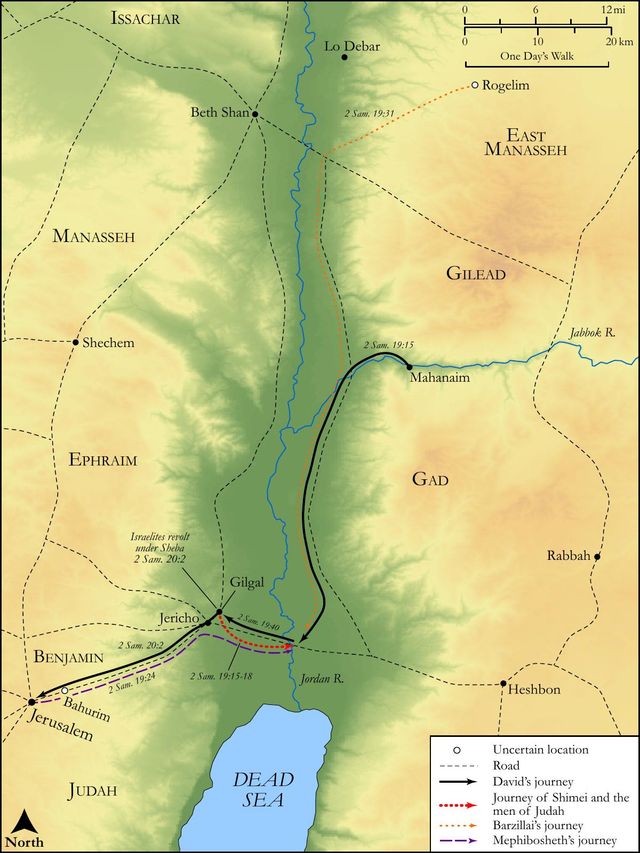
3.The point was hereby gained. He bowed the heart of the men of Judah to pass a vote, nemine contradicente - unanimously, for the recall of the king, Sa2 19:14. God's providence, by the priests' persuasions and Amasa's interest, brought them to this resolve. David stirred not till he received this invitation, and then he came as far back as Jordan, at which river they were to meet him, Sa2 19:15. Our Lord Jesus will rule in those that invite him to the throne in their hearts and not till he be invited. He first bows the heart and makes it willing in the day of his power, and then rules in the midst of his enemies, Psa 110:2, Psa 110:3.
Continue studying 2 Samuel 19:10 across the web’s major study libraries — every link below opens this exact verse, chapter, or book on the destination site.
Read & Compare
 BibleGatewayThis verse in more than 200 translations and 70 languages.
 Bible.comThe YouVersion reader — hundreds of translations, reading plans, and highlights.
 ESV.orgCrossway's official English Standard Version reader.
 NET BibleThe NET translation with 60,000+ translators' notes on every rendering decision.
 STEP BibleTyndale House's free study tool — original text, vocabulary, and scholarly resources.
 BibliaLogos Bible Software's free web reader.
 USCCBThe New American Bible (Revised Edition) with the U.S. bishops' study notes.
Commentaries
 BibleHub CommentariesDozens of classic commentaries on this verse, gathered on one page.
 StudyLightMore than 100 commentary sets — the largest collection on the web.
 BibleRefPlain-English commentary on what this verse means, verse by verse.
 Enduring WordDavid Guzik's free commentary on this chapter, widely used by Bible teachers.
 Bible Study ToolsVerse commentary alongside Greek and Hebrew study aids.
Original Language & Research
- BibleHub InterlinearThe verse word by word — original language, transliteration, and English.
- BibleHub LexiconEvery word's original-language definition and Strong's entry.
 Blue Letter BibleDeep-study tools — Strong's numbers, concordance, and word studies.
 SefariaThe Hebrew text with Rashi and centuries of Jewish commentary.
Sermons, Hymns & Audio


TrulyRandomVerse is not affiliated with these sites and doesn’t control their content. They’re linked because they’re genuinely useful.
Summary
Following the tragic death of Absalom, who had usurped the throne and plunged Israel into civil war, 2 Samuel 19:10 captures a pivotal moment of national reckoning. The verse reflects the growing consensus among the northern tribes of Israel, who had previously supported Absalom's rebellion, that their chosen leader is now dead, and the rightful king, David, must be restored to his throne. It marks a crucial turning point, signaling the end of the rebellion and the urgent need for national reconciliation and the re-establishment of legitimate authority.
Context
ShowHideLiterary Context
This verse immediately follows the decisive resolution of Absalom's rebellion and his death at the hands of Joab in 2 Samuel 18. King David is depicted in profound mourning for his son, a grief so overwhelming that it demoralizes his loyal troops and prompts a sharp rebuke from Joab, urging David to acknowledge the victory and address his people (2 Samuel 19:1-8). The narrative then shifts focus to the scattered tribes of Israel, particularly those who had aligned with Absalom. 2 Samuel 19:9 sets the stage, describing the internal debates and murmuring among the tribes about who should lead them now that Absalom is gone. Verse 10 articulates the conclusion of these discussions, expressing the collective realization that David is their legitimate king and that it is time to bring him back. The subsequent verses detail David's strategic efforts to win back the loyalty of Judah and the northern tribes, culminating in his eventual return to Jerusalem.
Historical & Cultural Context
The period of the united monarchy under David was characterized by complex tribal loyalties and the evolving nature of kingship in Israel. While David had been divinely anointed by Samuel (1 Samuel 16:13), the people's allegiance could shift based on perceived injustices, charismatic leadership, or political expediency. Absalom's rebellion exploited these underlying tensions, particularly between the northern tribes and Judah, which was David's primary base of support. The act of "anointing" (Hebrew: mashach) was traditionally a sacred rite signifying divine appointment, but in Absalom's case (2 Samuel 15:10), it was a popular, self-proclaimed act of usurpation, highlighting the people's active participation in elevating an illegitimate ruler. The death of a king or claimant in battle often led to immediate power vacuums and intense negotiations for succession, as seen here with the tribes deliberating David's return, driven by the pragmatic need for stable governance.
Key Themes
ShowHideThe verse powerfully encapsulates several key themes prevalent in the book of Samuel and the broader Old Testament narrative. Firstly, it underscores the consequences of rebellion against God-ordained authority, demonstrating how Absalom's ambition ultimately led to chaos, civil war, and his own demise, fulfilling the principle that pride goes before destruction. Secondly, it highlights the theme of legitimate authority and divine sovereignty. Despite the people's temporary rejection of David, his divine anointing and God's ultimate plan for his reign remain paramount, leading to the inevitable recognition of his rightful place. Thirdly, the verse touches upon national reconciliation and unity. The rhetorical question posed by the tribes signals a desire to heal the deep divisions wrought by the civil war and to restore stability under the rightful king, paving the way for David's efforts to bring the nation back together, as seen in 2 Samuel 19:11-15. Finally, it subtly reveals the fluidity of human loyalty and the element of political pragmatism, as the same people who "anointed" Absalom now seek to reinstate David, driven by the practical need for stable governance after the failure of their chosen leader.
Exposition and Analysis
ShowHideKey Word Analysis
ShowHideThis verb, a primitive root meaning "to rub with oil, i.e. to anoint; by implication, to consecrate; also to paint," carries profound theological weight. In the context of Absalom, "whom we anointed over us," it highlights the stark contrast between Absalom's popular, human-initiated "anointing" and David's divine anointing by Samuel at God's command (1 Samuel 16:13). The people's act of anointing Absalom was a self-declaration of his kingship, a rebellious act of human will against God's established order, rather than a sacred rite of divine appointment. This word choice emphasizes the illegitimacy of Absalom's rule and the people's complicity in the rebellion.
This primitive root signifies "to die (literally or figuratively); causatively, to kill." In this verse, "is dead in battle" signifies the absolute finality of Absalom's rebellion. His physical death, explicitly "in battle," underscores the violent and destructive outcome of his usurpation. It serves as the undeniable, irreversible fact that forces the people to confront the vacuum of leadership and the failure of their chosen path, compelling them to seek an alternative.
This primitive root means "to scratch, i.e. (by implication) to engrave, plough; hence (from the use of tools) to fabricate (of any material); figuratively, to devise (in a bad sense); hence (from the idea of secrecy) to be silent, to let alone." In the phrase "why speak ye not a word," it conveys a sense of silence or inaction. The question implies a perceived hesitation or lack of initiative on the part of the people to address the pressing issue of David's return, urging them to break their silence and act.
Verse Breakdown
ShowHide"And Absalom, whom we anointed over us, is dead in battle."
This clause serves as the factual premise for the ensuing question. It acknowledges the undeniable reality of Absalom's demise and, significantly, implicates the speakers ("whom we anointed over us"). This admission reveals their prior complicity in the rebellion, acknowledging their active role in elevating Absalom as king, an act that lacked divine sanction and led to national turmoil. The phrase "dead in battle" underscores the violent and conclusive end of the rebellion, leaving no room for doubt or further support for the usurper.
"Now therefore why speak ye not a word of bringing the king back?"
This is a rhetorical question, posed by the elders or leaders of the northern tribes. The "now therefore" indicates a logical consequence of Absalom's death: with the usurper gone, the rightful king's return is the only sensible course of action. The question "why speak ye not a word" implies a sense of urgency and perhaps a subtle rebuke, highlighting their perceived inaction or hesitation. It suggests that the restoration of David should be an obvious and immediate priority, prompting them to move beyond mourning and disunity towards national reconciliation and the re-establishment of legitimate rule.
Literary Devices
ShowHideThe verse employs several impactful literary devices that enhance its meaning and rhetorical force. The most prominent is the Rhetorical Question: "Now therefore why speak ye not a word of bringing the king back?" This question is not posed to elicit information but to make a forceful point, implying that the answer is self-evident and that their inaction is illogical or even culpable. It serves to galvanize the people towards a necessary course of action, urging them to move from passive deliberation to active restoration. There is also a strong element of Irony present. The very people who "anointed" Absalom, demonstrating their rejection of David's legitimate rule, are now the ones advocating for David's return. This highlights the fickle nature of human allegiance and the ultimate failure of rebellion against God-ordained authority. Furthermore, the verse utilizes Contrast between the dead usurper, Absalom, and the living, legitimate king, David, whose return is now imperative. This stark juxtaposition underscores the shift in power dynamics and the restoration of divine order after a period of chaos and illegitimate rule.
Theological and Thematic Connections
ShowHideThis verse powerfully illustrates the theological principle of God's enduring sovereignty over human affairs, even amidst rebellion and political upheaval. Despite the people's misguided choice to follow Absalom, God's ultimate plan for David's kingship prevails. The recognition of David as "the king" after Absalom's death signifies a return to the divinely appointed order, underscoring that true authority is not merely derived from popular acclamation but from God's decree. It also highlights the consequences of rejecting legitimate authority, leading to chaos and ultimately, the demise of the rebellious path. The call to bring David back is a tacit acknowledgment of error and a move towards repentance and restoration, demonstrating God's capacity to bring order out of disorder and to re-establish His chosen leadership, even when human choices have led to profound disarray.
Reflection and Application
ShowHideThe narrative of 2 Samuel 19:10 offers profound lessons for contemporary life, challenging us to critically evaluate the sources of authority we follow, discerning between popular appeal and genuine, God-ordained leadership. Just as the Israelites faced the destructive consequences of following Absalom's rebellion, we too must recognize that choosing paths contrary to divine will or legitimate authority often leads to chaos, division, and sorrow. This verse calls us to humility, encouraging us to acknowledge our errors when we have strayed and to actively pursue reconciliation and restoration. It reminds us that true repentance involves not just recognizing wrong, but actively seeking to re-establish what is right. In our personal lives, this might mean mending broken relationships, returning to neglected spiritual disciplines, or submitting to authorities (whether civil, ecclesiastical, or familial) that God has placed over us. It also speaks to the hope of restoration: even after significant turmoil, God can sovereignly work to bring order and healing, prompting us to play our part in that process, actively seeking to align our lives with His will and His appointed order.
Questions for Reflection
ShowHideFAQ
ShowHideWho are "we" who anointed Absalom, and what does it imply about their allegiance?
ShowHideThe "we" refers to the various tribes of Israel, particularly those in the northern regions, who had actively supported Absalom's rebellion and recognized him as their king. This implies a popular, self-proclaimed "anointing" that lacked divine sanction, in stark contrast to David's legitimate anointing by the prophet Samuel at God's command (1 Samuel 16:13). It highlights their complicity in the rebellion and their shifting allegiance based on political expediency rather than divine will, demonstrating the fickle nature of human loyalty.
Why did the people delay in bringing David back, despite Absalom's death?
ShowHideSeveral factors likely contributed to the delay. Firstly, there was the immediate aftermath of civil war, with lingering fear of David's wrath and uncertainty about the future. Secondly, David himself was in deep mourning for Absalom, which caused distress among his loyal supporters and likely created a leadership vacuum (2 Samuel 19:1-8). Thirdly, the tribes needed time to deliberate and reach a consensus, as tribal loyalties were complex and not easily shifted. The verse itself indicates that the discussion was ongoing ("why speak ye not a word"), suggesting a period of internal debate and political maneuvering before decisive action could be taken to restore the king.
Christ-Centered Fulfillment
ShowHideThe restoration of King David in 2 Samuel 19:10 serves as a powerful foreshadowing of the ultimate and eternal kingship of Jesus Christ. David, though divinely chosen, was a flawed earthly king whose reign was often marred by rebellion, personal sin, and the shifting loyalties of his people. Yet, his return to the throne, after a period of usurpation and chaos, points to a greater King whose reign will never be challenged or overthrown. Jesus is the true Anointed One, the Messiah (from the Hebrew mashiaḥ, meaning "anointed one"), whose rightful kingship was established not by popular acclamation or human anointing, but by divine decree and His triumphant resurrection from the dead (Acts 2:36). Just as Absalom's rebellion ultimately failed, so too will all human rebellion against God's authority ultimately collapse before Christ's triumphant return. The rhetorical call to "bring the king back" resonates with the New Testament's call for humanity to acknowledge Jesus as Lord and to welcome His reign into their lives and the world. His death on the cross was the ultimate victory over the rebellion of sin, and His resurrection confirms His eternal sovereignty. We, like the Israelites, are called to turn from our own rebellious ways and actively participate in the establishment of His kingdom, eagerly awaiting the day when He returns as the King of Kings and Lord of Lords to reign forever.