


Judges 18:9
Bible text: King James Version (1769 Blayney text) · Public domain
Bible text: King James Version with Strong's numbers · Public domain
Bible text: Berean Standard Bible · Public domain
Bible text: American Standard Version (1901) · Public domain
Bible text: World English Bible, Messianic edition · Public domain
Bible text: Geneva Bible (1599) · Public domain
Bible text: Young's Literal Translation · Public domain
- וַיֹּאמְרוּvai·yo·me·Ruand they saidH559Conj-w ¦ V-Qal-ConsecImperf-3mpVerb Qal Consecutive Imperfect 3rd Plural Masculineוַandיֹּאמְרוּthey said
- קוּמָהKu·maharise !H6965V-Qal-Imp-2ms ¦ SfxVerb Qal Imperative 2nd Singular Masculineקוּמָariseה!
- וְנַעֲלֶהve·na·'a·Lehso we may go upH5927Conj-w ¦ V-Qal-ConjImperf-1cpVerb Qal Conjunction+Imperfect 1st Plural common genderוְsoנַעֲלֶהwe may go up
- עֲלֵיהֶם'a·lei·Hemon themH5921Prep ¦ 3mpPreposition Definiteעֲלֵיonהֶםthem
- כִּיkiforH3588PrtParticle Conditional
- רָאִינוּra·'I·nuwe have seenH7200V-Qal-Perf-1cpVerb Qal Perfect 1st Plural common gender
- אֶת'et<obj.>H853DirObjMParticle Object Indicator
- הָאָרֶץha·'A·retzthe landH776Art ¦ N-fsNoun Singular Feminine Absoluteהָtheאָרֶץland
- וְהִנֵּהve·hi·Nehand there!H2009Conj-w ¦ PrtParticle Interjectionוְandהִנֵּהthere!
- טוֹבָהto·Vah[it is] goodH2896Adj-fsAdjective Singular Feminine Absolute
- מְאֹדme·'OdveryH3966Adj-msAdjective Numerical Singular Masculine Absolute
- וְאַתֶּםve·'a·Temand youH859Conj-w ¦ Pro-2mpPronoun Personal 2nd Plural Masculineוְandאַתֶּםyou
- מַחְשִׁיםmach·Shim[are] inactiveH2814V-Hiphil-Prtcpl-mpVerb Hiphil Participle Plural Masculine Absolute
- אַל'almay notH408NegParticle Negative
- תֵּעָצְלוּte·'A·tze·Luyou hesitateH6101V-Niphal-Imperf-2mpVerb Niphal Imperfect 2nd Plural Masculine
- לָלֶכֶתla·Le·khetto goH1980Prep-l ¦ V-Qal-InfVerb Qal Infinitive Constructלָtoלֶכֶתgo
- לָבֹאla·Vo'to goH935Prep-l ¦ V-Qal-InfVerb Qal Infinitive Constructלָtoבֹאgo
- לָרֶשֶׁתla·Re·shetto take possession ofH3423Prep-l ¦ V-Qal-InfVerb Qal Infinitive Constructלָtoרֶשֶׁתtake possession of
- אֶת'et<obj.>H853DirObjMParticle Object Indicator
- הָאָרֶץha·'A·retzthe landH776Art ¦ N-fsNoun Singular Feminine Absoluteהָtheאָרֶץland
English is a literal word-by-word gloss of the Hebrew, not the KJV's wording. Why?
This is the original text the KJV's translators worked from — each Hebrew word with its own literal English meaning in this verse, prepared by scholars at Tyndale House, Cambridge. The KJV translates whole sentences, not word by word, so its wording differs: one Hebrew word can become several English words, and the KJV may choose “the LORD” where the gloss reads “Yahweh”. Both are faithful — they answer different questions. For the KJV's own rendering, switch to the KJV text.
Details
See on the biblical-era maps

Study this verse
Public-domain commentary
Matthew Henry
From his Commentary on the Whole Bible. Henry comments on passages, not single verses — this entry covers Judges 18:7–13. His three-level outline is real structure in the source text, so it is rendered as structure.
Here is, I. The observation which the spies made upon the city of Laish, and the posture of its inhabitants, Jdg 18:7. Never was place so ill governed and so ill guarded, which would make it a very easy prey to the invader.
1.It was ill governed, for every man might be as bad as he would, and there was no magistrate, no heir of restraint (as the word is), that might so much as put them to shame in any thing, much less put them to death, so that by the most impudent immoralities they provoked God's wrath, and by all manner of mutual mischiefs weakened and consumed one another. See here,
(1.)What the office of magistrates is. They are to be heirs of restraint, that is, to preserve a constant entail of power, as heirs to an inheritance, in the places where they are, for the restraining of that which is evil. They are possessors of restraint, entrusted with their authority for this end, that they may check and suppress every thing that is vicious and be a terror to evil doers. It is only God's grace that can renew men's depraved minds and turn their hearts; but the magistrate's power may restrain their bad practices and tie their hands, so that the wickedness of the wicked may not be either so injurious or so infectious as otherwise it would be. Though the sword of justice cannot cut up the root of bitterness, it may cut off its branches and hinder its growth and spreading, that vice may not go without a check, for then it becomes daring and dangerous, and the community shares in the guilt.
(2.)See what method must be used for the restraint of wickedness. Sinners must be put to shame, that those who will not be restrained by the shamefulness of the sin before God and their own consciences may be restrained by the shamefulness of the punishment before men. All ways must be tried to dash sin out of countenance and cover it with contempt, to make people ashamed of their idleness, drunkenness, cheating, lying, and other sins, by making reputation always appear on virtue's side.
(3.)See how miserable, and how near to ruin, those places are that either have no magistrates or none that bear the sword to any purpose; the wicked then walk on every side, Psa 12:8. And how happy we are in good laws and a good government.
2.It was ill guarded. The people of Laish were careless, quiet, and secure, their gates left open, their walls out of repair, because under no apprehension of danger in any way, though their wickedness was so great that they had reason to fear divine vengeance every day. It was a sign that the Israelites, through their sloth and cowardice, were not now such a terror to the Canaanites as they were when they first came among them, else the city of Laish, which probably knew itself to be assigned to them, would not have been so very secure. Though they were an open and inland town, they lived secure, like the Zidonians (who were surrounded with the sea and were well fortified both by art and nature), but were far from the Zidonians, who therefore could not come in to their assistance, nor help to defend them from the danger which, by debauching their manners, they had helped to bring them into. And, lastly, they had no business with any man, which bespeaks either the idleness they affected (they followed no trade, and so grew lazy and luxurious, and utterly unable to defend themselves) or the independency they affected: they scorned to be either in subjection to or alliance with any of their neighbours, and so they had none to protect them nor bring in any aid to them. They cared for nobody and therefore nobody cared for them. Such as these were the men of Laish.
II.The encouragement which they consequently gave to their countrymen that sent them to prosecute their design upon this city, Jdg 18:8-10.
Probably the Danites had formed notions of the insuperable difficulties of the enterprise, thought it impossible ever to make themselves masters of Laish, and therefore had kept themselves so long out of the possession of it, perhaps suggesting likewise to one another, in their unbelief, that it was not a country worth going so far and running such a risk for, which jealousies the spies (and they were not, in this, evil spies) had an eye to in their report.
1.They represent the place as desirable: "If you will trust our judgments, we have seen the land, and we are agreed in our verdict upon the view, that, behold, it is very good (Jdg 18:9), better than this mountainous country into which we are here crowded by the Philistines. You need not doubt of living comfortably in it, for it is a place where there is no want of any thing," Jdg 18:10. See what a good land Canaan was, that this city which lay furthest of all northward, in the utmost corner of the country, stood on such a fruitful spot.
2.They represent it as attainable. They do not at all question but, with God's blessing, they may soon get possession of it; for the people are secure, Jdg 18:10. And the more secure always the less safe. "God has given it into your hands, and you may have it for the taking." They stir them up to the undertaking: "Arise, that we may go up against them, let us go about it speedily and resolutely." They expostulate with them for their delays, and chide them out of their sluggishness: Are you still? Be not slothful to go. Men need to be thus stirred up to mind even their interest. Heaven is a very good land, where there is no want of any thing; our God has, by the promise, given it into our hands; let us not then be slothful in making it sure, and laying hold on eternal life, but strive to enter.
III.The Danites' expedition against Laish.
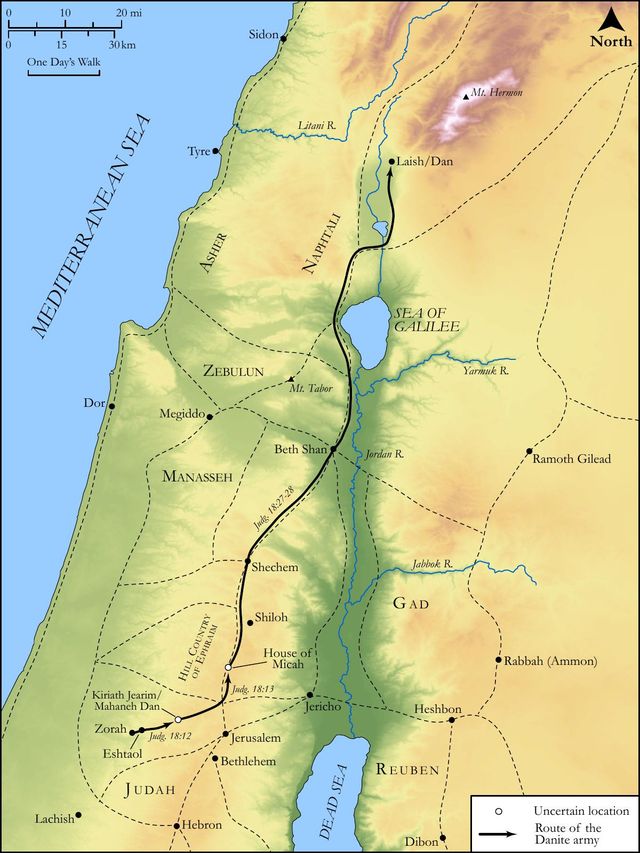
This particular family of them, to whose lot that city fell, now at length make towards it, Jdg 18:11-13. The military men were but 600 in all, not a hundredth part of that tribe, for when they entered Canaan the Danites were above 64,000, Num 26:43. It was strange that none of their brethren of their own tribe, much less of any other, came in to their assistance; but it was long after Israel came to Canaan before there appeared among them any thing of a public spirit, or concern for a common interest, which was the reason why they seldom united in a common head, and this kept them low and inconsiderable. It appears (by Jdg 18:21) that these 600 were the whole number that went to settle there, for they had their families and effects with them, their little ones and cattle, so confident were they of success. The other tribes gave them a free passage through their country. Their first day's march brought them to Kirjath-jearim (Jdg 18:12), and such rare things had military encampments now become in Israel that the place where they rested that night was thence called Mahaneh-dan, the camp of Dan, and probably the place whence they began their march between Zorah and Eshtaol was called by the same name, and is meant, Jdg 13:25. The second day's march brought them to Mount Ephraim, near Micah's house (Jdg 18:13), and there we must pause awhile.
Continue studying Judges 18:9 across the web’s major study libraries — every link below opens this exact verse, chapter, or book on the destination site.
Read & Compare
 BibleGatewayThis verse in more than 200 translations and 70 languages.
 Bible.comThe YouVersion reader — hundreds of translations, reading plans, and highlights.
 ESV.orgCrossway's official English Standard Version reader.
 NET BibleThe NET translation with 60,000+ translators' notes on every rendering decision.
 STEP BibleTyndale House's free study tool — original text, vocabulary, and scholarly resources.
 BibliaLogos Bible Software's free web reader.
 USCCBThe New American Bible (Revised Edition) with the U.S. bishops' study notes.
Commentaries
 BibleHub CommentariesDozens of classic commentaries on this verse, gathered on one page.
 StudyLightMore than 100 commentary sets — the largest collection on the web.
 BibleRefPlain-English commentary on what this verse means, verse by verse.
 Enduring WordDavid Guzik's free commentary on this chapter, widely used by Bible teachers.
 Bible Study ToolsVerse commentary alongside Greek and Hebrew study aids.
Original Language & Research
- BibleHub InterlinearThe verse word by word — original language, transliteration, and English.
- BibleHub LexiconEvery word's original-language definition and Strong's entry.
 Blue Letter BibleDeep-study tools — Strong's numbers, concordance, and word studies.
 SefariaThe Hebrew text with Rashi and centuries of Jewish commentary.
Sermons, Hymns & Audio


TrulyRandomVerse is not affiliated with these sites and doesn’t control their content. They’re linked because they’re genuinely useful.
Summary
Judges 18:9 captures a pivotal moment for the migrating Danites, as their reconnaissance team delivers an urgent and compelling report to their brethren. Having thoroughly surveyed the northern city of Laish, the scouts present an overwhelmingly positive assessment of the land's fertility and the inhabitants' vulnerability, issuing a direct and forceful summons to immediate, decisive action. The verse serves as a powerful exhortation against complacency and a call to seize a divinely presented opportunity for establishing their tribal inheritance.
Context
ShowHideLiterary Context
Judges 18:9 is situated within a significant narrative block (Judges 17-18) that deviates from the typical "cycle of apostasy, oppression, deliverance" found elsewhere in the book. This section vividly illustrates the moral and spiritual decay of Israel during the period when "there was no king in Israel; everyone did what was right in his own eyes" as stated in Judges 17:6. Specifically, chapters 17 and 18 detail the establishment of idolatry by Micah and the subsequent migration of the tribe of Dan. The Danites, having failed to secure their original inheritance in the south against the Philistines, as noted in Judges 1:34, send five spies northward to find new territory. Verse 9 represents the climax of their scouting mission, as the spies return to their 600 armed men, presenting their findings and urging immediate conquest of the unsuspecting city of Laish. This episode highlights the decentralization and lawlessness characteristic of the Judges period, where a tribe takes matters into its own hands, establishing its own territory and even its own religious practices without divine direction.
Historical & Cultural Context
The period of the Judges (c. 13th-11th centuries BC) was a transitional era for Israel, marked by a loose tribal confederation rather than a unified monarchy. The tribes were meant to fully dispossess the Canaanites from the land God had promised them, but many failed to do so, leading to ongoing conflict and cultural assimilation. The tribe of Dan, originally allotted a challenging coastal plain territory in Joshua 19:40-46, found themselves pressured by powerful neighbors like the Philistines. Their decision to seek new land in the far north reflects this inability to secure their initial inheritance. Laish (later renamed Dan) was a Sidonian city, geographically isolated and culturally distinct, living "secure, quiet, and unsuspecting" as described in Judges 18:7. This isolation, coupled with a lack of alliances, made them an easy target for the well-organized Danite force. The Danites' actions, while fulfilling a need for territory, also reflect a pragmatic, self-serving approach characteristic of the period, rather than a direct divine command for this specific conquest.
Key Themes
ShowHideThis verse powerfully encapsulates several themes central to the Book of Judges and broader biblical narrative. Firstly, it underscores the theme of Seizing Opportunity. The spies' report that the land is "very good" and its inhabitants vulnerable presents a clear, almost irresistible, opportunity for the Danites to establish themselves. This echoes the divine provision of the promised land to Israel, which they were commanded to possess. Secondly, it highlights the Call to Decisive Action. The repeated exhortations ("Arise," "go up," "be not slothful") are direct commands for immediate, bold movement, emphasizing that hesitation could lead to the loss of this prime chance. This theme of prompt obedience to a perceived call is recurrent throughout scripture. Thirdly, the verse includes a strong Warning Against Slothfulness or Inaction. The rhetorical question, "and are ye still?" coupled with the explicit command "be not slothful," serves as a rebuke against spiritual lethargy or procrastination in the face of a clear path forward. This aligns with biblical wisdom literature that warns against idleness and encourages diligence, as seen in Proverbs 6:6-11. Finally, at its core, the verse speaks to the broader biblical mandate of Possessing the Land. For the Danites, this meant actively taking hold of their new inheritance, a physical manifestation of God's promise to Israel to dwell securely in the land He had given them, as commanded in Deuteronomy 1:8.
Exposition and Analysis
ShowHideKey Word Analysis
ShowHideThe Hebrew word טוֹב (ṭôwb) is a fundamental descriptor of quality, beauty, and suitability. When combined with מְאֹד (mᵉʼôd), "very," as in "very good" (טוֹב מְאֹד, ṭôwb mᵉʼōd), it signifies superlative excellence, indicating something exceptionally pleasant, beneficial, or desirable. This exact phrase is famously used in Genesis 1:31 to describe God's completed creation, implying that the land of Laish was exceptionally fertile, spacious, and desirable—a truly prime location. The spies' use of this phrase would have evoked a sense of divine blessing and optimal conditions for settlement.
The word מַחְשִׁים (maḥšîm), translated "still" or "silent," comes from the root חָשָׁה (châshâh), meaning "to hush or keep quiet; hold peace, keep silence, be silent, (be) still." In this context, it is a rhetorical question designed to shame the Danites out of their inaction or hesitation. It implies a state of passive complacency or indecision when prompt, vigorous action is clearly required. It challenges their current state of rest or deliberation, urging them to move from contemplation to conquest.
The term תֵּעָצְלוּ (tēʿāṣəlû), translated "slothful," derives from the root עָצֵל (ʻâtsal), meaning "to lean idly, i.e. to be indolent or slack; be slothful." This is a direct and strong admonition against procrastination or spiritual apathy. It warns that idleness or a lack of zeal could cause them to miss the opportune moment to secure their future. The spies are not merely suggesting action but actively rebuking any potential for delay born of laziness or fear.
Verse Breakdown
ShowHide"And they said, Arise, that we may go up against them"
This opening clause immediately establishes the urgent and confrontational nature of the spies' message. "Arise" (קוּמוּ, qûmû) is an imperative, a call to immediate physical and mental readiness for action. The phrase "go up against them" (וְנַעֲלֶה עֲלֵיהֶם, wənaʿăleh ʿălêhem) clearly states the aggressive intent—a military campaign to conquer the inhabitants of Laish.
"for we have seen the land, and, behold, it [is] very good"
This provides the justification for the proposed action. The spies' eyewitness account ("we have seen the land") lends credibility and authority to their report. The emphatic declaration "behold, it [is] very good" (וְהִנֵּה הִיא טוֹבָה מְאֹד, wəhinnēh hî ṭôḇâ məʾōḏ) highlights the exceptional quality and suitability of the territory. This positive assessment is designed to motivate and assure their brethren of the value of the prize.
"and [are] ye still? be not slothful to go, [and] to enter to possess the land."
This final, powerful segment contains a rhetorical question and a direct command, serving as a forceful rebuke and an urgent exhortation. "Are ye still?" (וְאַתֶּם מַחְשִׁים, wə'attem maḥšîm) challenges their present inaction, implying that any delay is unacceptable given the favorable conditions. The command "be not slothful" (אַל־תֵּעָצְלוּ, ʾal-tēʿāṣəlû) directly condemns any tendency towards laziness or hesitation. The ultimate goal is clearly stated: "to go, and to enter to possess the land" (לָלֶכֶת לָבוֹא לָרֶשֶׁת אֶת־הָאָרֶץ, lālêḵeṯ lāḇô lārešeṯ ʾeṯ-hāʾāreṣ), emphasizing the full and decisive act of taking control and establishing their inheritance.
Literary Devices
ShowHideJudges 18:9 employs several potent Literary Devices to convey its urgent message. The most prominent is Exhortation, as the spies deliver a fervent call to action, using imperative verbs like "Arise" and direct commands like "be not slothful." This creates a sense of immediacy and underscores the critical nature of the moment. A Rhetorical Question ("and are ye still?") is strategically placed to challenge the Danites' potential complacency or hesitation, designed to provoke a sense of shame and spur them into action rather than elicit a verbal answer. The phrase "very good" is an instance of Hyperbole (or a strong affirmation), echoing the divine assessment of creation in Genesis, which serves to emphasize the exceptional quality of the land and intensify the motivation for conquest. Finally, there is a strong element of Contrast between the ideal, fertile land and the potential for the Danites' own inaction or "slothfulness," highlighting the missed opportunity if they fail to act decisively.
Theological and Thematic Connections
ShowHideJudges 18:9, while set in a specific historical context, resonates with profound theological and thematic truths applicable across the biblical narrative. It speaks to the interplay between divine provision and human responsibility. God had promised Israel the land, but its possession required active, courageous engagement. The "very good" land of Laish, though found by human reconnaissance, represents a type of opportunity or blessing that God often places before His people. The spies' urgent call against "slothfulness" underscores a recurring biblical theme: that God's promises and provisions often require diligence, faith, and decisive action on the part of His people. Spiritual lethargy or fear can hinder the realization of divine purposes. This principle is seen in the Israelites' initial failure to fully dispossess the Canaanites due to fear and lack of faith, and conversely, in the successes achieved through bold obedience. The verse serves as a microcosm of the larger challenge for God's people to actively "possess" or walk in the inheritance and blessings that have been divinely granted, whether physical land or spiritual realities.
Reflection and Application
ShowHideJudges 18:9 offers timeless principles for believers today, transcending its historical context to speak to our spiritual lives. Just as the Danite spies saw a clear, desirable path to their inheritance, Christians are called to be vigilant for opportunities to advance God's kingdom, to grow in their faith, and to walk in the spiritual inheritance Christ has provided. This verse serves as a powerful reminder that while God provides the "good land"—His grace, His calling, His open doors—we are often required to "arise" and "go up" with diligence and intentionality. Spiritual slothfulness, procrastination, or fear can cause us to miss divine appointments and hinder us from fully experiencing the abundant life and purpose God has for us. It encourages us to cultivate a spirit of readiness, discerning God's leading, and acting decisively in faith, trusting that He has prepared the way for us to "possess" the good works He has called us to.
Questions for Reflection
ShowHideFAQ
ShowHideWas the Danites' conquest of Laish morally justified according to biblical standards?
ShowHideThe question of the Danites' justification for conquering Laish is complex and often debated among scholars. While the narrative in Judges 18 describes the event without explicit condemnation from the narrator, it also doesn't present it as a divinely commanded conquest like those under Joshua. The Danites were seeking new territory because they had failed to dispossess the inhabitants of their original inheritance, as mentioned in Judges 1:34. Their actions in Judges 18, including the theft of Micah's idol and priest, illustrate the moral and spiritual decline of the period where "everyone did what was right in his own eyes" (Judges 17:6). The conquest of Laish, while pragmatic for the Danites' survival and expansion, was driven by their own initiative and desire for an "easy" land, rather than a direct mandate from God to conquer this specific city. It reflects the chaotic and often morally ambiguous nature of the Judges period, where human expediency often overshadowed divine principles.
What does the phrase "it is very good" imply about the land of Laish?
ShowHideThe phrase "it is very good" (טוֹב מְאֹד, ṭôwb mᵉʼōd) is highly significant. It is the same emphatic declaration God uses in Genesis 1:31 to describe His completed creation, signifying absolute perfection and suitability. In Judges 18:9, when the spies use this phrase, it implies that the land of Laish was exceptionally fertile, spacious, and desirable for settlement. Judges 18:10 further elaborates, describing it as a "spacious land" where there was "no lack of anything that is on the earth." This suggests abundant natural resources, fertile ground for agriculture, and ample room for the Danite tribe to thrive. The phrase is intended to convey to the Danites that this was an optimal opportunity, a land of great promise and ease of living, making their inaction all the more inexcusable.
Christ-Centered Fulfillment
ShowHideWhile Judges 18:9 describes a physical conquest of land, its themes find profound Christ-centered fulfillment in the New Testament. The "very good" land of Laish, a place of promise and opportunity for the Danites, foreshadows the superior spiritual inheritance that believers receive in Christ. We are no longer called to physically conquer earthly territory, but to "possess" the spiritual blessings and realities of the new covenant. In Christ, we have been given "every spiritual blessing in the heavenly places" as declared in Ephesians 1:3, a far greater inheritance than any physical land. The spies' urgent call to "arise" and "not be slothful" resonates deeply with the New Testament's call to spiritual diligence. Believers are exhorted to "walk in a manner worthy of the calling to which you have been called" in Ephesians 4:1, to "work out your own salvation with fear and trembling" as instructed in Philippians 2:12, and to "strive to enter that rest" as encouraged in Hebrews 4:11. The "slothfulness" warned against in Judges 18:9 finds its ultimate antidote in the Spirit-empowered zeal of believers who are actively pursuing the Great Commission given in Matthew 28:19-20 and living out their identity as new creations in Christ, as described in 2 Corinthians 5:17. Our ultimate "good land" is not a physical place but the Kingdom of God, which we are called to seek first in Matthew 6:33 and whose realities we are to manifest in the world through faith and obedience, anticipating the new heavens and new earth promised in Revelation 21:1-4.