


2 Samuel 19:42
Bible text: King James Version (1769 Blayney text) · Public domain
Bible text: King James Version with Strong's numbers · Public domain
Bible text: Berean Standard Bible · Public domain
Bible text: American Standard Version (1901) · Public domain
Bible text: World English Bible, Messianic edition · Public domain
Bible text: Geneva Bible (1599) · Public domain
Bible text: Young's Literal Translation · Public domain
- וַיַּעַןvai·ya·'Anand he answeredH6030Conj-w ¦ V-Qal-ConsecImperf-3msVerb Qal Consecutive Imperfect 3rd Singular Masculineוַandיַּעַןhe answered
- כָּלkoleveryH3605N-mscNoun Singular Masculine Construct
- אִישׁ'ish<the> man ofH376N-mscNoun Singular Masculine Construct
- יְהוּדָהye·hu·DahJudahH3063N-properNoun Proper Location
- עַל'altoH5921PrepPreposition
- אִישׁ'ish[the] man ofH376N-mscNoun Singular Masculine Construct
- יִשְׂרָאֵלYis·ra·'ElIsraelH3478N-properNoun Proper Location
- כִּיkiforH3588PrtParticle Conditional
- קָרוֹבka·Rov[is] closeH7138Adj-msAdjective Singular Masculine Absolute
- הַמֶּלֶךְha·Me·lekhthe kingH4428Art ¦ N-msNoun Singular Masculine Absoluteהַtheמֶּלֶךְking
- אֵלַי'e·Laito meH413Prep ¦ 1csPreposition Definiteאֵלַtoיme
- וְלָמָּהve·La·mahand <to> why?H4100Conj-w ¦ Prep-l ¦ InterrogPronoun Interrogativeוְandלָ<to>מָּהwhy?
- זֶּהzehthisH2088PrtParticle Demonstrative
- חָרָהcha·Rahhas it burnedH2734V-Qal-Perf-3msVerb Qal Perfect 3rd Singular Masculine
- לְךָle·Khato <the> youPrep-l ¦ 2msSuffix Personal 2nd Singular Masculineלְto <the>ךָyou
- עַל'alonH5921PrepPreposition
- הַדָּבָרha·da·Varthe matterH1697Art ¦ N-msNoun Singular Masculine Absoluteהַtheדָּבָרmatter
- הַזֶּהha·Zeh<the> thisH2088Art ¦ PrtParticle Demonstrativeהַ<the>זֶּהthis
- הֶאָכוֹלhe·'a·Khol¿ really <to eat>H398Interrog ¦ V-Qal-InfAbsVerb Qal Infinitive Absoluteהֶ¿אָכוֹלreally <to eat>
- אָכַלְנוּ'a·Khal·nuhave we eatenH398V-Qal-Perf-1cpVerb Qal Perfect 1st Plural common gender
- מִןminfromH4480PrepPreposition
- הַמֶּלֶךְha·Me·lekhthe kingH4428Art ¦ N-msNoun Singular Masculine Absoluteהַtheמֶּלֶךְking
- אִם'imor?H518PrtParticle Conditional
- נִשֵּׂאתni·Setreally <be taken away>H5379V-Niphal-Prtcpl-fsVerb Niphal Participle Singular Feminine Absolute
- נִשָּׂאni·Sa'has it been taken awayH5375V-Niphal-Perf-3msVerb Niphal Perfect 3rd Singular Masculine
- לָנוּLa·nuby <the> usPrep-l ¦ 1cpSuffix Personal 1st Plural common genderלָby <the>נוּus
English is a literal word-by-word gloss of the Hebrew, not the KJV's wording. Why?
This is the original text the KJV's translators worked from — each Hebrew word with its own literal English meaning in this verse, prepared by scholars at Tyndale House, Cambridge. The KJV translates whole sentences, not word by word, so its wording differs: one Hebrew word can become several English words, and the KJV may choose “the LORD” where the gloss reads “Yahweh”. Both are faithful — they answer different questions. For the KJV's own rendering, switch to the KJV text.
Details
See on the biblical-era maps
Study this verse
Public-domain commentary
Matthew Henry
From his Commentary on the Whole Bible. Henry comments on passages, not single verses — this entry covers 2 Samuel 19:40–43.
David came over Jordan attended and assisted only by the men of Judah; but when he had advanced as far as Gilgal, the first stage on this side Jordan, half the people of Israel (that is, of their elders and great men) had come to wait upon him, to kiss his hand, and congratulate him on his return, but found they came too late to witness the solemnity of his first entrance. This put them out of humour, and occasioned a quarrel between them and the men of Judah, which was a damp to the joy of the day, and the beginning of further mischief. Here is, 1. The complaint which the men of Israel brought to the king against the men of Judah (Sa2 19:41), that they had performed the ceremony of bringing the king over Jordan, and not given them notice, that they might have come to join in it. This reflected upon them, as if they were not so well affected to the king and his restoration as the men of Judah were, whereas the king himself knew that they had spoken of it before the men of Judah thought of it, Sa2 19:11. It seemed likewise as if they intended to monopolize the king's favours when he had come back, and to be looked upon as his only friends. See what mischief comes from pride and jealousy. 2. The excuse which the men of Judah made for themselves, Sa2 19:42. (1.) They plead relations to the king: "He is near of kin to us, and therefore in a matter of mere ceremony, as this was, we may claim precedency. It was into our country that he was to be brought, and therefore who so fit as we to bring him?" (2.) They deny the insinuated charge of self-seeking in what they had done: "Have we eaten at all of the king's cost? No, we have all borne our own charges. Hath he given us any gift? No, we have no design to engross the advantages of his return; you have come time enough to share in them." Too many that attend princes do so only for what they can get. 3. The men of Israel's vindication of their charge, Sa2 19:43. They pleaded, "We have ten parts in the king" (Judah having Simeon only, whose lot lay within his, to join with him), "and therefore it is a slight upon us that our advice was not asked about bringing back the king." See how uncertain the multitude is. They were lately striving against the king, to drive him out; now they are striving about him, which shall honour him most. A good man and a good cause will thus recover their credit and interest, though, for a time, they may seem to have lost them. See what is commonly the origin of strife, nothing so much as impatience of contempt or the least seeming slight. The men of Judah would have done better if they had taken their brethren's advice and assistance; but, since they did not, why should the men of Israel be so grievously offended? If a good work be done, and well done, let us not be displeased, nor the work disparaged, though we had no hand in it. 4. The scripture takes notice, by way of blame, which of the contending parties managed the cause with most passion: The words of the men of Judah were fiercer than those of the men of Israel. Though we have right and reason on our side, yet, if we express ourselves with fierceness, God takes notice of it and is much displeased with it.
Continue studying 2 Samuel 19:42 across the web’s major study libraries — every link below opens this exact verse, chapter, or book on the destination site.
Read & Compare
 BibleGatewayThis verse in more than 200 translations and 70 languages.
 Bible.comThe YouVersion reader — hundreds of translations, reading plans, and highlights.
 ESV.orgCrossway's official English Standard Version reader.
 NET BibleThe NET translation with 60,000+ translators' notes on every rendering decision.
 STEP BibleTyndale House's free study tool — original text, vocabulary, and scholarly resources.
 BibliaLogos Bible Software's free web reader.
 USCCBThe New American Bible (Revised Edition) with the U.S. bishops' study notes.
Commentaries
 BibleHub CommentariesDozens of classic commentaries on this verse, gathered on one page.
 StudyLightMore than 100 commentary sets — the largest collection on the web.
 BibleRefPlain-English commentary on what this verse means, verse by verse.
 Enduring WordDavid Guzik's free commentary on this chapter, widely used by Bible teachers.
 Bible Study ToolsVerse commentary alongside Greek and Hebrew study aids.
Original Language & Research
- BibleHub InterlinearThe verse word by word — original language, transliteration, and English.
- BibleHub LexiconEvery word's original-language definition and Strong's entry.
 Blue Letter BibleDeep-study tools — Strong's numbers, concordance, and word studies.
 SefariaThe Hebrew text with Rashi and centuries of Jewish commentary.
Sermons, Hymns & Audio


TrulyRandomVerse is not affiliated with these sites and doesn’t control their content. They’re linked because they’re genuinely useful.
Summary
2 Samuel 19:42 vividly portrays the escalating tension between the men of Judah and the men of Israel in the immediate aftermath of Absalom's rebellion and King David's return. This verse records Judah's impassioned defense against accusations of self-serving motives, asserting their right to escort David based on kinship and vehemently denying any pursuit of personal gain or royal favor. It underscores the deep-seated tribal rivalries that plagued the nascent monarchy and ultimately threatened the unity of Israel.
Context
ShowHideLiterary Context
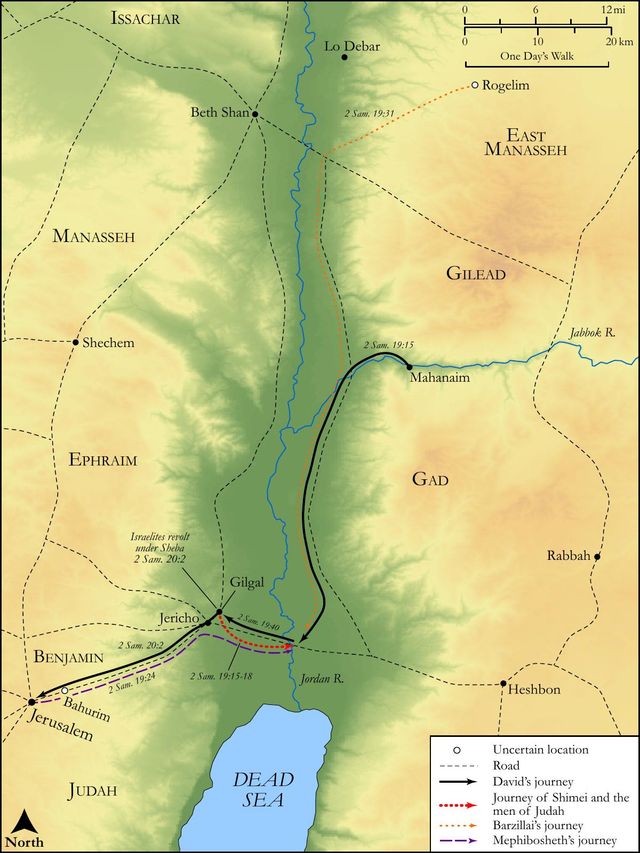
This verse is situated at a critical juncture in the narrative of 2 Samuel, following the defeat and death of Absalom (2 Samuel 18:14). King David, having mourned his son, is preparing to return to Jerusalem and reclaim his throne. A significant point of contention arises regarding who will facilitate his return. David, through Zadok and Abiathar, specifically appeals to the elders of Judah, his own tribe, reminding them of their kinship (2 Samuel 19:11-12). Judah's swift and independent action in escorting David across the Jordan River (2 Samuel 19:15) is perceived by the northern tribes of Israel as an act of favoritism and an usurpation of their collective right to bring back their king. The ensuing heated exchange, culminating in the accusations from Israel and Judah's rebuttal in this verse, sets the stage for further tribal strife and even another rebellion by Sheba (2 Samuel 20:1-2).
Historical & Cultural Context
Ancient Israel was a tribal society, where kinship and lineage were paramount. Loyalty was primarily to one's tribe, and the concept of a unified nation-state under a single king was still relatively new and fragile. David, though king over all Israel, was deeply rooted in the tribe of Judah. This created an inherent tension, as other tribes, particularly the larger and more powerful northern tribes like Ephraim, often felt overlooked or slighted. The act of "eating at the king's cost" or receiving "gifts" was a common practice under the kings of that day, signifying royal patronage, favor, and a dependent relationship. To deny such benefits was to assert independence and purity of motive, claiming that their actions were driven by genuine loyalty and kinship rather than self-interest or a desire for special privilege. The political landscape was volatile, with the recent rebellion highlighting the precariousness of David's reign and the deep divisions within his kingdom.
Key Themes
ShowHideThe central theme illuminated by this verse is the Tribal Rivalry and Jealousy that permeated the Israelite monarchy. The men of Israel's accusation, and Judah's defensive retort, clearly articulate the deep-seated resentment and competition for influence and favor with the king. This rivalry, particularly between Judah and the northern tribes, is a recurring motif throughout the books of Samuel and Kings, ultimately culminating in the Division of the Kingdom after Solomon's reign (1 Kings 12:16). Another prominent theme is Kinship and Loyalty, as Judah's primary justification for their actions is their blood relation to David ("Because the king is near of kin to us"). This highlights the enduring power of familial bonds and tribal identity in shaping political allegiance. Finally, the verse probes the theme of Motive and Self-Interest. By denying any material gain or gifts, Judah attempts to portray their actions as purely altruistic, driven by duty and kinship, rather than by a desire for personal enrichment or exclusive access to royal power, a common accusation in political disputes (Proverbs 28:21).
Exposition and Analysis
ShowHideKey Word Analysis
ShowHideThis Hebrew word (H7138) literally means "near," "close," or "at hand." In this context, it carries the strong connotation of familial proximity, blood relation, and intimate connection, specifically "any of kin" or "kinsfold." Judah's use of this term emphasizes their direct lineage to David and their perceived inherent right and duty to act on his behalf, distinct from the other tribes. It underscores a claim of natural, privileged access and loyalty based on shared ancestry.
This primitive root (H398) means "to eat" (literally or figuratively). In the phrase "have we eaten at all of the king's cost?", the verb ʼâkal is part of an idiom for receiving sustenance, provision, or patronage from a benefactor. In the context of a king, it implies being supported by the royal treasury, receiving a stipend, or benefiting from royal favor. Judah's emphatic denial ("not at all") serves to refute any accusation that their actions were motivated by a desire for material gain or to become royal dependents. They assert their independence from such patronage.
This passive participle feminine (H5379) refers to "something taken, i.e. a present" or "gift." In a royal context, it could signify a reward for service, a bribe for loyalty, or a special favor granted by the monarch. By denying receipt of any "gift," Judah further reinforces their claim of pure motives, asserting that their loyalty was not bought or influenced by any form of special remuneration or bribery from David.
Verse Breakdown
ShowHide"And all the men of Judah answered the men of Israel"
This opening clause immediately establishes the confrontational setting. It highlights the collective voice of Judah, indicating a unified and firm stance against the accusations leveled by the northern tribes of Israel. The public nature of this exchange underscores the deep tribal divisions and the struggle for influence within the kingdom.
"Because the king [is] near of kin to us"
This is Judah's primary justification and the core of their defense. They appeal to the fundamental principle of kinship, asserting that their close blood relationship with David (who was from the tribe of Judah) naturally gave them precedence and a special right to act in his interest. This argument dismisses Israel's claims of being slighted by appealing to a higher, more intrinsic bond.
"wherefore then be ye angry for this matter?"
This is a rhetorical question designed to challenge the legitimacy of Israel's anger. Judah implies that their actions were entirely reasonable and justifiable given their unique relationship with David, and therefore, Israel's resentment is unfounded and illogical. It seeks to deflect blame and put Israel on the defensive.
"have we eaten at all of the king's [cost]?"
This is the first of two rhetorical questions aimed at refuting accusations of self-interest. By denying that they have "eaten at the king's cost," Judah emphatically states that they have not received any financial support, provisions, or ongoing patronage from David. This is a strong assertion that their actions were not driven by a desire for material benefit or to become royal dependents.
"or hath he given us any gift?"
This second rhetorical question further reinforces Judah's denial of corrupt motives. By denying that they have received "any gift," they are disclaiming any special favors, bribes, or rewards from the king. This aims to demonstrate that their loyalty was not bought but was freely given out of genuine kinship and duty, distinguishing their actions from those motivated by personal gain.
Literary Devices
ShowHideThe verse employs several potent literary devices. The most prominent is the Rhetorical Question, used twice ("wherefore then be ye angry...?" and "have we eaten at all...? or hath he given us any gift?"). These questions are not posed to elicit information but to make a forceful assertion and to challenge the validity of the accuser's premise, implying that Israel's anger is baseless and their accusations of self-interest are false. There is also an element of Antithesis at play: Judah's claim of pure, kinship-driven loyalty is set in stark contrast to Israel's implied accusation of self-serving motives and the pursuit of material gain. This highlights the fundamental disagreement over the nature of their respective relationships with the king. Furthermore, the entire exchange serves as Foreshadowing, hinting at the deep-seated tribal divisions that would eventually lead to the schism of the kingdom into Judah and Israel after Solomon's reign, demonstrating that the unity achieved under David was always precarious and fraught with internal tensions.
Theological and Thematic Connections
ShowHideThis tribal dispute, seemingly a mere political squabble, reveals profound theological truths about human nature, leadership, and the challenges of unity. It underscores how easily envy, perceived favoritism, and self-interest can fracture even divinely ordained communities. The emphasis on kinship highlights the biblical importance of covenant and familial bonds, yet also demonstrates how these can become sources of division when elevated above the common good or a broader national identity. The episode serves as a cautionary tale against the dangers of partiality and the need for leaders to foster genuine unity rather than playing into existing divisions. It implicitly calls for a higher loyalty, one that transcends tribal or personal gain, to the God who chose and established the nation as a whole.
Reflection and Application
ShowHideThe intense exchange in 2 Samuel 19:42 offers timeless lessons for navigating conflict and fostering unity within any community, whether family, church, or organization. It challenges us to examine the underlying causes of division, which often stem from perceived slights, jealousy over influence, or accusations of impure motives. Judah's defense, while understandable from their perspective, also reveals the human tendency to prioritize narrow group interests over broader communal harmony. For us today, this narrative prompts deep introspection: Are our actions truly driven by selfless devotion and genuine connection, or are we subtly seeking personal advantage, recognition, or exclusive access? How do we respond when others are perceived to receive favor or opportunities we believe are rightfully yours? The passage reminds us that true unity is not merely the absence of conflict, but the active pursuit of reconciliation, mutual respect, and a shared vision that transcends individual or group agendas. It calls us to cultivate humility, to celebrate the successes of others, and to prioritize the well-being of the whole body over the perceived entitlements of any single part.
Questions for Reflection
ShowHideFAQ
ShowHideWhy were the men of Israel so angry with Judah for bringing David back?
ShowHideThe men of Israel, representing the ten northern tribes, felt deeply slighted and disrespected. They believed they had an equal, if not greater, claim to the king, stating in 2 Samuel 19:43 that they had "ten parts in the king." They likely viewed Judah's independent action in bringing David back as a unilateral move that excluded them from a significant national event and reinforced Judah's perceived favoritism in David's eyes. This fueled their jealousy and sense of being overlooked, leading to the angry confrontation.
What does "eaten at all of the king's cost" mean in this cultural context?
ShowHideThis phrase is an idiom signifying receiving royal patronage, provision, or financial support. In the courts of kings, those who "ate at the king's table" were often officials, loyal servants, or those in special favor, indicating a dependent relationship and a share in the king's resources. Judah's denial was a strong assertion that their actions were not motivated by a desire for material gain, a stipend, or to become royal dependents. They were claiming purity of motive, stating their loyalty was freely given, not bought.
How does this incident foreshadow later events in Israel's history?
ShowHideThis intense tribal dispute is a stark foreshadowing of the eventual division of the united monarchy. The deep-seated rivalry and jealousy between Judah and the northern tribes, particularly Ephraim, continued to simmer throughout David's and Solomon's reigns. After Solomon's death, this tension erupted into open schism when the northern tribes rejected Rehoboam, Solomon's son, and formed their own kingdom under Jeroboam (1 Kings 12:16). The arguments presented in 2 Samuel 19:42-43 directly mirror the very reasons for that later, permanent split, highlighting the persistent challenge of maintaining national unity in the face of strong tribal identities and perceived injustices.
Christ-Centered Fulfillment
ShowHideThe tribal rivalries and the fractured loyalties evident in 2 Samuel 19:42 powerfully underscore humanity's desperate need for a King who transcends all earthly divisions and establishes a kingdom of true, enduring unity. David, despite being God's anointed, could not ultimately overcome the deep-seated tribalism and self-interest that plagued Israel, leading to eventual schism. In stark contrast, Jesus Christ is the true King, not merely "near of kin" to one tribe, but the Son of God, who came to reconcile all humanity to Himself and to each other. He breaks down the "dividing wall of hostility" (Ephesians 2:14) between Jew and Gentile, slave and free, male and female, uniting them into one new humanity in His body, the church (Galatians 3:28). Unlike human leaders who are accused of seeking personal gain or distributing "gifts" to secure loyalty, Christ's leadership is characterized by ultimate self-sacrifice, giving His life as a ransom for many (Mark 10:45). His kingdom is "not of this world" (John 18:36), and therefore, it is not built upon tribal favoritism or material benefits, but on righteousness, peace, and joy in the Holy Spirit (Romans 14:17). He is the head of His body, the church, in whom all things hold together (Colossians 1:18), offering a fulfillment of kingship that truly brings all people into a unified, eternal family under His perfect, selfless reign.