


2 Samuel 19:41
- וְהִנֵּהve·hi·Nehand there!H2009Conj-w ¦ PrtParticle Interjectionוְandהִנֵּהthere!
- כָּלkoleveryH3605N-mscNoun Singular Masculine Construct
- אִישׁ'ish<the> man ofH376N-mscNoun Singular Masculine Construct
- יִשְׂרָאֵלYis·ra·'ElIsraelH3478N-properNoun Proper Location
- בָּאִיםba·'Im[were] comingH935V-Qal-Prtcpl-mpVerb Qal Participle Plural Masculine Absolute
- אֶל'eltoH413PrepPreposition
- הַמֶּלֶךְha·Me·lekhthe kingH4428Art ¦ N-msNoun Singular Masculine Absoluteהַtheמֶּלֶךְking
- וַיֹּאמְרוּvai·yo·me·Ruand they saidH559Conj-w ¦ V-Qal-ConsecImperf-3mpVerb Qal Consecutive Imperfect 3rd Plural Masculineוַandיֹּאמְרוּthey said
- אֶל'eltoH413PrepPreposition
- הַמֶּלֶךְha·Me·lekhthe kingH4428Art ¦ N-msNoun Singular Masculine Absoluteהַtheמֶּלֶךְking
- מַדּוּעַma·du·a'why?H4069InterrogParticle Interrogative
- גְּנָבוּךָge·na·Vu·khadid they steal youH1589V-Qal-Perf-3cp ¦ 2msVerb Qal Perfect 3rd Plural common genderגְּנָבוּdid they stealךָyou
- אַחֵינוּ'a·Chei·nuour brothersH251N-mpc ¦ 1cpNoun Plural Masculine Constructאַחֵיbrothersנוּour
- אִישׁ'ish[the] man ofH376N-mscNoun Singular Masculine Construct
- יְהוּדָהye·hu·DahJudahH3063N-properNoun Proper Location
- וַיַּעֲבִרוּvai·ya·'a·Vi·ruand they brought overH5674Conj-w ¦ V-Hiphil-ConsecImperf-3mpVerb Hiphil Consecutive Imperfect 3rd Plural Masculineוַandיַּעֲבִרוּthey brought over
- אֶת'et<obj.>H853DirObjMParticle Object Indicator
- הַמֶּלֶךְha·Me·lekhthe kingH4428Art ¦ N-msNoun Singular Masculine Absoluteהַtheמֶּלֶךְking
- וְאֶתve·'Etand <obj.>H853Conj-w ¦ DirObjMParticle Object Indicatorוְandאֶת<obj.>
- בֵּיתוֹbei·Tohis householdH1004N-msc ¦ 3msNoun Singular Masculine Constructבֵּיתhouseholdוֹhis
- אֶת'et<obj.>H853DirObjMParticle Object Indicator
- הַיַּרְדֵּןhai·yar·Denthe JordanH3383Art ¦ N-properNoun Proper LocationהַtheיַּרְדֵּןJordan
- וְכָלve·kholand allH3605Conj-w ¦ N-mscNoun Singular Masculine Constructוְandכָלall
- אַנְשֵׁי'an·Shei[the] men ofH582N-mpcNoun Plural Masculine Construct
- דָוִדda·VidDavidH1732N-proper-mNoun Proper Masculine
- עִמּוֹi·Mowith himH5973Prep ¦ 3msPreposition Definiteעִמּwithוֹhim
English is a literal word-by-word gloss of the Hebrew, not the KJV's wording. Why?
This is the original text the KJV's translators worked from — each Hebrew word with its own literal English meaning in this verse, prepared by scholars at Tyndale House, Cambridge. The KJV translates whole sentences, not word by word, so its wording differs: one Hebrew word can become several English words, and the KJV may choose “the LORD” where the gloss reads “Yahweh”. Both are faithful — they answer different questions. For the KJV's own rendering, switch to the KJV text.
Details
See on the biblical-era maps
Study this verse
Public-domain commentary
Matthew Henry
From his Commentary on the Whole Bible. Henry comments on passages, not single verses — this entry covers 2 Samuel 19:40–43.
David came over Jordan attended and assisted only by the men of Judah; but when he had advanced as far as Gilgal, the first stage on this side Jordan, half the people of Israel (that is, of their elders and great men) had come to wait upon him, to kiss his hand, and congratulate him on his return, but found they came too late to witness the solemnity of his first entrance. This put them out of humour, and occasioned a quarrel between them and the men of Judah, which was a damp to the joy of the day, and the beginning of further mischief. Here is, 1. The complaint which the men of Israel brought to the king against the men of Judah (Sa2 19:41), that they had performed the ceremony of bringing the king over Jordan, and not given them notice, that they might have come to join in it. This reflected upon them, as if they were not so well affected to the king and his restoration as the men of Judah were, whereas the king himself knew that they had spoken of it before the men of Judah thought of it, Sa2 19:11. It seemed likewise as if they intended to monopolize the king's favours when he had come back, and to be looked upon as his only friends. See what mischief comes from pride and jealousy. 2. The excuse which the men of Judah made for themselves, Sa2 19:42. (1.) They plead relations to the king: "He is near of kin to us, and therefore in a matter of mere ceremony, as this was, we may claim precedency. It was into our country that he was to be brought, and therefore who so fit as we to bring him?" (2.) They deny the insinuated charge of self-seeking in what they had done: "Have we eaten at all of the king's cost? No, we have all borne our own charges. Hath he given us any gift? No, we have no design to engross the advantages of his return; you have come time enough to share in them." Too many that attend princes do so only for what they can get. 3. The men of Israel's vindication of their charge, Sa2 19:43. They pleaded, "We have ten parts in the king" (Judah having Simeon only, whose lot lay within his, to join with him), "and therefore it is a slight upon us that our advice was not asked about bringing back the king." See how uncertain the multitude is. They were lately striving against the king, to drive him out; now they are striving about him, which shall honour him most. A good man and a good cause will thus recover their credit and interest, though, for a time, they may seem to have lost them. See what is commonly the origin of strife, nothing so much as impatience of contempt or the least seeming slight. The men of Judah would have done better if they had taken their brethren's advice and assistance; but, since they did not, why should the men of Israel be so grievously offended? If a good work be done, and well done, let us not be displeased, nor the work disparaged, though we had no hand in it. 4. The scripture takes notice, by way of blame, which of the contending parties managed the cause with most passion: The words of the men of Judah were fiercer than those of the men of Israel. Though we have right and reason on our side, yet, if we express ourselves with fierceness, God takes notice of it and is much displeased with it.
Continue studying 2 Samuel 19:41 across the web’s major study libraries — every link below opens this exact verse, chapter, or book on the destination site.
Read & Compare
 BibleGatewayThis verse in more than 200 translations and 70 languages.
 Bible.comThe YouVersion reader — hundreds of translations, reading plans, and highlights.
 ESV.orgCrossway's official English Standard Version reader.
 NET BibleThe NET translation with 60,000+ translators' notes on every rendering decision.
 STEP BibleTyndale House's free study tool — original text, vocabulary, and scholarly resources.
 BibliaLogos Bible Software's free web reader.
 USCCBThe New American Bible (Revised Edition) with the U.S. bishops' study notes.
Commentaries
 BibleHub CommentariesDozens of classic commentaries on this verse, gathered on one page.
 StudyLightMore than 100 commentary sets — the largest collection on the web.
 BibleRefPlain-English commentary on what this verse means, verse by verse.
 Enduring WordDavid Guzik's free commentary on this chapter, widely used by Bible teachers.
 Bible Study ToolsVerse commentary alongside Greek and Hebrew study aids.
Original Language & Research
- BibleHub InterlinearThe verse word by word — original language, transliteration, and English.
- BibleHub LexiconEvery word's original-language definition and Strong's entry.
 Blue Letter BibleDeep-study tools — Strong's numbers, concordance, and word studies.
 SefariaThe Hebrew text with Rashi and centuries of Jewish commentary.
Sermons, Hymns & Audio


TrulyRandomVerse is not affiliated with these sites and doesn’t control their content. They’re linked because they’re genuinely useful.
Summary
Following the tumultuous defeat of Absalom's rebellion, King David's return to Jerusalem was met not with universal celebration but with a sharp confrontation from the northern tribes of Israel. This pivotal verse captures their indignant challenge to the men of Judah, accusing them of having "stolen away" the king by unilaterally taking the initiative to escort him across the Jordan River. It profoundly reveals the deep-seated tribal jealousies and the fragile unity within the nascent united monarchy, highlighting the immediate political and social fallout of David's restoration and ominously foreshadowing future national divisions.
Context
ShowHideLiterary Context
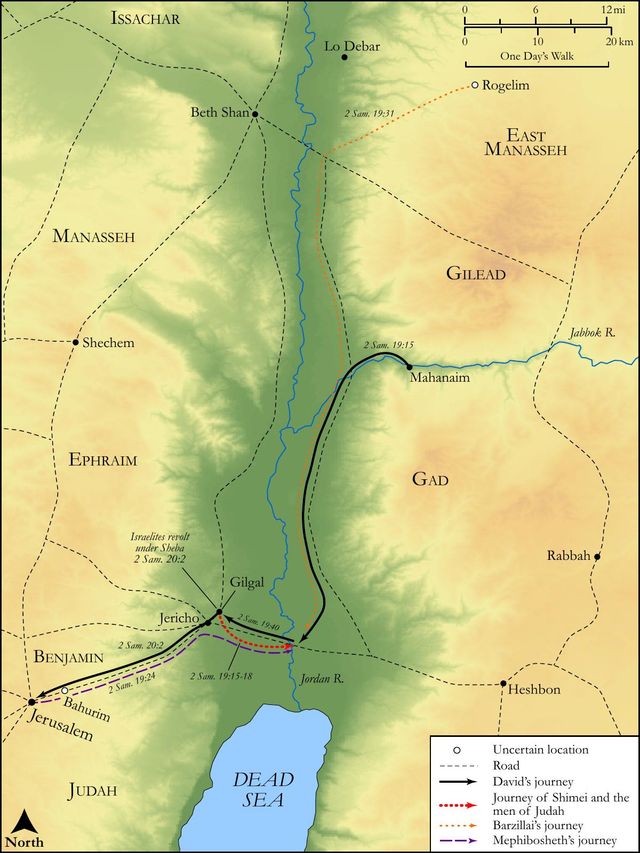
This verse emerges immediately after King David's perilous journey back across the Jordan River, a return from exile facilitated primarily by the men of Judah who met him at Gilgal and escorted him to Jerusalem, as detailed in 2 Samuel 19:40. The preceding chapters narrate the tragic rebellion led by David's son, Absalom, David's subsequent flight from Jerusalem, Absalom's ultimate demise in battle (2 Samuel 18:9-15), and David's profound grief, which eventually gave way to his decision to reclaim his throne. In an effort to foster reconciliation and heal the fractured kingdom, David extended an olive branch to his former adversary's general, Amasa, appointing him commander of the army (2 Samuel 19:13), and notably pardoned Shimei, who had cursed him during his flight (2 Samuel 19:18-23). Despite these overtures toward unity, the exclusive actions of Judah, though seemingly loyal, inadvertently ignited simmering resentment among the other tribes, setting the stage for the dramatic confrontation described in this verse and the subsequent, swift escalation into a new rebellion led by Sheba, the son of Bichri (2 Samuel 20:1-2).
Historical & Cultural Context
Ancient Israel was fundamentally structured as a tribal society, and while David had remarkably succeeded in uniting the twelve tribes under a single monarchy, deeply ingrained loyalties and persistent rivalries continued to exist beneath the surface. Judah, being David's home tribe, frequently enjoyed a privileged status, a position that often bred resentment among the northern tribes, who had historically aligned with Saul's lineage. The act of "bringing the king" or escorting him was an exceptionally symbolic and honorable gesture, signifying profound allegiance and publicly reaffirming the king's authority. For Judah to undertake this initiative exclusively, without prior consultation or waiting for representatives from the other tribes, was widely perceived as a blatant power grab or an audacious attempt to claim sole ownership of the king's loyalty and the honor associated with his restoration. The Jordan River itself held significant geographical and symbolic importance, marking a crucial boundary and representing a transition from exile to restoration. Thus, the exclusive escort across it amplified the perceived slight, making it a particularly potent act of loyalty that simultaneously exacerbated inter-tribal tensions.
Key Themes
ShowHideThis verse powerfully illuminates several critical themes pertinent to the narrative of David's reign and the broader history of Israel. Firstly, Tribal Rivalry and Jealousy are acutely foregrounded, as the northern tribes articulate their indignation at Judah's perceived usurpation of honor in restoring David. This deep-seated competition and sense of exclusion directly foreshadow the eventual National Disunity that would tragically culminate in the division of the kingdom after Solomon's reign (1 Kings 12:16). Secondly, the theme of Honor and Loyalty is central; each tribe earnestly desired to demonstrate its allegiance to the king, and Judah's unilateral actions were seen as undermining the rightful place of the other tribes in this crucial national demonstration. Lastly, the passage starkly underscores the Fragility of Unity even under the leadership of a strong and divinely appointed king like David. Despite his diligent efforts to reconcile and unify, the underlying tensions inherent in a tribal society quickly resurface, demonstrating that political unity does not automatically translate into social or relational harmony. The pointed question posed by the men of Israel reveals a profound sense of exclusion and betrayal, emphasizing the constant challenge of maintaining cohesion and shared identity within a diverse community.
Exposition and Analysis
ShowHideKey Word Analysis
ShowHideMeaning "he will rule as God," a symbolical name of Jacob and typically of his posterity. In this context, "all the men of Israel" refers specifically to the ten northern tribes, distinct from Judah. This highlights the political and social division within the united monarchy, where "Israel" often designated the non-Judean tribes, particularly after the kingdom's split. Their collective voice here signifies a broad, unified grievance from the majority of the Israelite population against the perceived favoritism or unilateral action of Judah, underscoring the deep-seated tribal identity that transcended national unity.
Meaning "celebrated." This refers to David's own tribe, which often held a privileged and prominent position within the united kingdom. Their proactive move to escort David across the Jordan was interpreted by the other tribes as an attempt to monopolize the king's favor and loyalty, reinforcing existing inter-tribal tensions and the perception of Judah's self-interest. This action, intended as an act of loyalty, inadvertently became a catalyst for division.
A primitive root meaning "to thieve (literally or figuratively); by implication, to deceive; carry away, secretly bring, steal (away), get by stealth." Here, it is used metaphorically. The men of Israel are not accusing Judah of physically abducting David, but rather of illicitly or unfairly appropriating the honor and privilege of restoring the king. It conveys a strong sense of being cheated, deprived, or having something rightfully belonging to them taken away by stealth or cunning. This accusation implies a breach of communal etiquette, a violation of shared responsibility, and a deep sense of being overlooked.
Verse Breakdown
ShowHide"And, behold, all the men of Israel came to the king, and said unto the king,"
This opening clause dramatically sets the scene. The interjection "behold" (וְהִנֵּה, wəhinnēh) functions as an attention-grabber, signaling a sudden and significant event—the arrival of a large delegation representing the northern tribes. Their direct approach to King David underscores the gravity of their grievance and their expectation that the king, as the ultimate arbiter, would address their concerns. This public confrontation highlights the immediate and widespread nature of the dispute, indicating that the perceived slight was a collective wound.
"Why have our brethren the men of Judah stolen thee away,"
This is the indignant core of the accusation, framed as a rhetorical question designed not to elicit information but to express profound indignation and a sense of betrayal. The use of the term "brethren" (אַחֵינוּ, ʾaḥênû) is ironically poignant, emphasizing the shared kinship that is now severely strained by this perceived transgression. The accusation of "stealing away" (גָּנַב, gānav) implies that Judah acted surreptitiously or unfairly, taking exclusive possession of the king's escort and favor, thereby depriving the other tribes of their rightful share in this national act of restoration and honor.
"and have brought the king, and his household, and all David's men with him, over Jordan?"
This clause precisely specifies the action that provoked the northern tribes' ire. Judah's unilateral initiative to transport David, his entire household (including his family and servants), and his loyal personal guard across the Jordan River was seen as an exclusive and presumptuous act. By taking this responsibility entirely upon themselves, Judah appeared to be asserting a unique claim to David's allegiance and the honor of his return, effectively sidelining the other tribes and fueling their deep-seated resentment and sense of injustice.
Literary Devices
ShowHideThe passage employs several potent literary devices to convey the tension and underlying dynamics of the narrative. The most prominent is the Rhetorical Question ("Why have our brethren the men of Judah stolen thee away...?"), which is not posed to elicit information but to express strong indignation, accusation, and a profound sense of injustice. It powerfully highlights the perceived grievance and implicitly demands an explanation or rectification from the king. There is also significant Foreshadowing at play; this immediate post-rebellion conflict, rooted in tribal jealousy and the struggle for honor and recognition, ominously prefigures the eventual Schism of the united monarchy into northern Israel and southern Judah after Solomon's reign. The use of "brethren" in the accusation creates a powerful Irony, as the very term of kinship is used to underscore a deep division and betrayal that threatens the fragile unity of the kingdom. Furthermore, the act of "stealing" is a Metaphor, as David was not literally abducted but rather taken exclusively by one tribe, highlighting the emotional and political "theft" of honor and shared national responsibility.
Theological and Thematic Connections
ShowHideThis incident in 2 Samuel 19:41 serves as a stark and enduring reminder of how easily human pride, tribalism, and the desire for recognition can undermine unity, even within a divinely established kingdom. The northern tribes' complaint, while perhaps legitimate in its feeling of exclusion, quickly devolves into a focus on "who gets the credit" or "who holds the most honor" rather than the collective good of the kingdom's restoration and the well-being of the king. This highlights a recurring theological theme throughout Scripture: the persistent struggle against disunity caused by self-interest, envy, and a lack of humility. It underscores the inherent fragility of human-made peace and the constant need for genuine reconciliation and a shared vision rooted in God's purposes. God's plan for His people was always one of unity, mutual respect, and a common purpose, yet human sin often fractured this ideal, necessitating divine intervention and a greater work of redemption that transcends human limitations.
Reflection and Application
ShowHideThe scene in 2 Samuel 19:41 offers a timeless and poignant lesson on the destructive power of jealousy and the critical importance of fostering genuine unity and inclusion within any community. Whether in families, workplaces, civic organizations, or the church, the temptation to compete for recognition, to feel slighted, or to exclude others can quickly erode bonds and create deep, lasting divisions. This passage calls us to soberly examine our own hearts: Do we genuinely rejoice when others are honored, or do we secretly harbor resentment at their prominence? Are we quick to accuse and demand our "fair share" of credit and attention, or are we willing to serve humbly, even when overlooked or unacknowledged? True unity is not merely the absence of overt conflict, but the active pursuit of shared purpose, marked by humility, mutual respect, and a willingness to defer to others for the greater good of the whole. Leaders, in particular, must be acutely aware of underlying tensions and proactively work to ensure that all members feel valued, included, and heard, mediating disputes with wisdom and grace, always pointing to the collective mission rather than individual or group glory.
Questions for Reflection
ShowHideFAQ
ShowHideWhy were the men of Israel so upset with Judah's actions?
ShowHideThe men of Israel (representing the northern tribes) were deeply upset because Judah, King David's own tribe, had taken the exclusive initiative to escort the king back across the Jordan River after Absalom's rebellion. This act, while seemingly loyal and honorable, was perceived by the other tribes as a unilateral power grab and an attempt to monopolize the honor and credit for restoring the king. In a tribal society where honor, status, and collective participation in national events were paramount, being excluded from such a significant act was a profound slight. It implied that their loyalty was less valued or that Judah was asserting a superior claim to the king's allegiance. They felt cheated out of their rightful share in the king's return, leading to deep resentment and the stinging accusation of Judah having "stolen" the king away, meaning they had illicitly appropriated the honor. This tension is further explored in 2 Samuel 19:42-43.
What was David's immediate response to this accusation?
ShowHideDavid's immediate response, detailed in the verses immediately following 2 Samuel 19:42-43, was to listen to both sides of the argument. He acknowledged Judah's close relationship with him, referring to them as "my bone and my flesh," highlighting their familial bond. However, he also recognized the legitimate grievance of the men of Israel, who passionately argued they had "ten parts" in the king, emphasizing their numerical majority and their right to participate in his restoration. While David initially seemed to lean towards Judah's loyalty, the dispute quickly escalated, demonstrating that the underlying tensions were too deep for a quick resolution. This unresolved conflict ultimately contributed to the new rebellion of Sheba, the son of Bichri, as seen in 2 Samuel 20:1-2.
Did this conflict have long-term consequences for the kingdom of Israel?
ShowHideYes, this conflict had profound and significant long-term consequences. The tribal jealousies and the deep-seated division between Judah and the northern tribes, so vividly expressed in this verse, continued to simmer throughout David's and Solomon's reigns. These underlying tensions ultimately erupted into the full-blown division of the united kingdom shortly after Solomon's death. At that point, the ten northern tribes seceded to form the independent kingdom of Israel, leaving only Judah and Benjamin to form the kingdom of Judah (1 Kings 12:16-20). The incident in 2 Samuel 19:41 serves as a crucial early indicator and a powerful microcosm of the inherent fragility of the united monarchy and the persistent challenge of forging a truly cohesive national identity from diverse and often competing tribal loyalties.
Christ-Centered Fulfillment
ShowHideThe tribal disunity and the struggle for honor depicted in 2 Samuel 19:41 find their ultimate resolution and transformative fulfillment in the person and redemptive work of Jesus Christ. The Old Testament narratives, including this poignant account, consistently expose the brokenness of human relationships and the inherent inability of even the most divinely appointed leaders—like David—to achieve lasting unity through human means. David, despite his anointing as king, could not fully overcome the deep-seated divisions within Israel. In stark contrast, Christ, the true King and perfect Son of David, came not to be served, but to serve, and to give His life as a ransom for many (Mark 10:45). He is the one who effectively breaks down the dividing walls of hostility, whether between Jew and Gentile (Ephesians 2:14), or between any groups vying for supremacy, honor, or recognition. Through His sacrificial death and glorious resurrection, Christ creates a new humanity, a unified body where there is neither Jew nor Greek, slave nor free, male nor female, for all are profoundly one in Christ Jesus (Galatians 3:28). The church, as the living body of Christ, is called to embody this divine unity, transcending all earthly divisions and rivalries, finding its common identity, ultimate honor, and shared purpose not in tribal allegiance, national origin, or personal achievement, but solely in the shared Lordship of Jesus Christ, who is our peace and our reconciliation (Colossians 3:11).