


2 Samuel 19:40
- וַיַּעֲבֹרvai·ya·'a·Vorand he passed overH5674Conj-w ¦ V-Qal-ConsecImperf-3msVerb Qal Consecutive Imperfect 3rd Singular Masculineוַandיַּעֲבֹרhe passed over
- הַמֶּלֶךְha·Me·lekhthe kingH4428Art ¦ N-msNoun Singular Masculine Absoluteהַtheמֶּלֶךְking
- הַגִּלְגָּלָהha·gil·Ga·lah<the> Gilgal towardsH1537Art ¦ N-proper ¦ SfxNoun Proper Locationהַ<the>גִּלְגָּלָGilgalהtowards
- וְכִמְהָןve·khim·Hanand KimhanH3643Conj-w ¦ N-proper-mNoun Proper MasculineוְandכִמְהָןKimhan
- עָבַר'a·Varhe passed overH5674V-Qal-Perf-3msVerb Qal Perfect 3rd Singular Masculine
- עִמּוֹi·Mowith himH5973Prep ¦ 3msPreposition Definiteעִמּwithוֹhim
- וְכָלve·kholand allH3605Conj-w ¦ N-mscNoun Singular Masculine Constructוְandכָלall
- עַם'am[the] people ofH5971N-mscNoun Singular Masculine Construct
- יְהוּדָהye·hu·DahJudahH3063N-properNoun Proper Location
- הֶעֱבִירוּvay·'e·vi·ruthey brought overH5674V-Hiphil-Perf-3cpVerb Hiphil Perfect 3rd Plural common gender
- אֶת'et<obj.>H853DirObjMParticle Object Indicator
- הַמֶּלֶךְha·Me·lekhthe kingH4428Art ¦ N-msNoun Singular Masculine Absoluteהַtheמֶּלֶךְking
- וְגַםve·Gamand alsoH1571Conj-w ¦ AdvAdverbוְandגַםalso
- חֲצִיcha·Tzi<the> half ofH2677N-mscNoun Singular Masculine Construct
- עַם'am[the] people ofH5971N-mscNoun Singular Masculine Construct
- יִשְׂרָאֵלYis·ra·'ElIsraelH3478N-properNoun Proper Location
English is a literal word-by-word gloss of the Hebrew, not the KJV's wording. Why?
This is the original text the KJV's translators worked from — each Hebrew word with its own literal English meaning in this verse, prepared by scholars at Tyndale House, Cambridge. The KJV translates whole sentences, not word by word, so its wording differs: one Hebrew word can become several English words, and the KJV may choose “the LORD” where the gloss reads “Yahweh”. Both are faithful — they answer different questions. For the KJV's own rendering, switch to the KJV text.
Details
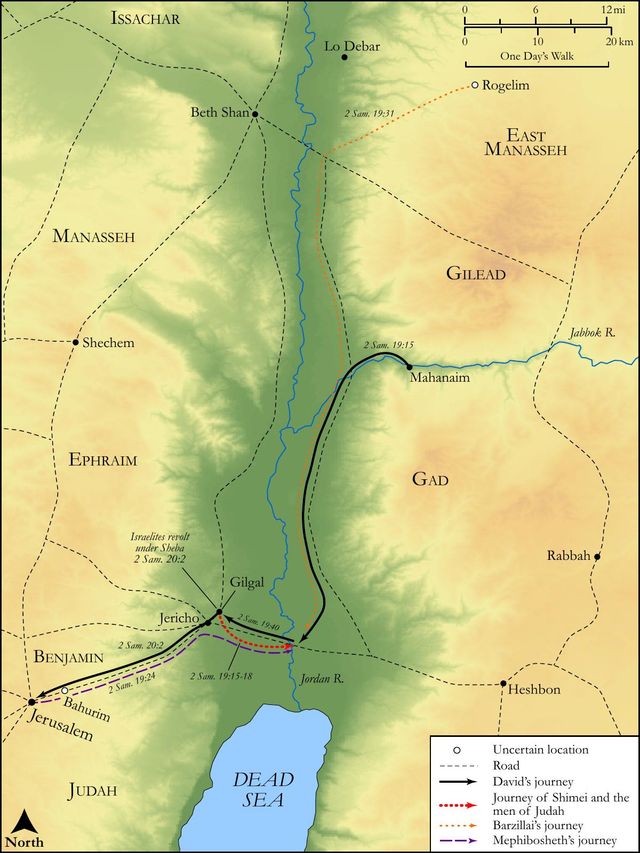
See on the biblical-era maps

Study this verse
Public-domain commentary
Matthew Henry
From his Commentary on the Whole Bible. Henry comments on passages, not single verses — this entry covers 2 Samuel 19:40–43.
David came over Jordan attended and assisted only by the men of Judah; but when he had advanced as far as Gilgal, the first stage on this side Jordan, half the people of Israel (that is, of their elders and great men) had come to wait upon him, to kiss his hand, and congratulate him on his return, but found they came too late to witness the solemnity of his first entrance. This put them out of humour, and occasioned a quarrel between them and the men of Judah, which was a damp to the joy of the day, and the beginning of further mischief. Here is, 1. The complaint which the men of Israel brought to the king against the men of Judah (Sa2 19:41), that they had performed the ceremony of bringing the king over Jordan, and not given them notice, that they might have come to join in it. This reflected upon them, as if they were not so well affected to the king and his restoration as the men of Judah were, whereas the king himself knew that they had spoken of it before the men of Judah thought of it, Sa2 19:11. It seemed likewise as if they intended to monopolize the king's favours when he had come back, and to be looked upon as his only friends. See what mischief comes from pride and jealousy. 2. The excuse which the men of Judah made for themselves, Sa2 19:42. (1.) They plead relations to the king: "He is near of kin to us, and therefore in a matter of mere ceremony, as this was, we may claim precedency. It was into our country that he was to be brought, and therefore who so fit as we to bring him?" (2.) They deny the insinuated charge of self-seeking in what they had done: "Have we eaten at all of the king's cost? No, we have all borne our own charges. Hath he given us any gift? No, we have no design to engross the advantages of his return; you have come time enough to share in them." Too many that attend princes do so only for what they can get. 3. The men of Israel's vindication of their charge, Sa2 19:43. They pleaded, "We have ten parts in the king" (Judah having Simeon only, whose lot lay within his, to join with him), "and therefore it is a slight upon us that our advice was not asked about bringing back the king." See how uncertain the multitude is. They were lately striving against the king, to drive him out; now they are striving about him, which shall honour him most. A good man and a good cause will thus recover their credit and interest, though, for a time, they may seem to have lost them. See what is commonly the origin of strife, nothing so much as impatience of contempt or the least seeming slight. The men of Judah would have done better if they had taken their brethren's advice and assistance; but, since they did not, why should the men of Israel be so grievously offended? If a good work be done, and well done, let us not be displeased, nor the work disparaged, though we had no hand in it. 4. The scripture takes notice, by way of blame, which of the contending parties managed the cause with most passion: The words of the men of Judah were fiercer than those of the men of Israel. Though we have right and reason on our side, yet, if we express ourselves with fierceness, God takes notice of it and is much displeased with it.
Continue studying 2 Samuel 19:40 across the web’s major study libraries — every link below opens this exact verse, chapter, or book on the destination site.
Read & Compare
 BibleGatewayThis verse in more than 200 translations and 70 languages.
 Bible.comThe YouVersion reader — hundreds of translations, reading plans, and highlights.
 ESV.orgCrossway's official English Standard Version reader.
 NET BibleThe NET translation with 60,000+ translators' notes on every rendering decision.
 STEP BibleTyndale House's free study tool — original text, vocabulary, and scholarly resources.
 BibliaLogos Bible Software's free web reader.
 USCCBThe New American Bible (Revised Edition) with the U.S. bishops' study notes.
Commentaries
 BibleHub CommentariesDozens of classic commentaries on this verse, gathered on one page.
 StudyLightMore than 100 commentary sets — the largest collection on the web.
 BibleRefPlain-English commentary on what this verse means, verse by verse.
 Enduring WordDavid Guzik's free commentary on this chapter, widely used by Bible teachers.
 Bible Study ToolsVerse commentary alongside Greek and Hebrew study aids.
Original Language & Research
- BibleHub InterlinearThe verse word by word — original language, transliteration, and English.
- BibleHub LexiconEvery word's original-language definition and Strong's entry.
 Blue Letter BibleDeep-study tools — Strong's numbers, concordance, and word studies.
 SefariaThe Hebrew text with Rashi and centuries of Jewish commentary.
Sermons, Hymns & Audio


TrulyRandomVerse is not affiliated with these sites and doesn’t control their content. They’re linked because they’re genuinely useful.
Summary
This verse encapsulates a critical juncture in King David's restoration to power, detailing his journey to Gilgal alongside Chimham, the son of Barzillai. It meticulously records the enthusiastic and unified escort provided by "all the people of Judah," while notably highlighting the more reserved and partial support from "half the people of Israel," subtly yet powerfully foreshadowing the deep-seated tribal tensions that would persistently challenge the unity and stability of David's reign.
Context
ShowHideLiterary Context
2 Samuel 19:40 serves as the concluding movement in the dramatic narrative of King David's return to Jerusalem following the devastating rebellion orchestrated by his son, Absalom. The preceding verses meticulously chronicle the intricate political and personal reconciliations David undertakes. He has just navigated the complex pardon of Shimei, who had cursed him during his flight (2 Samuel 19:16-23), and addressed the contentious issue of Mephibosheth's loyalty (2 Samuel 19:24-30). Crucially, the verses immediately prior to our text detail David's poignant farewell to Barzillai the Gileadite, an aged and loyal supporter who provided essential provisions during David's exile, and David's solemn promise to care for Barzillai's son, Chimham (2 Samuel 19:31-39). Therefore, 2 Samuel 19:40 is not an isolated event but the immediate prelude to the escalating tribal dispute between Judah and Israel over the king's return, which erupts with significant tension in 2 Samuel 19:41-43.
Historical & Cultural Context
David's destination, Gilgal, held profound historical and spiritual significance for ancient Israel. It was the very first encampment of the Israelites after their miraculous crossing of the Jordan River into the Promised Land under the leadership of Joshua (Joshua 4:19). At Gilgal, the new generation was circumcised, and the "reproach of Egypt" was symbolically "rolled away," signifying a renewal of their covenant relationship with God and a fresh start as His people (Joshua 5:9). Thus, David's return to Gilgal was far more than a mere logistical stop; it was a deeply symbolic act of national re-establishment, covenant renewal, and a deliberate move to reclaim his rightful place as king after a period of profound internal strife and national disgrace. The explicit distinction between "all the people of Judah" and "half the people of Israel" vividly reflects the deep-seated tribal divisions that characterized the early Israelite monarchy, a persistent tension that would ultimately culminate in the tragic division of the kingdom after the reign of Solomon (1 Kings 12). The act of "conducting" the king was a customary and formal expression of homage, reaffirming royal authority and loyalty.
Key Themes
ShowHideThis verse masterfully encapsulates several critical and enduring themes. Firstly, it powerfully underscores the overarching theme of Restoration and Return, as King David not only physically reclaims his throne but also embarks on the arduous process of politically and spiritually healing a fractured nation. Secondly, the verse highlights Loyalty and Reconciliation, particularly through the unwavering allegiance of David's own tribe, Judah, which stands in stark contrast to the more cautious and partial reconciliation offered by the northern tribes. This dichotomy serves as a potent foreshadowing of future disunity. Thirdly, David's compassionate and faithful inclusion of Chimham exemplifies the theme of Gratitude and Covenant Faithfulness, showcasing the king's integrity and unwavering commitment to honoring those who demonstrated loyalty and provided crucial aid during his darkest hour. Finally, and perhaps most subtly, the verse introduces the theme of Lingering Divisions, setting the immediate stage for the tribal dispute detailed in the subsequent verses (2 Samuel 19:41-43) and the subsequent rebellion of Sheba (2 Samuel 20), indicating that true national unity and complete healing were far from fully achieved even with the king's return.
Exposition and Analysis
ShowHideKey Word Analysis
ShowHideDerived from a root meaning "to roll," Gilgal signifies "circle of stones" or "rolling away." This site held immense historical and spiritual weight for Israel. It was the first encampment after crossing the Jordan into the Promised Land (Joshua 4:19), where the "reproach of Egypt" was "rolled away" through circumcision and covenant renewal (Joshua 5:9). David's return to Gilgal, therefore, is deeply symbolic, representing not just a geographical movement but a national act of re-establishment, a desire for a fresh start, and a re-affirmation of the covenant relationship between king, people, and God after the chaos of rebellion.
Chimham is identified as the son of Barzillai the Gileadite, a wealthy and steadfast supporter who provided critical provisions and refuge to David and his loyalists during their flight from Absalom's rebellion (2 Samuel 17:27-29). Barzillai, too aged to accompany David to Jerusalem, requested that David extend his promised favor to Chimham instead (2 Samuel 19:31-39). Chimham's presence with David in this verse serves as a tangible testament to David's integrity, his faithfulness in fulfilling promises, and his commitment to honoring those who demonstrated unwavering loyalty during his time of profound distress.
The Hebrew root ʻâbar (H5674), translated here as "conducted," is a versatile verb meaning "to cross over" or "to pass through." In this context, particularly with the causative stem implied, it denotes more than mere accompaniment; it suggests a formal, deliberate, and perhaps even ceremonial escort. This implies a proactive, organized, and enthusiastic effort by the people of Judah to facilitate the king's passage and re-establish his authority. It highlights their unified and strong support, standing in sharp contrast to the less committed posture of "half the people of Israel."
Verse Breakdown
ShowHide"Then the king went on to Gilgal"
This initial clause establishes King David's immediate destination after crossing the Jordan River. His journey to Gilgal is not merely a geographical progression but a profoundly symbolic return to a site rich with national origins and covenant renewal. It signals David's intent for a fresh start for his reign and for the nation, aiming to symbolically cleanse the stain of the recent rebellion.
"and Chimham went on with him"
This phrase underscores David's unwavering faithfulness to his word. Having pledged to Barzillai the Gileadite that he would care for his son, Chimham, David immediately fulfills this promise. Chimham's presence serves as a visible emblem of David's gratitude and integrity, demonstrating his commitment to honoring those who stood by him in his hour of need.
"and all the people of Judah conducted the king"
This clause emphasizes the complete, unified, and enthusiastic support David received from his own tribe. The phrase "all the people of Judah" signifies a full, strong, and formal escort, demonstrating their unwavering loyalty and their proactive role in restoring their king to his rightful position. This highlights the deep tribal bond and the significant political strength of Judah.
"and also half the people of Israel"
This crucial detail reveals the persistent and underlying divisions within the kingdom. While Judah's support was absolute, the northern tribes, referred to collectively as "Israel," were only partially represented, with "half" of them joining the royal procession. This indicates a less unified, less enthusiastic, or perhaps even a hesitant welcome from the northern kingdom, directly foreshadowing the immediate tribal dispute over David's return (2 Samuel 19:41-43) and the deeper, long-standing tribal rifts that would eventually lead to the tragic division of the united monarchy.
Literary Devices
ShowHideThe verse effectively employs several literary devices to convey its nuanced and complex message. Symbolism is profoundly evident in David's deliberate journey to Gilgal, a site imbued with historical and spiritual significance as a place of new beginnings and covenant renewal for Israel. This choice suggests a national desire for a fresh start after the profound chaos of Absalom's rebellion. The stark contrast between "all the people of Judah" and "half the people of Israel" is a powerful instance of juxtaposition, highlighting the deep-seated tribal divisions and the varying degrees of loyalty and enthusiasm David commanded from different segments of his kingdom. This sharp contrast also functions as potent foreshadowing, subtly hinting at the immediate and heated dispute that will erupt in the very next verses (2 Samuel 19:41-43) and the deeper, long-standing tensions that would ultimately culminate in the tragic division of the united kingdom, as dramatically seen in the rebellion of Sheba (2 Samuel 20). The careful and precise phrasing of the verse thus masterfully sets the stage for future conflicts, even amidst the apparent triumph of David's return.
Theological and Thematic Connections
ShowHide2 Samuel 19:40, though seemingly a straightforward account of travel, is replete with profound theological and thematic implications. It powerfully underscores the unwavering divine sovereignty at play in King David's restoration, demonstrating God's enduring faithfulness to His covenant promises to David despite the king's personal failings and the nation's tumultuous civil war. David's deliberate return to Gilgal, a site historically associated with covenant renewal, symbolically re-establishes the sacred relationship between the king and his people under God's watchful and guiding eye. However, the verse also unflinchingly exposes the persistent human element of tribalism, disunity, and incomplete reconciliation, serving as a poignant reminder that even divinely appointed leadership faces formidable challenges from internal divisions. It highlights the inherent complexities of leadership, the paramount importance of integrity (vividly seen in David's compassionate care for Chimham), and the ongoing, often arduous, need for patience, grace, and persistent effort in healing deep societal and communal fractures. The partial support from "half the people of Israel" serves as a stark reminder of the inherent tension and fragility within a unified kingdom comprised of diverse tribes, a tension that would tragically culminate in schism.
Reflection and Application
ShowHideThis passage offers profound and enduring insights into the multifaceted nature of leadership, the dynamics of community, and the often-arduous process of reconciliation. David's journey back to Gilgal, characterized by both enthusiastic, unified support and the undeniable presence of lingering division, serves as a powerful mirror reflecting the complexities often encountered in our own lives, families, and communities after periods of intense conflict, disruption, or betrayal. It compels us to deeply consider our own responses to leadership and, more critically, how we actively contribute to either unity or division within our various spheres of influence. David's compassionate and faithful act of honoring Barzillai through his son, Chimham, stands as a timeless and powerful reminder of the indispensable importance of gratitude, unwavering integrity, and the sacred commitment to keeping one's word, even amidst overwhelming national upheaval and personal distress. True and effective leadership, as exemplified by David, involves not only strategic acumen and political prowess but also a profound commitment to personal faithfulness, a willingness to acknowledge and generously reward loyalty, and a deep sense of moral responsibility. Furthermore, the subtle yet significant detail of partial acceptance from "half the people of Israel" imparts a crucial lesson: genuine unity is often a gradual, messy, and imperfect process. It demands immense patience, a spirit of forgiveness, and persistent, intentional effort to bridge deep-seated divides. This reminds us that while physical returns or immediate resolutions may occur swiftly, true healing and profound reconciliation, particularly within communities or families, often require considerable time, intentionality, and a sustained commitment to grace.
Questions for Reflection
ShowHideFAQ
ShowHideWhy is Gilgal significant here?
ShowHideGilgal holds profound historical and spiritual significance for ancient Israel, making David's return to this site deeply meaningful. It was the very first encampment of the Israelites after they miraculously crossed the Jordan River into the Promised Land under the leadership of Joshua, marking the true beginning of their inheritance (Joshua 4:19). More importantly, at Gilgal, the new generation of Israelites born in the wilderness was circumcised, and the "reproach of Egypt" was symbolically "rolled away," signifying a profound renewal of their covenant with God and a fresh start as His redeemed people (Joshua 5:9). Therefore, for King David to return to Gilgal after the devastating civil war with Absalom was highly symbolic. It represented a deliberate act of re-establishing his reign on a foundation of covenant, a national act of spiritual renewal, and a symbolic fresh beginning for a nation desperately seeking to heal, reunite, and re-commit itself under its legitimate and divinely appointed king.
Who was Chimham, and why was he with David?
ShowHideChimham was the son of Barzillai the Gileadite, an elderly, wealthy, and remarkably loyal man who had provided crucial provisions, shelter, and unwavering support to King David and his loyalists during their desperate flight from Absalom's rebellion (2 Samuel 17:27-29). As David was preparing to return to Jerusalem and reclaim his throne, he offered Barzillai a place of honor and provision at his royal court as a reward for his steadfast loyalty. However, Barzillai, being very old and preferring to die in his own town, humbly declined the offer. Instead, he requested that David extend his promised favor and care to his son, Chimham, ensuring his family's continued well-being and a lasting legacy of David's gratitude (2 Samuel 19:31-39). David's inclusion of Chimham in his procession to Gilgal and subsequently to Jerusalem was a direct and faithful fulfillment of this solemn promise. It powerfully demonstrated David's deep gratitude, his integrity in keeping his word, and his commitment to honoring those who had shown him profound kindness and loyalty in his most desperate hour.
Christ-Centered Fulfillment
ShowHide2 Samuel 19:40, with its poignant depiction of King David's return to Gilgal and the complex, mixed reception from his people, powerfully foreshadows the ultimate King, Jesus Christ. David, the anointed king, was tragically rejected by his own son and forced into exile, only to be miraculously restored to his throne. This narrative arc profoundly mirrors Christ, the true Son of David, who was rejected by His own people, suffered a humiliating death on the cross, and was then gloriously raised from the dead and exalted to His heavenly throne (Philippians 2:8-9). David's journey to Gilgal, a place deeply symbolic of new beginnings and covenant renewal for Israel, points with profound significance to Christ's resurrection and ascension. These pivotal events inaugurated the new covenant and established a spiritual "Gilgal" for all who believe, through which the reproach of sin and death is definitively "rolled away" by His atoning sacrifice (Colossians 2:13-14). The enthusiastic "conducting" of David by "all the people of Judah" finds its ultimate and perfect fulfillment in the church, the global body of Christ, who joyfully welcome, worship, and serve their risen and reigning King (Ephesians 5:25-27). Yet, the subtle and sobering note of "half the people of Israel" joining David's procession also prefigures the partial acceptance of Christ by His earthly people, Israel, and the continued division among humanity regarding His kingship and saving work (Romans 11:25). Ultimately, while David's earthly reign was perpetually marked by lingering divisions and internal strife, Christ's eternal reign will be one of perfect unity, complete dominion, and universal reconciliation, gathering all His chosen people—Jew and Gentile alike—into one glorious, undivided kingdom where every knee will bow and every tongue will joyfully confess His Lordship (Revelation 11:15).