


2 Samuel 19:39
- וַיַּעֲבֹרvai·ya·'a·Vorand it passed overH5674Conj-w ¦ V-Qal-ConsecImperf-3msVerb Qal Consecutive Imperfect 3rd Singular Masculineוַandיַּעֲבֹרit passed over
- כָּלkolallH3605N-mscNoun Singular Masculine Construct
- הָעָםha·'Amthe peopleH5971Art ¦ N-msNoun Singular Masculine Absoluteהָtheעָםpeople
- אֶת'et<obj.>H853DirObjMParticle Object Indicator
- הַיַּרְדֵּןhai·yar·Denthe JordanH3383Art ¦ N-properNoun Proper LocationהַtheיַּרְדֵּןJordan
- וְהַמֶּלֶךְve·ha·Me·lekhand the kingH4428Conj-w ¦ Art ¦ N-msNoun Singular Masculine Absoluteוְandהַtheמֶּלֶךְking
- עָבָר'a·Varhe passed overH5674V-Qal-Perf-3msVerb Qal Perfect 3rd Singular Masculine
- וַיִּשַּׁקvai·yi·Shakand he kissedH5401Conj-w ¦ V-Qal-ConsecImperf-3msVerb Qal Consecutive Imperfect 3rd Singular Masculineוַandיִּשַּׁקhe kissed
- הַמֶּלֶךְha·Me·lekhthe kingH4428Art ¦ N-msNoun Singular Masculine Absoluteהַtheמֶּלֶךְking
- לְבַרְזִלַּיle·var·zi·Lai<to> BarzillaiH1271Prep-l ¦ N-proper-mNoun Proper Masculineלְ<to>בַרְזִלַּיBarzillai
- וַיְבָרֲכֵהוּvay·Va·ra·Khe·huand he blessed himH1288Conj-w ¦ V-Piel-ConsecImperf-3ms ¦ 3msVerb Piel Consecutive Imperfect 3rd Singular Masculineוַandיְבָרֲכֵhe blessedהוּhim
- וַיָּשָׁבvai·Ya·shovand he returnedH7725Conj-w ¦ V-Qal-ConsecImperf-3msVerb Qal Consecutive Imperfect 3rd Singular Masculineוַandיָּשָׁבhe returned
- לִמְקֹמוֹlim·ko·Moto his own placeH4725Prep-l ¦ N-msc ¦ 3msNoun Singular Masculine Constructלִtoמְקֹמown placeוֹhis
English is a literal word-by-word gloss of the Hebrew, not the KJV's wording. Why?
This is the original text the KJV's translators worked from — each Hebrew word with its own literal English meaning in this verse, prepared by scholars at Tyndale House, Cambridge. The KJV translates whole sentences, not word by word, so its wording differs: one Hebrew word can become several English words, and the KJV may choose “the LORD” where the gloss reads “Yahweh”. Both are faithful — they answer different questions. For the KJV's own rendering, switch to the KJV text.
Details
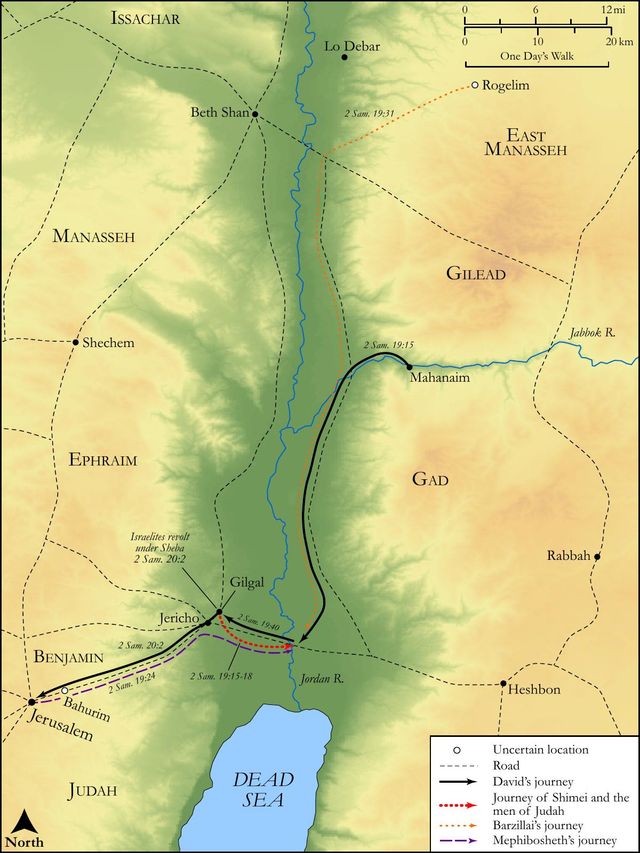
See on the biblical-era maps

Study this verse
Public-domain commentary
Matthew Henry
From his Commentary on the Whole Bible. Henry comments on passages, not single verses — this entry covers 2 Samuel 19:31–39. His three-level outline is real structure in the source text, so it is rendered as structure.
David had already graced the triumphs of his restoration with the generous remission of the injuries that had been done to him; we have him here gracing them with a no less generous reward of the kindnesses that had been shown to him. Barzillai, the Gileadite, who had a noble seat at Rogelim, not far from Mahanaim, was the man who, of all the nobility and gentry of that country, had been most kind to David in his distress. If Absalom had prevailed, it is likely he would have suffered for his loyalty; but now he and his shall be no losers by it. Here is,
I.Barzillai's great respect to David, not only as a good man, but as his righteous sovereign:
He provided him with much sustenance, for himself and his family, while he lay at Mahanaim, Sa2 19:32. God had given him a large estate, for he was a very great man, and, it seems, he had a large heart to do good with it: what else but that is a large estate good for? To reduced greatness generosity obliges us, and to oppressed goodness piety obliges us, to be in a particular manner kind, to the utmost of our power. Barzillai, to show that he was not weary of David, though he was so great a charge to him, attended him to Jordan, and went over with him, Sa2 19:31. Let subjects learn hence to render tribute to whom tribute is due and honour to whom honour, Rom 13:7.
II.The kind invitation David gave to him to court (Sa2 19:33): Come thou over with me. He invited him,
1.That he might have the pleasure of his company and the benefit of his counsel; for we may suppose that he was very wise and good, as well as very rich, otherwise he would not have been called here a very great man; for it is what a man is, more than what he has, that renders him truly great.
2.That he might have an opportunity of returning his kindness: "I will feed thee with me; thou shalt fare as sumptuously as I fare, and this at Jerusalem, the royal and holy city." David did not take Barzillai's kindness to him as a debt (he was not one of those arbitrary princes who think that whatever their subjects have is theirs when they please), but accepted it and rewarded it as a favour. We must always study to be grateful to our friends, especially to those who have helped us in distress.
III.Barzillai's reply to this invitation, wherein,
1.He admires the king's generosity in making him this offer, lessening his service, and magnifying the king's return for it: Why should the king recompense it with such a reward? Sa2 19:36. Will the master thank that servant who only does what was his duty to do? He though he had done himself honour enough in doing the king any service. Thus, when the saints shall be called to inherit the kingdom in consideration of what they have done for Christ in this world, they will be amazed at the disproportion between the service and the recompence. Mat 25:37, Lord, when saw we thee hungry, and fed thee?
2.He declines accepting the invitation. He begs his majesty's pardon for refusing so generous an offer: he should think himself very happy in being near the king, but,
(1.)He is old, and unfit to remove at all, especially to court. He is old, and unfit for the business of the court: "Why should I go up with the king to Jerusalem? I can do him no service there, in the council, the camp, the treasury, or the courts of justice; for how long have I to live? Sa2 19:34. Shall I think of going into business, now that I am going out of this world?" He is old and unfit for the diversions of the court, which will be ill-bestowed, and even thrown away, upon one that can relish them so little, Sa2 19:35. As it was in Moses's time, so it was in barzillai's and it is not worse now, that, if men be so strong that they come to fourscore years, their strength then is labour and sorrow, Psa 90:10. These were then, and are still, years of which men say they have no pleasure in them, Ecc 12:1. Dainties are insipid when desire fails, and songs to the aged ear are little better than those sung to a heavy heart, very disagreeable: how should they be otherwise when the daughters of music are brought low? Let those that are old learn of Barzillai to be dead to the delights of sense; let grace second nature, and make a virtue of the necessity. Nay, Barzillai, being old, thinks he shall be a burden to the king, rather than any credit to him; and a good man would not go any where to be burdensome, or, if he must be so, will rather be so to his own house than to another's.
(2.)He is dying, and must begin to think of his long journey, his removal out of the world, Sa2 19:37. It is good for us all, but it especially becomes old people to think and speak much of dying. "Talk of going to court!" says Barzillai; "Let me go home and die in my own city, the place of my father's sepulchre; let me die by the grave of my father, that my bones may be quietly carried to the place of their rest. The grave is ready for me, let me go and get ready for it, go and die in my nest."
3.He desires the king to be kind to his son Chimham: Let him go over with my lord the king, and have preferment at court. What favour is done to him Barzillai will take as done to himself. Those that are old must not grudge young people those delights which they themselves are past the enjoyment of, nor confine them to their retirements. Barzillai will go back himself, but he will not make Chimham go back with him; though he could ill spare Chimham, yet, thinking it would gratify and advance him, he is willing to do it.
IV.David's farewell to Barzillai.
1.He sends him back into his country with a kiss and a blessing (Sa2 19:39), signifying that in gratitude for his kindnesses he would love him and pray for him, and with a promise that whatever request he should at any time make to him he would be ready to oblige him (Sa2 19:38): Whatsoever thou shalt think of, when thou comest home, to ask of me, that will I do for thee. What is the chief excellency of power but this, that it gives men a capacity of doing the more good?
2.He takes Chimham forward with him, and leaves it to Barzillai to choose him his preferment. I will do to him what shall seem good to thee, Sa2 19:38. And, it should seem, Barzillai, who had experienced the innocency and safety of retirement, begged a country seat for him near Jerusalem, but not in it; for, long after, we read of a place near Beth-lehem, David's city, which is called the habitation of Chimham, allotted to him, probably, not out of the crown-lands or the forfeited estates, but out of David's paternal estate.
Continue studying 2 Samuel 19:39 across the web’s major study libraries — every link below opens this exact verse, chapter, or book on the destination site.
Read & Compare
 BibleGatewayThis verse in more than 200 translations and 70 languages.
 Bible.comThe YouVersion reader — hundreds of translations, reading plans, and highlights.
 ESV.orgCrossway's official English Standard Version reader.
 NET BibleThe NET translation with 60,000+ translators' notes on every rendering decision.
 STEP BibleTyndale House's free study tool — original text, vocabulary, and scholarly resources.
 BibliaLogos Bible Software's free web reader.
 USCCBThe New American Bible (Revised Edition) with the U.S. bishops' study notes.
Commentaries
 BibleHub CommentariesDozens of classic commentaries on this verse, gathered on one page.
 StudyLightMore than 100 commentary sets — the largest collection on the web.
 BibleRefPlain-English commentary on what this verse means, verse by verse.
 Enduring WordDavid Guzik's free commentary on this chapter, widely used by Bible teachers.
 Bible Study ToolsVerse commentary alongside Greek and Hebrew study aids.
Original Language & Research
- BibleHub InterlinearThe verse word by word — original language, transliteration, and English.
- BibleHub LexiconEvery word's original-language definition and Strong's entry.
 Blue Letter BibleDeep-study tools — Strong's numbers, concordance, and word studies.
 SefariaThe Hebrew text with Rashi and centuries of Jewish commentary.
Sermons, Hymns & Audio


TrulyRandomVerse is not affiliated with these sites and doesn’t control their content. They’re linked because they’re genuinely useful.
Summary
2 Samuel 19:39 captures a tender and highly significant moment in the narrative of King David's restoration to his throne following Absalom's devastating rebellion. It vividly portrays the final, poignant farewell between King David and Barzillai the Gileadite at the Jordan River. In this scene, David, deeply moved by Barzillai's unwavering loyalty and generous support during his period of exile, expresses profound esteem and gratitude through a personal kiss and a solemn blessing. This emotional parting marks a crucial transition, symbolizing David's full re-establishment of his kingship and Barzillai's humble, contented return to his home, thereby signifying the conclusion of a tumultuous chapter and the re-establishment of order within the kingdom.
Context
ShowHideLiterary Context
This verse serves as the emotional and narrative culmination of David's return journey to Jerusalem after the defeat of Absalom's rebellion. The preceding chapters detail David's desperate flight across the Jordan River to Mahanaim (2 Samuel 17:22) and the subsequent complex political maneuvering to bring him back. Barzillai is introduced earlier as a wealthy and influential man who, along with others, provided crucial provisions and unwavering support to David and his weary entourage while they were in Mahanaim (2 Samuel 17:27-29). As David prepares to cross back over the Jordan to reclaim his rightful place in Jerusalem, he offers Barzillai a place of honor and provision at the royal court. However, Barzillai, citing his advanced age and desire to die in his hometown, graciously declines the king's invitation, instead recommending his servant Chimham to go in his stead (2 Samuel 19:31-38). Verse 39, therefore, provides the poignant conclusion to this interaction, a final, respectful, and deeply personal parting at the symbolic boundary of the Jordan River, signaling the definitive end of David's exile and the formal beginning of his renewed reign.
Historical & Cultural Context
The period of David's reign was characterized by both remarkable expansion and profound internal strife, with Absalom's rebellion being a major crisis. In ancient Near Eastern monarchies, loyalty to the reigning king was paramount, and disloyalty was often met with severe, even fatal, consequences. Conversely, faithful service, particularly during times of national crisis, was highly esteemed and typically rewarded with honor and provision. Barzillai's actions are set against this backdrop of political instability, highlighting the moral character of those who remained steadfast amidst chaos. The act of "kissing" in this culture was not merely a casual greeting but often conveyed deep affection, profound respect, reconciliation, or a solemn farewell, especially between individuals of unequal status or at significant partings. To "bless" someone was to invoke divine favor and prosperity upon them, often carrying the weight of a prayer for God's presence and provision. The Jordan River itself held immense historical and symbolic weight for Israel, frequently representing a significant boundary or a transition point, from the nation's entry into the Promised Land under Joshua (Joshua 3) to Elijah's miraculous ascension (2 Kings 2:8). For David, crossing back over the Jordan symbolized his triumphant return from exile and the re-establishment of his legitimate, divinely appointed rule.
Key Themes
ShowHideThis verse encapsulates several profound themes central to David's life and the broader biblical narrative. Gratitude and Honor are prominently displayed in David's actions towards Barzillai, underscoring the importance of acknowledging and valuing those who provide selfless support, particularly in adversity. Barzillai himself embodies Loyalty and Selfless Service, having provided critical aid without seeking personal gain, standing in stark contrast to the self-serving ambition of Absalom and some of David's other advisors. His decision to return home, recognizing his advanced age and limitations, exemplifies Wisdom and Humility, demonstrating a profound understanding of his season of life and a willingness to step aside gracefully. The Jordan River crossing and the farewell signify a crucial Transition and Restoration, marking the definitive end of David's period of exile and the re-establishment of his kingship. This moment also highlights the enduring Personal Bonds forged through shared hardship, illustrating that even kings are dependent on the fidelity and kindness of their subjects. These themes collectively contribute to a deeper understanding of faithful living, righteous leadership, and the nature of true devotion.
Exposition and Analysis
ShowHideKey Word Analysis
ShowHideThis verb, derived from a primitive root meaning "to fasten up" or "to touch," signifies a profound act of affection, respect, or solemn farewell. In the ancient Near East, a kiss could seal a covenant, express deep personal esteem, or mark a significant parting. Here, David's kiss is a powerful, non-verbal expression of his deep gratitude and personal bond with Barzillai, conveying a tenderness that transcends mere formality and underscores the king's genuine appreciation for Barzillai's unwavering loyalty during his darkest hour. It is a gesture of intimate connection and profound honor.
A primitive root meaning "to kneel," and by implication "to bless God (as an act of adoration)" or "man (as a benefit)." To "bless" someone in this context means to invoke divine favor, prosperity, and well-being upon them. It is a formal and heartfelt expression of good wishes, often carrying the weight of a prayer for God's presence and provision. David's blessing of Barzillai is not just a polite farewell; it is a kingly pronouncement of honor and a petition for God's continued goodness upon Barzillai's life as he returns to his home, acknowledging his righteous deeds and the divine favor he deserves.
This primitive root means "to turn back (hence, away) transitively or intransitively, literally or figuratively (not necessarily with the idea of return to the starting point)." In this context, it emphasizes Barzillai's deliberate and humble choice to go back to his own place. It highlights his wisdom in declining the king's offer to live in Jerusalem, demonstrating a profound understanding of his season of life and a willingness to finish his days in familiar surroundings. This act speaks to his contentment and self-awareness, showing his loyalty was not for personal gain.
Verse Breakdown
ShowHide"And all the people went over Jordan."
This initial clause establishes the collective movement, emphasizing that not only David but his entire loyal entourage, including his family and supporters, crossed the Jordan River. This mass movement signifies the end of their exile and the physical act of returning to the heartland of Israel, symbolizing the re-establishment of order and the king's rightful place among his people.
"And when the king was come over,"
This phrase specifically highlights David's successful crossing, underscoring his personal journey from flight and vulnerability to restoration and authority. His presence on the western bank of the Jordan confirms the turning point in his reign, marking the definitive end of the rebellion's immediate threat and the beginning of his renewed leadership.
"the king kissed Barzillai, and blessed him;"
This is the emotional and relational core of the verse. David's actions are deliberate, deeply personal, and laden with meaning. The "kiss" conveys profound affection, respect, and a tender farewell to a loyal friend who provided crucial support during David's darkest hour. The "blessing" is a formal invocation of divine favor, a kingly act of honor and gratitude, ensuring Barzillai's well-being and publicly acknowledging his invaluable service.
"and he returned unto his own place."
This final clause describes Barzillai's humble and wise decision. Despite the king's generous offer of a place at court, Barzillai chooses to return to his home in Rogelim. This decision, rooted in his advanced age and desire for familiar surroundings, underscores his selfless character, demonstrating that his loyalty was not motivated by a desire for personal gain or courtly life, but by genuine devotion to the king and a profound contentment with his own life.
Literary Devices
ShowHideThe verse employs several literary devices to convey its profound meaning and emotional weight. Symbolism is prominently featured in the Jordan River itself, which acts as a powerful geographical and spiritual boundary marking the transition from David's exile and the chaos of rebellion to his restoration and the re-establishment of order. The act of crossing is not merely geographical but also deeply spiritual and politically significant. Poignancy is palpable in the tender farewell between David and Barzillai, a moment of deep gratitude, mutual respect, and heartfelt parting shared between a king and his loyal subject, highlighting the personal cost of leadership and the strong bonds forged during shared hardship. There is also an element of Contrast subtly embedded, as Barzillai's selfless loyalty and profound humility stand in stark opposition to the ambition and betrayal of Absalom and his followers, thereby emphasizing the virtues that truly uphold a kingdom and its leader. The brevity and directness of the description, focusing on key actions ("kissed," "blessed," "returned"), contribute to its Conciseness while allowing the emotional and thematic weight of the moment to resonate deeply with the reader.
Theological and Thematic Connections
ShowHideThe interaction between King David and Barzillai provides a powerful illustration of enduring biblical principles concerning gratitude, loyalty, and the proper response to faithful service. David's profound expression of thanks and blessing toward Barzillai reflects God's own character, who remembers and graciously rewards the acts of kindness and faithfulness shown to His servants and His kingdom. It underscores the divine expectation for leaders, both secular and spiritual, to honor and value those who serve diligently and selflessly. Barzillai's humble refusal of worldly honor, choosing instead to return to his own place, speaks to the wisdom of discerning one's season of life and valuing contentment over ambition. This narrative reminds us that true loyalty is not transactional but flows from a heart devoted to righteousness and the well-being of others, echoing the covenant faithfulness God desires from His people in their relationships with Him and with one another.
Reflection and Application
ShowHideThe poignant farewell between King David and Barzillai at the Jordan River offers timeless lessons for our own lives, urging us to cultivate virtues that strengthen our relationships and deepen our faith. David's immediate and heartfelt expression of gratitude reminds us of the profound impact a sincere "thank you" or a genuine gesture of appreciation can have on those who have supported us, especially during challenging times. It calls us to be intentional in acknowledging the contributions of others, whether in our families, churches, workplaces, or communities, recognizing that true leadership involves honoring those who serve. Barzillai's unwavering loyalty and selfless service, devoid of any expectation for personal gain, challenges us to examine the purity of our own motives in serving others and God. Are we truly seeking the good of others and the glory of God, or are we subtly seeking our own advantage or recognition? Furthermore, Barzillai's humble wisdom in recognizing his limitations and choosing to return to his familiar surroundings teaches us the importance of discerning our seasons of life. Not every opportunity, no matter how prestigious or seemingly beneficial, is meant for every person at every stage. We are called to exercise humility and wisdom in making choices that align with God's design for our lives, embracing contentment over endless striving for more. Finally, this graceful parting reminds us that even transitions and farewells can be handled with honor, blessing, and mutual respect, leaving a legacy of positive and God-honoring relationships.
Questions for Reflection
ShowHideFAQ
ShowHideWhy was Barzillai so important to King David?
ShowHideBarzillai was crucial to King David because he provided vital logistical and emotional support during David's most vulnerable period—his flight from Absalom's rebellion. While David was in exile across the Jordan River, Barzillai, a wealthy and influential man from Gilead, supplied David and his weary followers with essential provisions like food, bedding, and utensils (2 Samuel 17:27-29). This support was not only practical but also a powerful demonstration of unwavering loyalty to David, the legitimate king, at a time when many had abandoned or opposed him. His actions were a testament to his faithfulness and integrity.
Why did Barzillai refuse David's offer to live in Jerusalem?
ShowHideBarzillai humbly declined King David's generous offer to live in Jerusalem and be provided for at the king's table primarily due to his advanced age. As he states in 2 Samuel 19:34-35, he was eighty years old and felt he would be a burden, unable to fully enjoy the pleasures of the court or truly appreciate the king's kindness. He preferred to return to his own city, Rogelim, to die and be buried near his parents, demonstrating a wise self-awareness and a humble contentment with his life's season. He graciously suggested his servant Chimham go in his place, ensuring David's kindness would still be extended to his household.
What is the significance of David "kissing" and "blessing" Barzillai?
ShowHideDavid's actions of kissing and blessing Barzillai were highly significant gestures in ancient Near Eastern culture, conveying profound meaning beyond mere politeness. The "kiss" (Hebrew: nashaq) was more than a casual greeting; it conveyed deep personal affection, profound respect, and a solemn farewell between individuals, especially those of differing social status. It underscored the genuine bond and immense gratitude David felt for Barzillai's unwavering loyalty. The "blessing" (Hebrew: barak) was a formal invocation of divine favor, prosperity, and well-being. By blessing Barzillai, David, as king and God's anointed, was bestowing honor and praying for God's continued goodness upon Barzillai's life, acknowledging his righteous deeds and ensuring his legacy. These acts collectively represent David's profound appreciation and the high esteem in which he held Barzillai.
Christ-Centered Fulfillment
ShowHideThe poignant farewell between King David and Barzillai, marked by profound gratitude, loyal service, and humble self-awareness, finds its ultimate and most profound fulfillment in the person and redemptive work of Jesus Christ. Barzillai's selfless provision for David during his time of weakness and exile foreshadows Christ's own ultimate act of self-giving, where He, the true King of kings, humbled Himself to serve humanity, providing for our deepest spiritual needs, not with food and shelter, but with salvation and eternal life through His atoning sacrifice (Philippians 2:5-8). Just as David expressed profound gratitude and blessed Barzillai, so too does our heavenly Father lavish His blessings and eternal rewards upon those who faithfully serve Him and His kingdom, often in unseen ways and during times of great spiritual conflict (Matthew 25:21). The Jordan River, a powerful symbol of transition and restoration for David, points to the spiritual "crossing over" from death to life that Christ accomplishes for us through His resurrection, ushering in a new covenant and a new creation for all who believe (2 Corinthians 5:17). Ultimately, Christ is the King who, having overcome all rebellion and secured His eternal throne, will one day return to gather His loyal followers, not merely offering a place at His earthly table, but inviting them into eternal fellowship and co-reign in His glorious kingdom, where every act of faithful service will be remembered, honored, and fully rewarded beyond measure (Revelation 22:12).