


2 Samuel 19:38
- וַיֹּאמֶרvai·Yo·merand he saidH559Conj-w ¦ V-Qal-ConsecImperf-3msVerb Qal Consecutive Imperfect 3rd Singular Masculineוַandיֹּאמֶרhe said
- הַמֶּלֶךְha·Me·lekhthe kingH4428Art ¦ N-msNoun Singular Masculine Absoluteהַtheמֶּלֶךְking
- אִתִּי'i·Tiwith meH854Prep ¦ 1csPreposition Definiteאִתִּwithיme
- יַעֲבֹרya·'a·Vorhe will pass overH5674V-Qal-Imperf-3msVerb Qal Imperfect 3rd Singular Masculine
- כִּמְהָםkim·HamKimhamH3643N-proper-mNoun Proper Masculine
- וַאֲנִיva·'a·Niand IH589Conj-w ¦ Pro-1csPronoun Personal 1st Singular common genderוַandאֲנִיI
- אֶעֱשֶׂה'e·'e·sehI will doH6213V-Qal-Imperf-1csVerb Qal Imperfect 1st Singular common gender
- לּוֹlofor <the> himPrep-l ¦ 3msSuffix Personal 3rd Singular Masculineלּfor <the>וֹhim
- אֶת'et<obj.>H853DirObjMParticle Object Indicator
- הַטּוֹבha·Tovthe goodH2896Art ¦ Adj-msAdjective Singular Masculine Absoluteהַtheטּוֹבgood
- בְּעֵינֶיךָbe·'ei·Nei·khain your viewH5869Prep-b ¦ N-fdc ¦ 2msNoun Dual Feminine Constructבְּinעֵינֶיviewךָyour
- וְכֹלve·Kholand allH3605Conj-w ¦ N-msNoun Singular Masculine Absoluteוְandכֹלall
- אֲשֶׁר'a·SherthatH834RelParticle Relative
- תִּבְחַרtiv·Charyou will chooseH977V-Qal-Imperf-2msVerb Qal Imperfect 2nd Singular Masculine
- עָלַי'a·Laion meH5921Prep ¦ 1csPreposition Definiteעָלַonיme
- אֶעֱשֶׂה'e·'e·sehI will doH6213V-Qal-Imperf-1csVerb Qal Imperfect 1st Singular common gender
- לָּךְLakhfor <the> youPrep-l ¦ 2msSuffix Personal 2nd Singular Masculineלָּfor <the>ךְyou
English is a literal word-by-word gloss of the Hebrew, not the KJV's wording. Why?
This is the original text the KJV's translators worked from — each Hebrew word with its own literal English meaning in this verse, prepared by scholars at Tyndale House, Cambridge. The KJV translates whole sentences, not word by word, so its wording differs: one Hebrew word can become several English words, and the KJV may choose “the LORD” where the gloss reads “Yahweh”. Both are faithful — they answer different questions. For the KJV's own rendering, switch to the KJV text.
Details
See on the biblical-era maps

Study this verse
Public-domain commentary
Matthew Henry
From his Commentary on the Whole Bible. Henry comments on passages, not single verses — this entry covers 2 Samuel 19:31–39. His three-level outline is real structure in the source text, so it is rendered as structure.
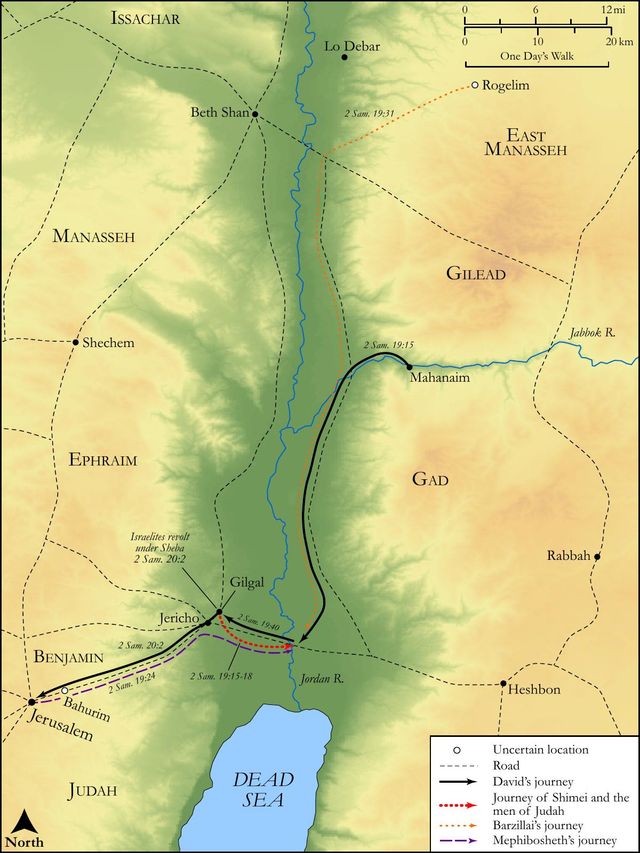
David had already graced the triumphs of his restoration with the generous remission of the injuries that had been done to him; we have him here gracing them with a no less generous reward of the kindnesses that had been shown to him. Barzillai, the Gileadite, who had a noble seat at Rogelim, not far from Mahanaim, was the man who, of all the nobility and gentry of that country, had been most kind to David in his distress. If Absalom had prevailed, it is likely he would have suffered for his loyalty; but now he and his shall be no losers by it. Here is,
I.Barzillai's great respect to David, not only as a good man, but as his righteous sovereign:
He provided him with much sustenance, for himself and his family, while he lay at Mahanaim, Sa2 19:32. God had given him a large estate, for he was a very great man, and, it seems, he had a large heart to do good with it: what else but that is a large estate good for? To reduced greatness generosity obliges us, and to oppressed goodness piety obliges us, to be in a particular manner kind, to the utmost of our power. Barzillai, to show that he was not weary of David, though he was so great a charge to him, attended him to Jordan, and went over with him, Sa2 19:31. Let subjects learn hence to render tribute to whom tribute is due and honour to whom honour, Rom 13:7.
II.The kind invitation David gave to him to court (Sa2 19:33): Come thou over with me. He invited him,
1.That he might have the pleasure of his company and the benefit of his counsel; for we may suppose that he was very wise and good, as well as very rich, otherwise he would not have been called here a very great man; for it is what a man is, more than what he has, that renders him truly great.
2.That he might have an opportunity of returning his kindness: "I will feed thee with me; thou shalt fare as sumptuously as I fare, and this at Jerusalem, the royal and holy city." David did not take Barzillai's kindness to him as a debt (he was not one of those arbitrary princes who think that whatever their subjects have is theirs when they please), but accepted it and rewarded it as a favour. We must always study to be grateful to our friends, especially to those who have helped us in distress.
III.Barzillai's reply to this invitation, wherein,
1.He admires the king's generosity in making him this offer, lessening his service, and magnifying the king's return for it: Why should the king recompense it with such a reward? Sa2 19:36. Will the master thank that servant who only does what was his duty to do? He though he had done himself honour enough in doing the king any service. Thus, when the saints shall be called to inherit the kingdom in consideration of what they have done for Christ in this world, they will be amazed at the disproportion between the service and the recompence. Mat 25:37, Lord, when saw we thee hungry, and fed thee?
2.He declines accepting the invitation. He begs his majesty's pardon for refusing so generous an offer: he should think himself very happy in being near the king, but,
(1.)He is old, and unfit to remove at all, especially to court. He is old, and unfit for the business of the court: "Why should I go up with the king to Jerusalem? I can do him no service there, in the council, the camp, the treasury, or the courts of justice; for how long have I to live? Sa2 19:34. Shall I think of going into business, now that I am going out of this world?" He is old and unfit for the diversions of the court, which will be ill-bestowed, and even thrown away, upon one that can relish them so little, Sa2 19:35. As it was in Moses's time, so it was in barzillai's and it is not worse now, that, if men be so strong that they come to fourscore years, their strength then is labour and sorrow, Psa 90:10. These were then, and are still, years of which men say they have no pleasure in them, Ecc 12:1. Dainties are insipid when desire fails, and songs to the aged ear are little better than those sung to a heavy heart, very disagreeable: how should they be otherwise when the daughters of music are brought low? Let those that are old learn of Barzillai to be dead to the delights of sense; let grace second nature, and make a virtue of the necessity. Nay, Barzillai, being old, thinks he shall be a burden to the king, rather than any credit to him; and a good man would not go any where to be burdensome, or, if he must be so, will rather be so to his own house than to another's.
(2.)He is dying, and must begin to think of his long journey, his removal out of the world, Sa2 19:37. It is good for us all, but it especially becomes old people to think and speak much of dying. "Talk of going to court!" says Barzillai; "Let me go home and die in my own city, the place of my father's sepulchre; let me die by the grave of my father, that my bones may be quietly carried to the place of their rest. The grave is ready for me, let me go and get ready for it, go and die in my nest."
3.He desires the king to be kind to his son Chimham: Let him go over with my lord the king, and have preferment at court. What favour is done to him Barzillai will take as done to himself. Those that are old must not grudge young people those delights which they themselves are past the enjoyment of, nor confine them to their retirements. Barzillai will go back himself, but he will not make Chimham go back with him; though he could ill spare Chimham, yet, thinking it would gratify and advance him, he is willing to do it.
IV.David's farewell to Barzillai.
1.He sends him back into his country with a kiss and a blessing (Sa2 19:39), signifying that in gratitude for his kindnesses he would love him and pray for him, and with a promise that whatever request he should at any time make to him he would be ready to oblige him (Sa2 19:38): Whatsoever thou shalt think of, when thou comest home, to ask of me, that will I do for thee. What is the chief excellency of power but this, that it gives men a capacity of doing the more good?
2.He takes Chimham forward with him, and leaves it to Barzillai to choose him his preferment. I will do to him what shall seem good to thee, Sa2 19:38. And, it should seem, Barzillai, who had experienced the innocency and safety of retirement, begged a country seat for him near Jerusalem, but not in it; for, long after, we read of a place near Beth-lehem, David's city, which is called the habitation of Chimham, allotted to him, probably, not out of the crown-lands or the forfeited estates, but out of David's paternal estate.
Continue studying 2 Samuel 19:38 across the web’s major study libraries — every link below opens this exact verse, chapter, or book on the destination site.
Read & Compare
 BibleGatewayThis verse in more than 200 translations and 70 languages.
 Bible.comThe YouVersion reader — hundreds of translations, reading plans, and highlights.
 ESV.orgCrossway's official English Standard Version reader.
 NET BibleThe NET translation with 60,000+ translators' notes on every rendering decision.
 STEP BibleTyndale House's free study tool — original text, vocabulary, and scholarly resources.
 BibliaLogos Bible Software's free web reader.
 USCCBThe New American Bible (Revised Edition) with the U.S. bishops' study notes.
Commentaries
 BibleHub CommentariesDozens of classic commentaries on this verse, gathered on one page.
 StudyLightMore than 100 commentary sets — the largest collection on the web.
 BibleRefPlain-English commentary on what this verse means, verse by verse.
 Enduring WordDavid Guzik's free commentary on this chapter, widely used by Bible teachers.
 Bible Study ToolsVerse commentary alongside Greek and Hebrew study aids.
Original Language & Research
- BibleHub InterlinearThe verse word by word — original language, transliteration, and English.
- BibleHub LexiconEvery word's original-language definition and Strong's entry.
 Blue Letter BibleDeep-study tools — Strong's numbers, concordance, and word studies.
 SefariaThe Hebrew text with Rashi and centuries of Jewish commentary.
Sermons, Hymns & Audio


TrulyRandomVerse is not affiliated with these sites and doesn’t control their content. They’re linked because they’re genuinely useful.
Summary
This verse captures King David's profound gratitude and unwavering commitment to Barzillai the Gileadite, who had faithfully sustained him during Absalom's rebellion. As David prepares to return to Jerusalem, Barzillai, citing his advanced age, humbly declines the king's invitation to the royal court but proposes his son, Chimham, go in his stead. David's immediate and open-ended acceptance of this request, promising to grant Chimham whatever Barzillai desires, underscores the king's integrity, the profound value of loyalty, and the enduring nature of royal favor extended across generations.
Context
ShowHideLiterary Context
This passage occurs at a pivotal moment in David's reign, marking his triumphant, yet somber, restoration to the throne after the devastating rebellion led by his son, Absalom. The immediate preceding verses (2 Samuel 19:31-37) detail the poignant interaction between King David and Barzillai. Barzillai, an eighty-year-old wealthy man from Rogelim in Gilead, had provided crucial provisions and unwavering support for David and his loyalists while they were in Mahanaim, fleeing from Absalom's forces (2 Samuel 17:27-29). As David prepares to cross the Jordan River to return to Jerusalem, he expresses his deep gratitude by inviting Barzillai to live in the capital and be honored at court. Barzillai, however, humbly declines, citing his old age and desire to die in his hometown. Instead, he proposes that his son, Chimham, accompany the king. David's response in 2 Samuel 19:38 is a swift and comprehensive affirmation of this request, demonstrating his commitment to extending his favor to Barzillai's family. This act of royal grace serves as a powerful counterpoint to the recent betrayal and chaos of the rebellion, highlighting David's character as a just, grateful, and promise-keeping king.
Historical & Cultural Context
In ancient Near Eastern monarchies, royal favor and patronage were central to societal structure, personal security, and economic well-being. A king's promise was considered sacred and binding, often extending beyond the immediate recipient to their family and descendants. Loyalty during times of crisis, such as Absalom's rebellion (2 Samuel 15), was highly valued and expected to be reciprocated with significant rewards. Barzillai's provision for David was not merely an act of charity but a profound demonstration of allegiance, risking his own safety and resources for the beleaguered king. His decision to send Chimham in his place reflects the cultural importance of intergenerational legacy and the desire to secure a prosperous future for one's offspring through royal connection. For Chimham to "go over with" the king meant not just a journey but an integration into the royal household, implying access to court life, potential administrative roles, and ongoing royal protection and provision. This arrangement secured the family's standing and ensured their continued well-being for generations.
Key Themes
ShowHideThis verse powerfully illustrates several key themes. First, Gratitude and Royal Favor are paramount; David's open-ended promise to Chimham is a direct expression of his profound appreciation for Barzillai's unwavering loyalty and generous support during his most vulnerable period. It exemplifies the principle that faithful service to the king (or to God) is remembered and rewarded. Second, the theme of Succession and Legacy is profoundly evident in Barzillai's choice to send his son. This act ensures that the favor and blessing earned by the father will be transferred to the next generation, securing the family's place within the kingdom's elite. This intergenerational blessing was a highly cherished concept in Israelite society, reflecting a desire for enduring prosperity and honor. Finally, Promise-Keeping and Integrity are central to David's character. His strong affirmation, "whatsoever thou shalt require of me, [that] will I do for thee," underscores the sacredness and binding nature of his word. This promise was so significant that David, on his deathbed, would later instruct his son Solomon to continue showing kindness to the sons of Barzillai (1 Kings 2:7), ensuring that the royal favor would indeed extend beyond his own reign, demonstrating the lasting impact of a king's integrity and the reliability of his word.
Exposition and Analysis
ShowHideKey Word Analysis
ShowHideFrom the root meaning "pining," this refers to Barzillai's son, who becomes the direct beneficiary of King David's favor. As a proxy for his aging father, Chimham's presence with the king signifies the continuation of Barzillai's legacy and ensures the family's ongoing connection to the royal court, providing access to its benefits and protection.
This adjective, used here in the phrase "that which shall seem good unto thee" (literally "the good in your eyes"), signifies what is pleasing, beneficial, or desirable. David's promise to do what seems "good" to Barzillai regarding Chimham conveys an open-ended commitment, granting Barzillai full discretion to specify the form of royal favor, whether it be provision, protection, or a position within the court. It highlights David's complete deference and genuine desire to honor Barzillai's wishes.
This verb, meaning "to try" or "to select," is used here in the sense of "to choose" or "to desire." In the phrase "whatsoever thou shalt require of me," it emphasizes the comprehensive and unconditional nature of David's pledge. It assures Barzillai that any specific request or future need he might articulate on behalf of Chimham will be met by the king, reinforcing David's earnest desire to reciprocate Barzillai's loyalty with abundant and tailored favor.
Verse Breakdown
ShowHide"And the king answered, Chimham shall go over with me,"
This clause immediately follows Barzillai's proposal, indicating David's swift and unhesitating acceptance. David agrees to take Chimham into his personal retinue, signifying a place of honor, direct access to the king, and integration into the royal household. This is a public declaration of royal favor and an acknowledgment of Barzillai's faithful and invaluable service during a time of crisis.
"and I will do to him that which shall seem good unto thee:"
This part of the promise grants Barzillai the authority to determine the specifics of Chimham's welfare and future. David is not merely offering a generic blessing but is inviting Barzillai to articulate his precise desires for his son, promising to fulfill them. This demonstrates David's deep respect for Barzillai's judgment and his genuine desire to honor him in a way that truly benefits his family and secures their prosperity.
"and whatsoever thou shalt require of me, [that] will I do for thee."
This concluding phrase expands and reiterates the comprehensive and unconditional nature of David's commitment. It functions as a powerful, open-ended pledge, assuring Barzillai that any future request or need he might have concerning Chimham or his family will be met by the king. This emphasizes David's integrity, the binding nature of his word, and the lasting bond of gratitude and loyalty that he intends to uphold.
Literary Devices
ShowHideThe passage employs several literary devices to enhance its meaning and impact. Hyperbole is evident in David's expansive promise, "whatsoever thou shalt require of me, [that] will I do for thee." This is not meant to be taken literally as an absolute blank check for any demand, but rather as a rhetorical expression of the king's boundless gratitude and comprehensive commitment to Barzillai and his family. It powerfully conveys the depth of David's appreciation and the extensive nature of the royal favor he intends to bestow. Additionally, there is a clear element of Foreshadowing in this promise. While not explicitly stated as such, David's solemn pledge here lays the groundwork for his dying instructions to Solomon in 1 Kings 2:7, where he specifically commands his son to show kindness to the sons of Barzillai. This later fulfillment underscores David's integrity and the enduring nature of his word, demonstrating that his promises were not fleeting but carried lasting weight across generations. The entire interaction also serves as a potent example of Royal Patronage, a thematic device that highlights the king's role in rewarding loyalty and securing the welfare of those who serve him faithfully, thereby reinforcing the stability and justice of his reign.
Theological and Thematic Connections
ShowHideDavid's unwavering commitment to Barzillai's family, expressed in this verse, resonates deeply with the biblical theme of God's faithfulness and covenant loyalty. Just as David, as an earthly king, remembers and rewards the steadfastness of his servant, so too does God consistently remember His covenant promises and extend His favor to those who are faithful to Him. This act of intergenerational blessing mirrors God's own character, where His kindness extends "to a thousand generations" for those who love Him and keep His commandments (Deuteronomy 7:9). David's integrity in keeping his word, even years later through Solomon, reflects the immutability of God's promises, which are always "Yes" and "Amen" in Christ. The principle of blessing those who bless God's anointed is also evident, underscoring the divine economy where acts of selfless service are not forgotten but result in lasting favor and security.
Reflection and Application
ShowHideThe exchange between David and Barzillai, culminating in David's solemn promise concerning Chimham, offers profound lessons for our lives today. It underscores the vital importance of gratitude—not just as a fleeting emotion, but as a proactive commitment to acknowledge and reciprocate kindness, especially from those who have supported us in our times of greatest need. David's willingness to extend open-ended favor reminds us that true leadership and genuine relationships are built on remembering the sacrifices of others and being generous in return. Furthermore, this passage highlights the sacred weight of our words. David's promise was not a casual remark but a binding pledge, demonstrating the integrity that should characterize all our dealings. In a world where promises are often lightly made and easily broken, this serves as a powerful call to cultivate trustworthiness and reliability in our personal and professional lives. Finally, Barzillai's concern for his son's future and David's readiness to bless the next generation compel us to consider our own intergenerational responsibilities. How are we investing in the future of our families, communities, and the next generation of believers? Our actions today can secure blessings and opportunities for those who come after us, extending our legacy of faith, service, and integrity.
Questions for Reflection
ShowHideFAQ
ShowHideWho was Chimham, and what became of him after this event?
ShowHideChimham was the son of Barzillai the Gileadite. He is significant because he served as his aging father's proxy, accepting King David's invitation to join the royal court in Jerusalem. While the Bible doesn't detail his daily life at court, we know that David's promise to Barzillai concerning Chimham was so strong that it extended beyond David's own lifetime. On his deathbed, David instructed his son Solomon to "deal kindly with the sons of Barzillai the Gileadite and let them be among those who eat at your table" (1 Kings 2:7). This indicates that Chimham, and likely his descendants, enjoyed continued royal favor, protection, and provision in Jerusalem, fulfilling David's comprehensive pledge to Barzillai. There is also a later mention of "the lodging place of Chimham" near Bethlehem (Jeremiah 41:17), suggesting that Chimham or his descendants may have established a significant estate or caravanserai there, perhaps as a result of the wealth and influence they received from the king's enduring patronage.
Christ-Centered Fulfillment
ShowHideDavid's open-ended promise to Chimham, born out of gratitude and secured by royal integrity, powerfully foreshadows the far greater and infinitely more comprehensive covenant of grace extended to believers through Jesus Christ. David, as an earthly king, could only offer temporal favor and a place at his table; Christ, the King of kings and Lord of lords, offers eternal life and a place in His heavenly kingdom. Just as David remembered Barzillai's loyalty, God remembers our faith and extends immeasurable grace, not based on our merit, but on the perfect obedience and atoning sacrifice of His Son (Ephesians 2:8-9). The "good" that David promised to do for Chimham, and "whatsoever" Barzillai might require, pales in comparison to the "every spiritual blessing in the heavenly places" that we have in Christ (Ephesians 1:3). Christ's promises are not limited by human lifespan or the whims of a monarch; they are "Yes" and "Amen" in Him (2 Corinthians 1:20), secured by His resurrection and guaranteed by His eternal reign. He not only invites us to His table but makes us co-heirs with Him (Romans 8:17), ensuring an eternal legacy that far surpasses any earthly royal favor. In Christ, we receive not just a place in the court, but adoption into the very family of God, with an inheritance that is imperishable, undefiled, and unfading, kept in heaven for us (1 Peter 1:3-4).