


2 Samuel 19:36
- כִּמְעַטkim·'Atlike a littleH4592Prep-k ¦ N-msNoun Singular Masculine Absoluteכִּlikeמְעַטa little
- יַעֲבֹרya·'a·Vorhe will pass overH5674V-Qal-Imperf-3msVerb Qal Imperfect 3rd Singular Masculine
- עַבְדְּךָ'av·de·Khayour servantH5650N-msc ¦ 2msNoun Singular Masculine Constructעַבְדְּservantךָyour
- אֶת'et<obj.>H853DirObjMParticle Object Indicator
- הַיַּרְדֵּןhai·yar·Denthe JordanH3383Art ¦ N-properNoun Proper LocationהַtheיַּרְדֵּןJordan
- אֶת'etwithH854PrepPreposition
- הַמֶּלֶךְha·Me·lekhthe kingH4428Art ¦ N-msNoun Singular Masculine Absoluteהַtheמֶּלֶךְking
- וְלָמָּהve·La·mahand <to> why?H4100Conj-w ¦ Prep-l ¦ InterrogPronoun Interrogativeוְandלָ<to>מָּהwhy?
- יִגְמְלֵנִיyig·me·Le·niwill he reward meH1580V-Qal-Imperf-3ms ¦ 1csVerb Qal Imperfect 3rd Singular Masculineיִגְמְלֵwill he rewardנִיme
- הַמֶּלֶךְha·Me·lekhthe kingH4428Art ¦ N-msNoun Singular Masculine Absoluteהַtheמֶּלֶךְking
- הַגְּמוּלָהha·ge·mu·Lahthe rewardH1578Art ¦ N-fsNoun Singular Feminine Absoluteהַtheגְּמוּלָהreward
- הַזֹּאתha·Zot<the> thisH2063Art ¦ PrtParticle Demonstrativeהַ<the>זֹּאתthis
English is a literal word-by-word gloss of the Hebrew, not the KJV's wording. Why?
This is the original text the KJV's translators worked from — each Hebrew word with its own literal English meaning in this verse, prepared by scholars at Tyndale House, Cambridge. The KJV translates whole sentences, not word by word, so its wording differs: one Hebrew word can become several English words, and the KJV may choose “the LORD” where the gloss reads “Yahweh”. Both are faithful — they answer different questions. For the KJV's own rendering, switch to the KJV text.
Details
See on the biblical-era maps
Study this verse
Public-domain commentary
Matthew Henry
From his Commentary on the Whole Bible. Henry comments on passages, not single verses — this entry covers 2 Samuel 19:31–39. His three-level outline is real structure in the source text, so it is rendered as structure.
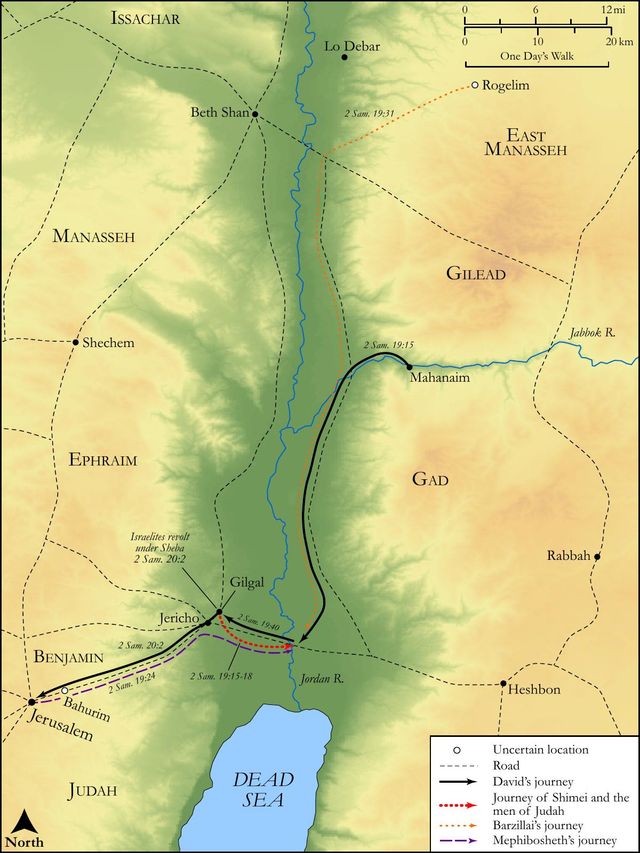
David had already graced the triumphs of his restoration with the generous remission of the injuries that had been done to him; we have him here gracing them with a no less generous reward of the kindnesses that had been shown to him. Barzillai, the Gileadite, who had a noble seat at Rogelim, not far from Mahanaim, was the man who, of all the nobility and gentry of that country, had been most kind to David in his distress. If Absalom had prevailed, it is likely he would have suffered for his loyalty; but now he and his shall be no losers by it. Here is,
I.Barzillai's great respect to David, not only as a good man, but as his righteous sovereign:
He provided him with much sustenance, for himself and his family, while he lay at Mahanaim, Sa2 19:32. God had given him a large estate, for he was a very great man, and, it seems, he had a large heart to do good with it: what else but that is a large estate good for? To reduced greatness generosity obliges us, and to oppressed goodness piety obliges us, to be in a particular manner kind, to the utmost of our power. Barzillai, to show that he was not weary of David, though he was so great a charge to him, attended him to Jordan, and went over with him, Sa2 19:31. Let subjects learn hence to render tribute to whom tribute is due and honour to whom honour, Rom 13:7.
II.The kind invitation David gave to him to court (Sa2 19:33): Come thou over with me. He invited him,
1.That he might have the pleasure of his company and the benefit of his counsel; for we may suppose that he was very wise and good, as well as very rich, otherwise he would not have been called here a very great man; for it is what a man is, more than what he has, that renders him truly great.
2.That he might have an opportunity of returning his kindness: "I will feed thee with me; thou shalt fare as sumptuously as I fare, and this at Jerusalem, the royal and holy city." David did not take Barzillai's kindness to him as a debt (he was not one of those arbitrary princes who think that whatever their subjects have is theirs when they please), but accepted it and rewarded it as a favour. We must always study to be grateful to our friends, especially to those who have helped us in distress.
III.Barzillai's reply to this invitation, wherein,
1.He admires the king's generosity in making him this offer, lessening his service, and magnifying the king's return for it: Why should the king recompense it with such a reward? Sa2 19:36. Will the master thank that servant who only does what was his duty to do? He though he had done himself honour enough in doing the king any service. Thus, when the saints shall be called to inherit the kingdom in consideration of what they have done for Christ in this world, they will be amazed at the disproportion between the service and the recompence. Mat 25:37, Lord, when saw we thee hungry, and fed thee?
2.He declines accepting the invitation. He begs his majesty's pardon for refusing so generous an offer: he should think himself very happy in being near the king, but,
(1.)He is old, and unfit to remove at all, especially to court. He is old, and unfit for the business of the court: "Why should I go up with the king to Jerusalem? I can do him no service there, in the council, the camp, the treasury, or the courts of justice; for how long have I to live? Sa2 19:34. Shall I think of going into business, now that I am going out of this world?" He is old and unfit for the diversions of the court, which will be ill-bestowed, and even thrown away, upon one that can relish them so little, Sa2 19:35. As it was in Moses's time, so it was in barzillai's and it is not worse now, that, if men be so strong that they come to fourscore years, their strength then is labour and sorrow, Psa 90:10. These were then, and are still, years of which men say they have no pleasure in them, Ecc 12:1. Dainties are insipid when desire fails, and songs to the aged ear are little better than those sung to a heavy heart, very disagreeable: how should they be otherwise when the daughters of music are brought low? Let those that are old learn of Barzillai to be dead to the delights of sense; let grace second nature, and make a virtue of the necessity. Nay, Barzillai, being old, thinks he shall be a burden to the king, rather than any credit to him; and a good man would not go any where to be burdensome, or, if he must be so, will rather be so to his own house than to another's.
(2.)He is dying, and must begin to think of his long journey, his removal out of the world, Sa2 19:37. It is good for us all, but it especially becomes old people to think and speak much of dying. "Talk of going to court!" says Barzillai; "Let me go home and die in my own city, the place of my father's sepulchre; let me die by the grave of my father, that my bones may be quietly carried to the place of their rest. The grave is ready for me, let me go and get ready for it, go and die in my nest."
3.He desires the king to be kind to his son Chimham: Let him go over with my lord the king, and have preferment at court. What favour is done to him Barzillai will take as done to himself. Those that are old must not grudge young people those delights which they themselves are past the enjoyment of, nor confine them to their retirements. Barzillai will go back himself, but he will not make Chimham go back with him; though he could ill spare Chimham, yet, thinking it would gratify and advance him, he is willing to do it.
IV.David's farewell to Barzillai.
1.He sends him back into his country with a kiss and a blessing (Sa2 19:39), signifying that in gratitude for his kindnesses he would love him and pray for him, and with a promise that whatever request he should at any time make to him he would be ready to oblige him (Sa2 19:38): Whatsoever thou shalt think of, when thou comest home, to ask of me, that will I do for thee. What is the chief excellency of power but this, that it gives men a capacity of doing the more good?
2.He takes Chimham forward with him, and leaves it to Barzillai to choose him his preferment. I will do to him what shall seem good to thee, Sa2 19:38. And, it should seem, Barzillai, who had experienced the innocency and safety of retirement, begged a country seat for him near Jerusalem, but not in it; for, long after, we read of a place near Beth-lehem, David's city, which is called the habitation of Chimham, allotted to him, probably, not out of the crown-lands or the forfeited estates, but out of David's paternal estate.
Continue studying 2 Samuel 19:36 across the web’s major study libraries — every link below opens this exact verse, chapter, or book on the destination site.
Read & Compare
 BibleGatewayThis verse in more than 200 translations and 70 languages.
 Bible.comThe YouVersion reader — hundreds of translations, reading plans, and highlights.
 ESV.orgCrossway's official English Standard Version reader.
 NET BibleThe NET translation with 60,000+ translators' notes on every rendering decision.
 STEP BibleTyndale House's free study tool — original text, vocabulary, and scholarly resources.
 BibliaLogos Bible Software's free web reader.
 USCCBThe New American Bible (Revised Edition) with the U.S. bishops' study notes.
Commentaries
 BibleHub CommentariesDozens of classic commentaries on this verse, gathered on one page.
 StudyLightMore than 100 commentary sets — the largest collection on the web.
 BibleRefPlain-English commentary on what this verse means, verse by verse.
 Enduring WordDavid Guzik's free commentary on this chapter, widely used by Bible teachers.
 Bible Study ToolsVerse commentary alongside Greek and Hebrew study aids.
Original Language & Research
- BibleHub InterlinearThe verse word by word — original language, transliteration, and English.
- BibleHub LexiconEvery word's original-language definition and Strong's entry.
 Blue Letter BibleDeep-study tools — Strong's numbers, concordance, and word studies.
 SefariaThe Hebrew text with Rashi and centuries of Jewish commentary.
Sermons, Hymns & Audio


TrulyRandomVerse is not affiliated with these sites and doesn’t control their content. They’re linked because they’re genuinely useful.
Summary
2 Samuel 19:36 profoundly illustrates the humility and selfless devotion of Barzillai the Gileadite as he responds to King David's generous offer of provision and honor in Jerusalem. Despite his crucial support to David during Absalom's rebellion, Barzillai respectfully declines the king's lavish invitation, citing his advanced age and preference to die in his own city. This verse specifically highlights his willingness to accompany the king only a short distance across the Jordan River, humbly questioning the necessity of such an extravagant "reward" for his service, thereby emphasizing his pure motives.
Context
ShowHideLiterary Context
This verse is situated at a pivotal moment in David's reign, immediately following the suppression of Absalom's devastating rebellion. King David is returning to Jerusalem from his exile in Mahanaim, a period of immense vulnerability and uncertainty for the monarch. During David's desperate flight, Barzillai, along with other loyalists like Shobi and Machir, provided crucial provisions and support, as detailed in 2 Samuel 17:27-29. As David prepares to cross the Jordan River, he expresses deep gratitude and extends a remarkable invitation to Barzillai to join him in Jerusalem and be cared for in his old age, as seen in 2 Samuel 19:33. Barzillai's response, beginning in 2 Samuel 19:34 and culminating in this verse, articulates his reasons for declining the full offer while still demonstrating unwavering loyalty by agreeing to a symbolic escort. This exchange serves as a poignant conclusion to the period of rebellion, highlighting the restoration of order and the recognition of faithful service.
Historical & Cultural Context
In ancient Near Eastern societies, the relationship between a king and his loyal subjects, especially those who provided aid in times of crisis, involved a strong expectation of patronage and recompense. A king was honor-bound to reward fidelity, and such rewards often included positions at court, land, or provision. Barzillai, an eighty-year-old wealthy man from Rogelim in Gilead, would have been highly respected for his age, wisdom, and resources. His decision to decline David's offer, rather than being seen as disrespectful, would have been understood as a profound act of humility and wisdom, recognizing the limitations of old age and the cultural importance of dying among one's own people and ancestral land. The Jordan River itself often served as a significant geographical and symbolic boundary, marking transitions, returns, and sometimes, the limits of one's earthly journey, as seen in the crossing of Joshua into the Promised Land.
Key Themes
ShowHideBarzillai's interaction with King David powerfully illustrates several key themes prevalent in the book of 2 Samuel. Foremost among these are loyalty and gratitude, as David honors Barzillai's steadfast support during his most vulnerable period. Barzillai's response, however, introduces themes of humility and selfless service, demonstrating a heart that gave without expectation of lavish earthly reward. His discerning choice also highlights wisdom in old age, as he understands his physical limitations and prioritizes a peaceful end to his life over the luxuries of court. This exchange underscores the principle of discerning one's season, recognizing when to step back gracefully and entrust the future to others, a motif that resonates throughout biblical narratives concerning leadership and legacy, such as Moses entrusting leadership to Joshua. Barzillai's character stands in stark contrast to those who sought personal gain or power during the tumultuous period of Absalom's revolt, reinforcing the value of integrity and genuine devotion to God's anointed king.
Exposition and Analysis
ShowHideKey Word Analysis
ShowHideFrom the root meaning "to work" or "to serve," this noun denotes a bondman, slave, or one who serves. Barzillai's self-identification as "Thy servant" (KJV) is a profound expression of humility and submission to the king's authority, even as he respectfully declines the offer. It underscores his posture of loyalty and duty, rather than one of a peer or a benefactor seeking repayment. This term highlights the hierarchical relationship and Barzillai's understanding of his place within it, even as his actions transcend mere obligation.
A primitive root meaning "to treat a person (well or ill), i.e., benefit or requite." It implies a reciprocal action, a giving back for what has been received. Barzillai's rhetorical question, "why should the king recompense it me," uses this verb to challenge the very notion that his service was a transaction requiring repayment. He implies that his actions were not a "debt" to be settled, but a pure expression of loyalty and duty, thus deflecting any claim to a "just" reward. His service was not for what he could gain, but for the king's welfare.
This feminine noun, derived from the same root as gâmal, refers to a "deed," "recompense," or "return." In this context, it signifies the lavish benefit David intended to bestow upon Barzillai. Barzillai's humble deflection of this "reward" underscores his selfless motivation; he did not serve for personal gain or recognition, but out of devotion to his king. His question minimizes the value of his own contribution, suggesting it was not worthy of such an extravagant return.
Verse Breakdown
ShowHide"Thy servant will go a little way over Jordan with the king:"
This clause demonstrates Barzillai's unwavering respect, loyalty, and courtesy. Despite declining the full invitation to reside in Jerusalem, he offers a symbolic gesture of escorting David across the Jordan River. This act signifies a final, honorable farewell and a public affirmation of his support for the king's return to power and the re-establishment of his reign. It is a profound act of allegiance, confirming his commitment even as he sets his own boundaries, indicating his willingness to honor the king to the very edge of his capacity.
"and why should the king recompense it me with such a reward?"
This is a powerful rhetorical question that reveals the depth of Barzillai's humility and selflessness. He views his past actions not as a service deserving of extravagant payment, but as a natural expression of duty and loyalty to his monarch. By questioning the need for such a grand "reward," he deflects the king's generosity, indicating that his motivation for serving David was pure and unburdened by expectations of personal gain or recognition. It highlights a spirit of giving that finds its satisfaction in the act itself, rather than in the return or any external validation.
Literary Devices
ShowHideThe verse employs a significant Rhetorical Question ("and why should the king recompense it me with such a reward?"), which serves not to elicit an answer but to emphasize Barzillai's profound humility and selfless motives. This question communicates his internal conviction that his service was not transactional but a genuine act of loyalty. There is also an element of Understatement in "a little way over Jordan," as Barzillai's modest offer stands in stark contrast to David's grand invitation, subtly highlighting Barzillai's practical and unassuming nature. The act of crossing the Jordan itself can be seen as Symbolism, representing a crucial transition back to stability and the re-establishment of David's reign after the chaos of rebellion, with Barzillai's presence marking a loyal farewell at this significant threshold, signifying the completion of his vital role in the crisis.
Theological and Thematic Connections
ShowHideBarzillai's conduct in 2 Samuel 19:36 stands as a powerful biblical example of selfless service and profound humility, challenging the human tendency toward self-promotion and the expectation of earthly reward for good deeds. His actions model a spiritual maturity that values genuine loyalty and duty over personal gain or recognition. This attitude resonates deeply with the biblical emphasis on serving God and others with pure motives, understanding that true reward often lies beyond the visible and immediate, and is ultimately from God. It encourages believers to examine their own hearts, ensuring that service springs from love and devotion rather than from a desire for human praise or material recompense, reflecting a kingdom ethic where the last shall be first and true greatness is found in humble service.
Reflection and Application
ShowHideBarzillai's response to King David offers a timeless lesson on the nature of true service and the wisdom of knowing oneself. In a world that often measures worth by accumulation, recognition, and the pursuit of personal advantage, Barzillai's humility challenges us to evaluate our own motivations. Do we serve others, our communities, or our God with an expectation of return, or out of a genuine desire to contribute, bless, and fulfill our calling? His discerning choice regarding his "season" of life also provides a model for embracing our limitations with grace, understanding that true wisdom lies in knowing when to step back, to pass the torch, and to prioritize what truly matters for our well-being and spiritual peace. Barzillai teaches us that the greatest acts of loyalty and generosity are often those performed without fanfare or the desire for recompense, finding their reward in the integrity of the act itself and the satisfaction of having served faithfully.
Questions for Reflection
ShowHideFAQ
ShowHideWhy did Barzillai decline David's generous offer to live in Jerusalem?
ShowHideBarzillai, at 80 years old, wisely recognized his advanced age and the limitations that came with it. He explicitly stated in 2 Samuel 19:34-35 that he would no longer be able to enjoy the pleasures of court life, such as food and music, and expressed a deep desire to die in his own city, near his family's burial place. His decision was not a lack of loyalty but a profound act of self-awareness and practical wisdom, prioritizing his comfort, familiar surroundings, and spiritual peace in his final years over the luxuries and demands of royal service.
What does Barzillai's question "why should the king recompense it me with such a reward?" reveal about his character?
ShowHideThis rhetorical question reveals Barzillai's deep humility, selflessness, and a non-transactional view of his service to the king. He did not see his actions during David's desperate flight as a debt owed or a service deserving of extravagant payment. Instead, he viewed his assistance as a natural expression of loyalty and duty to his monarch, not something to be "recompensed" with a lavish "reward." His character exemplifies genuine generosity and a heart that serves without expectation of personal gain, valuing the act of service itself over any external recognition or material benefit. He truly embodied the principle of giving without expecting anything in return, echoing the spirit of true biblical stewardship.
Christ-Centered Fulfillment
ShowHideBarzillai's profound humility and selfless refusal of an earthly reward beautifully foreshadow the ultimate self-emptying of Jesus Christ. Just as Barzillai served David without expectation of lavish recompense, so Christ, though eternally rich, "became poor, so that you through his poverty might become rich" (2 Corinthians 8:9). The Son of God did not come to be served, but to serve, and to give his life as a ransom for many (Mark 10:45). He did not grasp at equality with God but "emptied himself, by taking the form of a servant, being born in the likeness of men" (Philippians 2:6-8). Barzillai's disinterest in earthly glory and his focus on humble duty point to the divine humility of Christ, whose "reward" was not personal aggrandizement but the salvation of humanity and the glorification bestowed upon Him by the Father, as He "endured the cross, despising the shame, and is seated at the right hand of the throne of God" (Hebrews 12:2). His life, death, and resurrection illustrate that the greatest service is rendered not for what one can gain, but for the sheer love of God and neighbor, a grace-filled economy where salvation is a gift, not an earned recompense (Ephesians 2:8-9). Barzillai's choice to return to his home to die also subtly points to Christ's return to the Father, having completed His earthly mission of selfless service.